
Life, 1917-05-31 · page 13 of 38
Life — May 31, 1917 — page 13: what you’re looking at
What you’re looking at
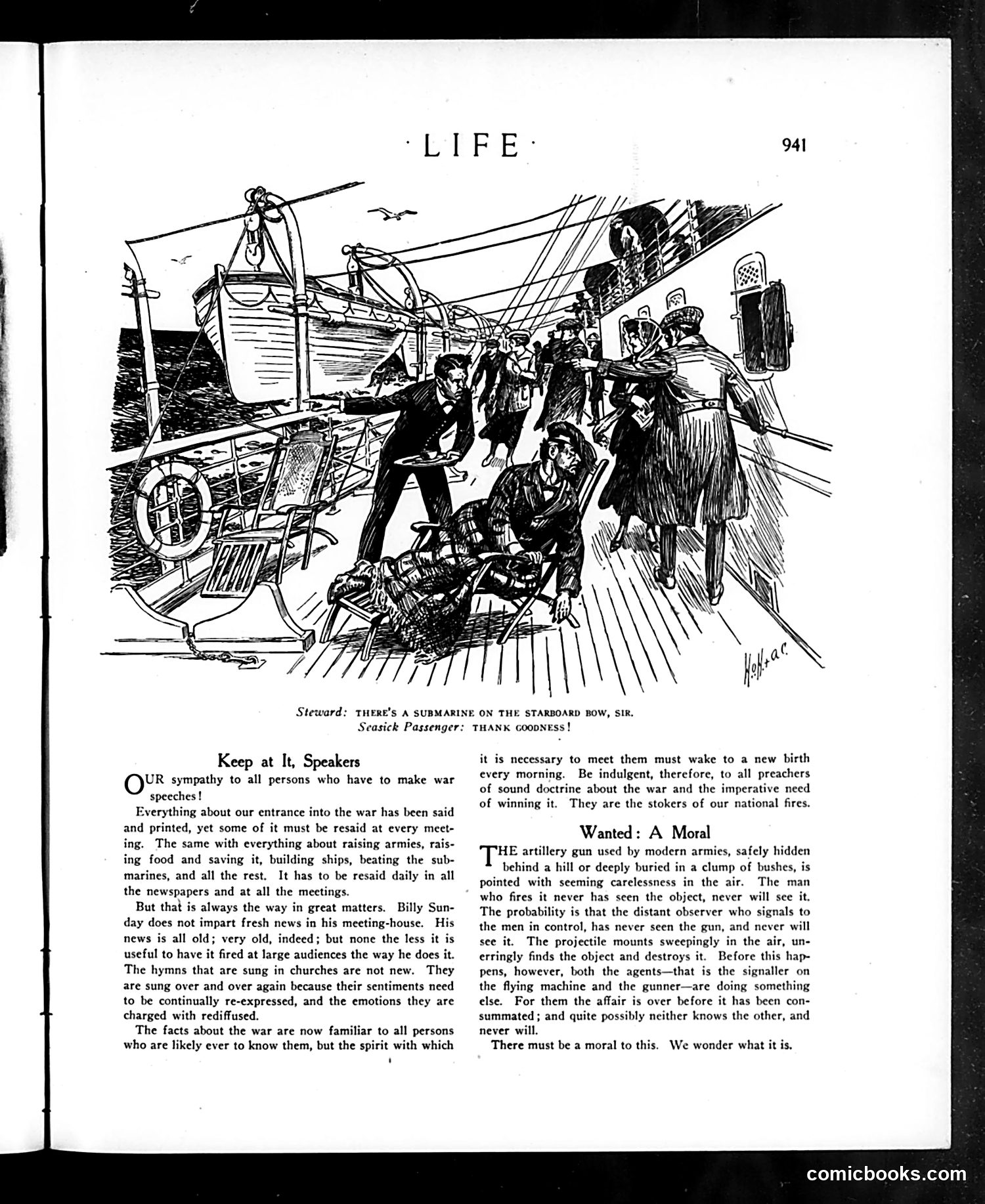
This page from *Life* magazine features a cartoon about wartime public speaking. The illustration shows a ship's deck crowded with well-dressed passengers and sailors, with one man addressing the crowd while others listen. The accompanying article critiques repetitive war propaganda. It argues that while public speeches about military recruitment, fundraising, and patriotic doctrine are necessary, they've become tedious through constant repetition. The author notes that Billy Sunday and other speakers rehash identical sentiments at every meeting, requiring audiences' emotions to be "continuously re-expressed and re-charged." The satire targets the mechanical, formulaic nature of wartime rhetoric rather than its necessity—audiences understand the facts, the article suggests, but speakers keep restating them anyway.
📄 Transcribed text from this page (OCR, searchable)
Machine-transcribed from the original scan — historical spelling and the odd misread are preserved.
Steward: THERE'S A SUBMARINE ON THE STARBOARD BOW, SIR. Seasick Passenger: THANK GoopNEss! Keep at It, Speakers Ov sympathy to all persons who have to make war speeches! Everything about our entrance into the war has been said and printed, yet some of it must be resaid at every meet- ing. The same with everything about raising armies, rais- ing food and saving it, building ships, beating the sub- marines, and all the rest. It has to be resaid daily in all the newspapers and at all the mectings. But that is always the way in great matters. Billy Sun- day does not impart fresh news in his meeting-house. His news is all old; very old, indeed; but none the less it is useful to have it fired at large audiences the way he does it. The hymns that are sung in churches are not new. They are sung over and over again because their sentiments need to be continually re-expressed, and the emotions they are charged with rediffused. The facts about the war are now familiar to all persons who are likely ever to know them, but the spirit with which ' it is necessary to meet them must wake to a new birth every morning. Be indulgent, therefore, to all preachers of sound doctrine about the war and the imperative need of winning it. They are the stokers of our national fires. Wanted: A Moral HE artillery gun used by modern armies, safely hidden behind a hill or deeply buried in a clump of bushes, is pointed with seeming carelessness in the air. The man who fires it never has seen the object, never will see it. The probability is that the distant observer who signals to the men in control, has never seen the gun, and never will see it. The projectile mounts sweepingly in the air, un- erringly finds the object and destroys it. Before this hap- pens, however, both the agents—that is the signaller on the flying machine and the gunner—are doing something else. For them the affair is over before it has been con- summated ; and quite possibly neither knows the other, and never will. There must be a moral to this. We wonder what it is. comicbooks.com