
A complete issue · 42 pages · 1917
Life — March 29, 1917
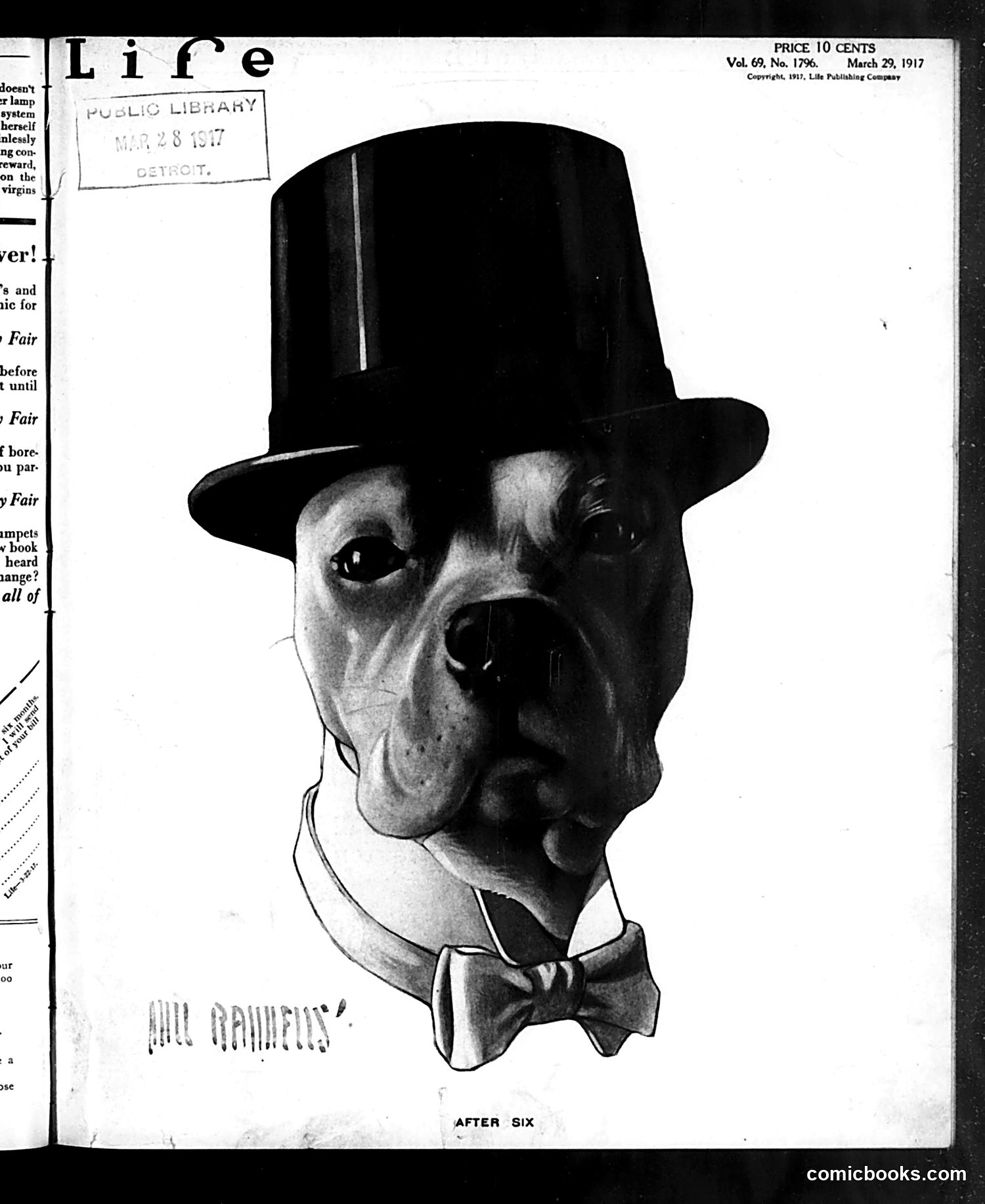
This illustration depicts a dog wearing formal evening attire—a top hat and bow tie—with an exaggerated, somewhat grotesque facial expression. The caption reads "AFTER SIX," referring to formal dress code conventions of the era where gentlemen wore tuxedos and top hats after 6 p.m. The cartoon satirizes the absurdity of rigid social conventions by showing a dog attempting to conform to human formal dress standards. The grotesque expression suggests the discomfort or ridiculousness of such strict etiquette rules. The artwork is credited to what appears to be "Will Gruelle" (visible signature). This is typical Life magazine satire targeting American social pretension and arbitrary class conventions of the 1910s era.
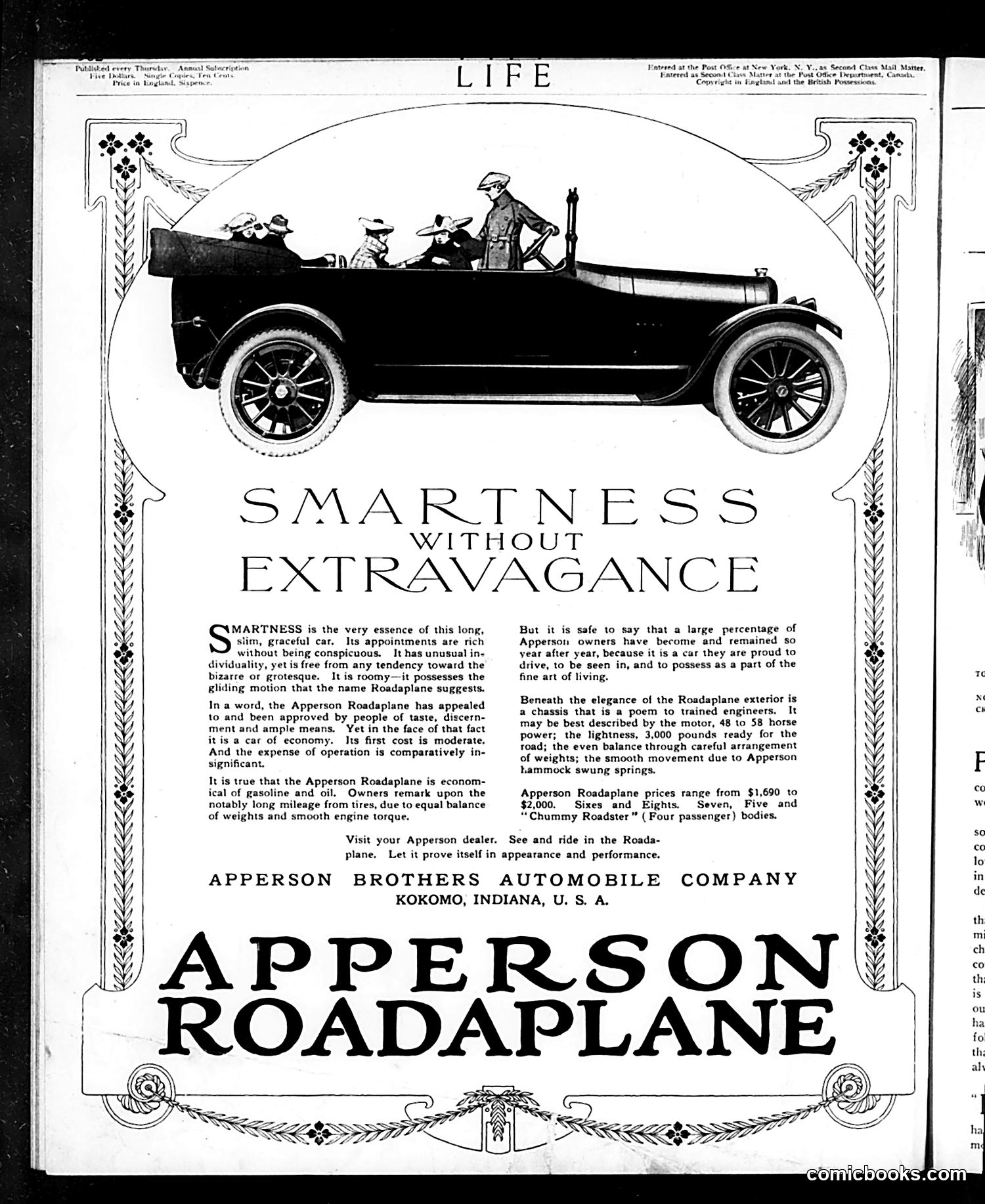
This page is **primarily an advertisement**, not political satire. It promotes the Apperson Roadaplane automobile, manufactured by Apperson Brothers Automobile Company in Kokomo, Indiana. The ad's headline—"Smartness Without Extravagance"—targets middle-class buyers seeking stylish vehicles without excessive cost. The illustration shows a well-dressed couple in an open-air car, representing aspirational automobile ownership. The accompanying text emphasizes practical virtues: fuel efficiency, balanced weight distribution, smooth engine performance, and moderate pricing ($1,690-$2,000). The ad encourages readers to visit dealers and test-drive the vehicle. This reflects early 1900s automobile marketing, when cars transitioned from luxury novelties to mass-market consumer goods, emphasizing reliability and value alongside style.
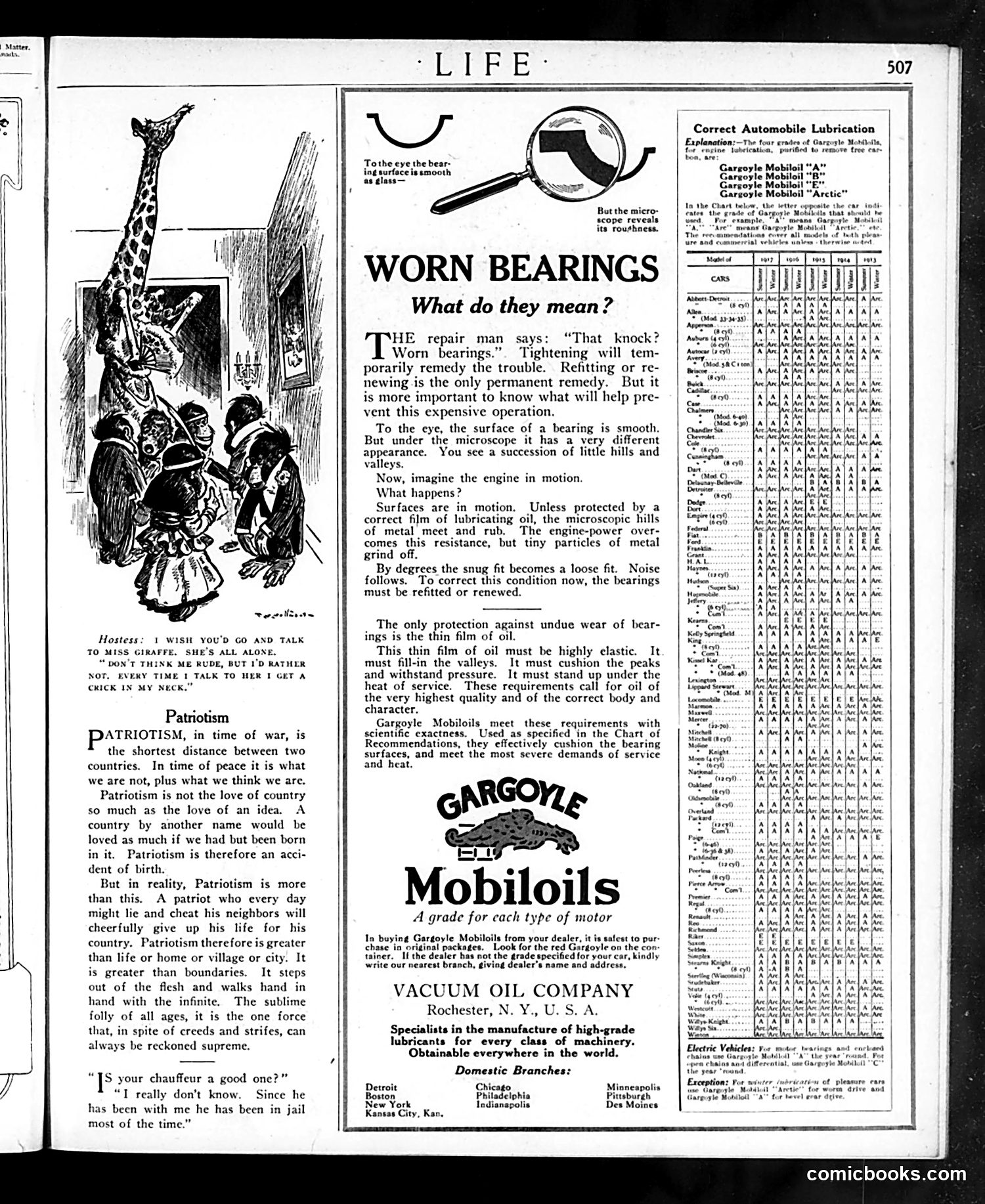
This page is primarily **advertising and technical content** rather than political satire. The main cartoon (left) depicts a giraffe being measured by multiple figures, with a hostess saying she wishes the giraffe would leave because "every time I talk to her I get a chick in my neck." This appears to be **social humor** about an awkward houseguest—the giraffe's height makes conversation literally uncomfortable. Below is an essay on **"Patriotism,"** defining it not as blind nationalism but as love of country's ideals and willingness to sacrifice for it. The page's bulk consists of **Gargoyle Mobiloils advertisement** (automobile lubricant) with a detailed compatibility chart, and a joke about a chauffeur's reliability. The humor is genteel and domestic rather than pointed political commentary.
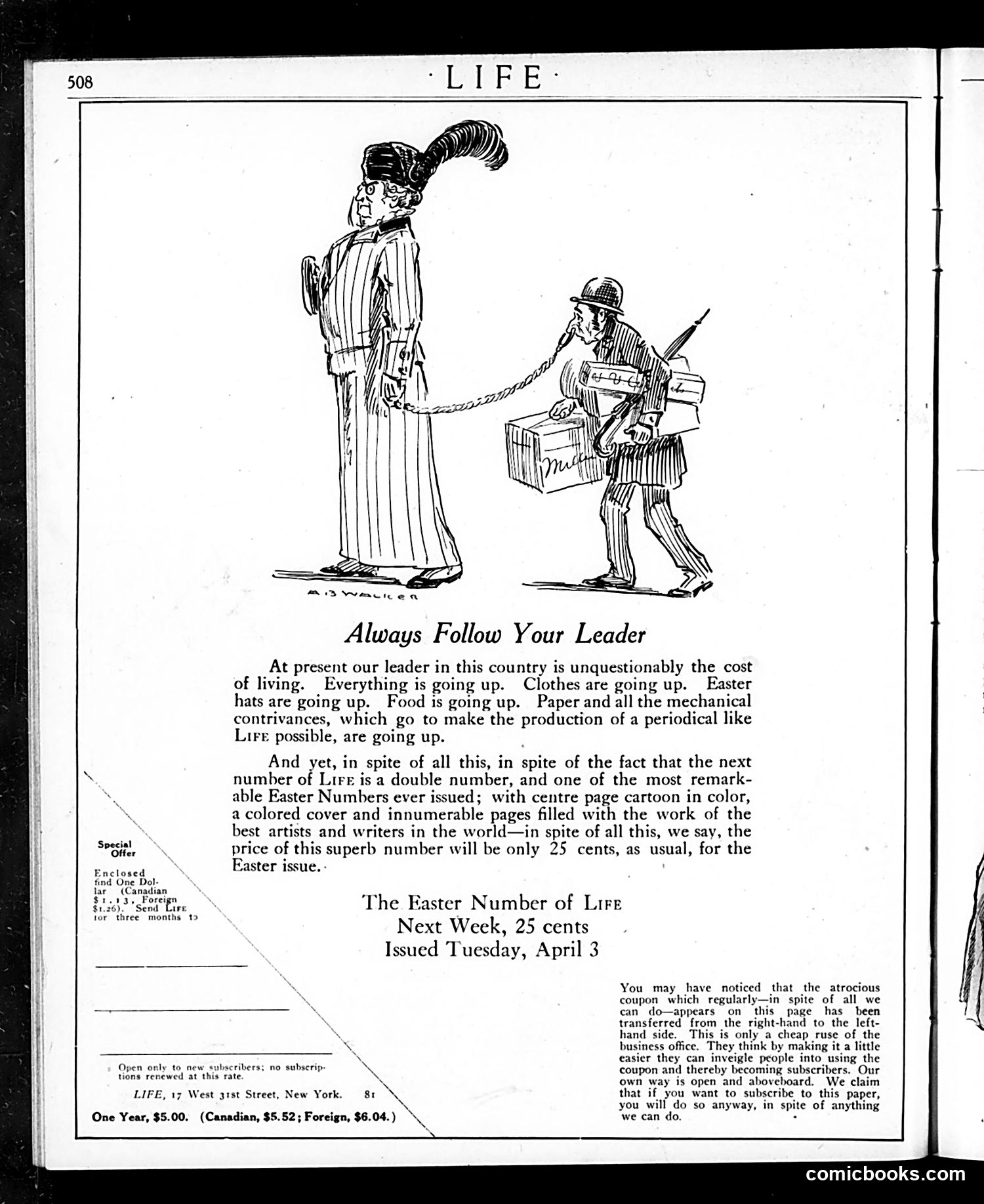
This cartoon satirizes rising cost-of-living during an unspecified period when prices were climbing across necessities—clothing, food, and production costs for publications like *Life* itself. The image shows a fashionably dressed woman (representing the nation's leader or leadership) on a leash held by a smaller, overburdened soldier or working man carrying heavy packages and supplies. The visual metaphor inverts typical power dynamics: the "leader" is being led by ordinary citizens bearing the actual burdens. The satire critiques how common people follow leaders passively despite economic hardship caused by leadership decisions. The title's irony suggests citizens blindly obey while suffering inflation, making the cartoon a commentary on class disparity and the disconnect between leadership and working-class struggles during this inflationary period.
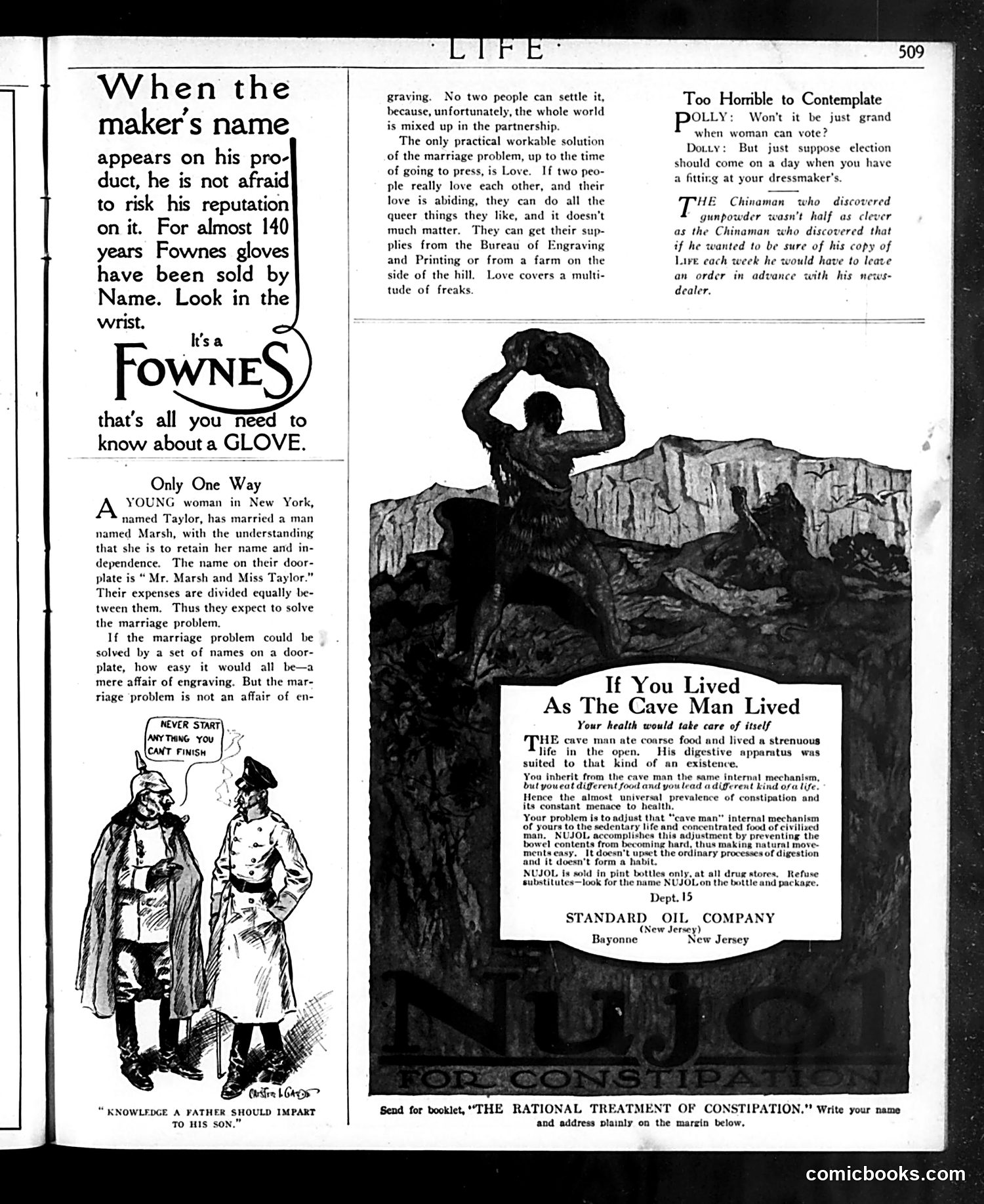
This page contains two separate items: a Fownes glove advertisement on the left and unrelated editorial content on the right. The **left side** is a straightforward commercial ad emphasizing brand prestige—Fownes gloves have been "sold by Name" for 140 years, establishing trustworthiness through longevity. The small cartoon about a doorplate naming dispute illustrates an absurdist marriage problem, contrasting trivial naming disputes with real relationship issues. This supports the ad's implied message: quality products solve practical concerns, leaving couples free to address actual problems. The **right side** contains a "Too Horrible to Contemplate" humor column, a Standard Oil Company constipation remedy ad featuring a cave-man scene, and an unrelated advice piece about marriage—none politically significant. The page appears primarily **commercial/entertainment rather than satirical commentary**.
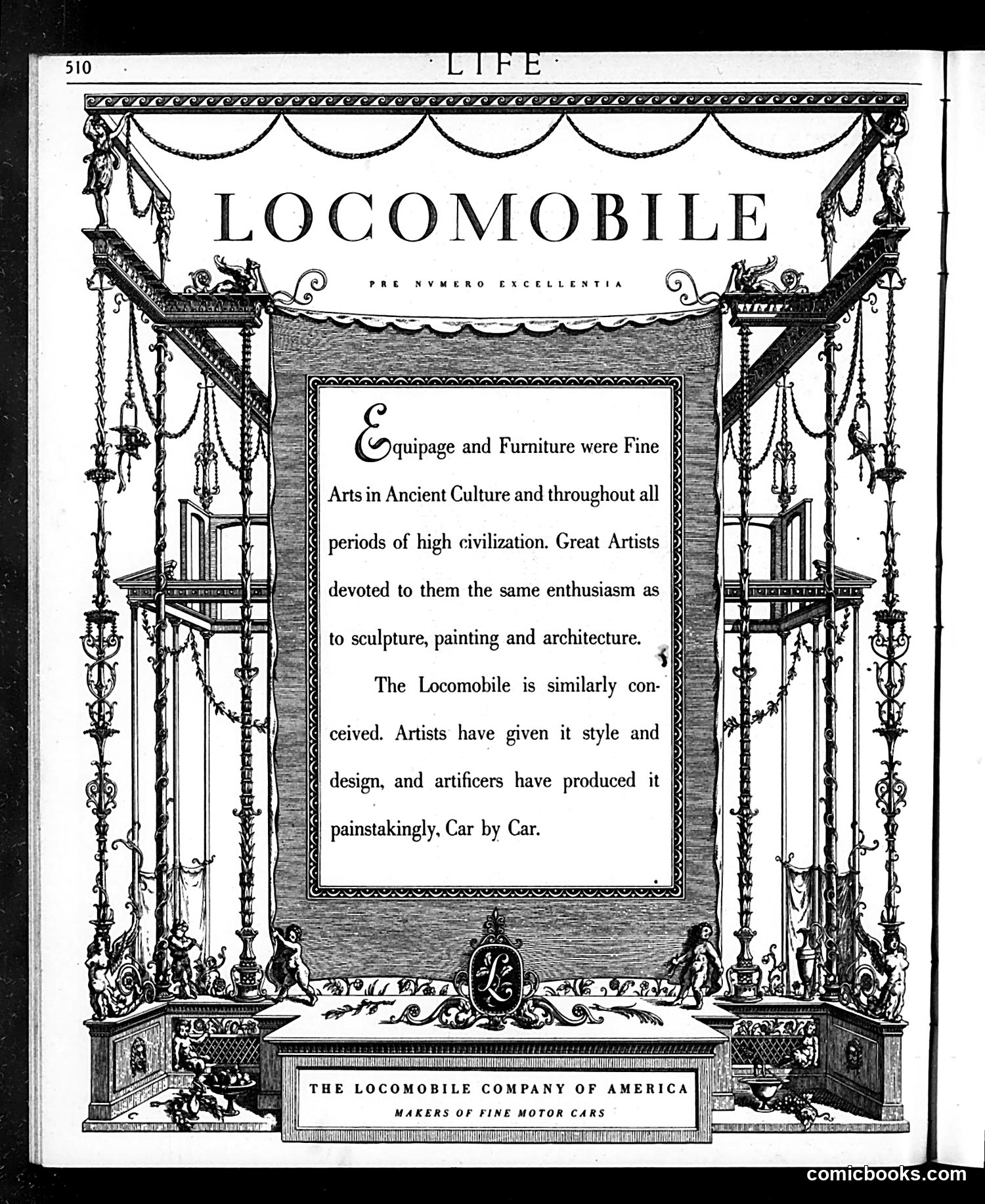
This page is **primarily a Locomobile automobile advertisement**, not a cartoon. The elaborate decorative border features classical and Renaissance design elements—cherubs, ornate hanging vessels, draped garlands—deliberately evoking fine art and high culture. The advertisement's text makes an explicit comparison: just as "Equipage and Furniture were Fine Arts in Ancient Culture," the Locomobile is similarly treated as an artistic achievement deserving serious aesthetic consideration. Artists and craftsmen have designed it "painstakingly, Car by Car." This reflects early 1900s luxury marketing strategy—positioning automobiles as fine craftsmanship rather than mere transportation. The pretentious framing satirizes or genuinely celebrates (unclear which) the elevation of consumer goods to artistic status. The Locomobile Company of America is identified as "Makers of Fine Motor Cars."
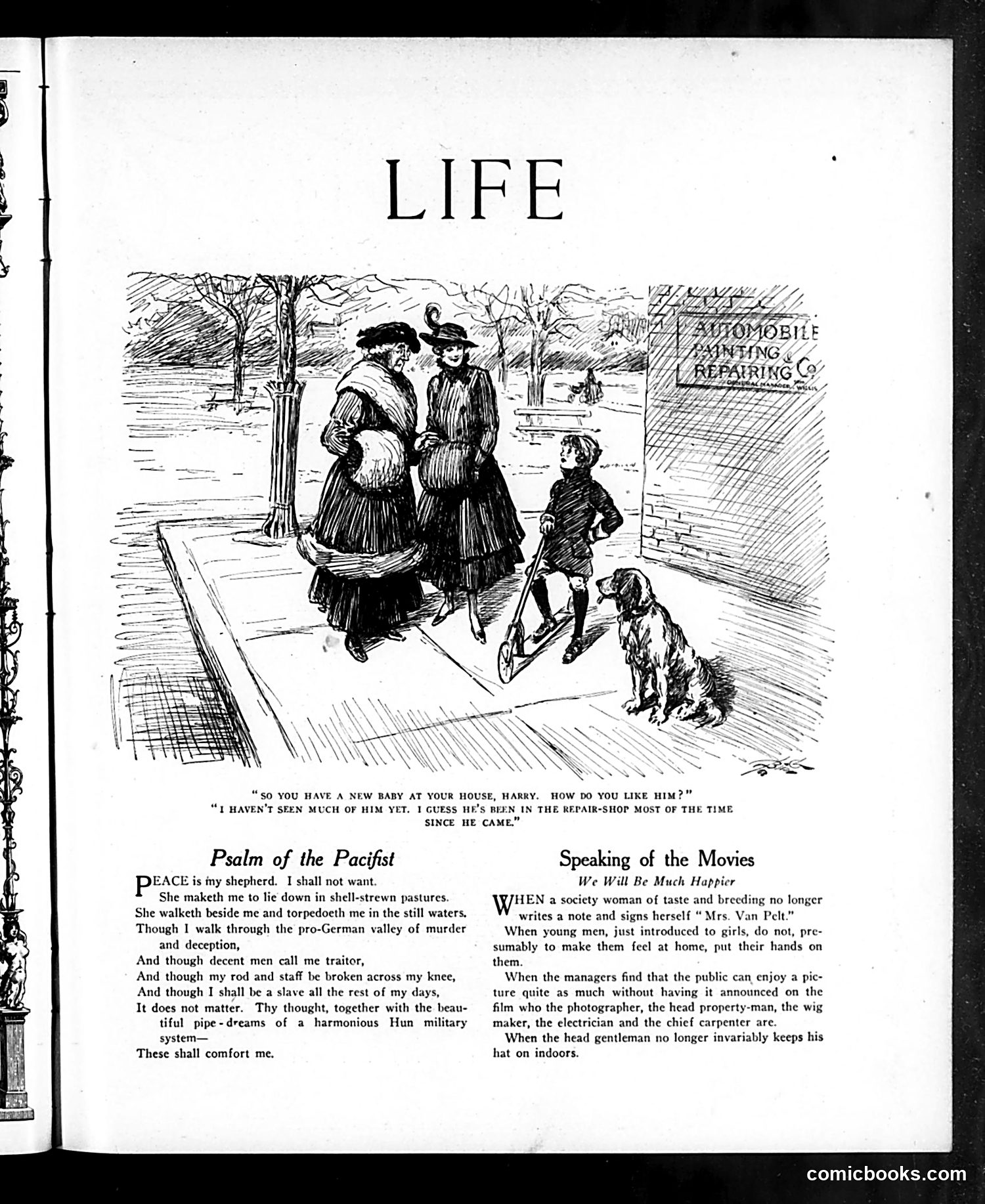
This page features a satirical cartoon about the post-WWI "new baby" — likely referring to the newly formed League of Nations or post-war peace efforts. Two well-dressed women discuss a child with a dog, while a sign advertises "Automobile Painting Repairing Co." The joke's caption reveals the satire: when asked about the "new baby," one woman says she hasn't seen much of him because "he's been in the repair-shop most of the time since he came." This mocks the fragility and constant problems of whatever post-war institution or agreement is represented — it needs constant fixing rather than functioning properly. The "Psalm of the Pacifist" below ironically contrasts peaceful ideals with harsh reality, while the movie section discusses women's roles in society, reflecting 1920s social commentary.
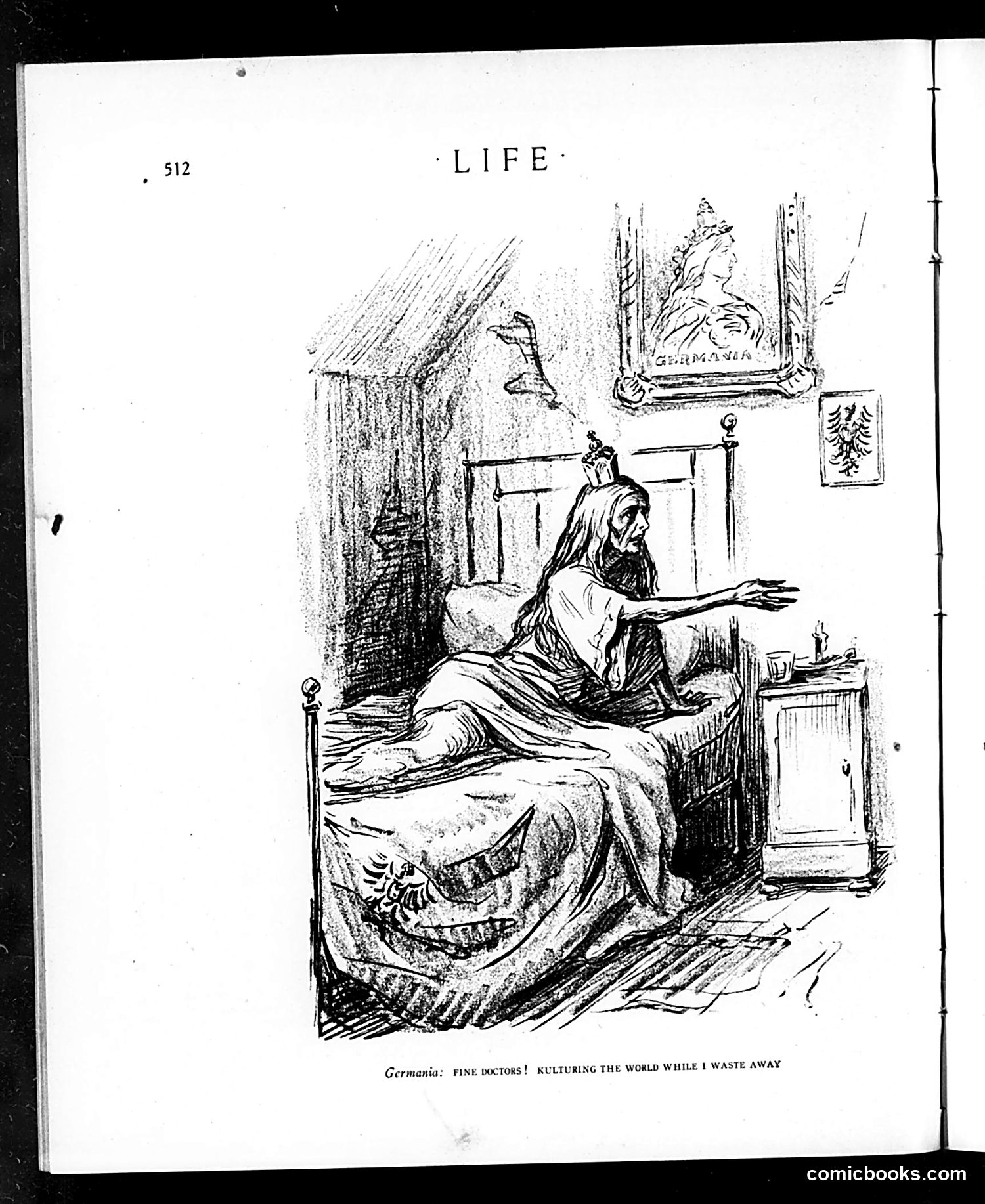
This is a satirical cartoon from *Life* magazine criticizing Germany. The image shows a bedridden, sickly figure (labeled "Germania" in the caption) lying in bed while appearing to gesture dismissively. The caption reads: "FINE DOCTORS! KULTURING THE WORLD WHILE I WASTE AWAY." The satire targets German leaders' claims of cultural superiority ("kulturing the world") while Germany itself suffers from decline—likely referencing the period following World War I, when Germany faced economic collapse and military defeat. The cartoon suggests German leadership prioritized aggressive expansion and ideological projects abroad rather than addressing the nation's own deteriorating condition. The bedridden personification emphasizes Germany's weakened state despite grandiose ambitions.
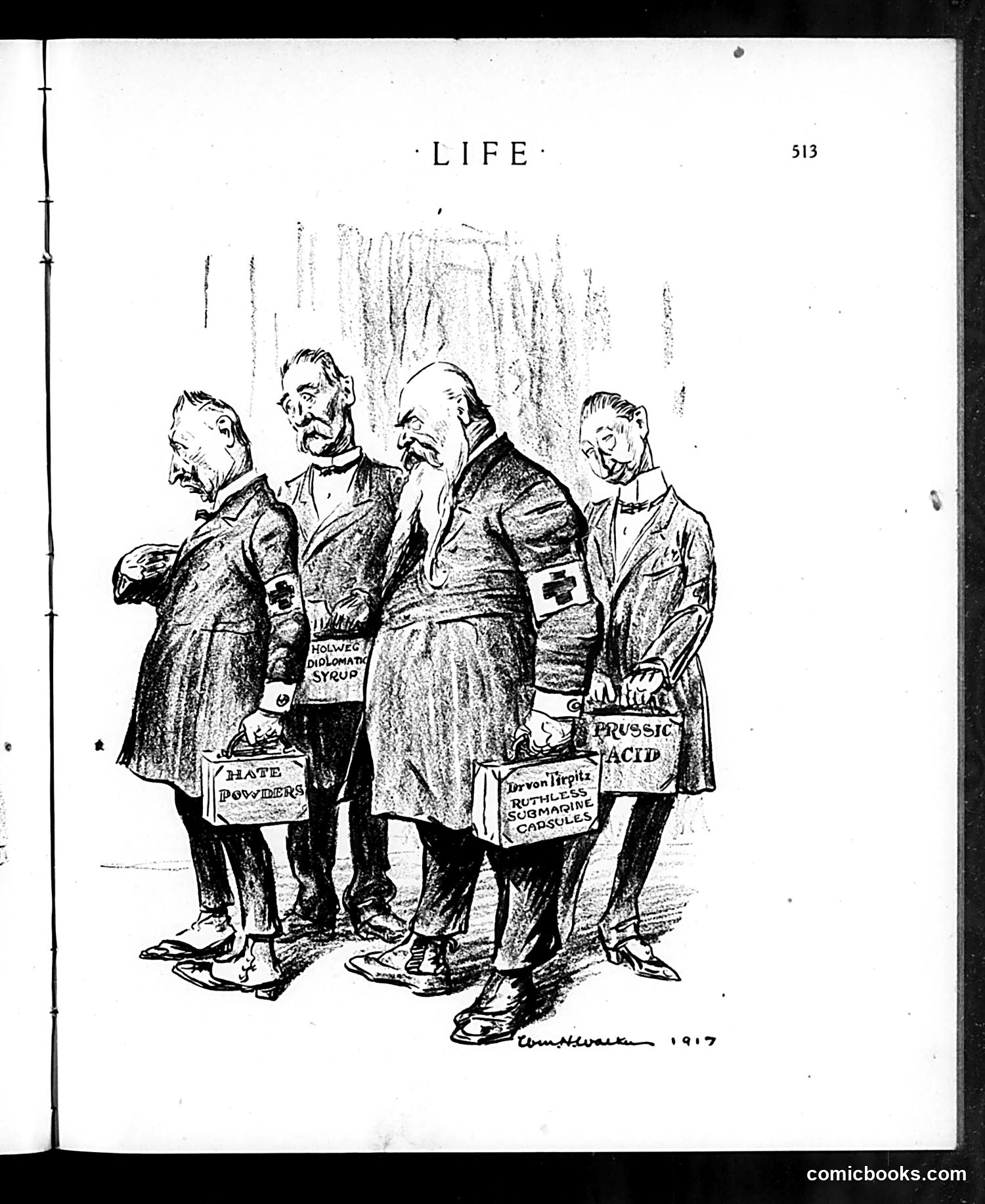
This is a satirical cartoon from 1917 depicting four men in diplomatic dress carrying bottles and packages labeled with German chemical weapons and poisons: "Hate Powders," "Holweg Diplomatic Syrup," "Prussic Acid," and "Jarvon Tablet Ruthless Sugarcapsules." The cartoon satirizes German diplomacy during World War I, suggesting that German diplomatic efforts were fundamentally toxic and poisonous rather than genuinely peaceful. The caricatures appear to represent German diplomatic or political figures. The deliberate labeling of their "gifts" as lethal substances mocks Germany's diplomatic overtures as inherently destructive. This reflects American wartime propaganda opposing Germany, published during the period leading toward or following U.S. entry into WWI (April 1917).
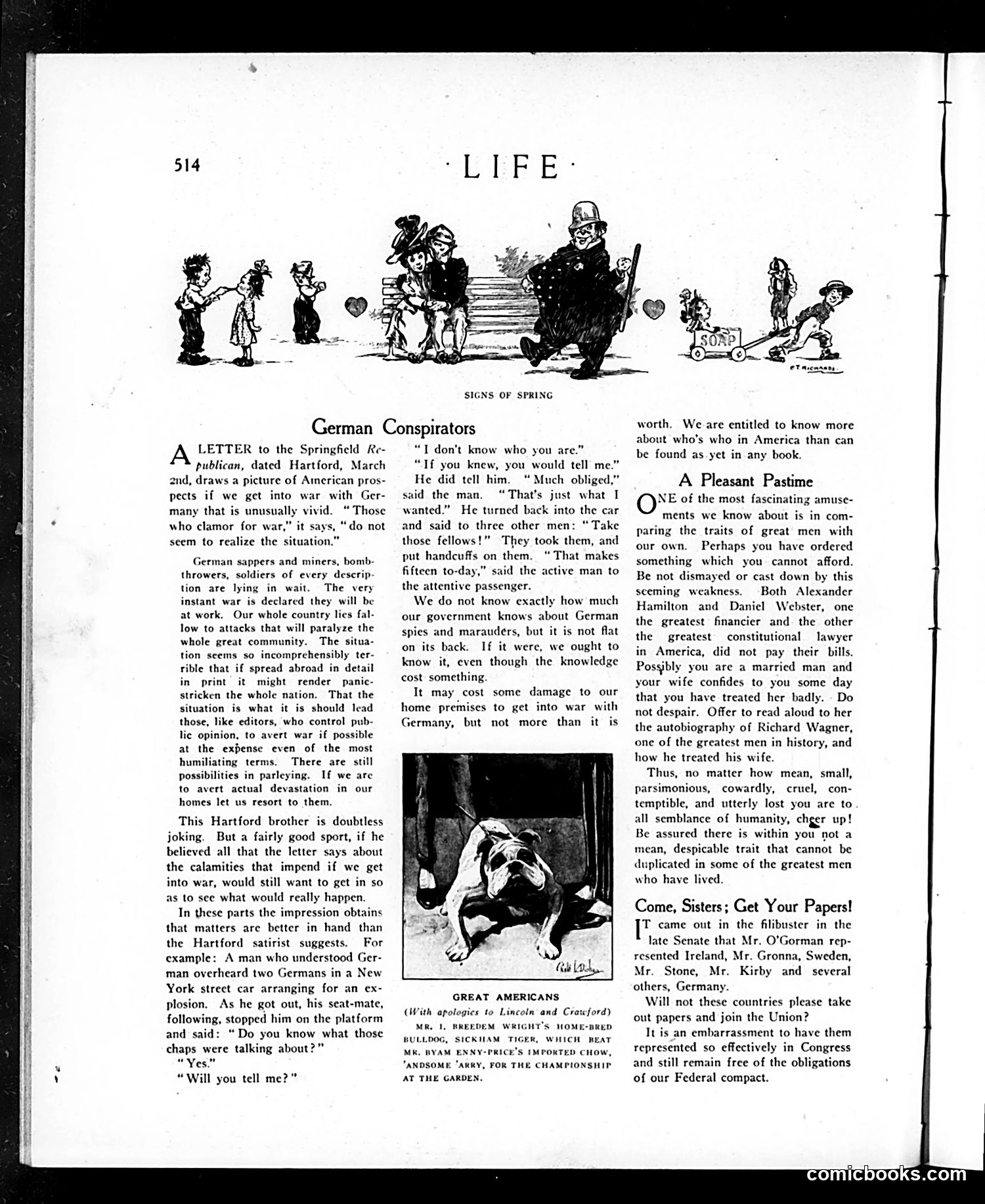
The page contains three distinct pieces: 1. **"Signs of Spring" cartoon** (top): A whimsical illustration showing children playing and an old man on a bench—typical springtime imagery with no apparent political content. 2. **"German Conspirators" article**: Discusses American concerns about German spies and saboteurs operating in the U.S., referencing a letter to the Springfield Republican. The piece expresses worry about German agents arranging explosions and asks whether the government truly understands the threat. This reflects WWI-era spy panic. 3. **"Great Americans" illustration**: Shows a bulldog labeled with references to Lincoln and Crawford, appearing to satirize American strength or stubbornness. 4. **"A Pleasant Pastime"** and **"Come, Sisters; Get Your Papers!"**: Brief pieces about comparing great men and political representation. The overall theme reflects wartime concerns about internal security and foreign threats.
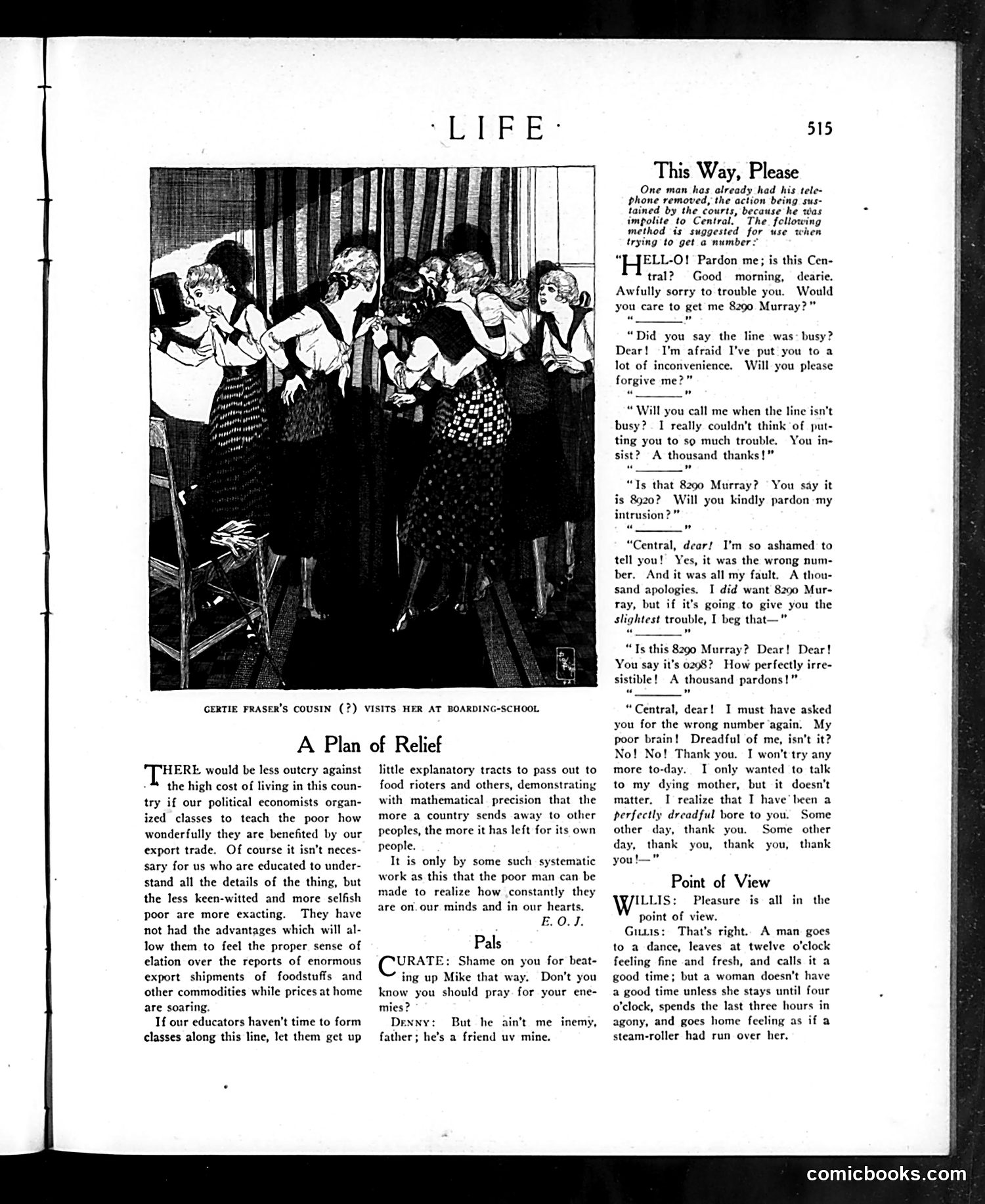
This page contains two distinct pieces: **"This Way, Please"** (top right) is a humorous dialogue about phone confusion—someone repeatedly tries to reach "8290 Murray" but keeps getting wrong numbers, creating escalating frustration for both the caller and the recipients. The joke satirizes early telephone systems' inefficiency and the annoyance of wrong-number calls, a common modern inconvenience that was apparently novel enough then to merit satirical treatment. **"A Plan of Relief"** (bottom left) argues that economics classes should teach poor people about export trade and commodity markets, suggesting that education about trade mechanisms could address poverty and high living costs. The accompanying cartoon shows a crowded telephone exchange scene. Both pieces reflect early 20th-century concerns about economic inequality and communication technology growing pains.
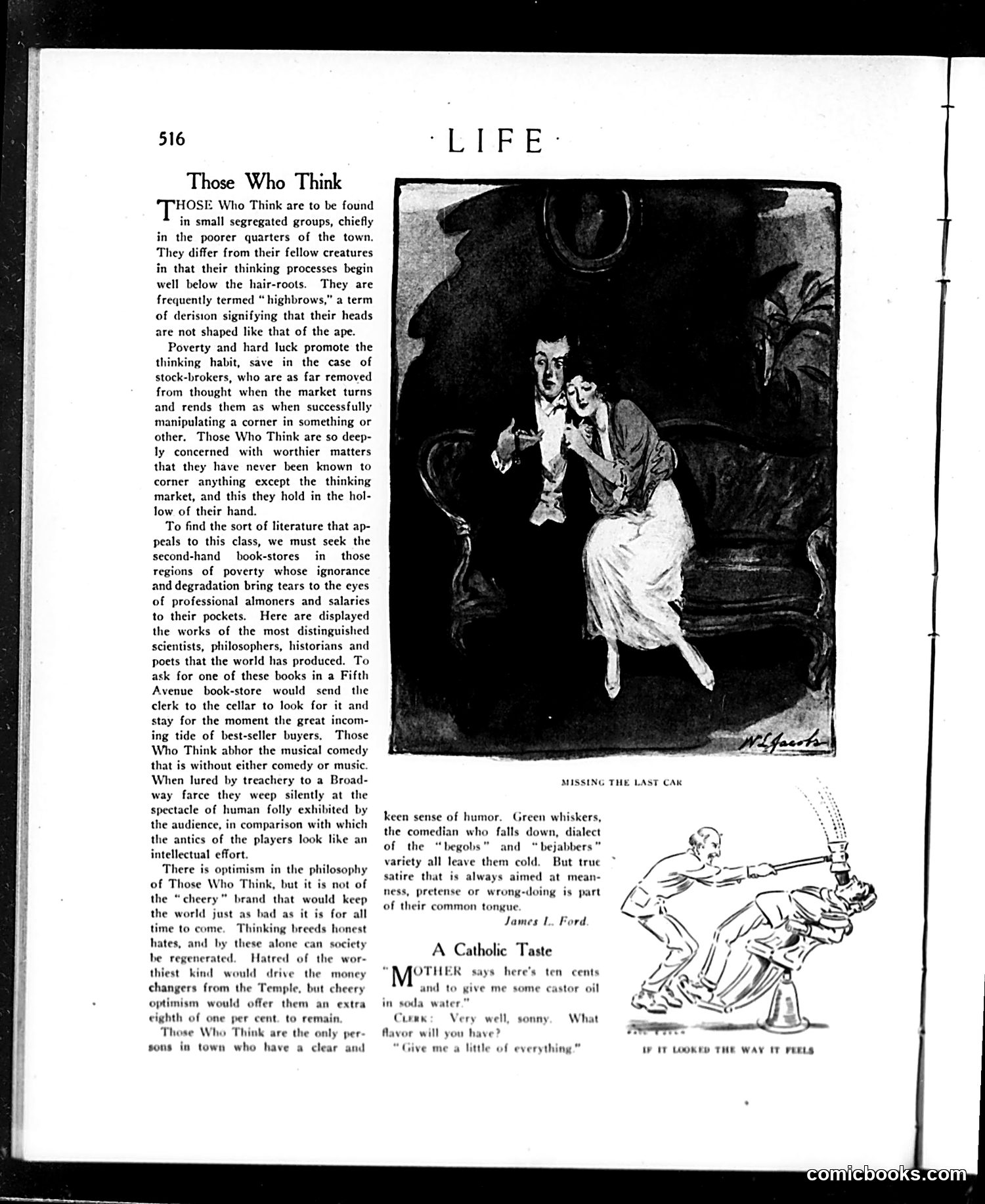
This page satirizes intellectuals and "thinkers" from poor neighborhoods. The article claims they're distinguished from ordinary people by thinking processes that begin "well below the hair-roots," and mockingly calls them "highbrows." The top illustration titled "MISSING THE LAST CAR" depicts a well-dressed couple (likely meant to represent pretentious intellectuals) in an awkward social situation—missing transportation, suggesting their abstract thinking makes them impractical. The lower cartoon "IF IT LOOKED THE WAY IT FEELS" shows a figure in an exaggerated pose, humorously illustrating the disconnect between physical reality and subjective perception—a jab at philosophical or overly analytical thinking. The "Catholic Taste" dialogue below mocks lowbrow humor preferences, reinforcing the page's theme of ridiculing different intellectual classes.
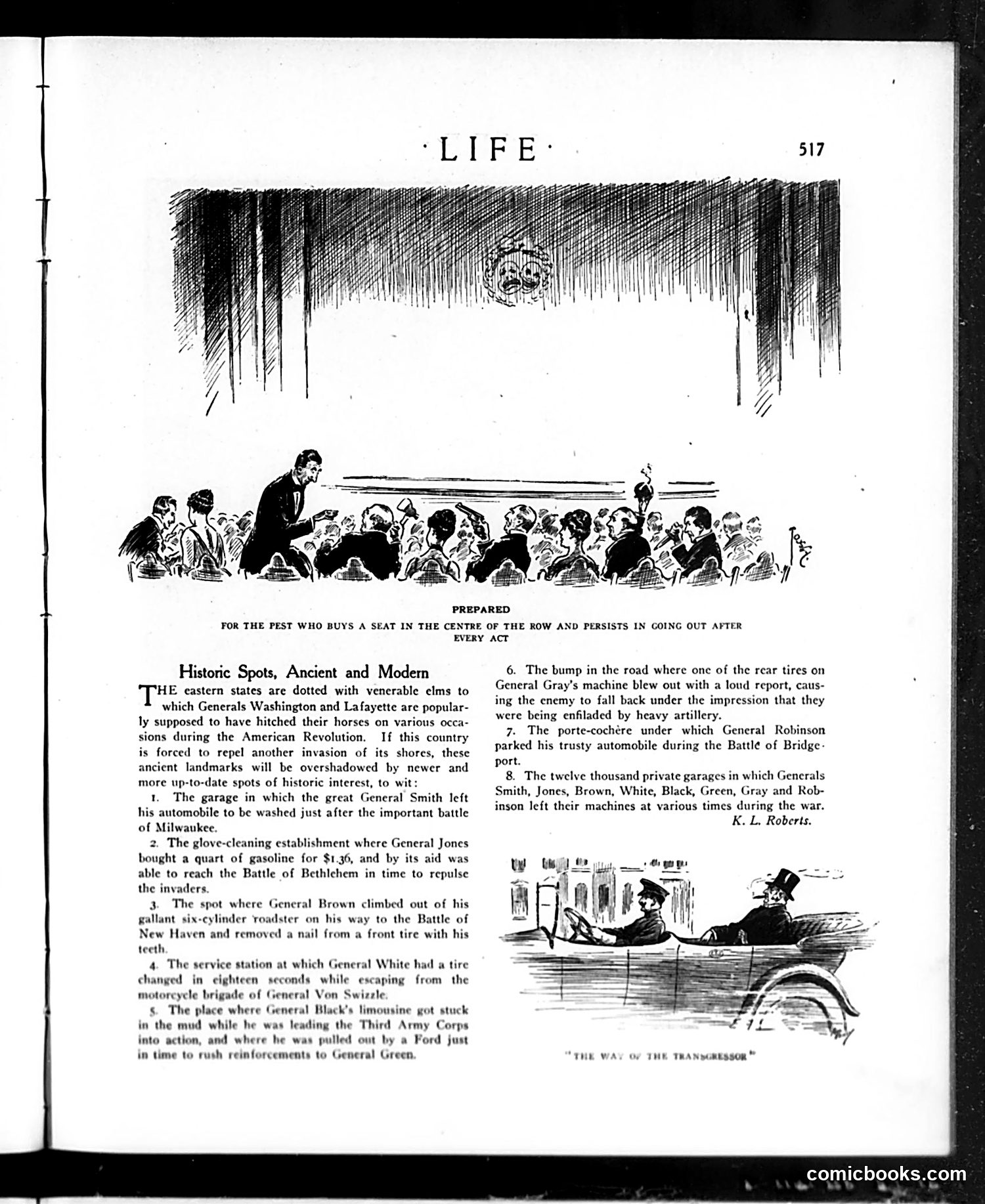
This page presents a satirical article titled "Historic Spots, Ancient and Modern" that humorously contrasts Revolutionary War-era locations with modern automobile-related sites. The top cartoon shows a theater audience where a man stands to leave mid-performance—the caption warns those who "buy a seat in the centre of the row and persist in going out after every act." The article then lists eight "historic spots" where various American generals supposedly washed cars, changed tires, or had automotive mishaps during the American Revolution—an absurdist joke treating early automobiles as if they existed during the 1770s. The bottom illustration labeled "The Way of the Transmissor" appears to show people in a boat, likely another automotive-related visual gag. The satire targets how modern Americans overlay contemporary concerns (automobiles) onto historical narratives.
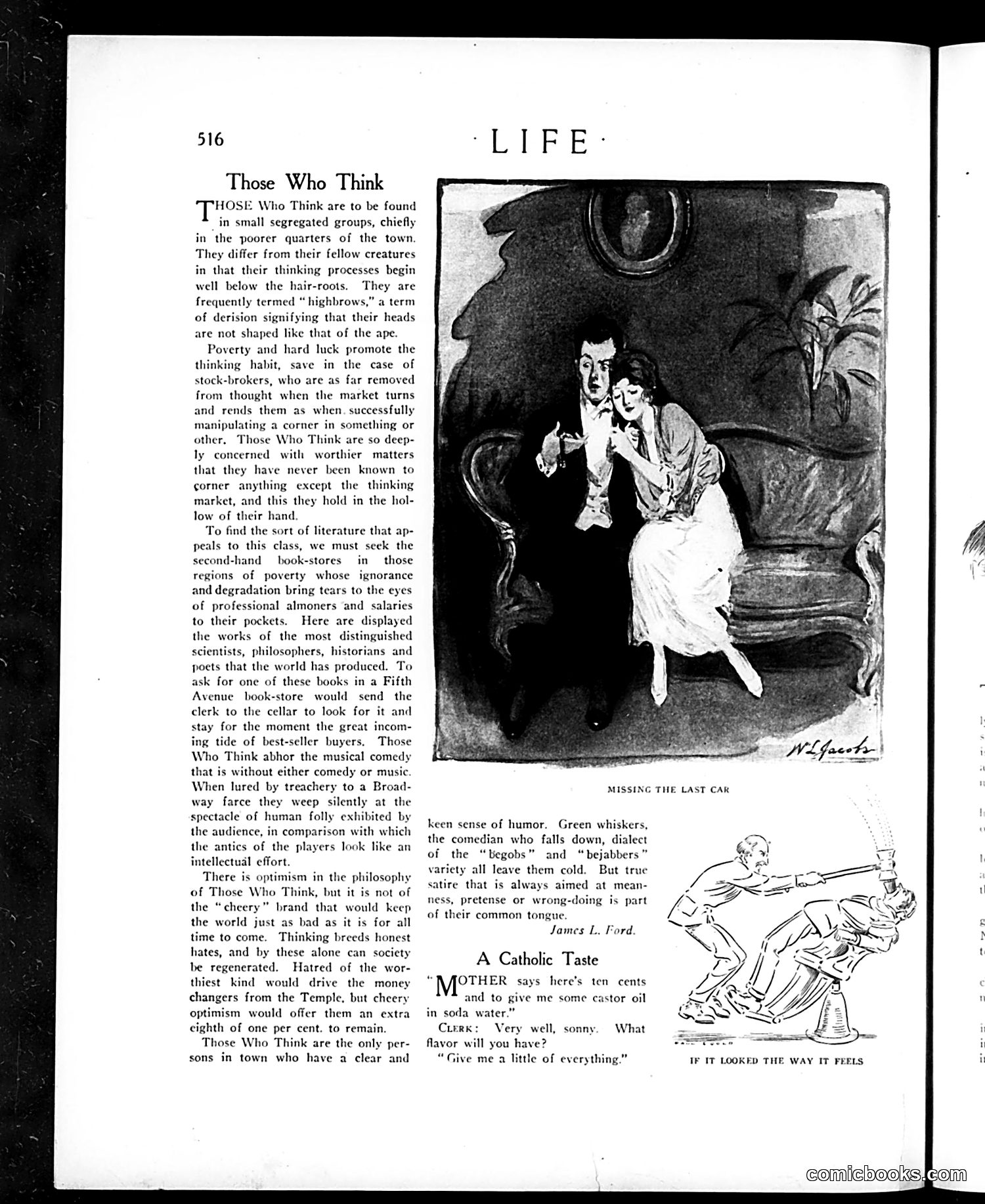
The main article satirizes intellectuals—people who think deeply—describing them as segregated in poor neighborhoods and characterized by high foreheads (a period stereotype suggesting intellectual capacity). The piece mocks how "Those Who Think" concern themselves with worthless matters while neglecting practical concerns, and suggests they inhabit second-hand bookstores in poverty-stricken areas. **Upper illustration ("Missing the Last Car"):** Shows a well-dressed couple apparently having missed their transportation, likely satirizing absent-mindedness among the intellectual class. **Lower illustration ("If It Looked the Way It Feels"):** Depicts someone stumbling or falling, captioned with a dialogue exchange about flavor preferences—a humorous non-sequitur typical of Life's comedic style. The overall message mocks intellectual pretension and impracticality.
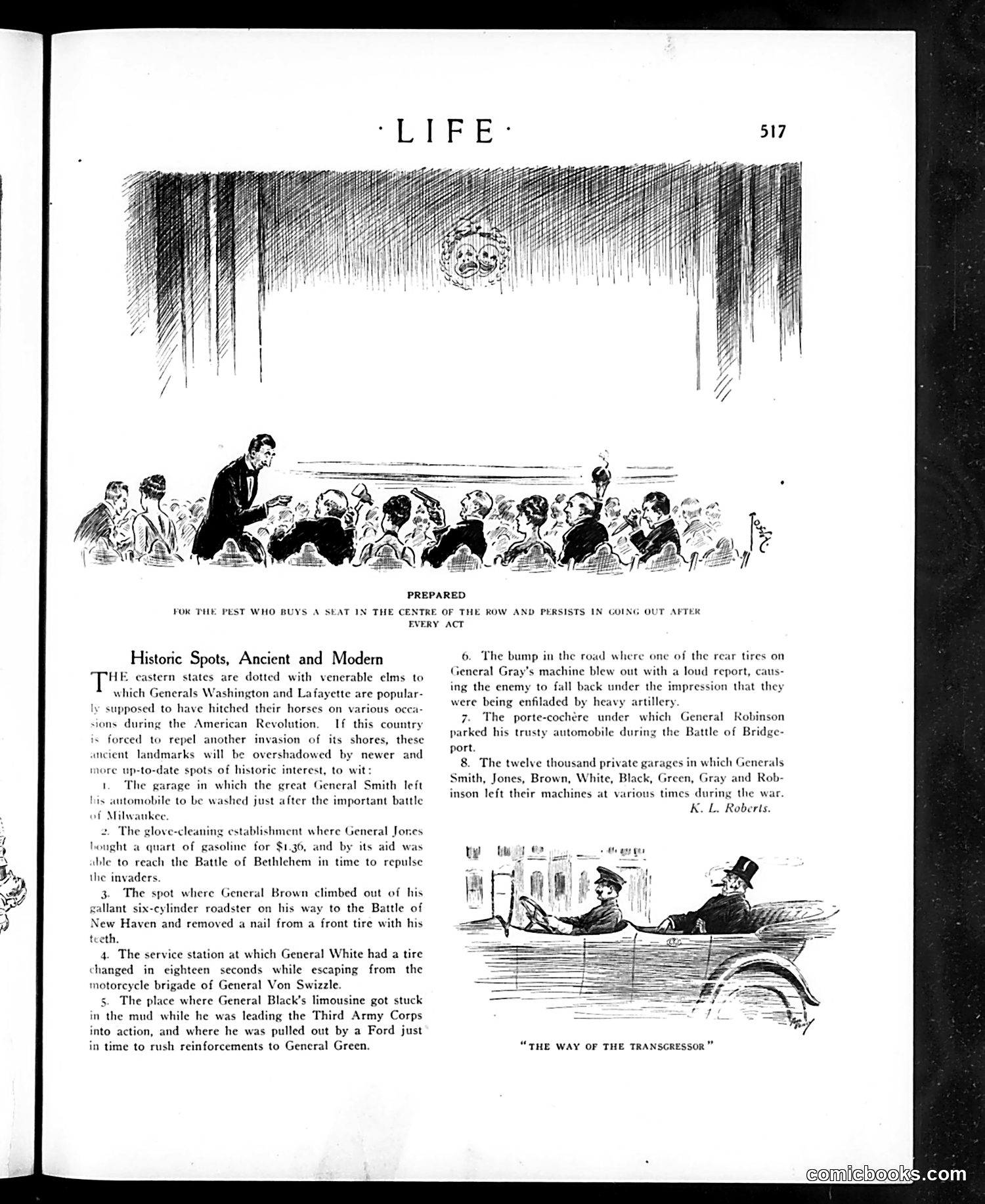
This page satirizes wealthy theater-goers who disrupt performances by leaving mid-show. The top cartoon depicts an usher managing an audience member departing during intermission—the caption mocks "the pest who buys a seat in the centre of the row and persists in going out after every act," addressing a common annoyance of the era. The lower section, titled "Historic Spots, Ancient and Modern," humorously compares Civil War battlefields with WWI-era automotive landmarks. It lists eight locations where various U.S. generals allegedly left cars during wartime service. The small cartoon "The Way of the Transgressor" depicts someone in a boat, though its connection to the numbered anecdotes is unclear from the visible text.
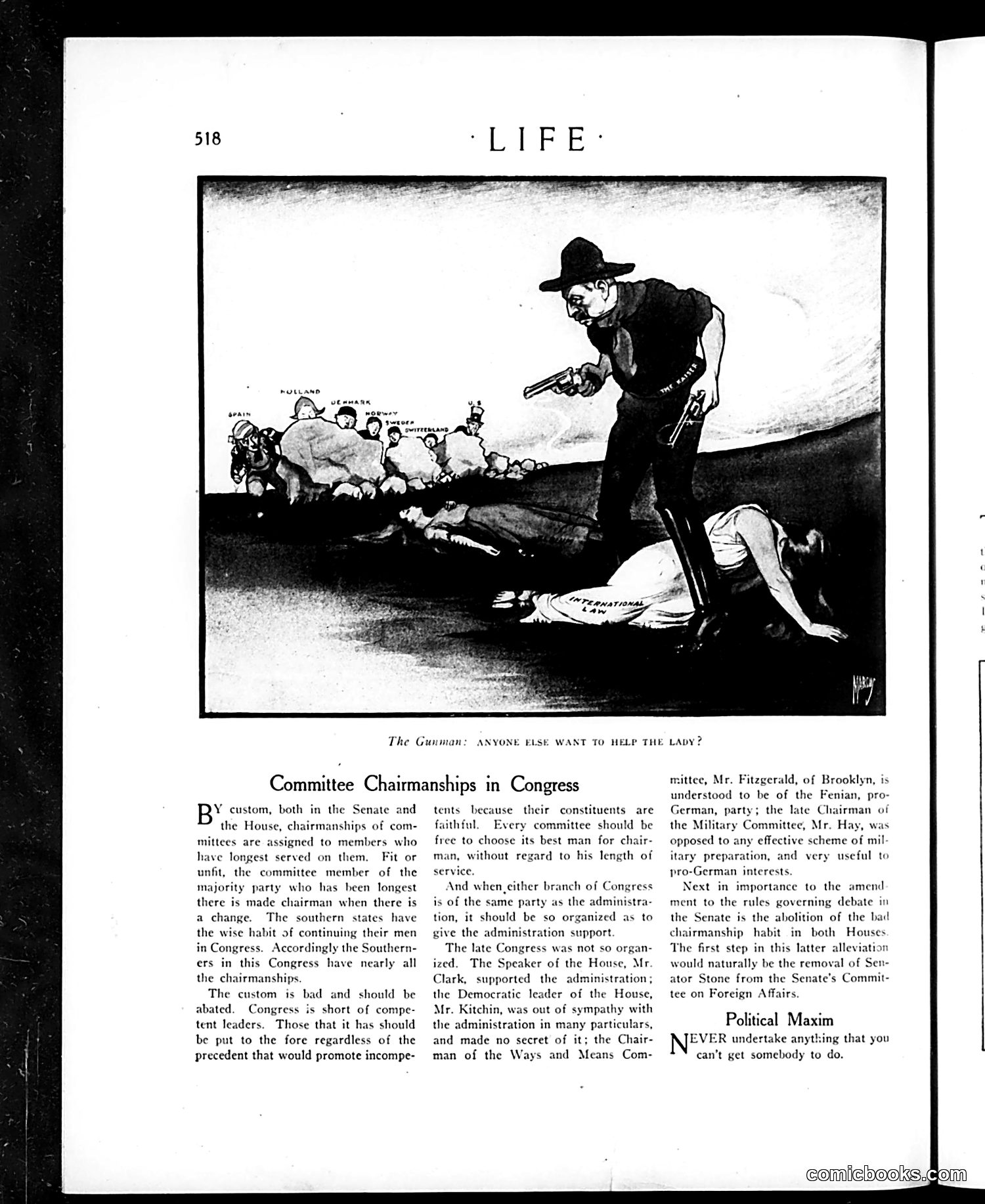
This satirical cartoon depicts a gunman shooting at a prone victim while a group of men labeled with various nations (appearing to include Germany) stand passively in the background. The caption sarcastically asks if anyone will help. The accompanying article critiques the congressional seniority system for committee chairmanships. It argues that assigning chairs based purely on length of service—rather than competence—produces incompetent leadership, particularly from Southern congressmen who consistently re-elect representatives. The cartoon appears to illustrate this systemic failure: the "lady" (likely representing America or democratic governance) is under attack while those responsible for protection or intervention either refuse to help or enable the aggressor. The article specifically names Chairman Fitzgerald as "pro-German" and Senator Stone as obstacles to effective foreign policy—suggesting that outdated congressional rules allow those unsympathetic to American interests to obstruct necessary action. The cartoon thus visualizes the article's core complaint: institutional inertia enables incompetence and obstruction of national interest.
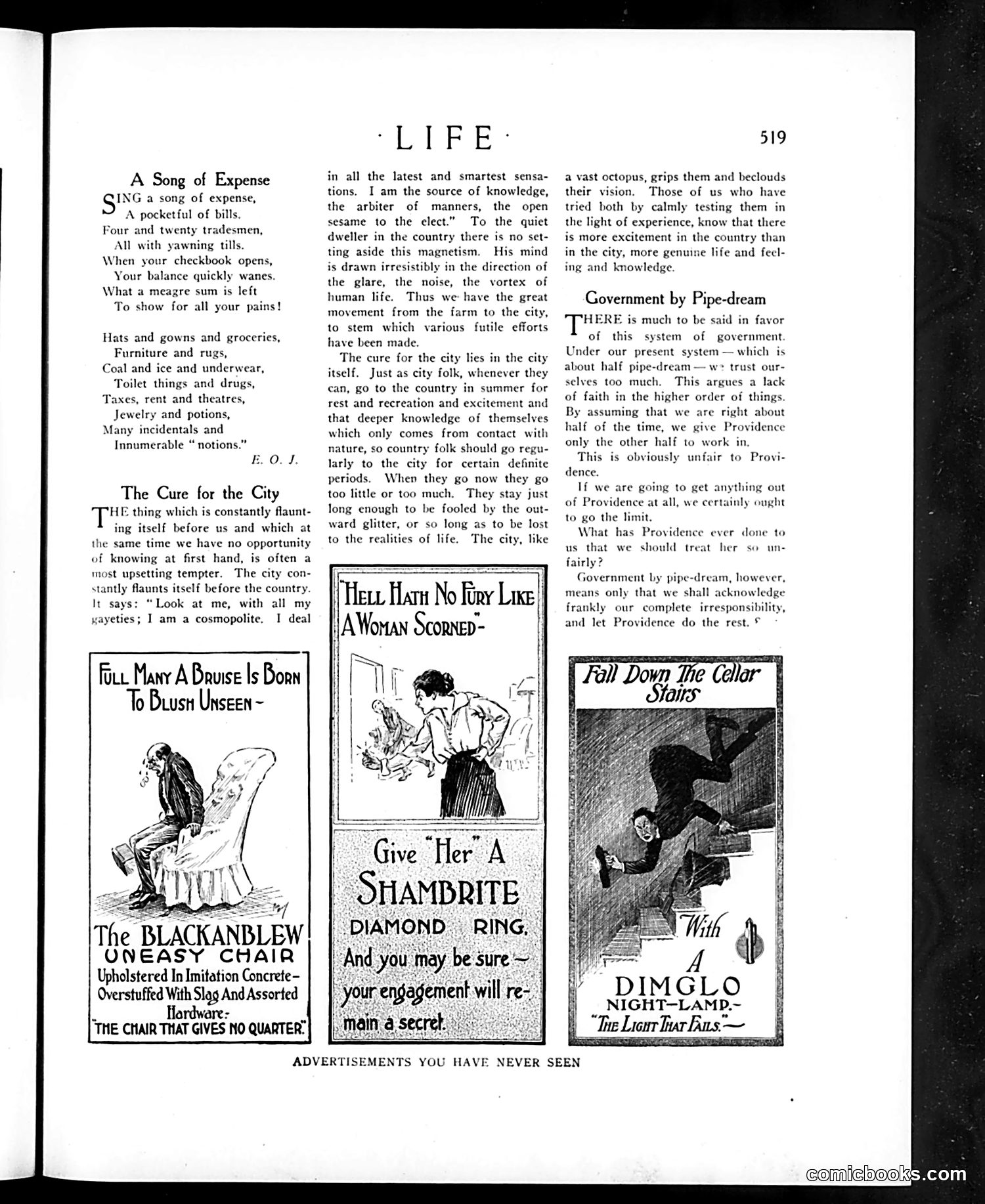
This page combines social commentary with period advertisements (circa 1920s-1930s). **Main Articles:** "A Song of Expense" satirizes middle-class financial anxiety—the endless drain of bills for household necessities and luxuries that leave nothing to show for one's earnings. "The Cure for the City" argues that rural residents are drawn to cities by false glamour, while city dwellers seek the country for genuine fulfillment. The solution: both should visit each other regularly in moderation to see reality clearly. "Government by Pipe-dream" uses ironic language to critique Americans' overconfidence in their own judgment. It humorously suggests we should trust Providence more and acknowledge our incompetence rather than assuming we're "right about half the time." **Advertisements** feature humorous fake products: an "uneasy chair" that bruises you, a diamond ring to keep engagements secret, and a night lamp for cellar stairs—all satirizing contemporary consumer culture and anxieties. The overall tone mocks both urban temptation and small-town naïveté, while poking fun at American self-reliance and consumerism.
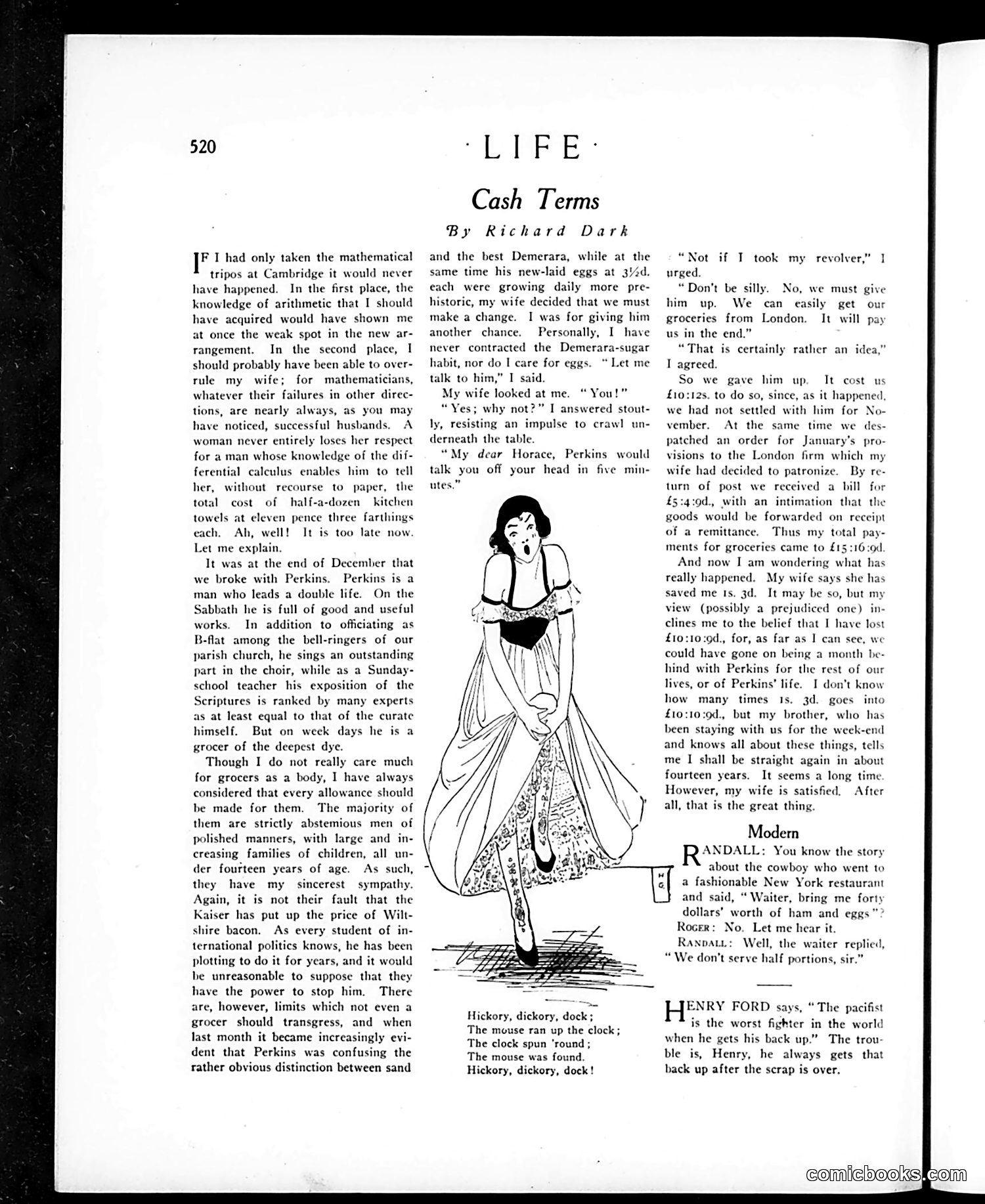
This is a humorous domestic story about a husband's failure to manage household finances. The narrator, Horace, describes firing their grocer, Perkins—a man leading a "double life" as both a pious churchgoer and a weekday grocer who confuses sand with Demerara sugar and sells stale eggs. The wife pressures Horace to dismiss Perkins, then switches to a London firm. The joke: Horace calculates he's actually *lost* money in the transaction (£15:16s. total vs. previous costs), despite his wife claiming savings of 1s. 3d. The cartoon illustrates the wife—shown in period dress with exaggerated skirts—representing the domestic authority figure who overrules her mathematically-incompetent husband. The satire mocks both marital dynamics and middle-class anxiety about household accounts and consumer choice in early 20th-century Britain.
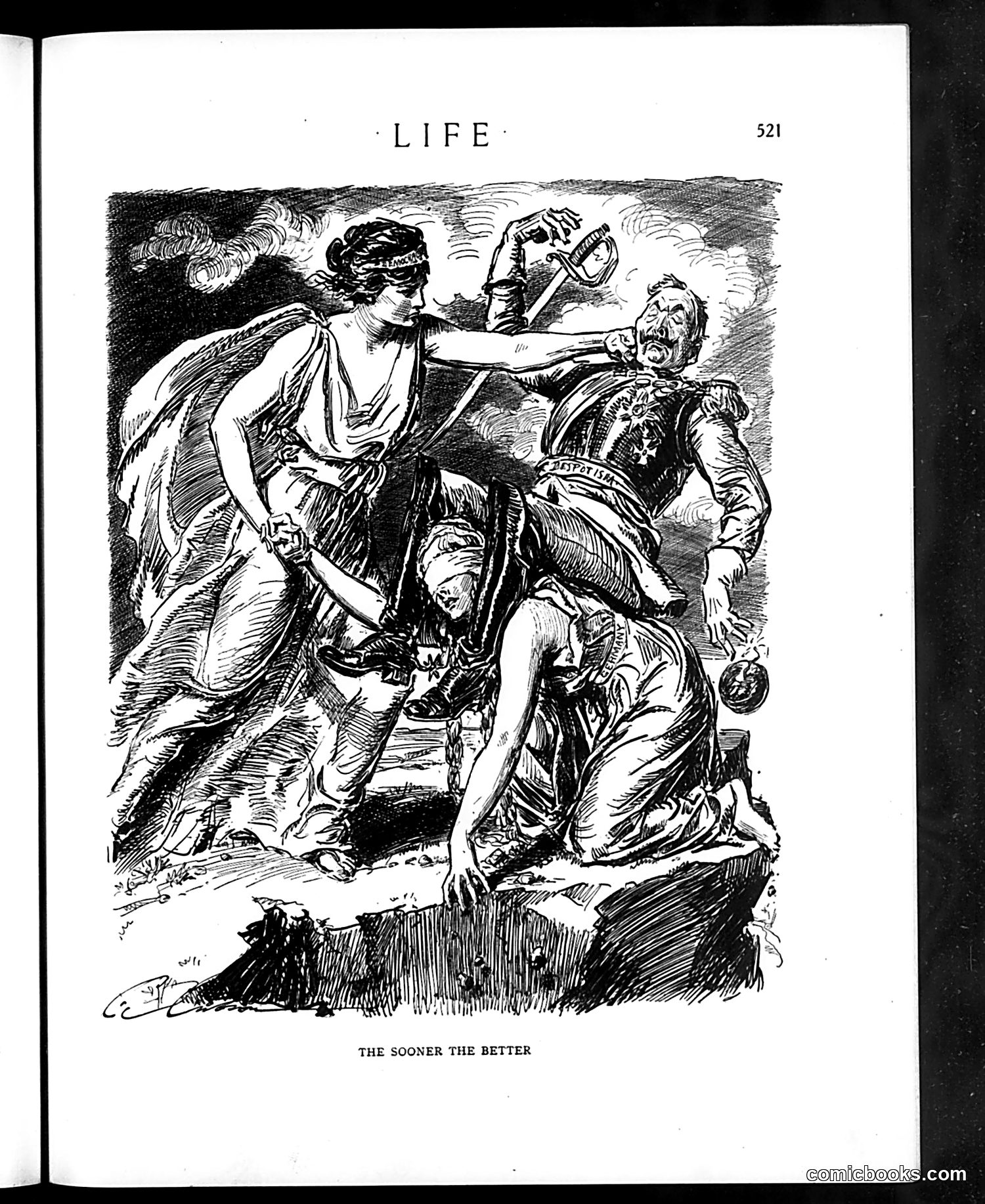
This political cartoon depicts an angelic or allegorical female figure (likely representing Justice, Peace, or the American nation) gesturing forcefully toward a military officer in uniform with decorations. The officer appears distressed or resistant. A kneeling figure is also present. The caption "The Sooner the Better" suggests the cartoon advocates for the rapid removal or departure of the military figure—likely commenting on demilitarization, the end of military rule, or criticism of a specific military leader or administration. Without the publication date visible, the precise historical context is unclear, but this appears to be satirical commentary on American military power or involvement, possibly during a period of post-war tension or military overreach. The allegorical female figure represents civilian/democratic values opposing militarism.
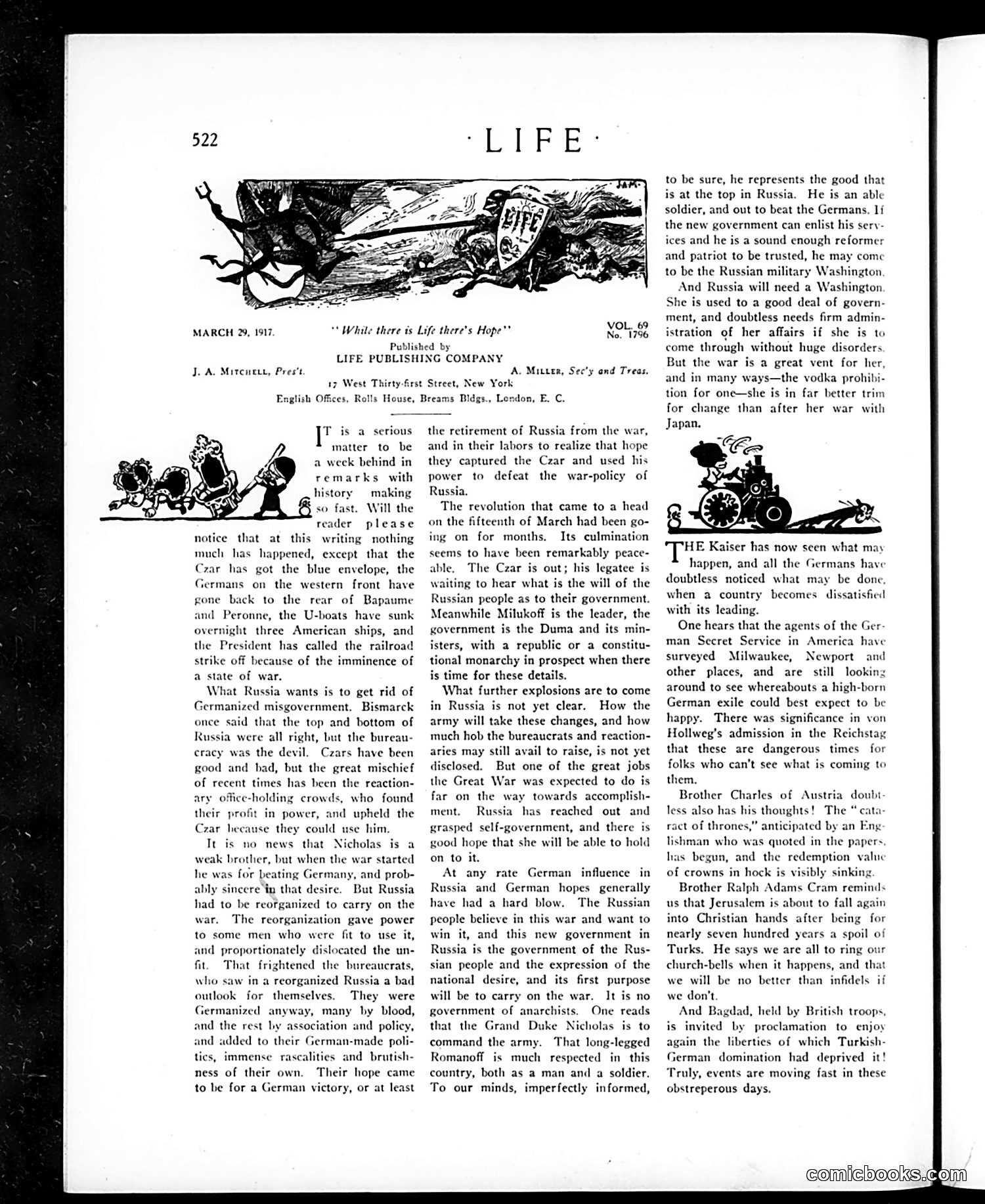
This page discusses the Russian Revolution of March 1917, which recently overthrew Czar Nicholas II. The cartoon at the top shows a fallen figure (the Czar) with a gravestone marked "RIP"—depicting his political death. The article argues that Russia's primary problem wasn't the Czar himself but corrupt bureaucrats who sabotaged Russia's war effort against Germany, some of whom were "Germanized" by blood or sympathy. With the Czar removed and reformers like Milukov leading a new government backed by the Duma (parliament), Life expresses hope that Russia will remain committed to defeating Germany in World War I. The author suggests Grand Duke Nicholas could become Russia's "military Washington"—implying he might stabilize the country militarily. The overall message: Russia's revolution, though dramatic, removes an obstacle to effective war-making against the Central Powers, which benefits the Allies (including America, about to enter the war).
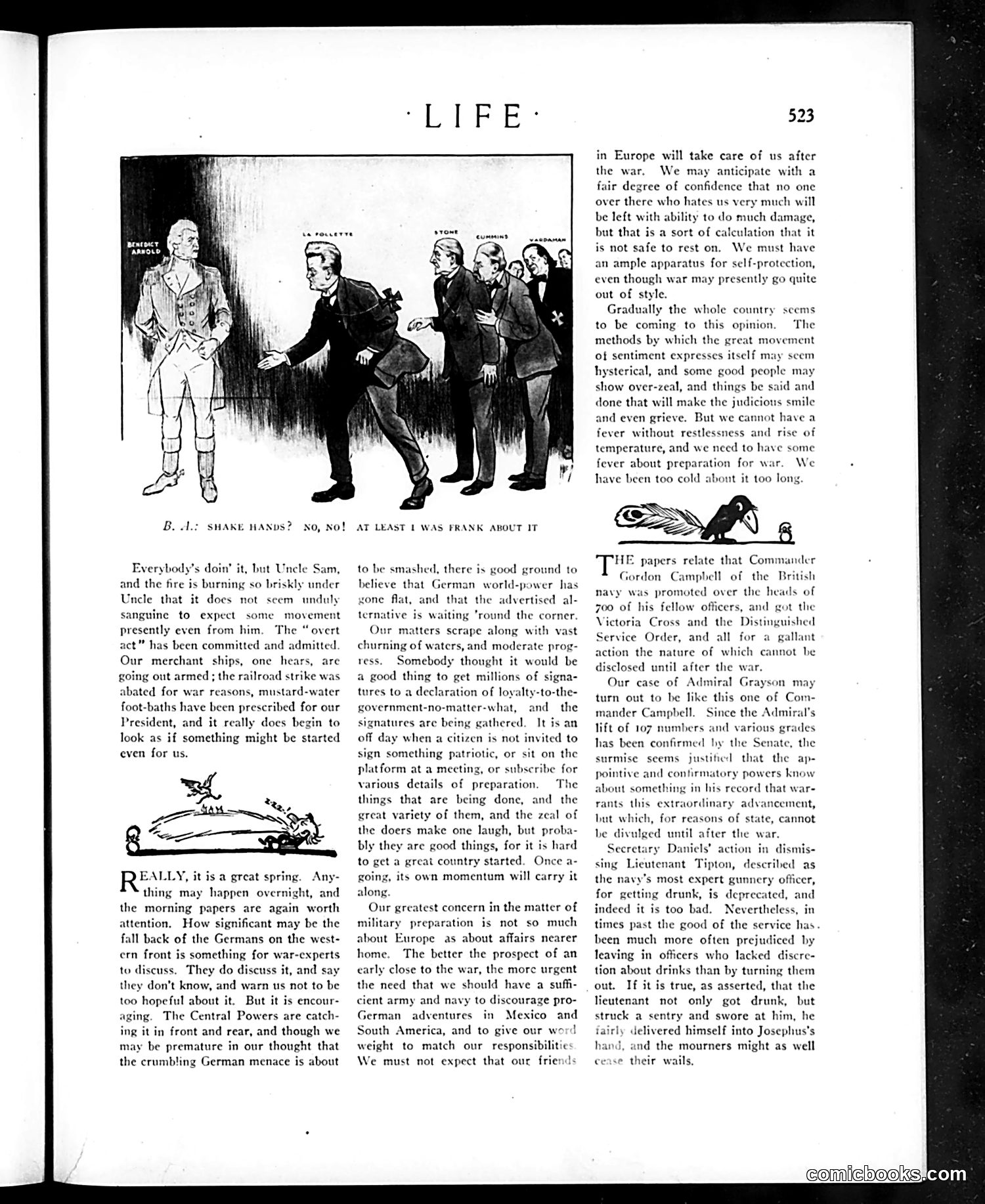
This page, likely from 1917-1918, satirizes American reluctance to enter World War I. **The main cartoon** depicts a figure labeled "BRITISH OFFICER" (on left) confronting others, with the caption "SHAKE HANDS? NO, NO! AT LEAST I WAS FRANK ABOUT IT." This mocks the U.S. for hesitating while Britain openly prosecuted the war—America's "frankness" apparently meaning delayed action. **The text's argument**: The author urges America to stop dragging its feet. While Germans face military collapse in Europe, the U.S. must urgently build military strength to prevent "pro-German adventures in Mexico and South America" and assert post-war authority. **The satire targets**: American complacency and excessive patriotic theater (mandatory loyalty declarations, endless fundraising campaigns) while actual war preparation lags. The author criticizes both extremes—those too cold toward war preparation and those now hysterically overselling patriotic gestures. **Context**: This reflects the pre-U.S. entry period when Germany's unrestricted submarine warfare and the Zimmermann Telegram pushed American opinion toward intervention, which occurred April 1917.
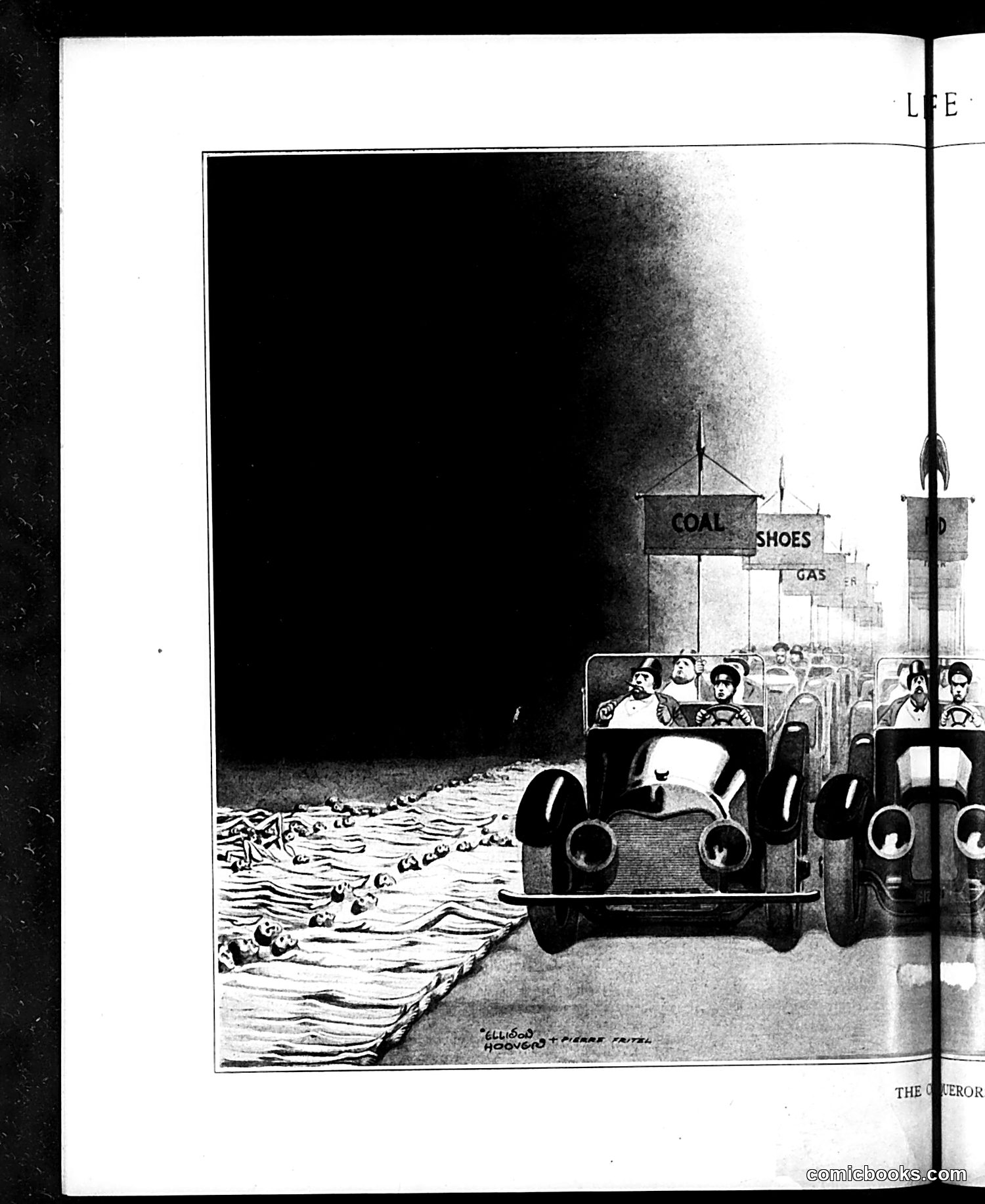
This is a darkly satirical cartoon depicting a row of luxury automobiles driving past bodies of the dead and dying on the ground. Signs advertise consumer goods: "COAL," "SHOES," and "GAS." The cartoon critiques materialism and inequality during what appears to be a period of economic hardship or crisis—the contrast between the well-dressed motorists enjoying modern conveniences and the corpses beneath their wheels suggests the callousness of the wealthy toward human suffering. The cartoonist appears to be attacking consumerism and the indifference of the affluent to mass poverty or death. The illustration style and satirical approach are characteristic of *Life* magazine's social commentary. Without a visible date, the specific historical context remains unclear, though the economic disparity theme was relevant across multiple American crises.
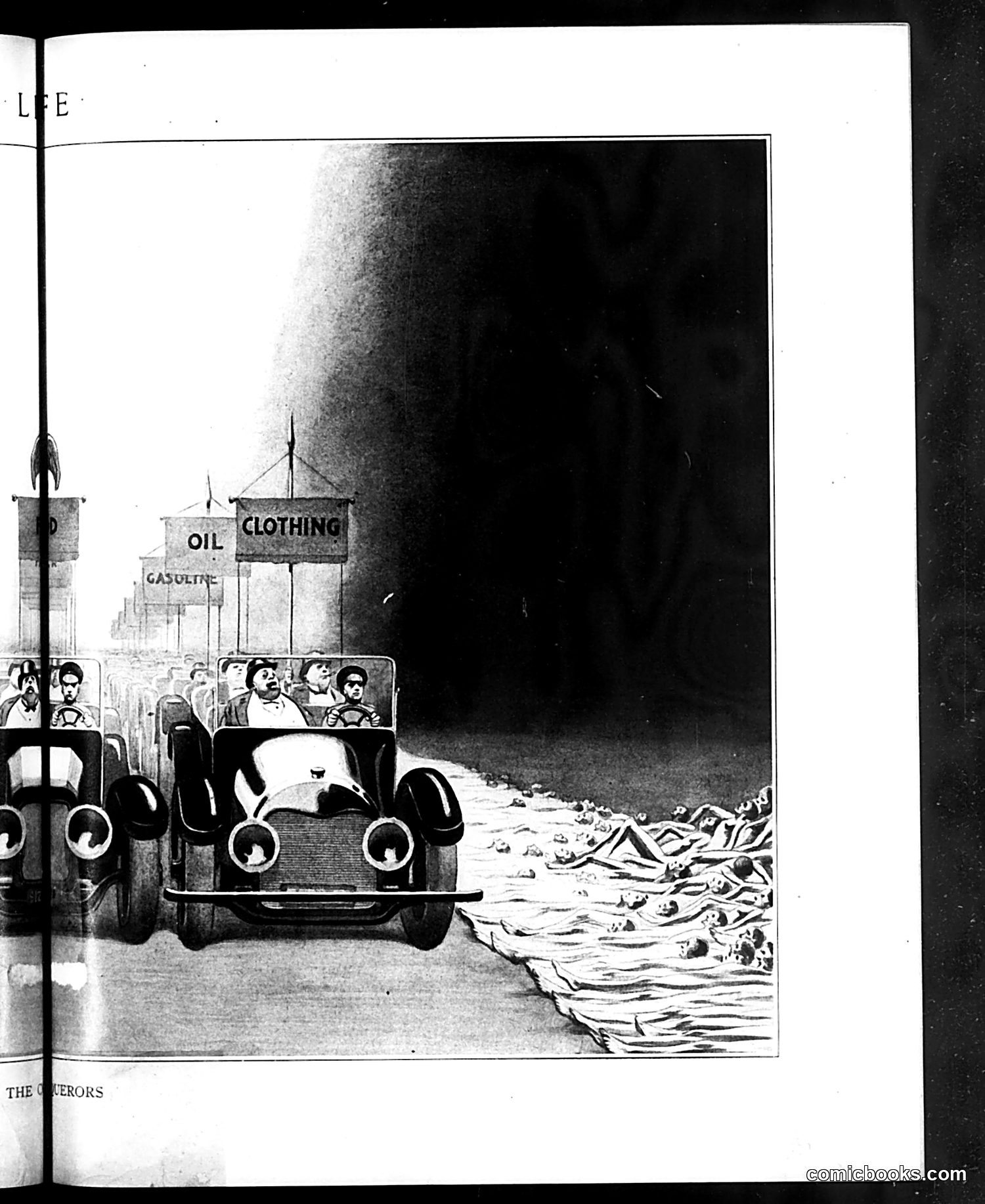
This appears to be a satirical cartoon from *Life* magazine depicting a dystopian scene. An automobile filled with passengers drives past roadside signs advertising "GASOLINE," "OIL," and "CLOTHING" toward a dark, ominous landscape littered with what appear to be corpses or skeletal remains. The satire critiques **consumer culture and materialism during an era of industrial excess**—likely the 1920s-30s. The irony is stark: while citizens drive comfortably past commercial signs promoting goods, they're simultaneously traveling toward a wasteland of death and destruction. The message suggests that blind consumerism and industrial expansion mask or ignore underlying human suffering and social consequences. The dark sky and scattered bodies represent the hidden costs of the commercial society those billboards promote.
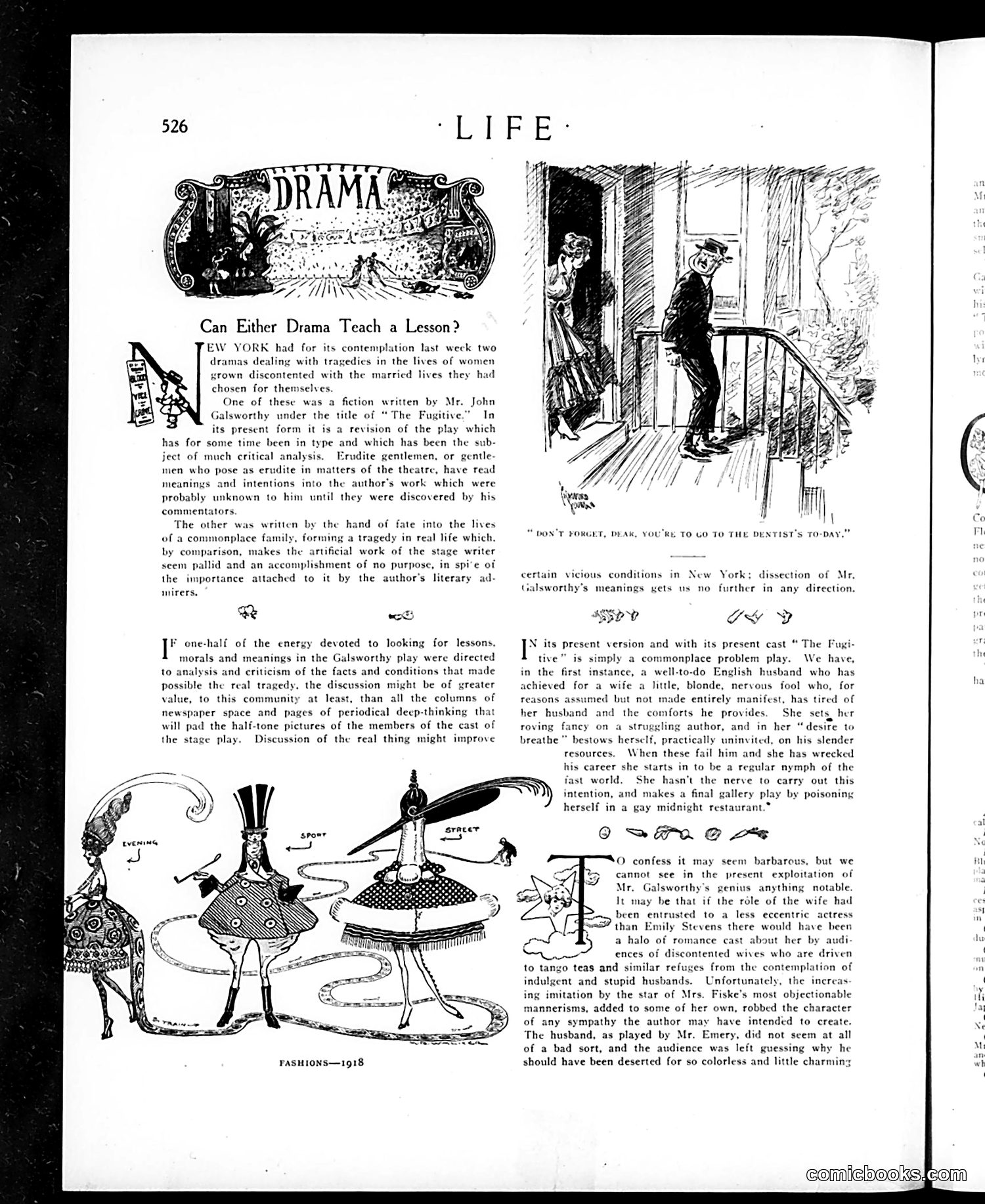
This page reviews John Galsworthy's play *"The Fugitive,"* comparing its artificial theatrical tragedy to real-life suffering in New York. The article criticizes both the play and its production. **The Play's Plot:** A wealthy English husband's blonde, nervous wife abandons him for a struggling author. When that affair fails financially, she becomes a "nymph of the fast world" before poisoning herself in a restaurant. **The Satire's Point:** The author argues that obsessing over the *meanings* critics project onto Galsworthy's work wastes energy better spent addressing actual "vicious conditions" causing real tragedies in New York—implying the play is pretentious melodrama disconnected from genuine social problems. **The Cast Criticism:** Actress Emily Stevens's "eccentric" performance and affected mannerisms undermine the character's intended sympathy. Actor Mr. Emery's portrayal of the husband makes him seem too decent, leaving audiences confused why he'd be abandoned. The illustrated fashion figures at bottom appear unrelated—standard magazine decoration.
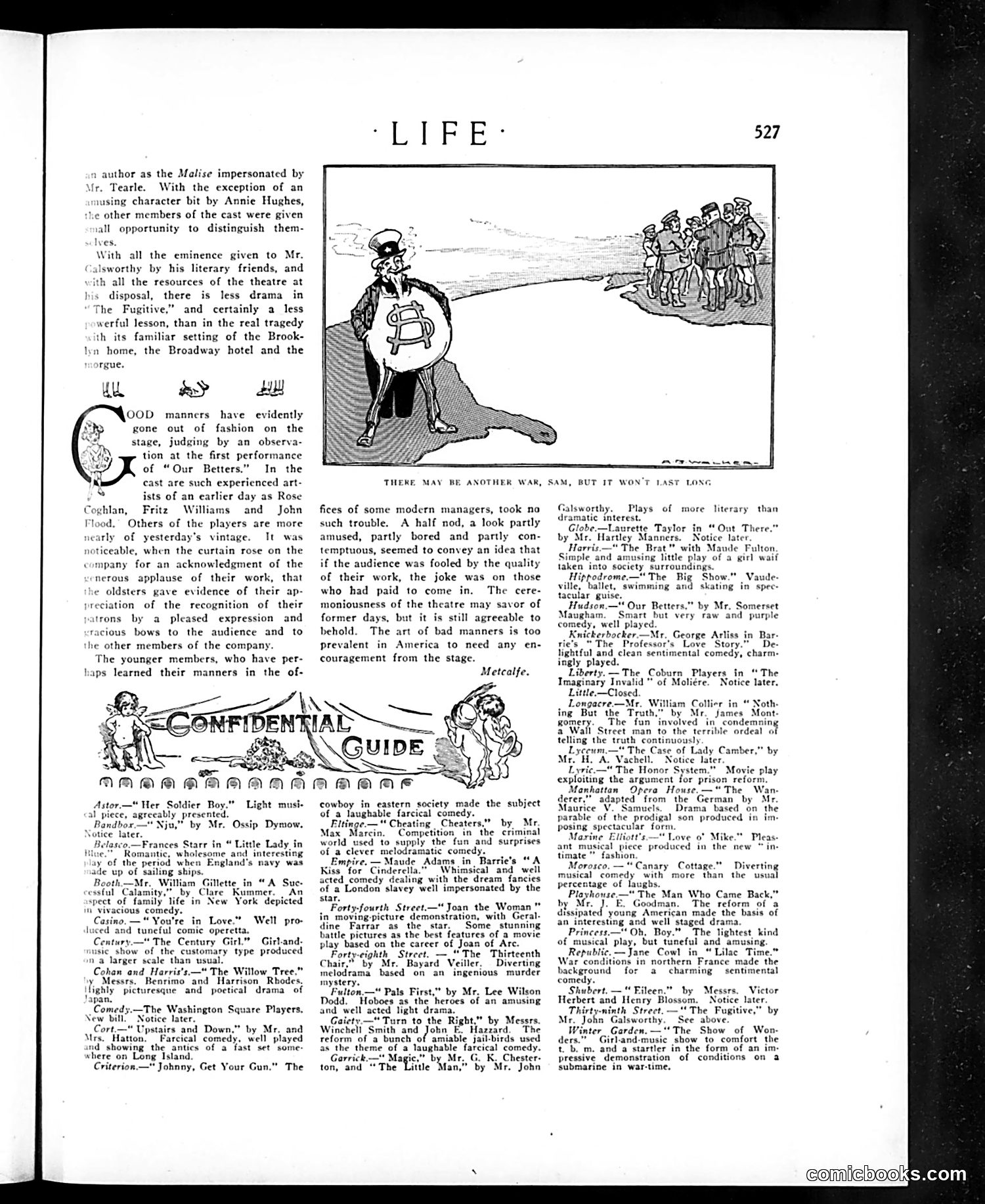
This page from *Life* magazine critiques theatrical manners and performance standards circa 1915-1920. The main cartoon depicts a man (labeled "Sam," likely representing a soldier or everyman) standing before a group of people, illustrating the caption "There May Be Another War, Sam, But It Won't Last Long"—a wartime or post-war commentary on conflict's impermanence. The text below discusses how older Broadway actors (Rose Coghlan, Fritz Williams, John Hood) demonstrated gracious acknowledgment of applause at "Our Betters," contrasting their courteous stage manners with younger performers who appeared indifferent or contemptuous toward audiences. The author argues that cultivating good theatrical manners remains important, as bad manners are already "too prevalent in America." The page is primarily a theater review column, not primarily satirical of current events, though the cartoon suggests wartime anxieties.
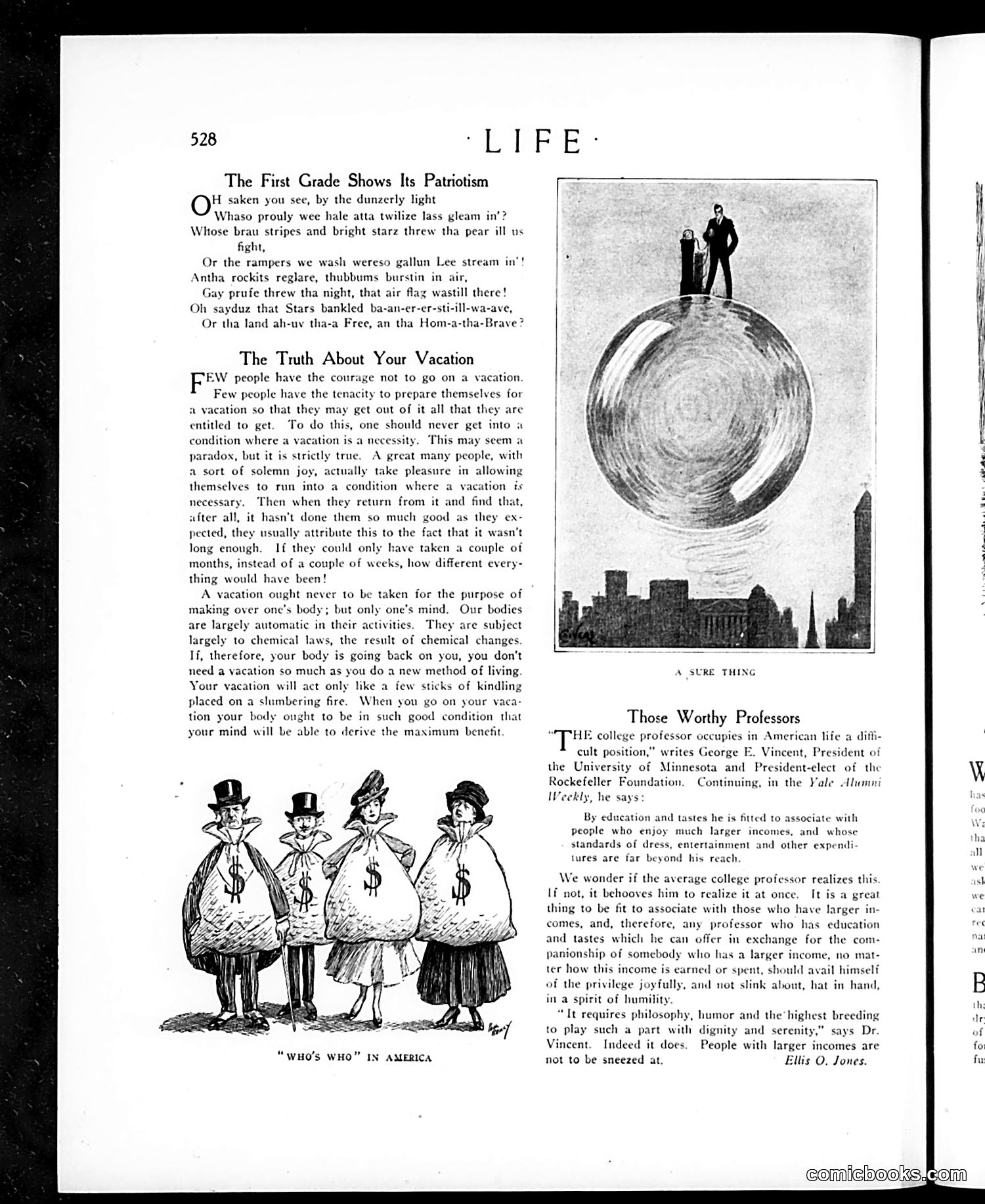
## "The First Grade Shows Its Patriotism" This section presents a patriotic poem written in exaggerated phonetic dialect—apparently children reciting the Pledge of Allegiance or patriotic verse. The broken spelling ("dunzerly," "prouly," "brau stripes") satirizes how young children mispronounce the words while attempting to express patriotic fervor. The joke: first-graders earnestly butcher the language while singing about the flag and freedom. ## "Who's Who in America" Cartoon Four figures in top hats carry money bags marked with dollar signs. This appears to satirize wealthy Americans and the social hierarchy reflected in "Who's Who" directories—suggesting that American prominence is defined by wealth rather than merit or achievement. ## "Those Worthy Professors" This section criticizes college professors' awkward social position. The article (quoting University of Minnesota president George Vincent) notes professors are educated but poorly paid, yet expected to socialize with the wealthy. The satire mocks Vincent's suggestion that professors should be *grateful* for access to wealthy company—essentially accepting their inferior economic status with humility rather than demanding fair compensation.
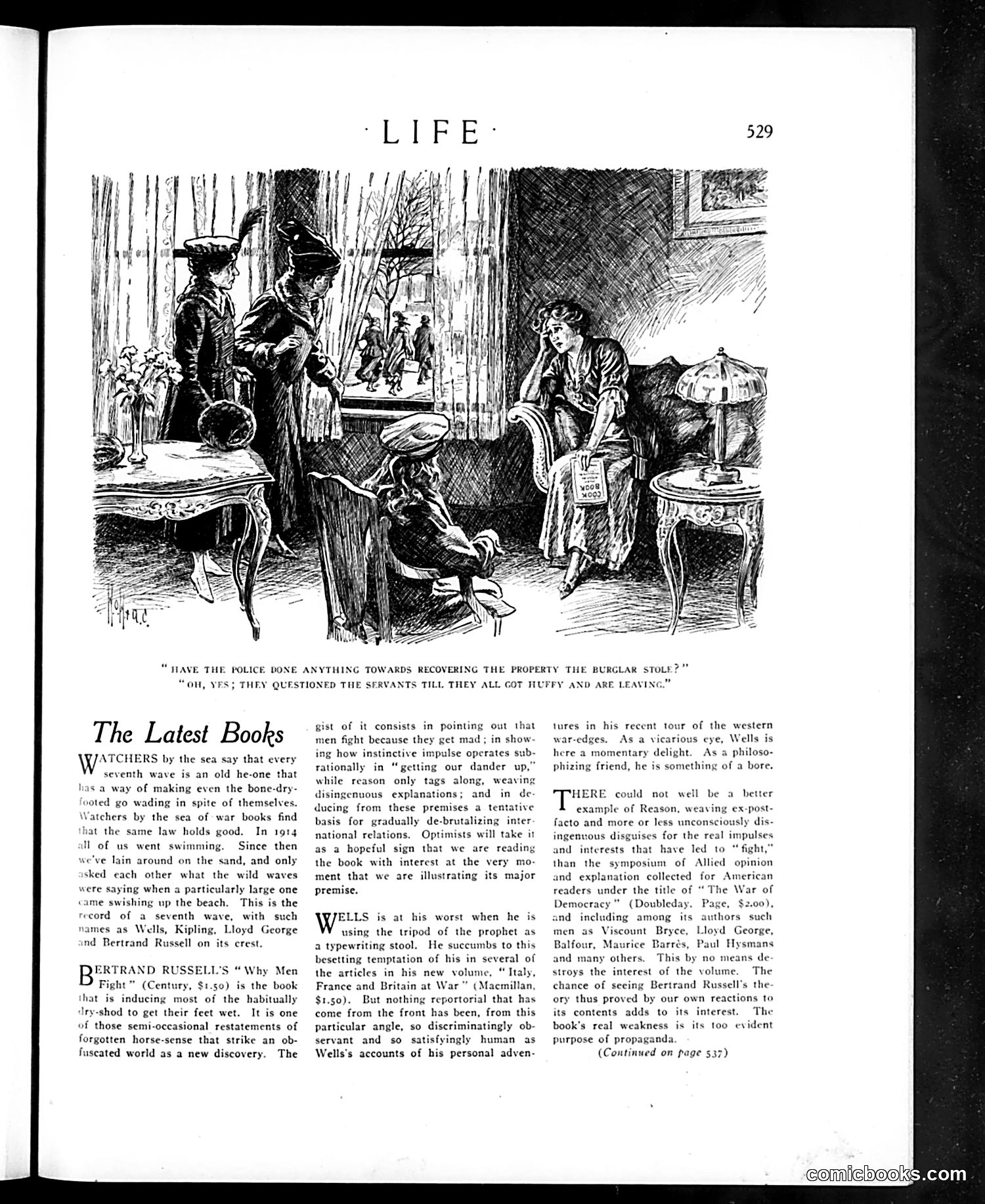
This page from *Life* magazine reviews wartime books, using a metaphor about ocean waves to suggest that interest in war literature comes in cycles—like the "seventh wave" sailors watch for. The **cartoon** depicts a domestic scene where police question servants about a burglary. The irony is stated in the caption: despite thorough investigation, the servants become irritated and leave. This illustrates the page's larger point about Bertrand Russell's book "Why Men Fight"—that people act on emotion (anger, defensiveness) rather than reason, even when logic should prevail. The **book reviews** discuss Russell, H.G. Wells, and a collection called "The War of Democracy" featuring Allied leaders like Lloyd George and Balfour. The critic praises Russell's argument that war stems from irrational passion disguised by rational-sounding explanations. The reviews suggest these wartime justifications are post-hoc rationalizations—people fighting emotionally, then constructing propaganda to explain themselves, which is precisely what Russell warned against.
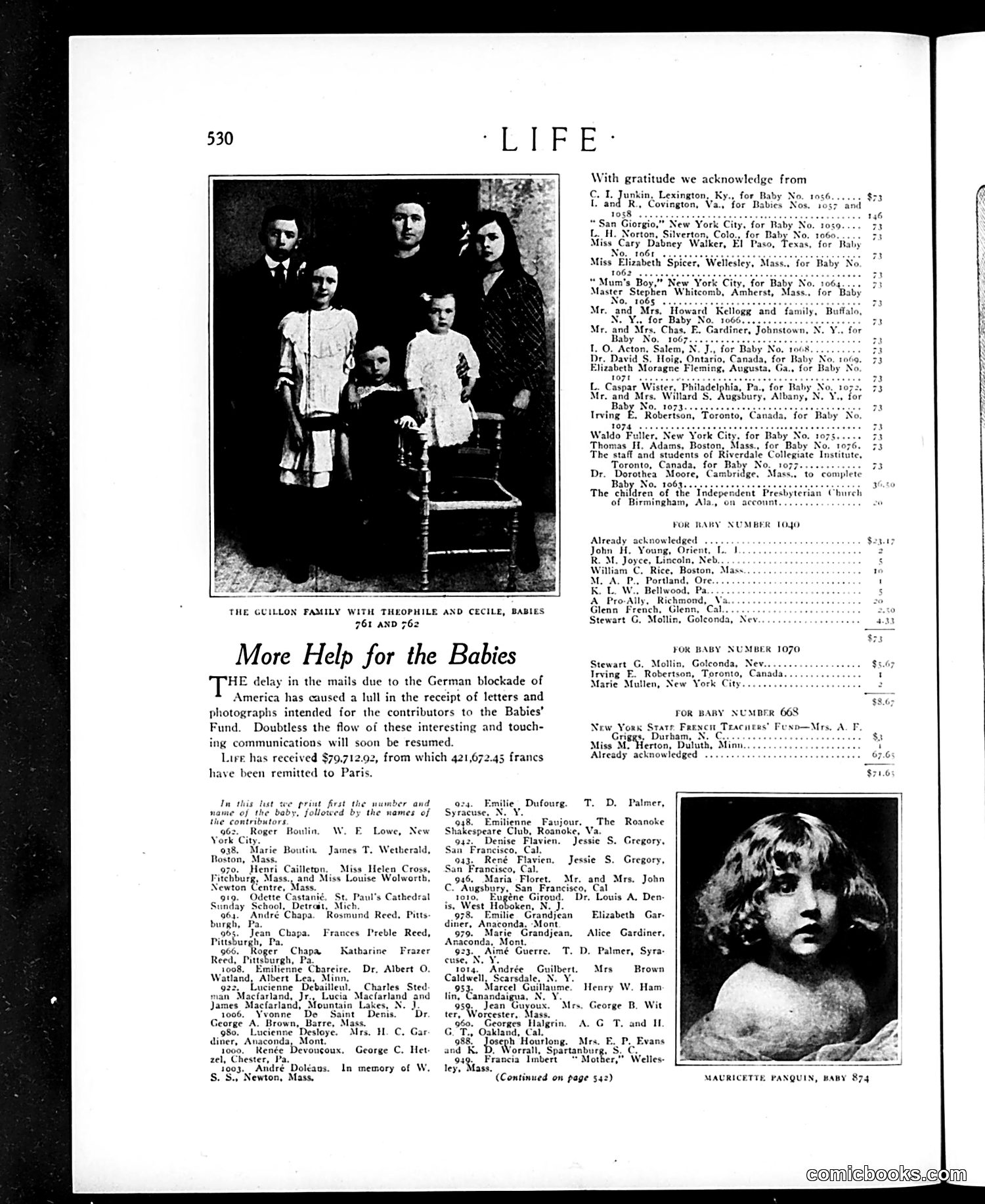
This page documents Life magazine's "Babies' Fund"—a charitable effort to aid French war orphans and infants during World War I. The main photograph shows the Guillon family with two sponsored babies, Theophile and Cecile (761 and 762). The article explains that German blockades have disrupted mail delivery to contributors, causing a temporary slowdown in donations and photographs. Despite this, Life reports collecting $79,712.92, with $421,672.45 francs remitted to Paris for child relief. The bulk of the page lists contributors' names and the babies they've sponsored, identified by number. This public acknowledgment served dual purposes: thanking donors and encouraging further contributions through social prestige. The lower image shows "Mauricette Panquin, Baby 874"—another orphan awaiting sponsorship. This reflects American philanthropic mobilization for Allied civilians during WWI's early years.
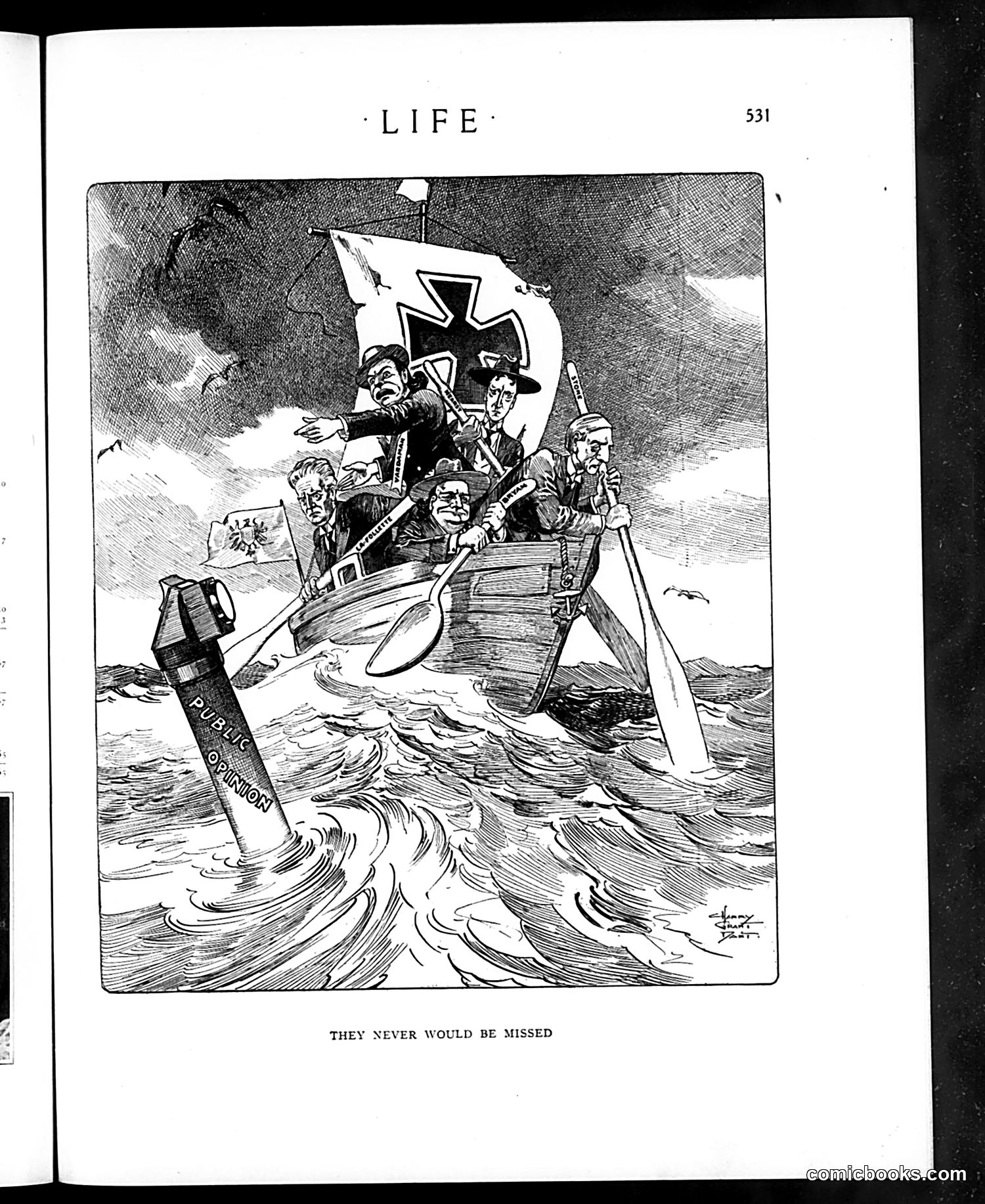
This satirical cartoon from *Life* magazine depicts several political figures in a sinking boat during a storm, carrying a Nazi flag. The vessel appears to be labeled "PUBLIC OPINION" (visible on the anchor). The cartoon's message, reinforced by the caption "THEY NEVER WOULD BE MISSED," suggests that certain politicians or leaders associated with Nazi sympathies or fascist ideology would not be lamented if they disappeared. The sinking boat symbolizes their political downfall or the rejection of their ideology. Without clearer identification of the specific caricatured figures, I cannot definitively name them, but the cartoon appears to be American anti-Nazi propaganda, likely from the 1930s-1940s era, warning against fascist sympathizers within American politics.
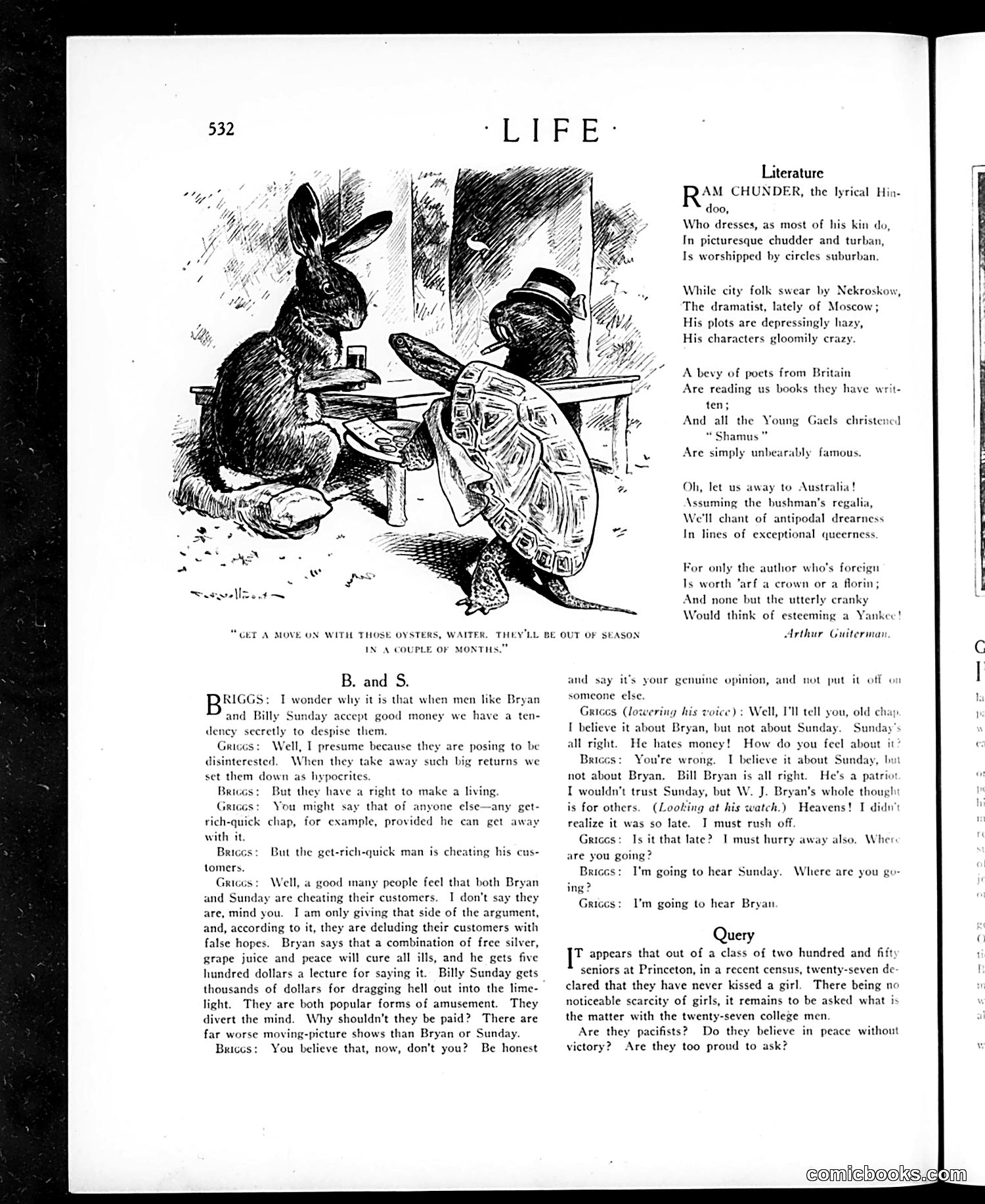
This page satirizes William Jennings Bryan (three-time presidential candidate) and Billy Sunday (famous evangelist), both popular speakers who charged substantial fees for their appearances. The cartoon dialogue between Briggs and Griggs mocks the hypocrisy of these public figures: they present themselves as disinterested servants of the public good, yet accept lucrative payments. Bryan promoted "free silver, grape juice and peace" as cure-alls; Sunday drew crowds by dramatizing hellfire and damnation—both profiting from selling hope and entertainment while claiming moral authority. The humor lies in the characters' admission that they themselves pay to hear these speakers despite recognizing the con. The accompanying poem by Arthur Guiterman ridicules literary fashion favoring foreign authors over Americans. The "Query" section appears unrelated—commenting on Princeton college men who claim never to have kissed girls.
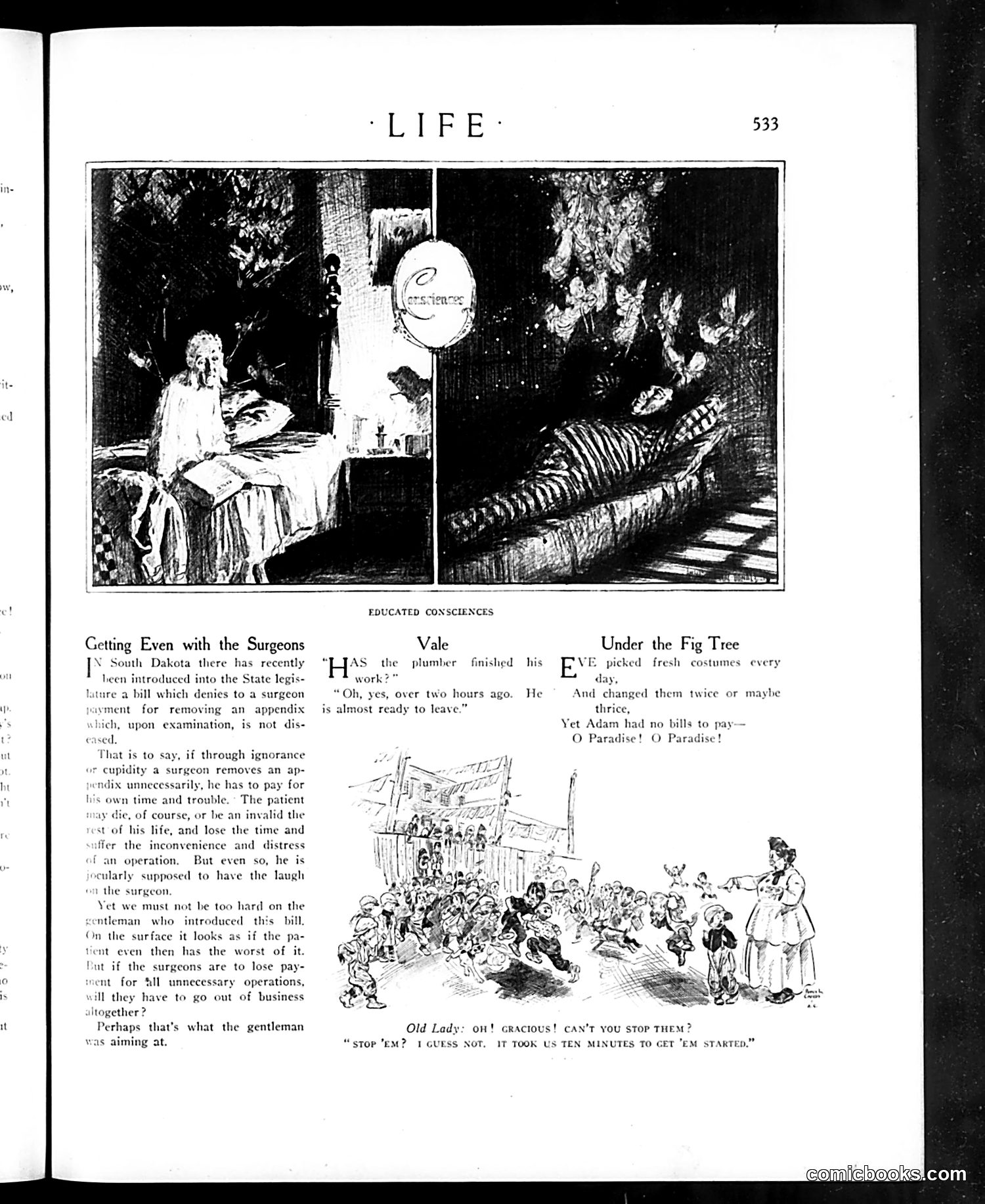
**"Getting Even with the Surgeons"** satirizes a South Dakota legislative bill holding surgeons financially liable for removing healthy appendixes. The piece argues this law, while seemingly protecting patients from unnecessary surgery, might actually destroy surgeons' business model—implying many surgeons depend on performing unnecessary operations for income. The satire suggests the bill's real aim may be eliminating the surgical profession altogether rather than merely regulating it. **"Vale" and "Under the Fig Tree"** are brief satirical verses. "Vale" jokes about a plumber's endless work, suggesting tradespeople create unnecessary jobs to stay employed—paralleling the surgeon critique. "Under the Fig Tree" nostalgically contrasts Adam's paradise (no bills, free clothing changes) with modern consumer expenses, lamenting lost simplicity. The illustrations show domestic/social scenes supporting these themes of modern commercial exploitation versus simpler times.
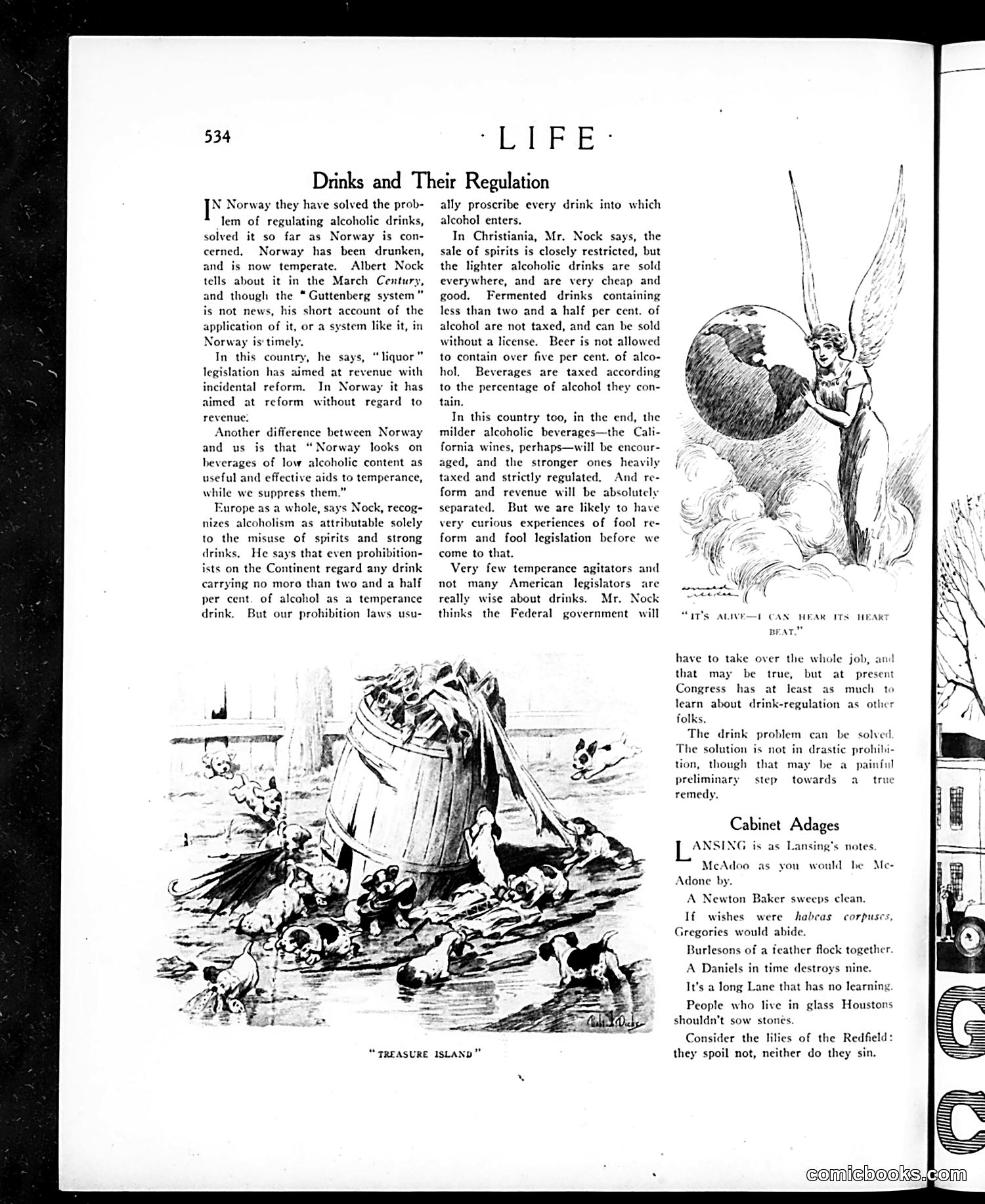
This article critiques American alcohol prohibition policy by contrasting it with Norway's more nuanced approach. The writer, citing Albert Nock, argues that Norway successfully reduced alcoholism by distinguishing between spirits (heavily restricted) and mild fermented drinks (taxed lightly or not at all, sold cheaply). The key satire: America's prohibition laws indiscriminately ban *all* alcohol, whereas Europe recognizes that low-alcohol beverages actually aid temperance. The article suggests American legislators are "fool[s]" who don't understand alcohol regulation and will likely bungle reform before reaching a sensible solution. The two illustrations—an angel on a globe and "Treasure Island" (pirates with a barrel)—appear to symbolize idealistic versus chaotic approaches to the drinking problem. The "Cabinet Adages" section is a separate joke, using cabinet members' names (McAdoo, Baker, Daniels, Redfield, etc.) in twisted proverbs, mocking their competence—a common contemporary satire technique.
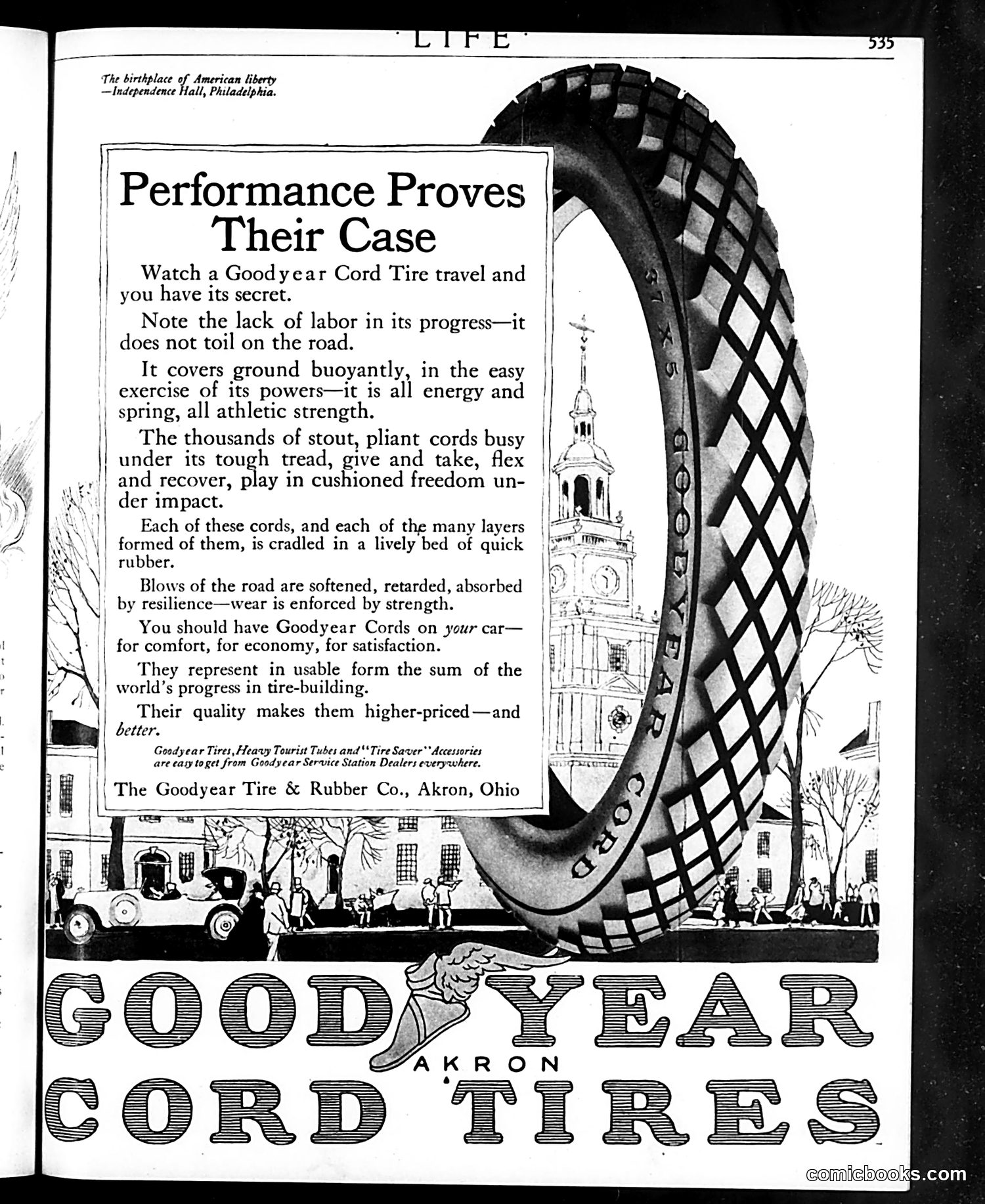
This is **not satire or political commentary**—it's a straightforward commercial advertisement for Goodyear tires, appearing in *Life* magazine around the 1920s. The imagery uses patriotic framing: Independence Hall in Philadelphia establishes American manufacturing pride. The enormous tire dominates the composition, dwarfing the classical building and tiny car/people below, visually emphasizing the tire's importance and durability. The ad's rhetorical strategy appeals to modernist values: efficiency, engineering progress, and athletic strength. Phrases like "all energy and spring" and "cushioned freedom under impact" anthropomorphize the tire, suggesting it performs effortlessly. The reference to "lack of labor in its progress" is **not** a labor critique but marketing copy claiming the tire requires minimal maintenance—it works without wearing out quickly. The patriotic setting and "progress in tire-building" language connect product quality to American industrial advancement, a common early 20th-century advertising tactic.
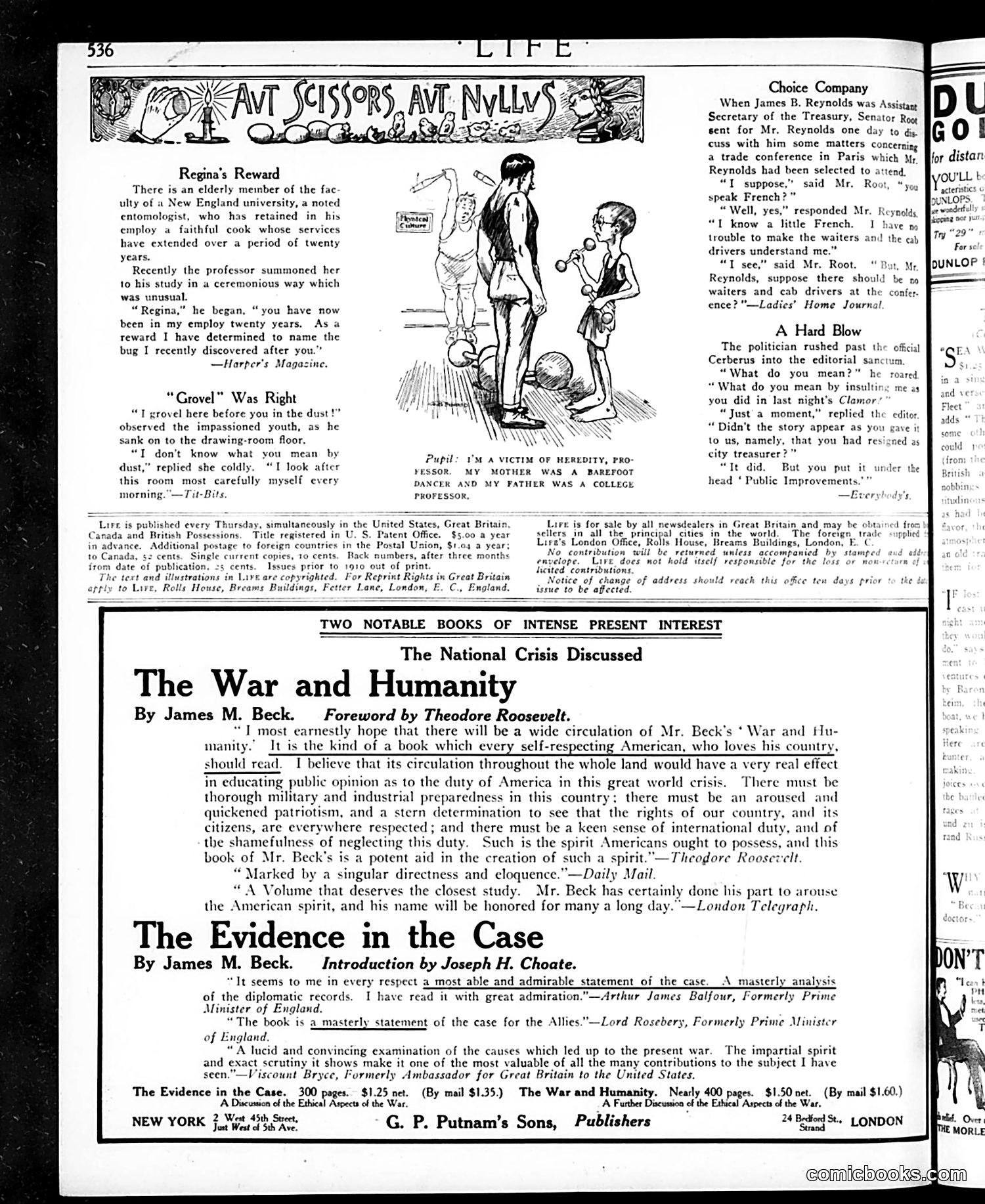
This *Life* magazine page contains three satirical anecdotes and advertisements. **"Regina's Reward"**: A professor honors his long-serving cook by naming a newly-discovered insect after her—a backhanded compliment implying the bug is as lowly as her station. **"Grovel Was Right"**: A young man dramatically declares his devotion by groveling before his beloved, who responds that she keeps her floor clean—mocking his romantic gesture as silly. **The cartoon**: A student claims hereditary excuse for poor performance: his mother was a barefoot dancer (morally suspect), his father a college professor—thus he's "a victim of heredity." The satire targets either class anxiety or pseudo-scientific heredity arguments fashionable in the era. The page primarily advertises two books on World War I by James M. Beck, endorsed by Theodore Roosevelt, urging American patriotic preparedness—reflecting pre-1917 U.S. debate about entering the war.
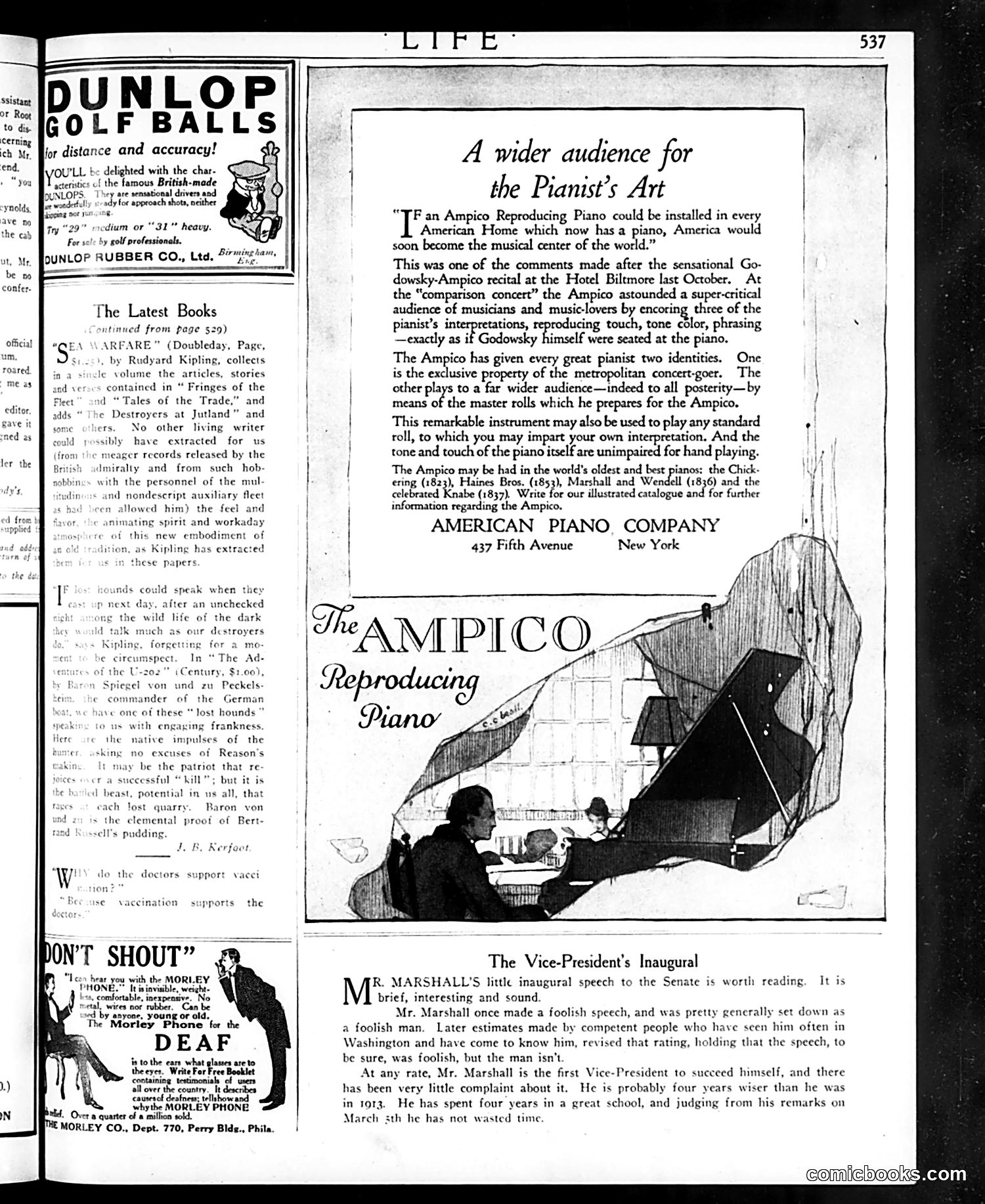
This page combines advertisements and cultural commentary from an early 20th-century American magazine. **Main Content:** The dominant feature is an advertisement for the Ampico Reproducing Piano, which claims to democratize classical music by mechanically reproducing famous pianists' performances. The ad references a recent "comparison concert" where the Ampico supposedly fooled music critics into believing the machine was reproducing pianist Godowsky's actual playing. The satirical point appears implicit: while the technology promises to bring elite concert hall experience to ordinary American homes, it fundamentally substitutes mechanical reproduction for live artistry. **Secondary Content:** A brief commentary praises Vice-President James Sherman Marshall's inaugural Senate speech, noting he was previously dismissed as foolish but has apparently matured in office. **Sidebar Advertisements:** Include Dunlop Golf Balls and a Morley Phone device for the deaf. The page exemplifies early 1900s anxieties about technology, authenticity, and cultural access.
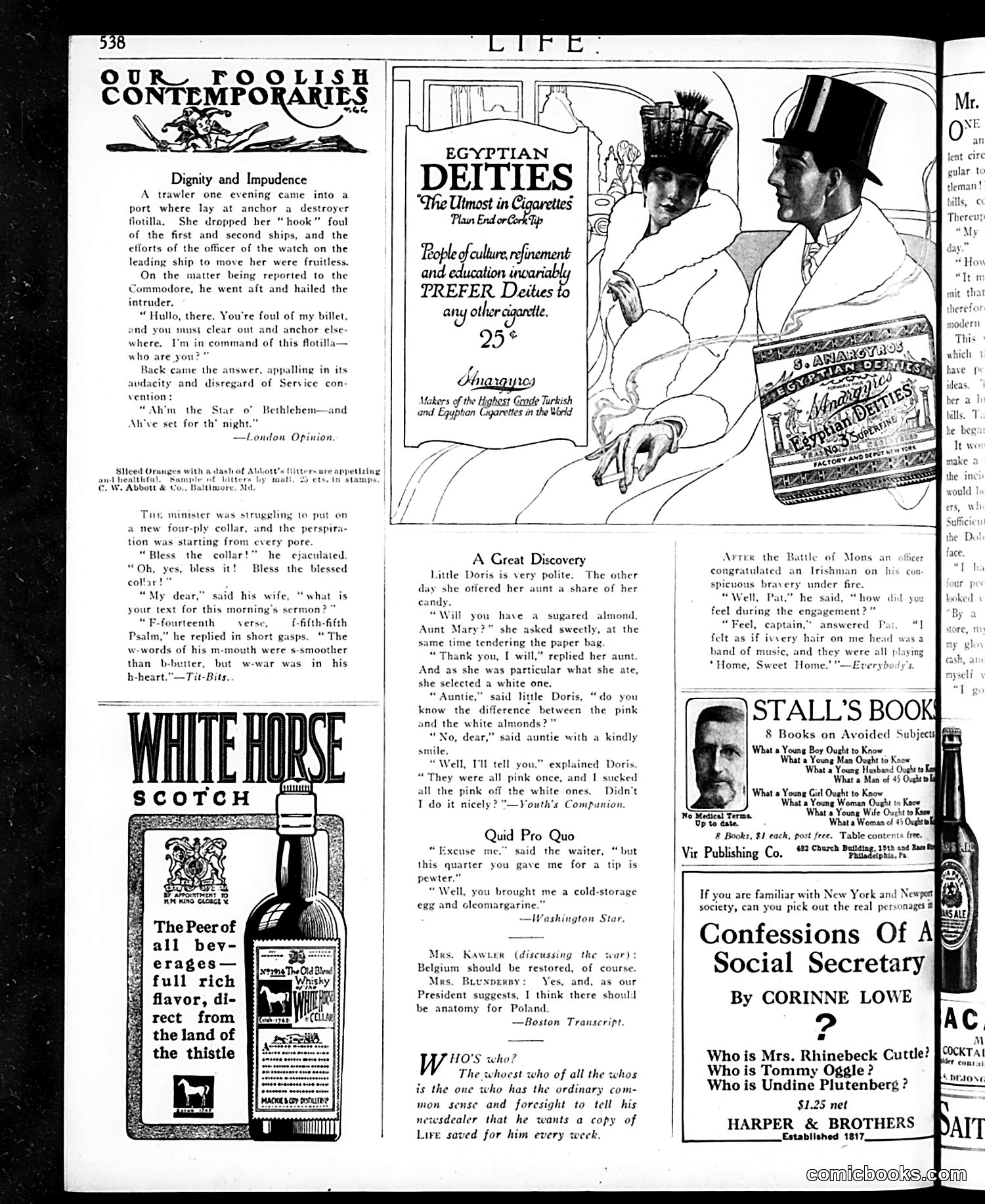
This page from *Life* magazine contains several satirical anecdotes under "Our Foolish Contemporaries," plus advertisements. **The cartoons/jokes:** 1. **"Dignity and Impudence"**: A naval anecdote mocking military hierarchy. A small trawler fouls a naval flotilla's anchor. When the Commodore demands it move, the trawler captain cheekily responds he's the "Star o' Bethlehem" and has "set for th' night"—a blasphemous pun on the Star of Bethlehem. The satire targets both military pomposity and irreverent working-class boldness. 2. **The collar joke**: A minister struggling with a stiff collar while quoting Psalm 55 ("words...smoother than butter, but war was in his heart")—ironic commentary on the gap between genteel appearance and harsh reality. 3. **"A Great Discovery"**: A child admits she's licked the pink coating off white candies before offering them to her aunt—satirizing childhood dishonesty and poor manners. The page is largely **advertisements** for cigarettes, whisky, and advice books on topics considered risqué or taboo.
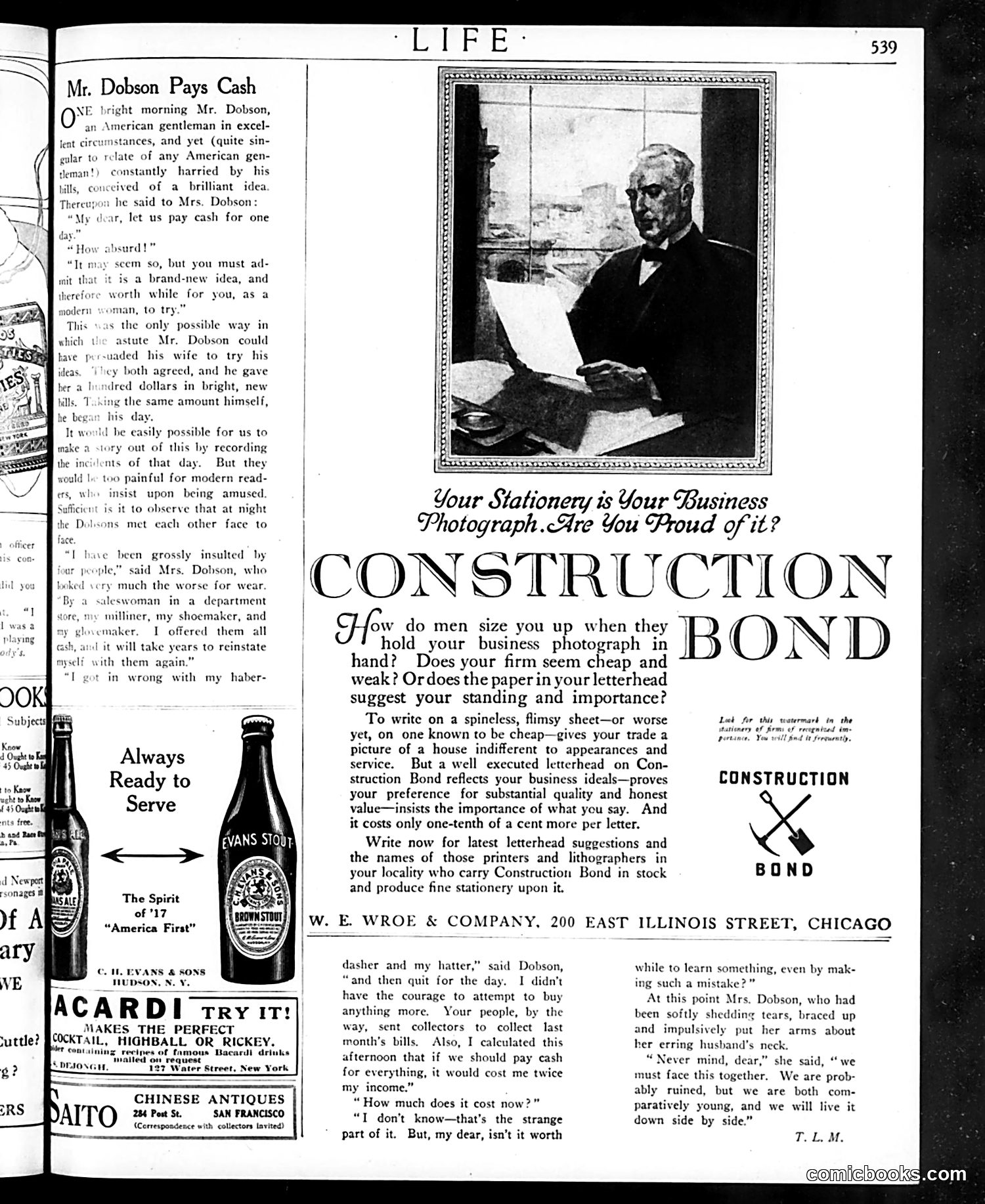
This story satirizes the early 20th-century American gentleman's perpetual debt problem. Mr. Dobson, an affluent but constantly bill-harassed man, proposes a radical experiment: spending one day paying cash for everything instead of buying on credit (the standard practice). The joke lies in the absurdity of treating *cash payment* as a "brand-new idea" worthy of surprise. The story reveals that Dobson doesn't even know his actual expenses—credit has so divorced him from the cost of living that paying cash for a single day nearly bankrupts him and requires his wife's tearful forgiveness. The satire targets the American upper-middle class's casual reliance on credit and their disconnection from actual monetary value. By treating basic fiscal responsibility as shocking and experimental, *Life* mocks the era's consumption-driven culture where debt was normalized among the respectable classes.
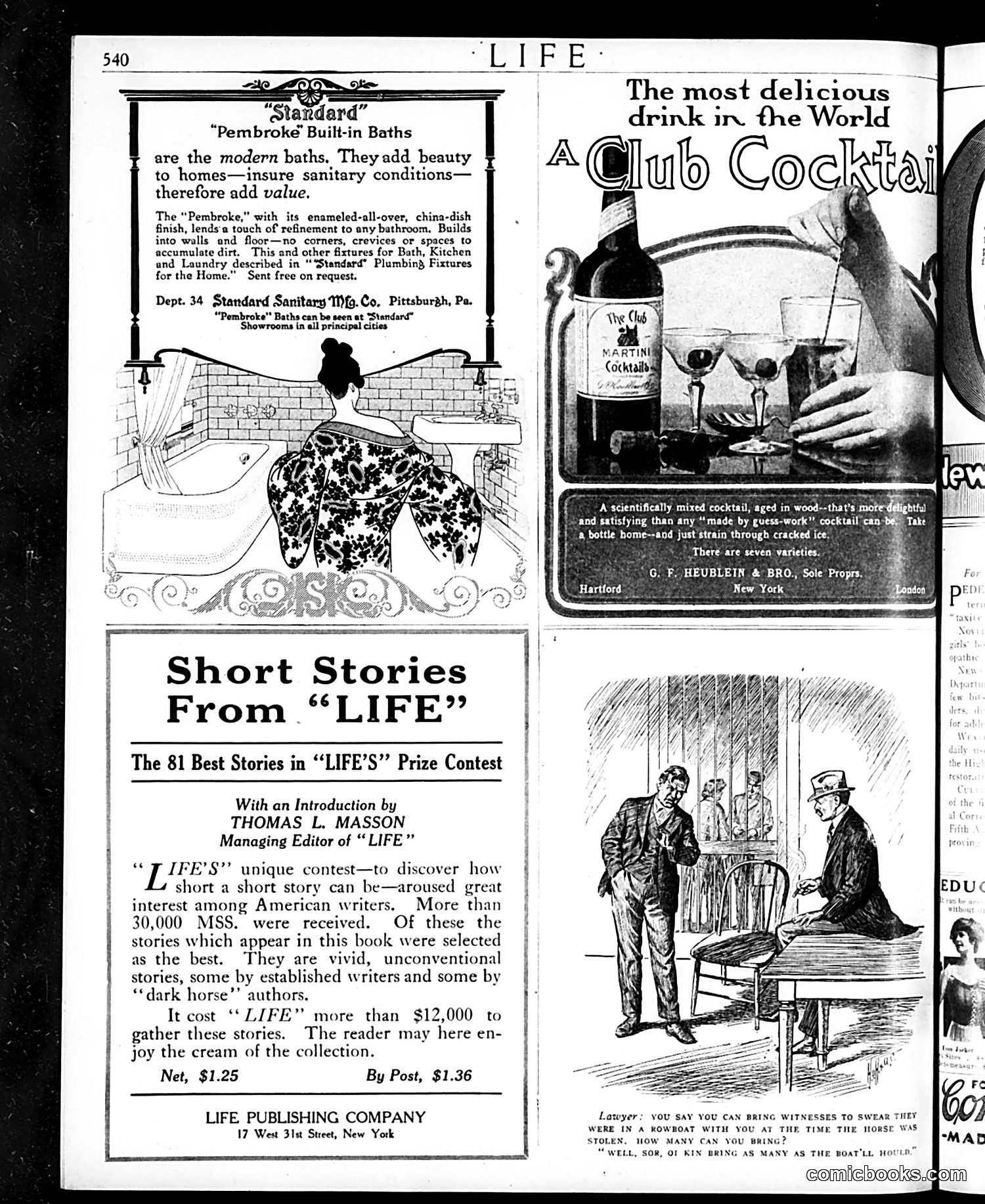
This page mixes advertisements with editorial content typical of early 20th-century Life magazine. The top half features ads for "Pembroke" built-in bathtubs (emphasizing modern sanitation and home value) and "Club Cocktail" martinis (marketed as scientifically formulated and aged in wood). The left side advertises a book collection: "Short Stories From 'LIFE'" — 81 prize-winning stories from a contest that received over 30,000 submissions. The introduction is by Thomas L. Masson, Life's Managing Editor. The magazine invested $12,000 gathering these stories, positioning the collection as premium editorial material. The bottom cartoon depicts a legal scene: a lawyer interrogates a witness about an alibi involving a rowboat. The witness replies he can bring "as many as the boat'll hold" — a joke about witness fabrication. The humor lies in the witness's willingness to produce false corroborating witnesses limited only by physical boat capacity, satirizing perjury and courtroom dishonesty.
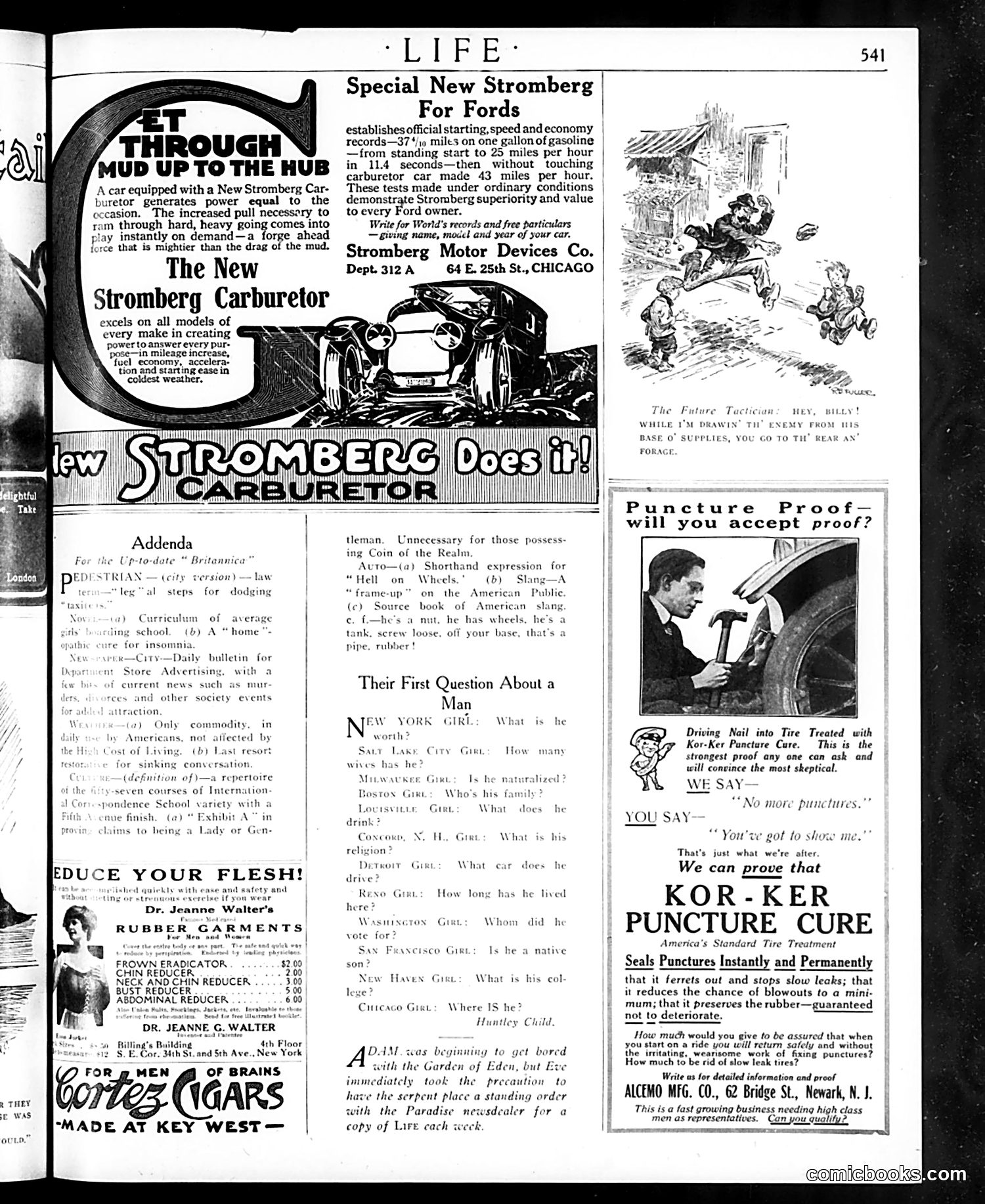
This page is primarily **advertising**, featuring auto-related products popular in the early 20th century. The main advertisements promote: 1. **Stromberg Carburetors** — performance upgrades for Ford automobiles, emphasizing fuel economy and power gains. The copy highlights official speed/mileage records to appeal to car owners. 2. **Kor-Ker Puncture Cure** — a tire sealant treatment. The ad uses a dramatic demonstration (driving a nail through a treated tire) as proof of effectiveness. This reflects the era's common problem with pneumatic tires. 3. **Rubber garments** for body shaping — women's undergarments marketed for "reducing" various body parts (chin, bust, abdomen), reflecting period beauty standards. The page also contains a satirical feature, **"Their First Question About a Man,"** comparing what women in different American cities prioritize when evaluating potential husbands — New York girls ask "What is he worth?" (wealth), while other regions ask about marital history, religion, or car ownership. This satirizes regional American attitudes and materialism.
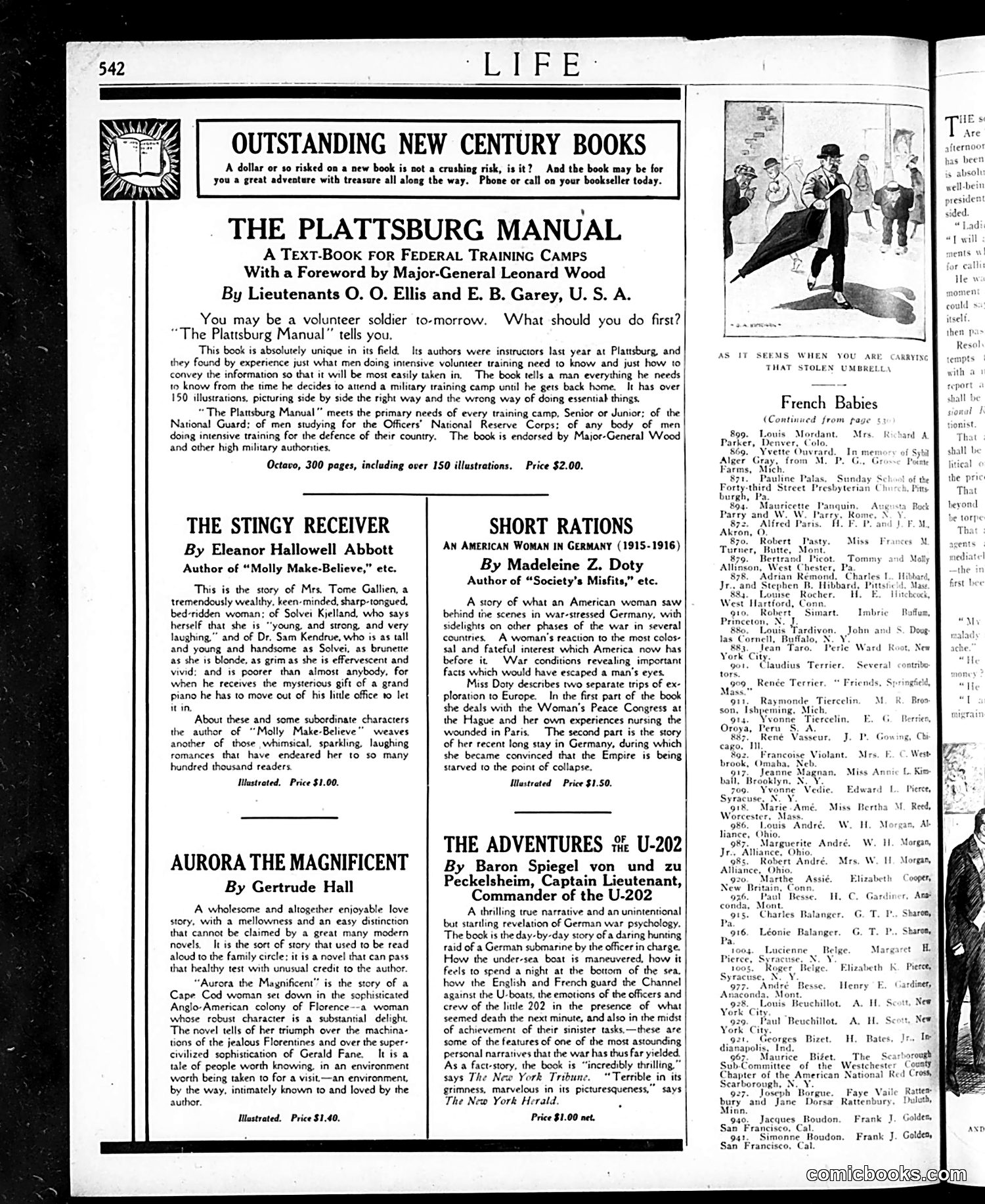
This page is primarily **book advertisements** from Century Publishers, not political cartoons. The small cartoon in the upper right ("As It Seems When You Are Carrying That Stolen Umbrella") is merely decorative filler, showing a man nervously carrying a large umbrella while others stare—a mild joke about social embarrassment. The substantive content advertises four books, notably **"The Plattsburg Manual"** and **"Short Rations: An American Woman in Germany (1915-1916)."** These reflect the historical moment: America was preparing for potential WWI entry. The Plattsburg Manual, endorsed by Major-General Leonard Wood, trained volunteer soldiers for military camps. Doty's book documents wartime Germany from a woman's perspective—timely given American interest in European war conditions. The other novels ("The Stingy Receiver," "Aurora the Magnificent") are conventional romance fiction. This page captures pre-1917 American publishing focused on military preparedness and war reporting alongside entertainment.
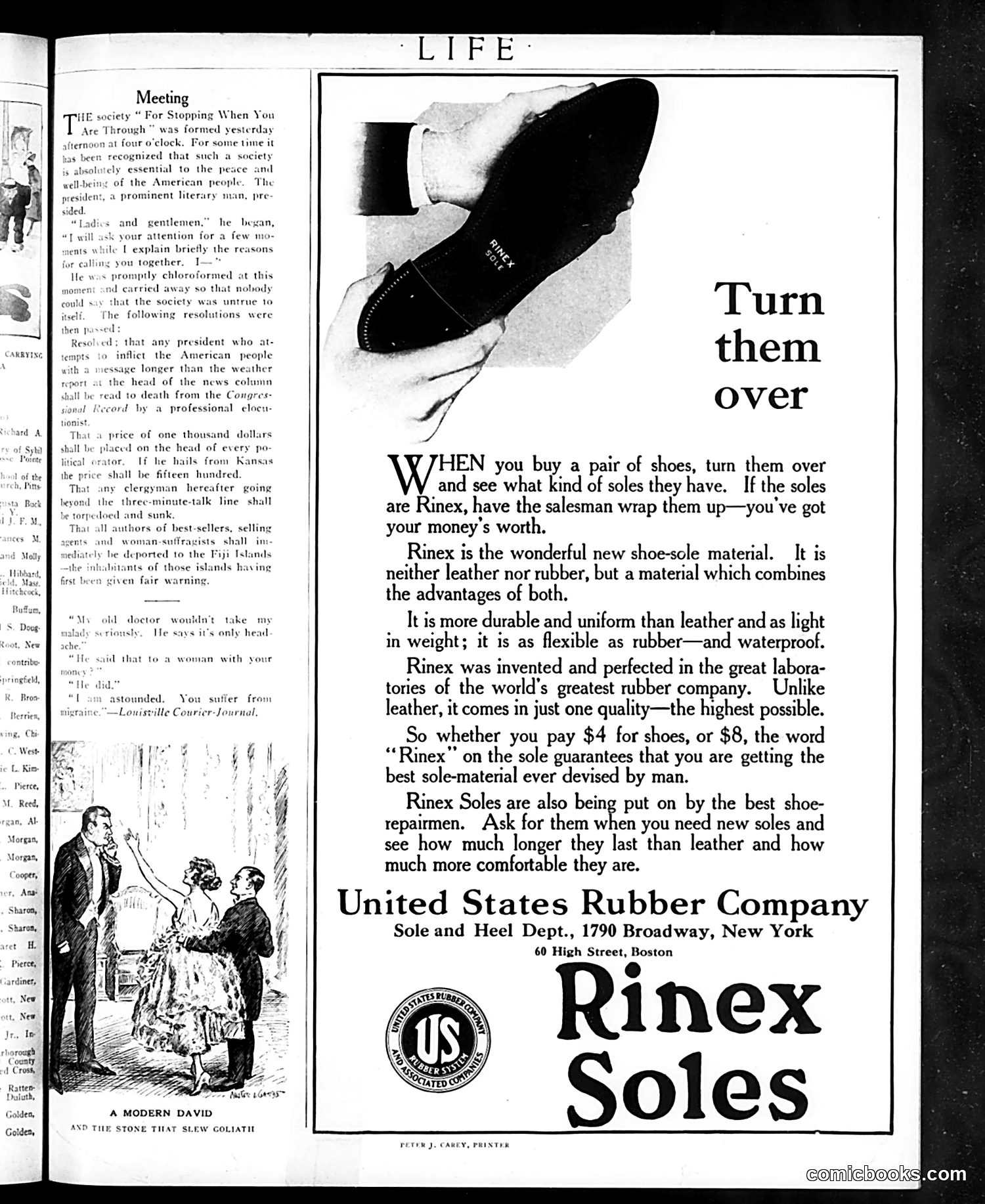
This page contains two distinct elements: **Left side - Satirical article "Meeting"**: A humorous piece about the formation of "For Stopping When You Are Through" society. The satire mocks verbose public speakers and long-winded orators by proposing absurd resolutions—including one that any president delivering weather-report-length messages should be read to death by a Congressional Record reader. The cartoon "A Modern David and the Stone That Slew Goliath" (below the text) appears to illustrate this theme of defeating an overwhelming force, likely commenting on how ordinary citizens or small interventions can combat tedious speechifying. **Right side - Rinex Soles advertisement**: A full-page ad for shoe soles made by United States Rubber Company. The company promotes Rinex as a synthetic material combining leather and rubber benefits. The advertisement is straightforward product marketing, not satire. The juxtaposition is typical of Life's format: satirical editorial content alongside commercial advertising. The two elements are unrelated in message.
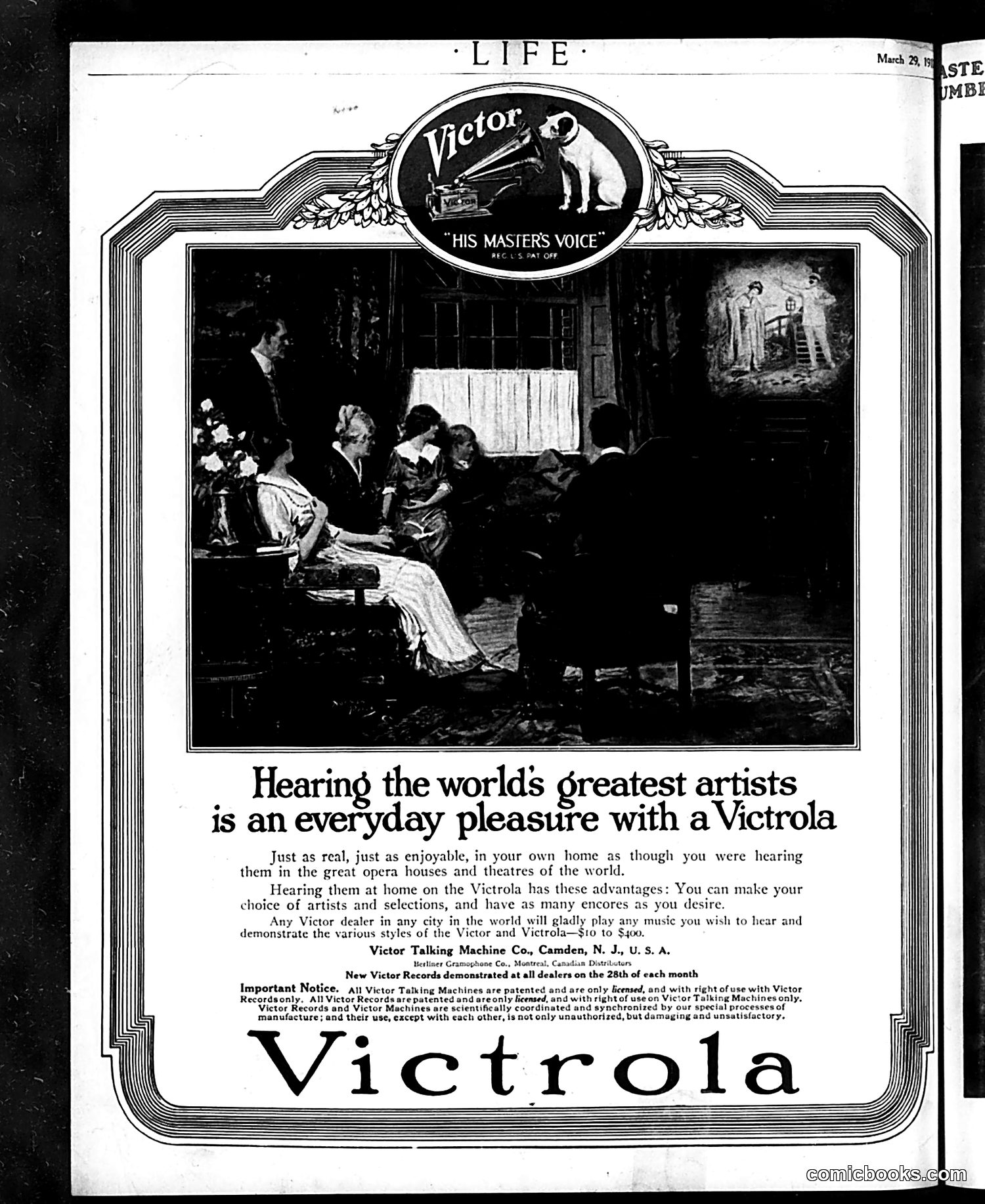
This is primarily a **product advertisement**, not political satire. It promotes the Victrola phonograph (Victor Talking Machine Co.'s brand) from the early 20th century. The image shows a parlor scene where well-dressed people gather around a Victrola to listen to recorded music. The ad's appeal is straightforward: owning a Victrola allows home listening to "the world's greatest artists" as if attending live opera houses and theaters—a luxury previously unavailable to ordinary households. The "His Master's Voice" logo (featuring a dog listening to a gramophone) was Victor's famous trademark, lending authority and warmth to the brand. The important notice at bottom reveals the actual point of interest: Victor's legal control over both machines and records, warning that using Victor records only on Victor machines maintained quality—this reflects early format wars in recorded music technology.