
Life, 1917-03-29 · page 14 of 42
Life — March 29, 1917 — page 14: what you’re looking at
What you’re looking at
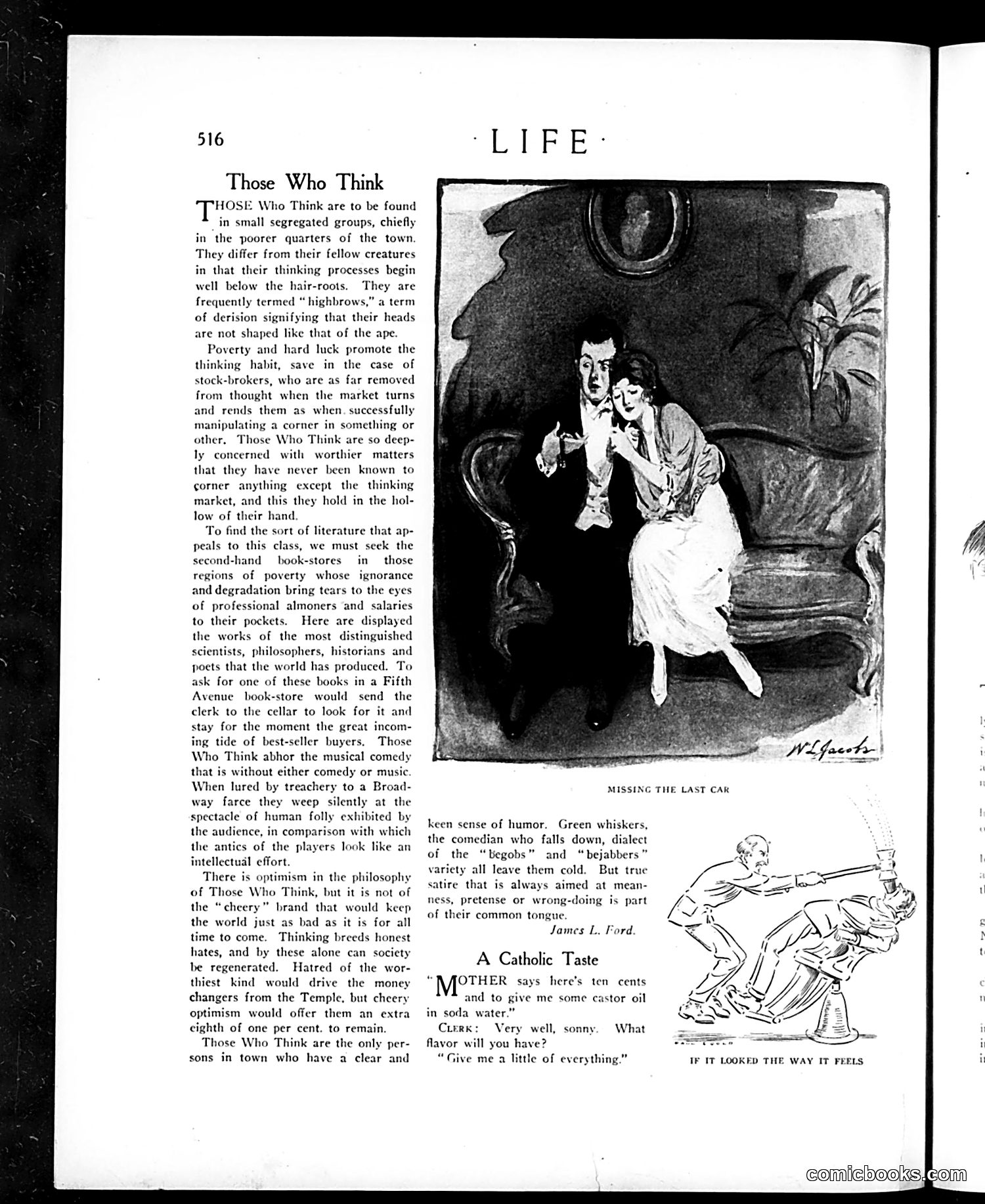
The main article satirizes intellectuals—people who think deeply—describing them as segregated in poor neighborhoods and characterized by high foreheads (a period stereotype suggesting intellectual capacity). The piece mocks how "Those Who Think" concern themselves with worthless matters while neglecting practical concerns, and suggests they inhabit second-hand bookstores in poverty-stricken areas. **Upper illustration ("Missing the Last Car"):** Shows a well-dressed couple apparently having missed their transportation, likely satirizing absent-mindedness among the intellectual class. **Lower illustration ("If It Looked the Way It Feels"):** Depicts someone stumbling or falling, captioned with a dialogue exchange about flavor preferences—a humorous non-sequitur typical of Life's comedic style. The overall message mocks intellectual pretension and impracticality.
📄 Transcribed text from this page (OCR, searchable)
Machine-transcribed from the original scan — historical spelling and the odd misread are preserved.
516 Those Who Think HOSE Who Think are to be found in small segregated groups, chiefly in the poorer quarters of the town. They differ from their fellow creatures in that their thinking processes begin well below the hair-roots. They are frequently termed “ highbrows,” a term of derision signifying that their heads are not shaped like that of the ape. Poverty and hard luck promote the thinking habit, save in the case of stock-brokers, who are as far removed from thought when the market turns and rends them as when. successfully manipulating a corner in something or other, Those Who Think are so deep- ly concerned with worthier matters that they have never been known to corner anything except the thinking market, and this they hold in the hol- low of their hand. To find the sort of literature that ap- peals to this cla we must seek the second-hand book-stores in those regions of poverty whose ignorance and degradation bring to the eyes of professional almoners and salaries to their pockets. Here are displayed the works of the most distinguished scientists, philosophers, historians and poets that the world has produced. To ask for one of these books in a Fifth Avenue book-store would send the clerk to the cellar to look for it and stay for the moment the great incom- ing tide of best-seller buyers, Those Who Think abhor the musical comedy that is without either comedy or music. When lured by treachery to a Broad- way farce they weep silently at the spectacle of human folly exhibited by the audience, in comparison with which the antics of the players look like an intellectual effort. There is optimism in the philosophy of Those Who Think, but it is not of the “cheery” brand that would keep the world just as bad as it is for all time to come. Thinking breeds honest hates, and by these alone can society be regenerated. Hatred of the wor- thiest kind would drive the money changers from the Temple, but cheery optimism would offer them an extra eighth of one per cent. to remain. Those Who Think are the only per- sons in town who have a clear and MISSING keen sense of humor. Green whiskers, the comedian who falls down, dialect of the “begobs” and “bejabbers” variety all leave them cold. But true satire that is always aimed at mean- ness, pretense or wrong-doing is part of their common tongue. James L. Ford. A Catholic Taste OTHER says here's and to give me some castor oil in soda water.” Crerk: Very well, flavor will you have? “Give me a little of everything.” ten cents sonny. What THE LAST CAR IF IT LOOKED THE WAY IT FEELS