
Life, 1917-03-29 · page 21 of 42
Life — March 29, 1917 — page 21: what you’re looking at
What you’re looking at
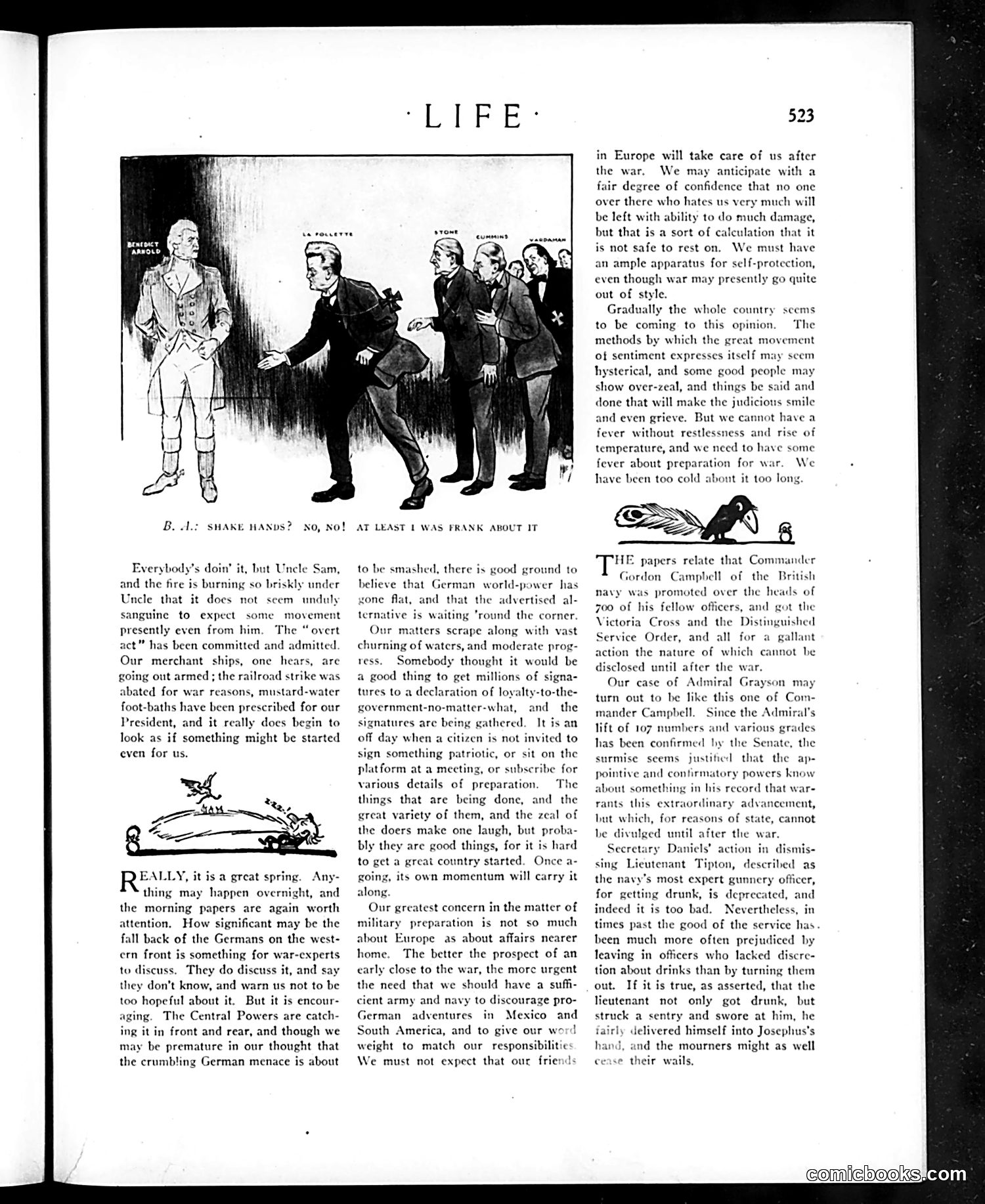
This page, likely from 1917-1918, satirizes American reluctance to enter World War I. **The main cartoon** depicts a figure labeled "BRITISH OFFICER" (on left) confronting others, with the caption "SHAKE HANDS? NO, NO! AT LEAST I WAS FRANK ABOUT IT." This mocks the U.S. for hesitating while Britain openly prosecuted the war—America's "frankness" apparently meaning delayed action. **The text's argument**: The author urges America to stop dragging its feet. While Germans face military collapse in Europe, the U.S. must urgently build military strength to prevent "pro-German adventures in Mexico and South America" and assert post-war authority. **The satire targets**: American complacency and excessive patriotic theater (mandatory loyalty declarations, endless fundraising campaigns) while actual war preparation lags. The author criticizes both extremes—those too cold toward war preparation and those now hysterically overselling patriotic gestures. **Context**: This reflects the pre-U.S. entry period when Germany's unrestricted submarine warfare and the Zimmermann Telegram pushed American opinion toward intervention, which occurred April 1917.
📄 Transcribed text from this page (OCR, searchable)
Machine-transcribed from the original scan — historical spelling and the odd misread are preserved.
No, No! Everybody’s doin’ it, but Uncle Sam, and the fire is burning so briskly under Uncle that it does not seem unduly sanguine to expect some movement presently even from him, The “ overt act” has been committed and admitted Our merchant ships, one going out armed ; the railroad strike was abated for war reasons, mustard-water foot-baths have been prescribed for our President, and it really docs begin to look as if something might be started even for us, EALLY, it is a great spring. Any- thing may happen overnight, and the morning papers are again worth attention, How significant may be the fall back of the Germans on the west- ern front is something for war-experts to discuss. They do discuss it, and say they don’t know, and warn us not to be too hopeful about it. But it is encour- aging. The Central Powers are catch- ing it in front and rear, and though we may be premature in our thought that the crumbling German menace is about AT LEAST 1 WAS FRANK ABOUT IT to be smashed, there is good ground to believe that German world-power has gone flat, and that the advertised al- ternative is waiting ‘round the corner. Our matters scrape along with vast churning of waters, and moderate prog- ress. Somebody thought it would be a good thing to get millions of signa- tures to a declaration of loyalty-to-the- government-no-matter-what, and the signatures are being gathered. It is an off day when a citizen is not invited to sign something patriotic, or sit on the platform at a mecting, or subscribe for various details of preparation. The things that are being done, and the great variety of them, and the zeal of the doers make one laugh, but proba- bly they are good things, for it is hard to get a great country started. Once a- going, its own momentum will carry it along. Our greatest concern in the matter of military preparation is not so much about Europe as about affairs nearer home. The better the prospect of an early close to the war, the more urgent the need that we should have a suffi- cient army and navy to discourage pro- German adventures in Mexico and South America, and to give our word weight to match our responsibilities We must not expect that our friends 523 in Europe will take care of us after the war. We may anticipate with a fair degree of confidence that no one over there who hates us very much will be left with ability to do much damage, but that is a sort of calculation that it is not safe to rest on. We must have an ample apparatus for self-protection, even though war may presently go quite out of style. Gradually the whole country seems to be coming to this opinion. The methods by which the great movement of sentiment expresses itself may seem hysterical, and some good people may show over-zeal, and things be said and done that will make the judicious smile and even grieve. But we cannot have a fever without restlessness and rise of temperature, and we need to have some fever about preparation for war. We have been too cold about it too long. HE papers relate that Commander Gordon Campbell of the British navy was promoted over the heads of 700 of his fellow officers, and got the Victoria Cross and the Distinguished ervice Order, and all for a gallant ction the nature of which cannot be disclosed until after the war. Our case of Admiral Grayson may turn out to be like this one of Com- mander Campbell. Since the Admiral’s lift of 107 numbers and various grades has been confirmed by the Senate, the surmise scems justified that the ap- pointive and confirmatory powers know about something in his record that war- rants this extraordinary advancement, but which, for reasons of state, cannot be divulged until after the war. Secretary Daniels’ action in dismis- sing Lieutenant Tipton, described as the navy’s most expert gunnery officer, for getting drunk, is deprecated, and indeed it is too bad. Nevertheless, in times past the good of the service has. been much more often prejudiced by leaving in officers who lacked discre- tion about drinks than by turning them out. If it is true, as asserted, that the lieutenant not only got drunk, but struck a sentry and swore at him, he fairly vered himself into Josephus’s han’ id the mourners might as well cease their wails, comichooks, com