
Life, 1917-03-29 · page 25 of 42
Life — March 29, 1917 — page 25: what you’re looking at
What you’re looking at
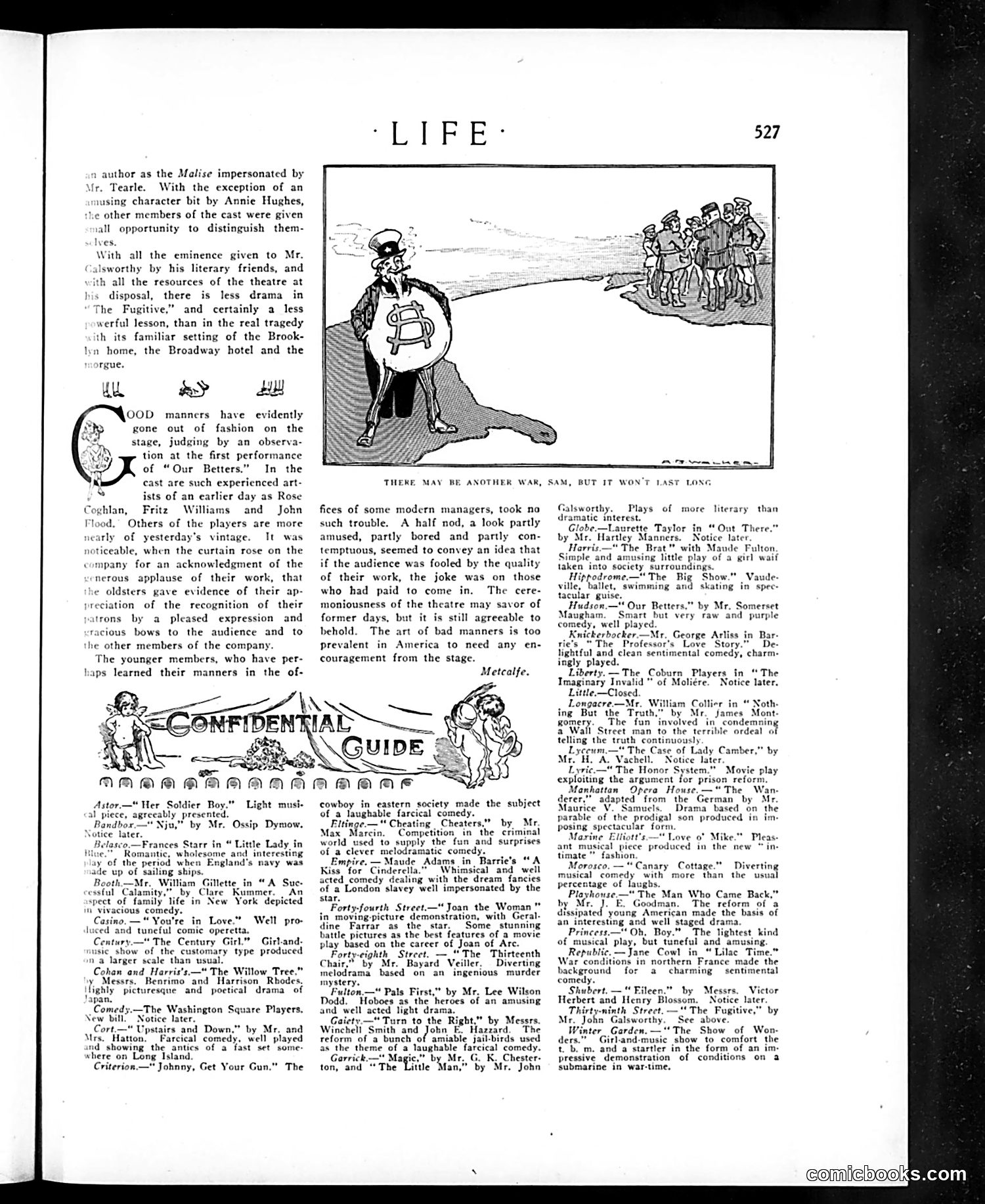
This page from *Life* magazine critiques theatrical manners and performance standards circa 1915-1920. The main cartoon depicts a man (labeled "Sam," likely representing a soldier or everyman) standing before a group of people, illustrating the caption "There May Be Another War, Sam, But It Won't Last Long"—a wartime or post-war commentary on conflict's impermanence. The text below discusses how older Broadway actors (Rose Coghlan, Fritz Williams, John Hood) demonstrated gracious acknowledgment of applause at "Our Betters," contrasting their courteous stage manners with younger performers who appeared indifferent or contemptuous toward audiences. The author argues that cultivating good theatrical manners remains important, as bad manners are already "too prevalent in America." The page is primarily a theater review column, not primarily satirical of current events, though the cartoon suggests wartime anxieties.
📄 Transcribed text from this page (OCR, searchable)
Machine-transcribed from the original scan — historical spelling and the odd misread are preserved.
author as the Malise impersonated by \ir. Tearle. With the exception of an using character bit by Annie Hughes, she other members of the cast were given ull opportunity to distinguish them- With all the eminence given to Mr. alsworthy by his literary friends, and h all the resources of the theatre at s disposal, there is less drama in The Fugitive,” and certainly a less werful lesson, than in the real tragedy th its familiar setting of the Brook- vn home, the Broadway hotel and the ES qe oD have evidently gone out of fashion on the stage, judging by an observa- tion at the first performance of “Our Betters.” In the cast are such experienced art- ists of an earlier day as Rose Coghlan, Fritz Williams and John ood. Others of the players are more nearly of yesterday's vintage. It noticeable, when the curtain rose on the company for an acknowledgment of the nerous applause of their work, that © oldsters gave evidence of their ap- of the recognition of their pleased expression and racious bows to the audience and to he other members of the company. The younger members, who have per- haps learned their manners in the of- manners was, preciation urons by a ARS ANMDARAAANDAAAAAE “Her Soldier Boy.” al piece, agreeably presented. Astor. Light musi- Bandbor.—" Nj Notice later. lasvo.—Frances Starr in “ Little Lady in ¢.” Romantic, wholesome and interesting ay of the period when England's navy was ade up of sailing ships. Booth—Mr. William Gillette in “A Suc- cessful Calamity,” by Clare Kummer. | An spect of family’ life in New York depicted vivacious comedy. Casino. —“ You're in Love.” Well pro- juced and tuneful comic operetta. Century.—" The Century Girl.” Girl-and- usic, show of the customary type produced na larger scale than usual, Cohan and Harris's.—" The Willow Tree.” y Messrs, Benrimo and Harrison Rhodes. fighly picturesque and poetical drama of Japan, Come! New bill, "by Mr. Ossip Dymow. ‘The Washington Square Players. otice later. Cort.—* Upstairs and Down.” by Mr, and Mrs. Hatton, Farcical comedy, well played nd showing the antics of a fast set some: where on Long Island. Criterion.—" Johnny, Get Your Gun." The THERE MAY BE fices of some modern managers, took no such trouble. A half nod, a look partly amused, partly bored and partly con- temptuous, seemed to convey an idea that if the audience was fooled by the quality of their work, the joke was on those who had paid to come in, The cere- moniousness of the theatre may savor of former days, but it is still agreeable to behold. The art of bad manners is too prevalent in America to need any en- couragement from the stage. Metcalfe. cowboy in eastern society made the subject of a laughable farcical comedy. Fltinge—"' Cheating Cheaters,” by Mr. Max Marcin. Competition in the criminal world used to supply the fun and surprises of a clever melodramatic comedy. Empire. — Maude Adams in, Barrie's “A Kiss for Cinderella.” Whimsical and well acted comedy dealing with the dream fancies of a London slavey well impersonated by the star. Forty-fourth Street,—" Joan the Woman" in moving-picture demonsiration, with Geral- dine Farrar asthe star, Some stunning battle pictures as the best features of a movie play based on the career of Joan of Arc. Forty-eighth Strect. — ‘The Thirteenth Chair,” by Mr. Bayard Veiller. Diverting melodrama based on an ingenious murder mystery. Fulton —“ Pals First,” by Mr, Lee Wilson Dodd. Hoboes as the ‘heroes of an amusing and well acted light dram: Gaiety —" Turn to the Right.” by Messrs. Winchell Smith and John E. Hazzard. The reform of a bunch of amiabie jail-birds used as the theme of a laughable farcical comedy. Garrick." Magic,” by Mr, G. K, Chester- ton, and “The Little Man,” by Mr. John ANOTHER WAR, SAM, BUT IT WON'T LAST LONG Galsworthy. Plays of more than dramatic interest. Globe.—Laurette Taylor in “Out There.” by Mr. Hartley Manners. Notice later. Horris—" The Brat" with Maude Fulton Simple and amusing little play of a girl waif taken into society surroundings. Hippodrome.—' The Big Show." Vaude- ville, ballet, swimming and skating in spec- tacular guise. Hudson.—"' Our Betters.” by Mr. Somerset Maugham. Smart but very raw and purp comedy, well played. Knickerbocker.—Mr., George Arliss in Bar- rie’s “The Professor's Love Story.” De- lightful and clean sentimental comedy, charm: ingly played. Liberty. —The Coburn Players in‘ The Imaginary Invalid ” of Moliére. Notice later. Little. —Closed. Longacre—Mr. William Collier in “ Noth. ing But the Trath,” by Mr. james Mont- gomery. The fun ‘involved in’ condemnini a Wall Street man to the terrible ordeal of telling the truth continuously Lyceum.—" The Case of Lady Camber,” by Mr. H. A. Vachell. Notice later Lyric.—" The Honor System.” Movie play exploiting the argument for prison reform. Manhattan Opera House. —"“The Wan- Gerer,” adapted from the German by Mr. Maurice V. Samuels. Drama based on the parable of the prodigal son produced in im- posing spectacular for: Marine Eliiott’s ant musical piece timate " fashion. Morosco.— "Canary Cottage." Diverting musical comedy with more than the usual percentage of laughs. Playhouse.—" The Man Who Came Back,” by Mr, E. Goodman. The reform of ‘a dissipated young American made the basis of an interesting and well staged drama. Princess.—" Oh, Boy.” The lightest kind of musical play, but tuneful and amusing. Republic. —Jane Cowl in_“ Lilac Time.” War conditions in northern France made the background for a comedy. Shubert, —"" Eileen.” by Messrs. Victor Herbert and Henry Blossom. Notice later. Thirty-ninth Strect.—‘ The Fugitive,” by Mr. John Galsworthy, See above. Winter Garden.—“The Show of Won- ders.” Girl-and-music show to comfort the tb. m, and a startler in the form of an im- pressive demonstration of conditions on a submarine in war-time, literary .ove 0” Mike." Pleas: ‘oduced in the new “in charming sentimental comichoo! Ks.com