
Life, 1917-03-29 · page 24 of 42
Life — March 29, 1917 — page 24: what you’re looking at
What you’re looking at
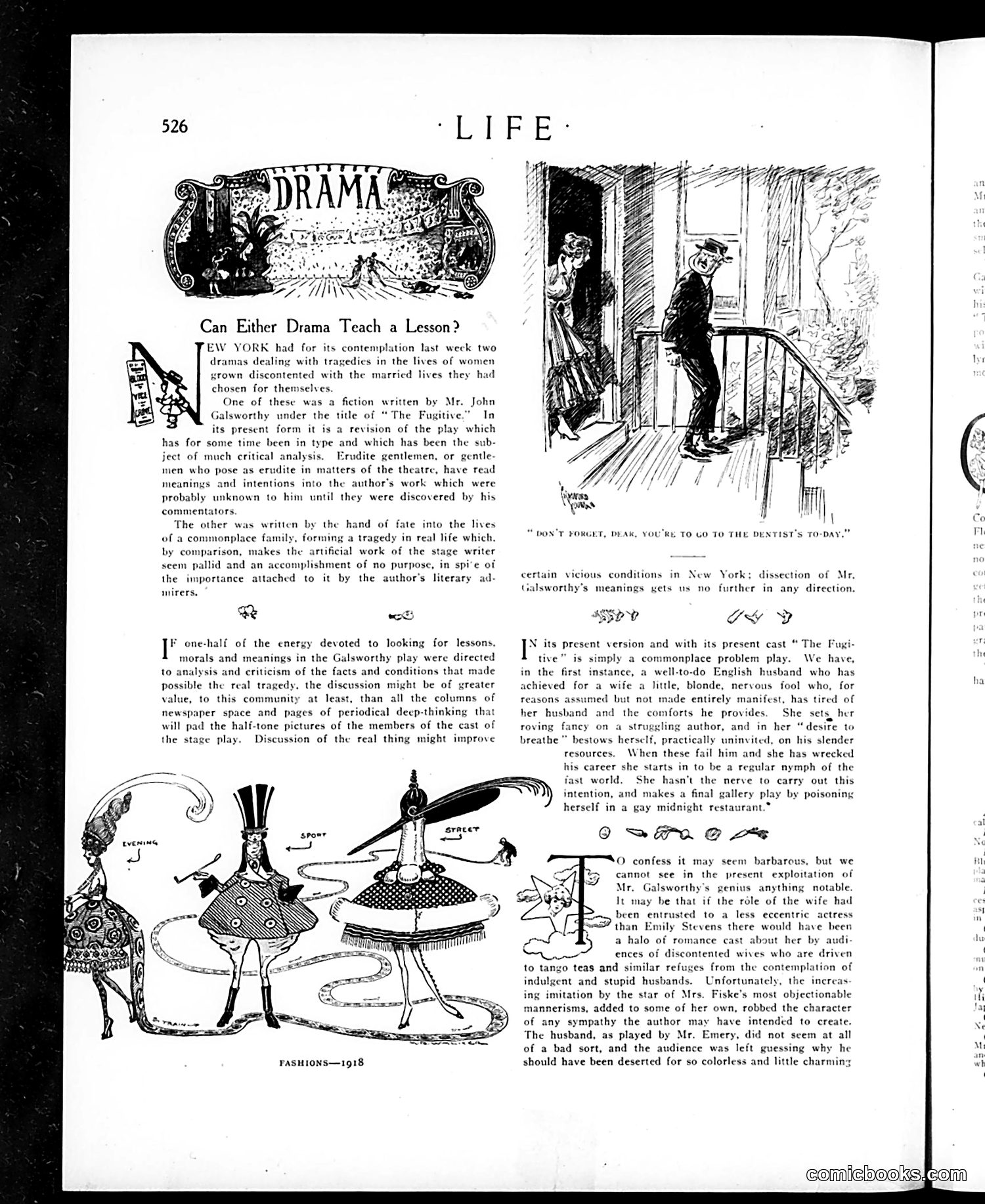
This page reviews John Galsworthy's play *"The Fugitive,"* comparing its artificial theatrical tragedy to real-life suffering in New York. The article criticizes both the play and its production. **The Play's Plot:** A wealthy English husband's blonde, nervous wife abandons him for a struggling author. When that affair fails financially, she becomes a "nymph of the fast world" before poisoning herself in a restaurant. **The Satire's Point:** The author argues that obsessing over the *meanings* critics project onto Galsworthy's work wastes energy better spent addressing actual "vicious conditions" causing real tragedies in New York—implying the play is pretentious melodrama disconnected from genuine social problems. **The Cast Criticism:** Actress Emily Stevens's "eccentric" performance and affected mannerisms undermine the character's intended sympathy. Actor Mr. Emery's portrayal of the husband makes him seem too decent, leaving audiences confused why he'd be abandoned. The illustrated fashion figures at bottom appear unrelated—standard magazine decoration.
📄 Transcribed text from this page (OCR, searchable)
Machine-transcribed from the original scan — historical spelling and the odd misread are preserved.
EW YORK had for its contemplation last week two dramas dealing with tragedies in the lives of women xrown discontented with the married lives they had chosen for themselves. One of these was a fiction written by Mr. John Galsworthy under the title of “The Fugitive.” In its present form it is a revision of the play which has for some time been in type and which has been the sub- ject of much critical analysis. Erudite gentlemen, or gentle- men who pose as erudite in matters of the theatre, have read meanings and intentions into the author's work which were probably unknown to him until they were discovered by his commentators The other was written by the hand of fate into the lives of a commonplace family, tragedy in real life which, . makes the artificial work of the stage writer seem and an accomplishment of no purpose, in spi'e of the importance attached to it by the author's literary ad- mirers. Se —S one-half of the energy devoted to looking for lessons. morals and meanings in the Galsworthy play were directed to analysis and criticism of the facts and conditions that made possible the real tragedy, the discussion might be of greater value, to this community at least, than all the columns of newspaper space and pages of periodical deep-thinking that will pad the half-tone pictures of the members of the cast of the stage play. Discussion of the real thing might improve sracet PASMIONS—1918 WON'T FORGET, DEAK, YOU'RE TO GO TO THE DENTIST'S TO-DAY.” certain vicious conditions in New York; dissection of Mr, Galsworthy’s meanings gets us no further in any direction. ad oe D N its present version and with its present cast “The F tive” is simply a commonplace problem play. We hav in the first instance, a well-to-do English husband who has achieved for a wife a little, blonde, nervous fool who, for reasons assumed but not made entirely manifest, has tired of her husband and the comforts he provides. She sets, her roving fancy on a struggling author, and in her “desite to breathe” bestows herself, practically uninvited, on his slender resources. When these fail him and she has wrecked his career she starts in to be a regular nymph of the iast world. She hasn't the nerve to carry out this intention, and makes a final gallery play by poisoning herself in a gay midnight restaurant.” OD FOO Zs O confess it may seem barbaro but we cannot see in the present exploitation of Mr, Galsworthy’s genius anything notable. It may be that if the role of the wife had been entrusted to a less eccentric actress “than Emily Stevens there would have been a halo of romance cast about her by audi ences of discontented wives who are driven ‘© teas and similar refuges from the contemplation of indulgent and stupid husbands. Unfortunately, the increas ing imitation by the star of Mrs. Fiske’s most objectionable mannerisms, added to some of h . robbed the character of any sympathy the author may have intended to create. The husband, as played by Mr. nery, did not seem at all of a bad sort, and the audience was left guessing why he should have been deserted for so colorless and little charming Fl