
Life, 1917-03-29 · page 27 of 42
Life — March 29, 1917 — page 27: what you’re looking at
What you’re looking at
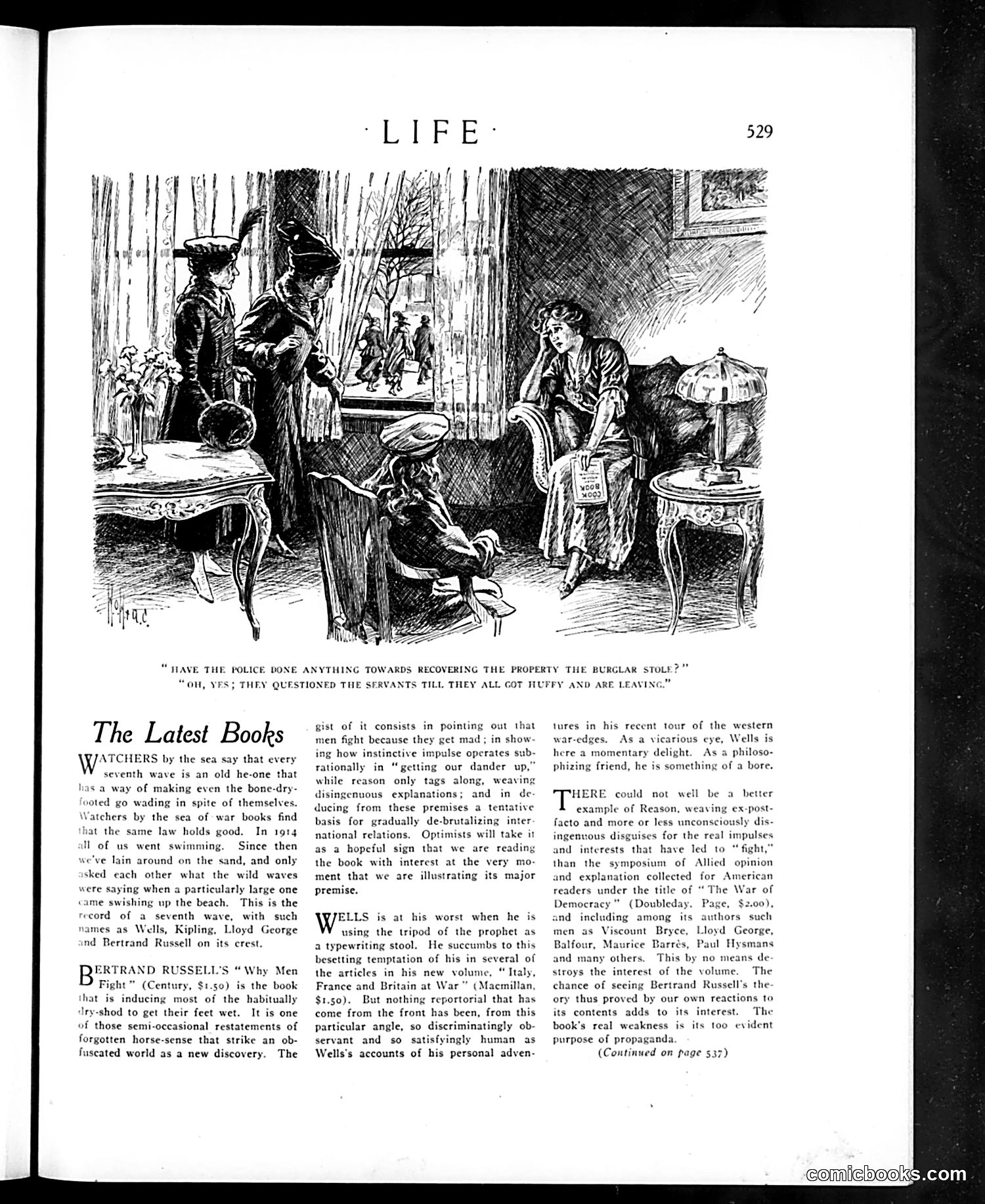
This page from *Life* magazine reviews wartime books, using a metaphor about ocean waves to suggest that interest in war literature comes in cycles—like the "seventh wave" sailors watch for. The **cartoon** depicts a domestic scene where police question servants about a burglary. The irony is stated in the caption: despite thorough investigation, the servants become irritated and leave. This illustrates the page's larger point about Bertrand Russell's book "Why Men Fight"—that people act on emotion (anger, defensiveness) rather than reason, even when logic should prevail. The **book reviews** discuss Russell, H.G. Wells, and a collection called "The War of Democracy" featuring Allied leaders like Lloyd George and Balfour. The critic praises Russell's argument that war stems from irrational passion disguised by rational-sounding explanations. The reviews suggest these wartime justifications are post-hoc rationalizations—people fighting emotionally, then constructing propaganda to explain themselves, which is precisely what Russell warned against.
📄 Transcribed text from this page (OCR, searchable)
Machine-transcribed from the original scan — historical spelling and the odd misread are preserved.
aS “HAVE THE POLICE DOD “ou, YES The Latest Books ATCHERS by the sea say that every seventh wave is an old he-one that sa way of making even the bone-dry- ooted go wading in spite of themselves. Watchers by the sea of war books find nat the same law holds good. In 1914 Ml of us went swimming. Since then we've lain around on the sand, and only sked each other what the wild waves were saying when a particularly large one came swishing up the beach. This is the record of a seventh wave, with such names as Wells, Kipling, Lloyd George nd Bertrand Russell on its crest. “Why Men B™ TRAND RUSSEL ht” (Century, $1.50) is the book that is inducing most of the habitually shod to get their feet wet. It is one of those semi-occasional restatements of forgotten horse-sense that strike an ob- fuscated world as a new discovery. The ANYTHING TOWARDS gist of it consists in pointing out that men fight because they get mad; in show ing how instinctive impulse operates sub- rationally in “getting our dander up,” while reason only tags along, weaving disingenuous explanations; and in de- ducing from these premises a tent basis for gradually de-brutalizing inter national relations. Optimists will take it as a hopeful sign that we are reading the book with interest at the very mo- ment that we are illustrating its major premise. tive ELLS using the tripod of the prophet as a typewriting stool. He succumbs to this besetting temptation of his in several of the articles in his new volume, “Italy, France and Britain at War” (Macmillan $1.50). But nothing reportorial that has come from the front has been, from this particular angle, so discriminatingly ob- servant and so satisfyingly human as Wells's accounts of his personal adven- is at his worst when he is RECOVERING THE PROPERTY THEY QUESTIONED THE SERVANTS TILL THEY ALL GOT HUFFY AND ARE LEAVING.” THE BURGLAR STOLE?” tures in his recent tour of the western war-edges. As a vicarious eye, Wells is here a momentary delight. As a philoso- phizing friend, he is something of a bore. Tere could not well be a better example of Reason, weaving ex-post- facto and more or less unconsciously dis- ingentous disguises for the real impulses and interests that have led to “fight,” than the symposium of Allied opinion and explanation collected for American readers under the title of “The War of Democracy” (Doubleday. P. and including among its authors such men as Viscount Bryce, Lloyd George, Balfour, Maurice Barrés, Paul Hysmans and many others. This by no means de stroys the interest of the volume. The chance of seeing Bertrand Russell's the ory thus proved by our own reactions to its contents adds to its interest. The book's real weakness is its too evident purpose of propaganda (Continued on page 537) $2.00),