
Life, 1917-03-29 · page 30 of 42
Life — March 29, 1917 — page 30: what you’re looking at
What you’re looking at
This page satirizes William Jennings Bryan (three-time presidential candidate) and Billy Sunday (famous evangelist), both popular speakers who charged substantial fees for their appearances. The cartoon dialogue between Briggs and Griggs mocks the hypocrisy of these public figures: they present themselves as disinterested servants of the public good, yet accept lucrative payments. Bryan promoted "free silver, grape juice and peace" as cure-alls; Sunday drew crowds by dramatizing hellfire and damnation—both profiting from selling hope and entertainment while claiming moral authority. The humor lies in the characters' admission that they themselves pay to hear these speakers despite recognizing the con. The accompanying poem by Arthur Guiterman ridicules literary fashion favoring foreign authors over Americans. The "Query" section appears unrelated—commenting on Princeton college men who claim never to have kissed girls.
📄 Transcribed text from this page (OCR, searchable)
Machine-transcribed from the original scan — historical spelling and the odd misread are preserved.
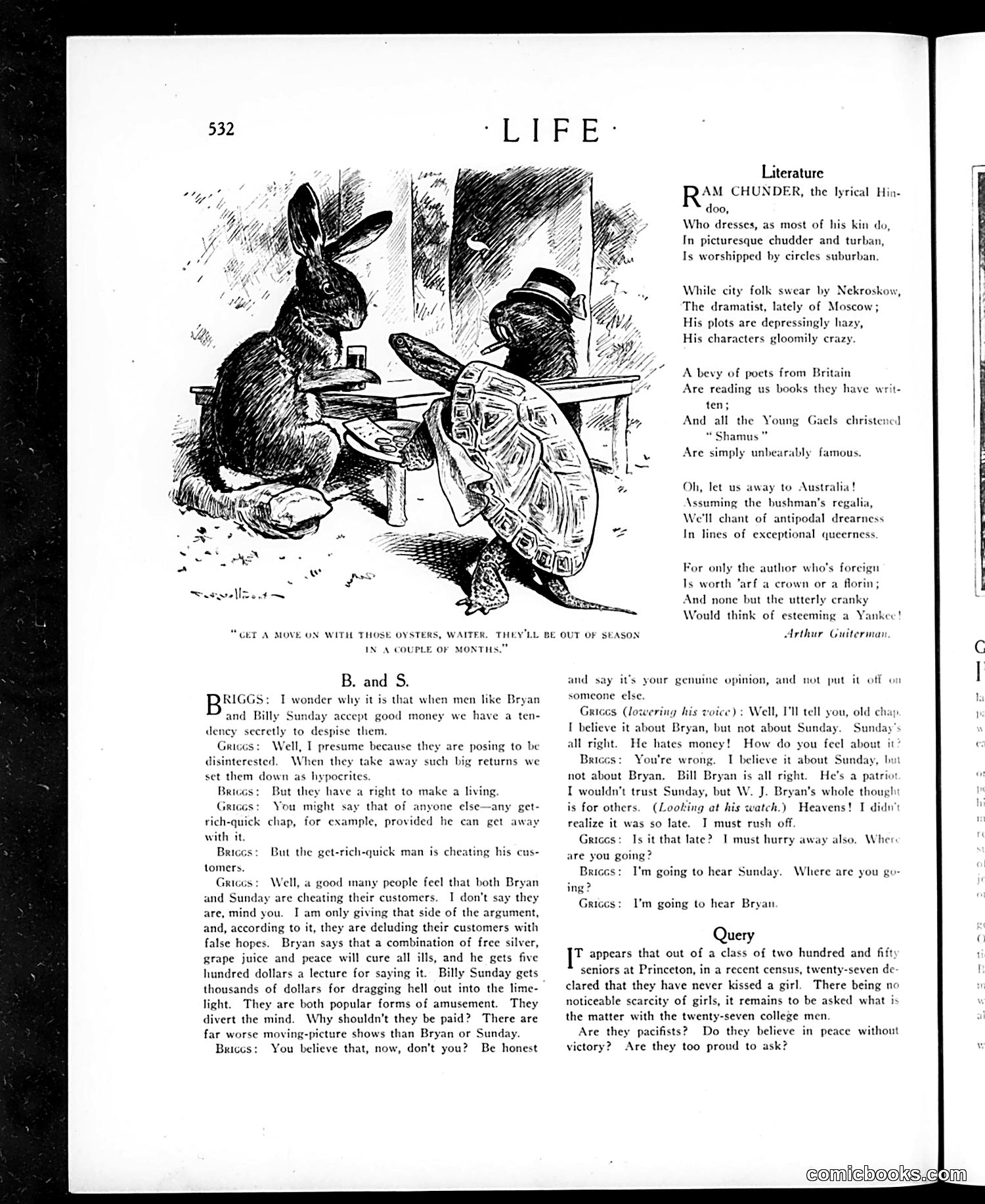
metvrellE et “GET A MOVE ON WITH THOSE OYSTERS, WAITER, THEY'LL BE OUT OF SEASON IN A COUPLE OF MONTHS.” B. and S. RIGGS: I wonder why it is that when men like Bryan and Billy Sunday accept good money we have a ten- deney secretly to despise them. Grices: Well, I presume because they are posing to be disinterested. When they take away such big returns we set them down as hypocrites Briccs: But they have a right to make a living Grices: You might say that of anyone else—any get- ch-quick chap, for example, provided he can get away with it Braces: tomers. Grices: Well, a good many people feel that both Bryan and Sunday are cheating their customers, I don't say they are, mind you. I am only giving that side of the argument, and, according to it, they are deluding their customers with false hopes. Bryan says that a combination of free silver, grape juice and peace will cure all ills, and he gets five hundred dollars a lecture for saying it. Billy Sunday gets thousands of dollars for dragging hell out into the lime- light. They are both popular forms of amusement. They divert the mind. Why shouldn't they be paid? There are se moving-picture shows than Bryan or Sunday. You believe that, now, don't you? Be honest But the get-rich-quick man is cheating his cus- Literature AM CHUNDER, the lyrical Hin- doo, Who dresses, as most of his kin do, In picturesque chudder and turban, Is worshipped by circles suburban While city folk swear by Nekroskow, The dramatist, lately of Moscow; His plots are depressingly | His characters gloomily crazy. A bevy of poets from Britain Are reading us books they have writ- ten; And all the Young Gaels christened “ Shamus” Are simply unbearably famous. Oh, let us away to Australia \ssuming the bushman’s regalia, We'll chant of antipodal drearness In lines of exceptional queerness. For only the author who's foreign Is worth ‘arf a crown or a florin; And none but the utterly cranky Would think of esteeming a Yankee! Arthur Guiterman and say it’s your genuine opinion, and not put it off on someone else Grices (lowering his voice): Well, I'll tell you, old chap. I believe it about Bryan, but not about Sunday. Sunday's all right. How do you feel about it Brices : He hates money! You're wrong. I believe it about Sunday, | not about Bryan. Bill Bryan is all right. He's a patri I wouldn't trust Sunday, but W. J. Bryan's whole thought is for others. (Looking at his watch.) Heavens! I didn’t realize it was so late. I must rush off. Griccs: Is it that late? I must hurry away also. Wher are you going? Bric I'm going to hear Sunday. Where are you go- ing? Gaiccs: I'm going to hear Bryan Query T appears that out of a class of two hundred and fift seniors at Princeton, in a recent census, twenty-seven de clared that they have never kissed a girl. There being no noticeable scarcity of girls, it remains to be asked what is the matter with the twenty-seven college men. Are they pacifists? Do they believe in peace without victory? Are they too proud to ask? comichooks.com