
A complete issue · 36 pages · 1916
Life — December 21, 1916
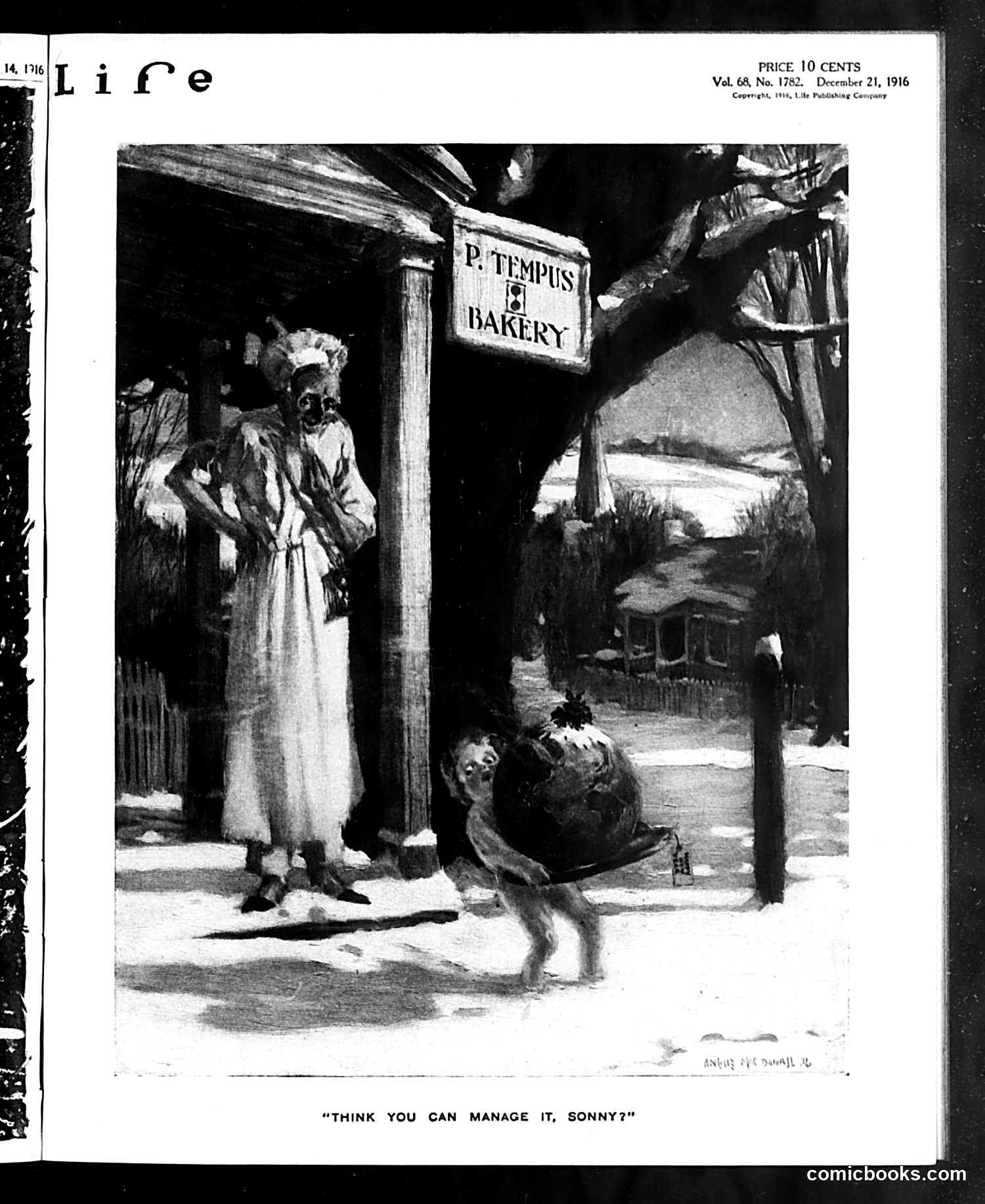
This 1916 *Life* magazine cartoon depicts a domestic scene outside "P. Tempus Bakery." An adult figure (likely a mother or baker) stands with a child, while another child runs with what appears to be a large basket or container of baked goods. The caption suggests the adult is questioning the child's ability to manage carrying the heavy load. The humor derives from the contrast between the child's small size and the oversized burden, a common satirical theme about childhood responsibilities or the difficulty of everyday tasks. The rural setting and period clothing suggest this may reference post-WWI American life, though the specific social commentary remains unclear without additional context.
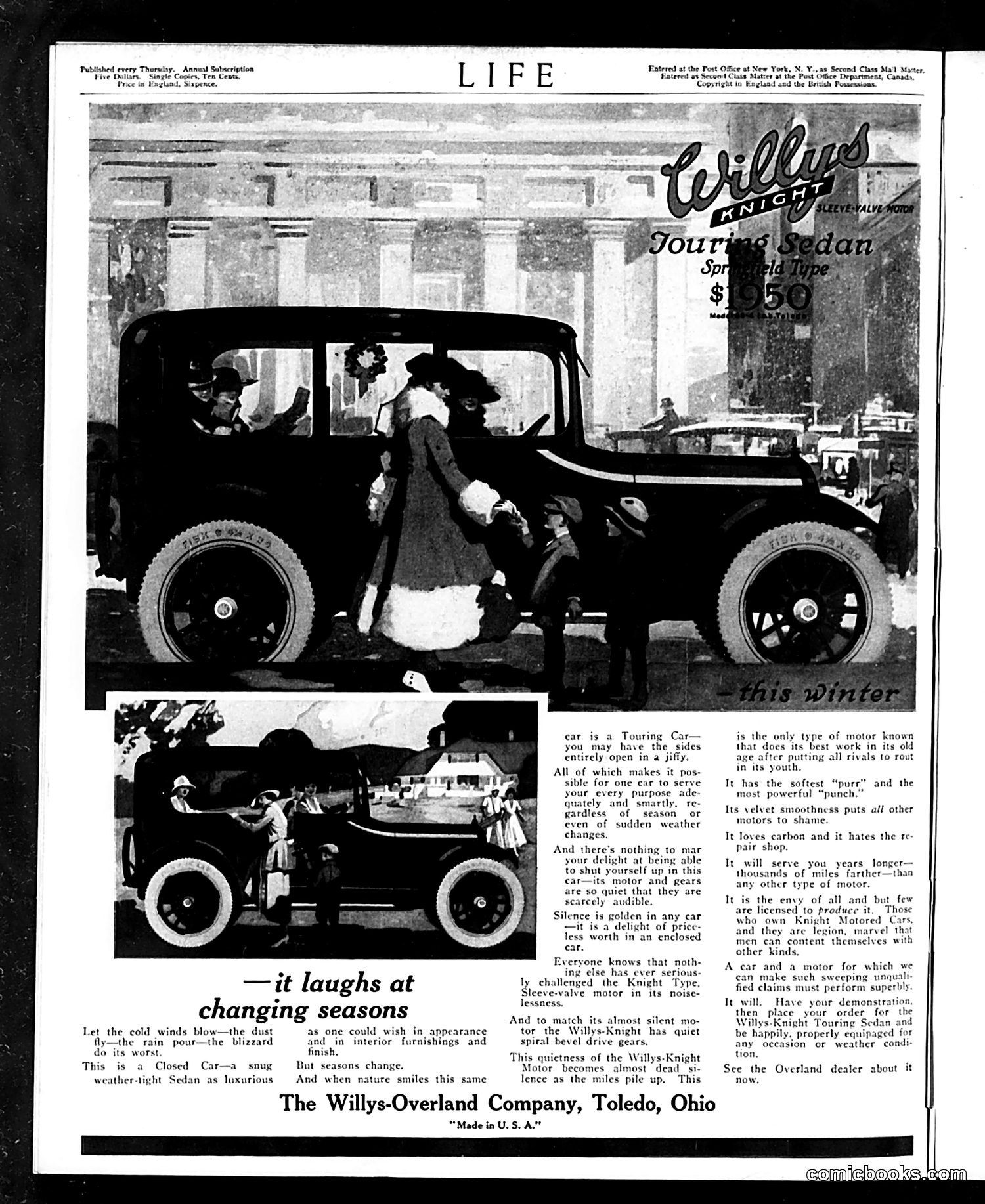
This page is primarily **advertising**, not satire or political commentary. It's a full-page advertisement for the Willys-Knight automobile, published in *Life* magazine. The ad features two photographs of the car with the headline "it laughs at changing seasons" — emphasizing the vehicle's all-weather reliability and comfort. The copy describes the Knight's features, particularly its silent motor and enclosed design, presenting these as superior to competing vehicles. The only "content" beyond advertising is the tagline claiming the car's engineering puts "all other motors to shame." This is typical commercial puffery rather than satire. The ad targets affluent readers by emphasizing luxury, durability, and technological superiority — standard early-20th-century automobile marketing appeals.
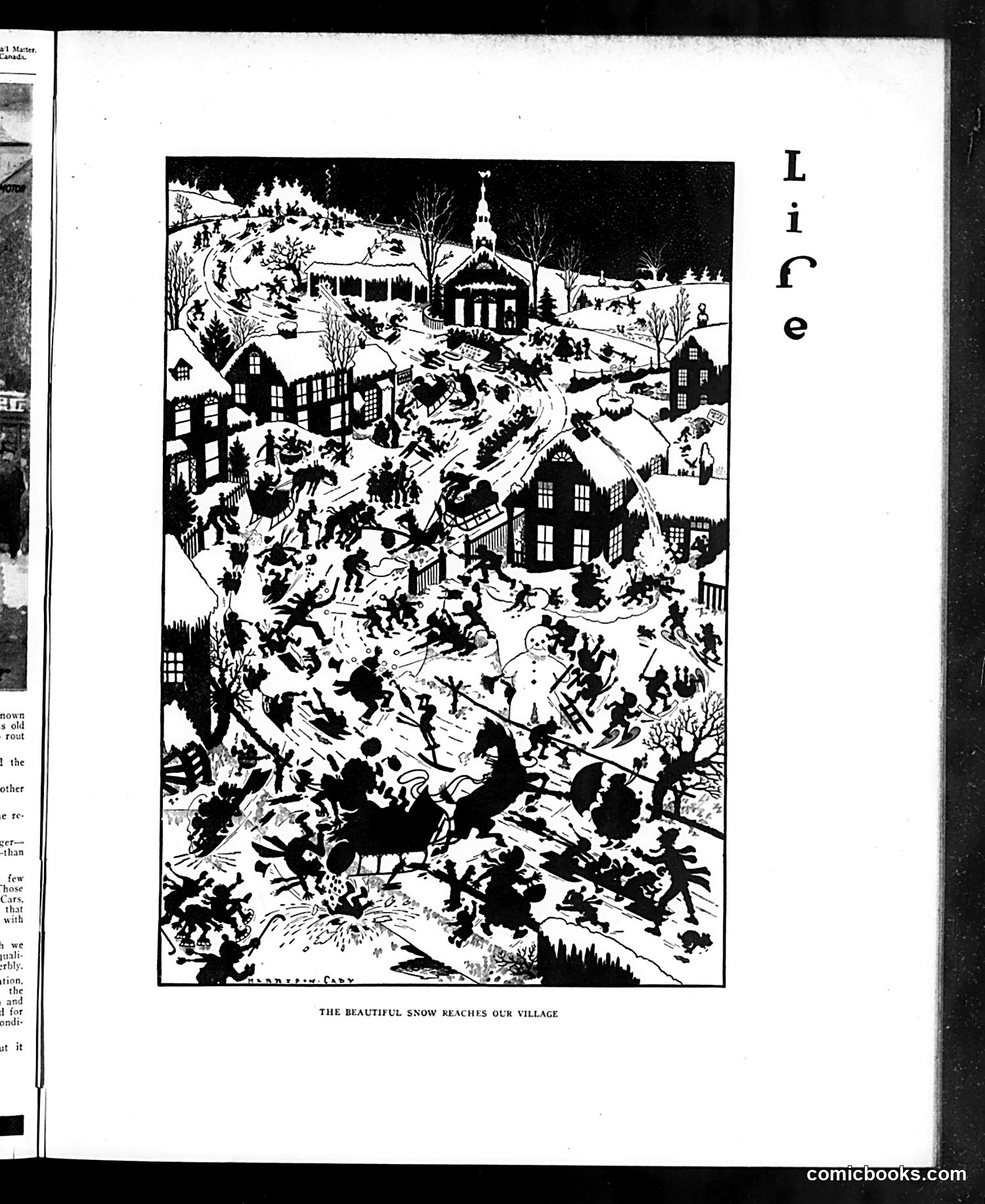
This appears to be an illustration titled "THE BEAUTIFUL SNOW REACHES OUR VILLAGE" from *Life* magazine. The image depicts a bustling winter village scene with numerous figures engaged in snow-related activities—sledding, skating, playing, and general merriment. The illustration is a straightforward seasonal scene rather than political satire. It shows idealized small-town American winter recreation, with prominent buildings (including a church), horses, and crowds of people enjoying themselves in snow. The title suggests the piece celebrates winter's arrival as a positive, community-wide event bringing joy and activity to village life. This reflects early 20th-century *Life* magazine's frequent use of wholesome, nostalgic imagery. Without additional context or visible caricatures of specific political figures, this appears to be sentimental seasonal content rather than satirical commentary.
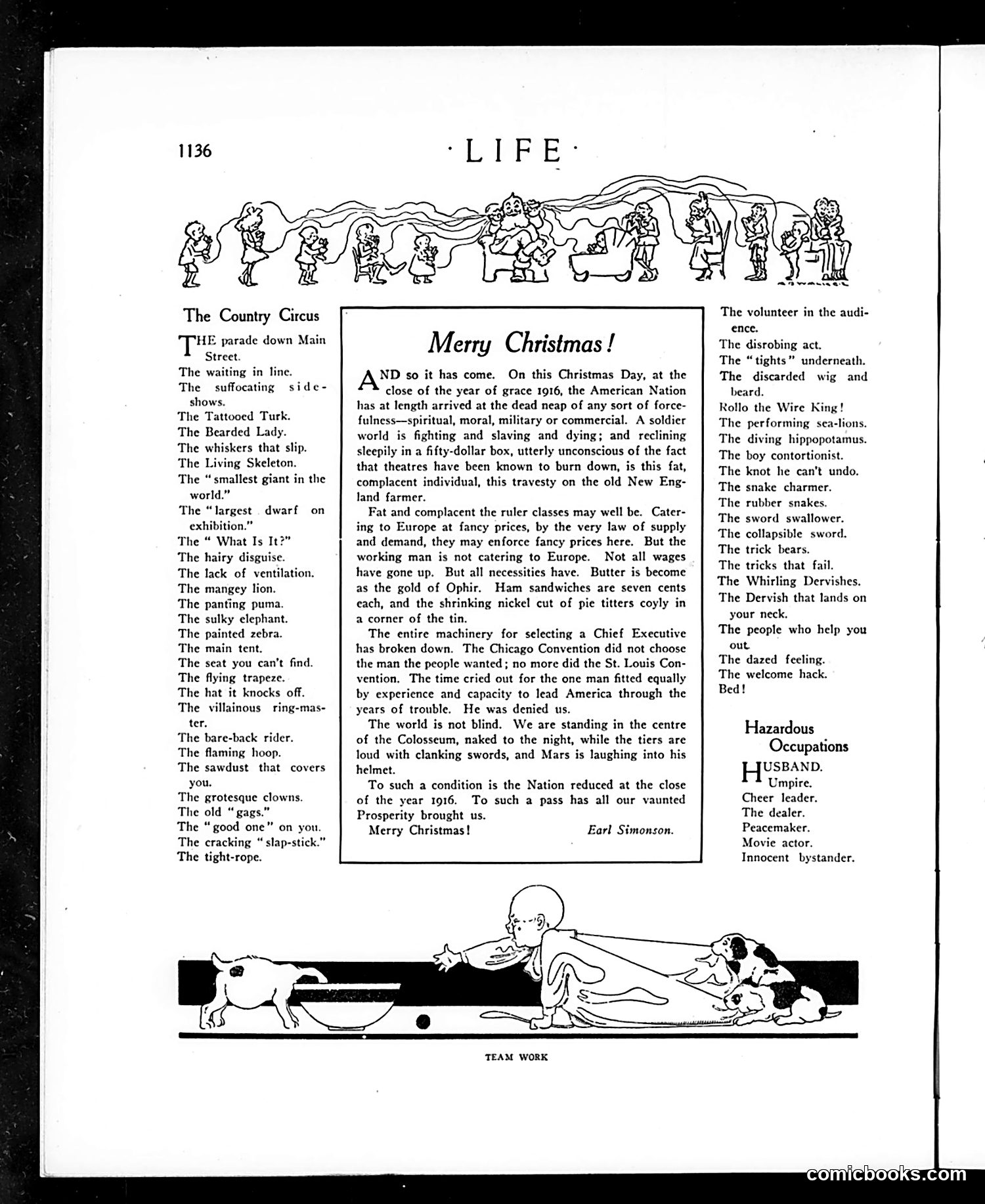
This page presents a Christmas 1916 editorial by Earl Simonson criticizing American leadership during World War I. The "Merry Christmas" essay sarcastically contrasts the nation's suffering—soldiers fighting, dying, and living in poverty—with complacent ruling classes enjoying luxury. Simonson condemns both major political conventions (Chicago and St. Louis) for failing to nominate a leader "fitted equally by experience and capacity" to guide America through the crisis. He laments that qualified leadership was "denied us." The left column lists circus acts, likely satirizing how Americans are distracted by entertainment while serious national problems persist. The bottom cartoon labeled "Team Work" appears to show figures pulling together, though its specific meaning is unclear without additional context.
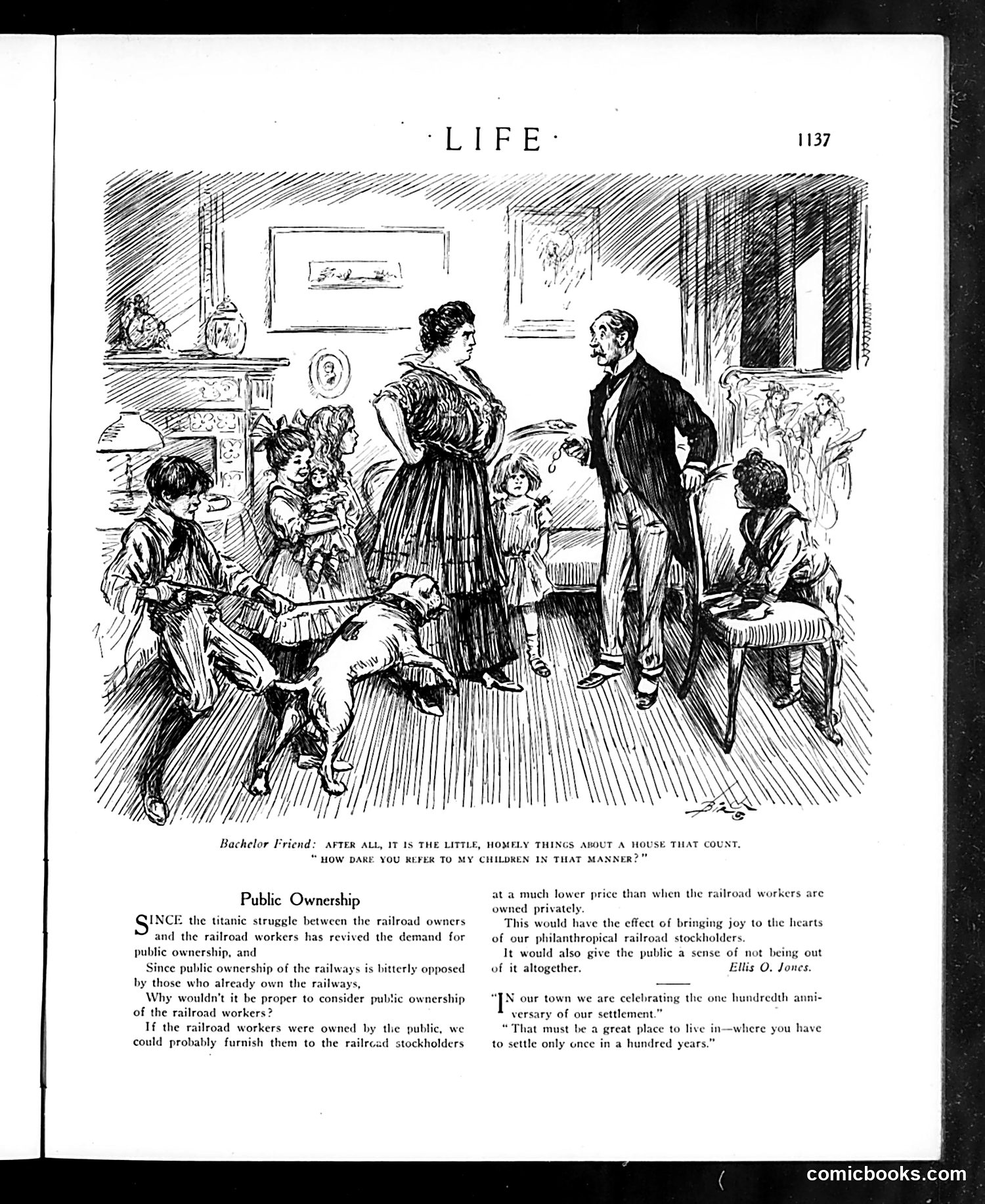
The top cartoon is titled "Bachelor Friend" and depicts a domestic scene where a man addresses a woman holding children, saying: "After all, it is the little, homely things about a house that count. How dare you refer to my children in that manner?" The satire mocks Victorian-era social pretension—the bachelor friend apparently made a casual or unflattering remark about the man's children, who are presented as rowdy and unruly. The joke plays on the contrast between the man's pompous declaration that children represent a home's "little, homely things" and the obvious chaos they're causing. Below, an article titled "Public Ownership" debates whether railroad workers should be furnished to stockholders if railroads were publicly owned—a serious policy discussion about labor and nationalization, likely reflecting early-20th-century labor debates.
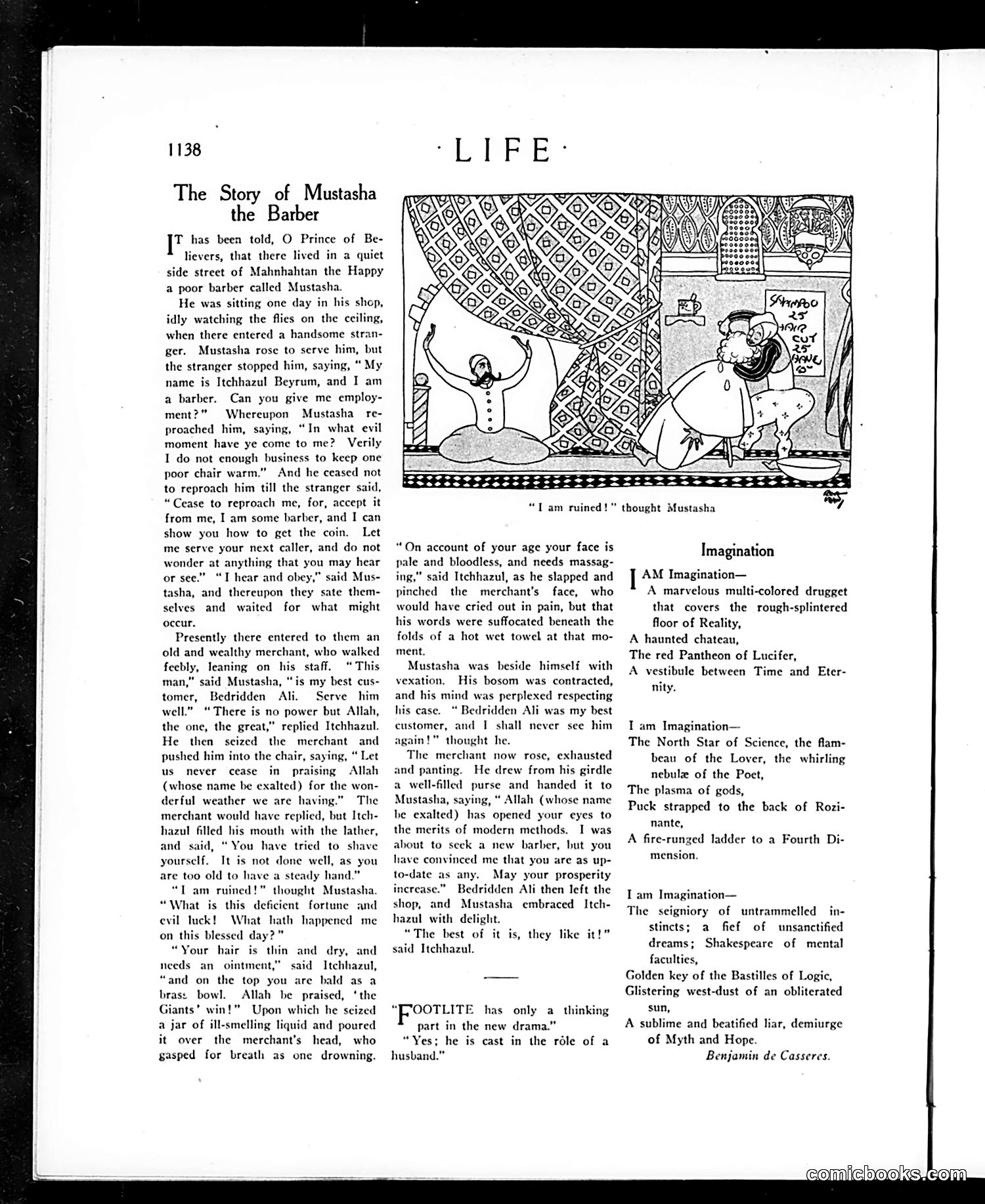
This page contains **two distinct pieces**: a satirical story and a poem, not political commentary. **"The Story of Mustasha the Barber"** is a humorous tale about a poor Baghdad barber who encounters a wealthy merchant. When the merchant complains about his appearance, Mustasha proposes a dubious "treatment" involving pouring foul-smelling liquid on his head—a practical joke played at the merchant's expense. The humor derives from class reversal: the lowly barber outwits the wealthy man through wit rather than deference. **"Imagination,"** attributed to Benjamin de Casseres, is a romantic poem celebrating imagination as transcendent—superior to science and logic, offering escape from mundane reality. Both pieces are **literary content**, not political satire. The page showcases *Life* magazine's mix of humor, fiction, and poetry during the early 20th century.
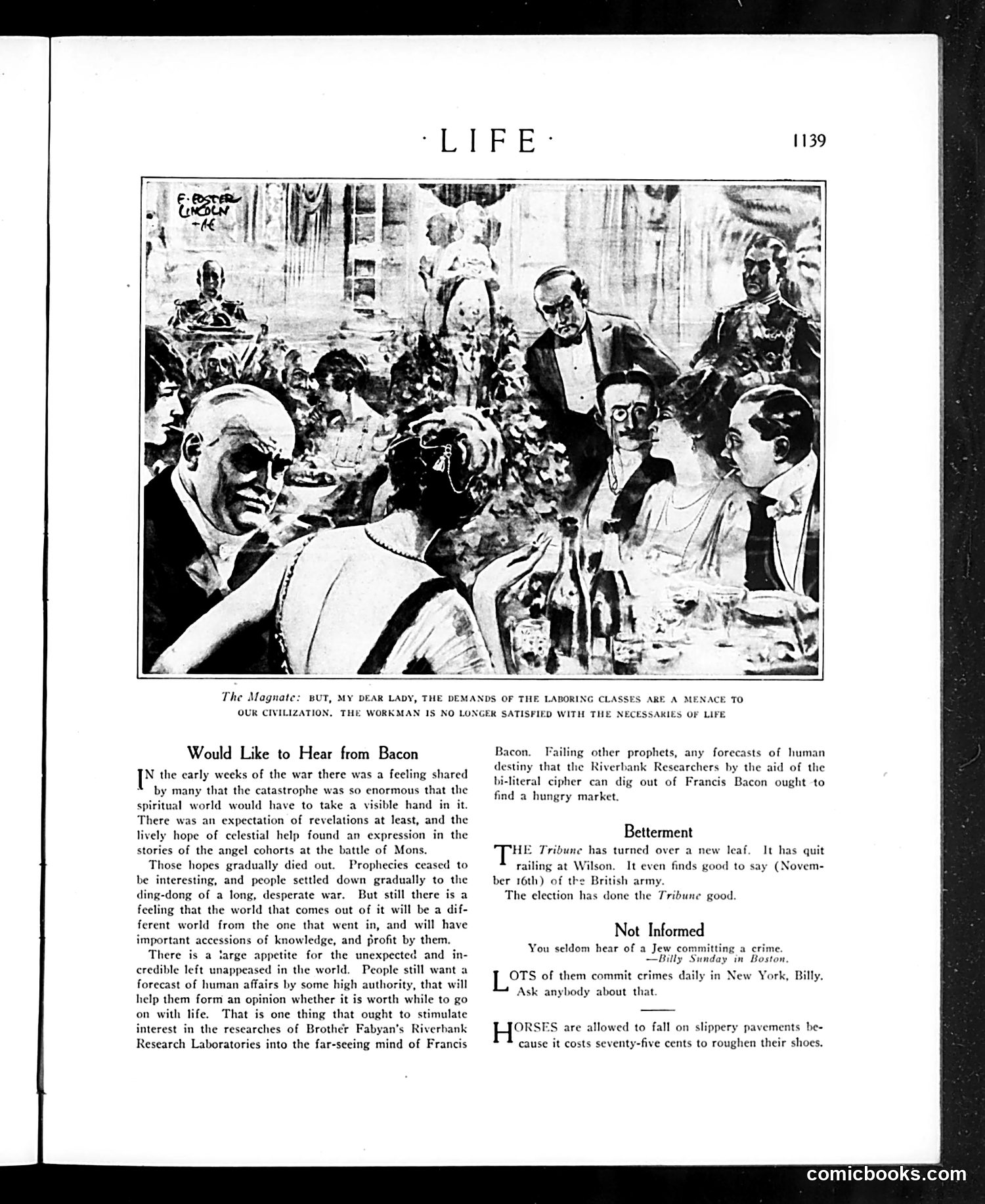
The main illustration depicts a formal dinner scene with well-dressed figures in evening wear. The caption quotes "The Magnate" complaining that labor's demands threaten civilization and that "the workman is no longer satisfied with the necessities of life." **The satire:** This targets wealthy industrialists who resent workers' demands for better conditions beyond bare subsistence. The irony is that the magnate voices this complaint while dining at an elaborate, luxurious meal—highlighting the hypocrisy of the rich claiming workers' expectations are unreasonable while they themselves enjoy abundant excess. The accompanying text discusses post-World War I social unrest and references Francis Bacon's "Riverbank Research Laboratories," appearing to satirize predictions about future social upheaval and the wealthy's detachment from ordinary people's struggles.
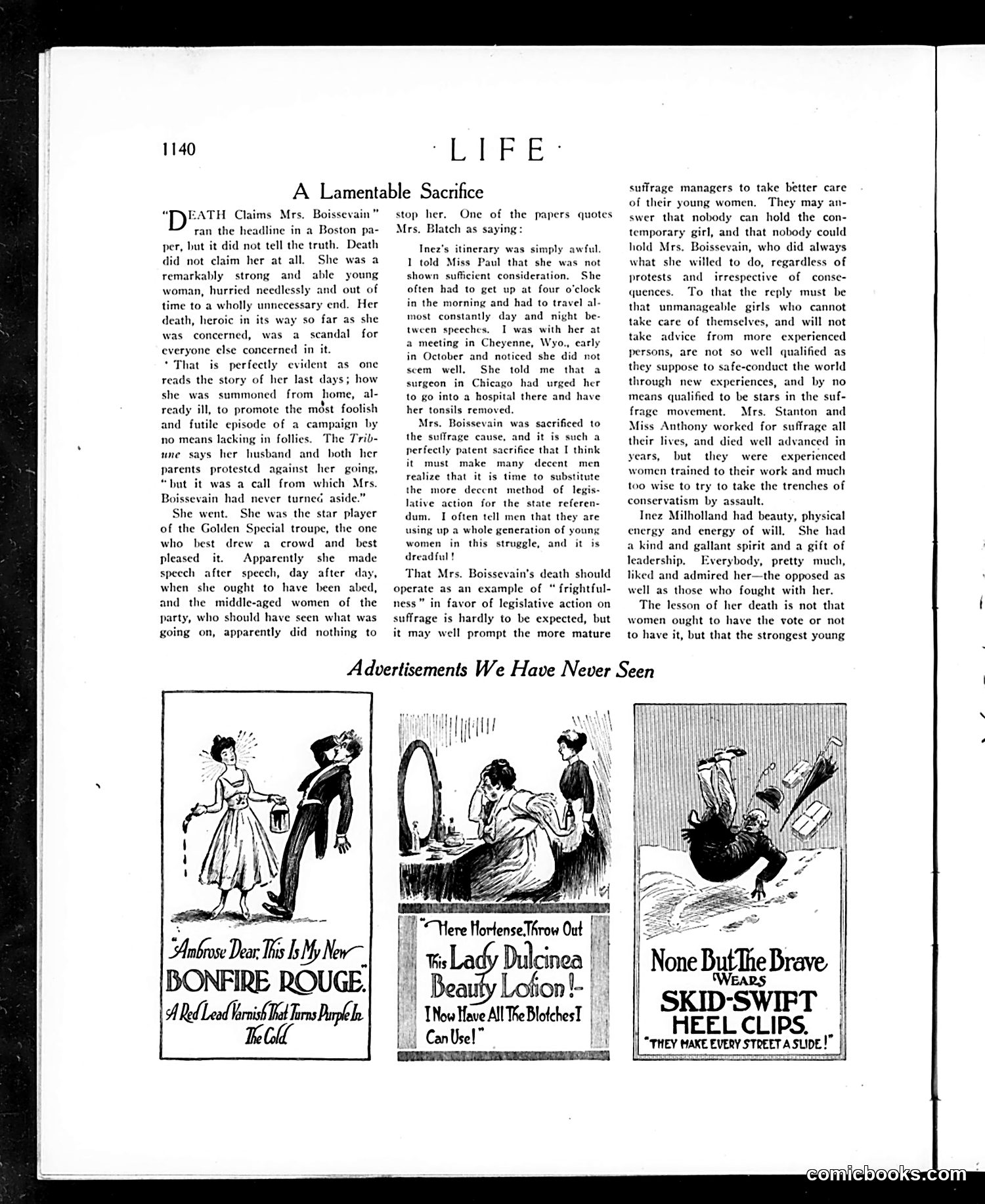
This page contains a serious article titled "A Lamentable Sacrifice" discussing Mrs. Boissevain's death and her activism for women's suffrage. The article criticizes her sacrifice to the cause and reflects on lessons from her death regarding young women in the suffrage movement. Below is a section labeled "Advertisements We Have Never Seen"—a satirical feature presenting fake, humorous ads mocking common advertising tropes: 1. **"Bonfire Rouge"**: A beauty product ad parodying romantic advertising 2. **"Lady Dulcinea Beauty Lotion"**: A fake skincare ad with exaggerated claims about blotches 3. **"Swift Heel-Clips"**: A comedic ad about heel grips, with the absurd tagline "They Make Every Street a Slide" These fake ads satirize the period's dubious beauty and consumer product advertisements through absurdist humor and visual gags.
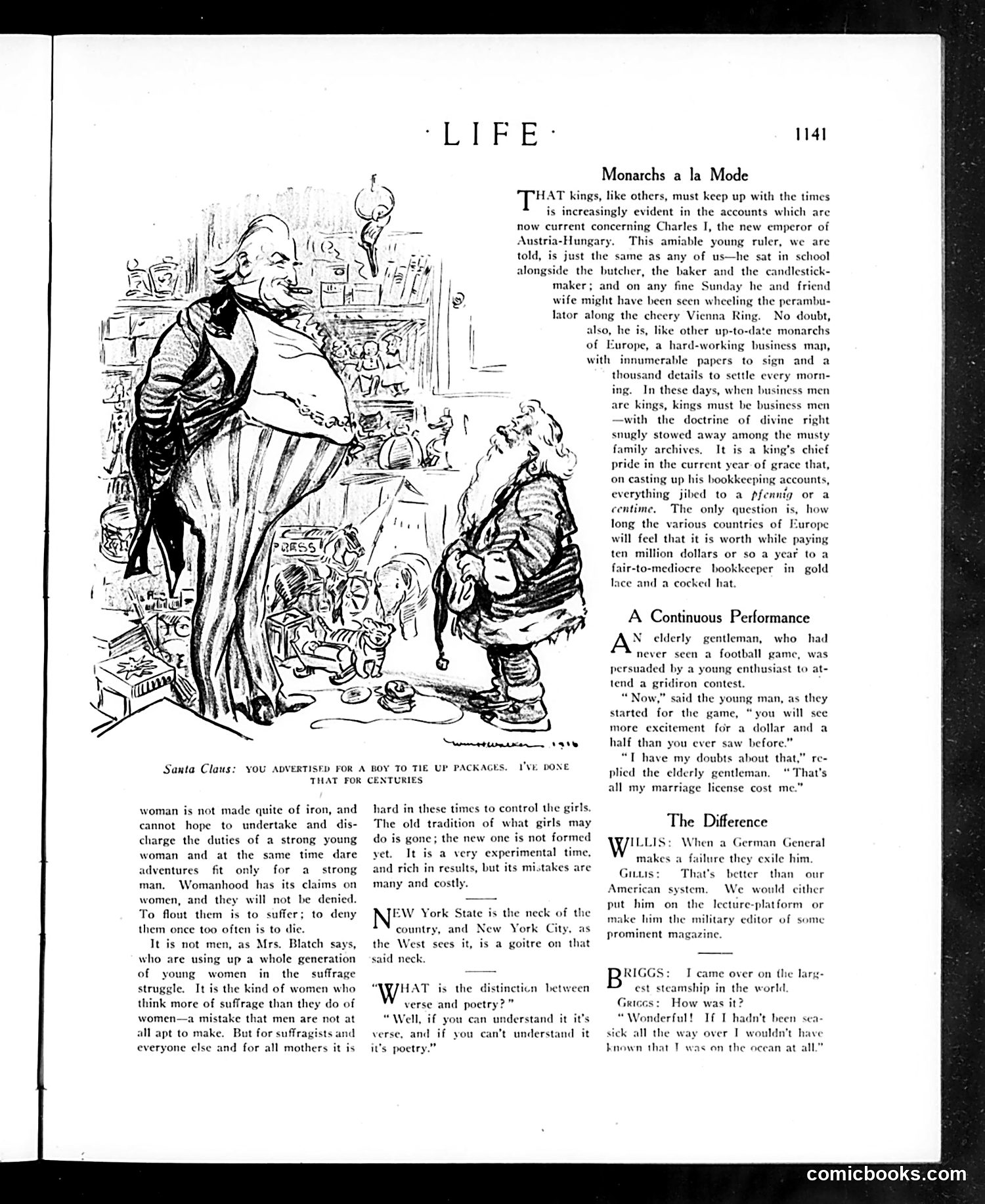
This page satirizes modern European monarchs, particularly the new Austrian-Hungarian Emperor Charles I, depicted as a businessman-king juggling ledgers and administrative duties rather than ruling traditionally. The cartoon shows a skeleton-thin, harried monarch surrounded by papers and accounting books, contrasted with an elderly gentleman observer. The satire's point: contemporary kings must function as modern business managers—handling "bookkeeping accounts" and financial details—rather than embodying divine right. The text mockingly suggests European nations might soon need to pay "ten million dollars...a year" to afford a competent "fair-to-mediocre bookkeeper" as monarch. The humor targets the unglamorous reality of twentieth-century monarchy stripped of mystique, reduced to bureaucratic labor.
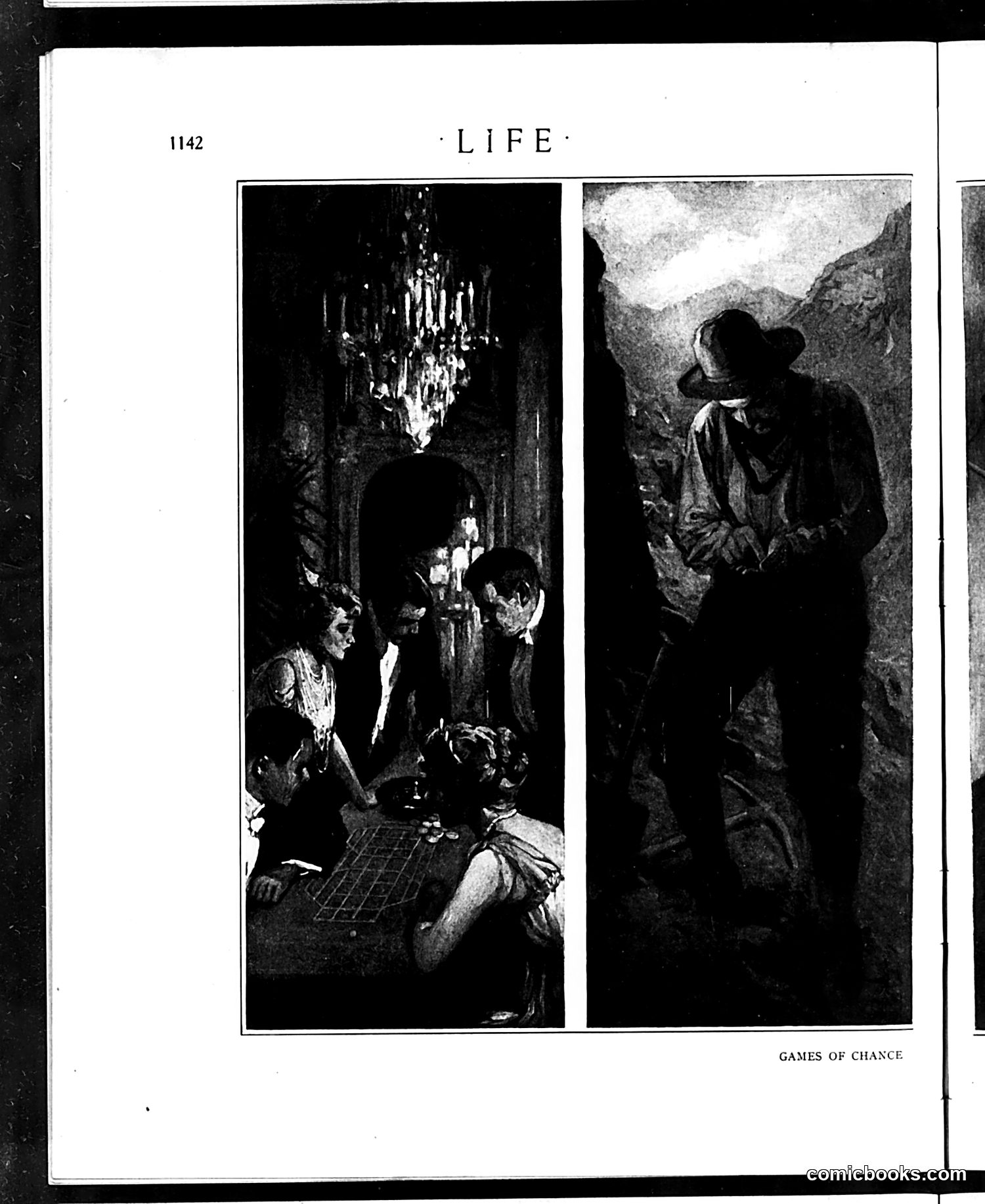
This page from *Life* magazine shows two dramatic black-and-white illustrations labeled "Games of Chance." The left panel depicts an indoor scene with figures gathered around what appears to be a gambling table, lit by a chandelier, suggesting illicit gaming in an elegant setting. The right panel shows a solitary figure in dark clothing and a hat in an outdoor, rocky landscape, appearing to be in a tense or furtive situation. The caption "Games of Chance" likely satirizes gambling and its consequences—contrasting the sophisticated urban vice (left) with the desperate circumstances it produces (right). Without additional context or visible text identifying specific figures or events, the satire appears to critique gambling's social dangers generally rather than target particular individuals or scandals.
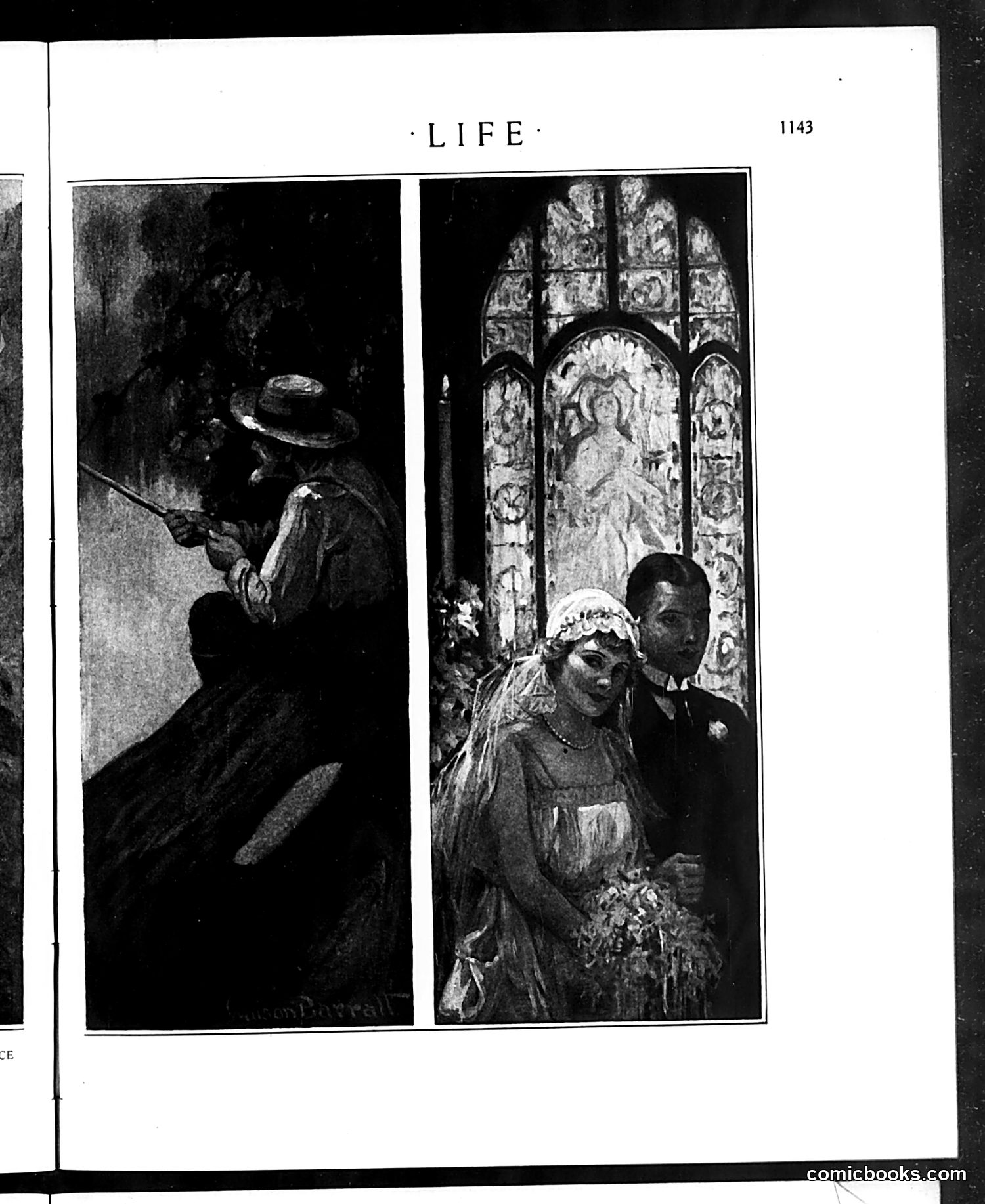
This page from *Life* magazine (page 1143) contains two black and white photographs or illustrations rather than traditional cartoons. The left image shows a figure in period clothing and a hat, appearing to aim or point a rifle or long gun. The right image depicts what appears to be a wedding scene inside a church, with a bride in a white veil and headpiece standing beside a man in dark formal attire, with ornate stained glass windows visible in the background. Without visible captions or accompanying text to explain the satirical point, the specific political or social commentary intended remains unclear. The juxtaposition of these two scenes—one depicting violence or conflict, the other depicting matrimony—may constitute the joke, but its exact meaning and historical context cannot be determined from the image alone.
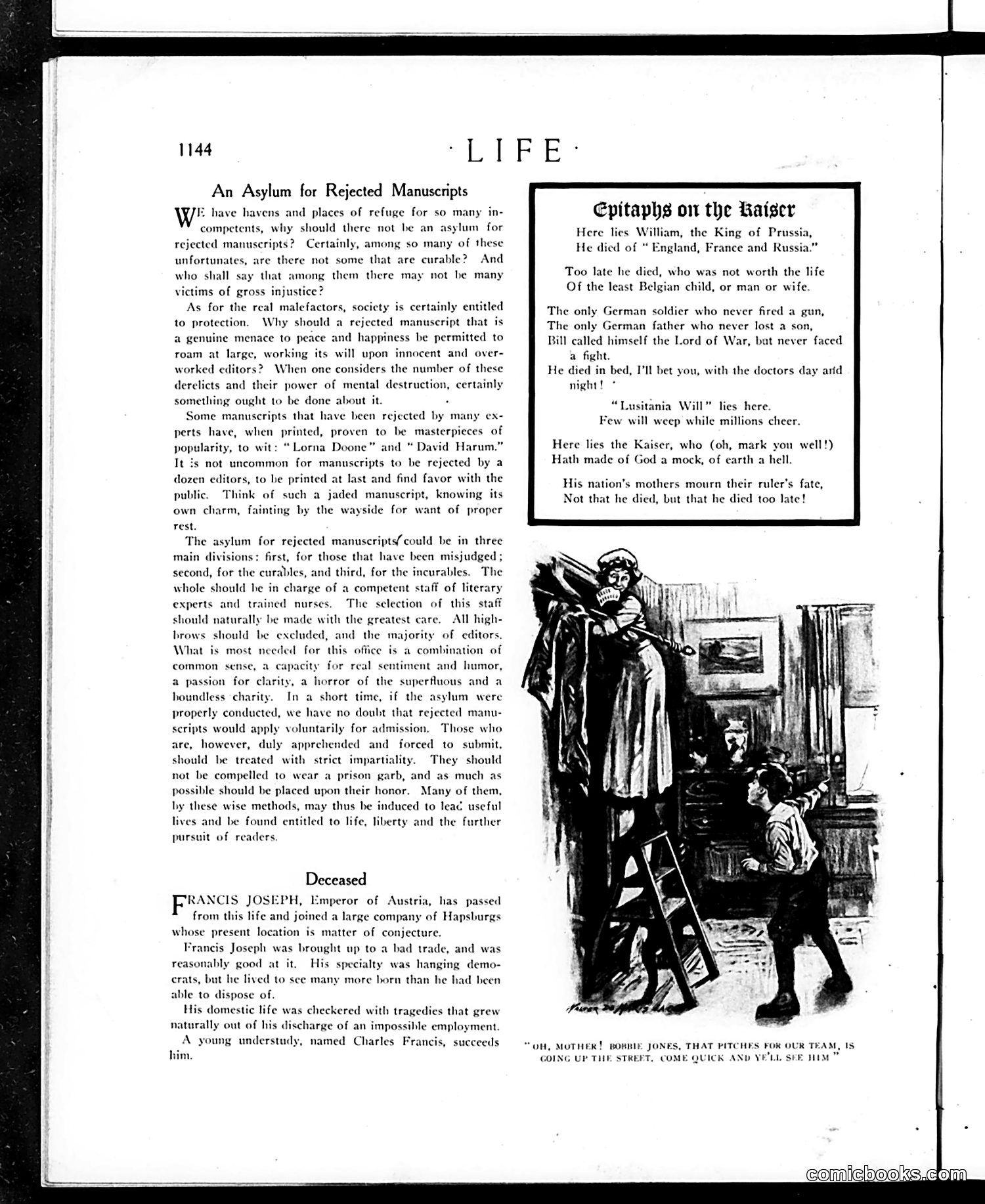
The page contains two distinct sections: **Left column:** An essay titled "An Asylum for Rejected Manuscripts" argues that bad manuscripts deserve sympathetic editorial treatment rather than dismissal. The author proposes a refuge staffed by literary experts who would handle rejections with "common sense, capacity for real sentiment and humor." **Right side:** A boxed poem titled "Epitaphs on the Kaiser" contains satirical verses mocking Kaiser Wilhelm II of Germany, emphasizing his cowardice ("never fired a gun"), ineffectiveness, and responsibility for German suffering. References to the "Lusitania" (the ship Germany sank in 1915) place this during WWI. **Below:** An illustration and brief item announce the death of Francis Joseph, Emperor of Austria, with succession to his understudy Charles Francis. The page reflects WWI-era American sentiment—mocking German leadership while treating serious subjects (rejected writers, imperial death) with dark humor characteristic of *Life* magazine's satirical approach.
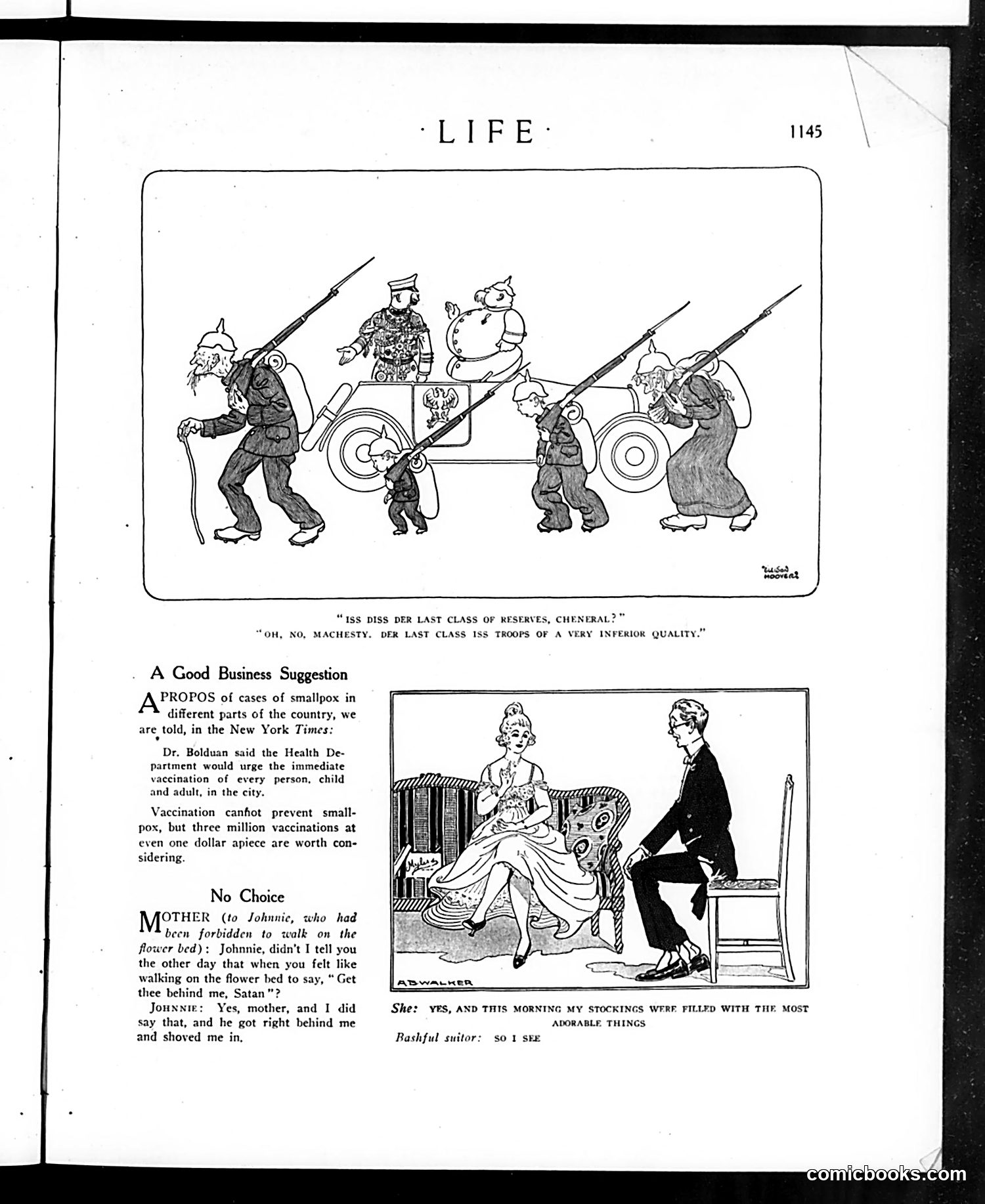
**Top Cartoon:** Depicts military figures (appearing to be German, based on the spiked helmets) transporting what look like civilian recruits or conscripts in cannons. The general's dialogue mocks "the last class of reserves" as "troops of a very inferior quality." This satirizes German military practices, likely commenting on forced conscription or the declining quality of late-war recruits—possibly referencing WWI conditions. **"A Good Business Suggestion":** References a New York Times report about Dr. Holladay proposing citywide smallpox vaccination. The text notes vaccination cannot prevent smallpox but that vaccinations cost money. The satire appears to critique either the medical establishment's profit motives or skepticism about vaccination's efficacy. **"No Choice":** A brief humorous anecdote about a mother and son named Johnnie, where Satan supposedly pushed the child into a flower bed—an absurdist joke.
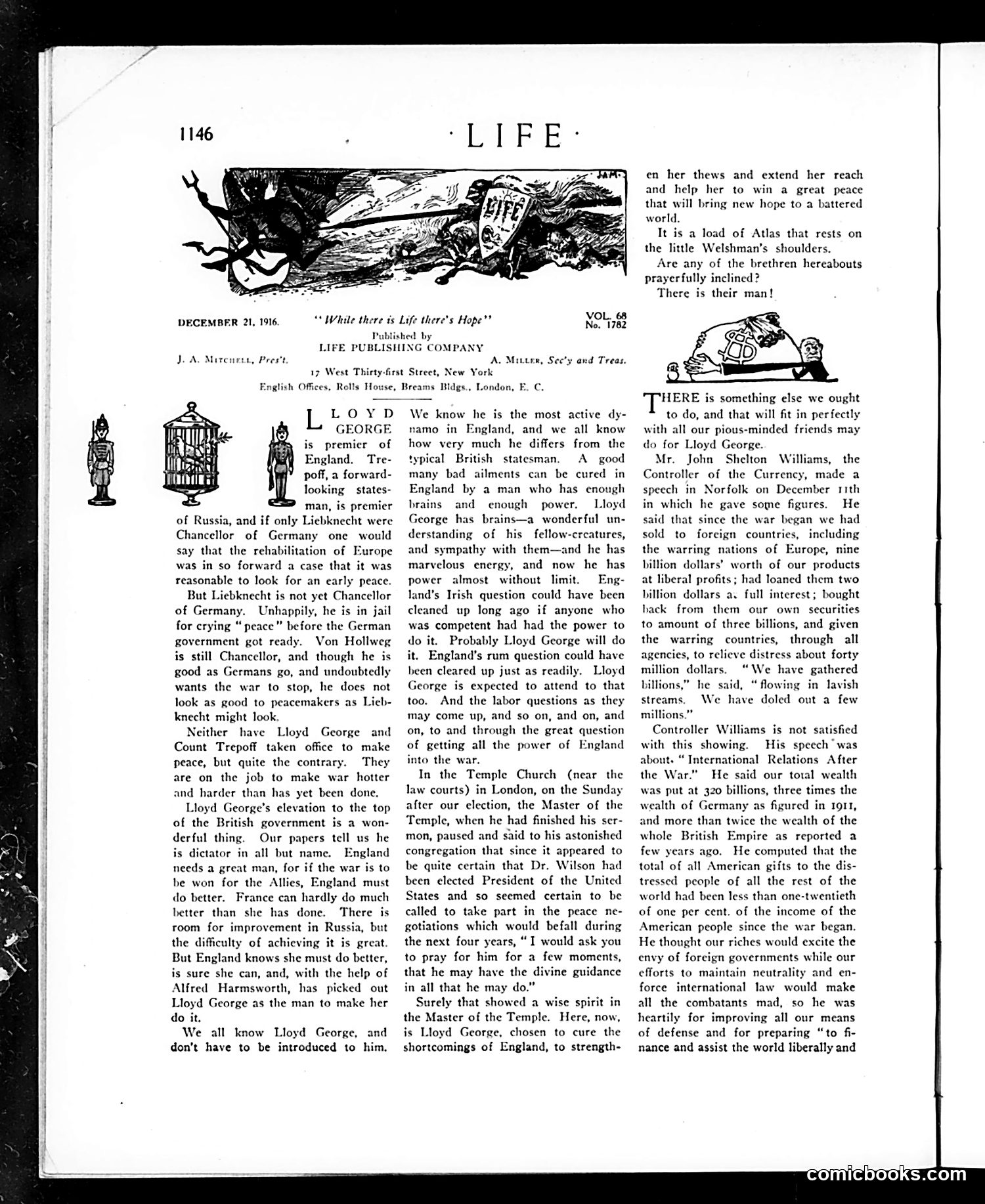
This page discusses **Lloyd George**, Britain's newly elevated political figure, in the context of World War I. The article praises his energy and problem-solving abilities, contrasting him favorably with other British leaders. It references his potential to resolve England's "Irish question" and "rum question" (prohibition), suggesting he has the power to address longstanding domestic issues. The piece also discusses **Controller of the Currency John Shelton Williams**, who apparently made a speech detailing Britain's war expenditures and America's financial support—three billion dollars lent to allied nations. The satirical tone celebrates Lloyd George as a capable leader while the broader context reflects 1916 wartime politics and Anglo-American financial relations during WWI.
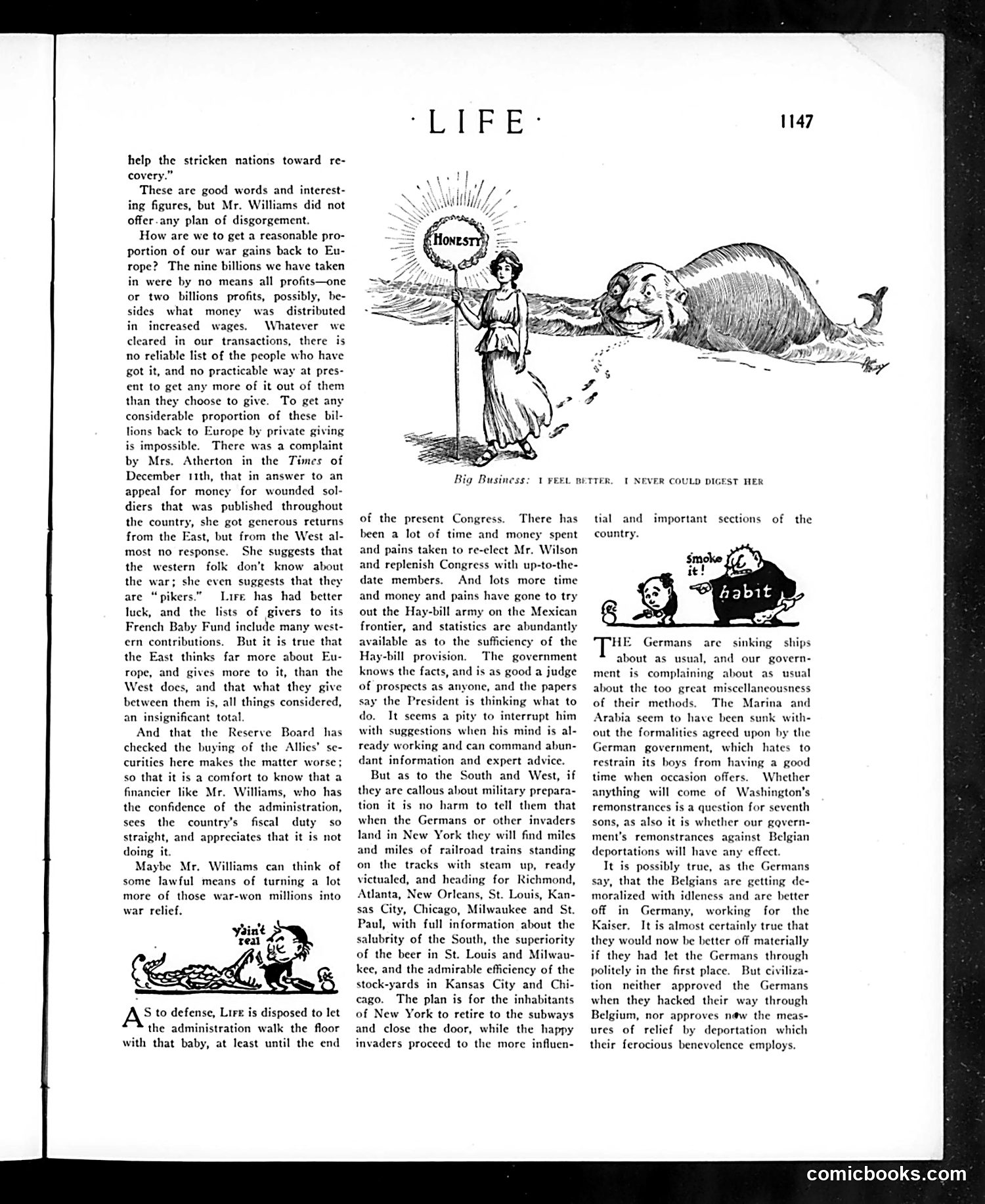
The top cartoon depicts Lady Liberty (holding the "Honesty" sphere) recoiling from a large, grinning creature labeled "Big Business," with the caption "I feel better. I never could digest her." This satirizes post-WWI concerns about profiteering—the text discusses how war profits were distributed to few wealthy interests rather than recovering European relief efforts. The lower section critiques the Wilson administration's war planning and military preparedness. It mocks suggestions that New York residents hide in subways during German invasion, while the government wastes time debating rather than acting decisively. The cartoon suggests administrative incompetence in handling national defense. Both target government inefficiency and corporate exploitation during wartime.
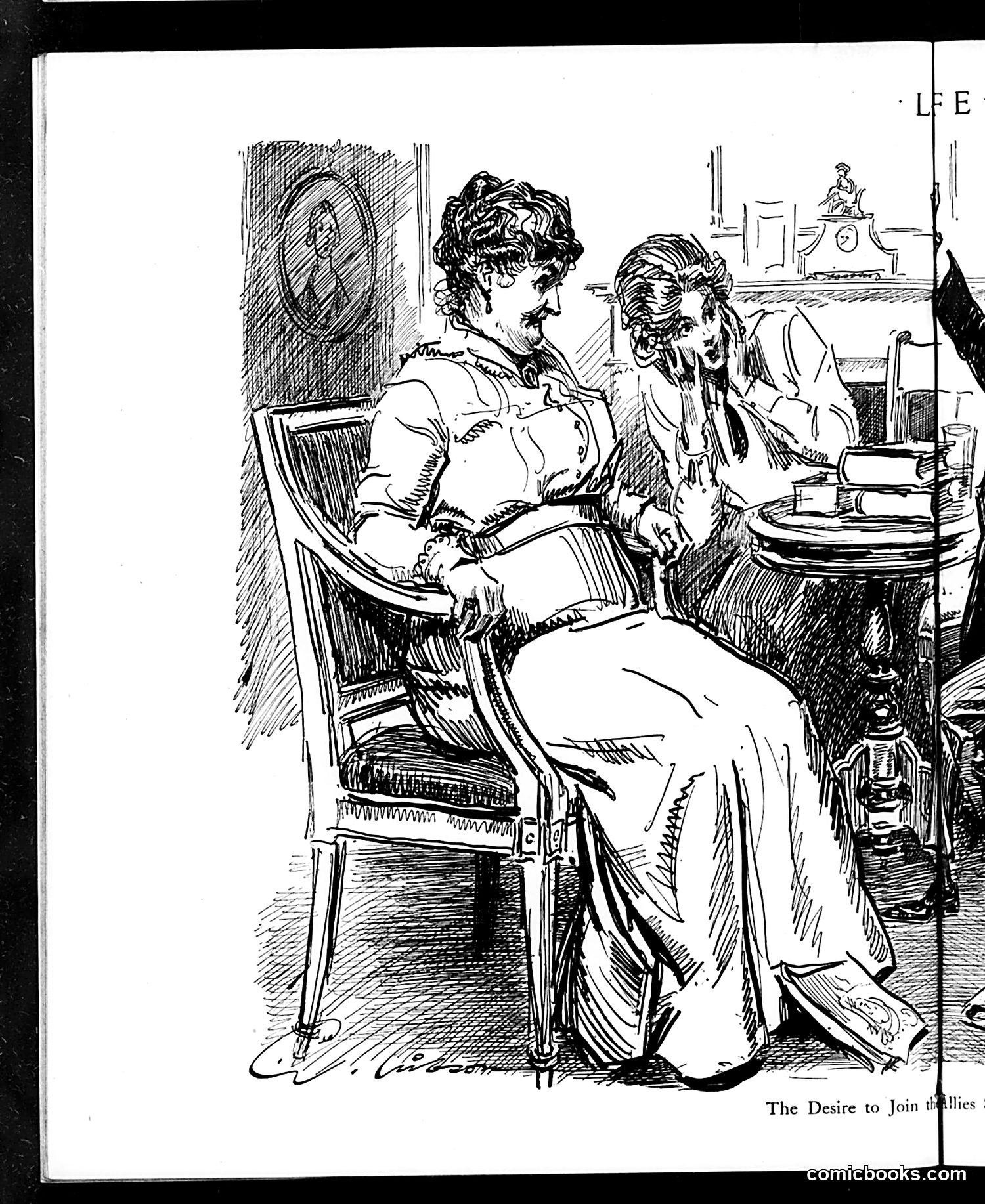
This cartoon depicts two women in an interior setting, likely satirizing women's desire for military or wartime involvement. The seated woman appears to be conversing with or being addressed by another woman standing nearby. A table with books and papers suggests an intellectual or official context. The caption "The Desire to Join the Allies" indicates this addresses women wanting to participate in allied war efforts—likely referencing World War I, when women sought roles in military support, nursing, or auxiliary services. The cartoon appears to mock or comment on this aspiration, though the specific satirical angle remains unclear without additional context about Life magazine's editorial stance at the time of publication.
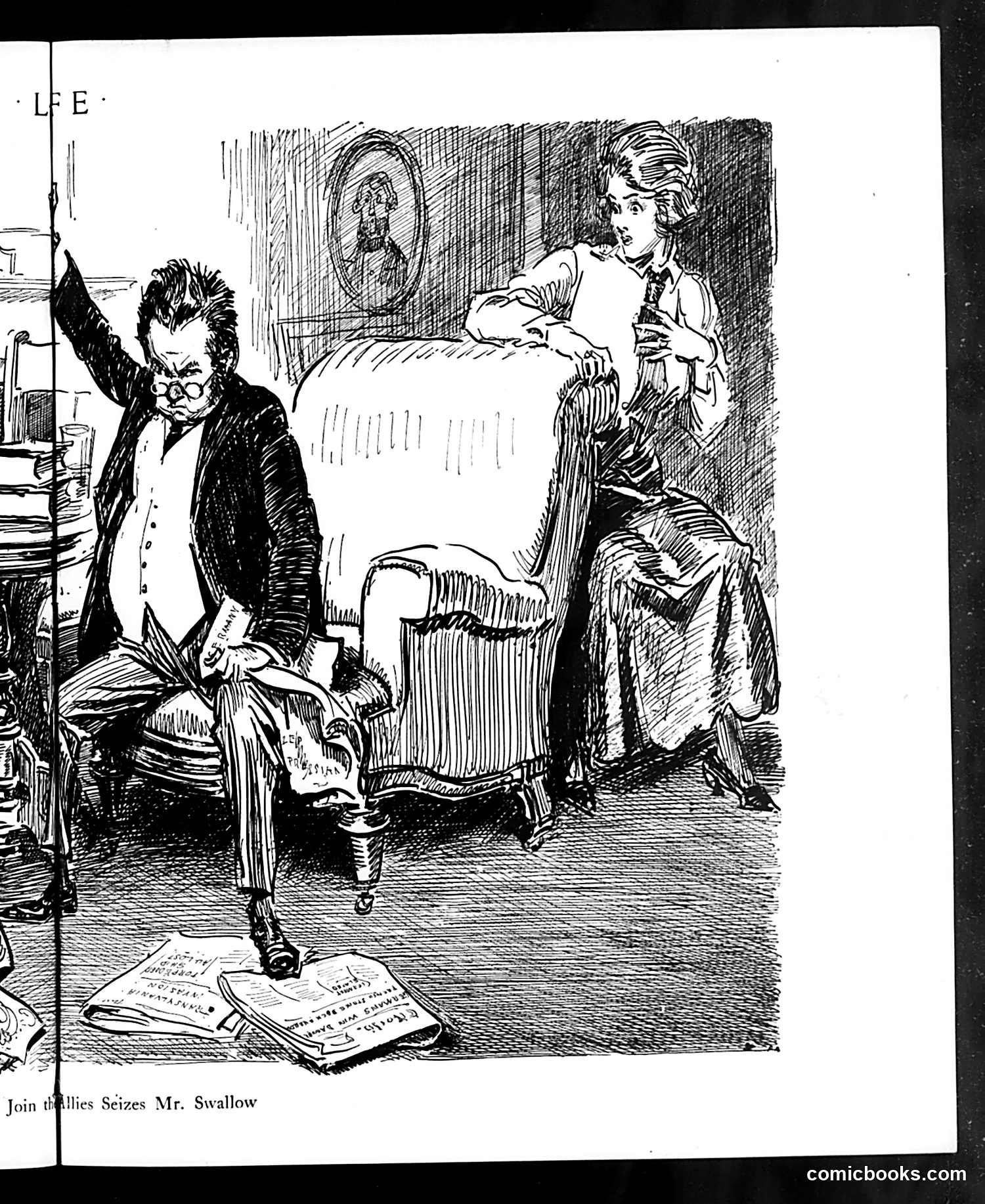
This appears to be a satirical cartoon from Life magazine titled "Join the Allies Seizes Mr. Swallow." The image shows a military or political figure on the left (appearing agitated or animated) alongside a woman and a bed, with papers scattered on the floor and a portrait on the wall. The OCR text is fragmentary and unclear, making precise identification difficult. However, the title suggests this references World War I-era political commentary—likely involving Allied powers and a figure with the surname Swallow or nicknamed "Swallow." The scattered papers and domestic setting suggest the satire concerns either political neutrality being "seized" or forced allegiance during wartime. Without clearer source information, I cannot definitively identify the specific political figures or events referenced.
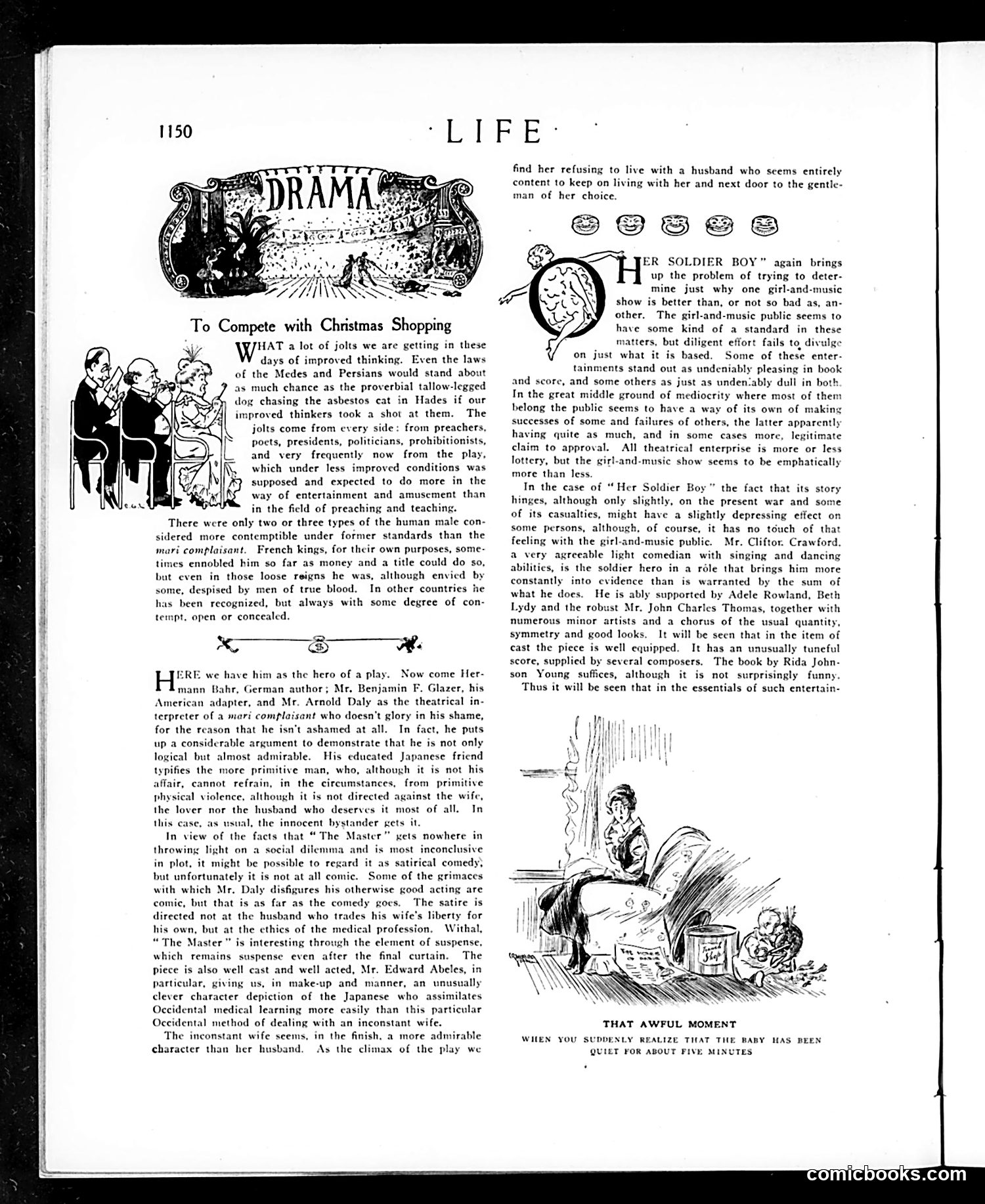
This page reviews theatrical productions, primarily criticizing "The Master," a play about a *mari complaisant* (a man who accepts his wife's infidelity). The critic attacks the play for presenting this traditionally contemptible male character as logical and admirable rather than shameful. The reviewer notes the play fails as social commentary—it's neither funny nor conclusive. Instead of satirizing the complicit husband, it critiques the medical profession. The Japanese character (played by Edward Abeles) represents "primitive" morality who resorts to violence, though significantly not against those deserving it. Ironically, the critic finds the unfaithful wife more admirable than her husband by play's end. A secondary review discusses "Her Soldier Boy," a musical whose quality the critic struggles to evaluate objectively, noting the entertainment industry's mysterious standards for success versus failure.
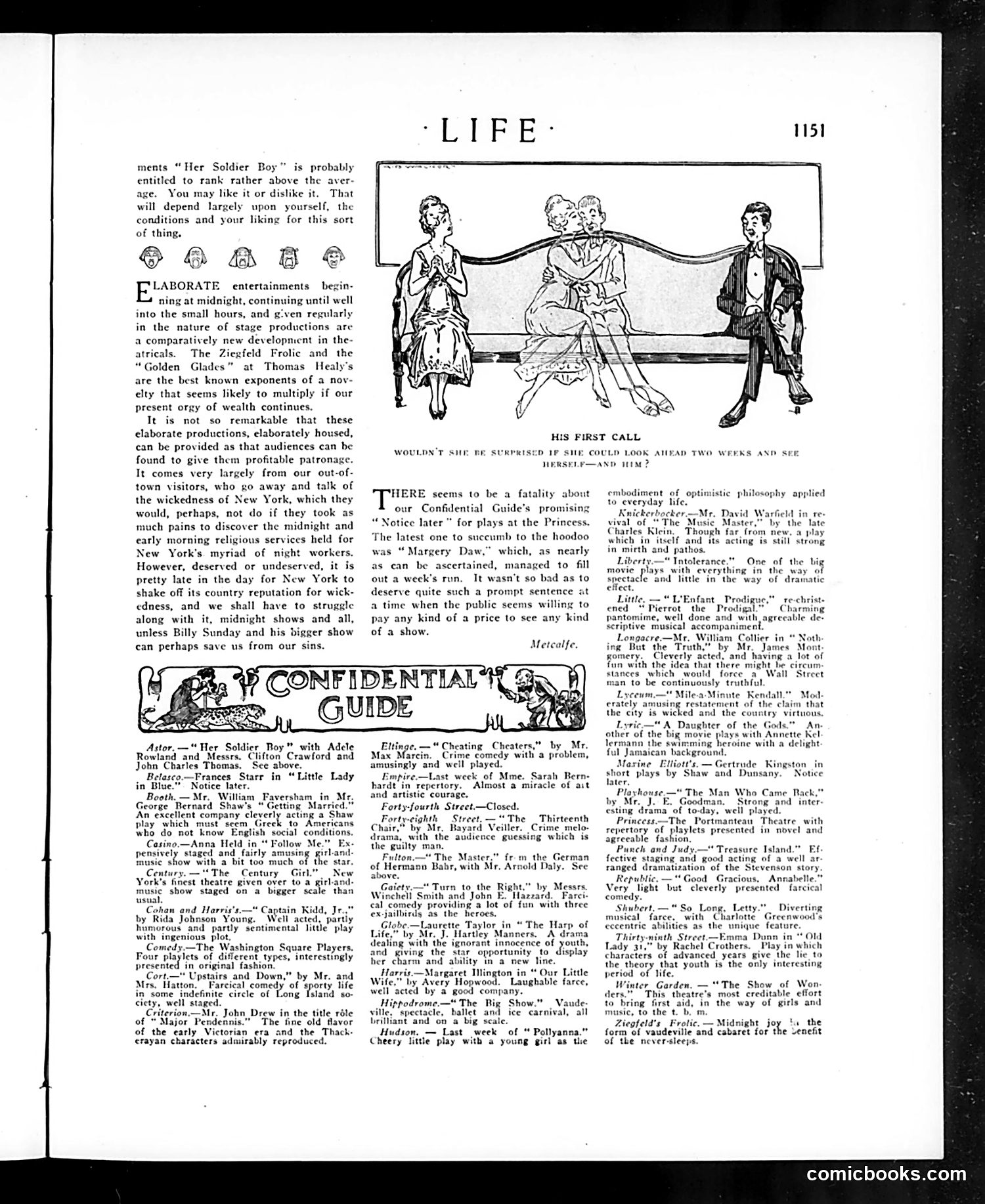
This page from *Life* magazine consists primarily of theater reviews and advertisements rather than political cartoons. The main illustration titled "His First Call" shows a young woman with two older figures, captioned with a joke about her being surprised if she could see herself two weeks ahead with "him"—likely satirizing the conventions and anxieties surrounding courtship and marriage in the early 20th century. The bulk of the page contains "The Confidential Guide," reviewing current Broadway productions. The text criticizes elaborate midnight entertainments like the Ziegfeld Frolic and "Golden Glades," noting New York's reputation for wickedness. There's a jab at the short run of "Margery Daw" at the Princess Theatre and various reviews of shows at venues like the Astor, Belasco, and Casino. The satirical point seems to be mocking both the extravagant theater productions catering to wealthy out-of-town visitors and New York's persistent moral reputation—suggesting the city embraces its "wicked" image.
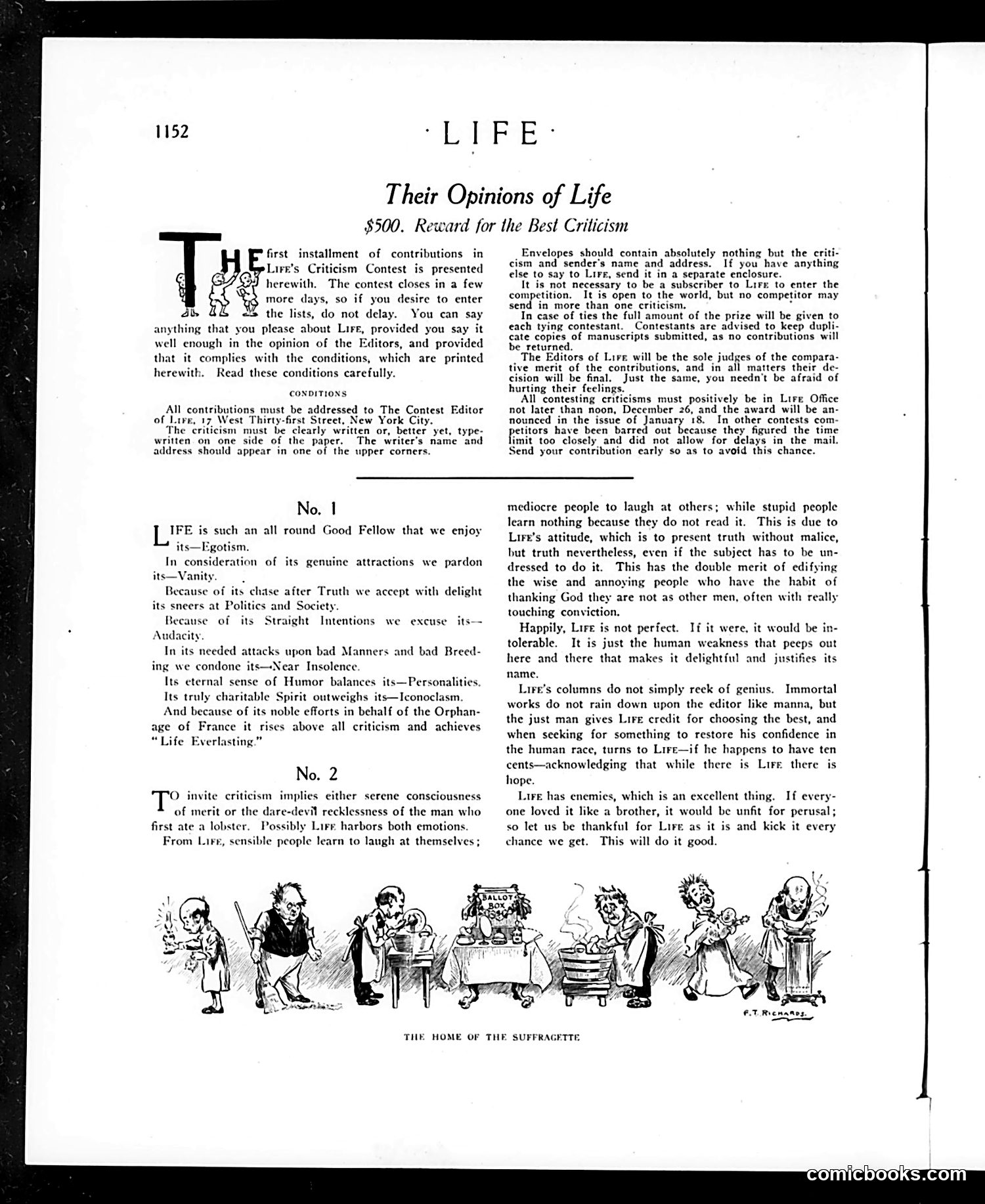
This page announces *Life* magazine's $500 contest inviting readers to submit criticism of the publication itself. The two sample submissions ("No. 1" and "No. 2") are self-referential satire—they praise *Life* while simultaneously mocking its flaws. "No. 1" uses backhanded compliments: *Life* is a "Good Fellow" despite its egotism and vanity; its attacks on politics and society are forgiven because of its "charitable spirit." The caption is sarcastic. "No. 2" suggests only confident or reckless people invite criticism, implying *Life* is either arrogant or foolhardy. The cartoon below ("The Home of the Suffragette") depicts women activists—likely referencing contemporary women's suffrage movements—in a domestic setting, further satirizing *Life's* irreverent commentary on social and political issues of the era. The contest itself demonstrates *Life's* self-aware, tongue-in-cheek editorial philosophy: inviting public critique while remaining confident in its satirical mission.
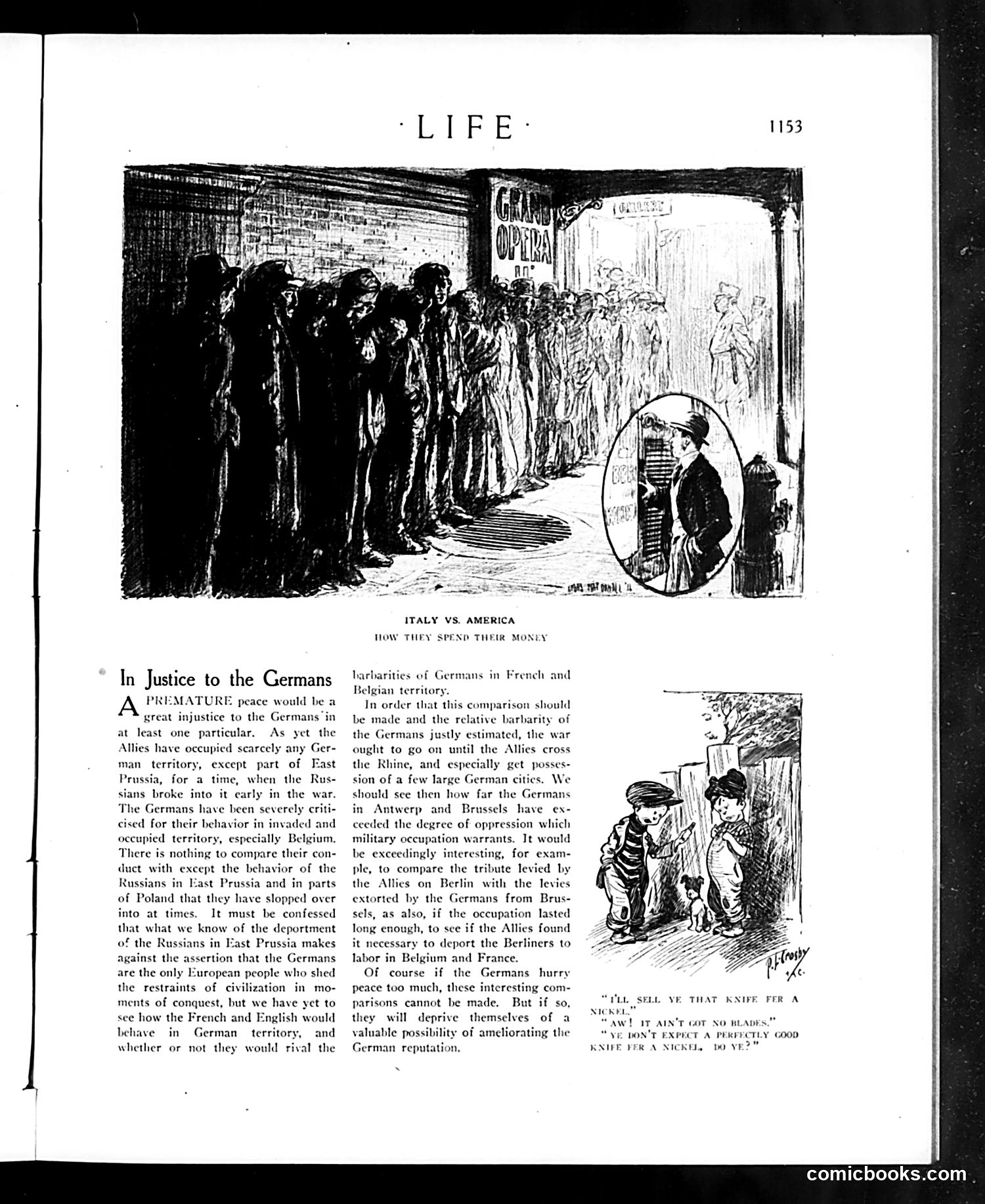
This page contains two satirical pieces from Life magazine during World War I. **"In Justice to the Germans"** (main article): The author argues sarcastically that Germany shouldn't be judged for atrocities in occupied Belgium and France until the Allies occupy German territory and can be observed behaving the same way. The cynical point: all occupying armies commit brutalities, so condemning only the Germans is hypocritical. The author suggests prolonging the war specifically to test whether French and English soldiers would match German conduct in conquered German cities—implying they likely would. **"Italy vs. America: How They Spend Their Money"** (cartoon): Shows contrasting national stereotypes. The left panel depicts Italians at an opera house (cultural refinement, leisure). The right cartoon shows an American street vendor attempting to sell a broken knife for a nickel, with dialogue mocking the poor quality. The satire targets American materialism and commerce versus European sophistication—a common period stereotype portraying Americans as cheap, unsophisticated traders.
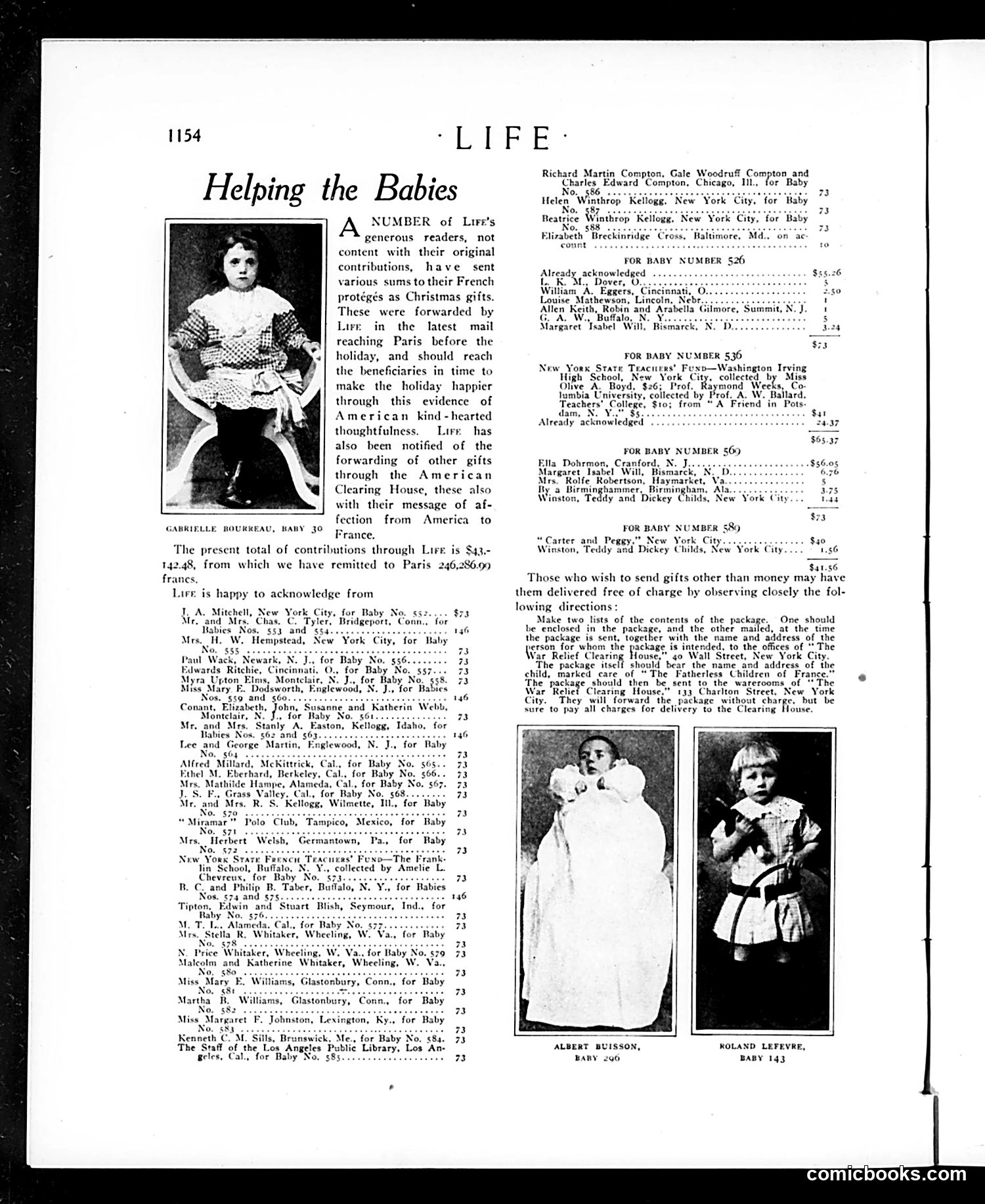
This page documents *Life* magazine's charitable fundraising initiative to aid French children during World War I. The main content is a donor acknowledgment list rather than satire or political cartoon. The article explains that *Life* readers have contributed money—totaling $43,142.48—designated for specific French orphans or war-affected children, identified by number (Baby No. 526, 536, etc.). Donors' names and contributions are listed, showing middle-class Americans adopting individual French children as Christmas beneficiaries. The three photographs show actual children being supported: Gabrielle Rourkeau, Albert Buisson (Baby 296), and Roland Lefevre (Baby 143). **Context for modern readers**: This reflects American humanitarian response to WWI devastation, the nascent "sponsorship" model of international aid, and how *Life*—despite its satirical reputation—also engaged in serious wartime charity work. The page demonstrates early-20th-century philanthropic practices and American concern for Allied nations' civilian populations.
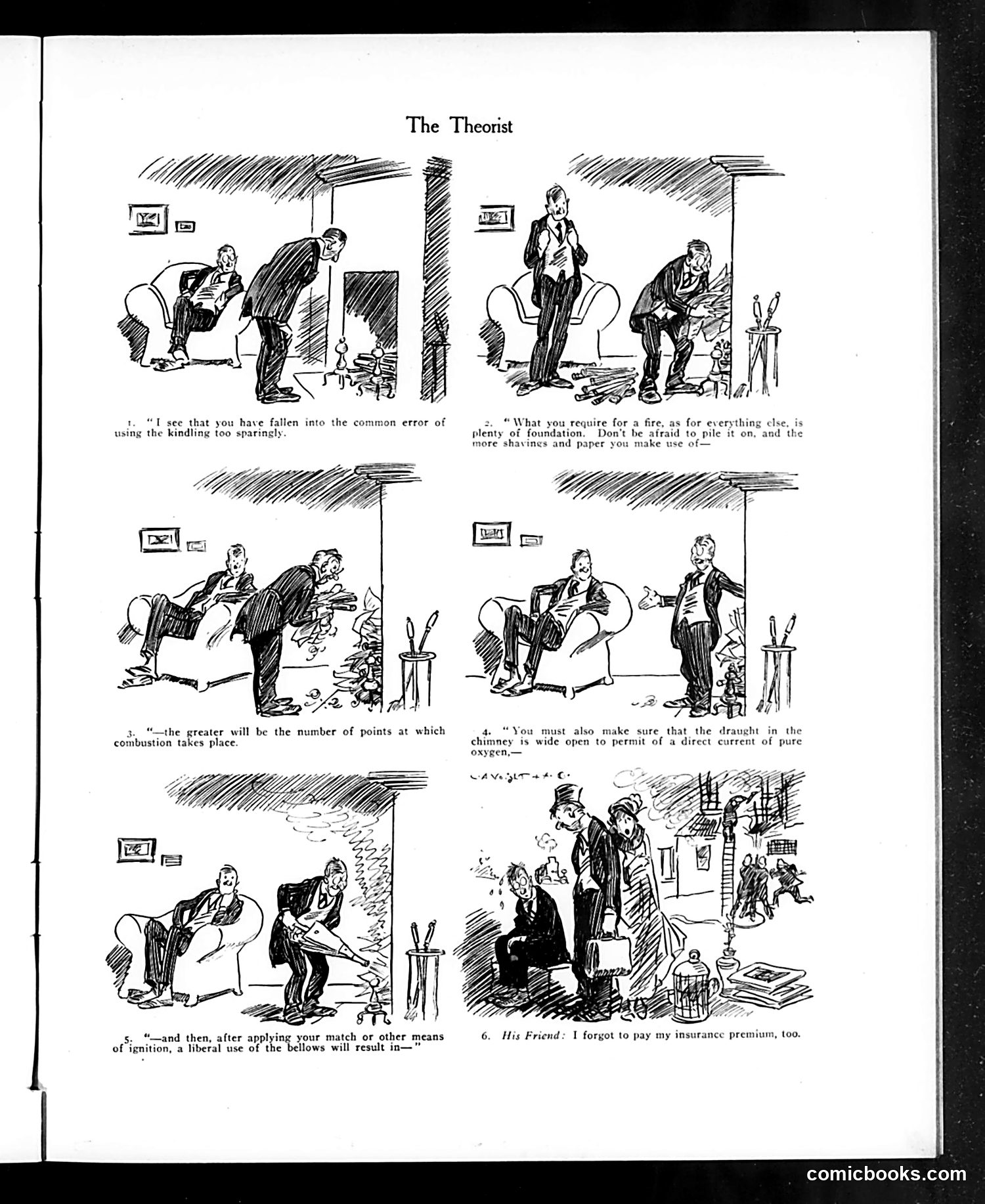
This six-panel satirical comic mocks overly intellectual or pedantic advice-givers. A well-dressed "theorist" lectures his friend on the "proper" scientific method for building a fire, using unnecessarily complex terminology: discussing "combustion," "foundation," "draught," and "pure oxygen" for what should be a simple task. Each panel shows the theorist elaborating increasingly pretentious instructions while the friend attempts practical fire-building. The humor culminates in panel 6, where the friend admits he "forgot to pay my insurance premium"—implying the theorist's overcomplication has caused a disaster (likely a house fire). The satire targets people who overcomplicate simple matters through pseudo-intellectual jargon, a timeless human folly that remains recognizable today.
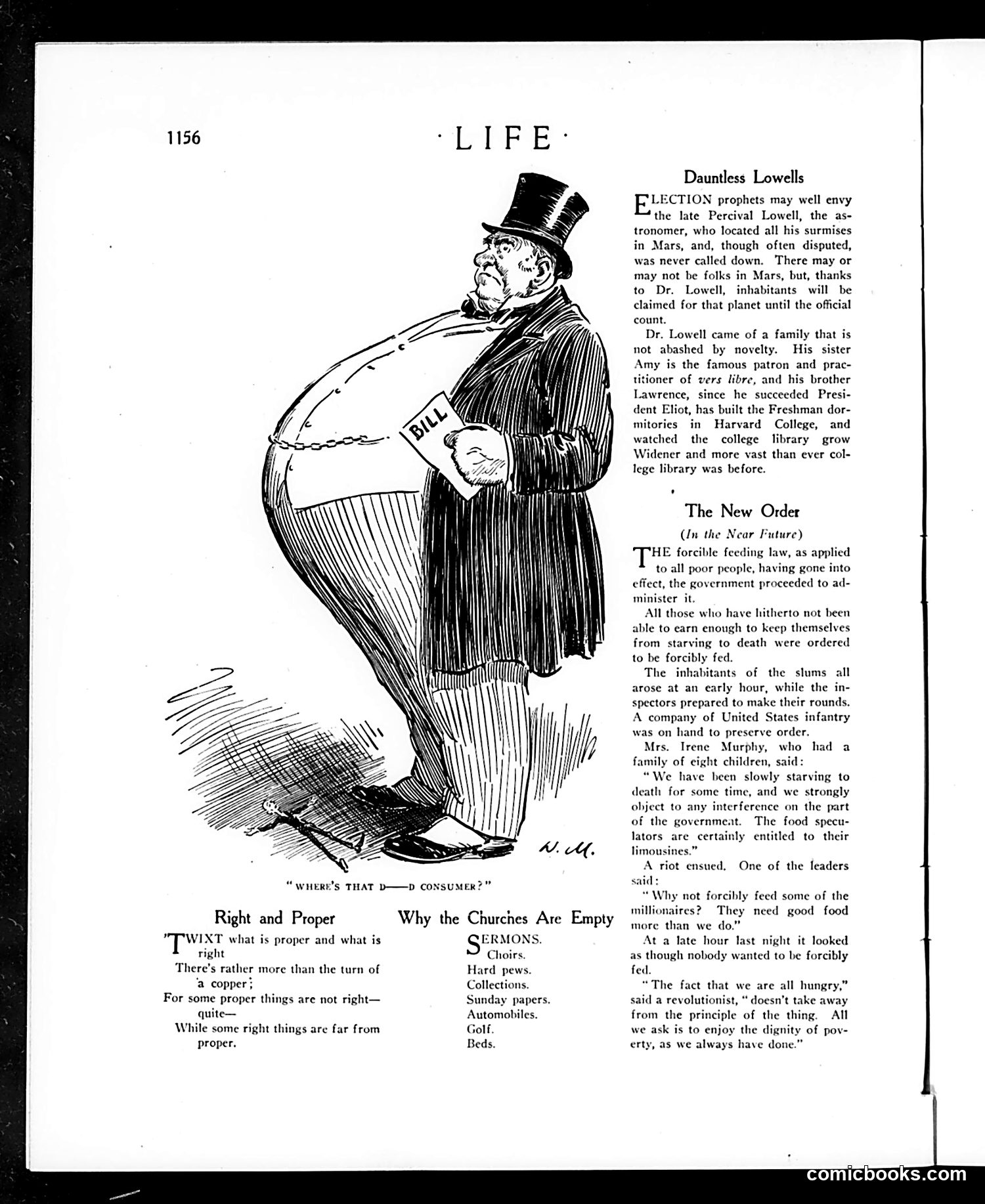
**The Main Cartoon** depicts a portly man labeled "Bill" (likely representing a politician or bill in Congress) holding a globe, with the caption "WHERE'S THAT D—D CONSUMER?" This satirizes concerns about where consumers or ordinary people fit into economic policy—suggesting they're being overlooked or exploited. **"Right and Proper"** is a brief philosophical poem about the tension between what's morally right versus socially acceptable. **"Why the Churches Are Empty"** humorously lists what competes with churchgoing: sermons, choirs, collections, newspapers, automobiles, golf, and beds—implying modern distractions have displaced religious observance. **"The New Order"** is sharp political satire. It imagines a dystopian future where the government forcibly feeds poor people (presented as "help"), yet the poor ironically resist, defending their "dignity of poverty" rather than accept government intervention. The satire targets both paternalistic government policies and the absurdity of the poor defending a system that starves them—while wealthy "food speculators" enjoy limousines.
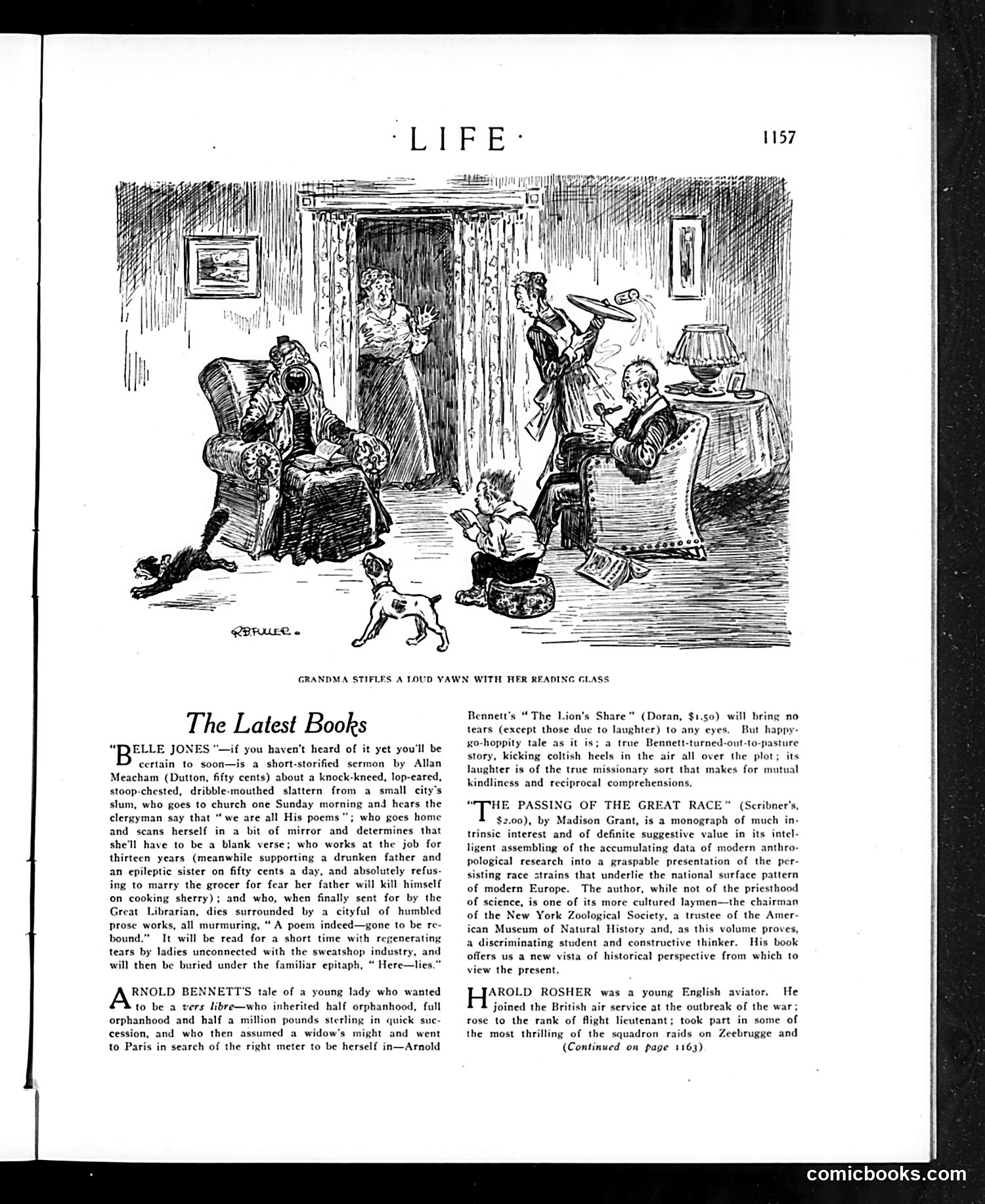
The cartoon depicts a domestic scene where an elderly grandmother stifles a yawn behind her reading glasses while surrounded by family members in a Victorian parlor. The satire targets contemporary literary works reviewed below. The "Latest Books" section mocks sentimentalist fiction: Allan Meacham's *"Belle Jones"* is ridiculed as manipulative melodrama—a preachy story about a poor woman's moral redemption designed to wring tears from readers, particularly women sympathetic to social causes, before being forgotten. Arnold Bennett's *"The Lion's Share"* receives backhanded praise as entertaining fluff for the masses. Madison Grant's *"The Passing of the Great Race"* receives serious treatment as scholarly anthropology examining European racial strains and historical perspective. The cartoon suggests that popular sentimental fiction bores discerning readers—the grandmother's suppressed yawn captures the disconnect between such books' emotional manipulation and actual literary merit. It's period satire on lowbrow versus highbrow literature tastes.
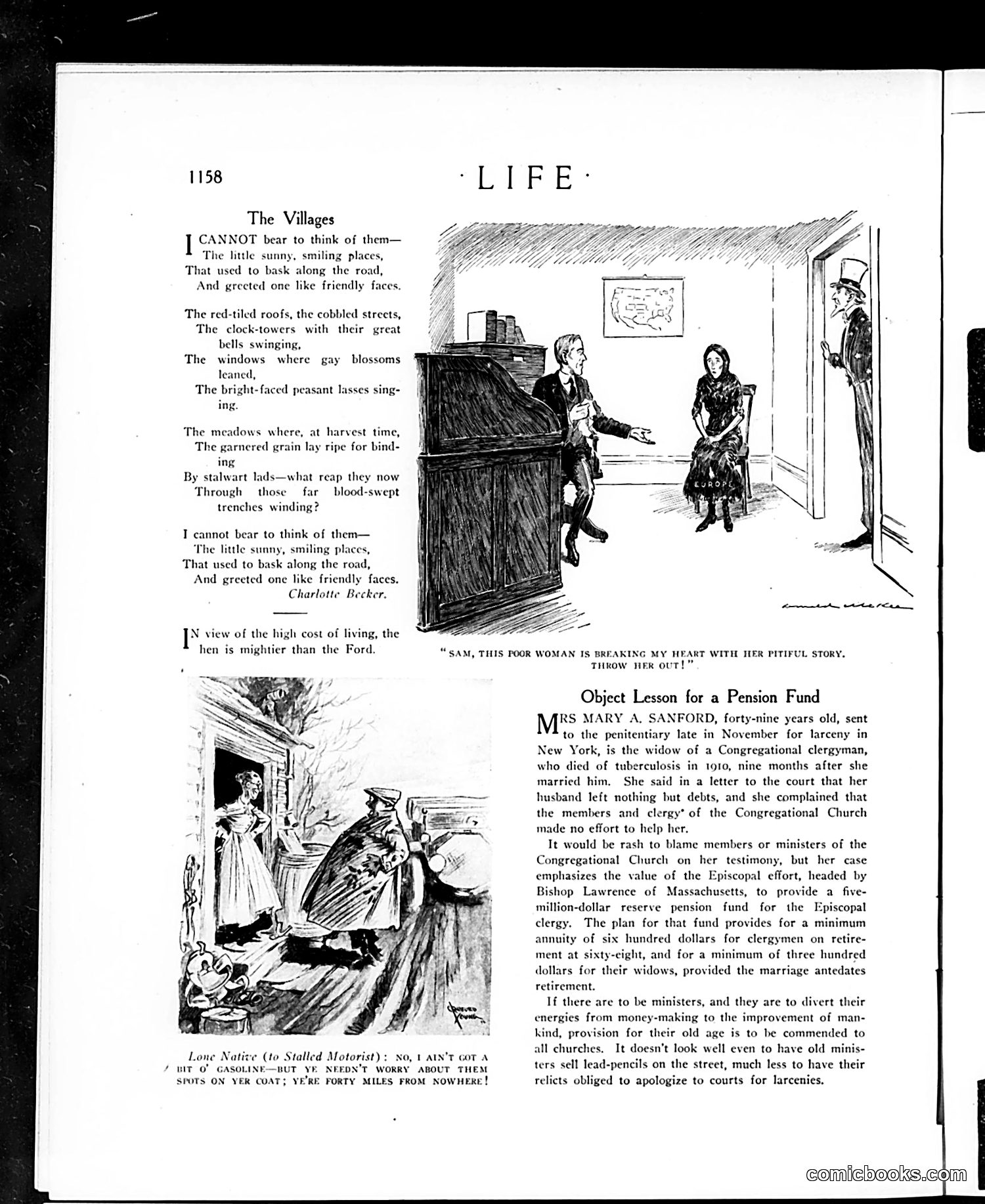
**"The Villages" Poem:** A nostalgic elegy lamenting the destruction of peaceful European village life caused by World War I. The poem, attributed to Charlotte Becker, mourns the pastoral idyll—red-tiled roofs, church bells, peasant girls singing—now devastated by the "blood-swept trenches" of the war. **Top Cartoon:** Shows a man dismissing a poor woman from his office with the callous remark "Throw her out!" — illustrating heartlessness toward the vulnerable. **"Object Lesson for a Pension Fund":** A critical article about Mrs. Mary Sanford, a 49-year-old widow imprisoned for theft. Her clergyman husband died leaving only debts; the Congregational Church abandoned her. The piece uses her case to advocate for the Episcopal Church's five-million-dollar clergy pension fund, arguing that ministers shouldn't need to sell pencils on streets or have widows resort to crime out of desperation. **Bottom Cartoon:** Rural humor about fuel scarcity—a motorist stranded without gasoline, told by a local he needn't worry about stains since he's "forty miles from nowhere."
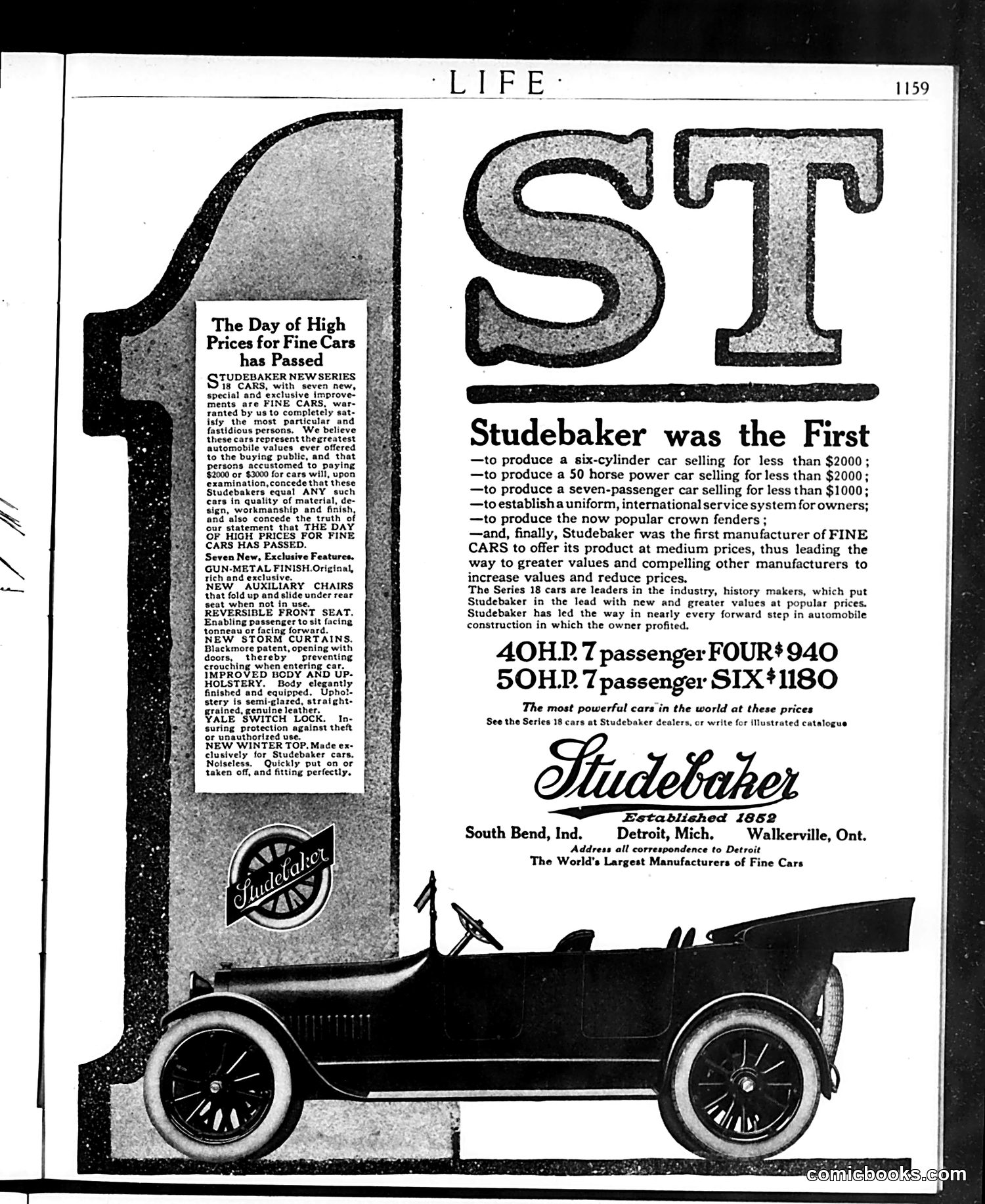
This is primarily a **Studebaker automobile advertisement**, not political satire. The page's central claim—"The Day of High Prices for Fine Cars Has Passed"—addresses the post-WWI economic context when automobile prices were declining due to increased manufacturing efficiency and competition. The advertisement emphasizes Studebaker's innovations and affordability, positioning the company as an industry leader that forced competitors to reduce prices. The "FIRST" claims (six-cylinder under $2000, 50 horsepower cars, etc.) establish market dominance. The large "1" graphic and prominent "ST" letters serve as visual branding rather than satirical commentary. The accompanying automobile illustration showcases the product. **Context for modern readers**: This reflects an era when automobiles were luxury goods transitioning to consumer products. The ad's competitive messaging reflects genuine price wars among manufacturers, with Studebaker claiming credit for making fine cars accessible to middle-class buyers—a significant cultural shift of that era.
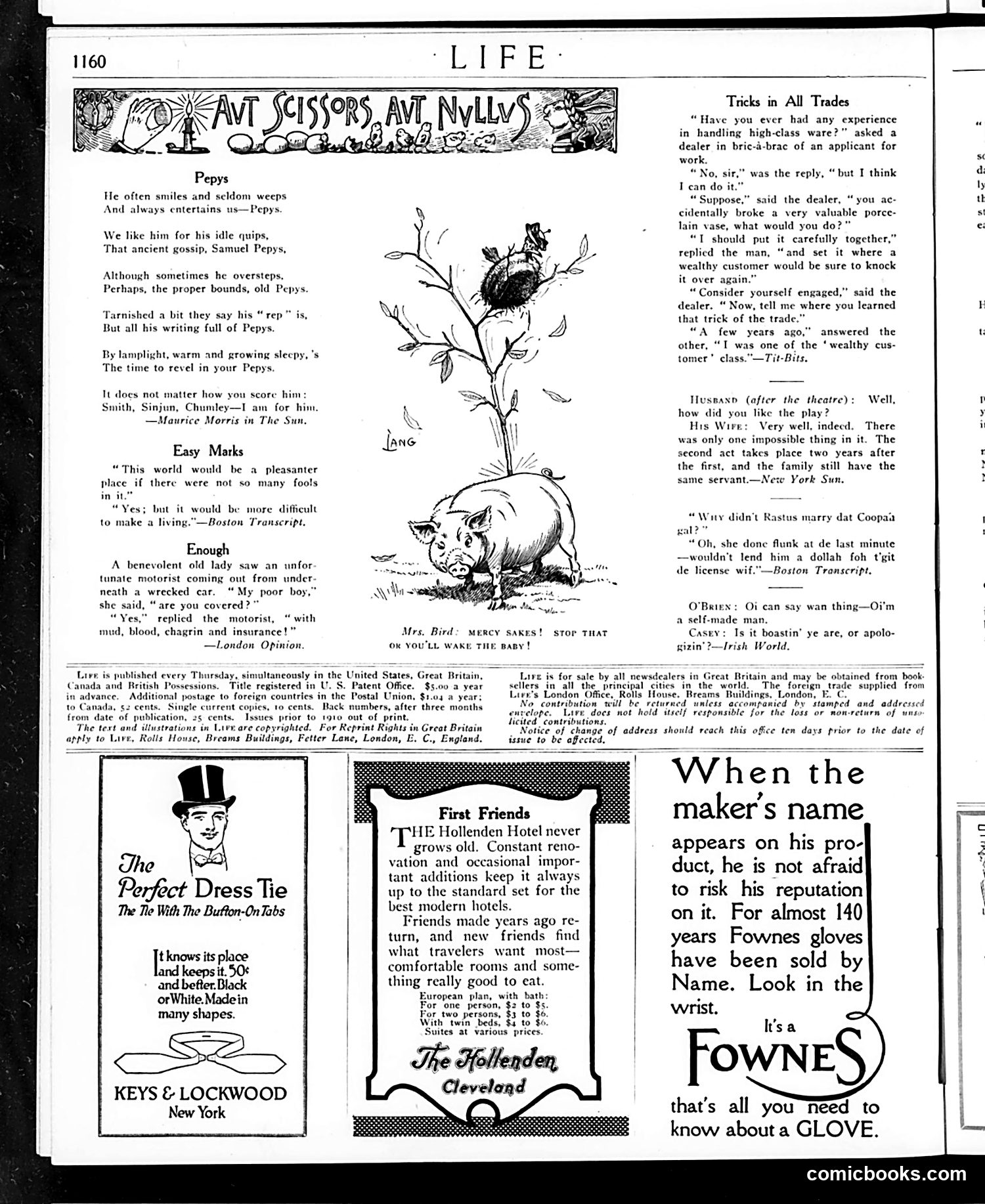
This page contains **humor columns and advertisements** rather than political cartoons. The content reflects early 20th-century American satirical sensibilities. The humor pieces use **ethnic and racial stereotypes common to the era**: an Irish character, a Black character named "Rastus," and working-class figures. The jokes rely on dialect humor and class-based comedy that would be considered offensive today. The "Tricks in All Trades" piece satirizes **servant-employer dynamics**, depicting a job applicant who admits to intentionally breaking expensive items for wealthy customers—suggesting servants exploited their employers' carelessness. Other jokes target **motorists, newlyweds, and self-made men**, poking fun at contemporary social types. The poetry section celebrates Samuel Pepys, the 17th-century diarist. The advertisements for **Fownes gloves, Perfect Dress Ties, and the Hollenden Hotel** emphasize brand reputation and quality—consistent with Life's affluent readership. The page reflects a publication aimed at educated, wealthy readers with tastes for genteel humor and consumer goods.
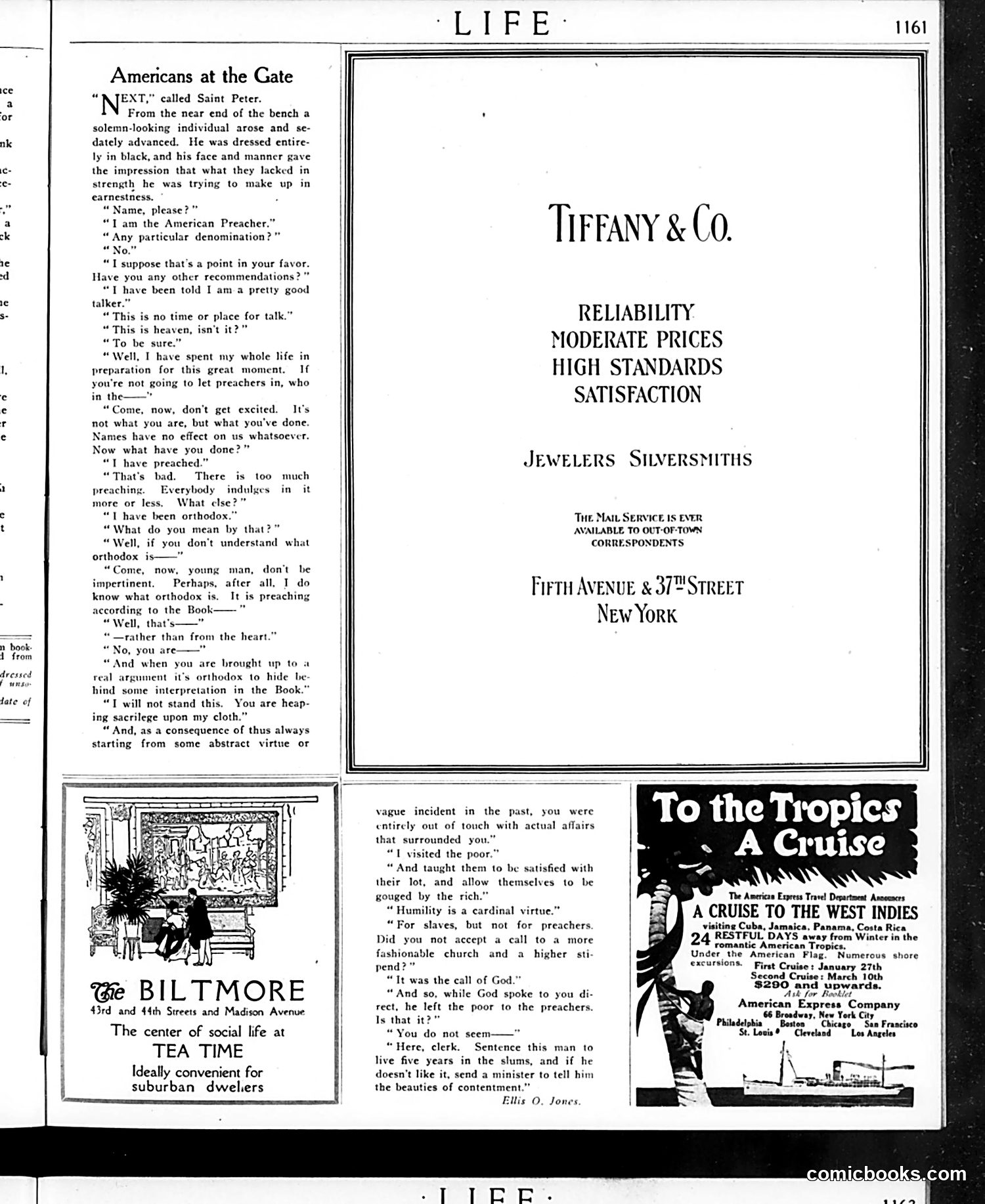
This cartoon depicts Saint Peter interrogating an "American Preacher" at heaven's gate. The satire targets clergy who prioritize formal orthodoxy and abstract doctrine over practical charity and social justice. Saint Peter condemns the preacher for: preaching excessively; hiding behind scriptural interpretation rather than acting from genuine compassion; visiting the poor only to teach them acceptance of their poverty rather than challenging injustice; and accepting calls to wealthy churches for higher stipends while abandoning the poor. The punishment—five years in the slums—inverts the preacher's own philosophy: experiencing actual suffering rather than merely preaching about virtue. The cartoon criticizes American Protestant clergy for spiritual hypocrisy: using religion to maintain social hierarchies and economic inequality rather than genuinely serving the disadvantaged. This reflects early-20th-century Progressive Era critiques of institutional religion's complicity in poverty and exploitation.
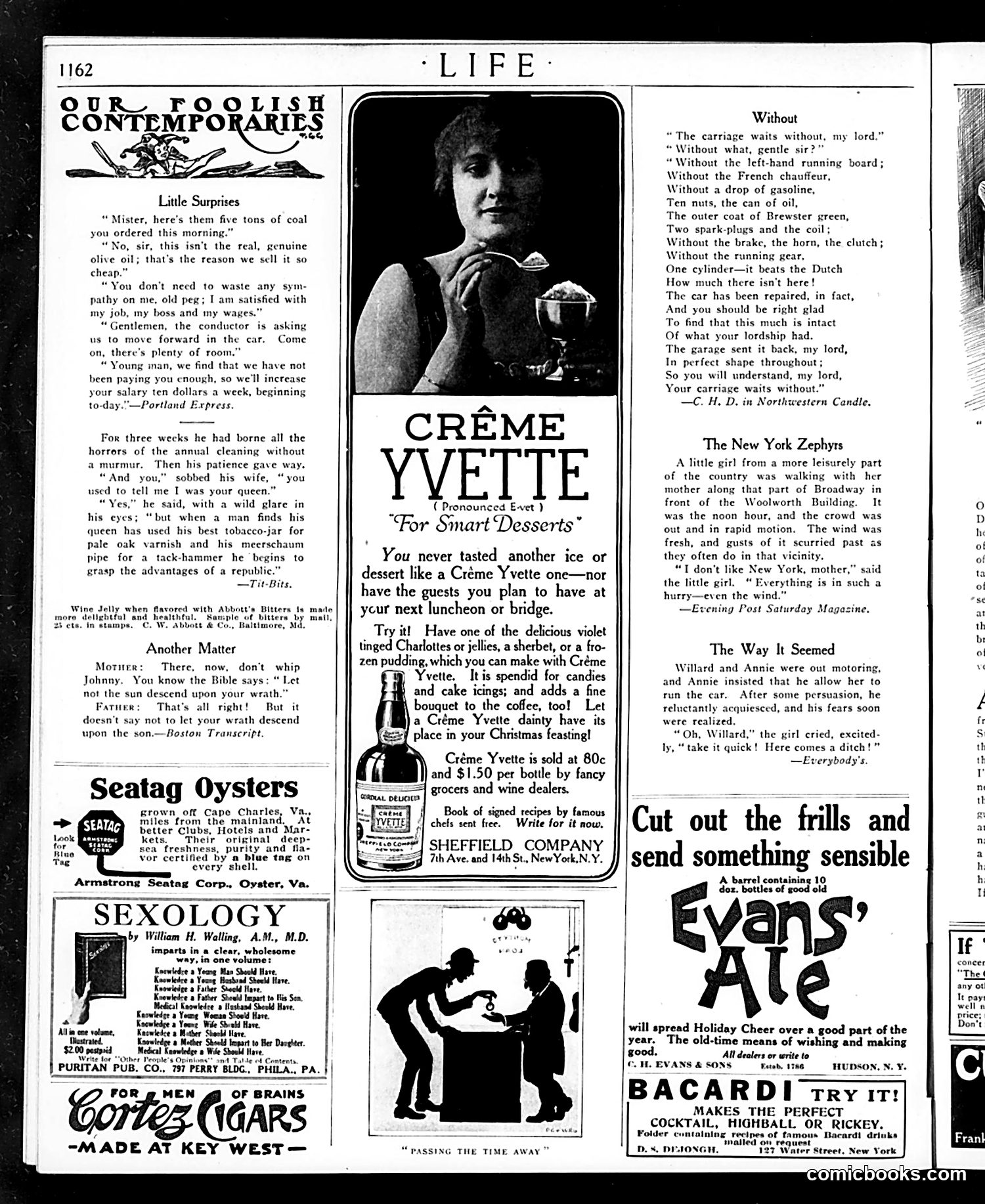
This is primarily a **advertisements and humor page** from Life magazine (circa 1920s, based on style). The content includes: **Main Satirical Pieces:** - "Little Surprises": office humor about coal delivery and salary discussions - "Without": A poem mocking wealthy car owners listing all the expensive auto parts their "lordship" lacks after repairs - "The New York Zephyrs": A child's observation that New York City is rushed and impersonal ("even the wind" hurries) - "The Way It Seemed": A joke about a woman driving while a man panics **Context:** These sketches satirize **class differences** (mocking the wealthy), **gender roles** (women drivers as comedic), and **modern city life's frenetic pace**. **Advertisements:** The page heavily features luxury goods—Crème Yvette dessert, Bacardi rum, Evans' Ale—typical of the prosperous 1920s before the Depression. The overall tone reflects period attitudes: gentle mockery of the rich, nervousness about women's changing roles, and ambivalence about urban modernity.
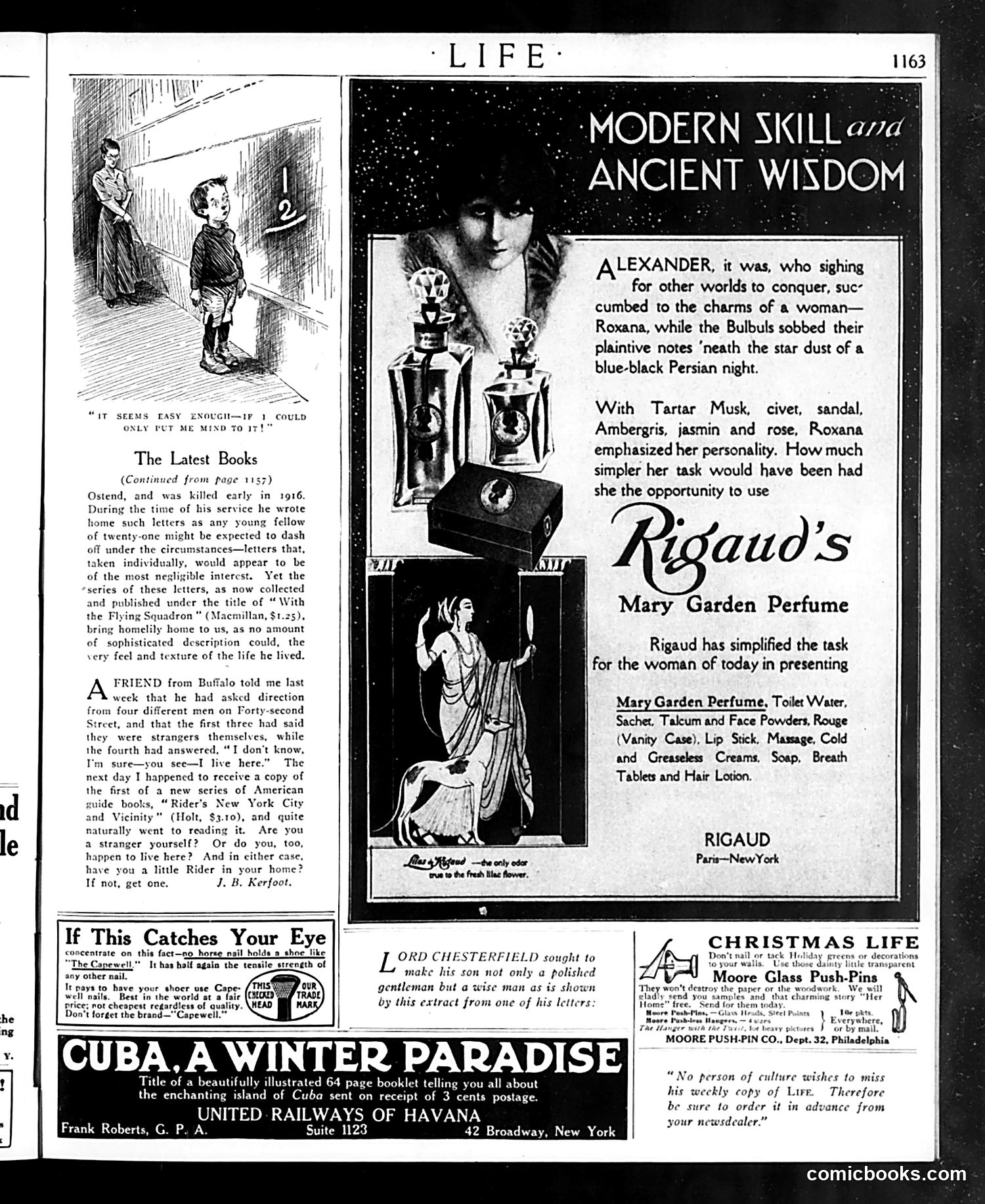
The page contains mostly **advertising and book reviews**, not political cartoons. The small sketch (top left) is a humorous domestic scene: a child asks his mother "It seems easy enough—if I could only put me mind to it!"—suggesting laziness or lack of focus. This illustrates a book review discussing letters home from a soldier in World War I. The main content is a **Rigaud perfume advertisement** featuring classical and romantic imagery (Alexander the Great, the woman Roxana, classical figures). It appeals to sophistication by invoking ancient history and "Persian nights" while actually promoting modern convenience—Rigaud has made maintaining femininity simpler for "the woman of today" by offering an integrated product line (perfume, powder, creams, etc.). The advertisement conflates "modern skill" with "ancient wisdom," suggesting that contemporary beauty products allow women to effortlessly embody timeless feminine allure. This reflects early-20th-century marketing that positioned consumer goods as democratizing luxury.
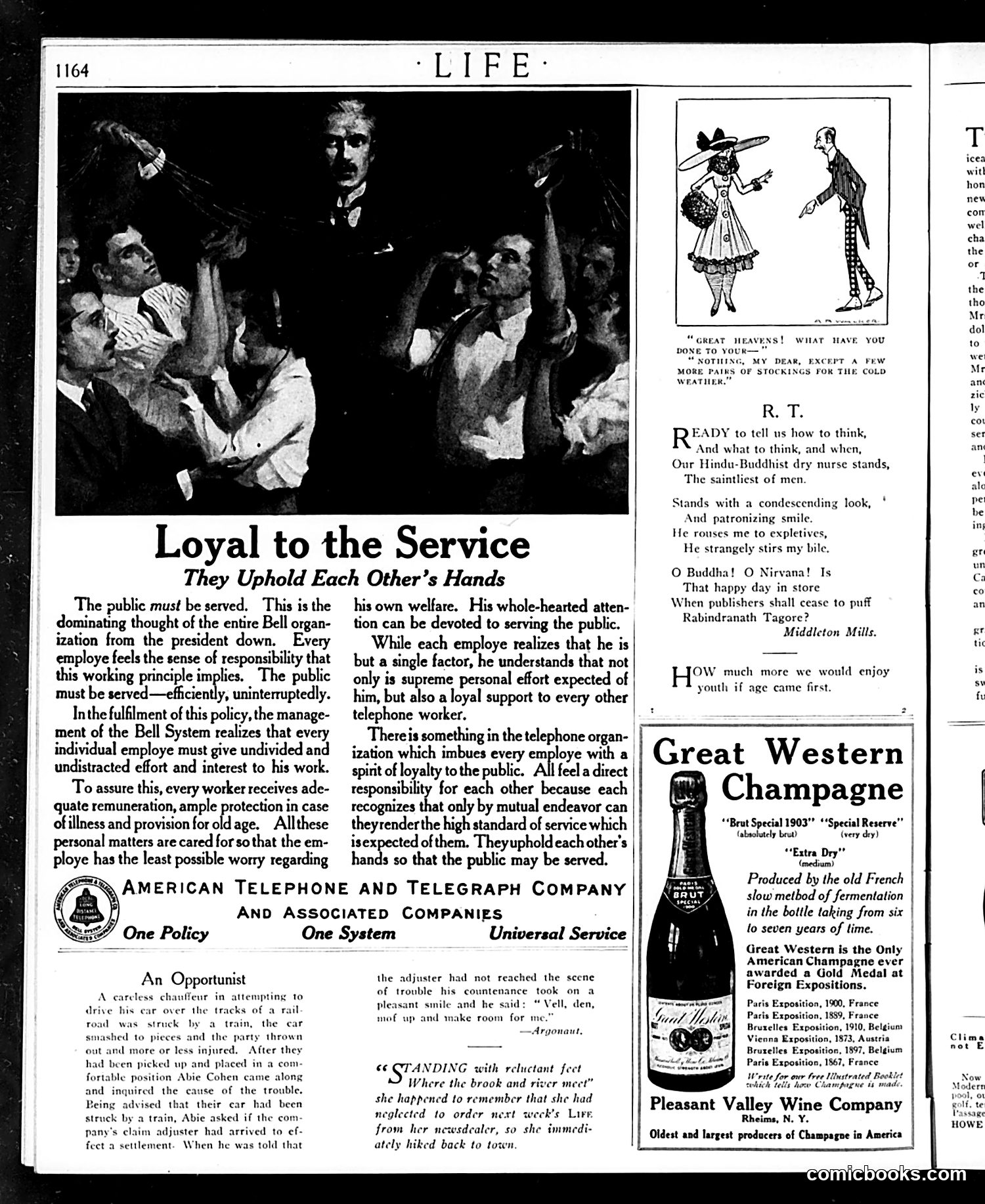
This page contains **corporate advertising and light satirical content**, not political cartooning in the traditional sense. The dominant feature is a **Bell Telephone Company advertisement** celebrating employee loyalty and mutual support. The accompanying photograph shows workers helping each other, illustrating the company's philosophy that employees must serve the public through dedicated mutual effort. The page also includes several humorous anecdotes: - **"An Opportunist"**: A joke about Abie Cohen, a Jewish character type common in period humor, who sees a railroad accident and immediately tries to profit by inserting himself into the scene. - **"R.T." poem**: Satirizes Rabindranath Tagore (the Hindu philosopher then popular in America) as a condescending spiritual guru whose work publishers promote excessively. The remaining content is **product advertising** (champagne, wine). The satire is gentle and commercial rather than politically pointed—typical of Life's advertising-heavy format in this era.
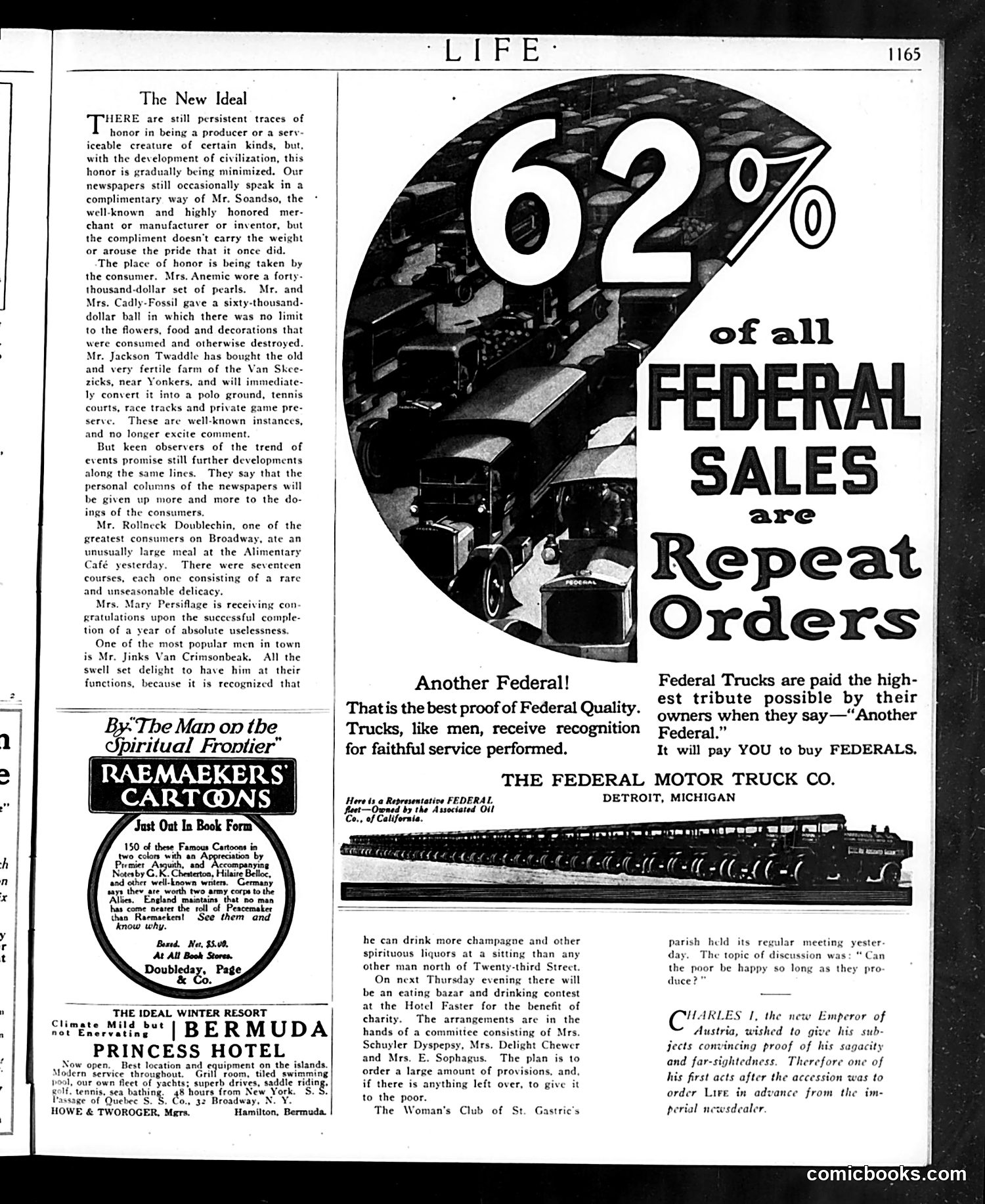
This essay satirizes the shifting values of American society. Traditionally, honor accrued to producers—merchants, manufacturers, inventors. But modern civilization has reversed this: honor now belongs to *consumers*—those who spend lavishly and wastefully. The piece ridicules wealthy figures with absurd names (Mrs. "Anemic," Mr. "Doublechin," Mr. "Van Crimsonbeak") celebrated solely for consumption: wearing expensive pearls, hosting extravagant balls, converting farms into leisure facilities, eating seventeen-course meals. Even Mr. Van Crimsonbeak's popularity derives entirely from his capacity to drink champagne. The satire culminates in a charity eating contest where organizers (with telling names like "Dyspepsy" and "Sophagus") plan to order excess food, donating leftovers to the poor—consumption as virtue. This targets the Gilded Age/Progressive Era's conspicuous consumption and questions whether a society valuing destruction of resources over productive work represents genuine civilization or moral decline.
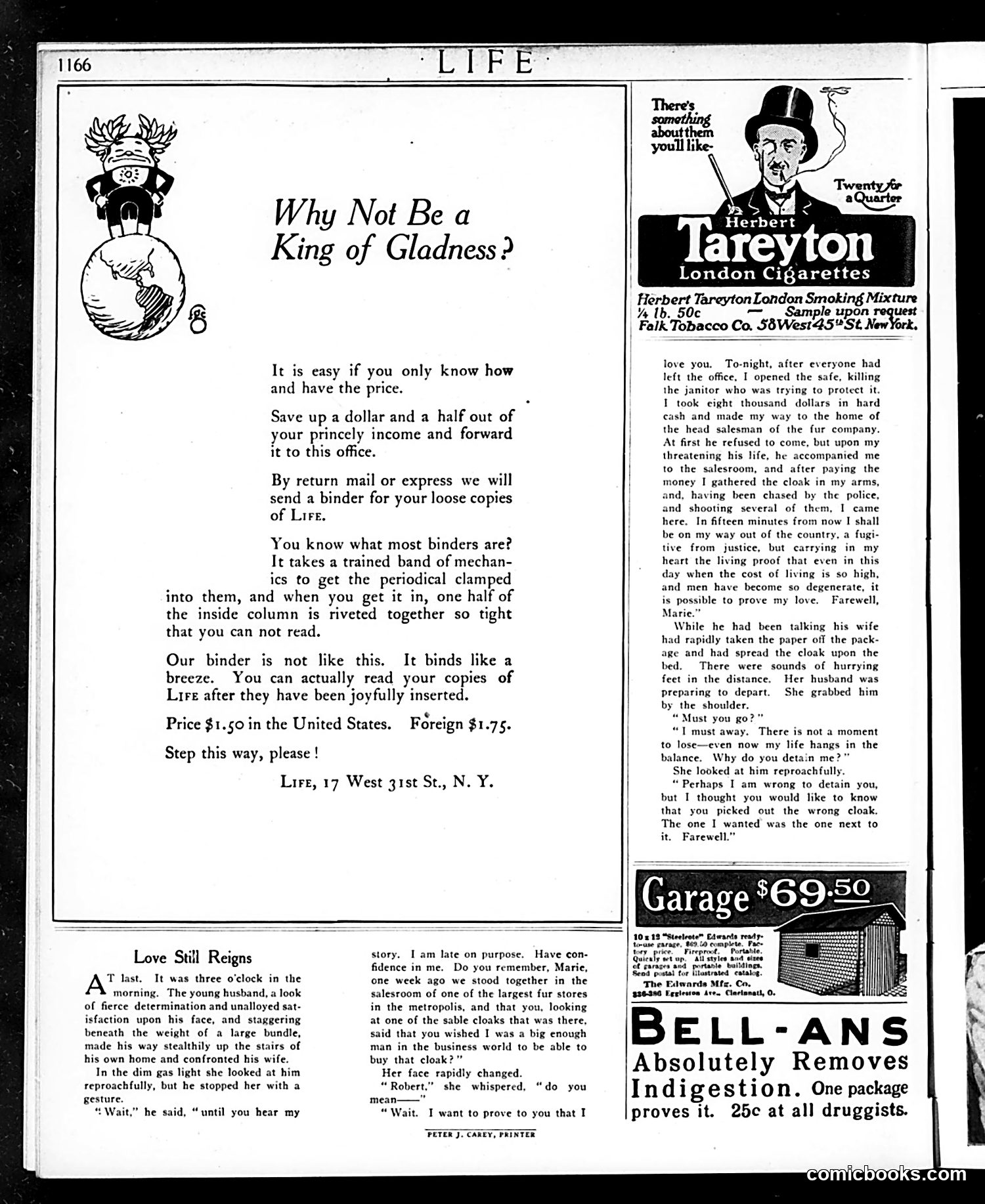
This page contains three distinct elements: **Left side:** A LIFE magazine subscription advertisement disguised as satirical copy. The "King of Gladness" pitch humorously sells magazine binders at $1.50, emphasizing their superior design compared to competitors' riveted binders that prevent reading. **Center story:** "Love Still Reigns" is dark satirical humor about marital devotion. A husband commits multiple felonies—murder, robbery, assault—to purchase an expensive fur coat for his wife as proof of love. The punchline subverts romantic sentiment: after he recounts his crimes, his wife reveals he bought her the *wrong cloak*, making his sacrifice pointless. The satire critiques both masculine materialism and female materialism in marriage. **Right side:** Period advertisements for Herbert Tareyton cigarettes, a garage, and Bell-Ans indigestion remedy. The "Love Still Reigns" story exemplifies Life magazine's satirical approach: taking contemporary social values (consumerism, romantic love, gender dynamics) to absurd extremes to mock them. Modern readers would recognize this as dark comedy commentary on consumer culture and relationship expectations.
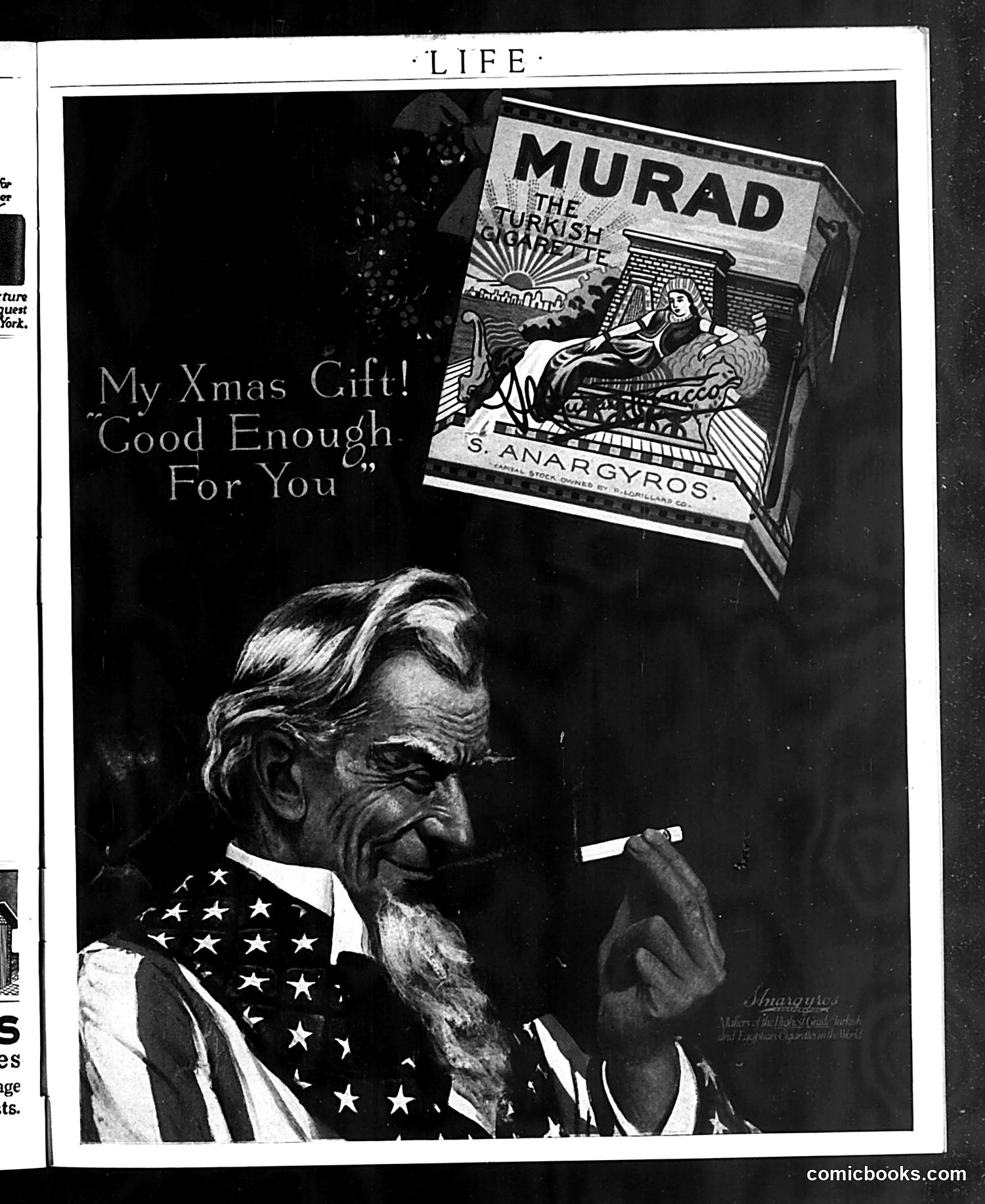
This appears to be a Christmas-themed advertisement or satirical cartoon from *Life* magazine. An elderly bearded man wearing an American flag vest and smoking a cigar looks skeptically upward at a wrapped gift box labeled "MURAD" (a cigarette brand) and "THE TURKISH CIGARETTE" with artist S. Anargyros credited below. The text reads "My Xmas Gift! 'Good Enough For You'" — presenting Murad cigarettes as a Christmas gift suggestion. The cartoon plays on American attitudes, suggesting that Turkish cigarettes are acceptable holiday presents. The figure's skeptical expression and the casual, somewhat dismissive framing creates the satirical humor, likely mocking either consumerism, gift-giving conventions, or attitudes toward imported goods in early 20th-century America.
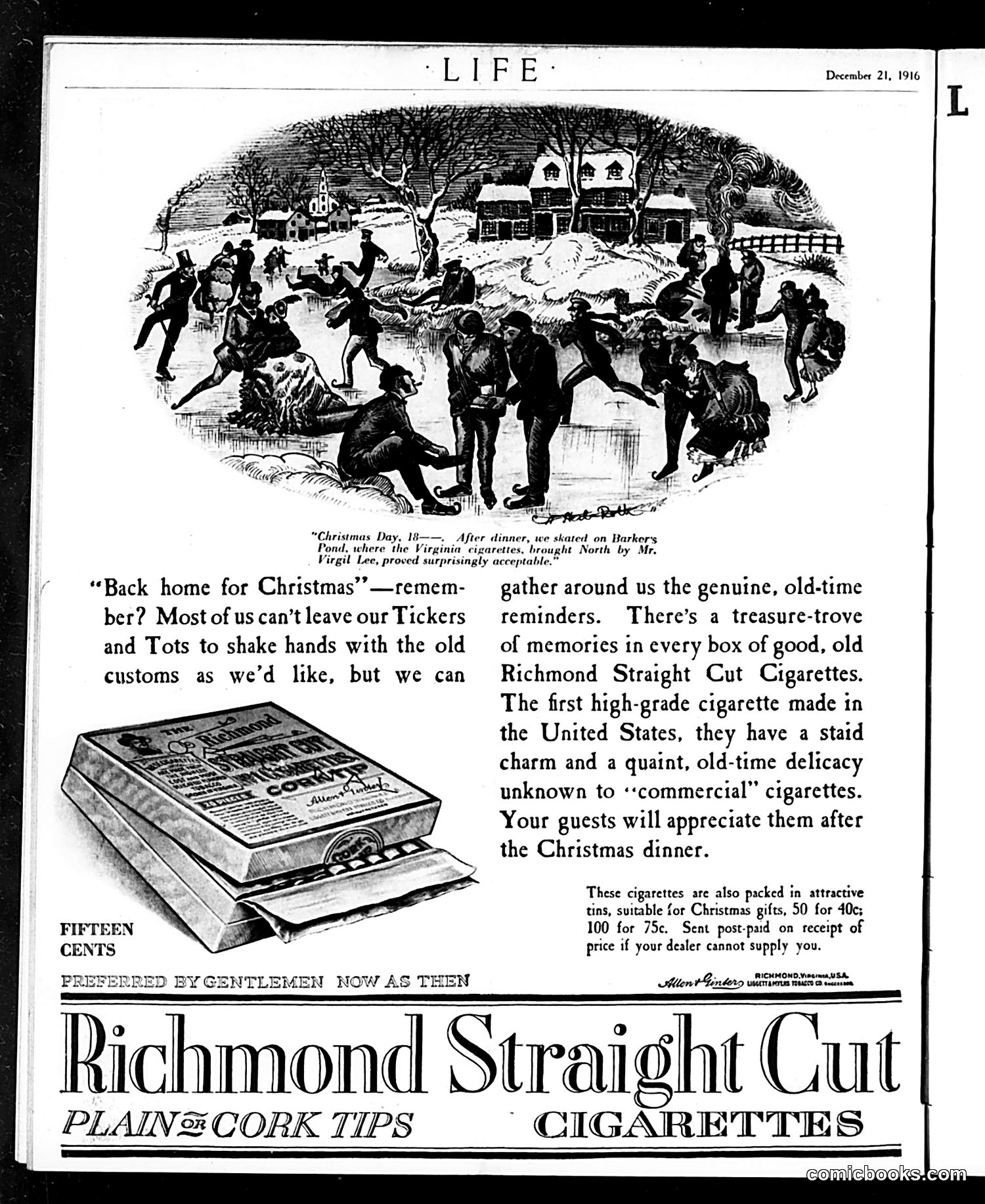
This is primarily a **cigarette advertisement** for Richmond Straight Cut Cigarettes, not political satire. The small illustration at top depicts a nostalgic Christmas scene—people ice-skating on a frozen pond near a farmhouse—with a caption referencing Virginia cigarettes brought north by someone named Virgil Lee. The ad's pitch exploits **wartime nostalgia**. Published December 21, 1916 (during World War I, before U.S. entry), it targets Americans separated from home by military service or war-related work ("Most of us can't leave our Tickers and Tots"). Richmond Straight Cut is marketed as an "old-time" luxury connecting buyers to pre-war American traditions and comfort. The advertisement claims these were "the first high-grade cigarette made in the United States" and positions them as superior to mass-produced "commercial" alternatives—a common marketing distinction of the era. The price (fifteen cents) and mail-order details suggest wartime distribution challenges. This reflects 1916 economic and social conditions, not political commentary.