
Life, 1916-12-21 · page 19 of 36
Life — December 21, 1916 — page 19: what you’re looking at
What you’re looking at
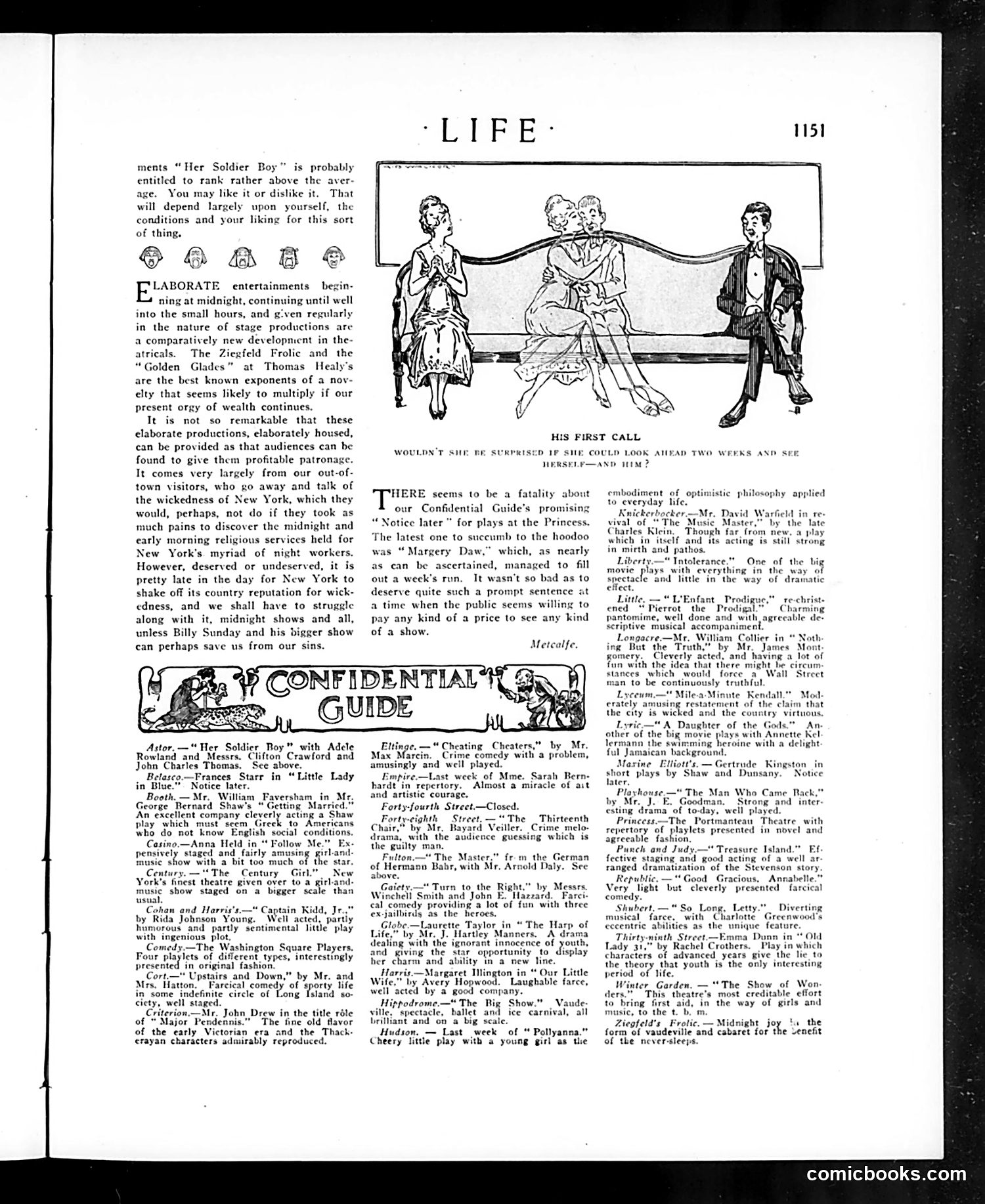
This page from *Life* magazine consists primarily of theater reviews and advertisements rather than political cartoons. The main illustration titled "His First Call" shows a young woman with two older figures, captioned with a joke about her being surprised if she could see herself two weeks ahead with "him"—likely satirizing the conventions and anxieties surrounding courtship and marriage in the early 20th century. The bulk of the page contains "The Confidential Guide," reviewing current Broadway productions. The text criticizes elaborate midnight entertainments like the Ziegfeld Frolic and "Golden Glades," noting New York's reputation for wickedness. There's a jab at the short run of "Margery Daw" at the Princess Theatre and various reviews of shows at venues like the Astor, Belasco, and Casino. The satirical point seems to be mocking both the extravagant theater productions catering to wealthy out-of-town visitors and New York's persistent moral reputation—suggesting the city embraces its "wicked" image.
📄 Transcribed text from this page (OCR, searchable)
Machine-transcribed from the original scan — historical spelling and the odd misread are preserved.
ments “Her Soldier Boy” is probably entitled to rank rather above the aver- age. You may like it or dislike it. That will depend largely upon yourself, the conditions and your liking for this sort of thing. © Oo @& B® LABORATE entertainments begin- ning at midnight, continuing until well into the small hours, and given regularly in the nature of stage productions are a comparatively new development in the- atricals. The Ziexfeld Frolic and the “Golden Glades” at Thomas Healy's are the best known exponents of a nov- elty that seems likely to multiply if our present orgy of wealth continues. It is not so remarkable that these elaborate productions, elaborately housed, can be provided as that audiences can be found to give them profitable patronage. It comes very largely from our out-of- town visitors, who go away and talk of the wickedness of New York, which they would, perhaps, not do if they took as much pains to discover the midnight and early morning religious services held for New York's. myriad of night workers. However, deserved or undeserved, it is pretty late in the day for New York to shake off its country reputation for wick- edness, and we shall have to struggle along with it, midnight shows and all, unless Billy Sunday and his bigger show can perhaps save us from our sins. HIS FIRST CALL WOULDN'T SHE TRE SURPRISED IF 8: hers HERE scems to be a fatality about our Confidential Guide's promising “Notice later” for plays at the Princess. The latest one to succumb to the hoodoo was “Margery Daw,” which, as nearly as can be ascertained, managed to fill out a week's run. It wasn't so bad as to deserve quite such a prompt sentence a time when the public seems willing to pay any kind of a price to see any kind of a show. Metcalfe. & Astor. —“ Her Soldier Roy" with Adele Rowland and Messrs. Clifton Crawford and John Charles Thomas. See above. Belasco.—Franees Starr in “Little Lady in Blue.” Notice later. Booth. — Mr. William F: George Bernard Shaw's “ Getting Married.” An excellent company cleverly acting a Shaw play which must seem Greek to Americans who do not know English social conditions. Cesino.—Anna Held in “ Follow Me." Ex- pensively staged and fairly amusing girland- Fiusic show with a bit too much of the star. Century. — "The Century Girl." New York's finest theatre given over to a girland- music show staged on a bigger scale than Cohan and Harris's.—“ Captain Kidd, Je..” by Rida Johnson Young. Well acted. ‘partiy humorous and partly sentimental little play with ingenious plot Comedy.—The Washington Square Players. Four playlets of different. types, interestingly presented in original fashion. Cort.—" Upstairs and Down,” by Mr. and Mrs. Hatton. Farcical comedy’ of sporty life in some indefinite circle of Long Island so- ciety, well staged. Criterion. —Mr. John, Drew in the title réte of “ Major Pendennis.” The fine old flavor of the early Victorian era and the Thack- erayan characters admirably reproduced. ersham in Mr, ing Cheaters," by Mr. Crime comedy with a problem, amusingly and well played. Empire.—Last week of Mme. Sarah Bern: hardt in repertory. Almost a miracle of ait and artistic courage. Forty-fourth Street.—Closed. _Forty-cighth Street, —“'The _ Thirteenth Chair,” by Mr, Bayard Veiller. Crime melo- drama, with the audience guessing which is Ma from the German of Hermann Bahr, with Mr. Arnold Daly. See above. Gaiety. Winchell Smith and John E. cal comedy providing a lot of fun exjailbirds as the heroes. Globe.—Laurette Taylor in “The Harp of Life,” by Mr, J. Hartley Manners. A dra dealing with the ignorant innocence of yout! and giving the star opportunity to display her charm and ability in a new line. Harris.—Margaret Mington in “ Our Little Wife,” by Avery Hopwood. Laughable farce, well acted by a good company. Hippodrome.—" The Big Show." —Vaude- ville, ‘spectacle, ballet and ice carnival, all brilliant and on a big scale. Hudson. — Last week of “ Pollyanna.” Cheery little play with a young girl as the ith three COULD LOOK AUEAD TWO WEEKS AND SEE LP—AND itm? embodiment of opt to everyday life. Knickerbocker —M vival of “The Music. Master,” by th Charles Klein, Though far from new, a play which in itself and its acting is still’ strong in mirth and pathos Liberty.—" Tntolerance.” movie plays with everyt ttle in stic_ philosophy David Warfield i One of the big n the way of y of dramatic ° re-christ- “Pierrot the Prodigal. Charming pantomime, well done and with agreeable de- scriptive musical accompaniment. Longacre.—Mr. William Collier in ing But the Truth,” by Mr. James 4 omery. Cleverly acted, and having a lot o} with the idea that if neces which would force a. Wall man to be continuously truthful. Lycei Mile-a-Minute Kendall" Mod: erately amusing res tof the claim that the city is wicked e country virtuous, Lyric.—" A Daughter of the Gods.” An: other of the big movie plays with Annette Ke lermann the swimming heroine with a delight. ful Jamaican background. Marine Elfiott's. — Gertrude short plays by Shaw and Dunsany. later, Playhouse —" The Man Who Came Mack,” by Mr. J. E, Goodman. Strong and inter esting d¥ama of to-day, weil pl Princess.—The Portmanteaut T repertory of playlets presented agreeable fashion, Punch and Judy.— Treasure Island.” Ef, fective staging and good acting of a well ar ranged dramatization of the Stevenson story Republic. —"* Good Gracious, Annabelle.” Very light but cleverly presented farcical comedy, Shubert, —“ So Long, Letty." Diverting musical farce, with Charlotte Greenwood's eccentric abilities as the unique feature. Thirty-ninth Street—Emma Dunn in“ Old Lady 31,” by Rachel Crothers. Play in which characters of advanced years give the lie to the theory that youth is the only interesting Kingston in Notice tre with » novel and “The Show of Won- This theatre's most creditable effort to bring first aid, in the way of girls and music, to the t. b. m. Zicgfeld’s | Frolic. — Midnight, joy ‘the form of vaudeville and cabaret for the venefit of the never-sleeps. comicbooks.com