
Life, 1916-12-21 · page 25 of 36
Life — December 21, 1916 — page 25: what you’re looking at
What you’re looking at
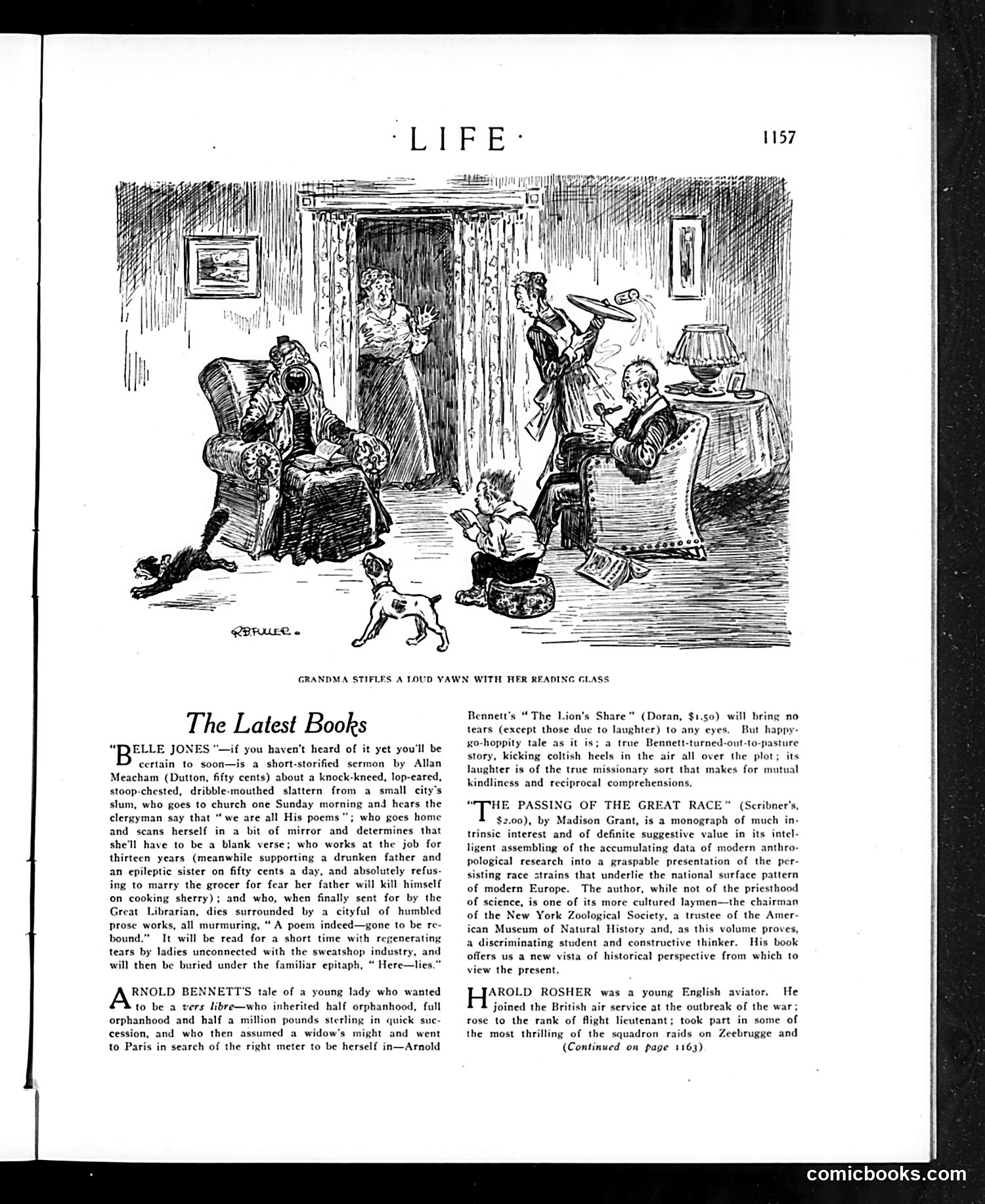
The cartoon depicts a domestic scene where an elderly grandmother stifles a yawn behind her reading glasses while surrounded by family members in a Victorian parlor. The satire targets contemporary literary works reviewed below. The "Latest Books" section mocks sentimentalist fiction: Allan Meacham's *"Belle Jones"* is ridiculed as manipulative melodrama—a preachy story about a poor woman's moral redemption designed to wring tears from readers, particularly women sympathetic to social causes, before being forgotten. Arnold Bennett's *"The Lion's Share"* receives backhanded praise as entertaining fluff for the masses. Madison Grant's *"The Passing of the Great Race"* receives serious treatment as scholarly anthropology examining European racial strains and historical perspective. The cartoon suggests that popular sentimental fiction bores discerning readers—the grandmother's suppressed yawn captures the disconnect between such books' emotional manipulation and actual literary merit. It's period satire on lowbrow versus highbrow literature tastes.
📄 Transcribed text from this page (OCR, searchable)
Machine-transcribed from the original scan — historical spelling and the odd misread are preserved.
i | Hae Ne hi GRANDMA STIFLES A LOUD YAWN WITH HER READING GLASS The Latest Books “DELLE JONES "—if you haven't heard of it yet you'll be certain to soon—is a short-storified sermon by Allan Meacham (Dutton, fifty cents) about a knock-kneed, lop-eared, stoop-chested, dribble-mouthed slattern from a small. city’s slum, who goes to church one Sunday morning and hears the clergyman say that “we are all His poems”; who goes home and scans herself in a bit of mirror and determines that she'll have to be a blank verse; who works at the job for thirteen years (meanwhile supporting a drunken father and an epileptic sister on fifty cents a day, and absolutely refus- ing to marry the grocer for fear her father will kill himself on cooking sherry); and who, when finally sent for by the Great Librarian, dies surrounded by a cityful of humbled prose works, all murmuring, “A poem indeed—gone to be re- bound.” It will be read for a short time with regenerating tears by ladies unconnected with the sweatshop industry, and will then be buried under the familiar epitaph, “ Here—lies.” RNOLD BENNETT'S tale of a young lady who wanted to be a vers libre—who inherited half orphanhood, full orphanhood and half a million pounds sterling in quick suc- cession, and who then assumed a widow's might and went to Paris in search of the right meter to be herself in—Arnold Rennett’s “The Lion's Share” (Doran, $1.50) will bring tears (except those due to laughter) to any eyes. But happy- go-hoppity tale as it is; a true Bennett-turned-out-to-pasture story, kicking coltish heels in the air all over the plot; i laughter is of the true missionary sort that makes for mutual kindliness and reciprocal comprehensions. “"THE PASSING OF THE GREAT RACE” (Scribner's, $2.00), by Madison Grant, is a monograph of much in- trinsic interest and of definite suggestive value in its intel- ligent assembling of the accumulating data of modern anthro- pological research into a graspable presentation of the per- sisting race strains that underlie the national surface pattern of modern Europe. The author, while not of the priesthood of science, is one of its more cultured laymen—the chairman of the New York Zoological Society, a trustee of the Amer- ican Museum of Natural History and, as this volume proves, a discriminating student and constructive thinker. His book offers us a new vista of historical perspective from which to view the present. 'AROLD ROSHER was a young English aviator. He joined the British air service at the outbreak of the war; rose to the rank of flight licutenant; took part in some of the most thrilling of the squadron raids on Zeebrugge and (Continued on page 1163) comicbooks.com