
Life, 1916-12-21 · page 18 of 36
Life — December 21, 1916 — page 18: what you’re looking at
What you’re looking at
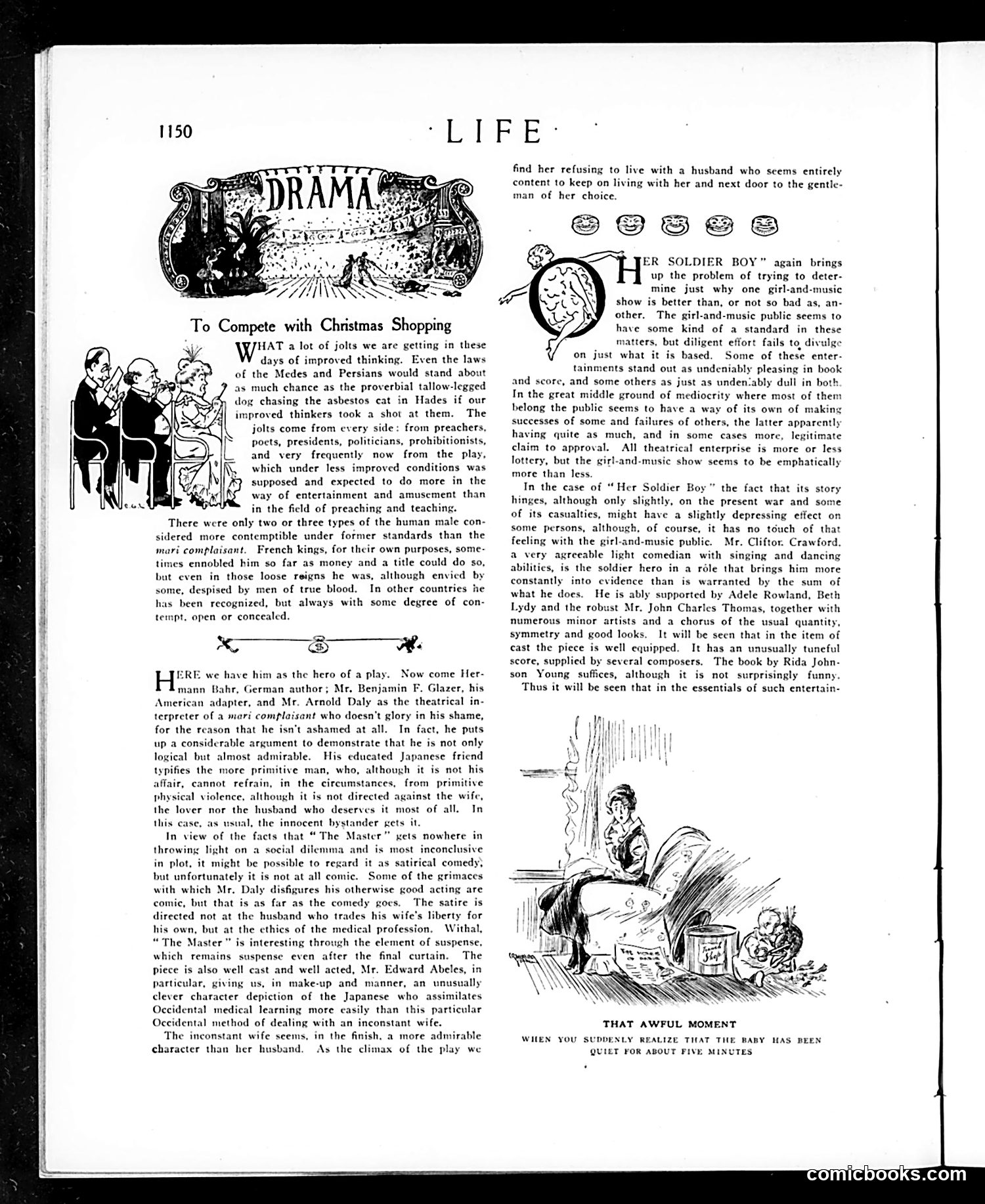
This page reviews theatrical productions, primarily criticizing "The Master," a play about a *mari complaisant* (a man who accepts his wife's infidelity). The critic attacks the play for presenting this traditionally contemptible male character as logical and admirable rather than shameful. The reviewer notes the play fails as social commentary—it's neither funny nor conclusive. Instead of satirizing the complicit husband, it critiques the medical profession. The Japanese character (played by Edward Abeles) represents "primitive" morality who resorts to violence, though significantly not against those deserving it. Ironically, the critic finds the unfaithful wife more admirable than her husband by play's end. A secondary review discusses "Her Soldier Boy," a musical whose quality the critic struggles to evaluate objectively, noting the entertainment industry's mysterious standards for success versus failure.
📄 Transcribed text from this page (OCR, searchable)
Machine-transcribed from the original scan — historical spelling and the odd misread are preserved.
ARE To Compete with Christmas Shopping HAT a lot of jolts we are getting in these days of improved thinking. Even the laws of the Medes and Persians would stand about as much chance as the proverbial tallow-legged dog chasing the asbestos cat in Hades if our improved thinkers took a shot at them. The jolts come from every side: from preachers, poets, presidents, politicians, prohibitionists, and very frequently now from the play, which under less improved conditions was supposed and expected to do more in the way of entertainment and amusement than in the ficld of preaching and teaching. There were only two or three types of the human male con- sidered more contemptible under former standards than the mari complaisant. French kings, for their own purposes, some- times ennobled him so far as money and a title could do so, but even in those loose reigns he was, although envied by some, despised by men of true blood. In other countries he has been recognized, but always with some degree of con- tempt, open or concealed. x 3) ERE we have him as the hero of a play. Now come Her- mann Bahr, German author; Mr. Benjamin F. Glazer, his American adapter, and Mr. Arnold Daly as the theatrical in- terpreter of a mari complaisant who doesn’t glory in his shame, for the reason that he isn't ashamed at all. In fact, he puts up a considerable argument to demonstrate that he is not only logical but almost admirable. His educated Japanese friend typifies the more primitive man, who, although it is not his affair, cannot refrain, in the circumstances, from primitive physical violence, although it is not directed against the wife, the lover nor the husband who deserves it most of all. In this case, as ustal, the innocent bystander gets it. In view of the facts that “The Master” xets nowhere in throwing light on a social dilemma and is most inconclusive in plot, it might be possible to regard it as satirical comedy, but unfortunately it is not at all comic. Some of the grimaces with which Mr. Daly disfigures his otherwise good acting are comic, but that is as far as the comedy gocs. The satire is directed not at the husband who trades his wife's liberty for his own, but at the ethics of the medical profession, Withal, “The Master” is interesting through the element of suspense, which remains suspense even after the final curtain. The piece is also well cast and well acted, Mr. Edward Abeles, in particular, giving us, in make-up and manner, an unusually clever character depiction of the Japanese who assimilates Occidental medical learning more casily than this particular Occidental method of dealing with an inconstant wife. The inconstant wife seems, in the finish, a more admirable character than her husband. As the climax of the play we find her refusing to live with a husband who seems entirely content to keep on living with her and next door to the gentle- man of her choice. SOSese —— ER SOLDIER BOY” again brings up the problem of trying to deter- mine just why one girl-and-music show is better than, or not so bad as, an- other. The girl-and-music public seems to have some kind of a standard in these matters, but diligent effort fails to, divulge on just what it is based. Some of these enter- tainments stand out as undeniably pleasing in book and score, and some others as just as unden‘ably dull in both In the great middle ground of mediocrity where most of ther belong the public seems to have a way of its own of making successes of some and failures of others, the latter apparently having quite as much, and in some cases more, legitimate claim to approval. All theatrical enterprise is more or less lottery, but the girl-and-music show seems to be emphatically more than less. In the case of “Her Soldier Boy” the fact that its story hinges, although only slightly, on the present war and some of its casualties, might have a slightly depressing effect on some persons, although, of course, it has no touch of that feeling with the girl-and-music public. Mr. Cliftor. Crawford. a very agreeable light comedian with singing and dancing abilities, is the soldier hero in a réle that brings him more constantly into evidence than is warranted by the sum of what he does. He is ably supported by Adele Rowland, Beth Lydy and the robust Mr. John Charles Thomas, together with numerous minor artists and a chorus of the usual quantity, symmetry and good looks, It will be seen that in the item of cast the piece is well equipped. It has an unusually tuneful score, supplied by several composers. The book by Rida John- son Young suffices, although it is not surprisingly funny. Thus it will be seen that in the essentials of such entertain- THAT AWFUL MOMENT WHEN YOU SUDDENLY REALIZE THAT THE BABY HAS BEEN QUIET FOR ABOUT FIVE MINUTES Comicbooks.com