
Life, 1916-12-21 · page 14 of 36
Life — December 21, 1916 — page 14: what you’re looking at
What you’re looking at
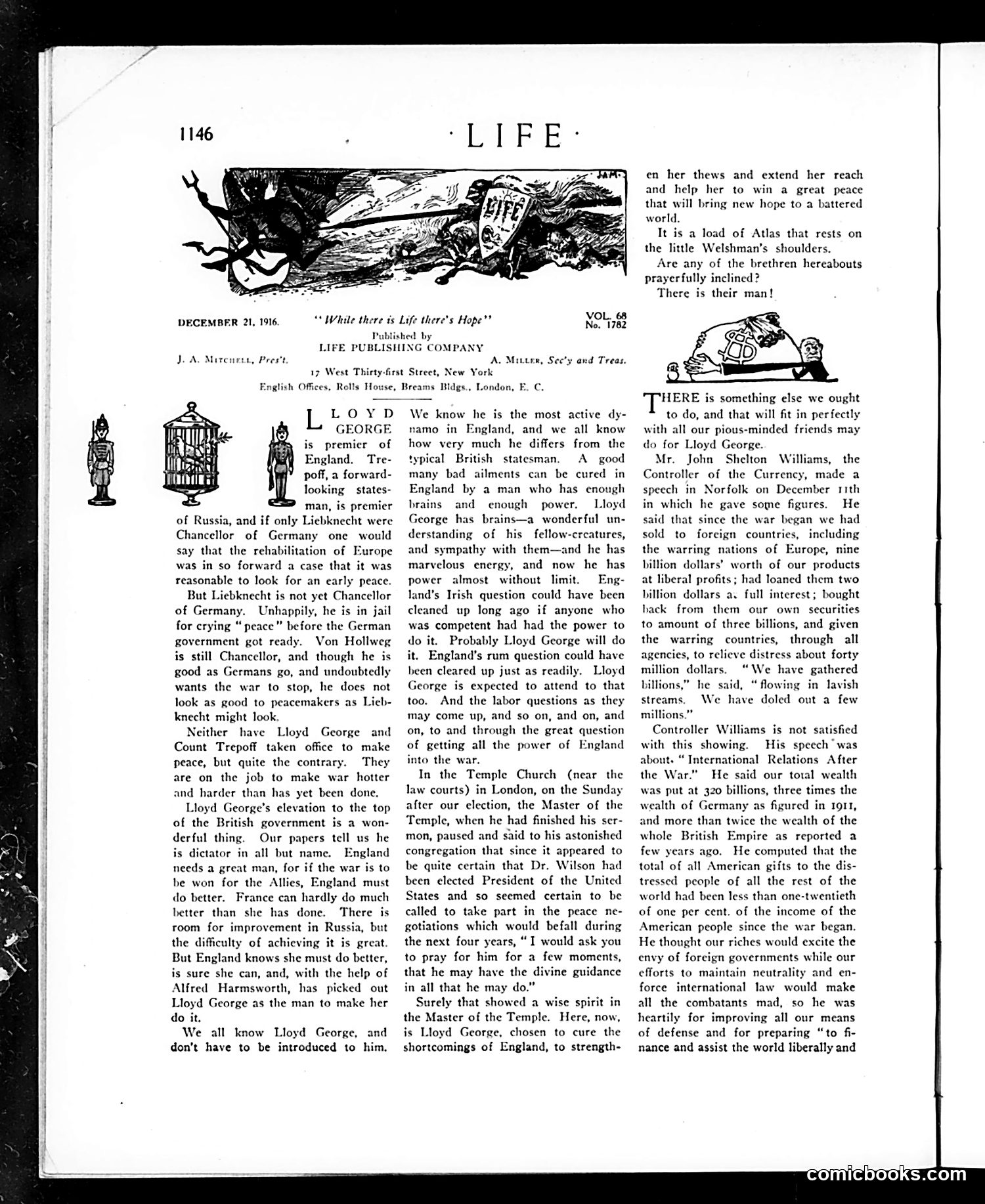
This page discusses **Lloyd George**, Britain's newly elevated political figure, in the context of World War I. The article praises his energy and problem-solving abilities, contrasting him favorably with other British leaders. It references his potential to resolve England's "Irish question" and "rum question" (prohibition), suggesting he has the power to address longstanding domestic issues. The piece also discusses **Controller of the Currency John Shelton Williams**, who apparently made a speech detailing Britain's war expenditures and America's financial support—three billion dollars lent to allied nations. The satirical tone celebrates Lloyd George as a capable leader while the broader context reflects 1916 wartime politics and Anglo-American financial relations during WWI.
📄 Transcribed text from this page (OCR, searchable)
Machine-transcribed from the original scan — historical spelling and the odd misread are preserved.
“While there is Pub LIFE PUBLIS DECEMBER 21, 1916. J. AL Mircnets, Pres’t, 17 West Thirty-fir English Offices, Rolls House, LOYD GEORGE is premier of England. Tre- poff, a forward- looking states- man, is premier of Russia, and if only Liebknecht were Chancellor of Germany one would say that the rehabilitation of Europe was in so forward a case that it was reasonable to look for an early peace. But Liebknecht is not yet Chancellor of Germany, Unhappily, he is in jail for crying “peace” before the German government got ready. Von Hollweg is still Chancellor, and though he is good as Germans go, and undoubtedly wants the war to stop, he does not look as good to peacemakers as Lieb- knecht might look. Neither have Lloyd George and Count Trepoff taken office to make peace, but quite the contrary, They are on the job to make war hotter and harder than has yet been done. Lloyd George’s elevation to the top of the British government is a won- derful thing. Our papers tell us he is dictator in all but name. England needs a great man, for if the war is to be won for the Allies, England must do better. France can hardly do much better than she has done. There is room for improvement in Russia, but the difficulty of achieving it is great. But England knows she must do better, is sure she can, and, with the help of Alfred Harmsworth, has picked out Lloyd George as the man to make her do We all know Lloyd George, and don’t have to be introduced to him. Life there's Hope"’ shed by 1ING COMPANY A. Mittre, Sei st Street, New York London, E. C. No, 1782 and Treas. Breams Bldgs., We know he is the most active dy- namo in England, and we all know how very much he differs from the typical British statesman. A good many bad ailments can be cured in England by a man who has enough brains and enough power. Lloyd George has brains—a wonderful un- derstanding of his fellow-creatures, and sympathy with them—and he has marvelous energy, and now he has power almost without limit. Eng- land's Irish question could have been cleaned up long ago if anyone who was competent had had the power to do it. Probably Lloyd George will do it. England’s rum question could have heen cleared up just as readily. Lloyd George is expected to attend to that too. And the labor questions as they may come up, and so on, and on, and on, to and through the great question of getting all the power of England into the war, In the Temple Church (near the law courts) in London, on the Sunday after our election, the Master of the Temple, when he had finished his ser- mon, paused and said to his astonished congregation that since it appeared to be quite certain that Dr. Wilson had been elected President of the United States and so seemed certain to be called to take part in the peace ne- gotiations which would befall during the next four years, “I would ask you to pray for him for a few moments, that he may have the divine guidance in all that he may do. Surely that showed a wise spirit in the Master of the Temple. Here, now, is Lloyd George, chosen to cure the shortcomings of England, to strength- en her thews and extend her reach and help her to win a great peace that will bring new hope to a battered world. It is a load of Atlas that rests on the little Welshman’s shoulders. Are any of the brethren hereabouts prayerfully inclined? There is their man! “THERE is something else we ought to do, and that will fit in perfectly with all our pious-minded friends may do for Lloyd George. Mr. John Shelton Williams, the Controller of the Currency, made a speech in Norfolk on December 11th in which he gave some figures. He said that since the war began we had sold to foreign countries, including the warring nations of Europe, nine Dillion dollars’ worth of our products at liberal profits; had loaned them two billion dollars a. full interest; bought hack from them our own securities to amount of three billions, and given the warring countries, through all agencies, to relieve distress about forty million dollars. “We have gathered Lillions,” he said, “flowing in lavish streams. We have doled out a few millions.” Controller Williams is not satisfied with this showing. His speech“ was about. “International Relations After the War.” He said our total wealth was put at 320 billions, three times the wealth of Germany as figured in 1911, and more than twice the wealth of the whole British Empire as reported a few years ago. He computed that the total of all American gifts to the dis- tressed people of all the rest of the world had been less than one-twentieth of one per cent. of the income of the American people since the war began. He thought our riches would excite the envy of foreign governments while our efforts to maintain neutrality and en- force international law would make all the combatants mad, so he was heartily for improving all our means of defense and for preparing “to fi- nance and assist the world liberally and