
Life, 1916-12-21 · page 9 of 36
Life — December 21, 1916 — page 9: what you’re looking at
What you’re looking at
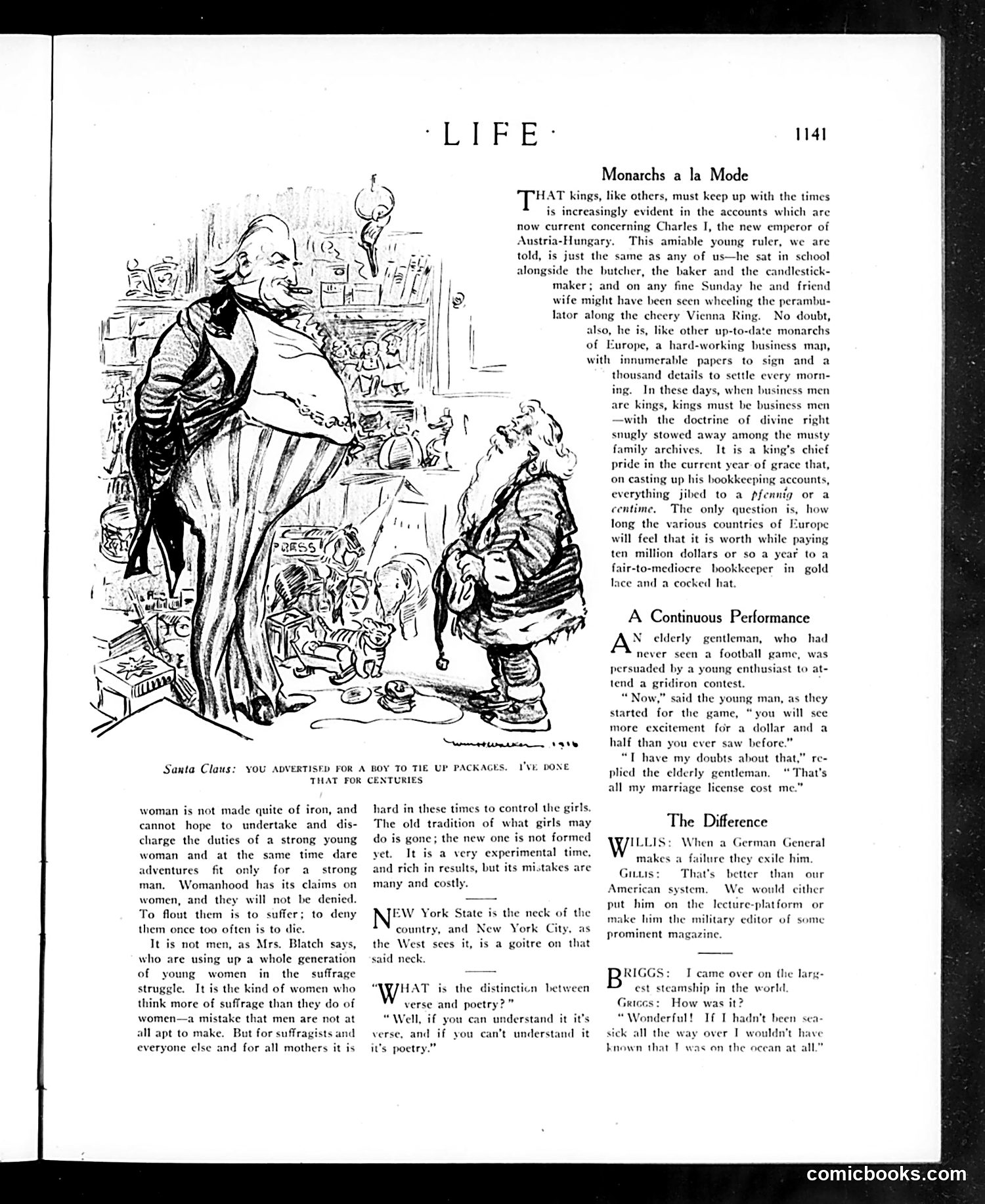
This page satirizes modern European monarchs, particularly the new Austrian-Hungarian Emperor Charles I, depicted as a businessman-king juggling ledgers and administrative duties rather than ruling traditionally. The cartoon shows a skeleton-thin, harried monarch surrounded by papers and accounting books, contrasted with an elderly gentleman observer. The satire's point: contemporary kings must function as modern business managers—handling "bookkeeping accounts" and financial details—rather than embodying divine right. The text mockingly suggests European nations might soon need to pay "ten million dollars...a year" to afford a competent "fair-to-mediocre bookkeeper" as monarch. The humor targets the unglamorous reality of twentieth-century monarchy stripped of mystique, reduced to bureaucratic labor.
📄 Transcribed text from this page (OCR, searchable)
Machine-transcribed from the original scan — historical spelling and the odd misread are preserved.
Santa Claus: YOU ADVERTISED FOR A BOY TO TIE UP PACKAGES. ‘iL TiF'E * 1141 Monarchs a la Mode HAT kings, like others, must keep up with the times is increasingly evident in the accounts which are now current concerning Charles I, the new emperor of Austria-Hungary. This amiable young ruler, we arc told, is just the same as any of us—he sat in school alongside the maker ; butcher, the baker and the candlestick- and on any fine Sunday he and friend wife might have been seen wheeling the perambu- lator along the cheery Vienna Ring. also, he is, like other up-to- No doubt, © monarchs of Europe, a hard-working business map, with innumerable papers to sign and a V'VE DONE THAT FOR CENTURIES woman is not made quite of iron, and cannot hope to undertake and dis- charge the duties of a strong young woman and at the same time dare adventures fit. only for a strong man. Womanhood has its claims on women, and they will not be denied. To flout them is to suffer; to deny them once too often is to die. It is not men, as Mrs. Blatch says, who are using up a whole generation of young women in the suffrage struggle. It is the kind of women who think more of suffrage than they do of women—a mistake that men are not at all apt to make. But for suffragists and everyone else and for all mothers it is hard in these times to control the girls. The old tradition of what girls may do is gone; the new one is not formed et. It is a very experimental tim and rich in results, but its mistakes are many and costly. NEY country, the West said neck. a verse and poetry? Well, if you can understand it it’s verse, and if you can't understand it it's poetry.” York State is the neck of the and New York City, as it, is a goitre on that AT is the distinction between thousand details to settle every morn- ing. In these days, when business men are kings, kings must be business men —with the doctrine of divine right snugly stowed away among the musty family archives. It is a king's chief pride in the current year of grace that, on casting up his bookkeeping accounts, everything jibed to a Pp, 9 or a centime. The only question i long the various countries of Europe will feel that it is worth while paying ten million dollars or so a year to a fair-to-mediocre bookkeeper in gold lace and a cocked hat. how A Continuous Performance AN slierly gentleman, had never seen a football game, was persuaded by a young enthusiast tend a gridiron contest. “Now,” said the young man, as they started for the game, “you will s more excitement for a dollar and a half than you ever saw before.” “T have my doubts about th plied the elderly gentleman. all my marriage license cost me.” who re= That's The Difference When a German General makes a failure they exile him. Gu. That's better than our American system. We would cither put him on the lecture-platform or make him the military editor of some prominent magazine. B IGGS: I came over on the larg- est steamship in the world Grices: How was it? “Wonderful! If T hadn't by sick all the way over I wouldn't known that T was on the ocean at all.” comicbooks.com