
Life, 1916-12-21 · page 5 of 36
Life — December 21, 1916 — page 5: what you’re looking at
What you’re looking at
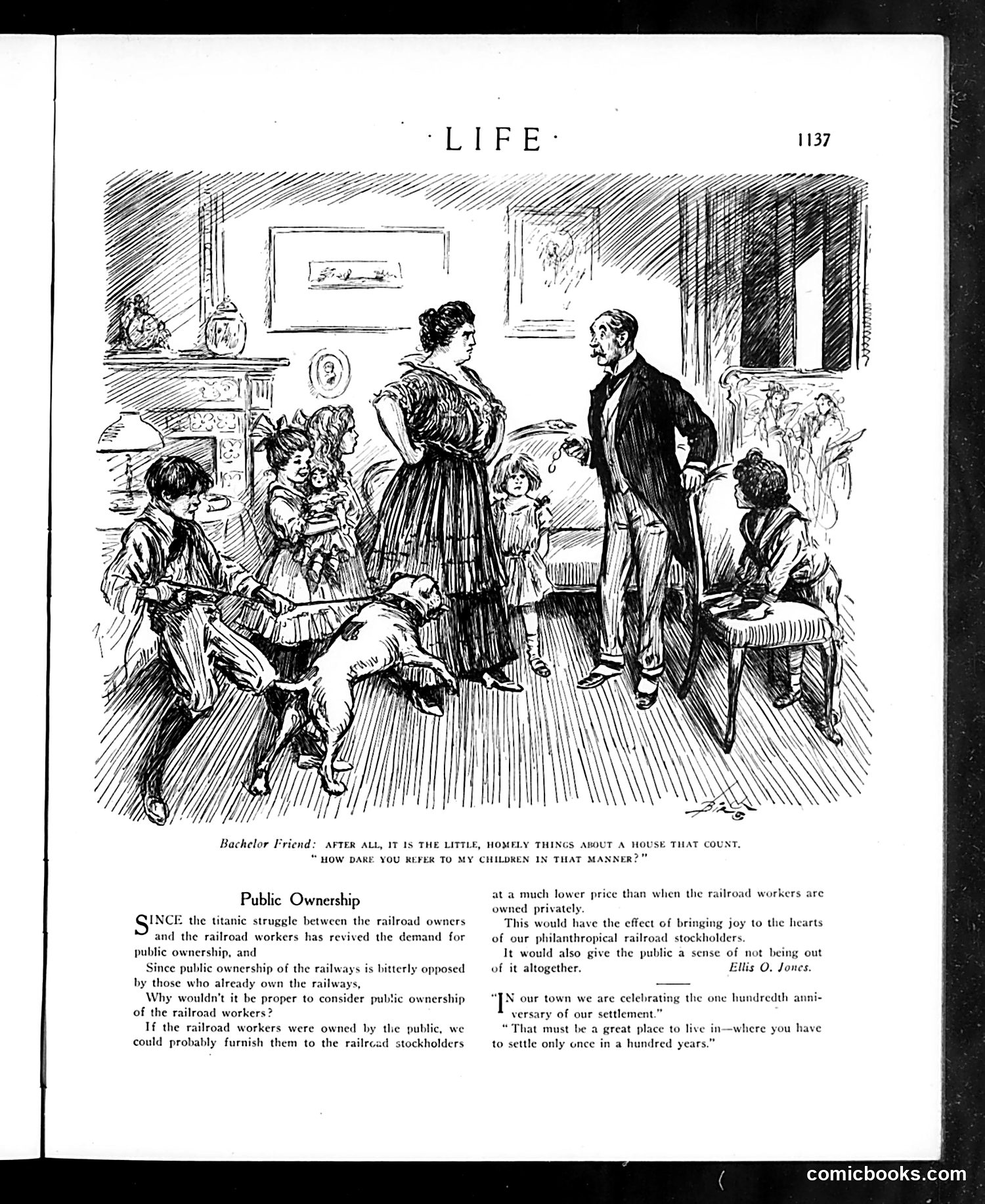
The top cartoon is titled "Bachelor Friend" and depicts a domestic scene where a man addresses a woman holding children, saying: "After all, it is the little, homely things about a house that count. How dare you refer to my children in that manner?" The satire mocks Victorian-era social pretension—the bachelor friend apparently made a casual or unflattering remark about the man's children, who are presented as rowdy and unruly. The joke plays on the contrast between the man's pompous declaration that children represent a home's "little, homely things" and the obvious chaos they're causing. Below, an article titled "Public Ownership" debates whether railroad workers should be furnished to stockholders if railroads were publicly owned—a serious policy discussion about labor and nationalization, likely reflecting early-20th-century labor debates.
📄 Transcribed text from this page (OCR, searchable)
Machine-transcribed from the original scan — historical spelling and the odd misread are preserved.
Bachelor Friend: ArTER ALL, 1T 1S THE LITTLE, HOMELY THINGS ABOUT A HOUSE THAT COUNT, “ MOW DARE YOU REFER TO MY CHILDREN IN THAT MANNER?” Public Ownership INCE the titanic struggle between the railroad owners and the railroad workers has revived the demand for public ownership, and Since public ownership of the railways is bitterly opposed by those who already own the railways, Why wouldn't it be proper to consider pubtic ownership of the railroad workers? If the railroad workers were owned by the public, we could probably furnish them to the railroad stockholders at a much lower price than when the railroad workers are owned privately. This would have the effect of bringing joy to the hearts of our philanthropical railroad stockholders. It would also give the public a sense of not being out of it altogether. Ellis O. Jones. ‘|S our town we are celebrating the one hundredth anni- versary of our settlement.” “That must be a great place to live in—where you have to settle only once in a hundred years.” comicbooks.com