
A complete issue · 38 pages · 1916
Life — September 14, 1916
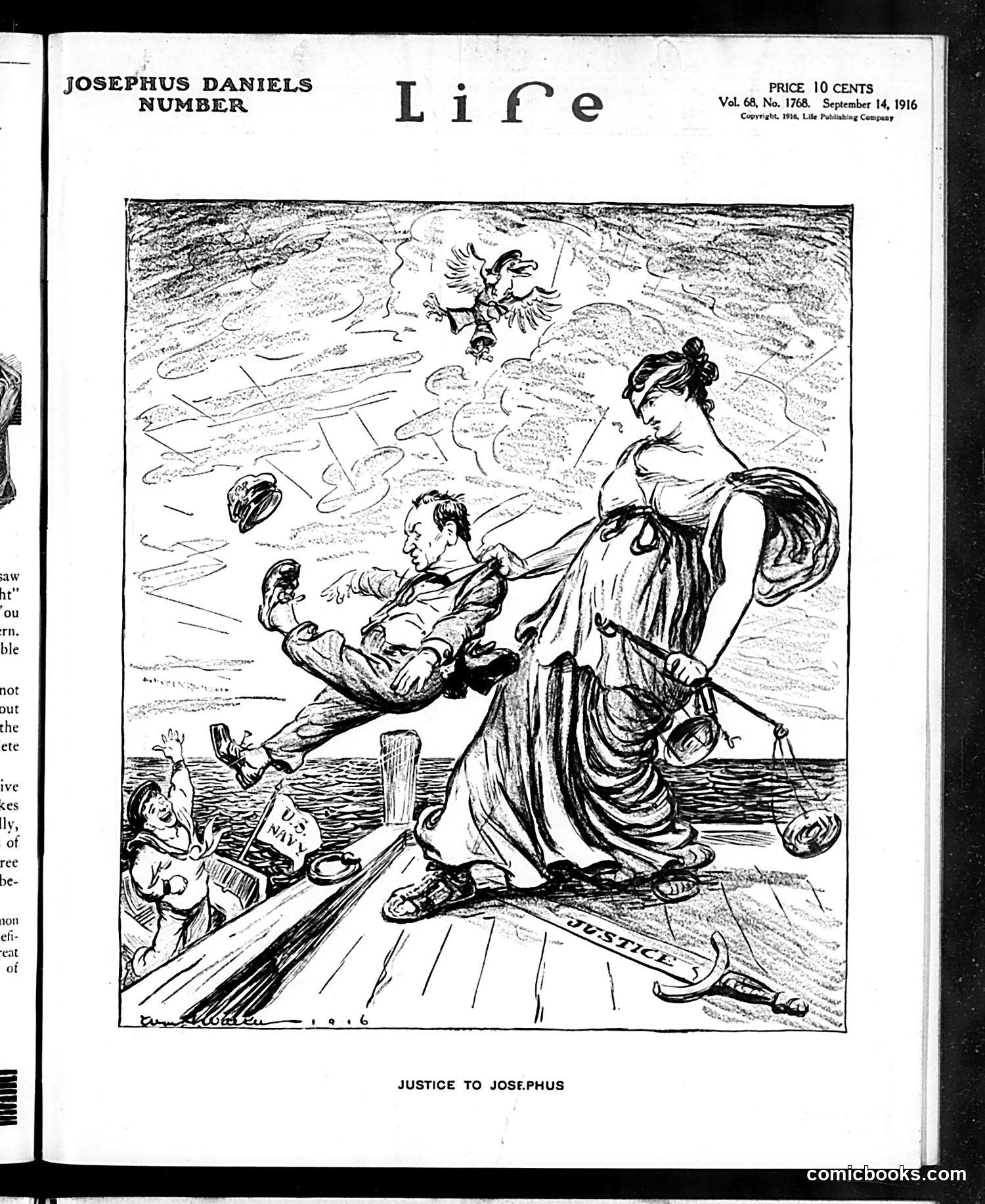
This September 1916 *Life* cartoon satirizes Josephus Daniels, Secretary of the Navy under President Wilson. The allegorical image depicts Lady Justice helping Daniels (shown as a man in a suit) stay afloat amid turbulent waters. Above, Cupid (or a similar figure) appears to oversee the scene. The satire likely references controversies surrounding Daniels's naval administration—possibly regarding preparedness, policy decisions, or personnel matters that his critics felt were unjust. The title suggests the cartoonist is ironically calling for "justice" by depicting Lady Justice herself intervening on Daniels's behalf, implying his critics believed he deserved accountability rather than protection.
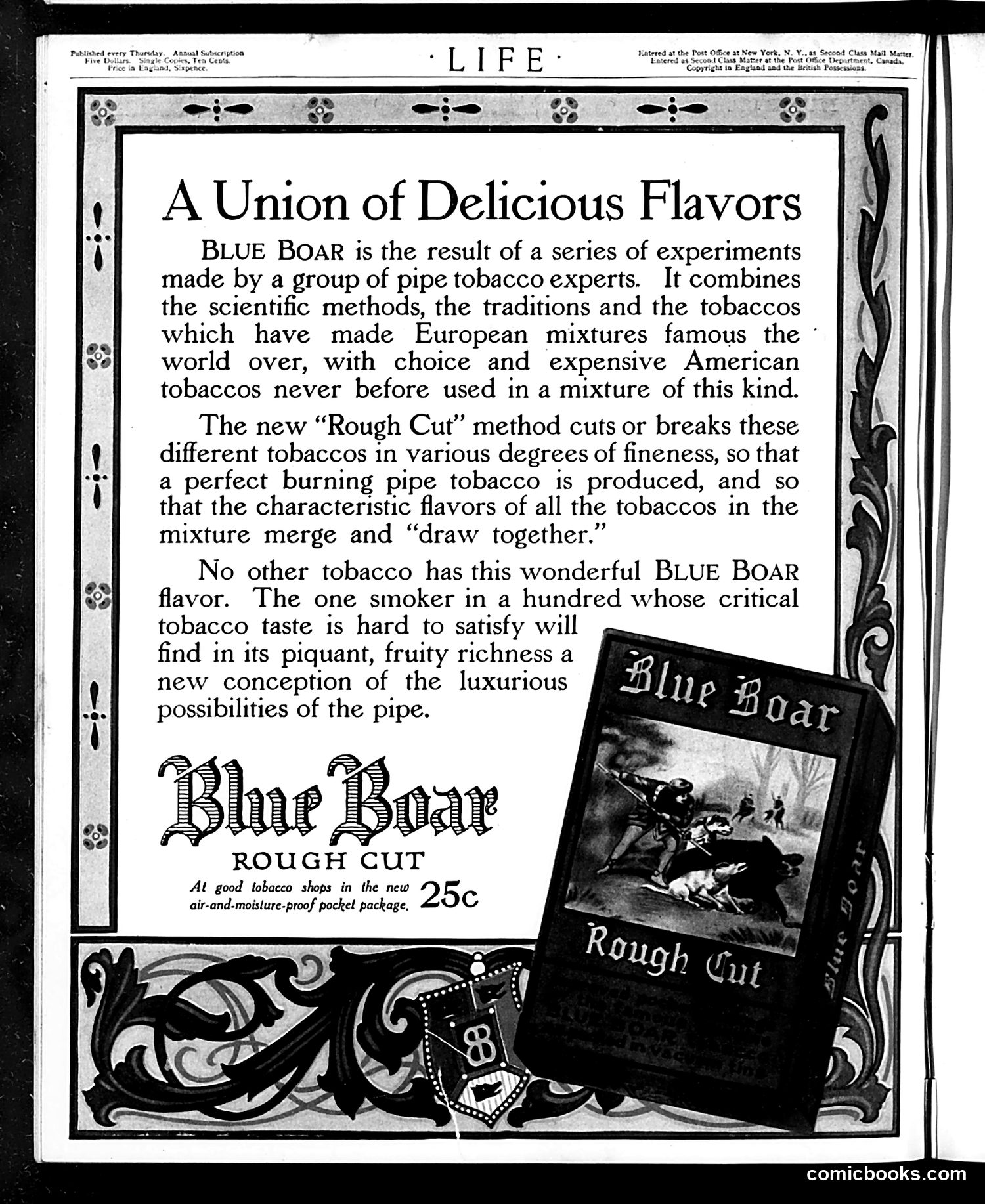
This is **not satire or political commentary** — it's a straightforward product advertisement for Blue Boar pipe tobacco, published in *Life* magazine. The ad promotes a new "Rough Cut" tobacco blend combining European traditions with American tobacco varieties. It highlights a novel cutting method that supposedly creates better flavor and burn characteristics. The marketing emphasizes luxury and sophistication, claiming the product offers "piquant, fruity richness" for discerning smokers. The decorative border and the package image featuring what appears to be a boar hunting scene are typical period design elements. The price of 25 cents suggests early-to-mid 20th century publication. **Bottom line:** This is commercial advertising, not editorial content or satire.
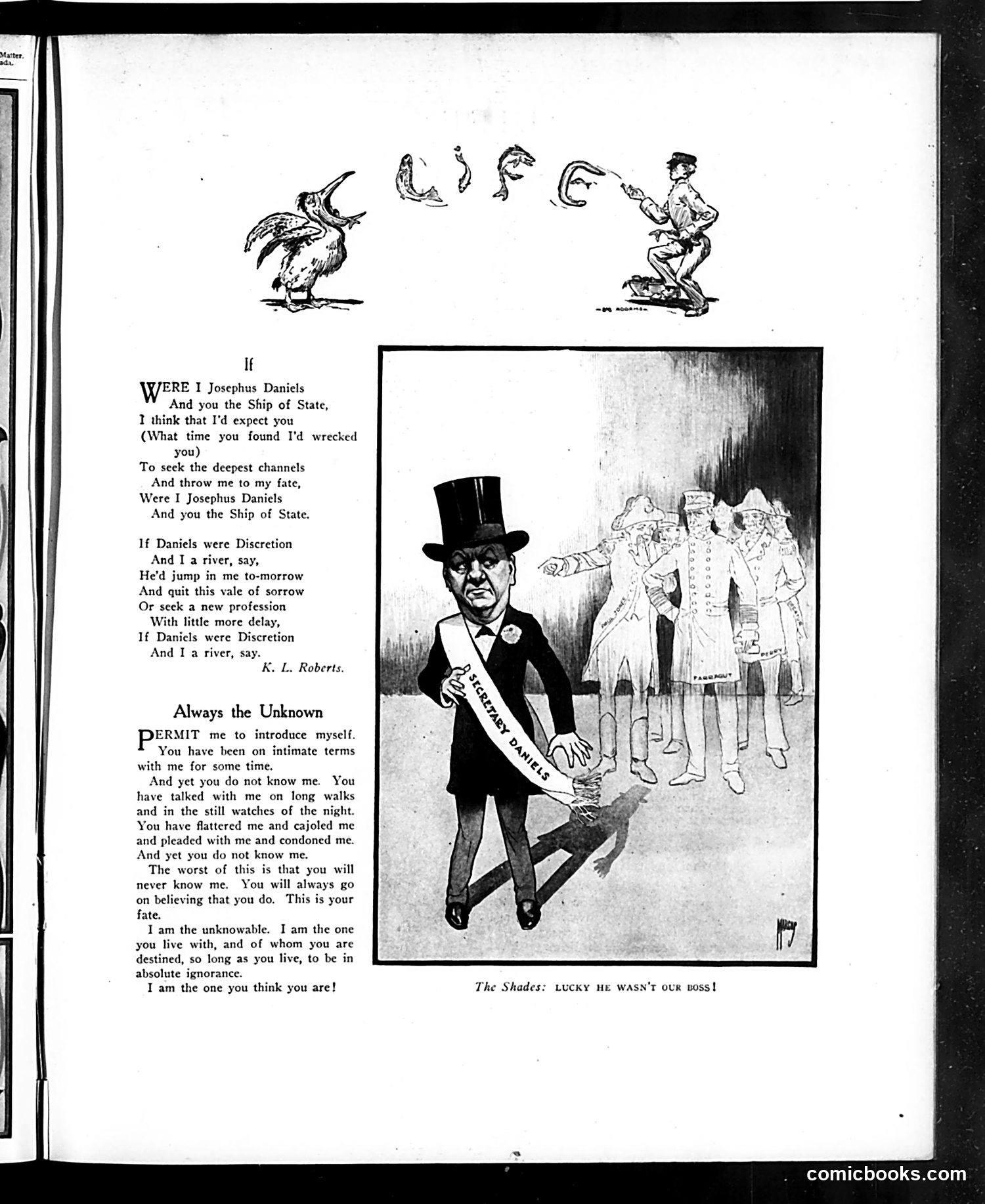
The main cartoon titled "The Shades: Lucky he wasn't our boss!" depicts a man in a top hat labeled "JOSEPHUS DANIELS" observing shadowy figures in the background. Josephus Daniels was Secretary of the Navy during World War I, making this likely commentary on his leadership or policies. The accompanying poem "Always the Unknown" appears to be satirical verse about an unknowable force or figure—possibly criticizing Daniels' administration or naval policies that remained opaque to the public. The decorative elements at top (bird, human figures) are typical Life magazine ornaments. Without additional publication context, the specific incident being mocked remains unclear, though it concerns naval administration during the WWI era.
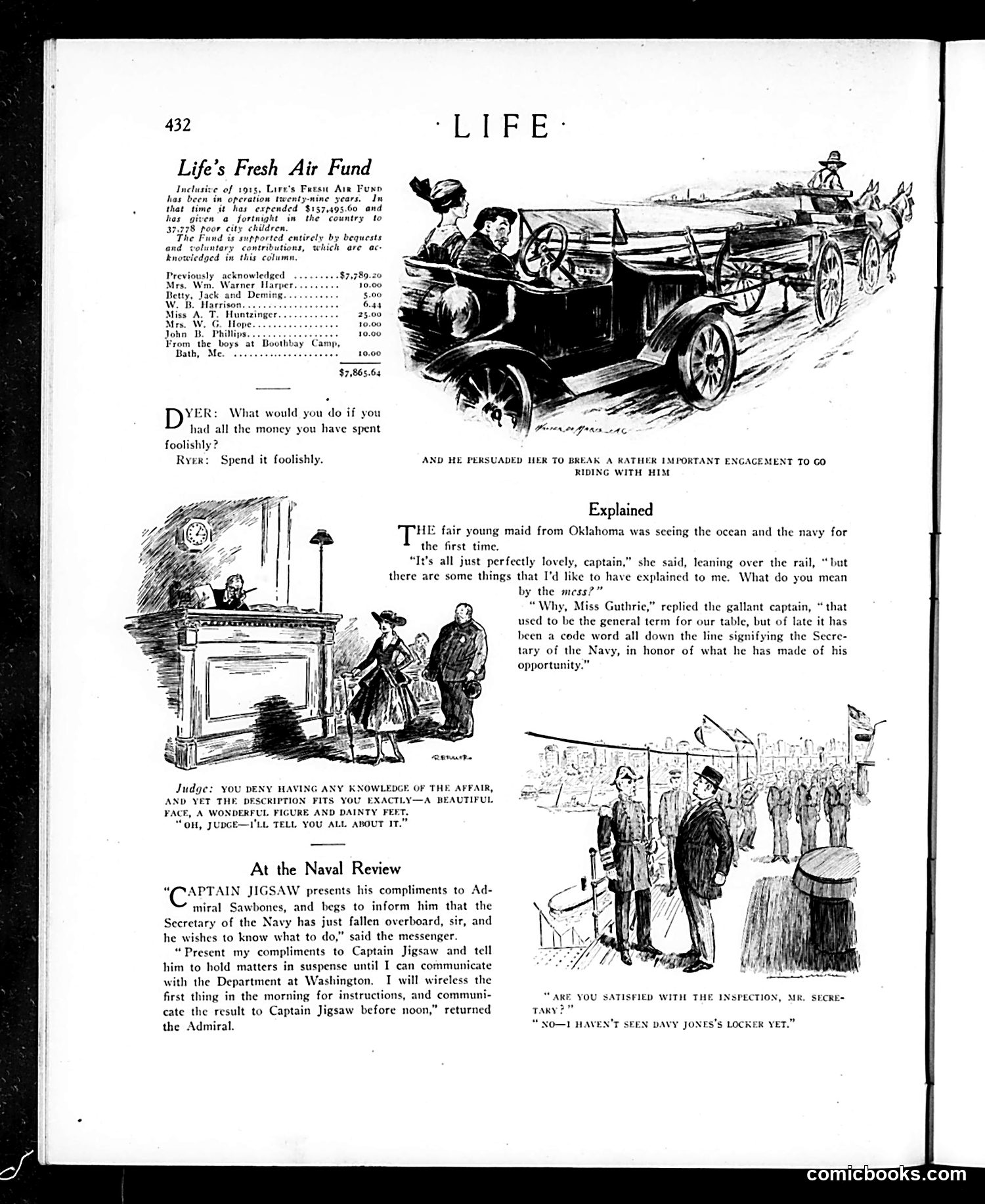
This page contains three distinct humor pieces: 1. **Life's Fresh Air Fund**: A fundraising announcement listing donations for a charitable camp program serving poor children—the satirical humor is minimal here. 2. **The "Messy" Joke**: A brief exchange between a Dyer and River about foolishly spending money, illustrated with a domestic scene. The humor is conventional wordplay. 3. **Naval Satire**: Two separate anecdotes mocking naval bureaucracy and protocol. The first depicts a captain explaining the term "messy" to a young woman from Oklahoma. The second shows Admiral Higsaw communicating through wireless channels about a fallen officer—satirizing military chain-of-command redundancy and communication inefficiency. The overall theme satirizes social pretension and institutional absurdity rather than specific political figures.
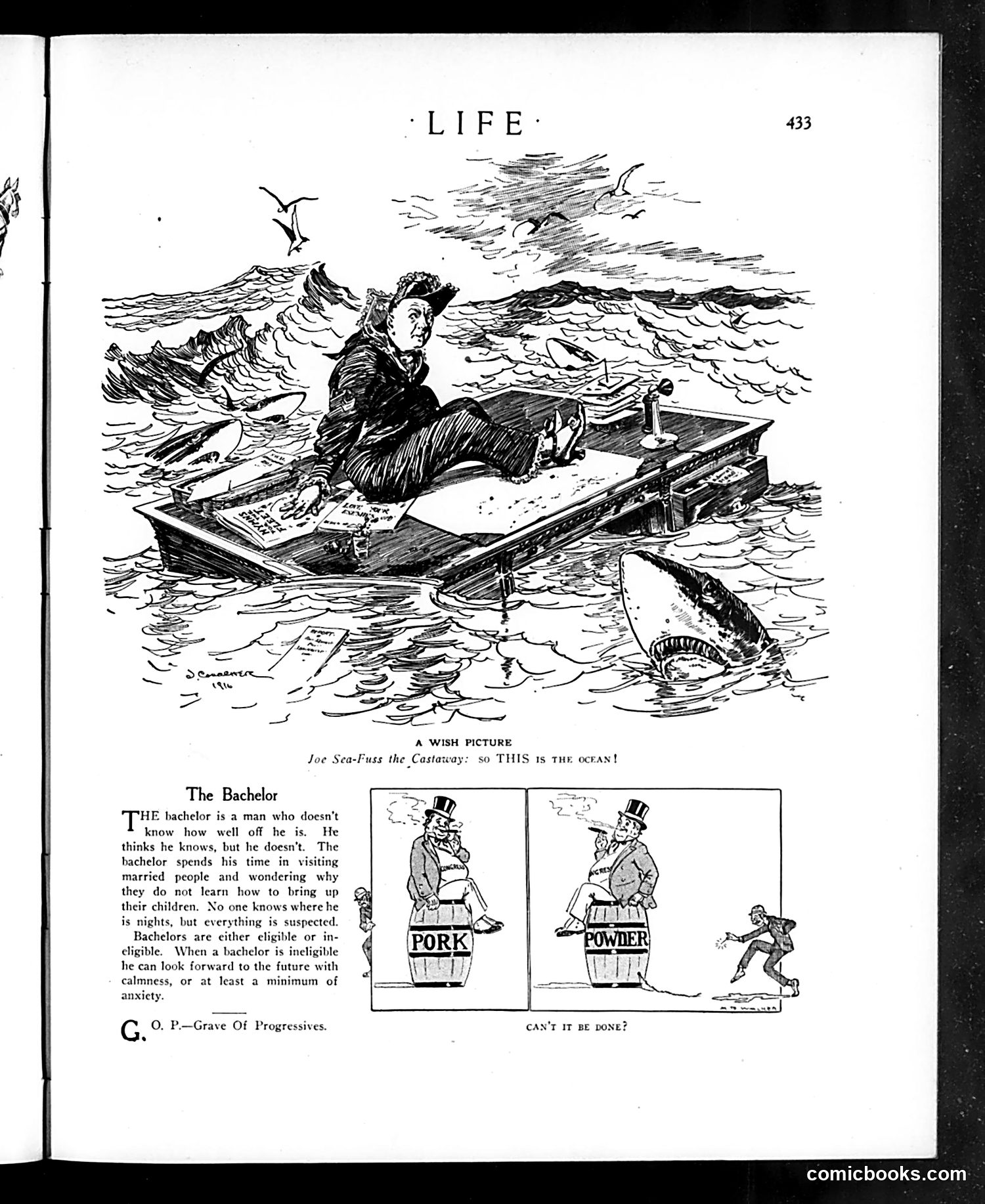
The top illustration is titled "A Wish Picture: Joe Sea-Fuzz the Castaway: so THIS is the OCEAN!" It depicts a man in a boat surrounded by sharks, satirizing someone's naive expectations versus reality—a castaway fantasizing about the ocean without comprehending its dangers. Below, "The Bachelor" is a humorous definition of unmarried men as socially ambiguous figures—neither fully eligible nor ineligible—who exist in a state of suspicion while visiting married couples. The small cartoon "Can't It Be Done?" shows two figures labeled "Pork" and "Powder" (likely references to political/industrial interests) with a third figure running away, suggesting satirical commentary on political or economic conflicts of the era, though the specific reference remains unclear without additional context.
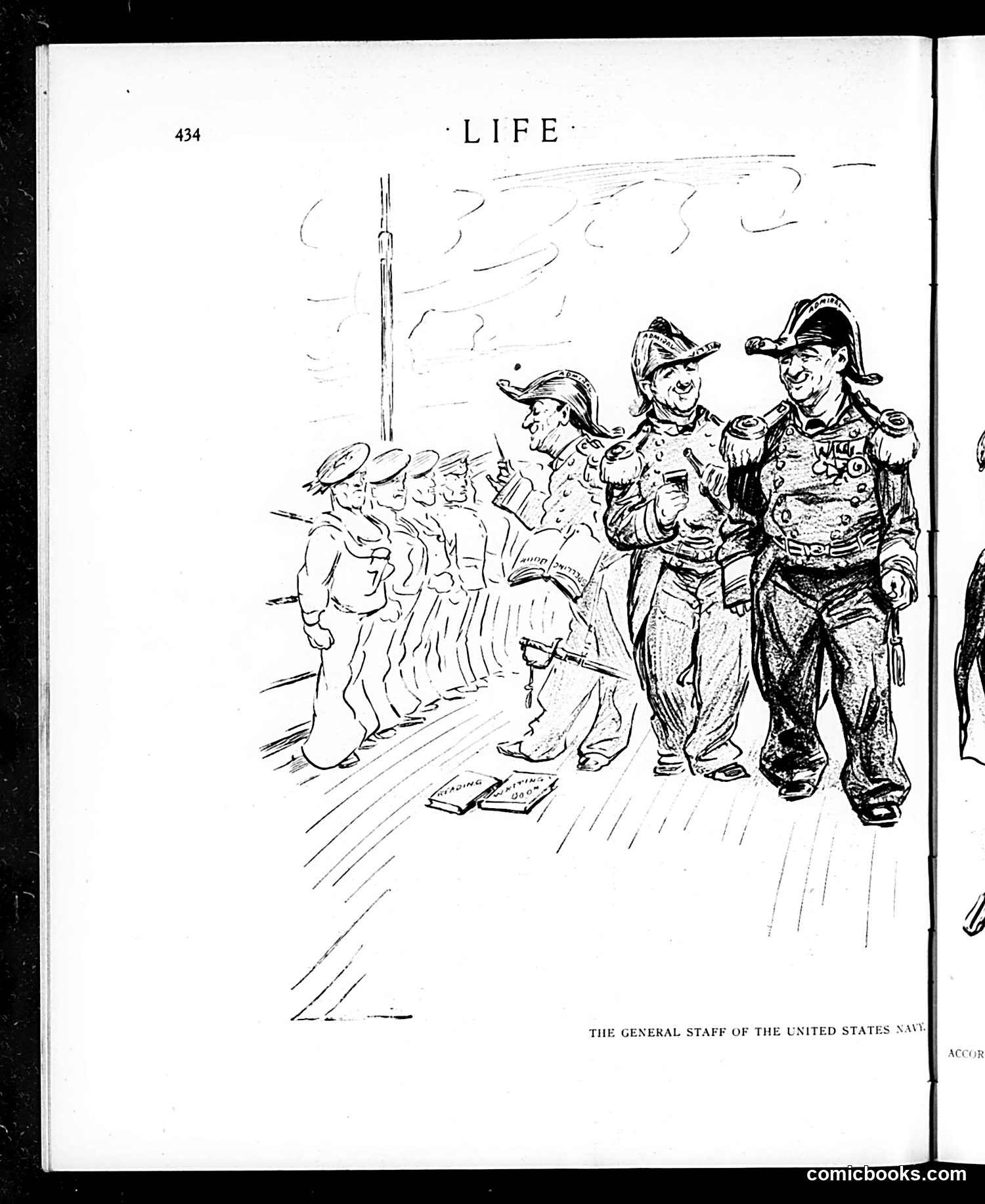
This is page 434 from *Life* magazine. The cartoon, titled "The General Staff of the United States Navy," depicts three high-ranking naval officers in elaborate uniforms with exaggerated facial features and expressions, standing before a line of enlisted sailors. The satire appears to mock naval hierarchy and military bureaucracy—specifically the contrast between the ornately decorated, self-important officers and the ordinary servicemen beneath them. The officers' caricatured faces and pompous postures suggest they're portrayed as vain or ridiculous authority figures. Without more context about the specific date or historical moment, the exact figures remain unclear, though this likely comments on WWI-era or interwar naval administration and the gap between officers and enlisted personnel.
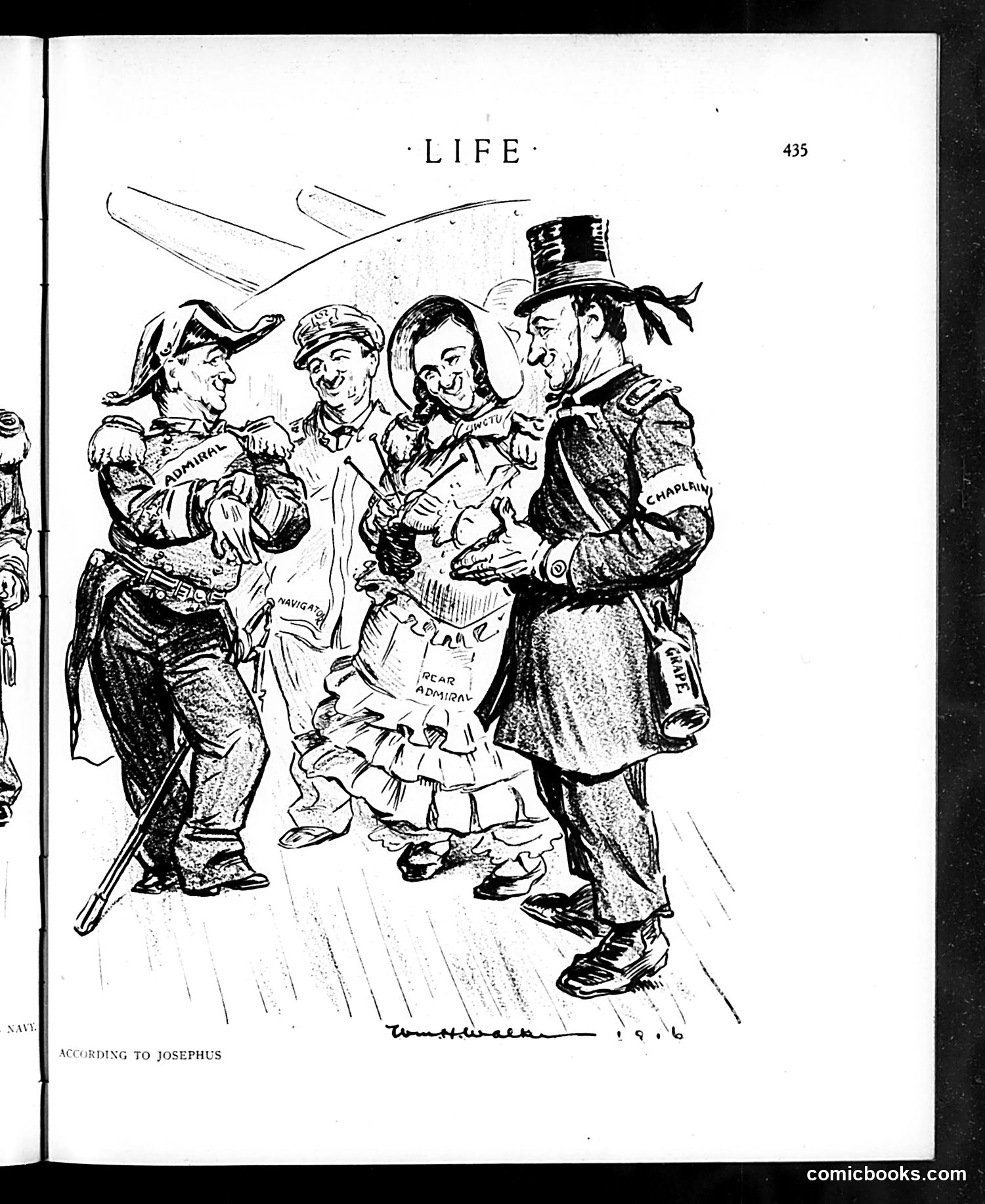
This Life magazine cartoon from 1916 depicts military and naval officers surrounding a woman labeled "REAR ADMIRAL" and "NAVIGATOR." The caption reads "ACCORDING TO JOSEPHUS," referencing Secretary of the Navy Josephus Daniels. The satire targets Daniels's naval policies and leadership. The woman figure—positioned centrally among uniformed men—likely represents the Navy itself or a controversial policy initiative under Daniels's command. The officers' varied expressions and body language suggest skepticism or confusion about the direction being taken. The cartoon mocks Daniels's authority and decision-making, implying his leadership is misguided or emasculating to the military establishment. This reflects contemporary debates over naval modernization and military preparedness during America's pre-WWI period.
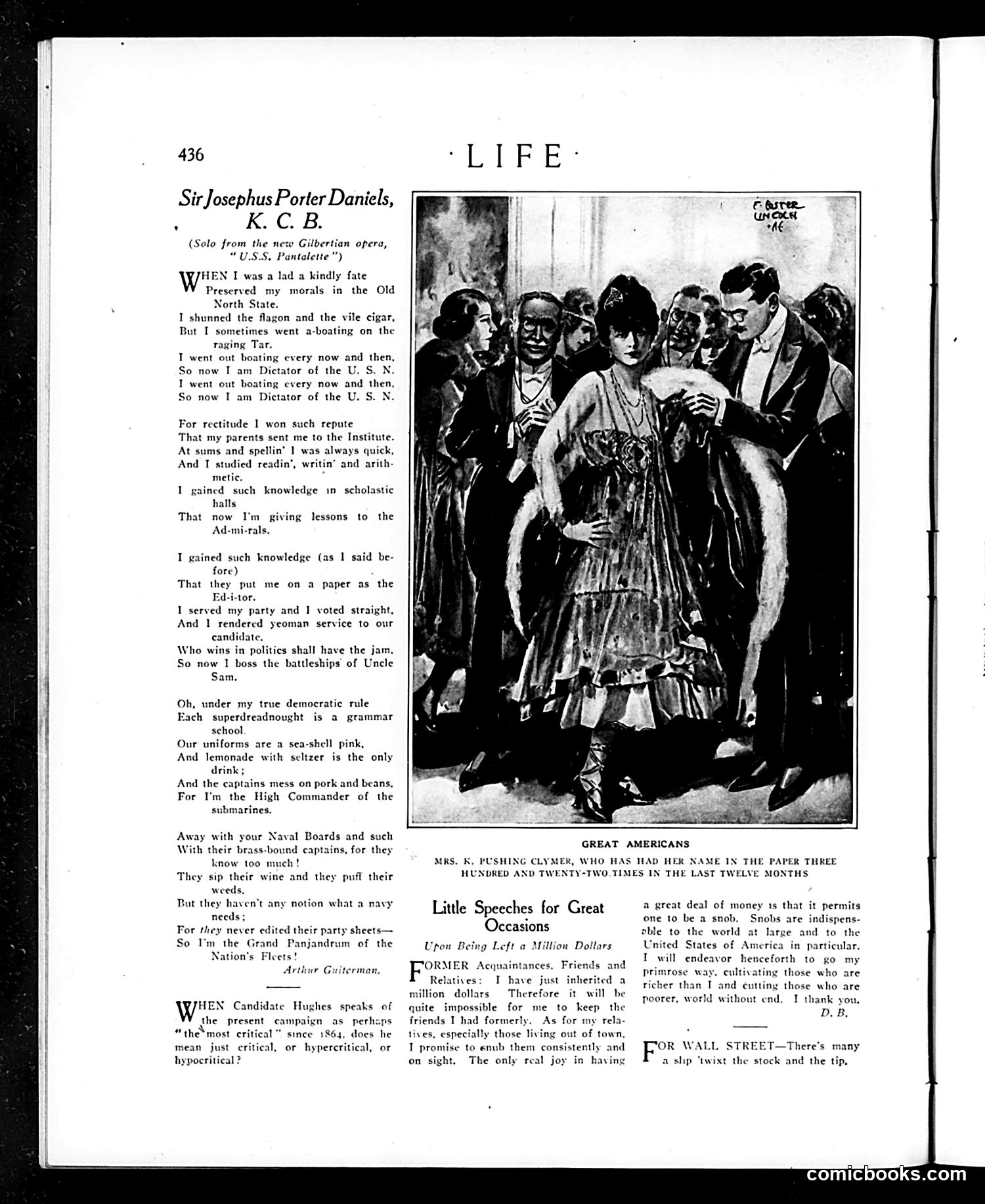
The page features a poem by Sir Josephus Porter Daniels, K.C.B., titled "Solo from the new Gilbertian opera 'U.S.S. Pantalette.'" The satirical poem mocks what appears to be Josephus Daniels (Secretary of the Navy under Woodrow Wilson), presenting him as self-aggrandizing and absurdly authoritarian—boasting of his rise from avoiding "the raging Tar" to becoming "Dictator of the U.S.N." The accompanying photograph labeled "Great Americans" shows Mrs. K. Pushing Clymer, noted as appearing in papers "one hundred and twenty-two times in the last twelve months"—satirizing celebrity culture and media obsession. Below, a brief column titled "Little Speeches for Great Occasions" offers humorous advice for the wealthy inheriting fortunes. The overall effect satirizes political pomposity, naval bureaucracy, and American social pretension of the era.
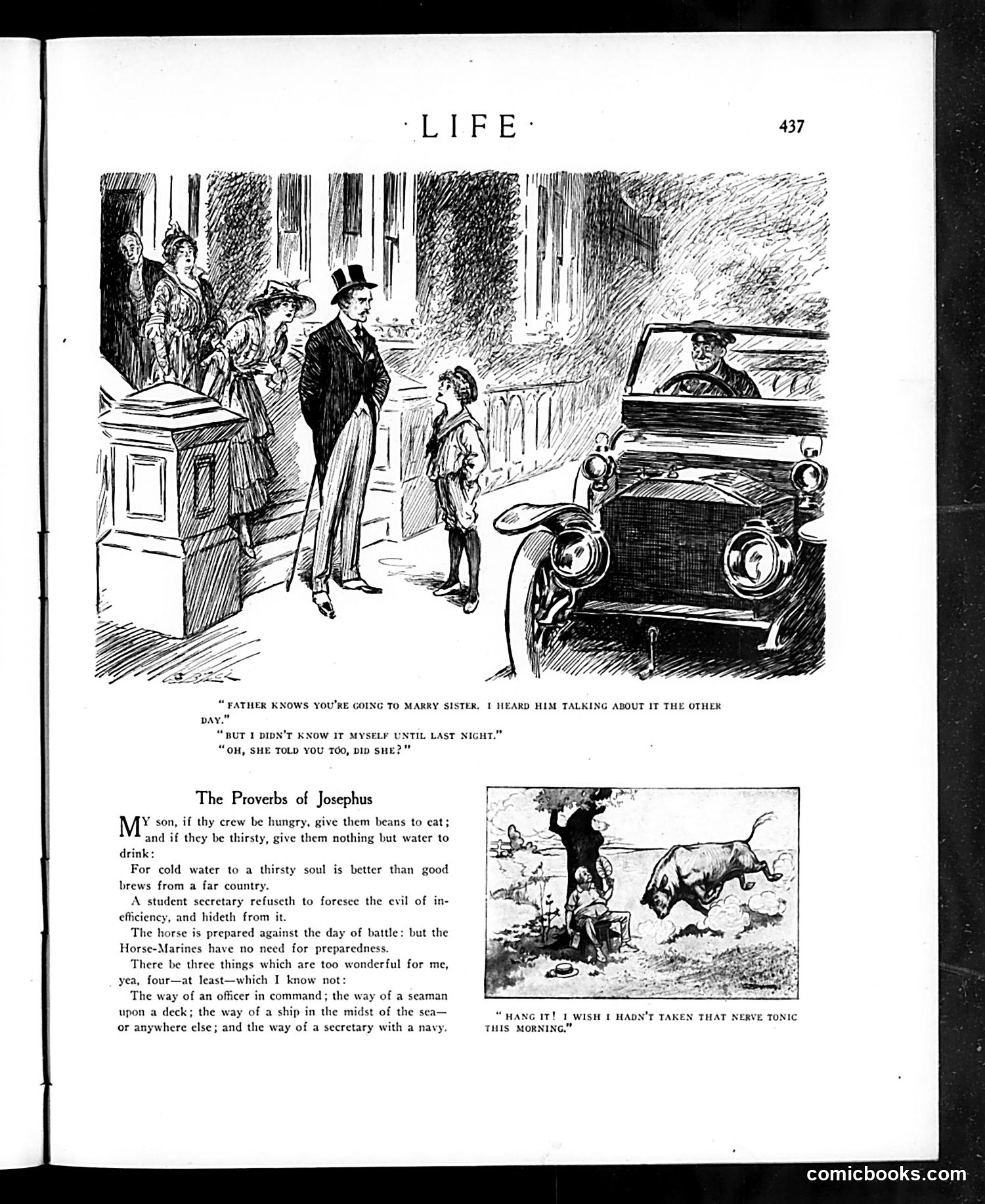
**Top Cartoon:** A street scene showing well-dressed men and a boy near a car. The dialogue reveals a social comedy: a father has told his son he's marrying "sister" (a woman), but the boy didn't know this until the previous night. The joke hinges on the boy's confusion and the father's awkward romantic situation—likely satirizing sudden remarriage announcements or the complications of blended families in early 20th-century society. **Bottom Section:** "The Proverbs of Josephus" presents practical wisdom about feeding the hungry, preparing for hardship, and organizational discipline—drawn from classical sources. The accompanying illustration of a man and donkey with the caption "Hang it! I wish I hadn't taken that nerve tonic this morning" provides humorous contrast, suggesting the proverbs' serious advice conflicts with modern anxieties about patent medicines or nerves.
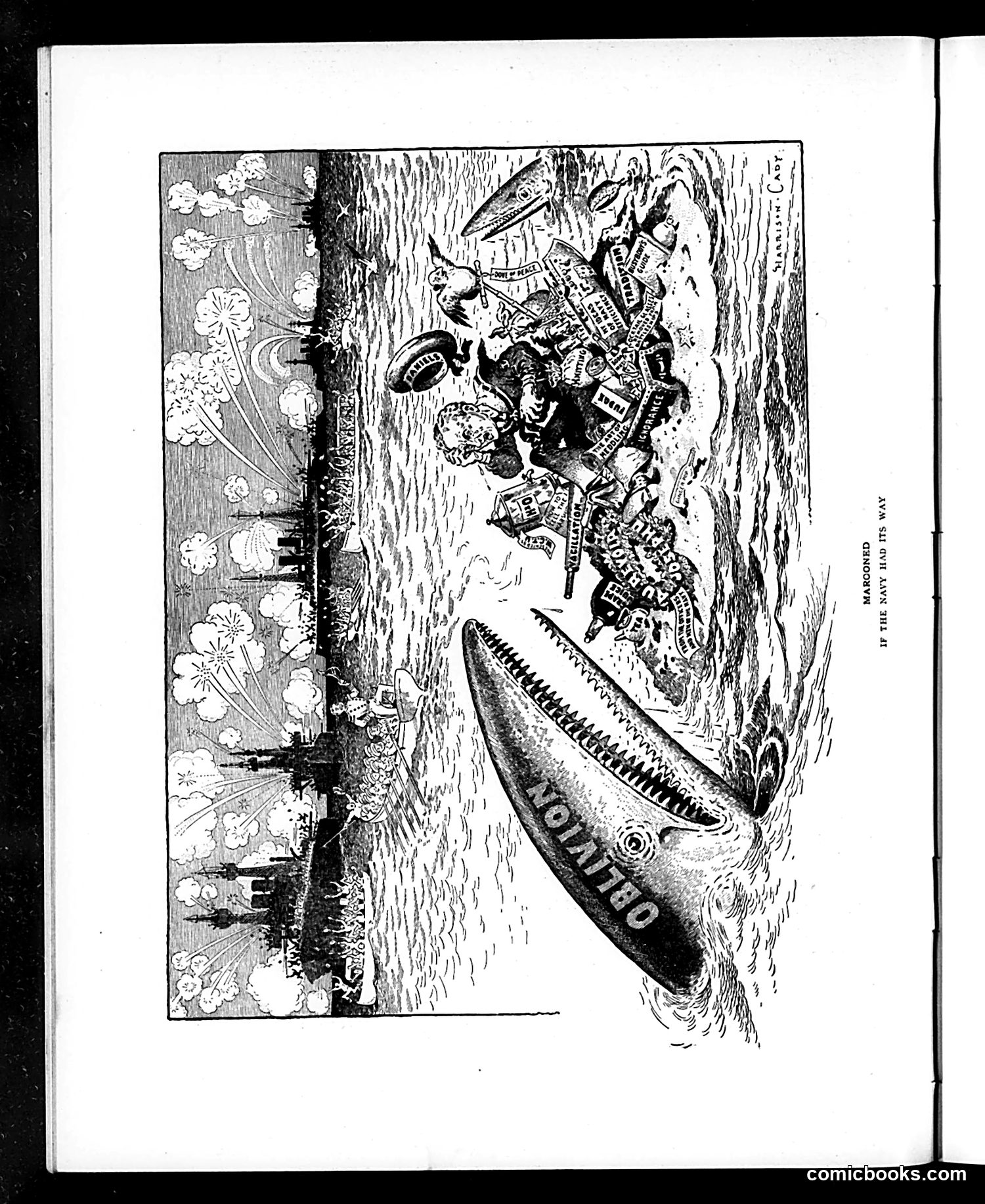
This page shows a single illustration labeled "A MACONDO" (visible at right edge, rotated with the image). The cartoon depicts a boat labeled "MONTERY" navigating through water, with several figures aboard appearing to be in period dress or costume. On the left side is an ornamental decorative panel with floral designs and human figures. The satire appears to reference a specific historical voyage or expedition, though without clearer context from surrounding text, the precise political or social commentary is unclear. The formal dress of the figures and the decorative framing suggest this may be commentary on a notable journey or expedition, possibly with satirical intent regarding those involved. Without additional page context or clearer OCR text identifying the specific historical reference, I cannot confidently explain the cartoon's exact meaning to a modern reader.
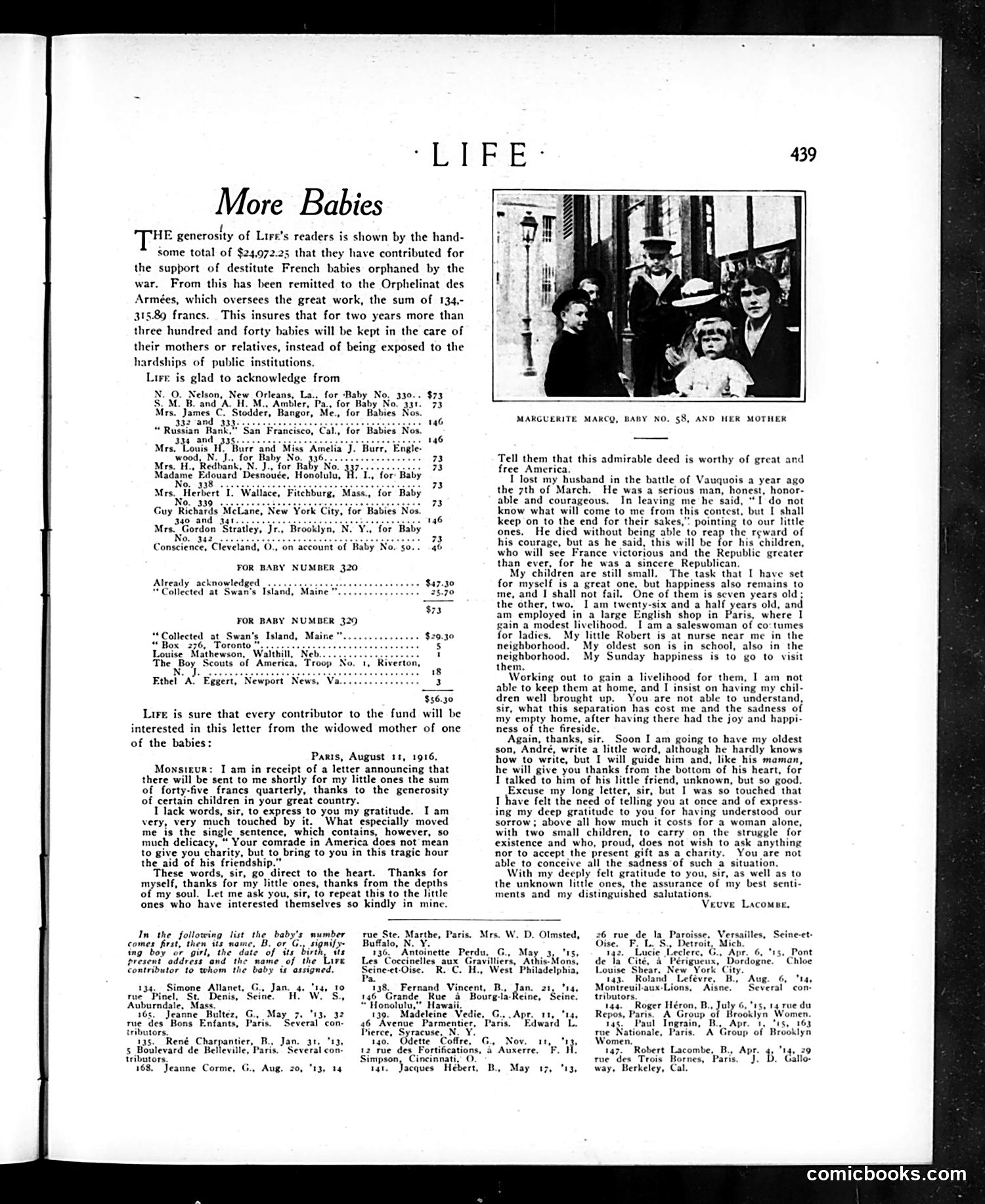
This page documents a charitable fundraising campaign supporting French war orphans during World War I. The photograph shows **Marguerite Marcq, Baby No. 58, and her mother** — representatives of children orphaned by the war. The text announces that Life magazine readers have contributed $24,072.25 to support orphans, with funds remitted to the "Orphelinat des Armées" (Army Orphanage). The campaign aims to keep over 340 babies in family care rather than institutions. The accompanying letter from a French widow expresses gratitude while describing her own loss—her husband killed at Vauquois—and her determination to support her children despite poverty. This reflects American charitable response to European war casualties, positioning Life as a vehicle for transatlantic humanitarian relief during WWI.
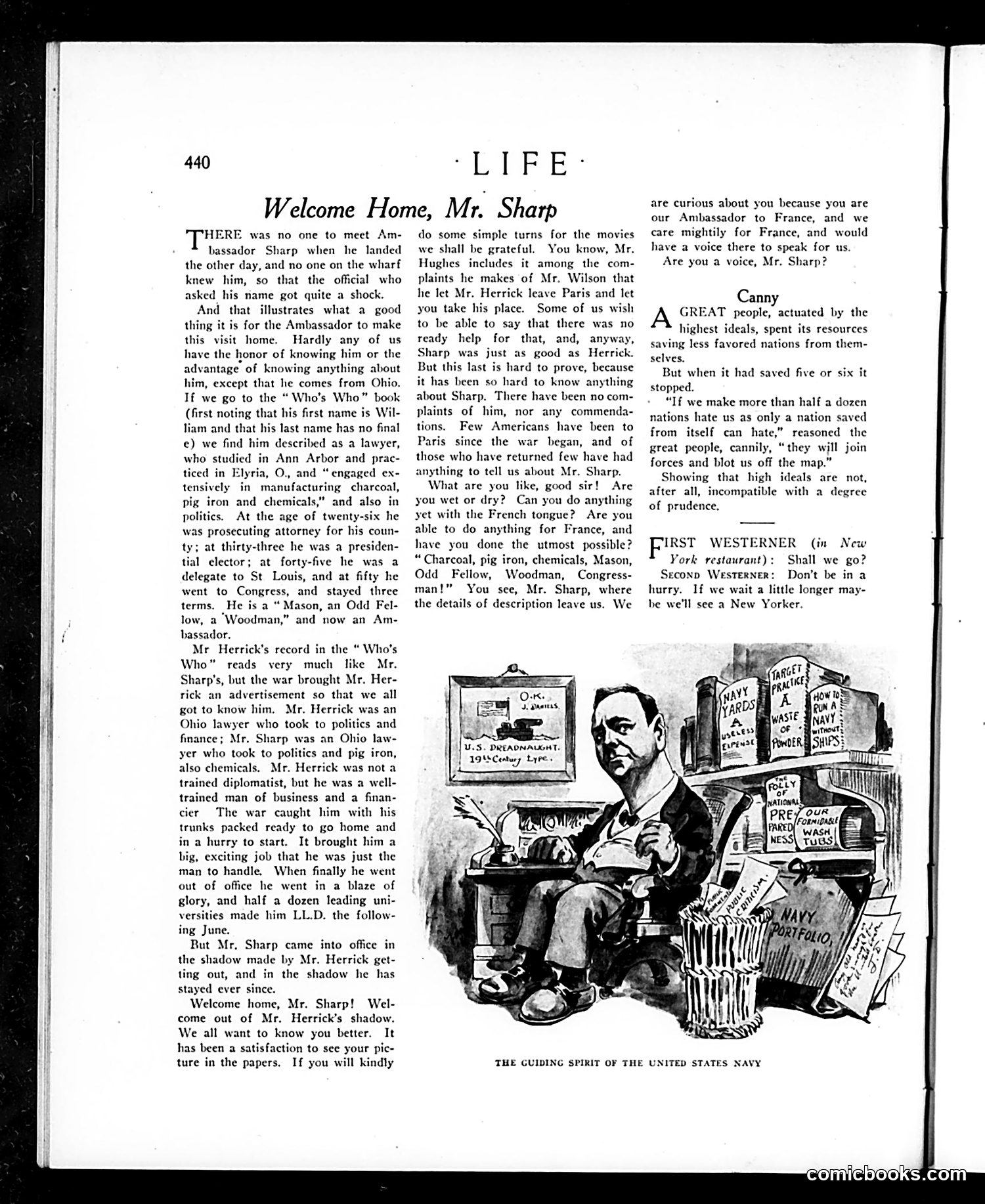
This page welcomes back Ambassador William Graves Sharp, who served as U.S. Ambassador to France during WWI. The article celebrates his return and discusses his background as an Ohio lawyer and politician. The accompanying cartoon, titled "The Guiding Spirit of the United States Navy," depicts a figure surrounded by naval-related documents and portfolios. The satire appears to critique naval bureaucracy and red tape—showing how administrative paperwork and departmental concerns ("Navy Portfolio," various files) guide naval decisions rather than clear strategic thinking. The cartoon humorously suggests the Navy is controlled by endless documentation and procedural complexity rather than purposeful leadership, a common Progressive-era criticism of government inefficiency.
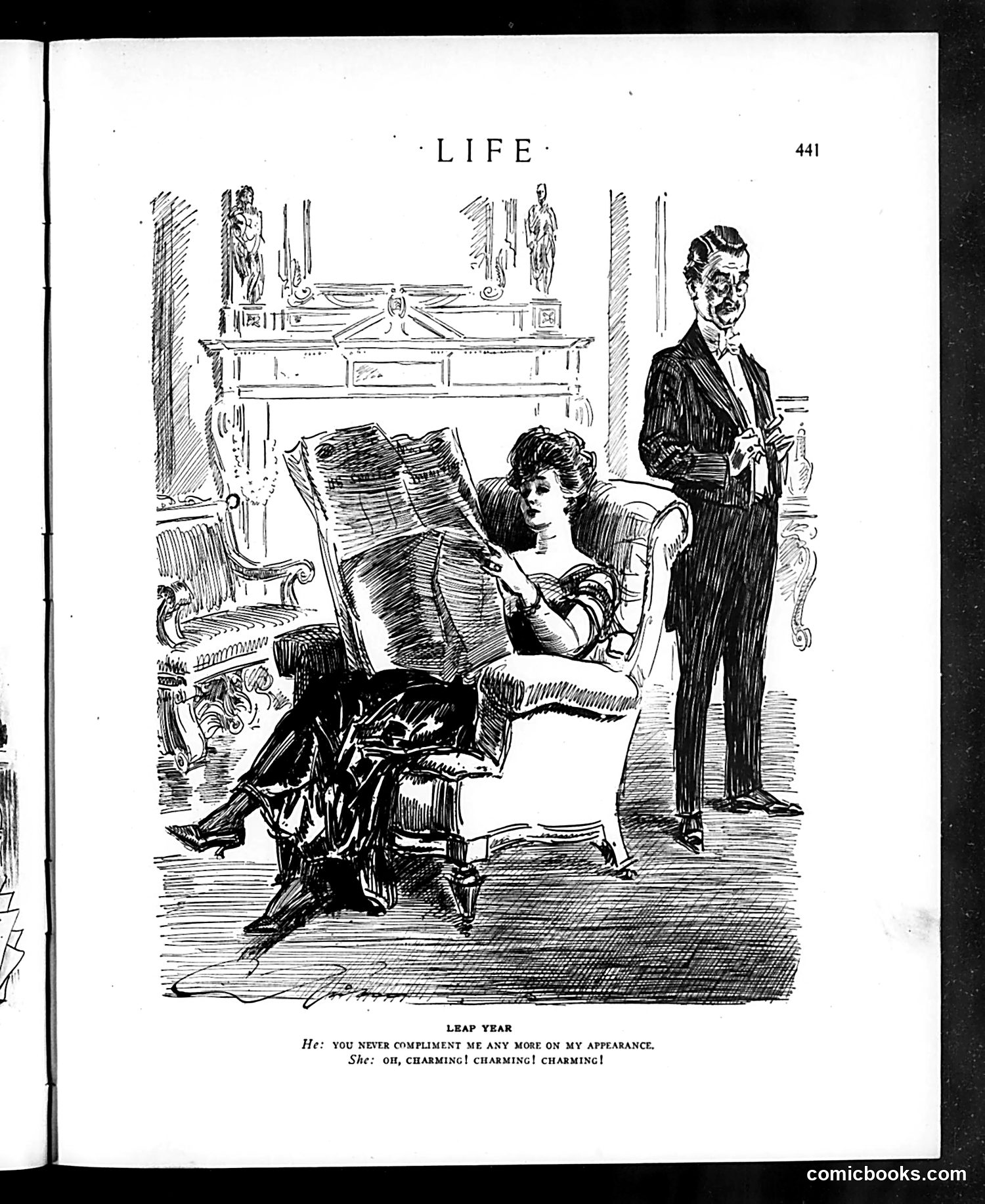
This satirical illustration depicts a reversal of traditional gender roles during "Leap Year"—a cultural phenomenon where women were permitted to propose marriage to men. The cartoon shows a woman seated comfortably, reading a newspaper while a man stands nervously nearby. The caption reveals the joke: the man complains "You never compliment me any more on my appearance," to which the woman replies, "Oh, charming! Charming! Charming!"—offering hollow, dismissive flattery. The satire mocks how leap year temporarily inverts courtship dynamics. The woman's casual indifference and the man's role-reversal anxiety humorously illustrate early 20th-century anxieties about changing gender relations. The ornate interior setting emphasizes domestic/social spaces where these power negotiations occurred.
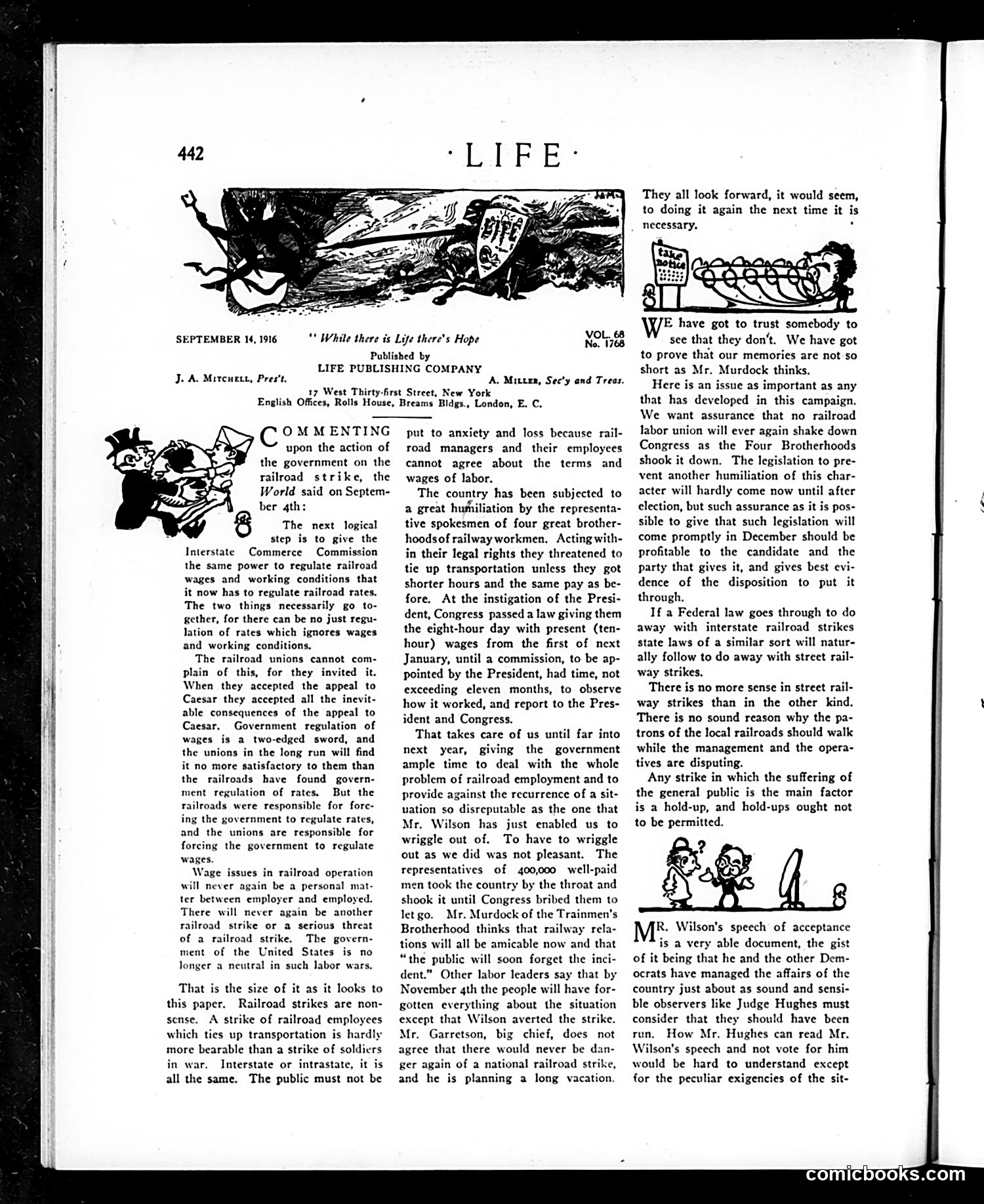
This *Life* magazine page from September 14, 1916 critiques the government's handling of a railroad strike. The main cartoon (top) shows a train derailment labeled "Where is Life there's Hope," satirizing the chaos created by labor disputes. The accompanying editorial argues that railroad strikes are as damaging as warfare and criticizes the government for inconsistently regulating both railroad management and workers' wages. It references President Wilson's recent intervention to establish an eight-hour workday for railroad employees—a compromise the author considers inadequate. The piece sarcastically notes that labor leaders expect the public to forget the strike's disruption by November's election, questioning whether voters should reward Wilson for this "solution" to ongoing industrial conflict.
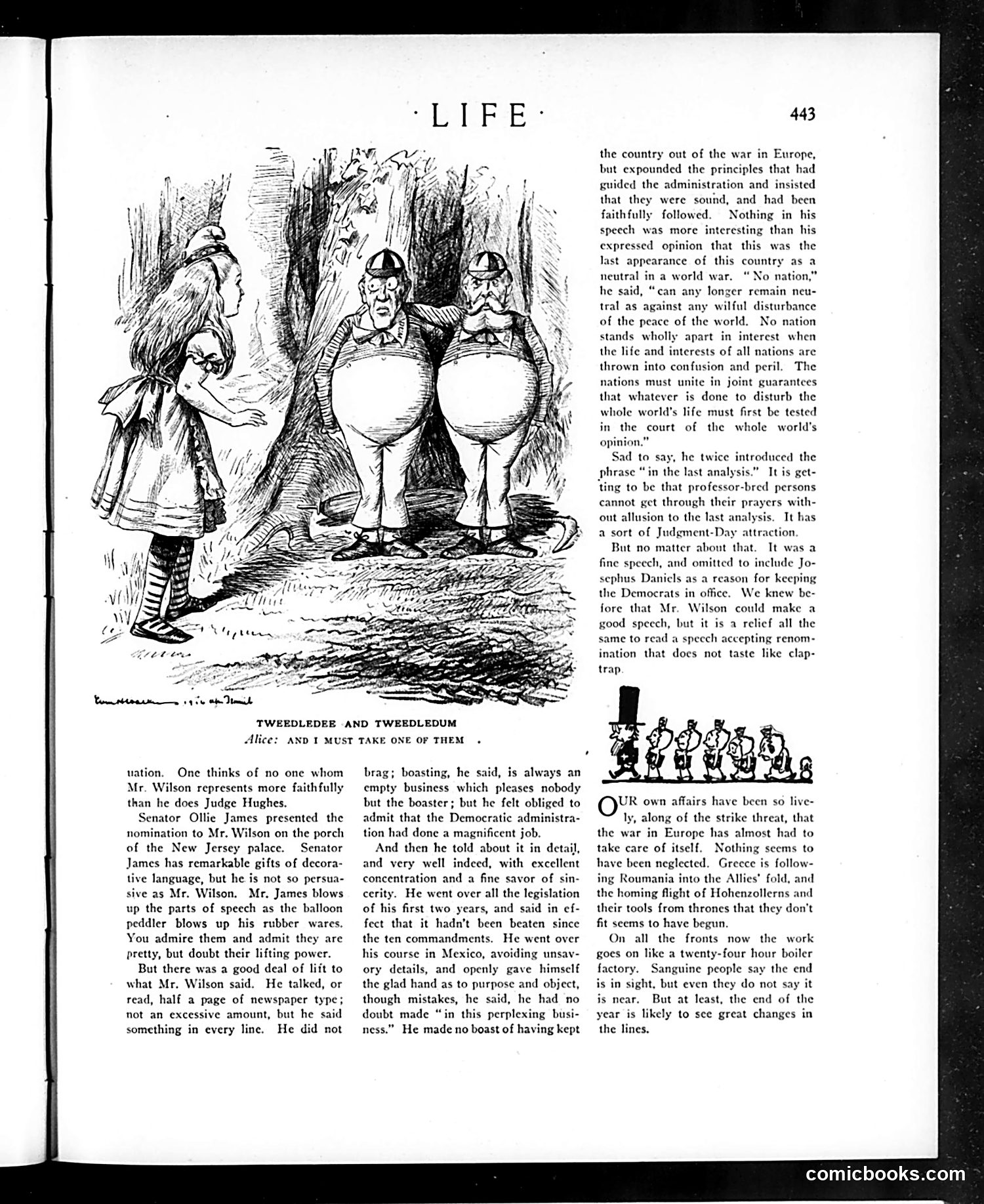
This political cartoon references the nursery rhyme characters to satirize two indistinguishable political figures—likely representing opposing politicians or parties viewed as essentially identical. Alice, the character from Lewis Carroll's *Through the Looking Glass*, confronts them saying "AND I MUST TAKE ONE OF THEM." The satire suggests that voters face a meaningless choice between two candidates who are fundamentally the same, differing only in superficial appearance. The text discusses President Wilson's speech and Democratic administration accomplishments, implying criticism that Republicans and Democrats offer no real alternative policies or leadership. The joke captures voter frustration with interchangeable political options—a sentiment that remains relevant today.
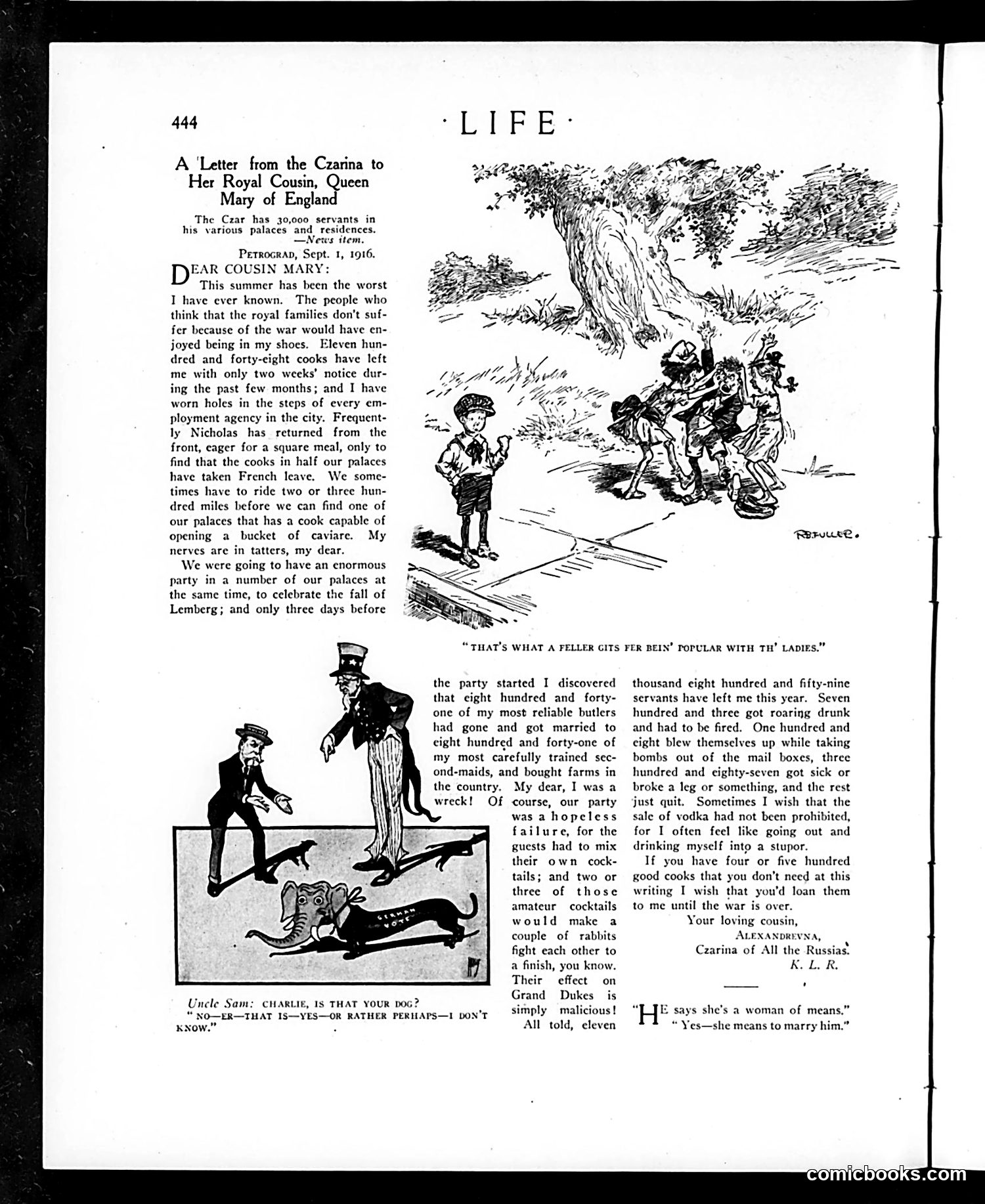
This satirical piece from *Life* magazine (September 1, 1916) mocks the Russian Imperial family during World War I through a fake letter from Czarina Alexandra to Queen Mary of England. **The joke:** While Russia suffered massive casualties and hardship from the war, the Czarina complains about trivial aristocratic problems—servants quitting, difficulty finding cooks, cancelled parties. The absurdity lies in her self-pitying tone about "wearing holes in the steps of employment agencies" while her country hemorrhaged soldiers and resources. **Historical context:** By 1916, Russia's war effort was collapsing, with widespread discontent about the royal family's perceived indifference to suffering. This satire exposes that disconnect—the royals' disconnection from reality becomes the target. **The smaller cartoon below** shows two figures discussing a dachshund, with one saying "That is—yes—or rather perhaps—I don't know." This likely references German dachshunds becoming unpopular in Britain during WWI due to anti-German sentiment, making ownership socially awkward. The satire's point: Imperial excess and obliviousness during national crisis.
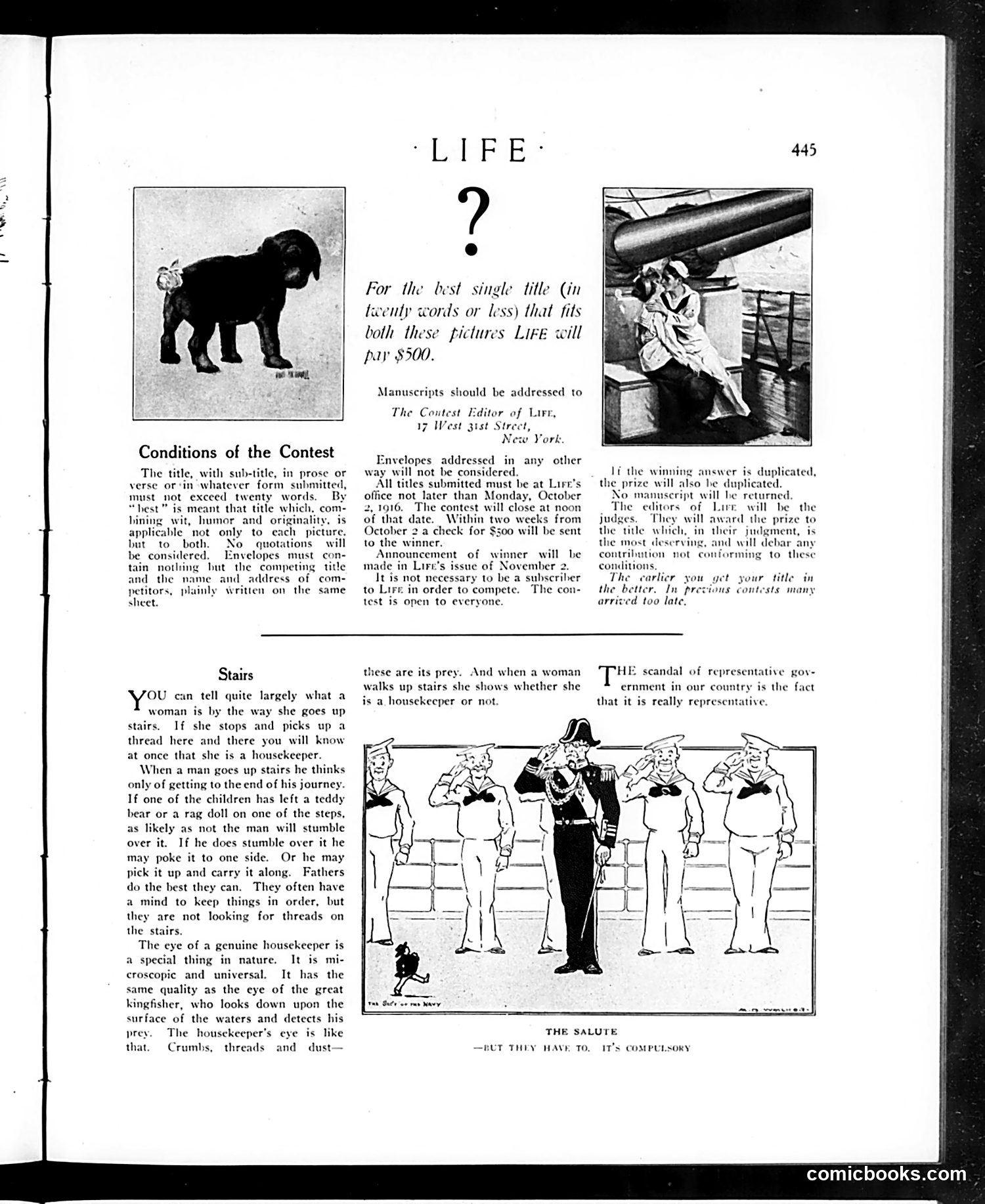
This page contains a **contest announcement** and two satirical pieces. The top section announces a $500 contest for readers to title two photographs: a young child with a toy and a woman on a ship's rigging. The contest rules are straightforward. Below is an essay titled "Stairs" that humorously characterizes gender differences: women are detail-oriented housekeepers who notice threads and crumbs, while men are single-minded about reaching their destination and largely indifferent to household order. It's gentle domestic satire reflecting early 20th-century gender stereotypes. The cartoon titled "The Salute" depicts a military officer surrounded by sailors saluting him reluctantly. The caption reads "BUT THEY HAVE TO. IT'S COMPULSORY." The accompanying text mocks representative government as a "scandal" because it "is really representative"—implying the public doesn't genuinely support its leaders but must perform allegiance anyway. It's political satire criticizing forced civic obedience.
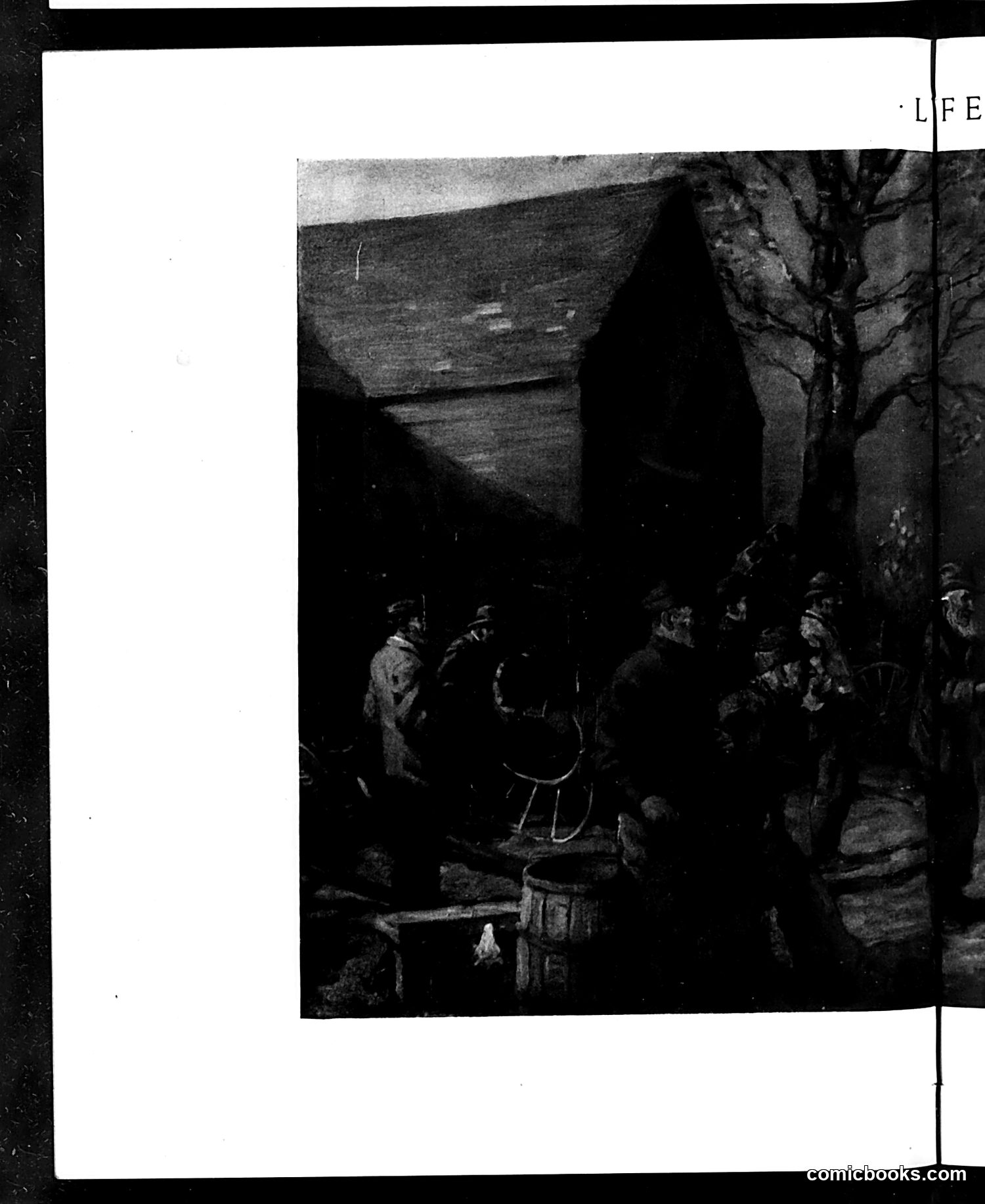
I can see this is a dark, atmospheric black and white illustration showing a group of figures gathered outside what appears to be a building or structure at night. The image has a dramatic, somewhat ominous quality typical of early 20th-century satirical illustration. However, the OCR text provided ("icbooks.com") does not contain readable article text or captions that would explain the cartoon's subject, political references, or satirical intent. Without legible accompanying text identifying the figures, the historical event being referenced, or the publication date visible on this page, I cannot reliably determine what specific political or social commentary this illustration represents. To accurately explain this cartoon's meaning to a modern reader, I would need either clearer OCR text from the page or additional context about the publication date and article title.
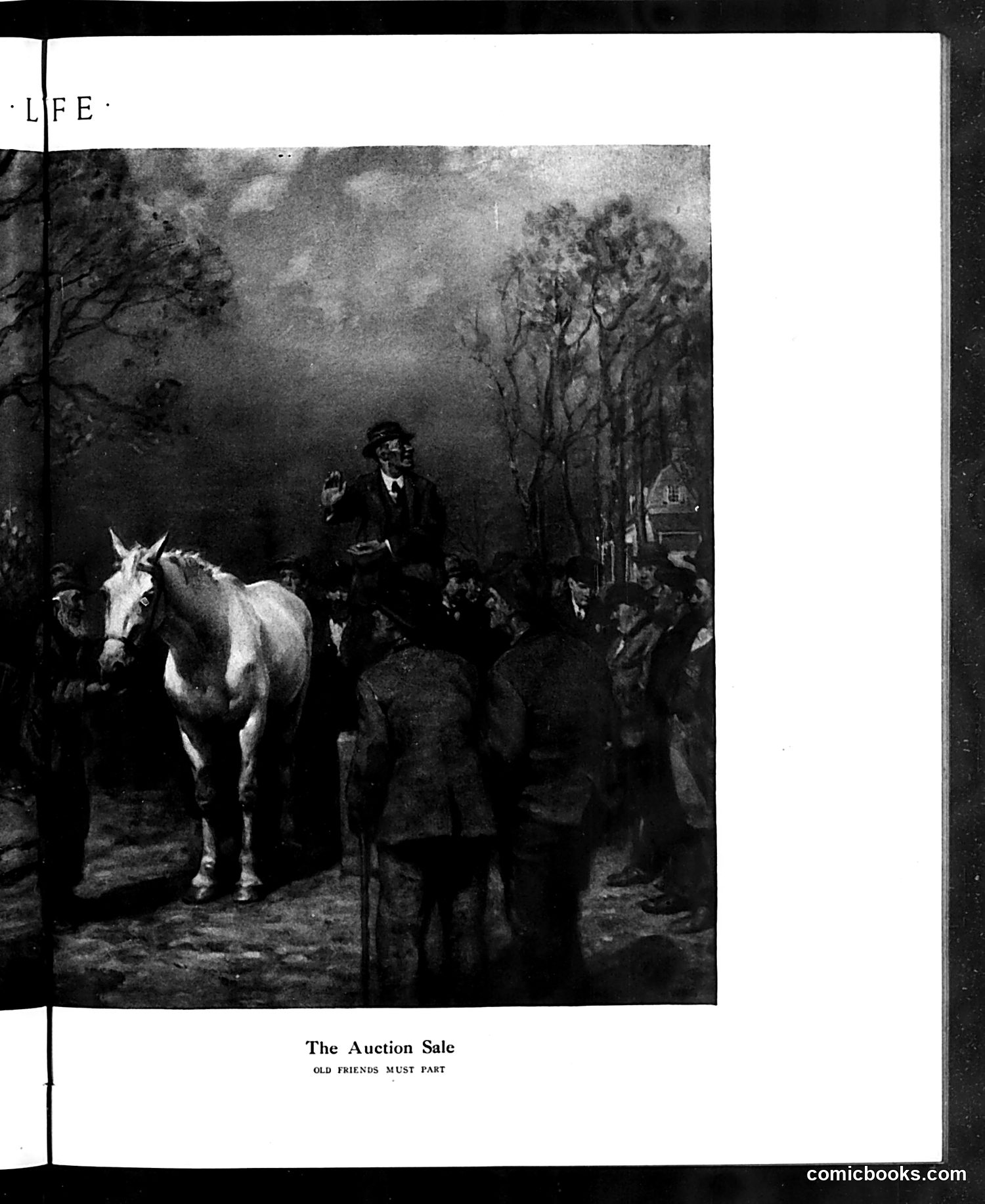
This illustration depicts an emotional scene at a horse auction. A well-dressed man on horseback gestures farewell to a crowd of people gathered around him, with bare trees and a building visible in the background. The caption "Old Friends Must Part" emphasizes the poignant nature of the moment. The satire likely comments on economic hardship forcing the sale of valued possessions or livestock—a common hardship during financial crises. The formal attire and somber tone suggest this represents someone of means experiencing financial loss, making the separation from his horse (a cherished companion and status symbol) particularly tragic. The crowd's presence underscores the public nature of such misfortune, a pointed commentary on financial vulnerability and social change.
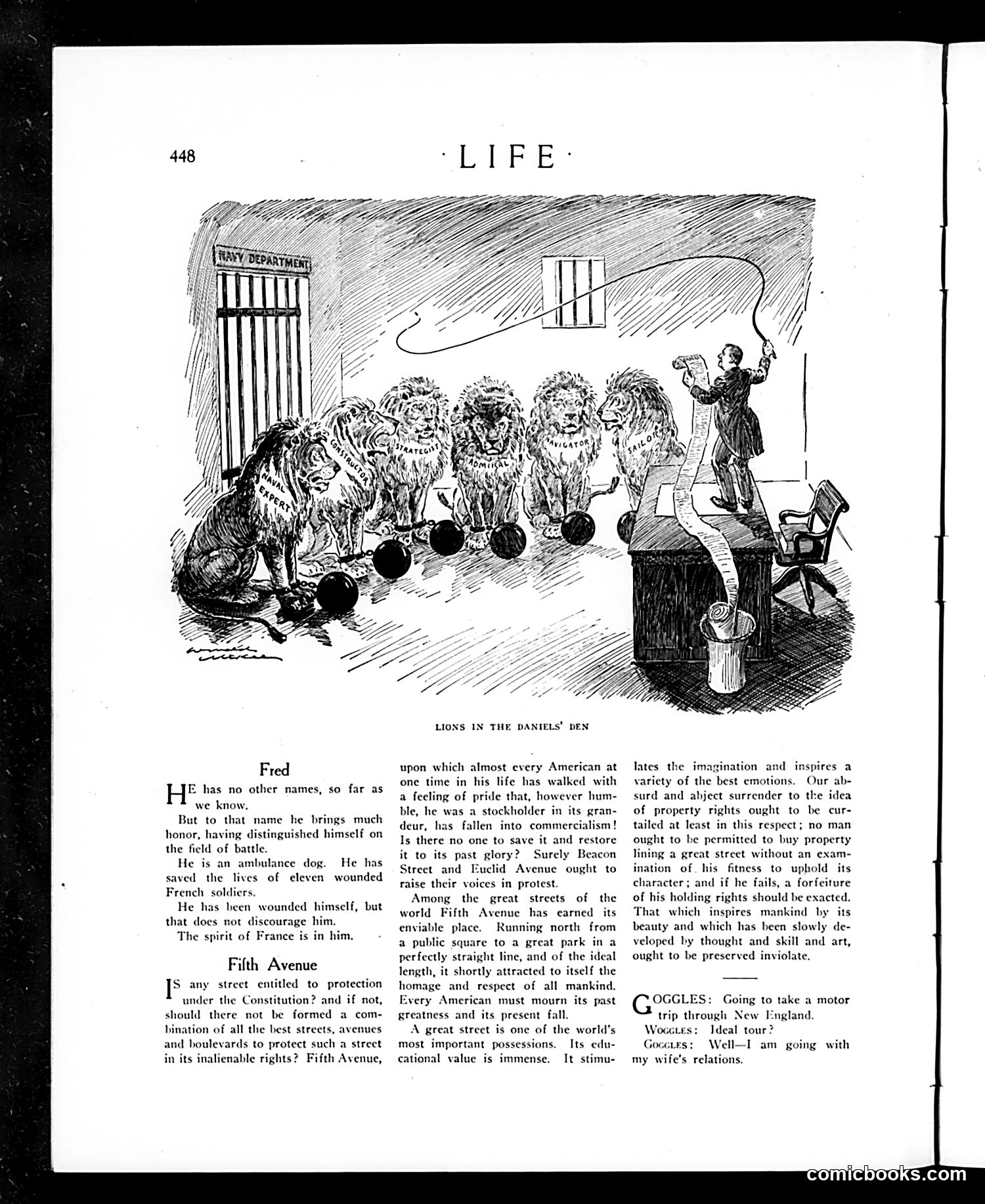
This cartoon satirizes Secretary of the Navy Josephus Daniels as a circus trainer taming "lions"—likely representing either Congress members, admirals, or military/political rivals who oppose his policies. The whip and the den setting suggest Daniels asserting forceful control over institutional resistance. The accompanying text celebrates "Fred," an ambulance dog wounded saving French soldiers in WWI, embodying French valor. It then pivots to lamenting Fifth Avenue's commercialization—arguing that great streets deserve constitutional protection and that property owners should be examined for fitness to maintain their character. This reflects early-20th-century anxieties about unchecked commercialism destroying America's cultural monuments. The bottom dialogue joke is a simple pun: taking a motor trip with one's wife's relations transforms an "ideal" tour into an ordeal.
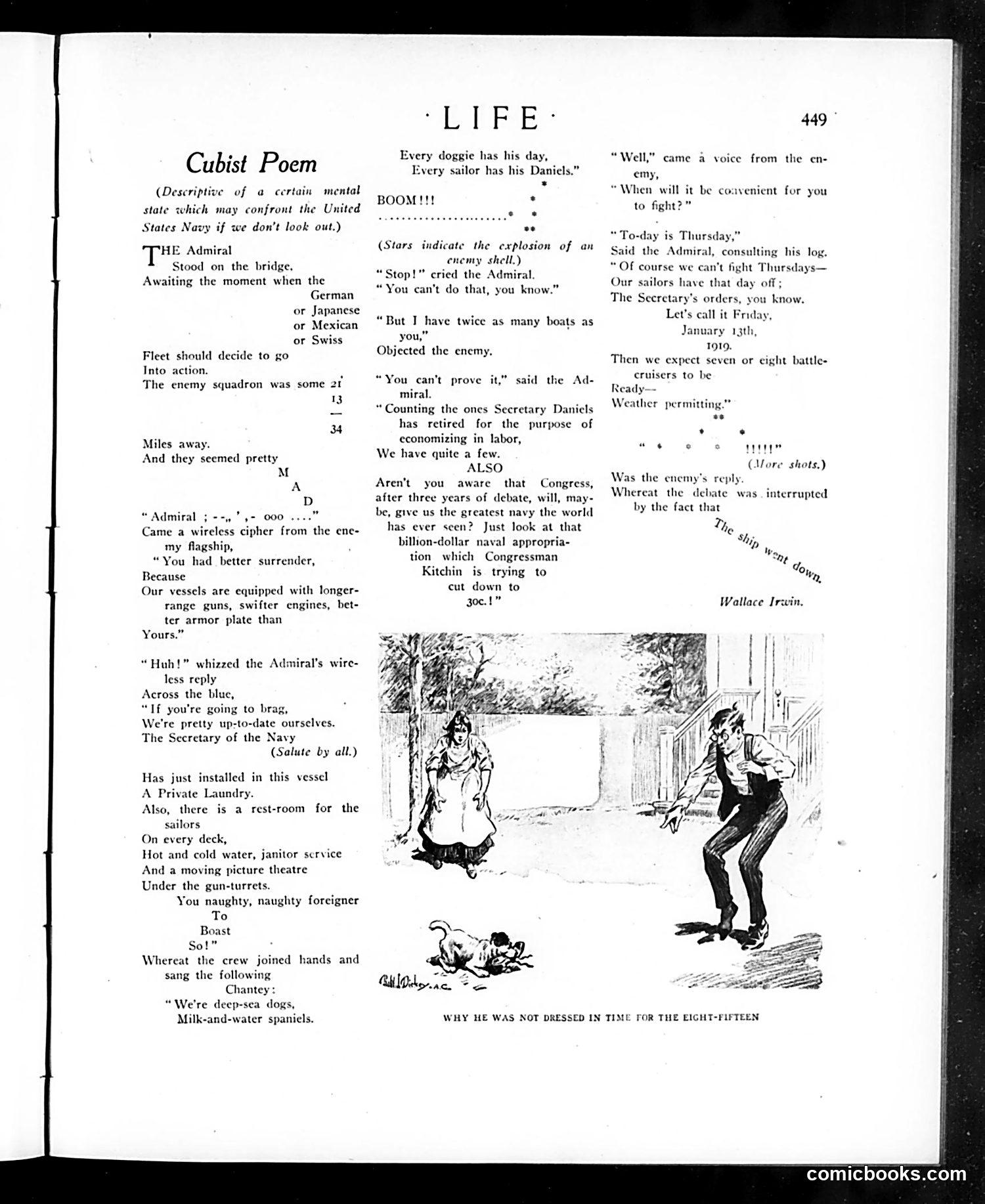
This 1919 satirical poem by Wallace Irwin mocks American naval preparedness anxieties and bureaucratic absurdity during potential wartime. The "Cubist" style fragments a naval battle scenario into disjointed, illogical exchanges. **The satire targets:** 1. **Secretary of the Navy Josephus Daniels** (referenced repeatedly)—mocked for installing trivial amenities (laundry, rest-rooms, movie theaters) aboard warships instead of prioritizing combat readiness. Daniels was known for naval reforms and prohibition advocacy. 2. **Congressional budget debates**—Congressman Kitchin's attempts to cut massive naval appropriations are presented as absurdly penny-pinching when the Navy boasts luxury amenities. 3. **Military incompetence**—an Admiral who cannot fight because sailors have Thursdays off, schedules battle for Friday the 13th "weather permitting," and argues about boat counts. The poem suggests American naval leadership is so consumed with comfort and bureaucracy that it cannot effectively defend the nation. The fragmented, nonsensical dialogue structure mirrors this mental confusion—the poem's "cubism" reflects a fractured, irrational military establishment.
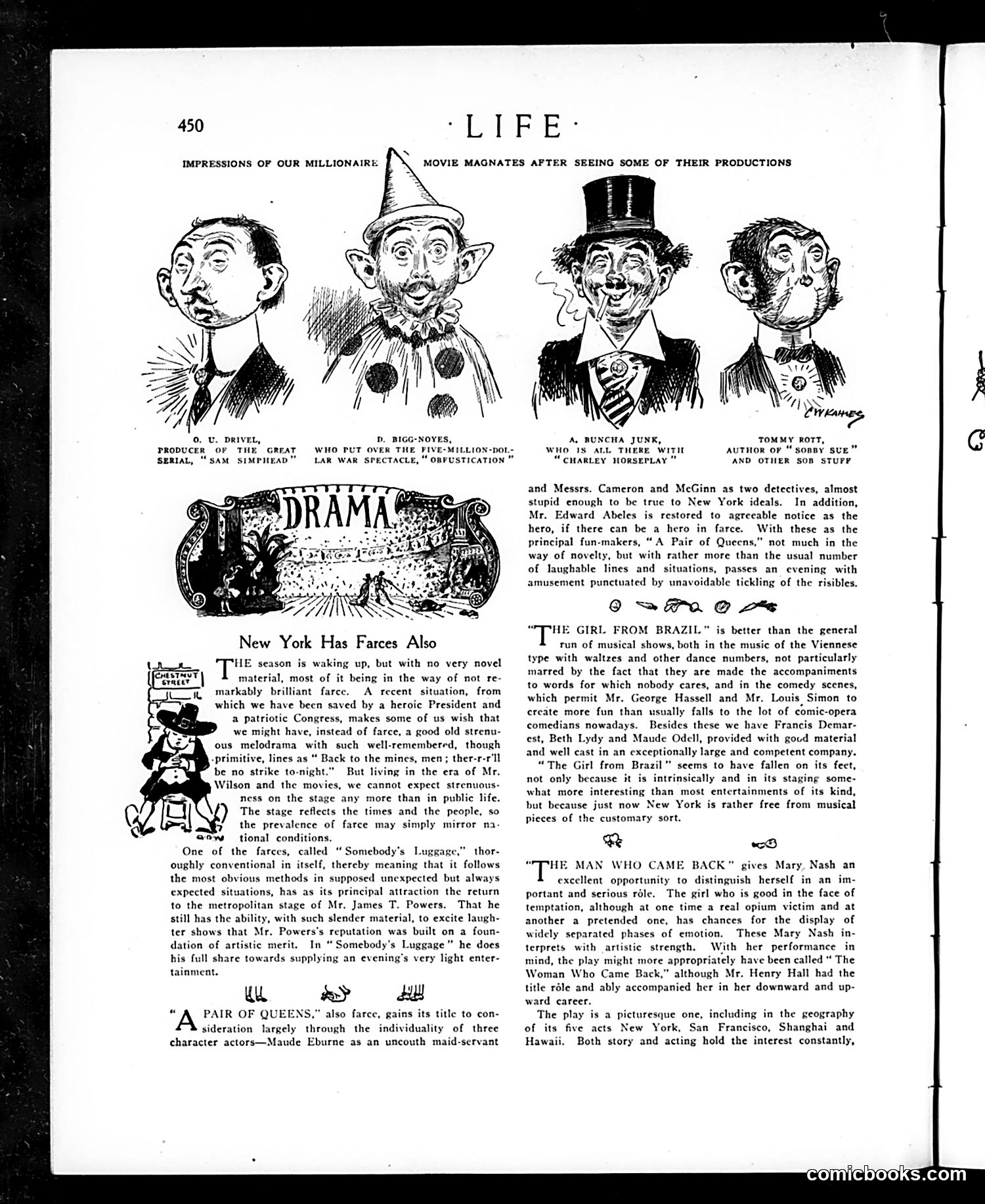
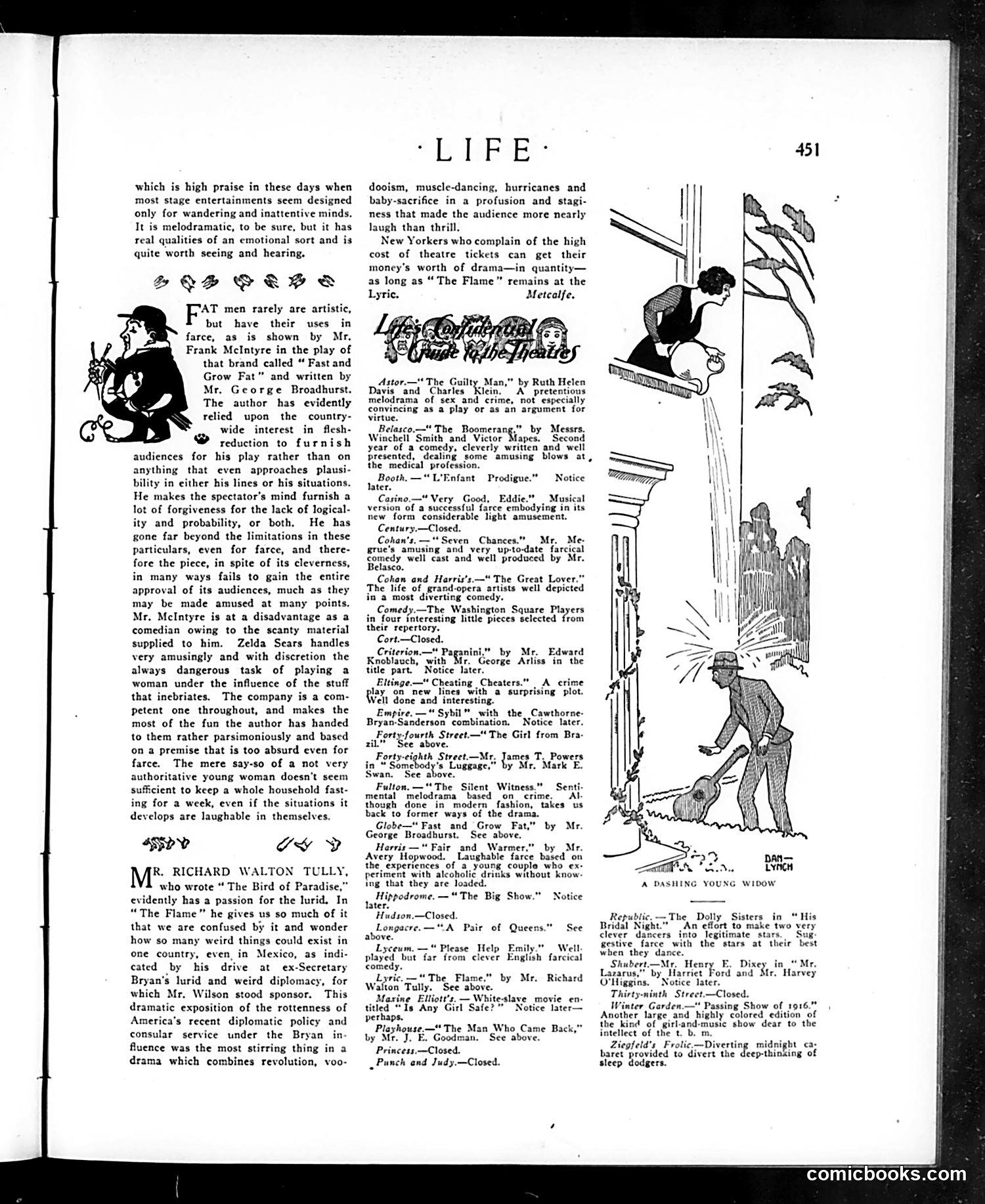
This page contains theatrical reviews from Life magazine, a satirical publication. The left column features a critical essay on farce comedies and their reliance on "fat men" and absurd premises rather than genuine wit—using Frank McIntyre's "Fast and Grow Fat" as an example. The main satire targets playwright Richard Walton Tully's melodrama "The Flame," set in Mexico. The review criticizes the play for combining lurid, confusing elements (revolution, voodoo, human sacrifice, muscle-dancing) while attempting to critique ex-Secretary William Jennings Bryan's "weird diplomacy" under Wilson. The author suggests the play's real contribution was exposing the "rottenness of America's recent diplomatic policy and consular service under the Bryan influence"—essentially saying the unintentional social commentary was more compelling than the actual plot. The right side contains thumbnail theater listings, including illustrations of what appears to be theatrical scenes. The overall tone dismisses most contemporary stage entertainment as designed for inattentive audiences.
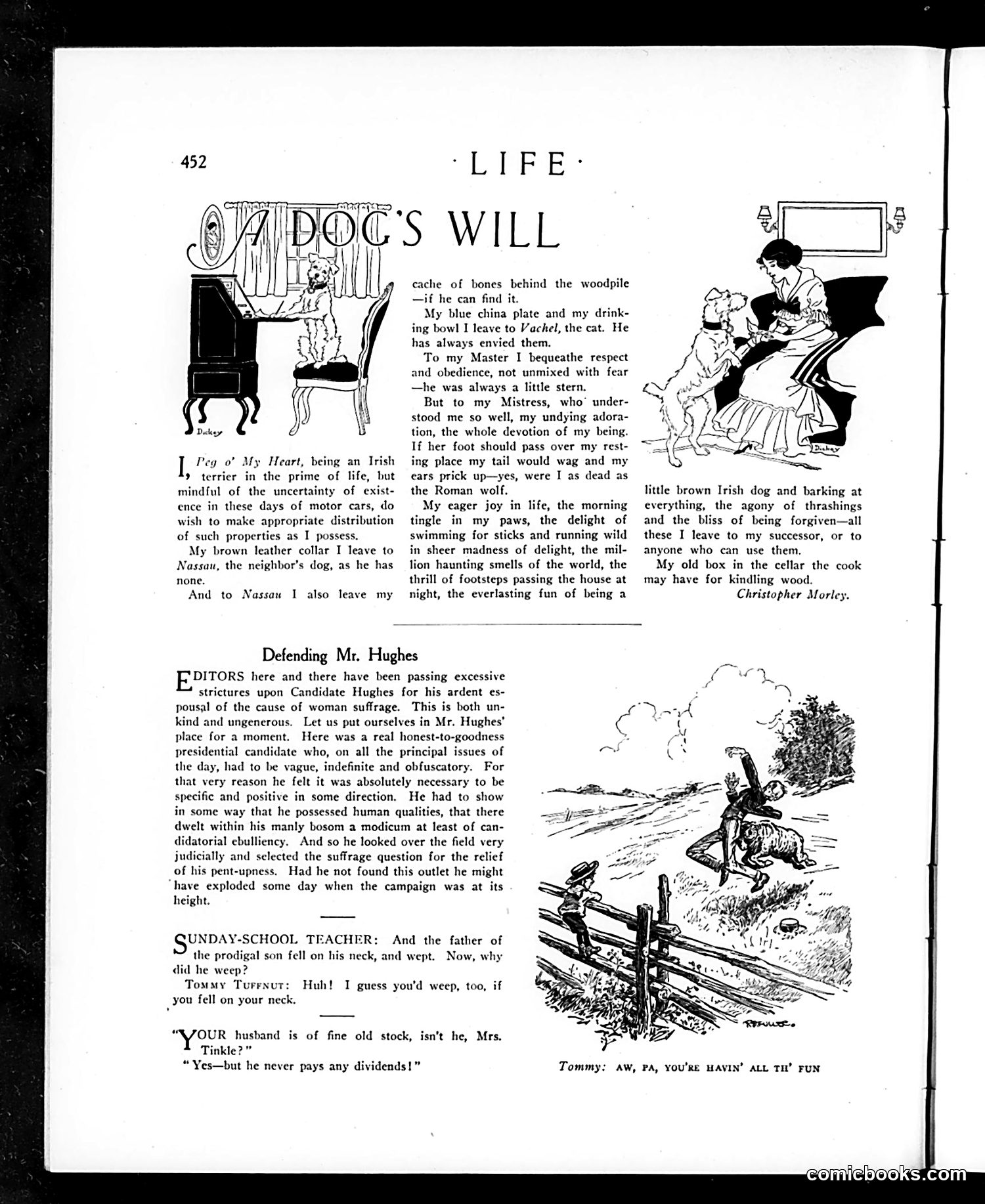
This Life magazine page (page 452) contains three distinct pieces: **"A Dog's Will"** is a humorous essay by Christopher Morley presenting an Irish terrier's last testament—a sentimental, tongue-in-cheek piece where the dog bequeaths his possessions and qualities to various household members and animals. The satire mocks both sentimental pet literature and human wills through gentle animal anthropomorphism. **"Defending Mr. Hughes"** defends presidential candidate Charles Evans Hughes's suffrage advocacy as a psychological outlet—he needed *some* concrete position since he remained vague on major issues. This satirizes Hughes's deliberately ambiguous campaign strategy. The remaining items are brief joke exchanges: a Sunday school student's pragmatic response to Biblical narrative, and a wife's quip that her "fine old stock" husband produces no financial return. These mock bourgeois pretensions and marital dynamics. The page reflects pre-1920 American political and social attitudes through light satire rather than sharp critique.
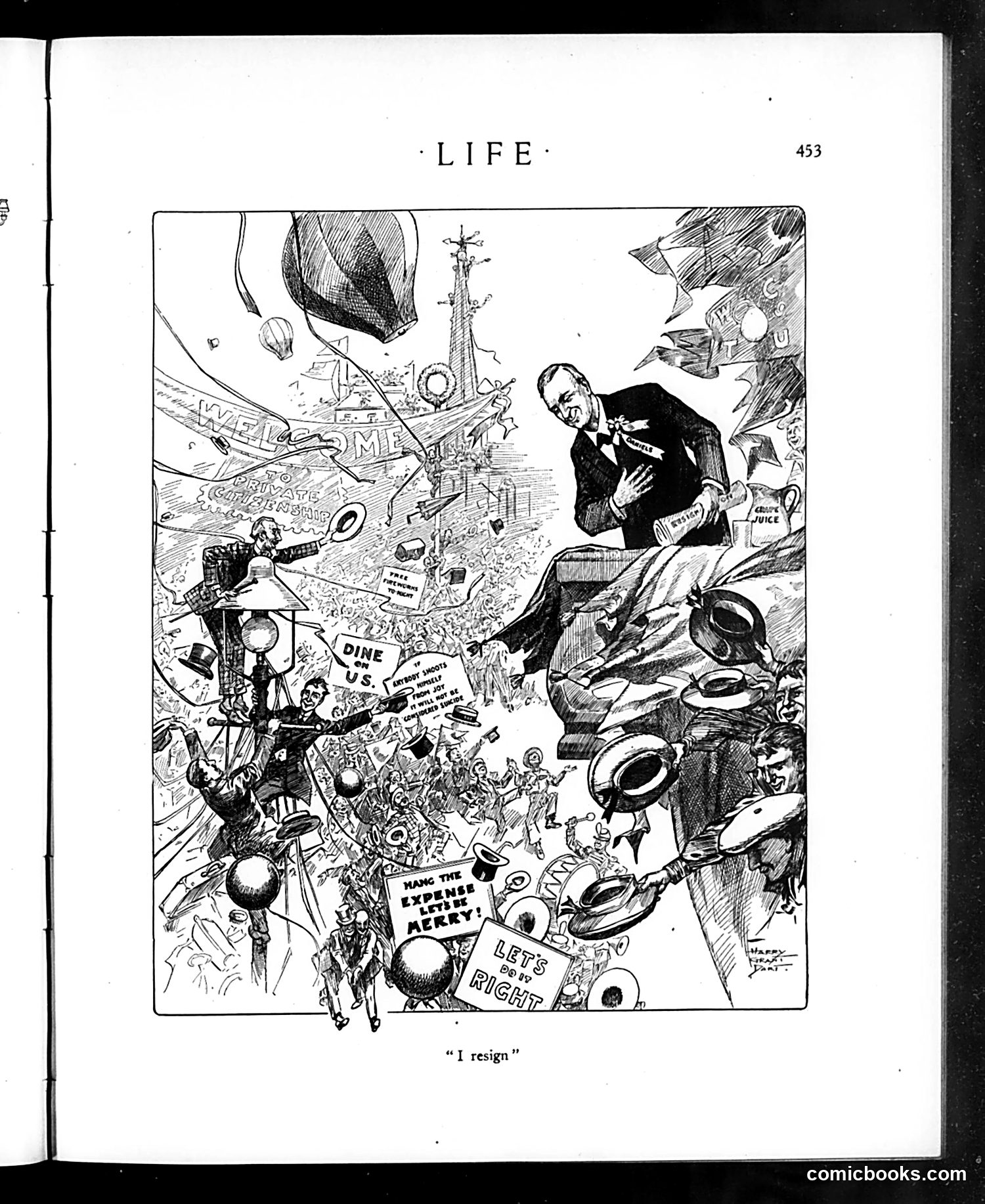
This satirical cartoon depicts a formal resignation scene. A well-dressed man in a suit sits at a desk, appearing to resign from his position. The chaotic scene around him includes military/naval imagery (ships, balloons, flags reading "DINE U.S." and "MAKING THE EXPENSE OF THE AERIES" and "LET'S BE RIGHT"), suggesting governmental or military administrative confusion. The cartoon likely satirizes political turmoil—possibly a cabinet member or official resigning amid fiscal mismanagement or military logistical chaos. The surrounding mayhem and expense-related signage suggest criticism of wasteful spending or administrative incompetence forcing the resignation. Without the publication date visible, the specific historical context remains unclear, though Life magazine frequently mocked government inefficiency and political instability during the early 20th century.
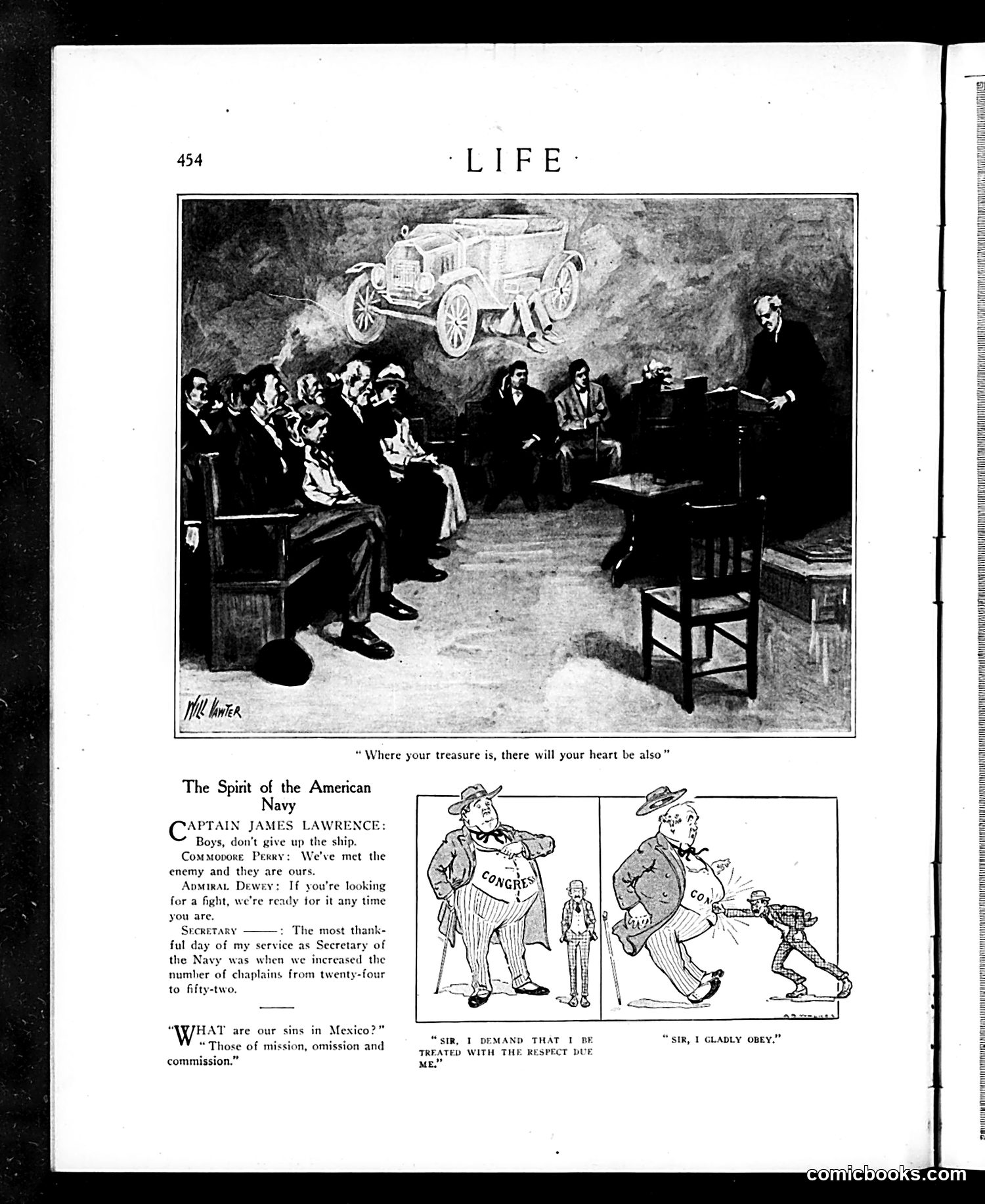
This page satirizes American military and political priorities. The top cartoon depicts a wealthy audience mesmerized by a vision of an automobile—illustrating materialism overriding higher ideals (the biblical quote "Where your treasure is, there will your heart be also" underscores this). Below, "The Spirit of the American Navy" mocks priorities by contrasting celebrated historical naval figures (Lawrence, Perry, Dewey) with a Secretary of the Navy whose proudest accomplishment was increasing chaplains from 24 to 52. This trivializes military leadership. The bottom exchange about "sins in Mexico" (likely referring to U.S. military interventions there) uses wordplay on "mission/omission/commission" to critique American foreign policy as hypocritical or incomplete. The three cartoon panels on the right mock Congressional posturing—representatives demanding and receiving respect while the nation faces real problems. Overall, the page critiques American society for prioritizing wealth and ceremonial honor over substantive military leadership and honest foreign policy.
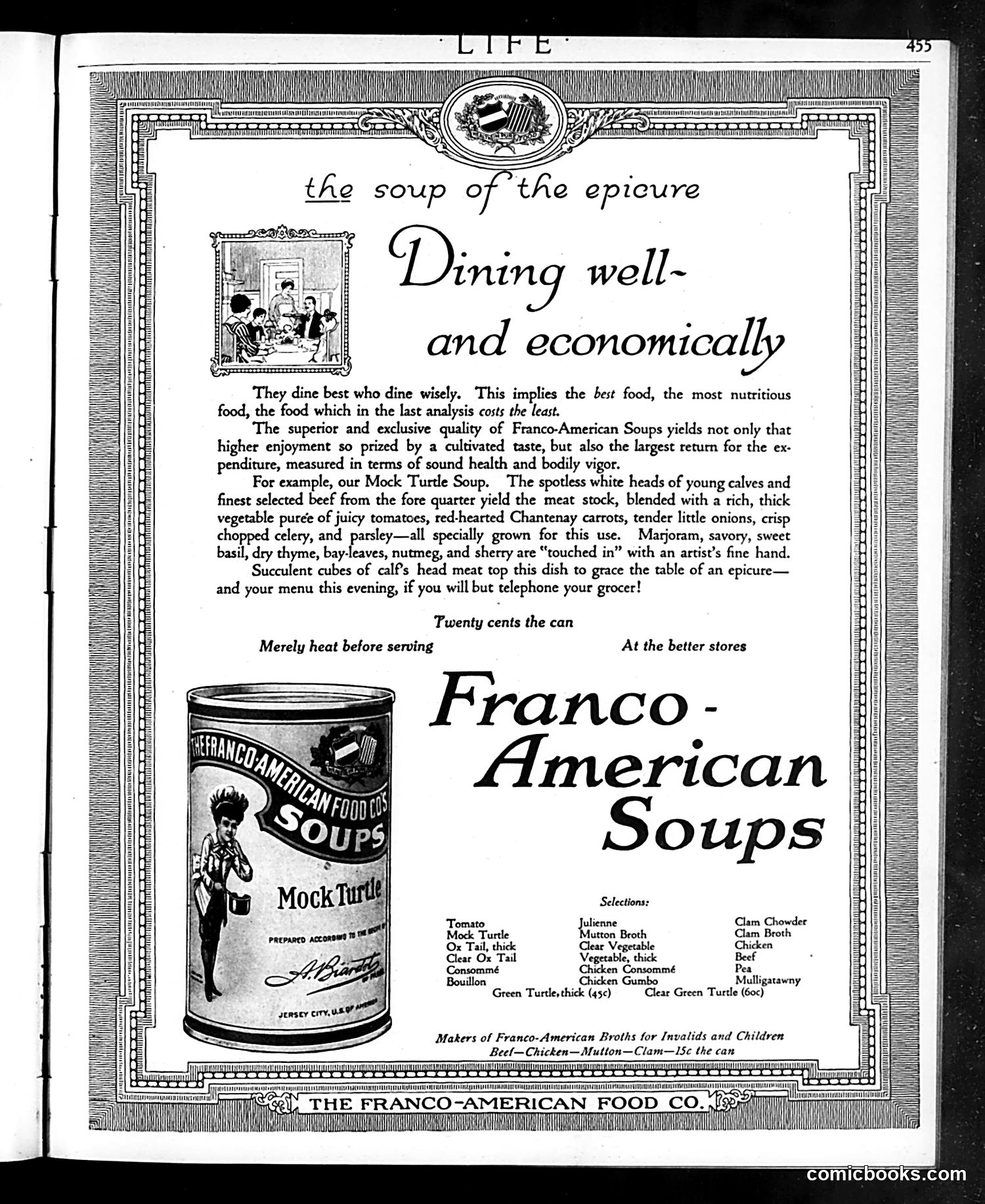
This is a **full-page advertisement**, not political satire. It promotes Franco-American Soups, positioning canned soup as both luxurious and affordable for middle-class consumers. The ad uses pseudo-sophisticated language ("soup of the epicure," "cultivated taste") to market convenience food as elegant dining. The Mock Turtle Soup example—describing fine ingredients like calf's head and sherry—attempts to elevate a simple canned product into something befitting formal dinner service. The key sales pitch is **economical luxury**: quality nutrition at twenty cents per can, requiring only heating before serving. This appeals to early 20th-century housewives seeking to entertain respectably without extensive cooking labor. The small illustration shows a formal dinner scene, reinforcing aspirational messaging. The product list emphasizes variety (turtle, consommé, gumbo) to suggest sophistication. This reflects broader marketing strategies of the era, which used class signifiers to sell mass-produced, affordable foods to aspirational consumers.
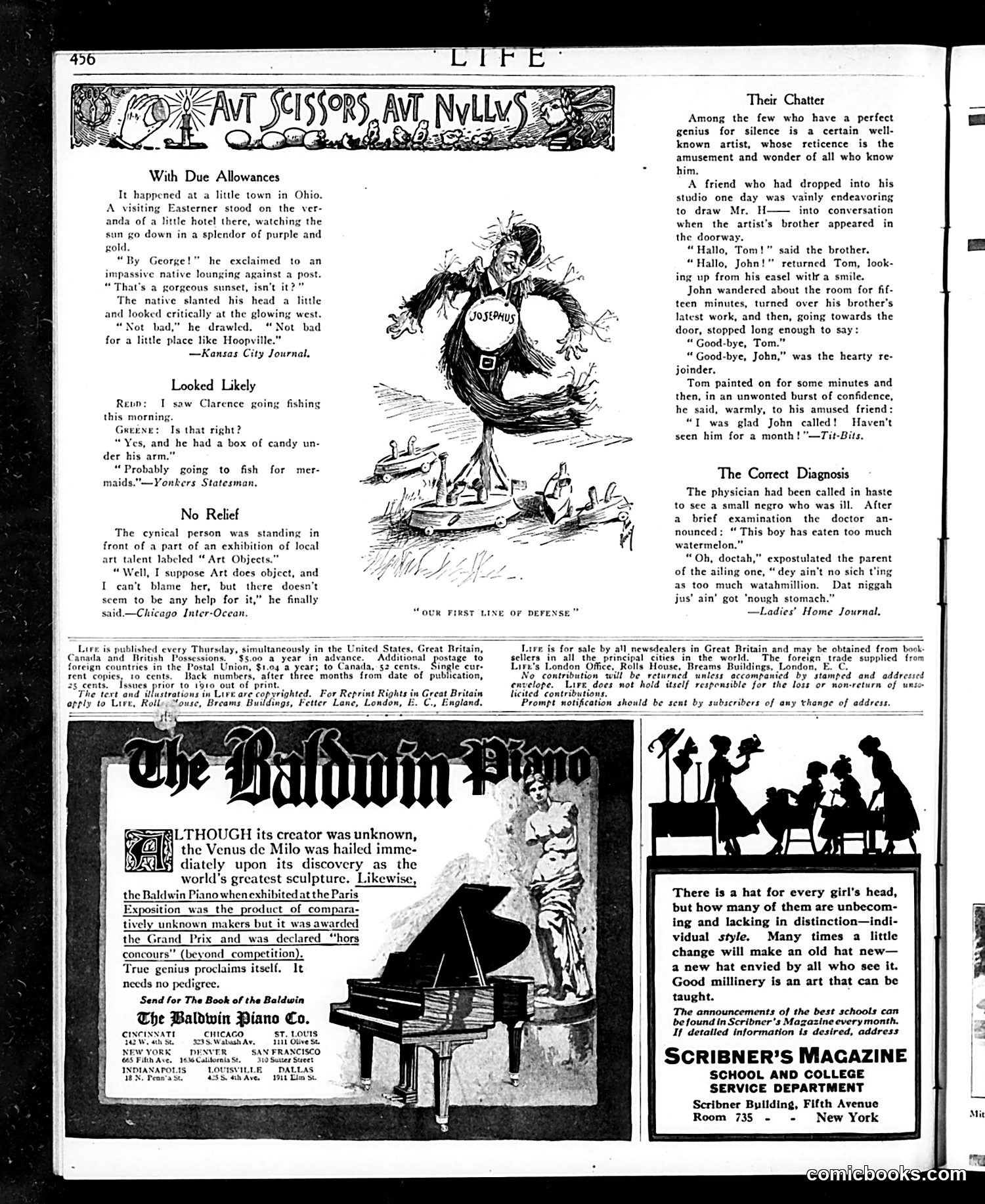
This page contains several brief humorous anecdotes typical of early 20th-century Life magazine's satirical style: **"With Due Allowances"**: An Eastern city visitor rhapsodizes about a sunset to a Midwestern small-town resident, who dismisses it as "not bad for a little place like Hoopville." The joke satirizes rural American modesty and lack of romantic sentiment versus Eastern affectation. **"Looked Likely"**: A brief joke suggesting a man carrying candy while going fishing must be courting "mermaids"—absurdist humor. **"No Relief"**: A cynic mocks an art exhibition as pretentious; the satire targets contemporary art world pretension. **"Their Chatter"** and **"The Correct Diagnosis"**: Anecdotes about a taciturn artist and a physician's interaction with a Black patient, using dialect humor typical (though offensive by modern standards) of the era. The page also includes advertisements for Baldwin Pianos and Scribner's Magazine. The illustration labeled "Our First Line of Defense" appears to be political commentary, though its specific reference is unclear from the visible image.
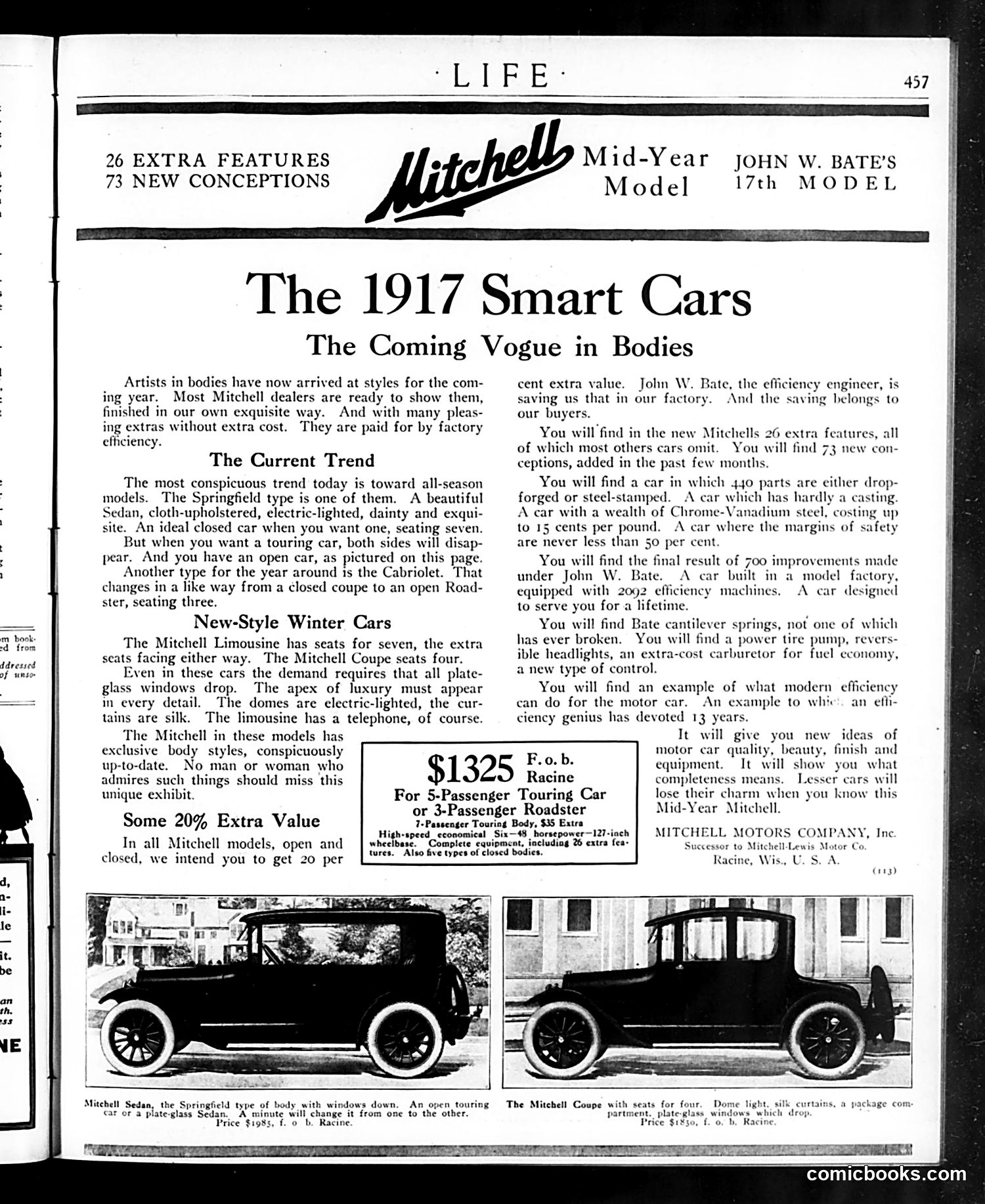
This is **not a cartoon or satire**—it's a straightforward automobile advertisement from *Life* magazine, circa 1917. The page promotes the Mitchell automobile's mid-year models, emphasizing their innovative convertible designs that transform from closed cars to open touring vehicles. The text highlights 26 "extra features" and 73 "new conceptions," positioning Mitchell cars as technologically advanced and efficient. Key selling points include: electric lighting, chrome-vanadium steel construction, cantilever springs, and reversible headlights. The advertisement credits John W. Bate, an "efficiency engineer," with 700 improvements developed over 13 years. Two photographs show the practical versatility: the Mitchell Sedan (convertible sedan) and Mitchell Coupe, demonstrating how side panels and tops could be removed or adjusted. The pricing ($1,325 for a 5-passenger touring car) and emphasis on "20% extra value" through factory efficiency reflect pre-mass-production automotive marketing, when such technical specifications and customizable features were genuine selling points.
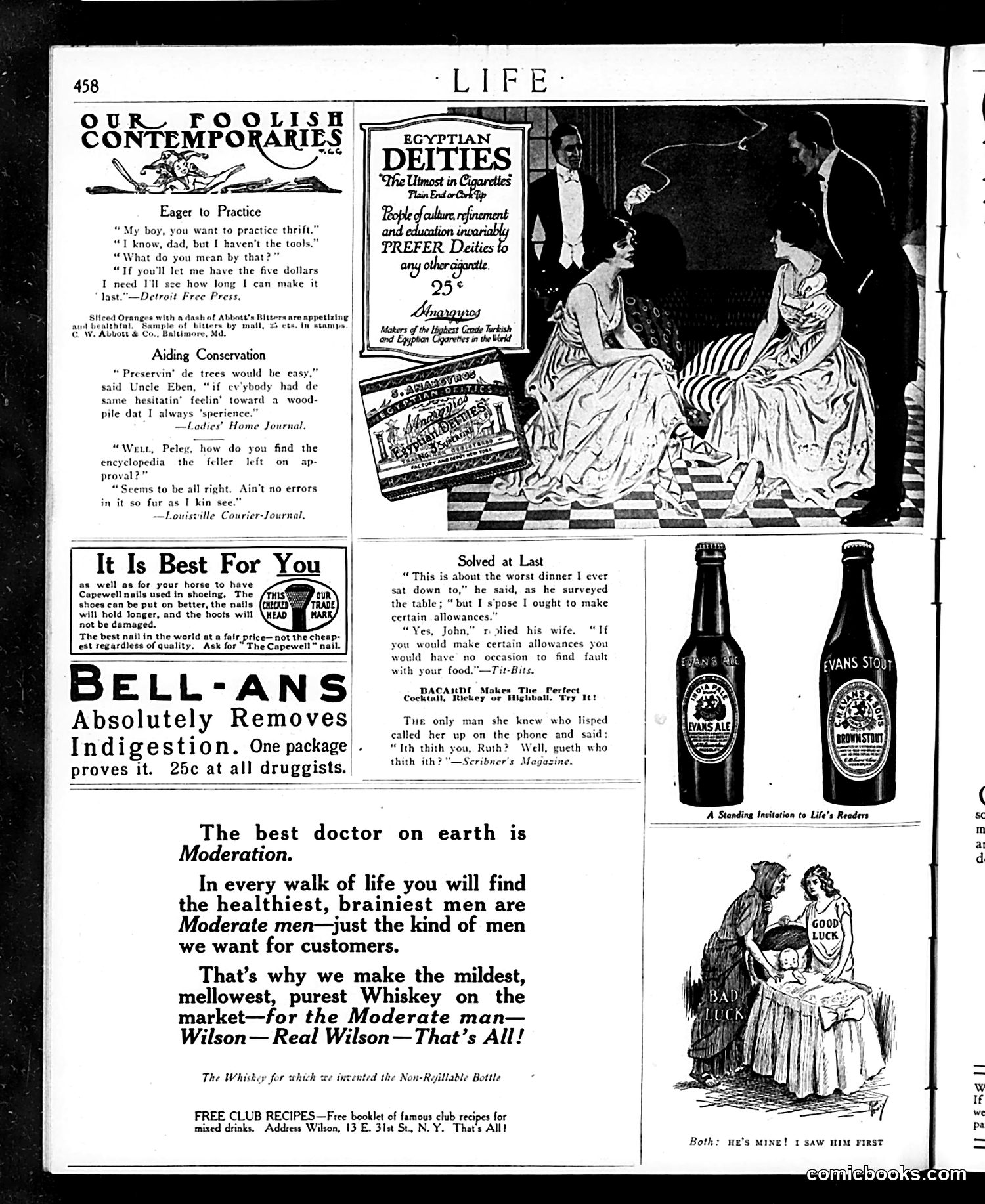
This page contains primarily **advertisements and comic humor snippets** rather than political cartoons. The "Our Foolish Contemporaries" section features brief satirical jokes poking fun at everyday life: a boy asking for money to learn thrift, an elderly man's reluctance about woodpiles, someone finding an encyclopedia with no errors, and marital dinner disputes. These are gentle social humor rather than pointed satire. The advertisements dominate the page—notably an **Egyptian Deities cigarette ad** (upper right), **Bell-Ans indigestion remedy**, and a **Wilson whiskey advertisement** that argues moderation in drinking produces the "healthiest, brainiest men." The whiskey ad is ironic given Prohibition was imminent or recently enacted (this appears early 20th century). The bottom illustration shows two figures (one labeled "Bad Luck," one "Good Luck") with text about a man's first encounter—likely a romance joke. Overall, this is a typical period magazine page mixing light humor with patent medicine and alcohol advertising, reflecting pre-Prohibition consumer culture.
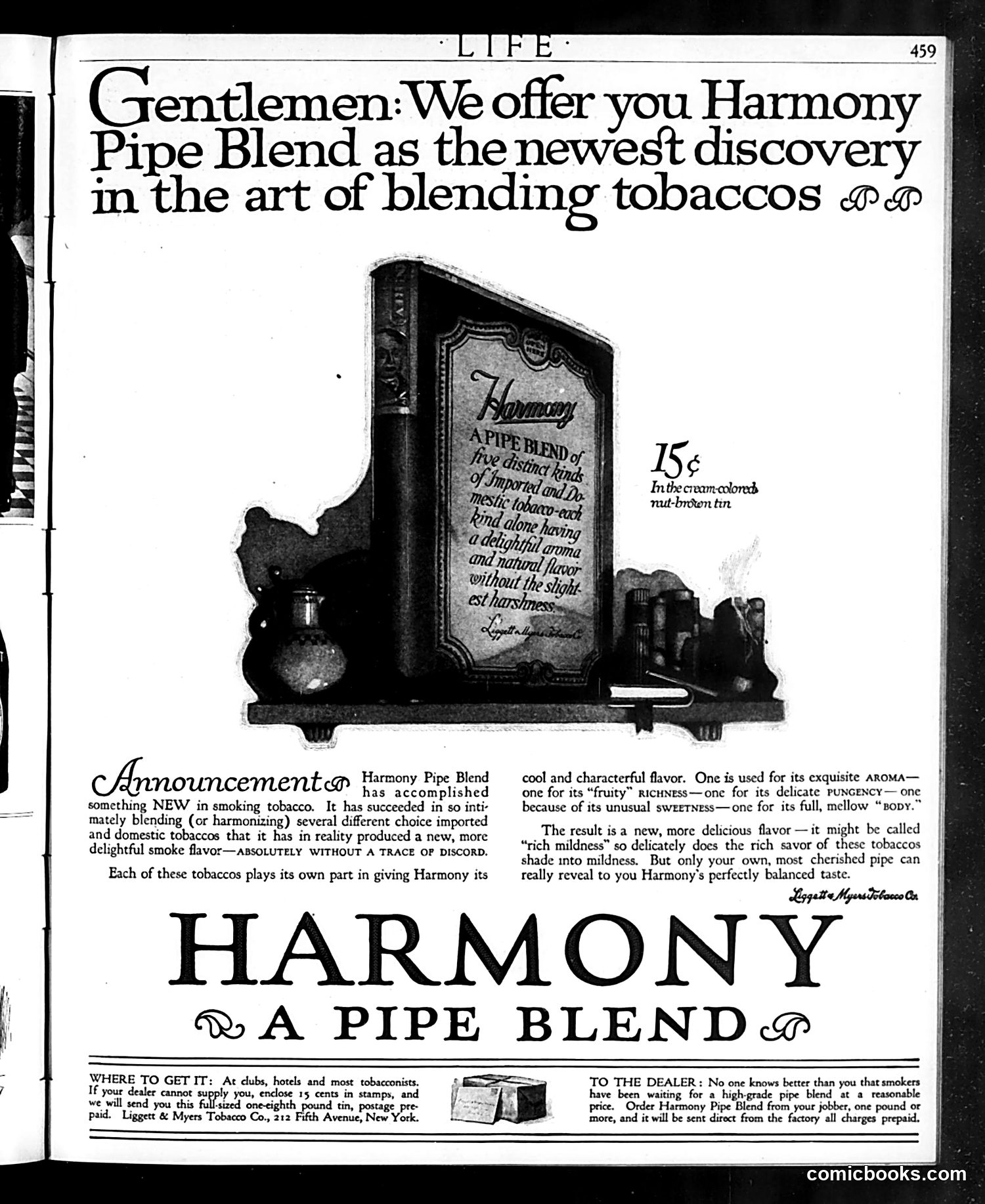
This is a **tobacco advertisement**, not satire or political commentary. It appears in *Life* magazine (page 459) promoting Harmony Pipe Blend tobacco by Liggett & Myers. The ad uses musical metaphor to market the product: tobacco blending is compared to musical "harmony," where different tobaccos blend "without a trace of discord," each contributing distinct qualities (aroma, richness, pungency, sweetness). The central image shows an ornate pipe display with the product label. The language emphasizes luxury and sophistication—"exquisite," "delicate," "rich mildness"—targeting gentlemen smokers. The price (15¢ for a tin) and distribution channels (clubs, hotels, tobacconists) indicate it's positioned as a premium product. This reflects early-20th-century advertising practices normalizing tobacco use before health concerns were widely publicized.
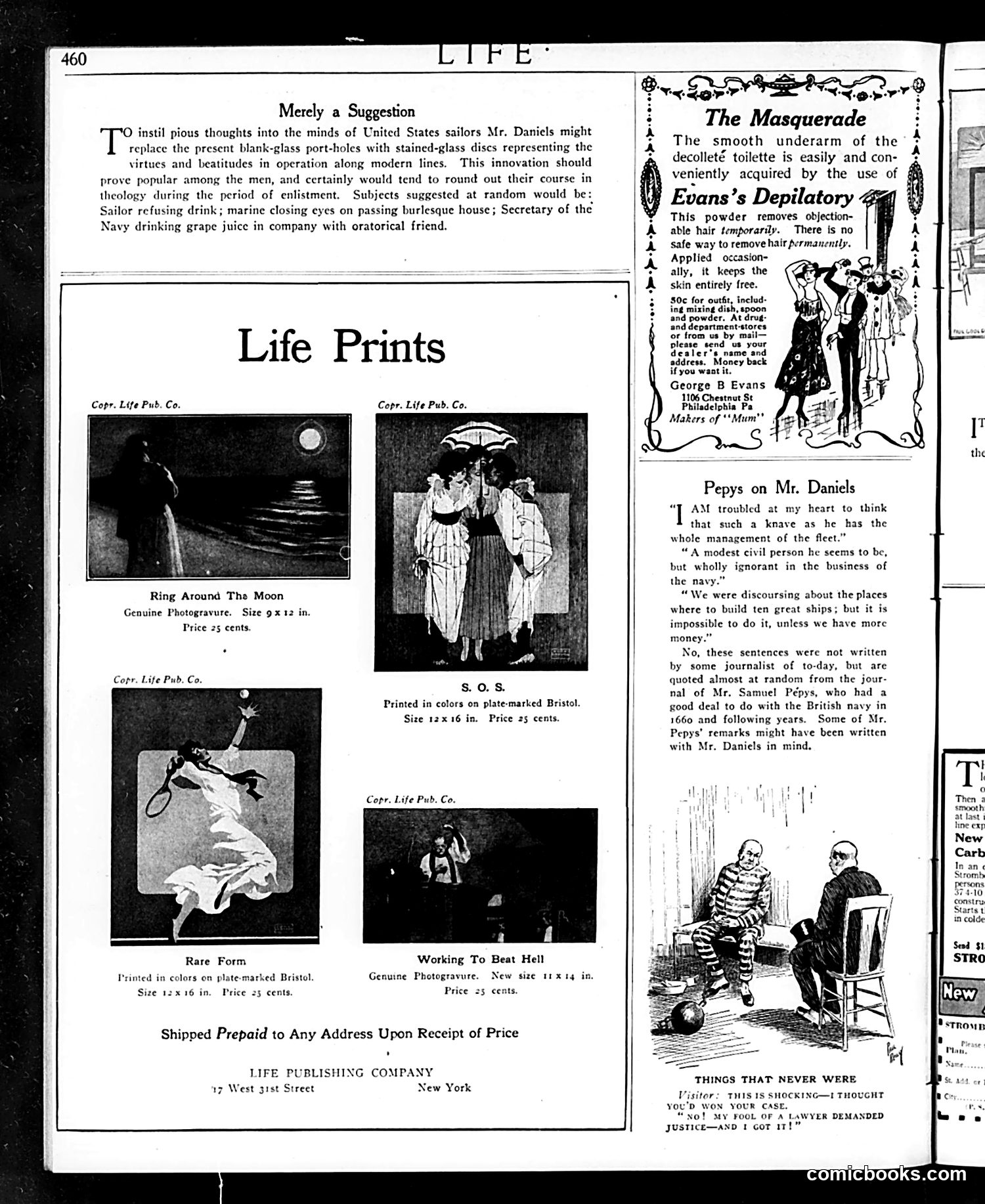
This page satirizes Josephus Daniels, Secretary of the Navy under President Wilson. The main article mocks Daniels's known temperance advocacy by suggesting sarcastically that he install stained-glass windows in Navy ships depicting moral virtues—including "Secretary of the Navy drinking grape juice," a jab at his abstinence in an era when sailors traditionally drank alcohol. The "Pepys on Mr. Daniels" section reinforces this criticism by quoting 17th-century diarist Samuel Pepys's complaints about naval management (incompetence, insufficient funding) and suggesting these same criticisms apply to Daniels—implying he's poorly suited to manage the fleet. The cartoons below are unrelated commercial advertisements. The satire reflects ongoing contemporary debate about Daniels's fitness for office and his efforts to enforce moral and temperance standards among servicemen.
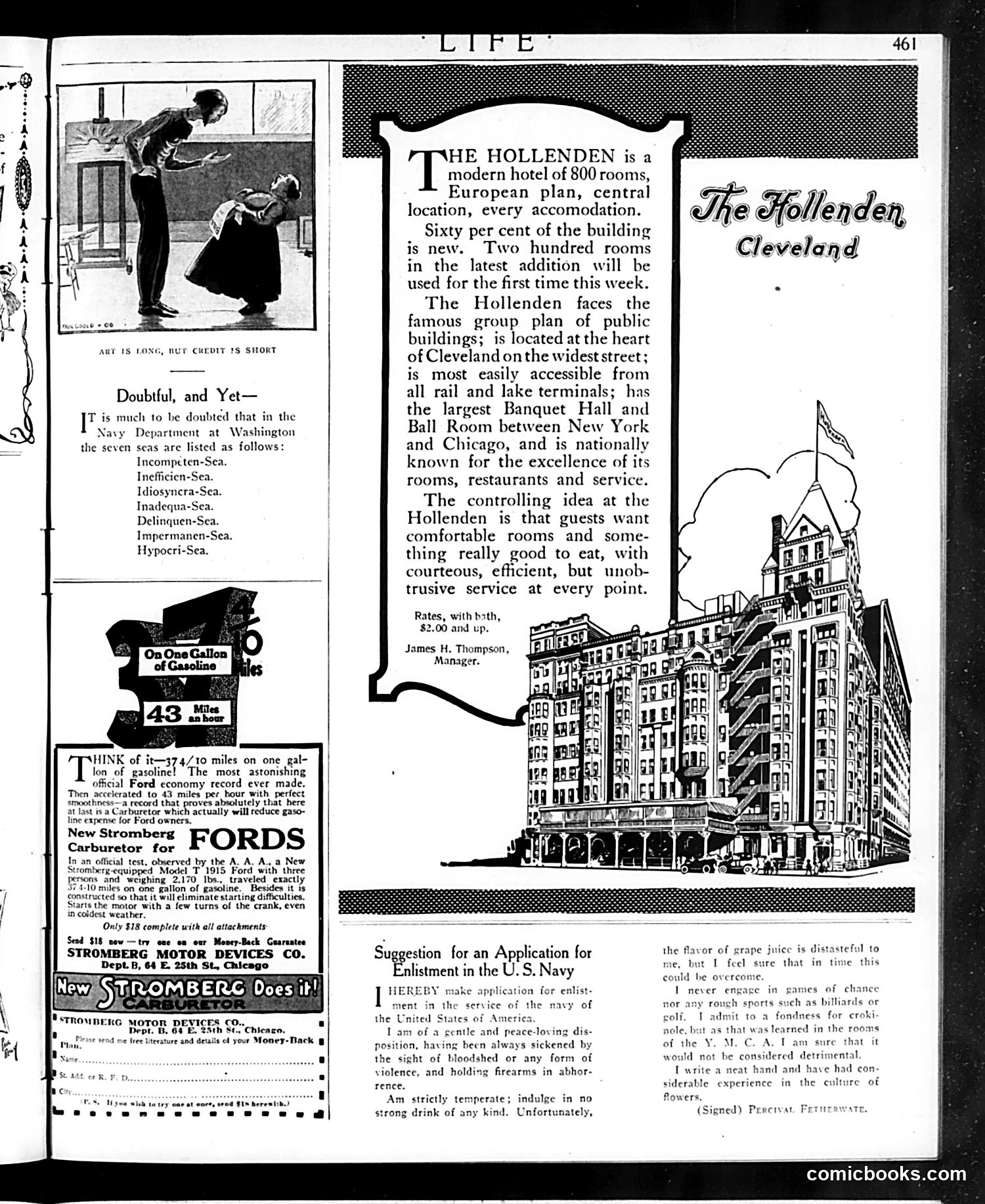
The main cartoon, titled "Doubtful, and Yet—," satirizes the U.S. Navy Department's incompetence. It presents a list of "seven seas" as the Navy would supposedly catalog them, but replaces actual sea names with satirical compounds: "Incompeten-Sea," "Inefficien-Sea," "Inadequa-Sea," and others. The joke mocks the Navy's perceived organizational failures and poor management, suggesting its leadership embodies these negative qualities rather than competence. The accompanying illustration shows a stern officer gesturing dismissively at a subordinate, visually reinforcing the theme of naval mismanagement and poor discipline. Below this, a humorous mock letter titled "Suggestion for an Application for Enlistment in the U.S. Navy" presents an absurdly pacifist candidate applying to join the military—someone who abhors violence, avoids strong drink, and prefers crokinole to combat sports. The satire highlights the disconnect between what a soldier should be and what this applicant represents, likely critiquing either recruitment standards or broader questions about military readiness.
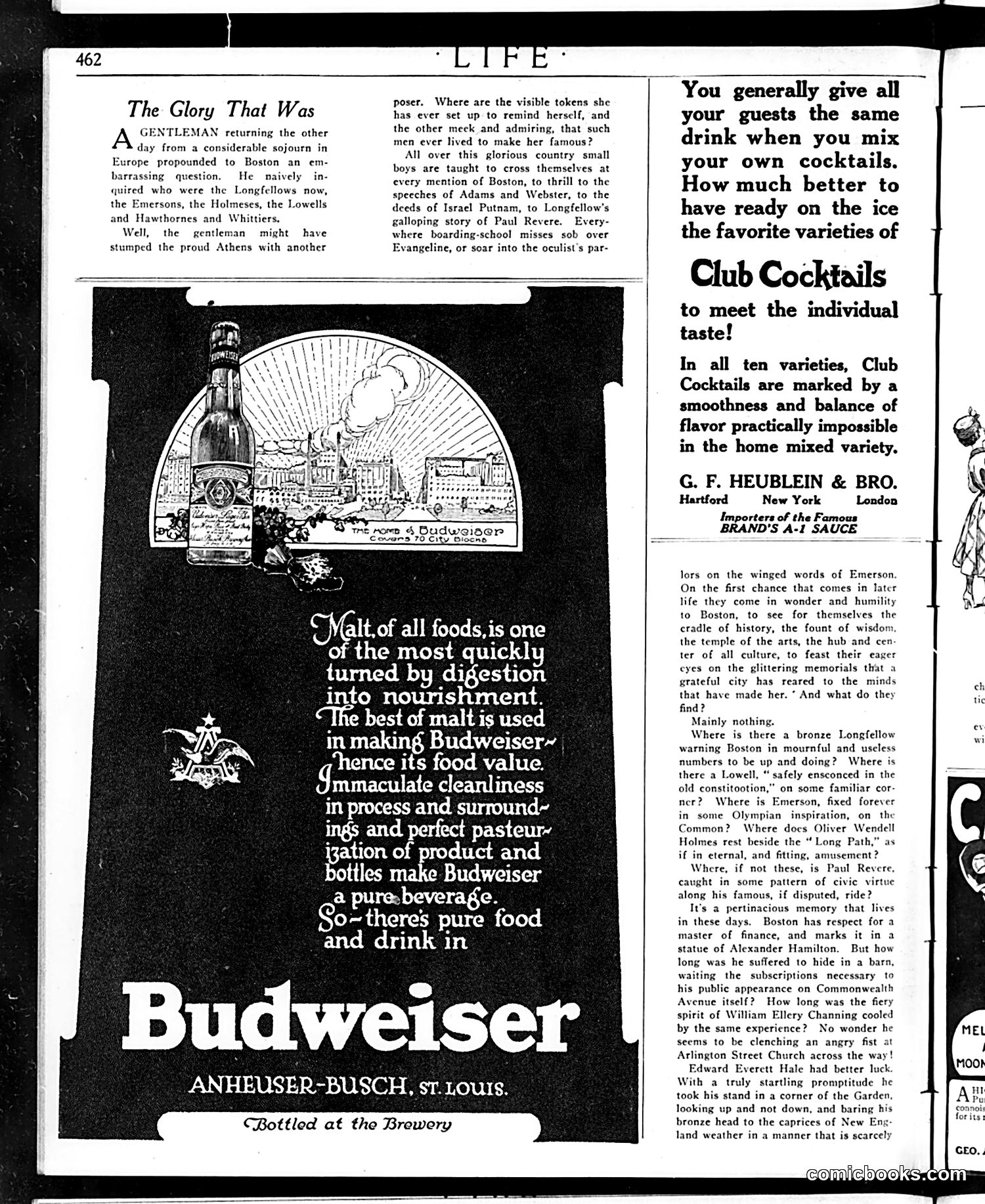
This article satirizes Boston's failure to commemorate its own literary giants. The author notes that Americans nationwide revere Boston's 19th-century cultural icons—Longfellow, Emerson, Holmes, Lowell, Whittier—yet Boston itself has erected no visible monuments to them. The piece mocks this contradiction: schoolchildren nationwide thrill to stories of Paul Revere and Adams, but when they visit Boston expecting to find bronze statues of the poets who made the city famous, they find "mainly nothing." The satire extends to Boston's erection of statues to financiers like Alexander Hamilton while literary figures languish—or worse, like William Ellery Channing, face years of delay. Even Edward Everett Hale's statue seems relegated to a corner, enduring New England weather with apparent indignity. The advertisement for Budweiser beer appears unrelated to the article's content.
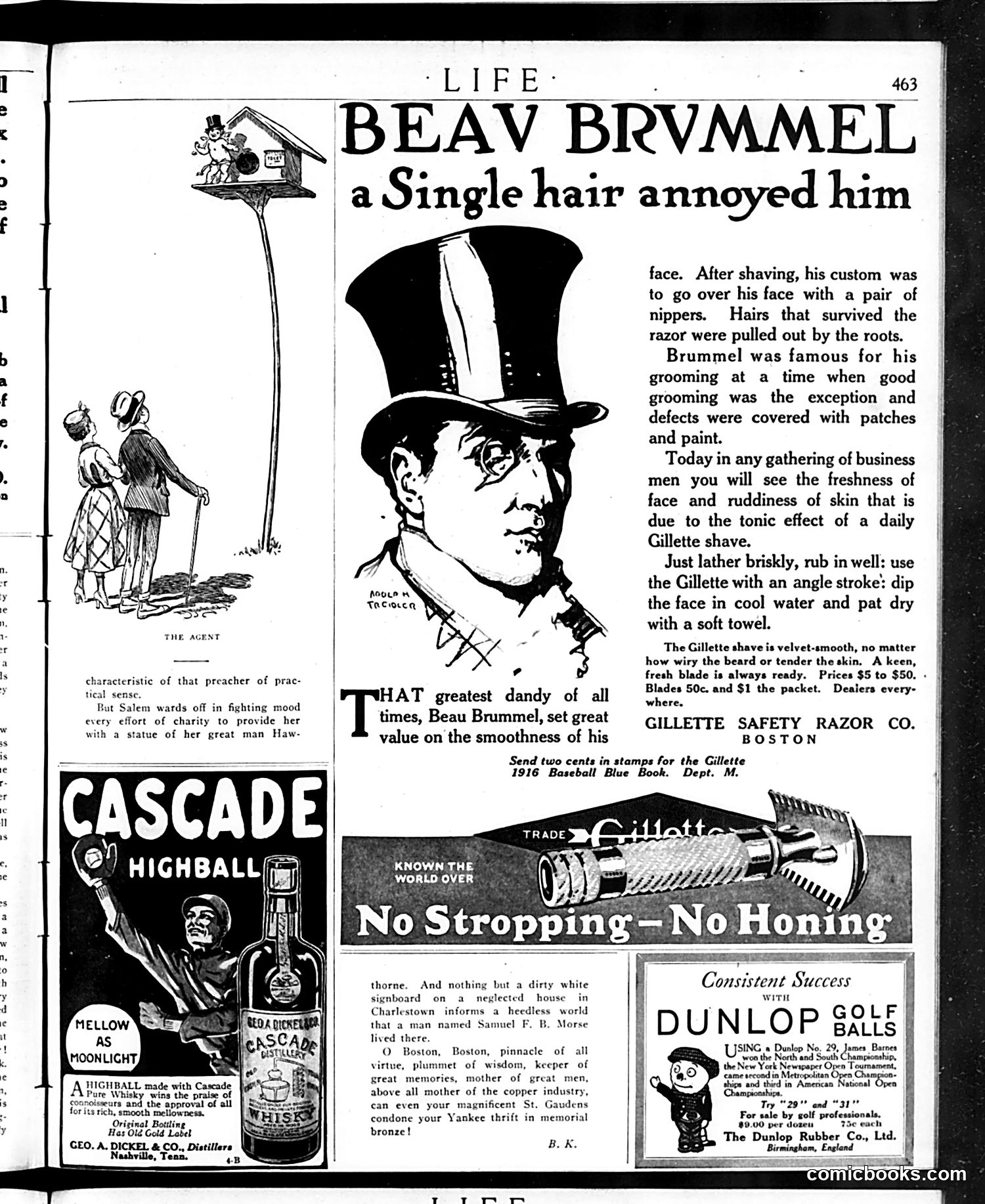
This page is primarily a **Gillette razor advertisement** disguised as historical editorial content. The ad uses Beau Brummel, the famous 19th-century English dandy, as its hook—explaining his obsessive grooming habits (shaving, then plucking remaining hairs with nippers) to promote daily shaving as a modern standard for businessmen. The satirical framing appears in the left column: a brief editorial jab at Boston's stinginess. It mocks the city for refusing to erect a statue honoring Samuel F.B. Morse (inventor of the telegraph, lived in Charleston) while boasting of its cultural superiority. The joke is that Boston, despite claiming to be "keeper of great memories" and "mother of great men," won't spend money memorializing actual greatness—a dig at New England Yankee frugality. The rest of the page contains unrelated period advertisements (Cascade whisky, Dunlop golf balls).
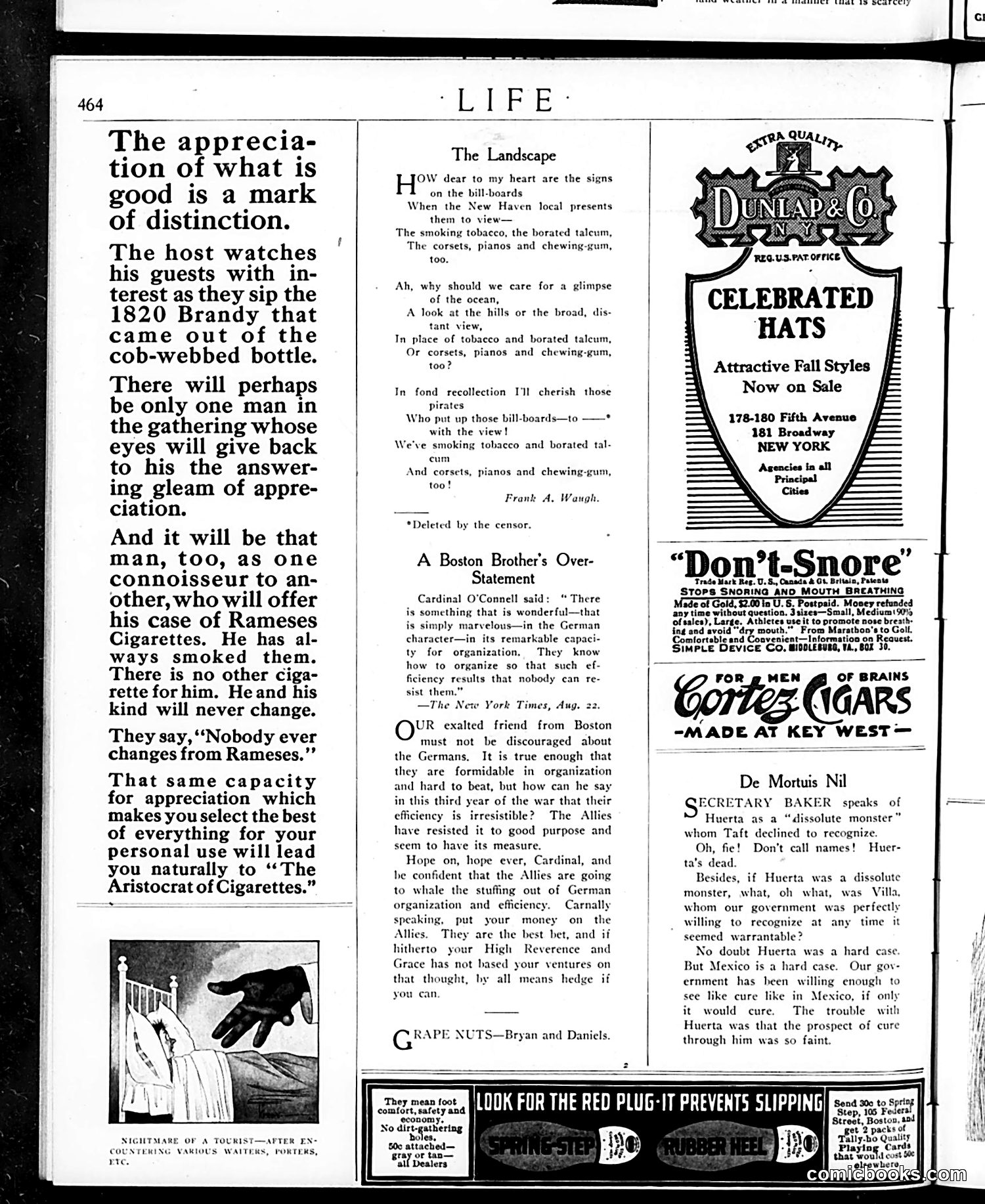
This page contains **political commentary and advertisements** from WWI-era America (suggested by references to the war and German efficiency). **Key Content:** The poem "The Landscape" satirizes **billboard advertising** cluttering American scenic views—a progressive-era complaint about commercialization ruining nature. The speaker ironically celebrates tobacco, talcum, corset, and chewing-gum ads instead of actual landscapes. "A Boston Brother's Overstatement" **mocks Cardinal O'Connell's** praise of German organizational efficiency during the war. The editor argues that while Germans are well-organized, the Allies have proven their efficiency "irresistible" and will defeat them—reassurance to American readers. "De Mortuis Nil" (roughly "speak no ill of the dead") criticizes **Secretary of War Baker** for calling the recently-deceased Mexican leader Huerta a "dissolute monster." The author notes the hypocrisy: the U.S. recognized Villa, who was equally problematic. The cartoon "Nightmare of a Tourist" (bottom left) depicts a nightmarish figure, likely representing **frustrations with service workers**—porters, waiters—common travel complaints.
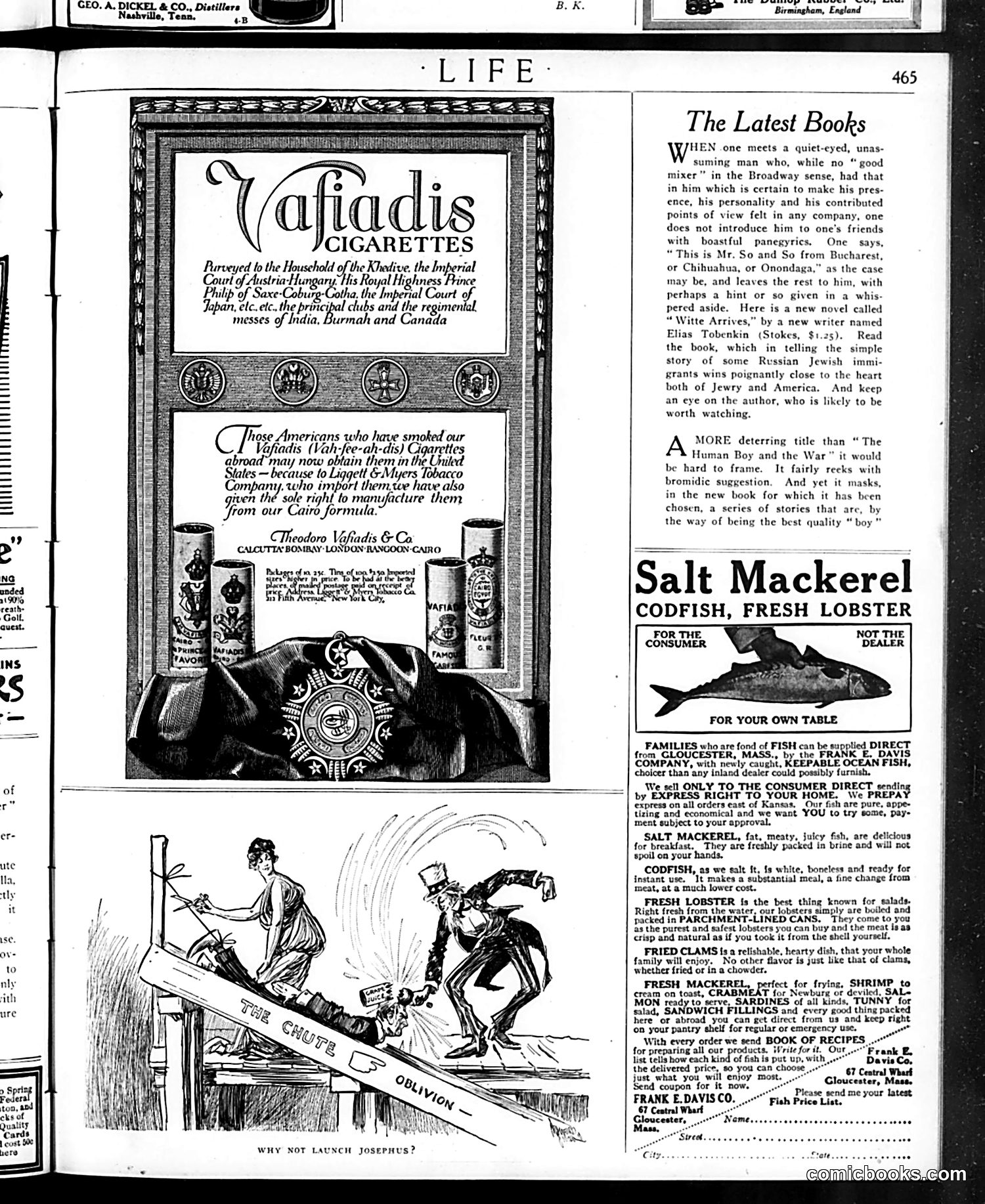
This page contains mostly advertisements rather than political cartoons. The dominant image is a large ad for Vafiadis Cigarettes, featuring ornate imperial seals and text claiming the product is "purveyed to the Household of the Khedive, the Imperial Court of Austria-Hungary" and other royal courts. This appeals to aspirational consumers by association with foreign aristocracy. Below is a small cartoon titled "Why Not Launch Josephus?" showing a figure being launched like a projectile—likely satirizing Joseph Josephus or a public figure, though the specific reference is unclear without additional context. The right side contains book reviews and a Frank E. Davis Company advertisement for fresh seafood (salt mackerel, codfish, lobster) marketed directly to consumers rather than dealers—emphasizing quality and direct delivery. The page reflects early 20th-century advertising and consumer culture, with emphasis on imported luxury goods and direct-mail commerce.
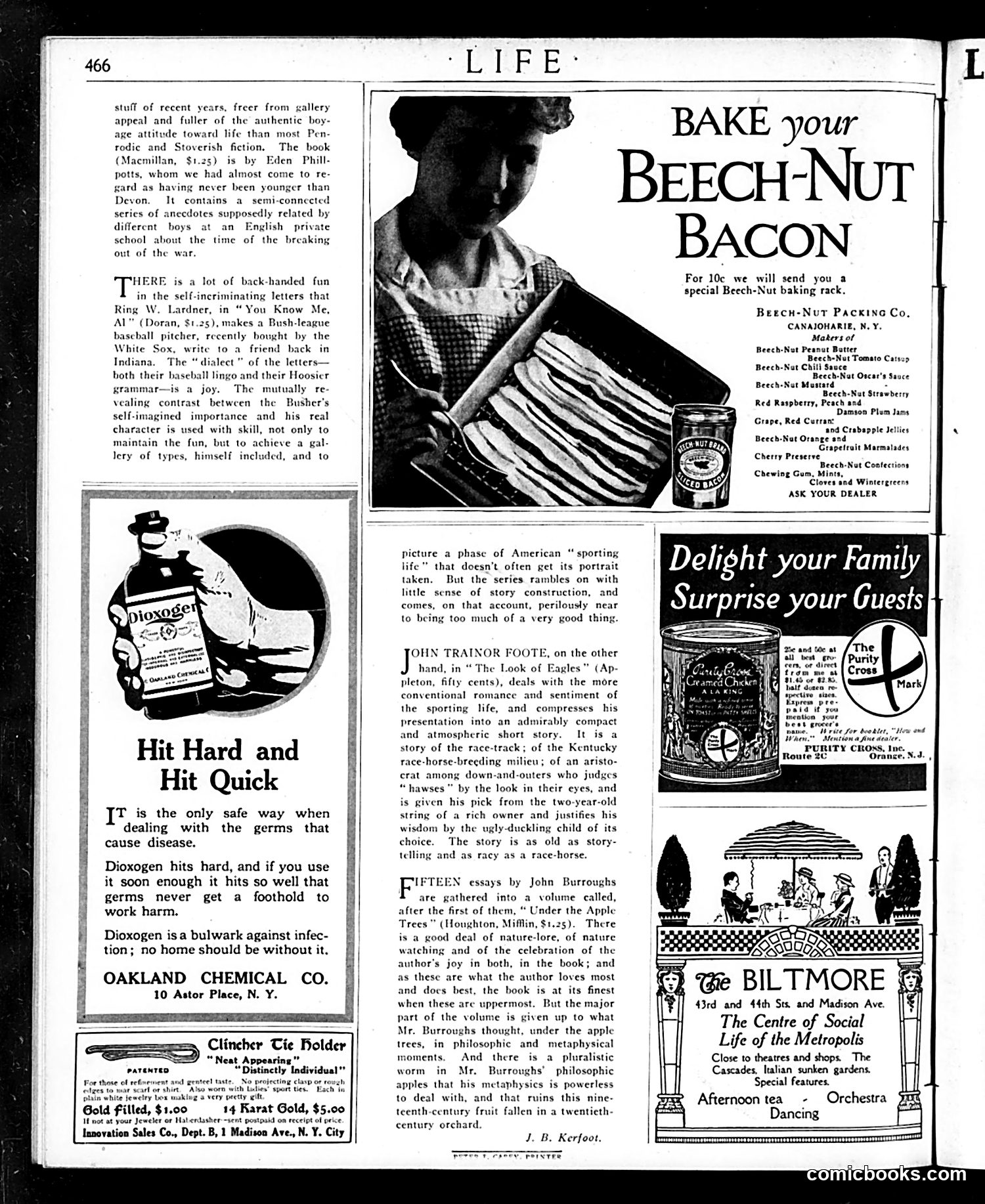
This page mixes book reviews with advertisements typical of early 20th-century magazines. **Book Reviews (Main Content):** The page discusses recent fiction, including works by Eden Phillpotts about English boarding school life during WWI. It reviews Ring Lardner's baseball fiction, praising his satirical use of dialect and character types. It also covers John Trainor Foote's Kentucky horse-racing story and John Burroughs' essay collection on nature and philosophy. **Advertisements:** The page includes ads for Beech-Nut bacon and baking products, a Dioxogen disinfectant ("hits hard" against germs—reflecting early 20th-century germ-theory anxiety), a tie holder, and the Biltmore Hotel in New York. **No Political Cartoons:** Despite the prompt's mention of political cartoons, this page contains only commercial illustrations and is primarily a book review section with period advertisements. The satirical content is limited to literary criticism rather than visual satire.