
Life, 1916-09-14 · page 14 of 38
Life — September 14, 1916 — page 14: what you’re looking at
What you’re looking at
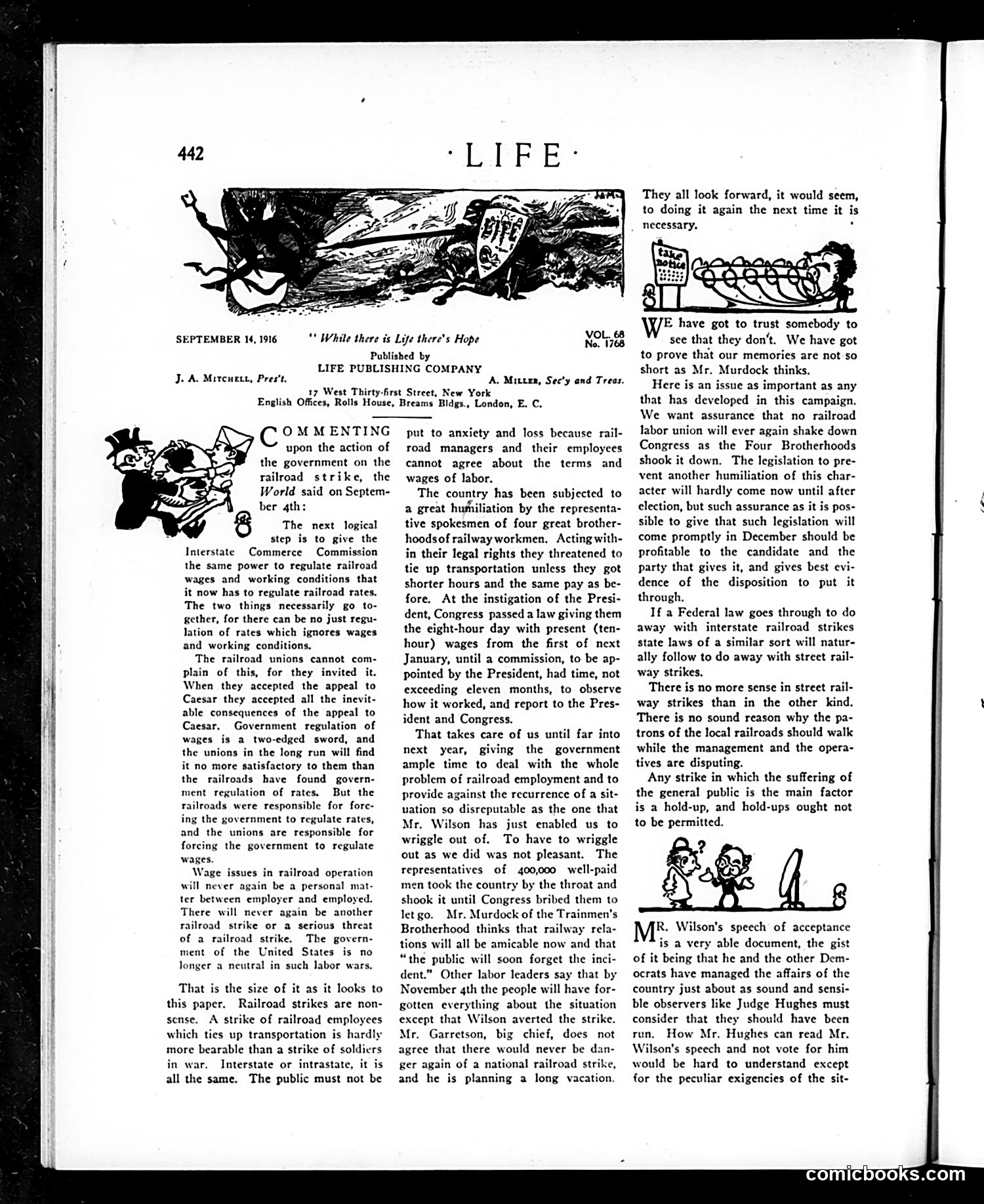
This *Life* magazine page from September 14, 1916 critiques the government's handling of a railroad strike. The main cartoon (top) shows a train derailment labeled "Where is Life there's Hope," satirizing the chaos created by labor disputes. The accompanying editorial argues that railroad strikes are as damaging as warfare and criticizes the government for inconsistently regulating both railroad management and workers' wages. It references President Wilson's recent intervention to establish an eight-hour workday for railroad employees—a compromise the author considers inadequate. The piece sarcastically notes that labor leaders expect the public to forget the strike's disruption by November's election, questioning whether voters should reward Wilson for this "solution" to ongoing industrial conflict.
📄 Transcribed text from this page (OCR, searchable)
Machine-transcribed from the original scan — historical spelling and the odd misread are preserved.
SEPTEMBER 14, 1916 “* While there is Life there's Hope NOL Published by LIFE PUBLISHING COMPANY J. A. Mirenrtt, Pres’t. OM MENTING upon the action of the government on the railroad strike, the World said on Septem- ber 4th: The next logical step is to give the Interstate Commerce Commission the same power to regulate railroad wages and working conditions that it now has to regulate railroad rates. The two things necessarily go to- gether, for there can be no just regu- lation of rates which ignores wages and working conditions. The railroad unions cannot com- plain of this, for they invited it. When they accepted the appeal to Caesar they accepted all the inevit- able consequences of the appeal to Caesar, Government regulation of wages is a two-edged sword, and the unions in the long run will find it no more satisfactory to them than the railroads have found govern- ment regulation of rates, But the railroads were responsible for forc- ing the government to regulate rates, and the unions are responsible for forcing the government to regulate wages, Wage issues in railroad operation will never again be a personal mat- ter between employer and employed. There will never again be another railroad strike or a serious threat of a railroad strike. The govern- ment of the United States is no longer a neutral in such labor wars. That is the size of it as it looks to this paper. Railroad strikes are non- sense. A strike of railroad employees which ties up transportation is hardly more bearable than a strike of soldiers in war. Interstate or intrastate, it is all the same. The public must not be A. Minune, Sec’y and Trees. 17 West Thirty-first Street, New York English Offices, Rolls House, Breams Bldgs., London, E. C. put to anxiety and loss because rail- road managers and their employces cannot agree about the terms and wages of labor. The country has been subjected to a great humiliation by the representa- tive spokesmen of four great brother- hoodsof railway workmen, Acting with- in their legal rights they threatened to tie up transportation unless they got shorter hours and the same pay as b fore. At the instigation of the Presi- dent, Congress passed a law giving them the eight-hour day with present (ten- hour) wages from the first of next January, until a commission, to be ap- pointed by the President, had time, not exceeding eleven months, to observe how it worked, and report to the Pres- ident and Congress. That takes care of us until far into next year, giving the government ample time to deal with the whole problem of railroad employment and to provide against the recurrence of a sit- uation so disreputable as the one that Mr. Wilson has just enabled us to wriggle out of. To have to wriggle out as we did was not pleasant. The representatives of 400,000 well-paid men took the country by the throat and shook it until Congress bribed them to let go. Mr. Murdock of the Trainmen’s Brotherhood thinks that railway rela- tions will all be amicable now and that “the public will soon forget the inci- dent.” Other labor leaders say that by November 4th the people will have for- gotten everything about the situation except that Wilson averted the strike. Mr. Garretson, big chief, does not agree that there would never be dan- ger again of a national railroad strike, and he is planning a long vacation. They all look forward, it would seem, to doing it again the next time it is necessary. WE have got to trust somebody to see that they don’t. We have got to prove that our memories are not:so short as Mr. Murdock thinks. Here is an issue as important as any that has developed in this campaign. We want assurance that no railroad labor union will ever again shake down Congress as the Four Brotherhoods shook it down. The legislation to pre- vent another humiliation of this char- acter will hardly come now until after election, but such assurance as it is pos- sible to give that such legislation will come promptly in December should be profitable to the candidate and the party that gives it, and gives best evi- dence of the disposition to put it through. If a Federal law goes through to do away with interstate railroad strikes state laws of a similar sort will natur- ally follow to do away with street rail- way strikes. There is no more sense in street rail- way strikes than in the other kind. There is no sound reason why the pa- trons of the local railroads should walk while the management and the opera- tives are disputing. Any strike in which the suffering of the general public is the main factor is a hold-up, and hold-ups ought not to be permitted. R. Wilson's speech of acceptance is a very able document, the gist of it being that he and the other Dem- ocrats have managed the affairs of the country just about as sound and sensi- ble observers like Judge Hughes must consider that they should have been run, How Mr. Hughes can read Mr. Wilson's speech and not vote for him would be hard to understand except for the peculiar exigencies of the sit- Ccomicbooks.com