
Life, 1916-09-14 · page 12 of 38
Life — September 14, 1916 — page 12: what you’re looking at
What you’re looking at
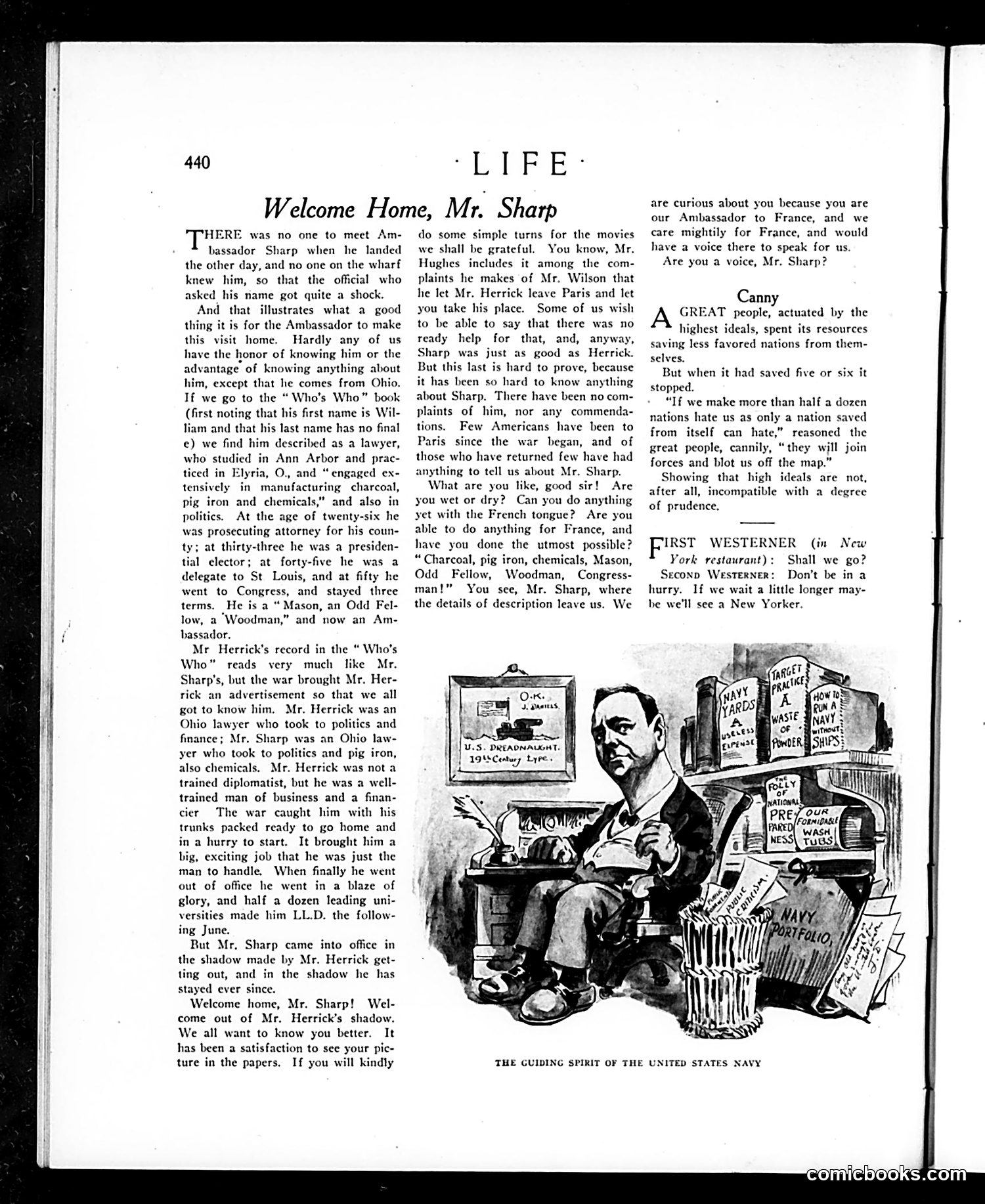
This page welcomes back Ambassador William Graves Sharp, who served as U.S. Ambassador to France during WWI. The article celebrates his return and discusses his background as an Ohio lawyer and politician. The accompanying cartoon, titled "The Guiding Spirit of the United States Navy," depicts a figure surrounded by naval-related documents and portfolios. The satire appears to critique naval bureaucracy and red tape—showing how administrative paperwork and departmental concerns ("Navy Portfolio," various files) guide naval decisions rather than clear strategic thinking. The cartoon humorously suggests the Navy is controlled by endless documentation and procedural complexity rather than purposeful leadership, a common Progressive-era criticism of government inefficiency.
📄 Transcribed text from this page (OCR, searchable)
Machine-transcribed from the original scan — historical spelling and the odd misread are preserved.
“LUPE - Welcome Home, Mr. Sharp 'HERE was no one to mect Am- bassador Sharp when he landed the other day, and no one on the wharf knew him, so that the official who asked his name got quite a shock. And that illustrates what a good thing it is for the Ambassador to make this visit home. Hardly any of us have the honor of knowing him or the advantage of knowing anything about him, except that he comes from Ohio. If we go to the “ Who's Who” book (first noting that his first name is Wil- liam and that his last name has no final e) we find him described as a lawyer, who studied in Ann Arbor and prac- ticed in Elyria, O., and “engaged ex- tensively in manufacturing charcoal, pig iron and chemicals,” and also in politics. At the age of twenty-six he was prosecuting attorney for his coun- ty; at thirty-three he was a presiden- tial elector; at forty-five he was a delegate to St Louis, and at fifty he went to Congress, and stayed three terms. He is a “ Mason, an Odd Fel- low, a “Woodman,” and now an Am- bassador. Mr Herrick’s record in the “ Who's Who” reads very much like Mr. Sharp's, but the war brought Mr. Her- rick an advertisement so that we all got to know him, Mr. Herrick was an Ohio lawyer who took to politics and finance; Mr. Sharp was an Ohio law- yer who took to politics and pig iron, also chemicals. Mr. Herrick was not a trained diplomatist, but he was a well- trained man of business and a finan- cier The war caught him with his trunks packed ready to go home and in a hurry to start. It brought him a big, exciting job that he was just the man to handle, When finally he went out of office he went in a blaze of glory, and half a dozen leading uni- versities made him LL.D. the follow- ing June. But Mr, Sharp came into office in the shadow made by Mr. Herrick get- ting out, and in the shadow he has stayed ever since. Welcome home, Mr. Sharp! Wel- come out of Mr. Herrick’s shadow. We all want to know you better. It has been a satisfaction to see your pic- ture in the papers. If you will kindly do some simple turns for the movies we shall be grateful. You know, Mr. Hughes includes it among the com- plaints he makes of Mr. Wilson that he let Mr. Herrick leave Paris and let you take his place. Some of us wish to be able to say that there was no ready help for that, and, any: Sharp was just as good as Herrick. But this last is hard to prove, because it has been so hard to know anything about Sharp. There have been no com- plaints of him, nor any commenda- tions. Few Americans have been to Paris since the war began, and of those who have returned few have had anything to tell us about Mr. Sharp. What are you like, good sir! Are you wet or dry? Can you do anything yet with the French tongue? Are you able to do anything for France, and have you done the utmost possible? “Charcoal, pig iron, chemicals, Mason, Odd Fellow, Woodman, Congress- man!” You see, Mr. Sharp, where the details of description leave us. We are curious about you because you are our Ambassador to France, and we care mightily for France, and would ¢ there to speak for us. Are you a voice, Mr. Sharp? Canny GREAT people, actuated by the highest ideals, spent its resources saving less favored nations from them- ves. But when it had saved five or six it stopped. “If we make more than half a dozen nations hate us as only a nation saved from itself can hate,” reasoned the great people, cannily, “they will join forces and blot us off the map.” Showing that high ideals are not, after all, incompatible with a degree of prudence, IRST WESTERNER (in New York restaurant): Shall we go? Seconp Westerner: Don’t be in a hurry. If we wait a little longer may- be we'll see a New Yorker. THE GUIDING SPIRIT OF THE UNITED STATES NAVY