
Life, 1916-09-14 · page 23 of 38
Life — September 14, 1916 — page 23: what you’re looking at
What you’re looking at
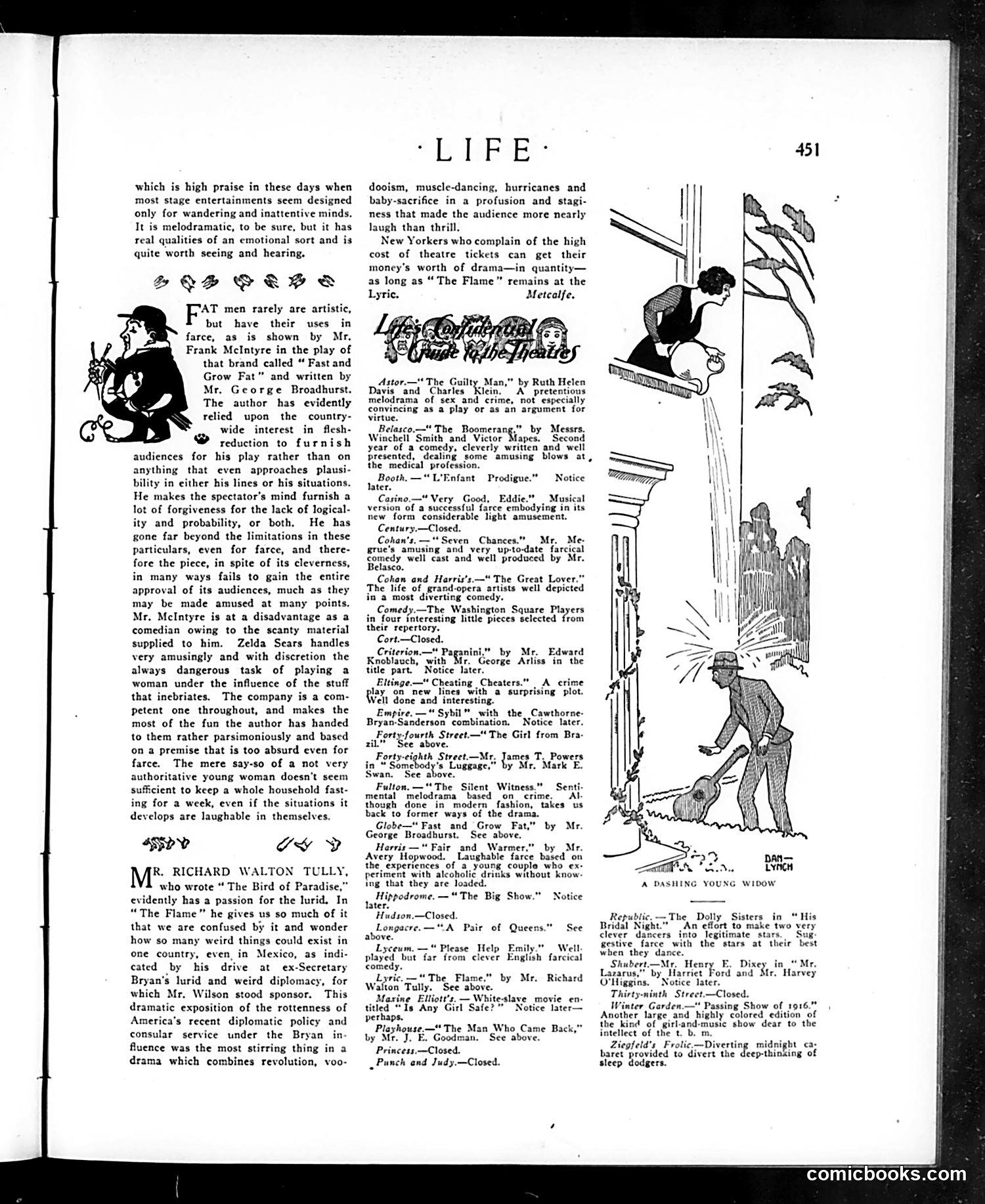
This page contains theatrical reviews from Life magazine, a satirical publication. The left column features a critical essay on farce comedies and their reliance on "fat men" and absurd premises rather than genuine wit—using Frank McIntyre's "Fast and Grow Fat" as an example. The main satire targets playwright Richard Walton Tully's melodrama "The Flame," set in Mexico. The review criticizes the play for combining lurid, confusing elements (revolution, voodoo, human sacrifice, muscle-dancing) while attempting to critique ex-Secretary William Jennings Bryan's "weird diplomacy" under Wilson. The author suggests the play's real contribution was exposing the "rottenness of America's recent diplomatic policy and consular service under the Bryan influence"—essentially saying the unintentional social commentary was more compelling than the actual plot. The right side contains thumbnail theater listings, including illustrations of what appears to be theatrical scenes. The overall tone dismisses most contemporary stage entertainment as designed for inattentive audiences.
📄 Transcribed text from this page (OCR, searchable)
Machine-transcribed from the original scan — historical spelling and the odd misread are preserved.
which is high praise in these days when most stage entertainments seem designed only for wandering and inattentive minds. It is melodramatic, to be sure, but it has real qualities of an emotional sort and is quite worth seeing and hearing. BRS BEBE ‘AT men rarely are artistic, but have their uses in farce, as is shown by Mr. Frank McIntyre in the play of that brand called “ Fast and Grow Fat” and written by Mr. George Broadhurst. The author has evidently relied upon the country- wide interest in flesh- @ reduction to furnish audiences for his play rather than on anything that even approaches plausi bility in either his lines or his situations. He makes the spectator’s mind furnish a lot of forgiveness for the lack of logical- ity and probability, or both, He has gone far beyond the limitations in these particulars, even for farce, and there- fore the piece, in spite of its cleverness, in many ways fails to gain the entire approval of its audiences, much as they may be made amused at many points. Mr. McIntyre is at a disadvantage as a comedian owing to the scanty material supplied to him. Zelda Sears handles very amusingly and with discretion the always dangerous task of playing a woman under the influence of the stuff that inebriates. The company is a com- petent one throughout, and makes the most of the fun the author has handed to them rather parsimoniously and based on a premise that is too absurd even for farce. The mere say-so of a not very authoritative young woman doesn’t seem sufficient to keep a whole household fast- ing for a week, even if the situations it develops are laughable in themselves. “Sov Gy D R. RICHARD WALTON TULLY, who wrote “ The Bird of Paradise evidently has a passion for the lurid, In “The Flame” he gives us so much of it that we are confused by it and wonder how so many weird things could exist in one country, even, in Mexico, as indi- cated by his drive at ex-Secretary Bryan’s lurid and weird diplomacy, for which Mr, Wilson stood sponsor. This dramatic exposition of the rottenness of America’s recent diplomatic policy and consular service under the Bryan in- fluence was the most stirring thing in a drama which combines revolution, voo- “1h EE dooism, muscle-dancing, hurricanes and baby-sacrifice in a profusion and stagi- ness that made the audience more nearly laugh than thrill, New Yorkers who complain of the high cost of theatre tickets can get their money's worth of drama—in quantity— as long as “‘ The Flame” remains at the Metcalfe. Astor.—" The Guilty Man,” by Ruth Helen Davis and Charles ‘Klein.’ A pretentious melodrama of sex and crime, not especially convincing as a play or as an argument for virtue. Belasco.—" The Boomerang,” by Messrs. Winchell ‘Smith and Victor Mapes. Second year of a comedy, cleverly written and well presented, dealing some amusing blows at the medical profession. Booth. —“ L'Enfant later. Casino—" Very Good, Eddie." | Musical version of a successful farce embodying in its new form considerable light amusement. Century.—Closed. Cohan’s. —**Seven Chances.” Mr, Me. grue’s amusing and very up-to-date farcical comedy well cast and well produced by Mr. Belasco. Cohan and Harris's.—" The Great Lover.” The life of grand-opera artists well depicted in a most diverting comedy. Comedy.—The Washington Square Players in four interesting little pieces selected from their repertory. Cort.—Closed. Criterion. —"* Paganini Knoblauch, with Mr. title part.’ Notice later. Eltinge —“ Cheating Cheaters.” A crime RAY, 9a. new jlines with a surprising plot. Well done and interesting. Empire. — Sybil” with the Cawthorne- Bryan-Sanderson combination. Notice later. Forty-fourth Street.—"The Girl from Bra- il.” See above. Prodigue.” Notice * by Mr. Edward eorge Arliss in the james T. Powers e ’s Luggage,” by Mr. Mark E. See above, Fulton. —" The Silent Witness.” Senti- mental melodrama based on. crime, Al though done in modern fashion, takes us back to former ways of the drama, Globe— Fast_and Grow Fat," George Broadhurst. See above, Harris —“ Fair and Warmer,” by Mr. Avery Hopwood. Laughable farce based on the experiences of a young couple who ex- periment with alcoholic drinks without know: ing that they are loaded. Hippodrome. —“ The Big Show.” later. Hudson.—Closed. Longacre. —““A Pair of Queens.” above. Lyceum. —“ Please Help Emi played ‘but far from clever English farcical come by Mr. Notice Lyric. —“ The Flame,” by Mr. Richard Walton Tully. See above. Maxine Elliott's, —White-slave movie en- titled “Is Any Girl Safe?” Notice later— perhaps. Playhouse.—* The Man Who Came Back,” by Mr. J. E. Goodman, See above. Princess.—Closed. Punch end Judy.—Closed. DAN— LYncH YOUNG Wipow A DASH Republ Dolly, Sisters in “His Bridal Night.” An effort to make two very clever dancers into legitimate stars. Sug gestive farce with the stars at their best when they dance. Shubert “Mr. Henry FE. Dixey. in," Mr. Lazarus, Harriet Ford and Mr. Harvey O'Higgins, Notice later. Thirty-ninth Strect.—Closed. Winter Garden.—"' Passing Show of 1916." Another large and highly colored edition of the kind of girland-music show dear to the intellect of the t. b. Ziegfeld’s Frolic. —Divertin baret provided to divert the sleep dodgers. midnight ca- feep-thinking of comicbooks.com