
Life, 1916-09-14 · page 22 of 38
Life — September 14, 1916 — page 22: what you’re looking at
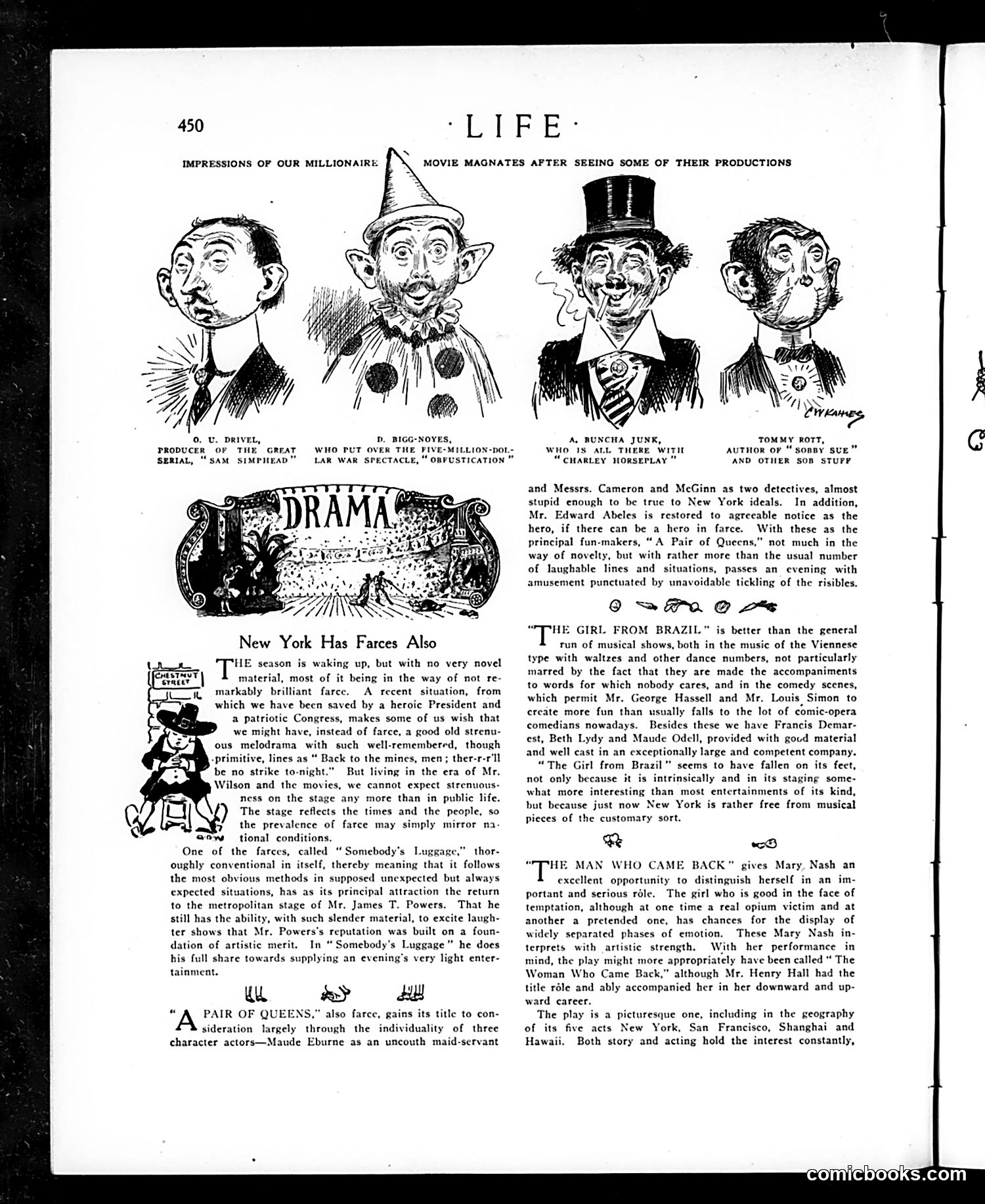
A restored page from Life, 1916-09-14. Page through the whole issue in the reader above.
📄 Transcribed text from this page (OCR, searchable)
Machine-transcribed from the original scan — historical spelling and the odd misread are preserved.
450 IMPRESSIONS OF OUR MILLIONAIRE ©. U. DRIVEL, PRODUCER OP THE GREAT SERIAL, “SAM SIMPITEAD” WHO PUT OVER THE PI New York Has Farces Also HE season is waking up, but with no very novel material, most of it being in the way of not re- markably brilliant farce. A recent situation, from which we have been saved by a heroic President and a patriotic Congress, makes some of us wish that we might have, instead of farce, a good old strenu- ous melodrama with such well-remembered, though primitive, lines as “ Back to the mines, men; ther-r-r'll be no strike to-night.” But living in the era of Mr. Wilson and the movies, we cannot expect strenuous- ness on the stage any more than in public life. The stage reflects the times and the people, so AY the prevalence of farce may simply mirror na- Sw tional conditions. One of the farces, called “Somebody's Lugga thor- oughly conventional in itself, thereby meaning that it follows the most obvious methods in supposed unexpected but always expected situations, has as its principal attraction the return to the metropolitan stage of Mr. James T. Powers. That he still has the ability, with such slender material, to excite laugh- ter shows that Mr. Powers’s reputation was built on a foun- dation of artistic merit. In “Somebody's Luggage" he does his full share towards supplying an evening's very light enter- rr by PAIR OF QU S$," also farce, gains its title to con- sideration largely through the individuality of three character actors—Maude Eburne as an uncouth maid-servant TOMMY ROTT, AuTHOR oF “sonny sue” AND OTHER SOB STUFF A, BUNCHA JUNK, WHO IS ALL THERE WITIE “ CHARLEY MORSEPLAY " and Messrs. Cameron and McGinn as two detectives, almost stupid enough to be true to New York ideals. In addition, Mr. Edward Abeles is restored to agreeable notice as the hero, if there can be a hero in farce. With these as the principal fun-makers, “A Pair of Queens,” not much in the way of novelty, but with rather more than the usual number of laughable lines and tions, passes an evening with amusement punctuated by unavoidable tickling of the risibles. 0 = &o @ 2*s “THE GIRL FROM BRAZIL” is better than the general run of musical shows, both in the music of the Viennese type with waltzes and other dance numbers, not particularly marred by the fact that they are made the accompaniments to words for which nobody cares, and in the comedy scenes, which permit Mr. George Hassell and Mr. Louis Simon to create more fun than usually falls to the lot of comic-opera comedians nowadays. Besides these we have Francis Demar- est, Beth Lydy and Maude Odell, provided with goud material and well cast in an exceptionally large and competent company. “The Girl from Brazil” seems to have fallen on its feet, not only because it is intrinsically and in its staging some- what more interesting than most entertainments of its kind, but because just now New York is rather free from musical pieces of the customary sort. Se <3 “TTHE MAN WHO CAME BACK” gives Mary, Nash an excellent opportunity to distinguish herself in an im- portant and serious réle. The girl who is good in the face of temptation, although at one time a real opium victim and at another a pretended one, has chances for the display of widely separated phases of emotion. These Mary Nash in- terprets with artistic strength, With her performance in mind, the play might more appropriately have been called “ The Woman Who Came Back,” although Mr. Henry Hall had the title réle and ably accompanied her in her downward and up- ward career. The play is a picturesque one, including in the geography of its five acts New York, San Francisco, Shanghai and Hawaii. Both story and acting hold the interest constantly,