
A complete issue · 38 pages · 1916
Life — August 10, 1916
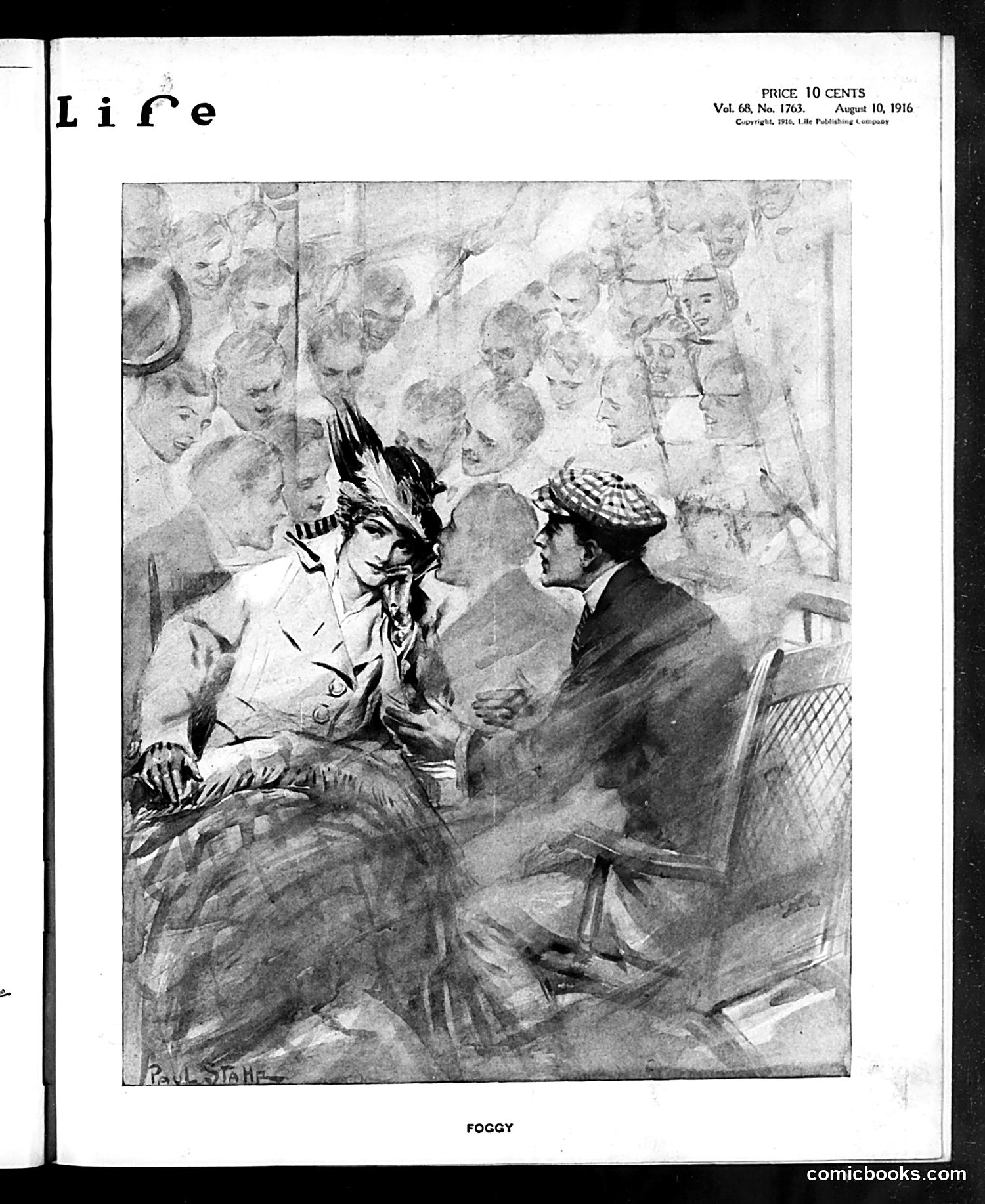
This cartoon by Paul Stahr depicts a scene titled "Foggy," showing two men in conversation before a wall covered with numerous faces. The composition suggests a political or social commentary, though the specific identities and event are unclear from the image alone. The wall of faces likely represents public opinion, a crowd, or perhaps politicians/officials. The two figures appear to be in discussion or negotiation. Given the 1916 date during World War I and an American presidential election year, this may reference wartime politics or diplomatic matters, but the exact satirical point cannot be definitively determined without additional context about the cartoon's original caption or commentary.
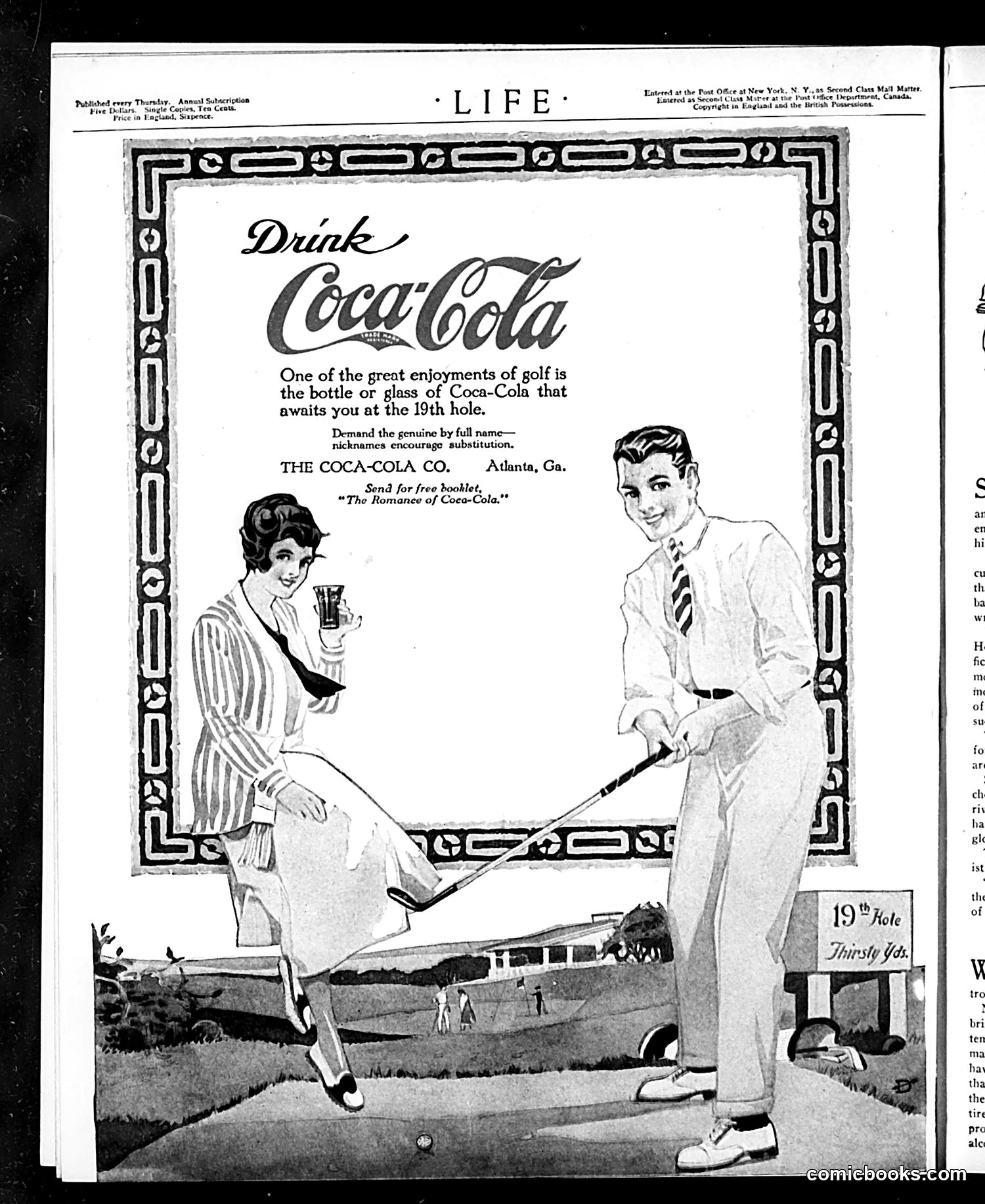
This is primarily a **Coca-Cola advertisement**, not political satire. It appears in *Life* magazine and depicts two well-dressed figures playing golf on the 19th hole (a golf course bar/clubhouse). The ad's appeal targets affluent golfers by suggesting Coca-Cola is an essential luxury during leisure activities. The tagline "One of the great enjoyments of golf is the bottle or glass of Coca-Cola that awaits you at the 19th hole" explicitly links the product to upper-class recreation. The early 20th-century illustration style, formal attire, and golf setting reflect period assumptions about aspirational consumer behavior. There is no political commentary—this is straightforward lifestyle advertising designed to associate Coca-Cola with leisure, refinement, and social status.
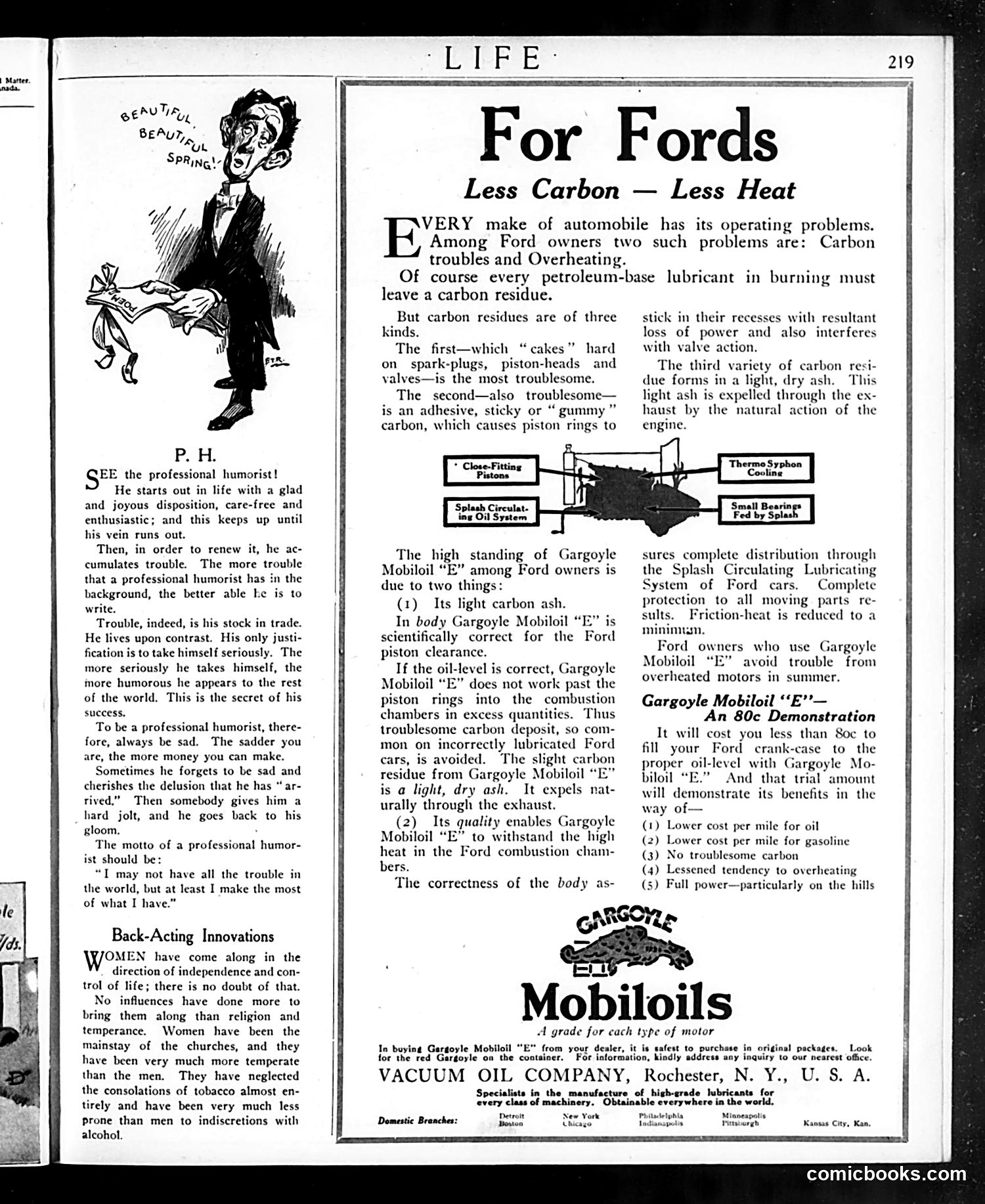
This page is primarily **advertising**, not satire. The right side contains a full-page Gargoyle Mobiloils advertisement promoting their "E" grade motor oil for Ford automobiles, emphasizing reduced carbon buildup and engine overheating. The left side features unrelated content: a satirical piece titled "P.H." mocking professional humorists. The cartoon depicts a caricatured man in formal dress, labeled as seeing "professional humorists" as troubled individuals who accumulate problems to fuel their comedy. The accompanying text humorously suggests that successful humorists profit from their misfortunes—the more troubles they experience, the more material they generate. This is era-typical **mixed editorial and advertising content** from a magazine page.
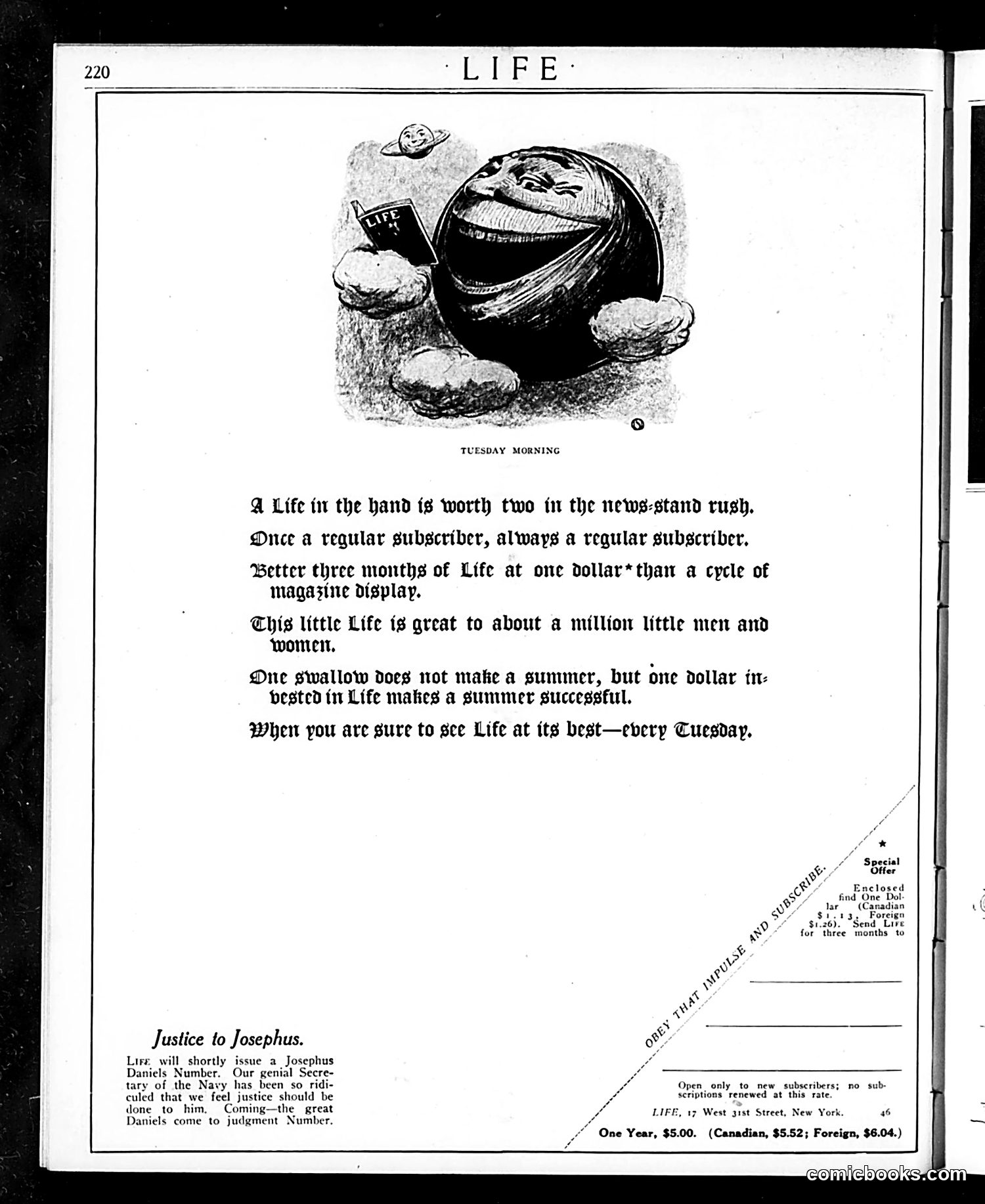
This page is primarily **advertising for Life magazine itself**, not political satire. The cartoon titled "Tuesday Morning" shows a large grinning face (likely personifying Life magazine) surrounded by hamburgers, holding a copy of Life magazine. The accompanying text uses playful metaphors to promote subscriptions: "A Life in the hand is worth two in the news-stand rush" (playing on "a bird in the hand"), emphasizing that regular subscription ensures you won't miss issues. Other slogans highlight Life's value and popularity ("great to about a million little men and women"). The bottom section advertises subscription rates ($5.00 yearly for U.S., $5.52 Canadian, $6.04 foreign) and includes a brief note about "Justice to Josephus" regarding someone named Josephus and Navy Secretary business—too vague to interpret without additional context.
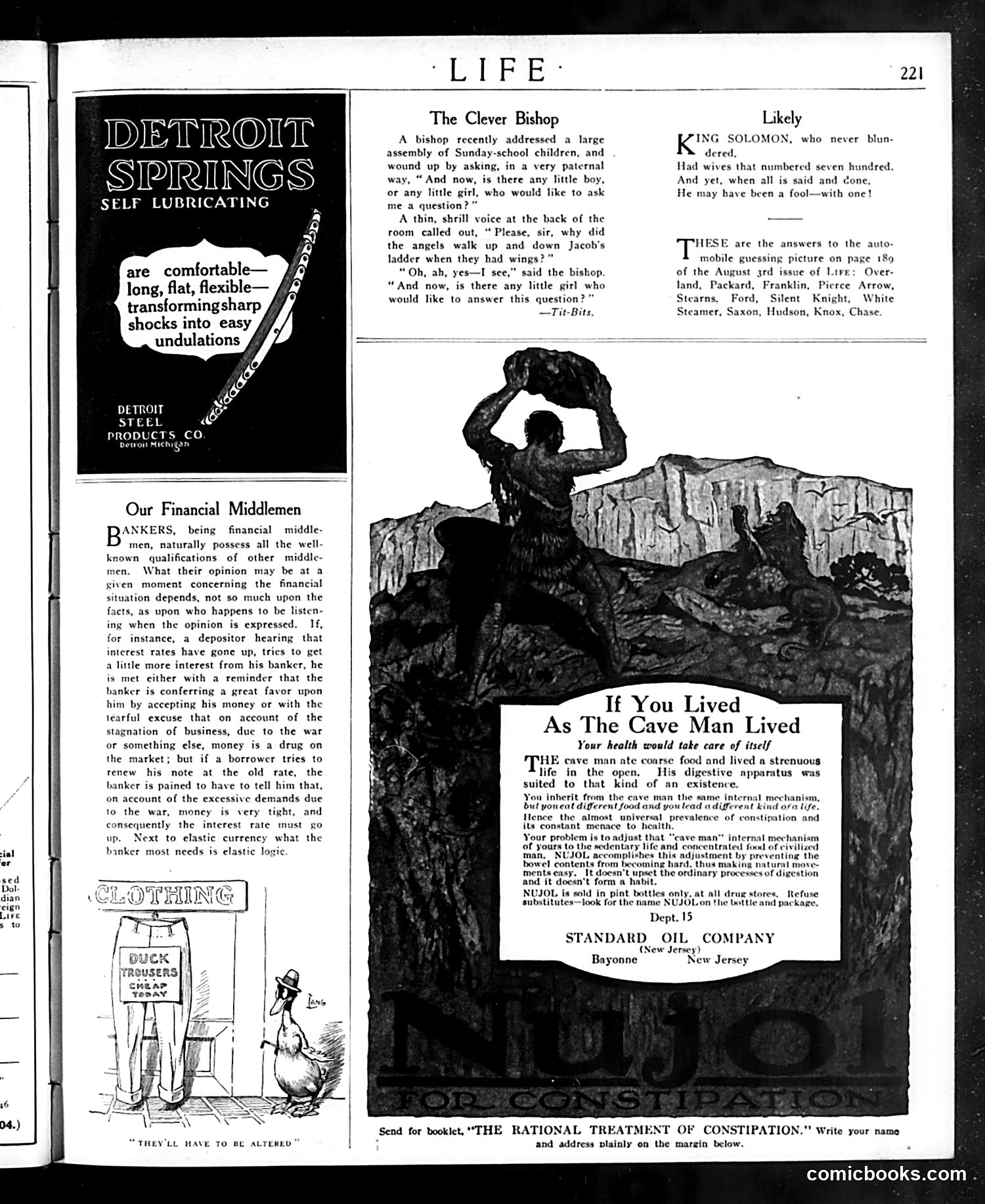
This page consists primarily of **advertisements and unrelated content** rather than coherent political satire. The main visual elements include: 1. **"The Clever Bishop"** — A brief anecdote about a bishop answering children's theological questions, ending with a punchline about angels' wings (source: *Tit-Bits* magazine) 2. **Detroit Springs advertisement** — promoting self-lubricating shock absorbers 3. **"Our Financial Middlemen"** — An essay on bankers' role during wartime, discussing interest rates and borrowing constraints (appears WWI-era context) 4. **Duck Trousers cartoon** — A humorous illustration about clothing alterations 5. **Standard Oil "Cave Man" advertisement** — promoting digestive products via lifestyle comparison The page lacks unified satirical purpose and reads as a typical early-20th-century magazine layout mixing editorial content with advertising.
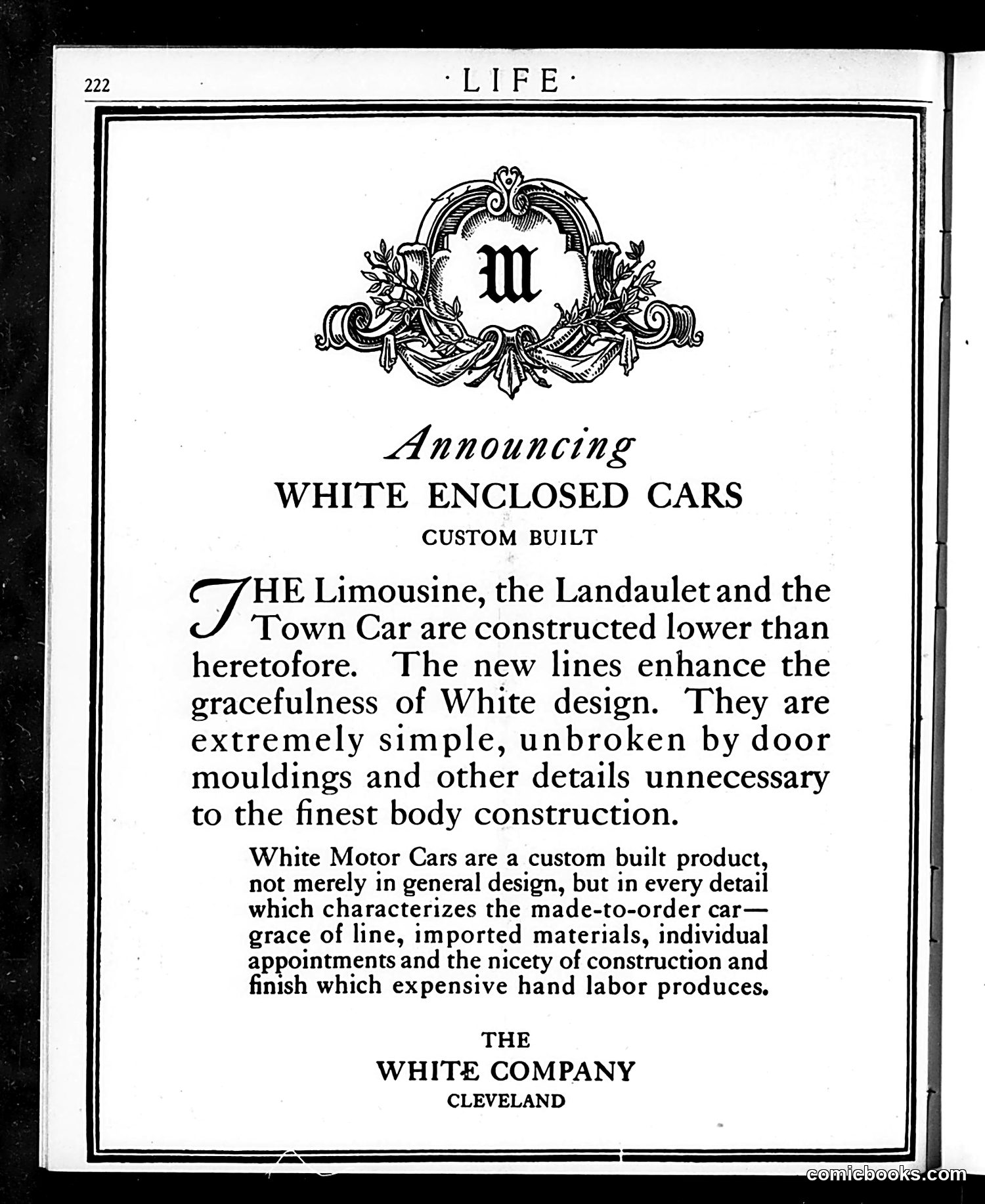
This page is **primarily an advertisement**, not satirical content. It announces White Motor Cars' custom-built enclosed vehicles—the Limousine, Landaulet, and Town Car—emphasizing their new lower construction lines and elegant, minimalist design. The ornamental "W" header is decorative branding. The ad highlights that White Motor Cars are "custom built products" featuring "grace of line, imported materials, individual appointments and the nicety of construction and finish which expensive hand labor produces." The company, based in Cleveland, positions itself as a luxury manufacturer competing in the high-end automobile market of this era. This reflects early 20th-century marketing toward wealthy clientele who valued handcrafted vehicles and refined aesthetics.
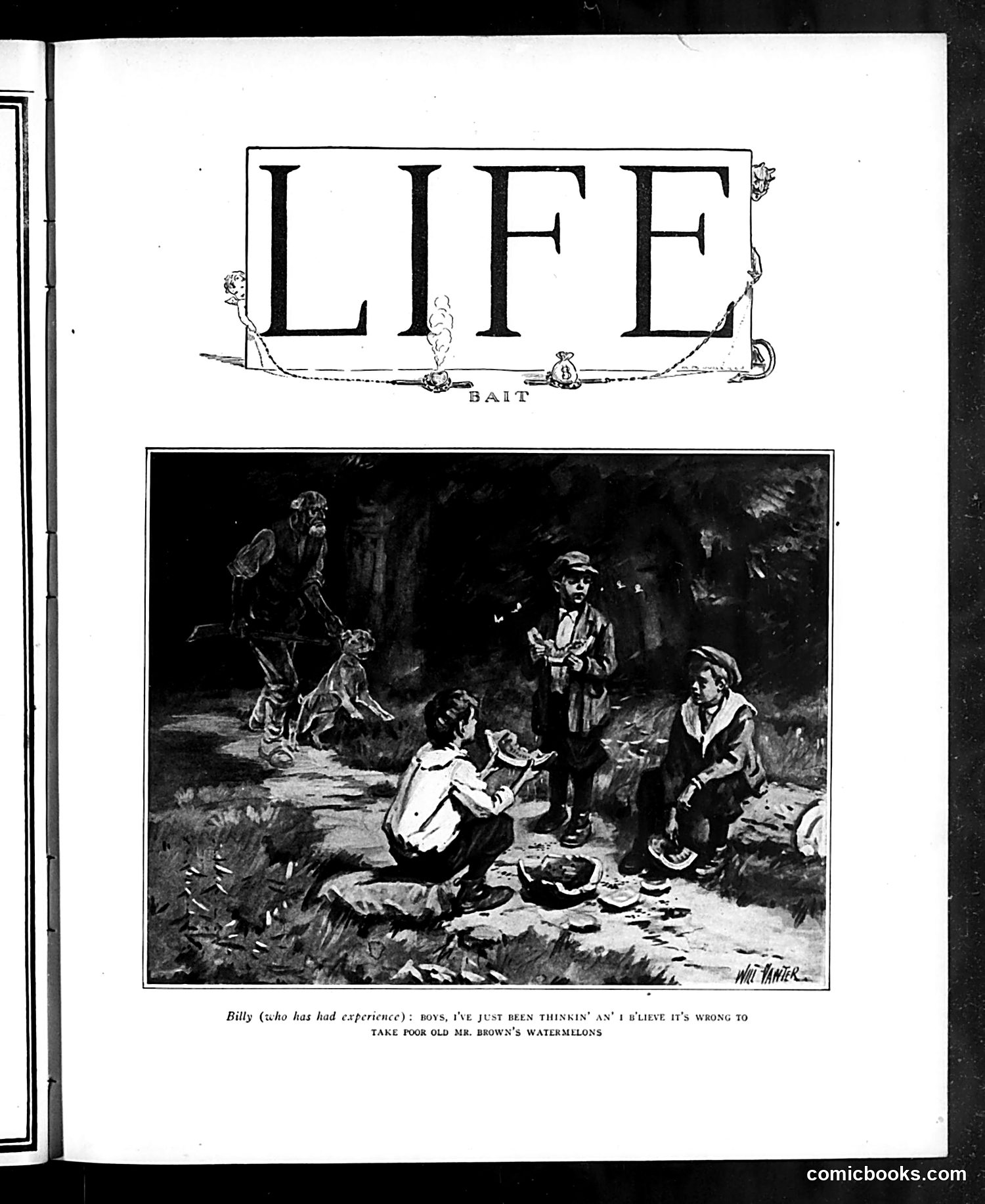
This is a humorous domestic scene satirizing childhood mischief and parental morality. The illustration shows "Billy," characterized as experienced ("who has had experience"), attempting to convince other boys that stealing watermelons from "poor old Mr. Brown" is wrong—despite his evident temptation by the stolen fruit visible in the scene. The satire works through irony: Billy's moral lecturing is undermined by the circumstances, suggesting his "experience" actually means he's been caught before and now hypocritically warns others while still participating in the theft. The humor targets the common childhood behavior of rationalizing petty crimes while simultaneously preaching virtue. The title "LIFE" and "BAIT" reference the temptation and moral compromise illustrated. This reflects early 20th-century American middle-class anxieties about youth morality and character development.
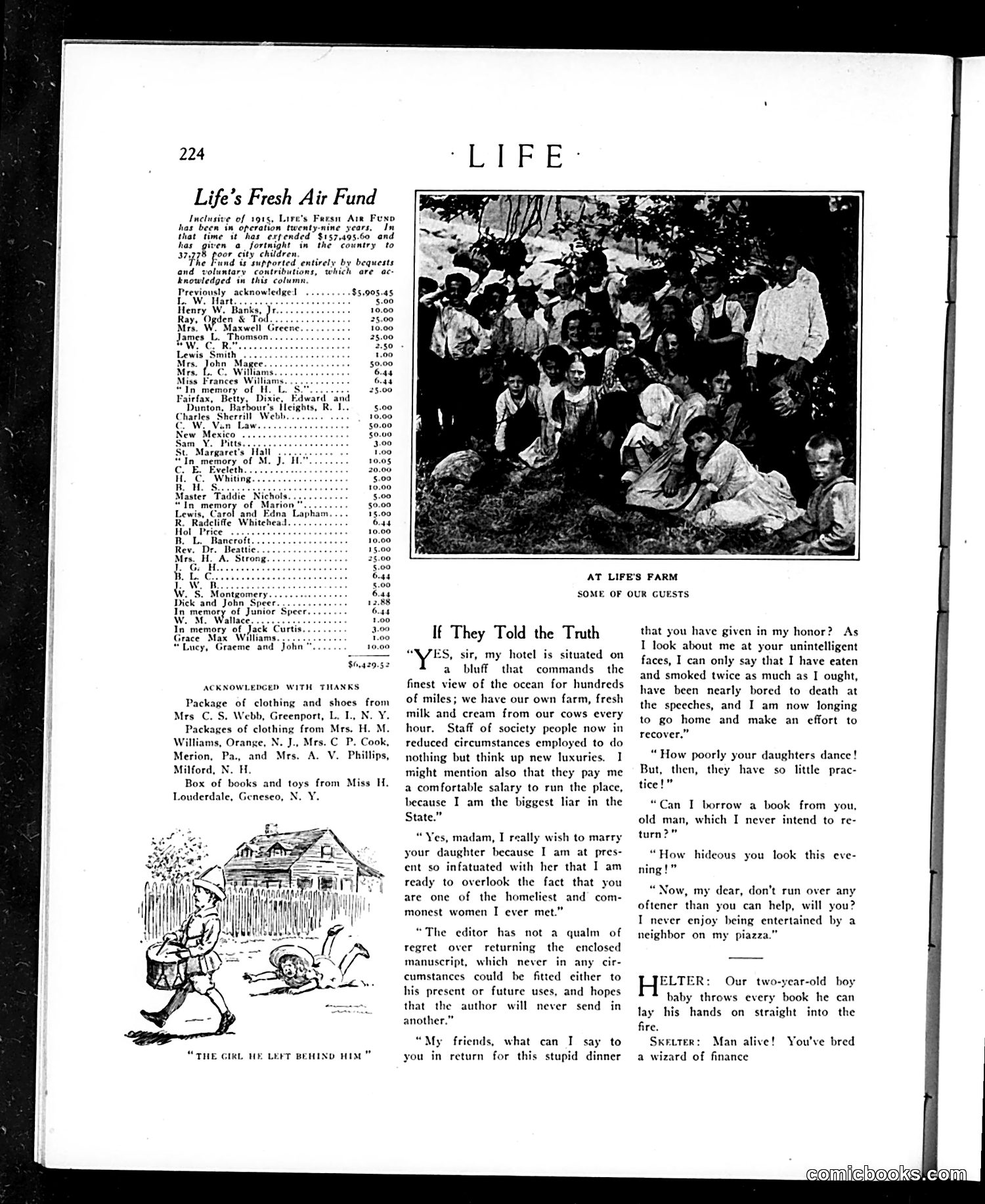
This page contains a satirical short story titled "If They Told the Truth" rather than political cartoons. The narrative presents a hotel proprietor boasting about his establishment's luxuries while inadvertently revealing his dishonesty and character flaws through increasingly absurd admissions—he's the "biggest liar in the State," admits to overcharging guests, and confesses to other moral failings. The accompanying illustration shows a man pursuing a woman, captioned "The Girl He Left Behind Him"—a visual reference to the popular wartime song, reinforcing themes of deception and abandonment. The satire targets hotel owners and businessmen who misrepresent their establishments to guests, exposing the gap between commercial advertising claims and actual behavior during this era.
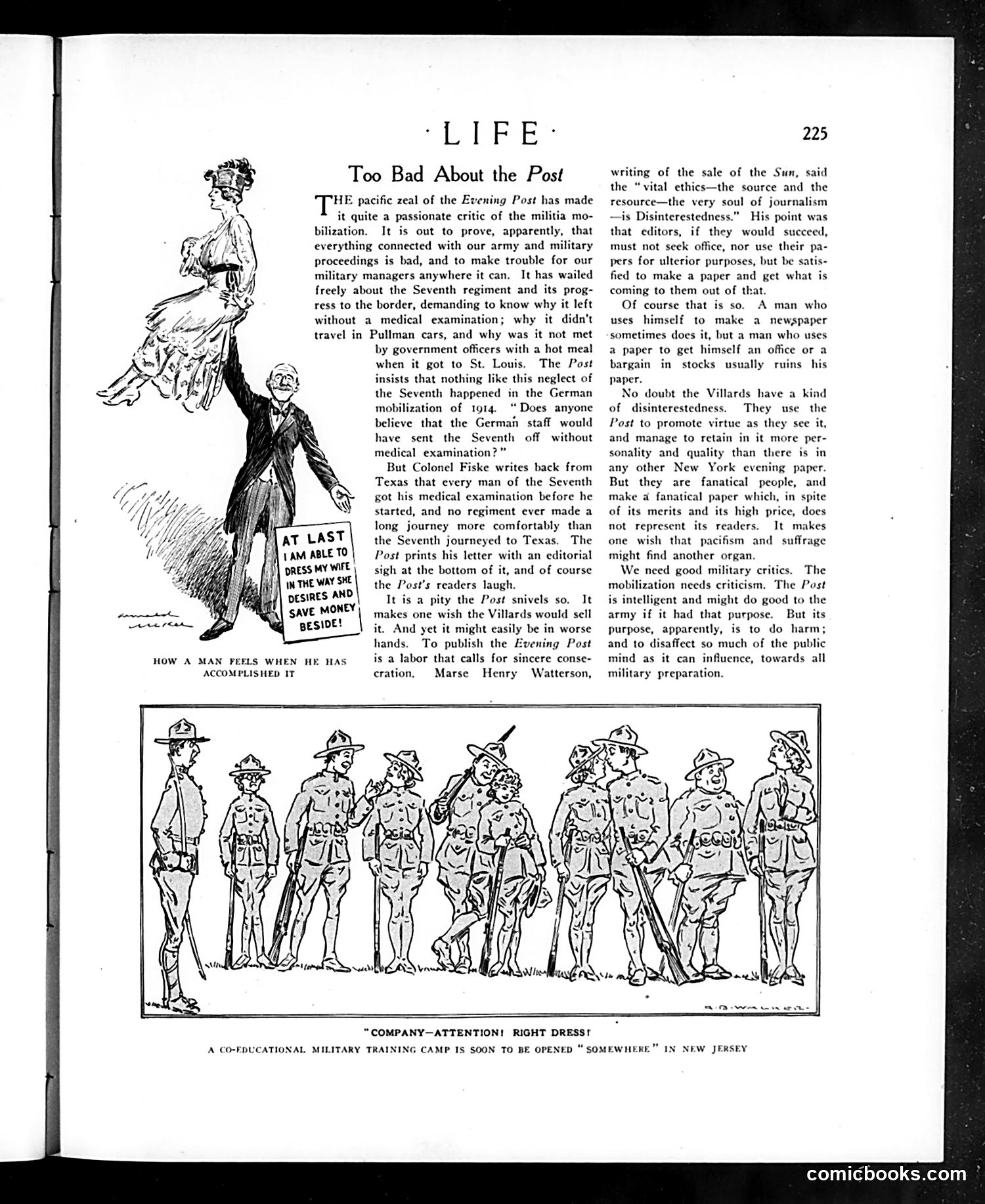
This page satirizes the *Evening Post*'s aggressive criticism of U.S. military mobilization during World War I. The article "Too Bad About the Post" defends the army against accusations that the Seventh Regiment received inadequate care (lacking Pullman cars, medical exams, hot meals en route to Texas). The cartoons illustrate the tension: a man celebrating finally dressing his wife in her "war rig" (top left), and soldiers in proper military dress (bottom). The satire's point: the *Post* is hypocritically using legitimate logistical concerns to undermine public support for military preparation. The author argues the newspaper prioritizes sensationalism over patriotic responsibility, making it an unreliable critic of actual military needs.
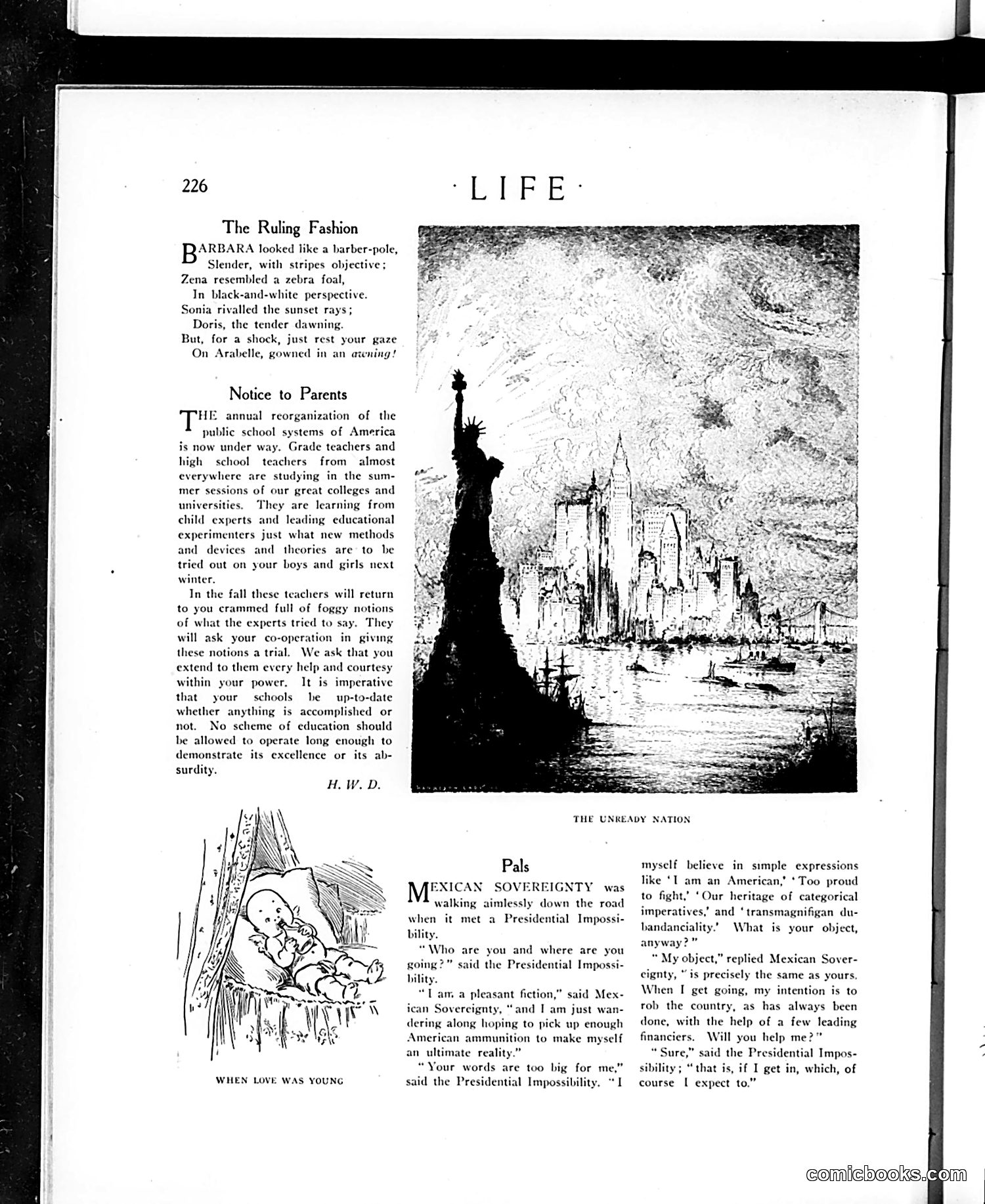
**"The Ruling Fashion"** (top poem): A satirical piece mocking fashionable women of the era—Barbara, Zena, Sonia, and Doris—who are described with exaggerated physical features (striped patterns, zebra-like appearance). The joke appears to target absurd women's fashion trends, suggesting they look ridiculous. **"Notice to Parents"** (center): An editorial warning parents that teachers are experimenting with new educational methods over summer. The piece ironically requests parental cooperation while sarcastically noting that failed experiments shouldn't continue—a critique of educational fads. **"Pals" and cartoon** (bottom): A dialogue between "Mexican Sovereignty" and "Presidential Impossibility" discussing Mexican military ambitions. The satire concerns American-Mexican relations and Mexico's desire for military aid, mocking diplomatic grandiosity.
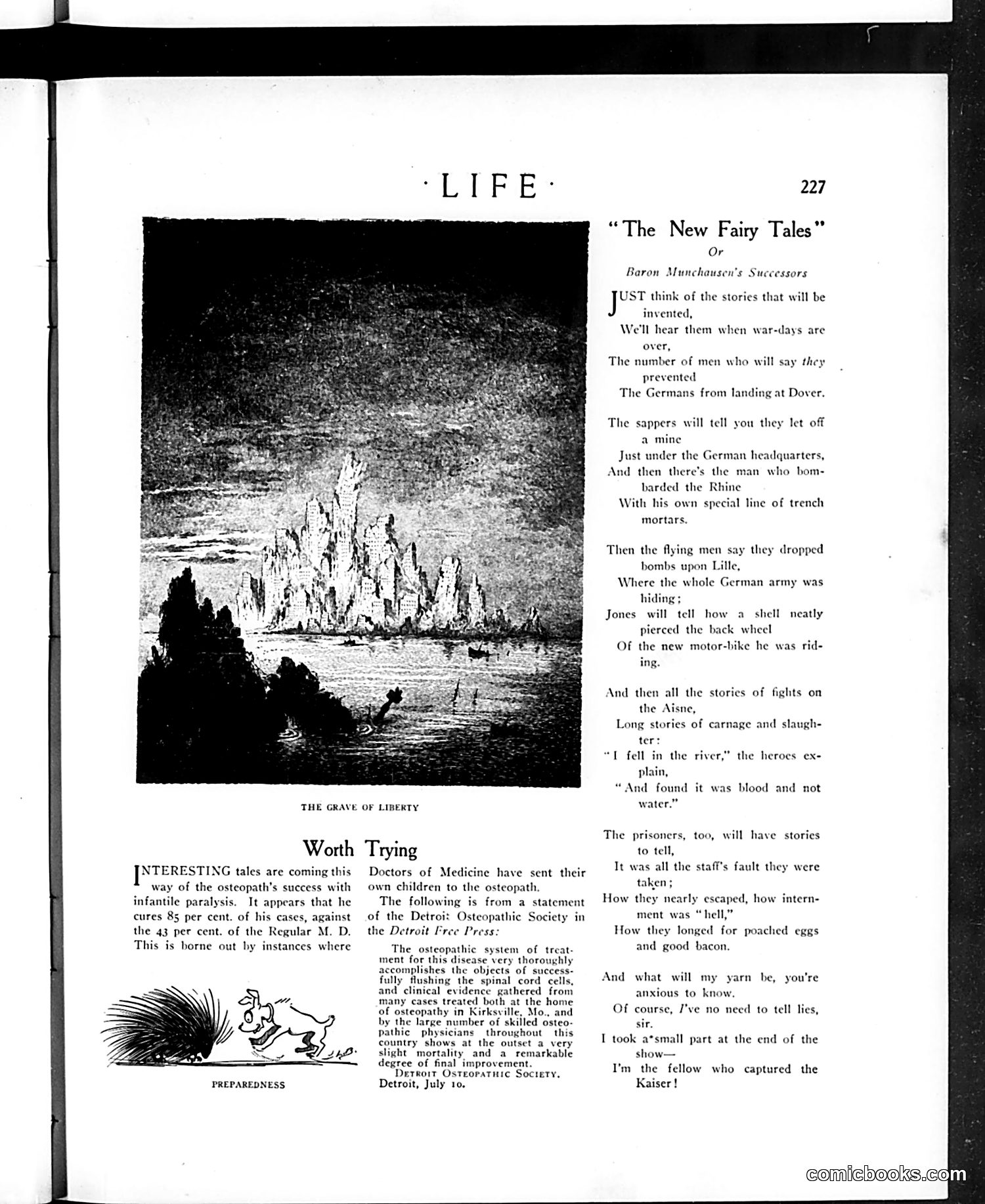
This page contains two distinct pieces: **"The Grave of Liberty"** (top illustration): A dramatic wartime image showing explosions or artillery fire near water, likely depicting WWI combat scenes. The caption suggests loss of civilian freedoms during wartime. **"Worth Trying"** (bottom section): A brief satirical article about osteopathy as a treatment for infantile paralysis. It reports that Detroit's Osteopathic Society claims success rates of 85 percent in treating the disease. The accompanying small cartoon labeled "Preparedness" shows a figure, likely satirizing medical overconfidence or the eagerness to promote alternative treatments during wartime health concerns. **"The New Fairy Tales"** (right column): A poem about exaggerated war stories soldiers will tell after WWI ends, mocking the likely tall tales and embellishments that will emerge from combat experiences.
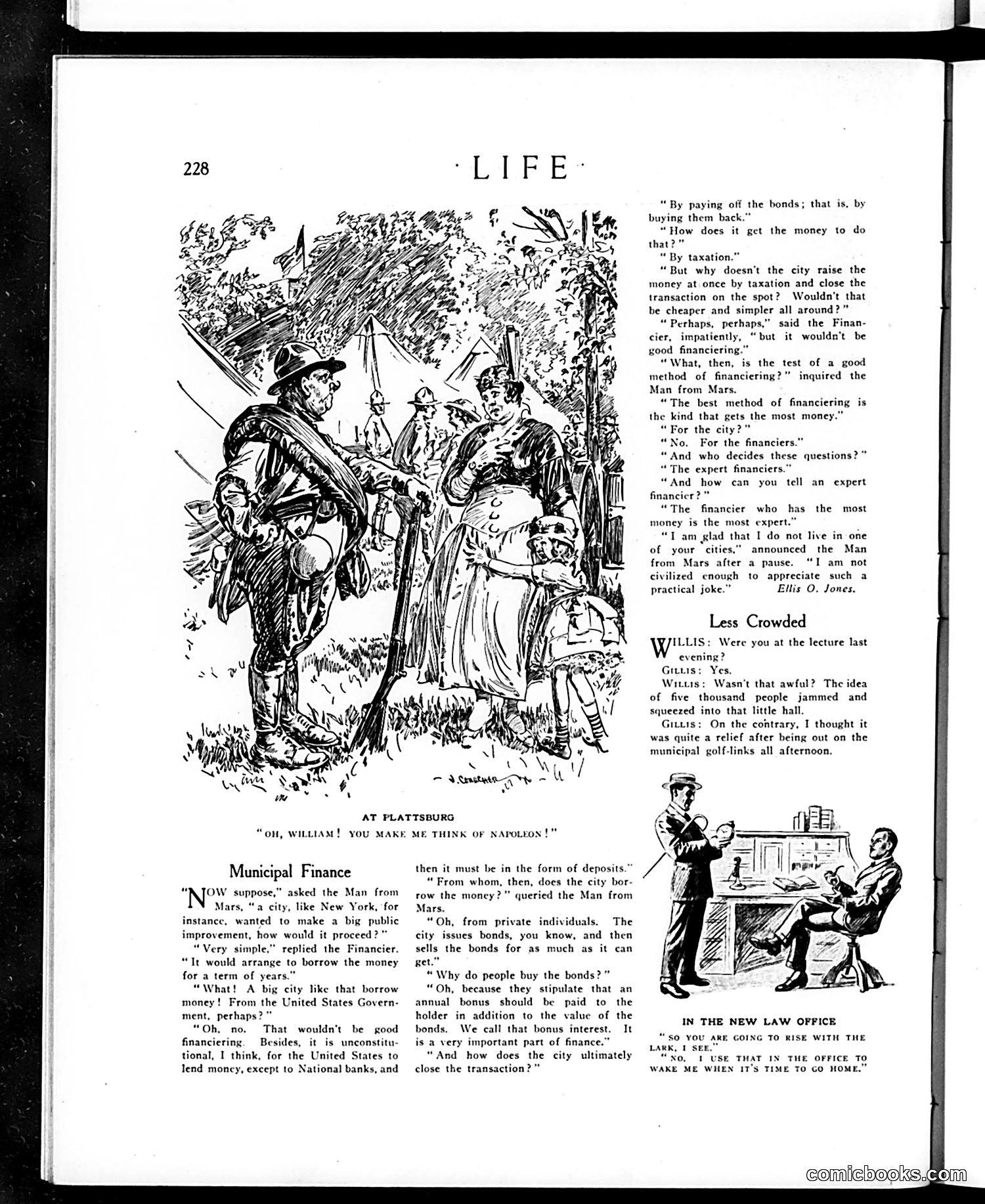
**Main Cartoon ("At Plattssburg"):** Shows military figures in a satirical scene captioned "Oh, William! You make me think of Napoleon!" The cartoon mocks American military preparedness or a specific military figure, likely commenting on early WWI-era tensions and America's military readiness debates. **"Municipal Finance" Article:** Features a dialogue between a "Man from Mars" and an unnamed Financier discussing how cities finance public improvements. The satire targets municipal bond financing—specifically how cities borrow money and issue bonds with interest (bonus interest). The joke presents municipal finance practices as absurdly complex or questionable to an outsider's perspective. **"Less Crowded" and "In the New Law Office":** Brief humorous office exchanges about lecture attendance and workplace schedules.
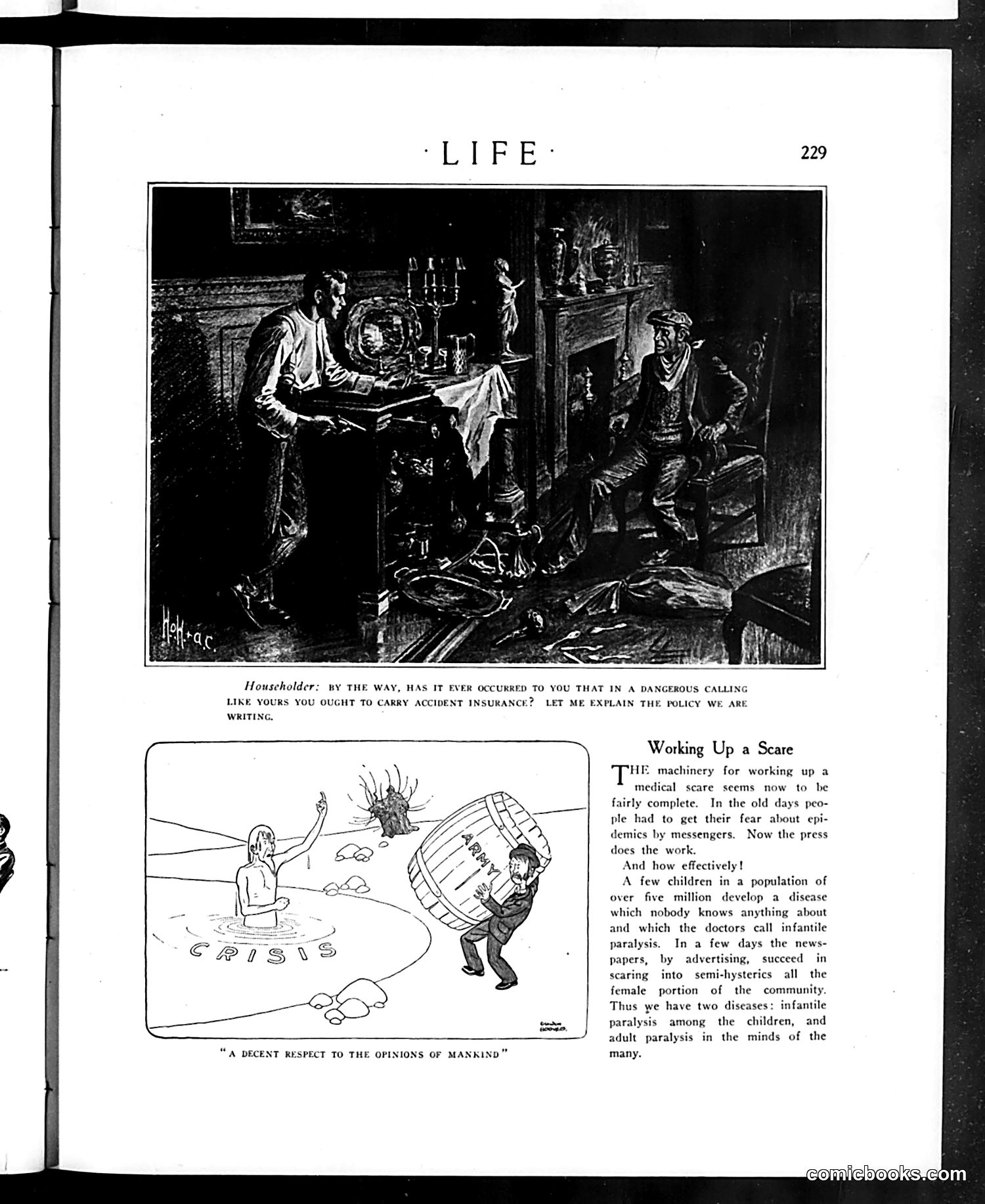
**Top Cartoon:** An insurance salesman explains accident insurance to a householder, implying that dangerous occupations (like the one depicted) require such coverage. The scene appears to show workers in a hazardous situation, making the pitch timely and darkly humorous. **Bottom Cartoon & Article ("Working Up a Scare"):** This section critiques how newspapers and press manufactured public health panics. The article describes how a few children developing infantile paralysis (polio) became sensationalized through press advertising into widespread fear affecting the entire female population—creating what the author calls "adult paralysis in the minds of the many." The cartoon satirizes this media-driven hysteria over disease scares.
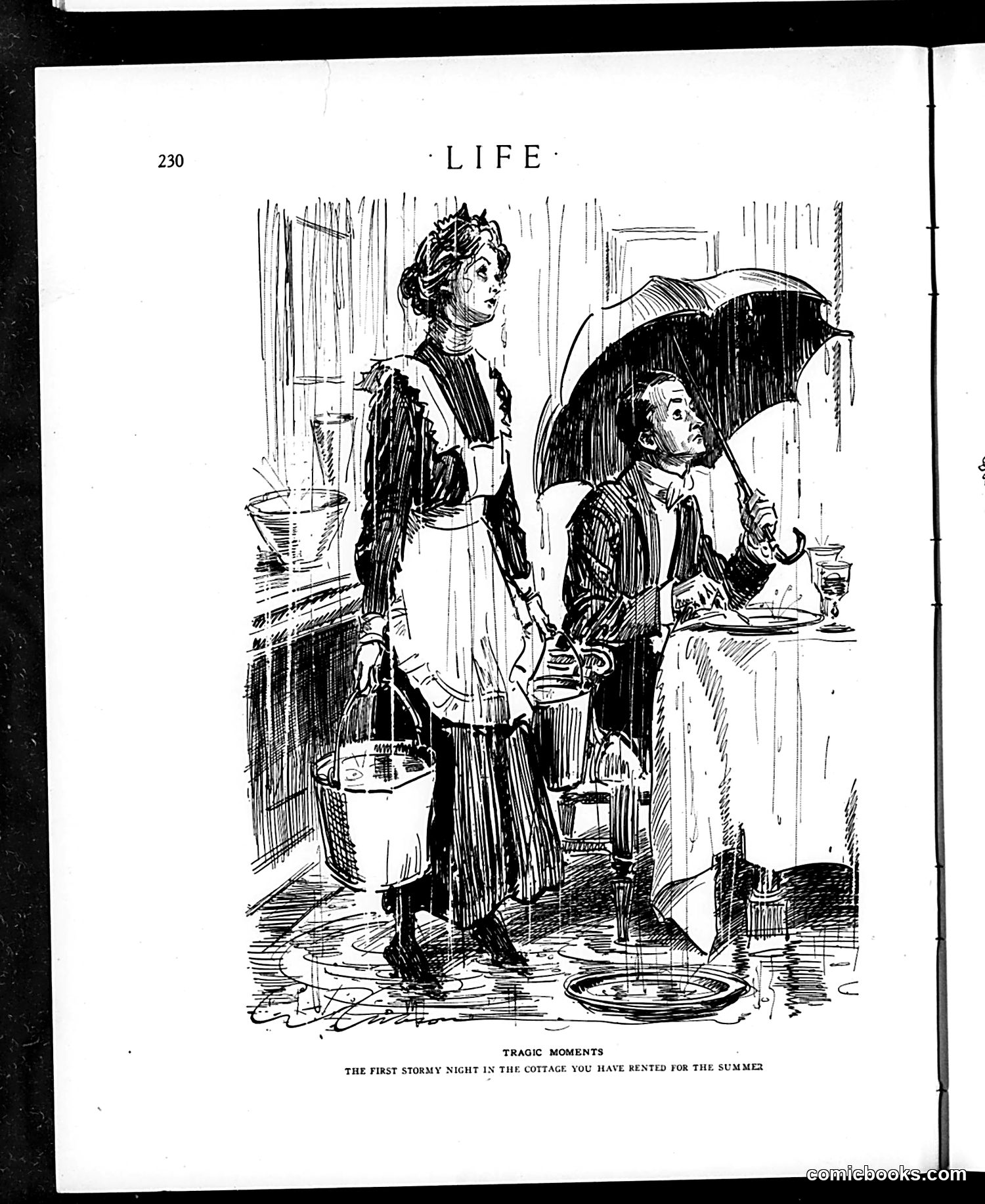
This is a humorous domestic scene satirizing the disappointment of renting a summer cottage. The illustration shows a couple experiencing the reality of their vacation rental during bad weather. The woman stands stoically holding a bucket (catching a leak), while the man sits at a table holding an umbrella indoors, apparently eating dinner. Water appears to be pooling on the floor. The satire mocks the gap between vacation expectations and reality—renters anticipate an idyllic summer getaway but instead encounter leaking roofs, dampness, and generally inadequate accommodations. The couple's resigned, uncomfortable postures emphasize the comedic tragedy of their situation. It's a relatable joke about the disappointments of vacation rentals that remains timely today.
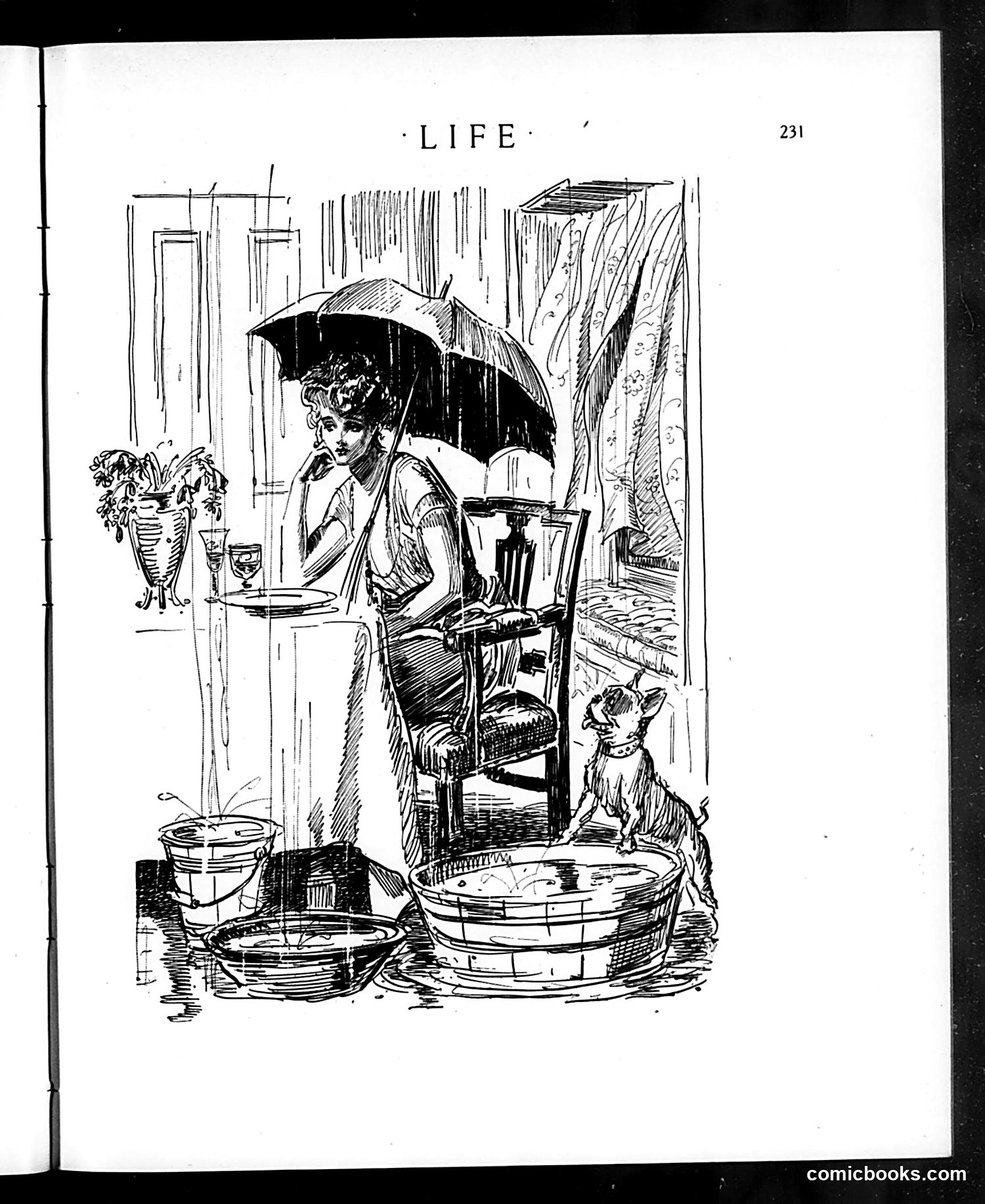
This single illustration depicts a woman sitting indoors during rainfall, holding an umbrella while seated. She's positioned near windows with curtains, and several basins and buckets are positioned on the floor—apparently catching water from leaks in the ceiling. A small dog sits in one of the basins. The satire targets poor housing conditions or landlord negligence, specifically the problem of leaky roofs that allow rainwater inside. The woman's dignified pose (holding an umbrella indoors, maintaining composure) contrasts sharply with the squalid reality of her living situation. The humor lies in this absurd juxtaposition: she's dressed formally while essentially camping inside her own home during a rainstorm, unable to escape the elements even indoors.
This editorial page argues against stereotyping entire nations during WWI. The writer contends that characterizing all Germans, Russians, or British as identical is misleading—each nation contains both progressive and backward-looking people. The "two great conceptions of government" span across borders, not align perfectly with them. The page quotes President Charles W. Eliot urging America to actively support the Allies (France, Belgium, Britain) rather than maintaining ineffective neutrality, as their fight represents universal ideals of liberty and justice America shares. The editorial suggests Presidential Candidate Hughes's acceptance speech might address whether America should enter the war—a major 1916 political question. This reflects the pre-U.S. entry debate when American involvement remained contested.
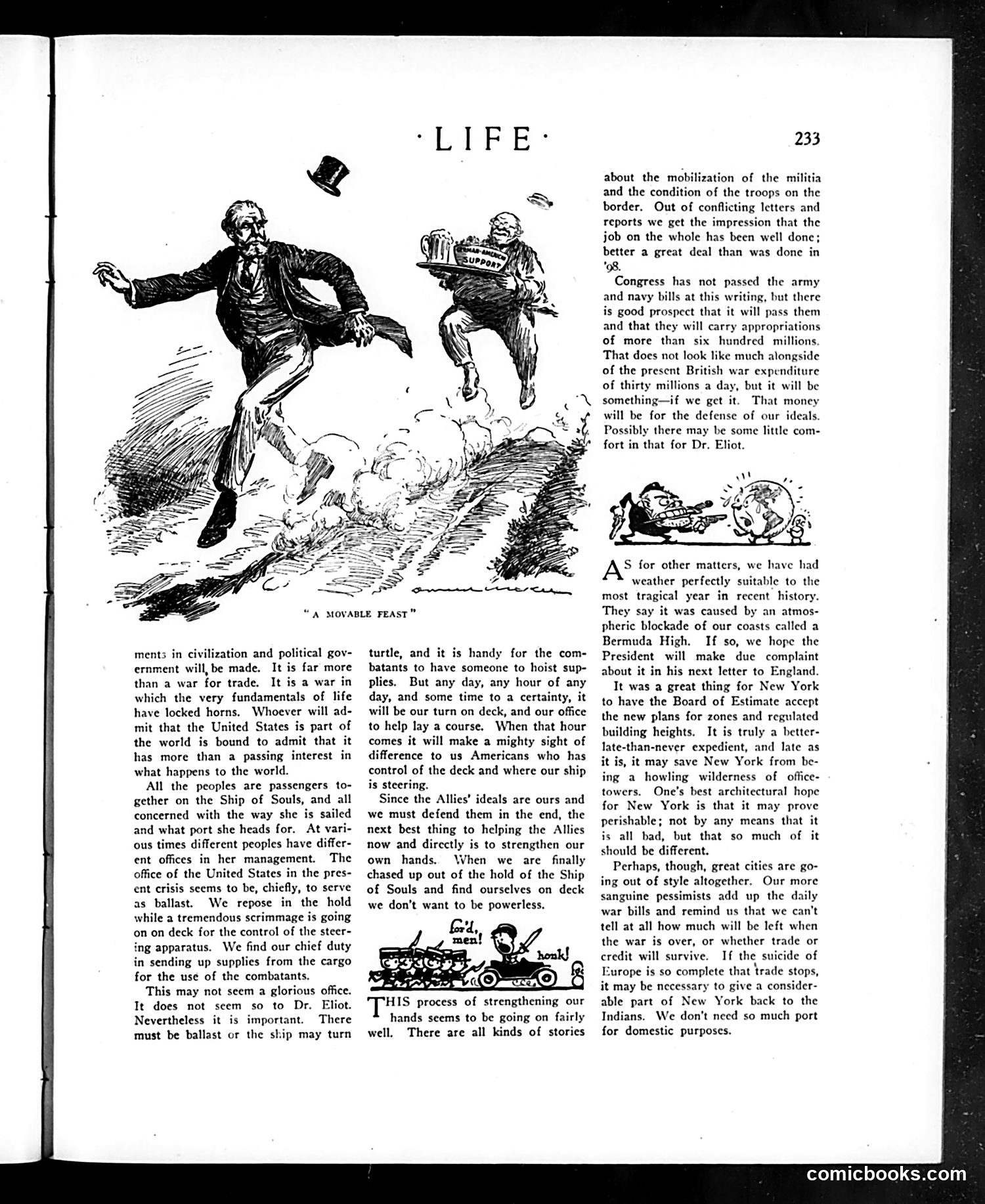
The main cartoon, titled "A Movable Feast," depicts two figures fleeing from an explosion—likely representing America and an Allied figure escaping conflict. The accompanying text uses a metaphor of the "Ship of Souls" to describe America's role in World War I. **Context:** This appears to be from around 1916, when America was still officially neutral but supplying the Allies. The satire critiques Dr. Eliot (likely Charles W. Eliot, Harvard president and peace advocate) for opposing military preparedness. **The argument:** The author contends America should strengthen its military capacity, using the ship metaphor—currently America serves as "ballast" below deck, supplying provisions, but will eventually be forced "on deck" to fight. Therefore, Americans should prepare now rather than remain powerless when directly involved. The piece argues that military spending isn't glorious but necessary, and that defending "the Allies' ideals" ultimately means defending American ideals. The satire mocks pacifist reluctance to prepare for inevitable military engagement.
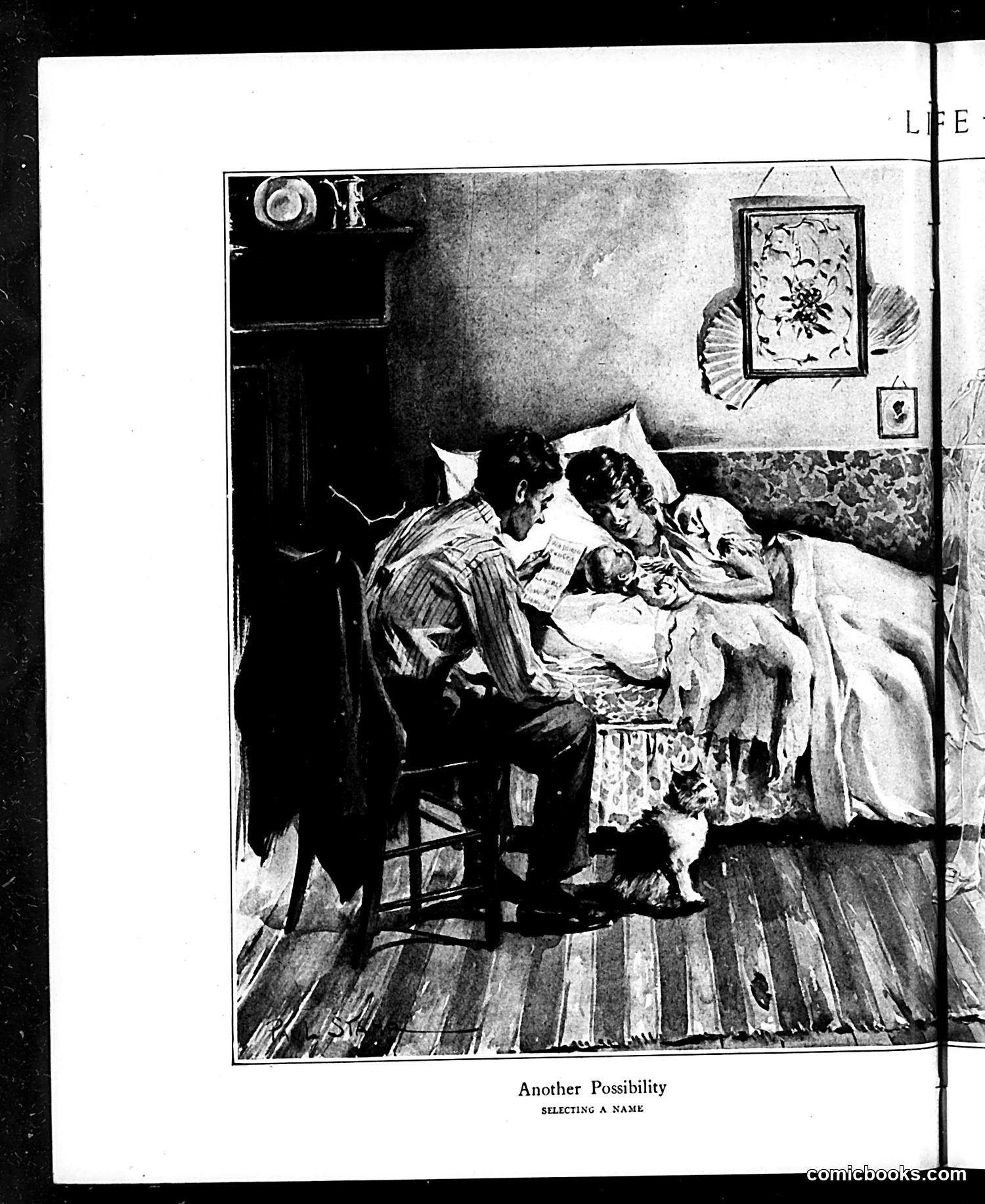
This illustration depicts a domestic scene where a family appears to be choosing a name for a newborn baby. A man sits with two women and children gathered around a bed, examining or discussing the infant. The room is modest, with simple furnishings, pictures on the wall, and wooden floorboards. The caption suggests this is satirical commentary on baby naming—likely mocking either fashionable naming practices of the era or the sentimental nature of the naming process itself. Without additional context about when this Life magazine page was published, the specific social trend being ridiculed remains unclear, though it appears to critique how families approach this significant decision.
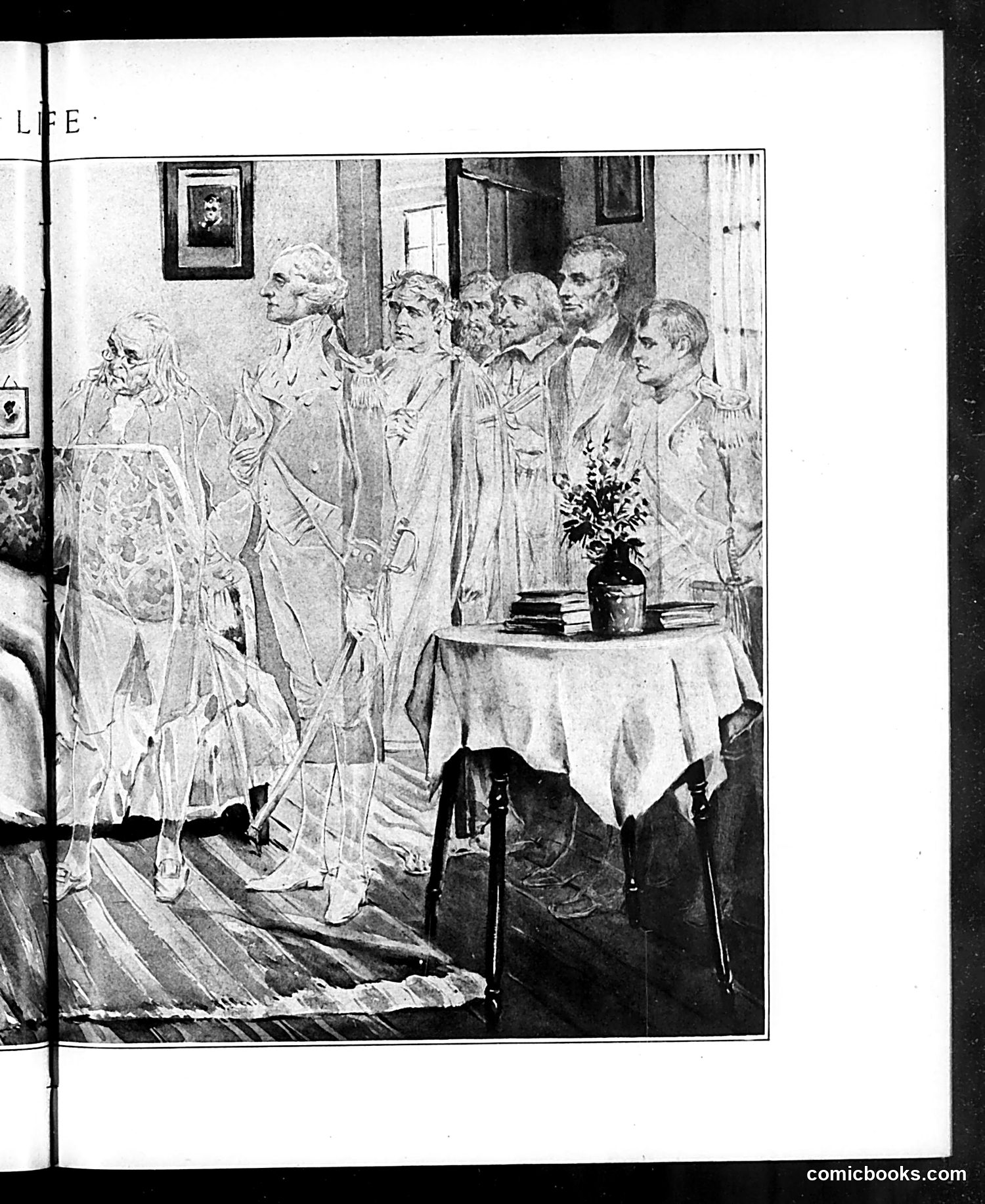
This appears to be a satirical illustration from *Life* magazine depicting what looks like a formal military or governmental gathering. The figures wear period military uniforms with epaulettes and formal dress. A table with a potted plant and what appears to be official documents sits centrally. Without visible OCR text providing specific identities or dates, I cannot definitively identify the historical figures or exact event being satirized. The style and uniforms suggest late 19th or early 20th century. The formal, somewhat awkward gathering—with figures standing rather stiffly—suggests the satire concerns serious political or military matters, possibly mocking diplomatic proceedings or military leadership. More context would be needed to specify the exact political reference.
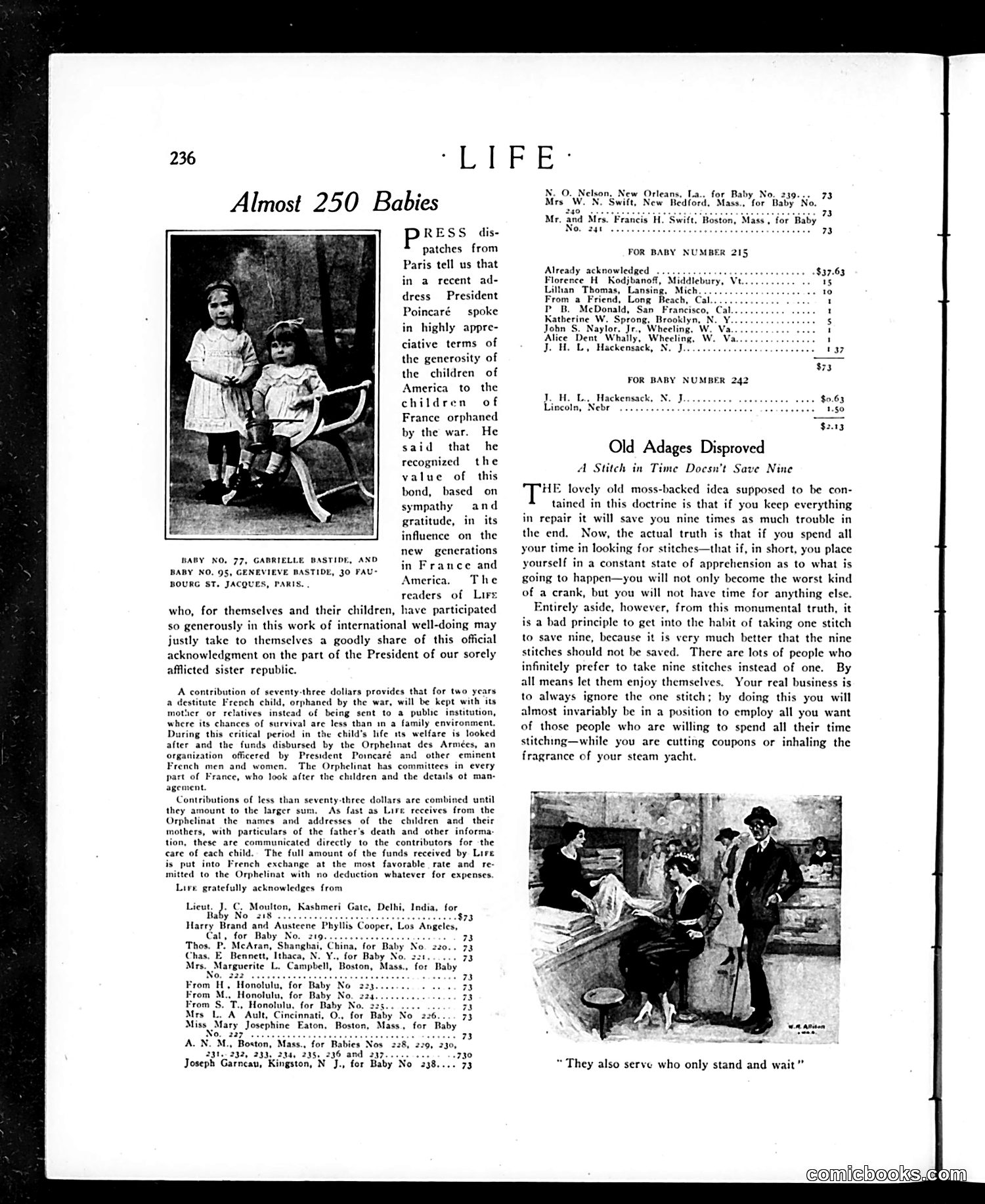
This page documents an American charitable initiative supporting French war orphans after World War I. President Poincaré of France publicly praised American children's generosity toward French orphans. The main feature shows two young American girls (Baby No. 77 and 95, Gabrielle and Genevieve Bastide) who are sponsorship recipients. The "Life" magazine organized a program where American donors contributed $73 to support individual French orphans for two years, keeping them with family rather than institutions. The page lists dozens of donors from across America (India, China, Hawaii, various U.S. cities) who funded specific babies. The second article humorously critiques the old proverb "A stitch in time saves nine," arguing that obsessive maintenance actually creates anxiety rather than preventing trouble. The bottom photograph shows someone engaged in domestic labor, likely illustrating the article's point about wasted effort through over-attention to detail. This reflects post-WWI America's engagement with European reconstruction and humanitarian aid.
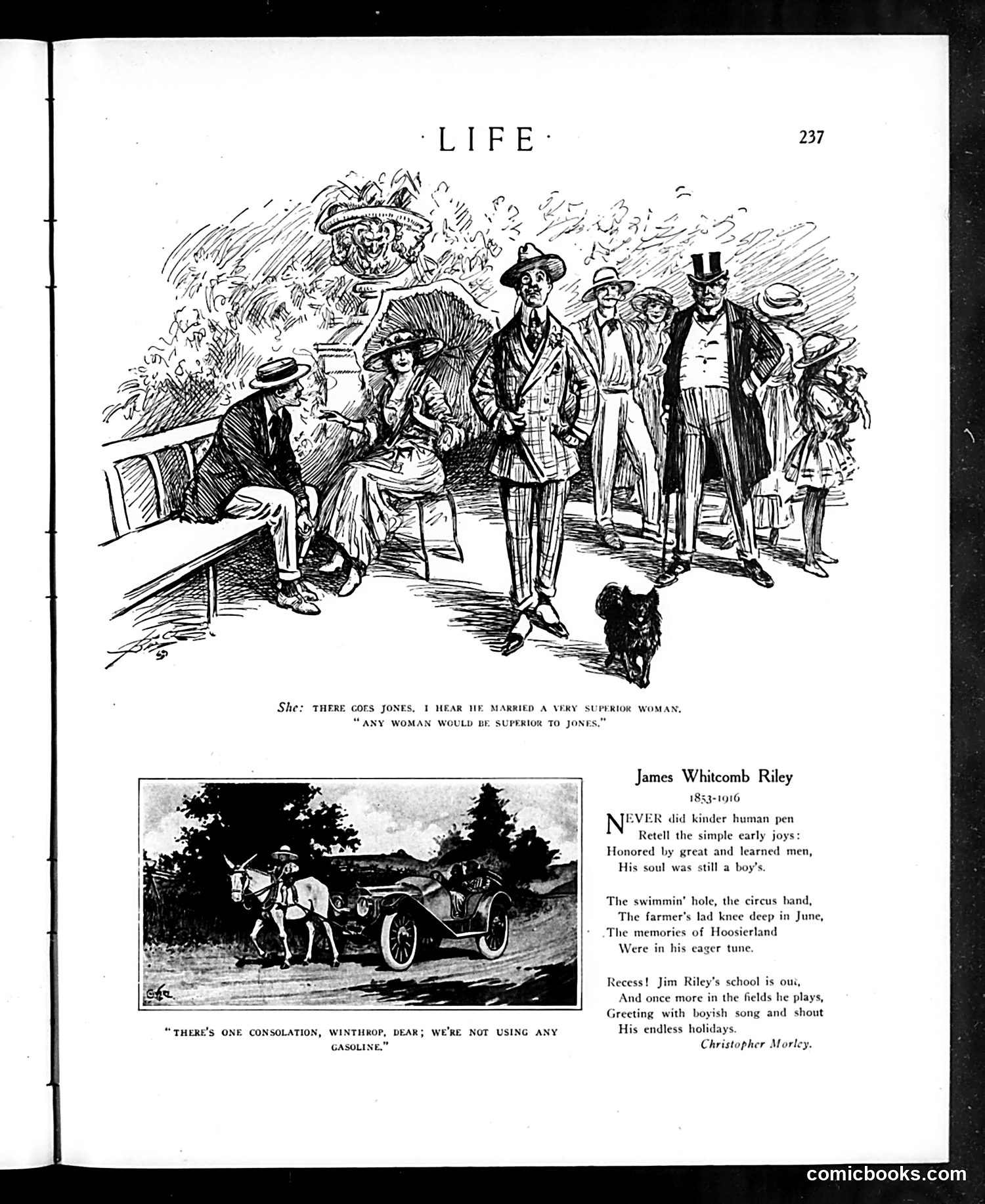
This page contains two satirical cartoons and a tribute to poet James Whitcomb Riley (1853-1916). **Top cartoon**: Shows a group of well-dressed people gossiping. The joke is a play on snobbery—a woman remarks that a man named Jones married "a very superior woman," and another responds that any woman would be superior to Jones himself. It's satire about social pretension and cattiness. **Bottom cartoon**: Shows two people with a car during what appears to be WWI-era fuel rationing. One says they have "one consolation"—they're not using gasoline. The humor lies in the grim acceptance of wartime scarcity; with no gas, they can't drive anyway, so there's nothing to regret. **Riley tribute**: Celebrates the Indiana poet known for nostalgic verses about rural childhood and Hoosier life, emphasizing his ability to capture simple joys despite being honored by intellectuals.
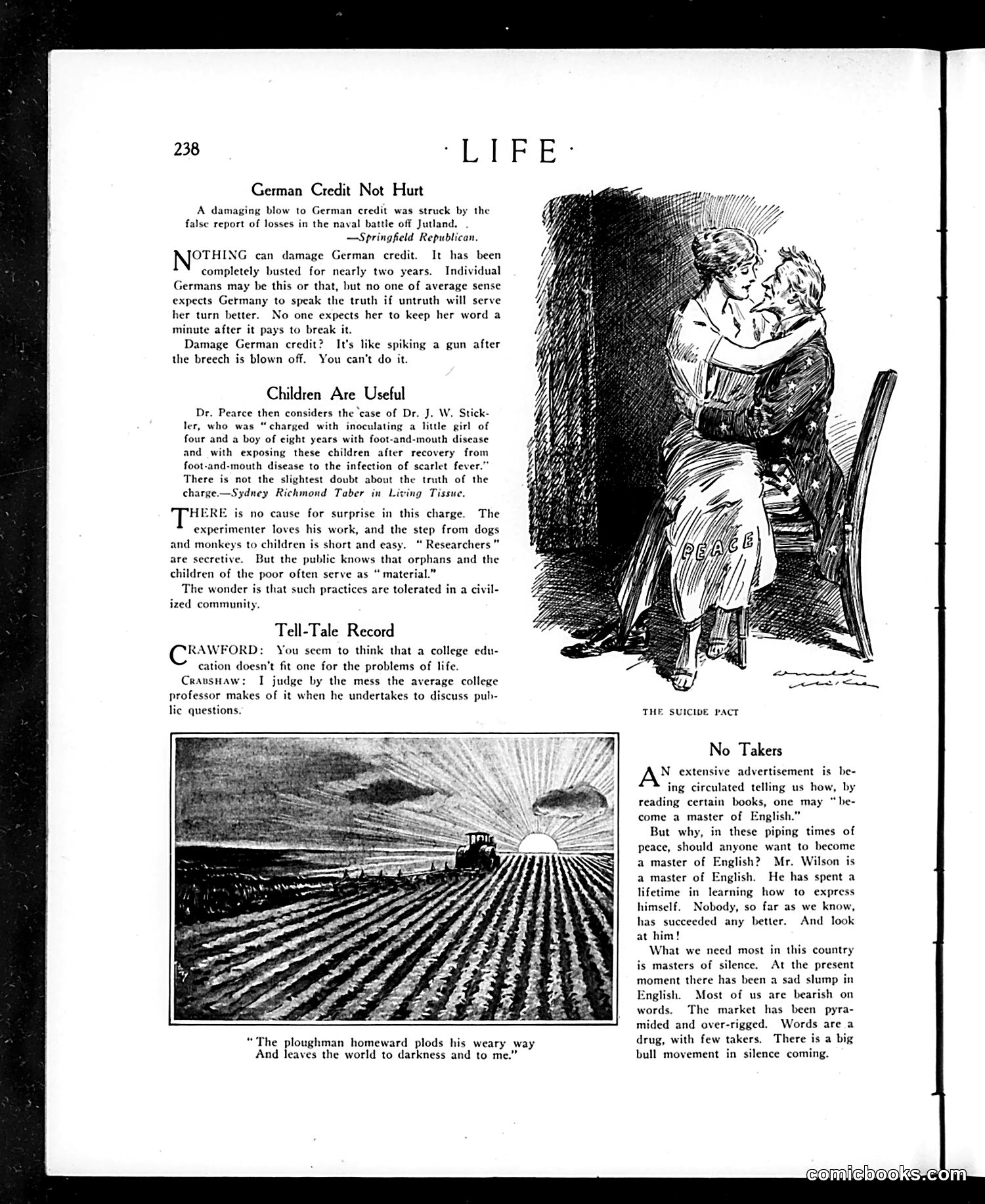
This page contains several satirical commentaries typical of Life's editorial stance: **"German Credit Not Hurt"** mocks Germany's reputation for dishonesty, particularly regarding false reports about naval losses at the Battle of Jutland (WWI). The satire argues Germany's credibility is already destroyed—you cannot damage what's already ruined. **"Children Are Useful"** criticizes unethical medical experimentation on orphans and poor children, referencing Dr. J.W. Stickler's case of deliberately infecting children with disease. It sardonically suggests researchers exploit vulnerable populations as "material." **"Tell-Tale Record"** presents a dialogue mocking college professors' poor judgment on public matters. **"No Takers"** satirizes an advertisement promising English mastery through books, arguing that in post-WWI America, silence—not eloquence—is valuable. The jab at President Wilson (known for his oratory) suggests words have become overused and worthless ("pyramided and over-rigged"). The accompanying rural image reinforces a preference for quiet labor over verbose leadership.
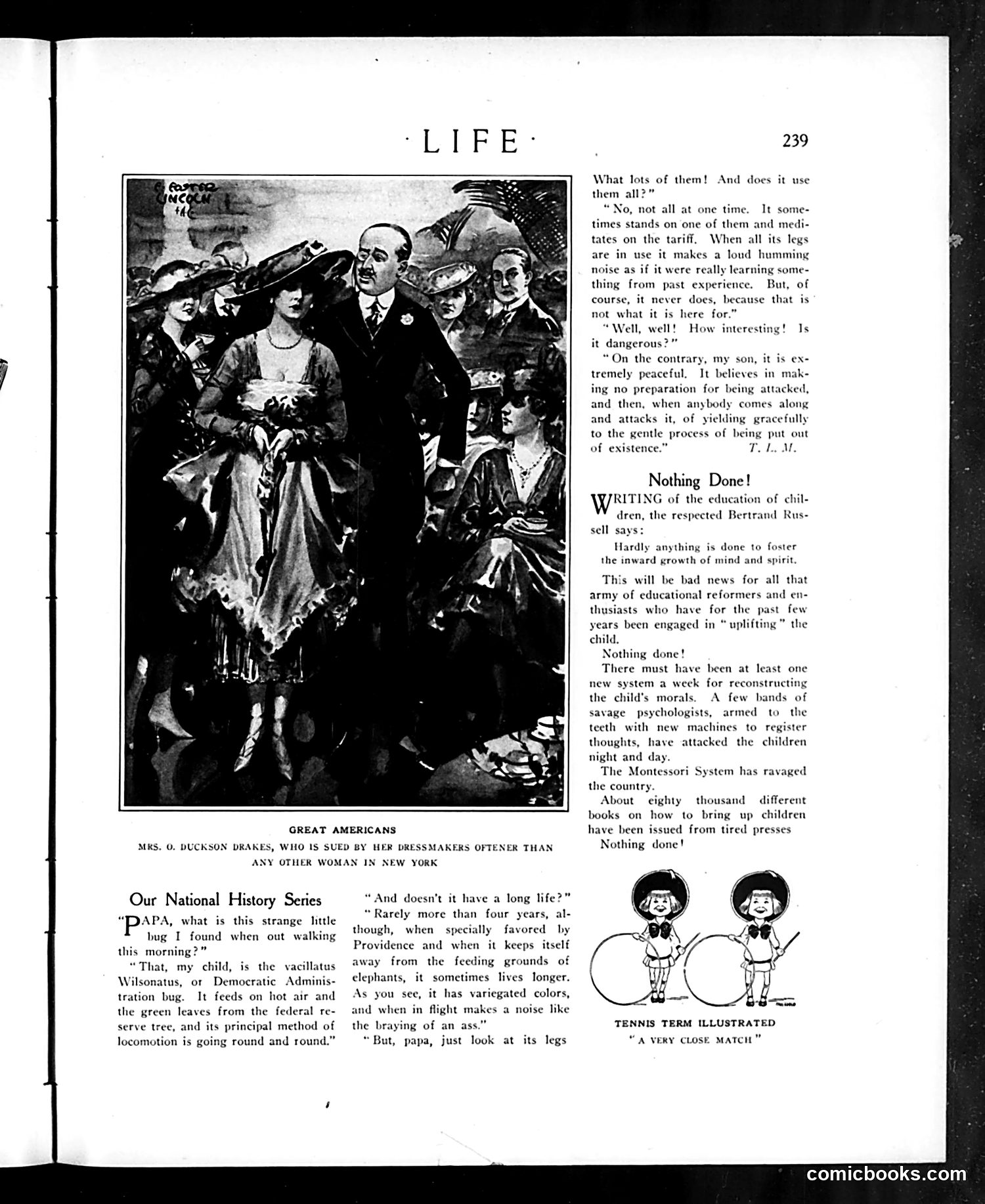
The page contains two distinct satirical pieces: **"Great Americans" portrait**: Mrs. O. Duckson Drakes, identified as a woman frequently sued by her dressmakers—a jab at wealthy Manhattan society women known for frivolous spending and litigation over fashion debts. **"Our National History Series"**: A father-child dialogue mocking the Wilson administration (Democratic) as a "vacillatus Wilsonatus bug" that feeds on "hot air" and federal reserve resources. The satire attacks Wilson-era policies as ineffective and circular ("going round and round"), with veiled criticism of pacifism ("extremely peaceful," unprepared for attack). The "four years" lifespan references a presidential term. **"Nothing Done!"**: Bertrand Russell quote sardonically criticizing educational reform movements (Montessori System specifically mentioned) as ineffective despite their proliferation—eighty books published with no actual results. The cartoons mock both wealthy frivolity and progressive political/educational movements as wasteful and pointless.
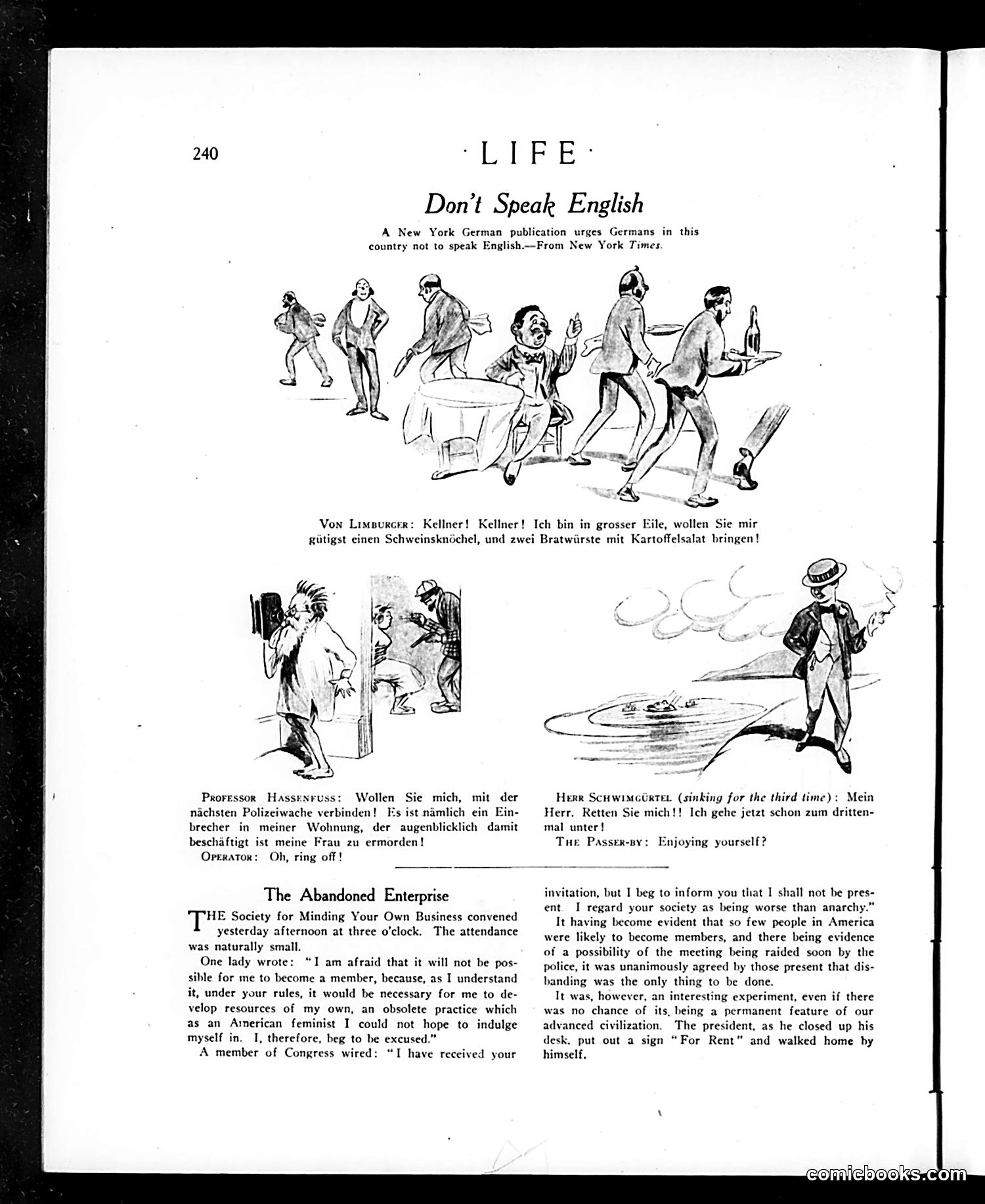
This page satirizes German-American ethnic tension during World War I. The top cartoons mock a New York German-language publication urging German immigrants to avoid English, depicting absurd scenarios where Germans speaking only German create chaos: a waiter ignores an emergency call about a burglary, a drowning man's cries for help are dismissed as idle chatter. The satire's point: German immigrants who refuse to assimilate linguistically endanger themselves and others, making them poor citizens. This reflects widespread anti-German sentiment and Americanization pressure of the era. Below, "The Abandoned Enterprise" humorously describes a "Society for Minding Your Own Business"—an impossible organization in America. A woman feminist refuses membership (won't develop self-reliance), a congressman calls it "worse than anarchy." The society promptly dissolves. Together, these pieces critique both ethnic insularity and American individualism/nosiness—suggesting Americans can't mind their own business, while some immigrants won't integrate.
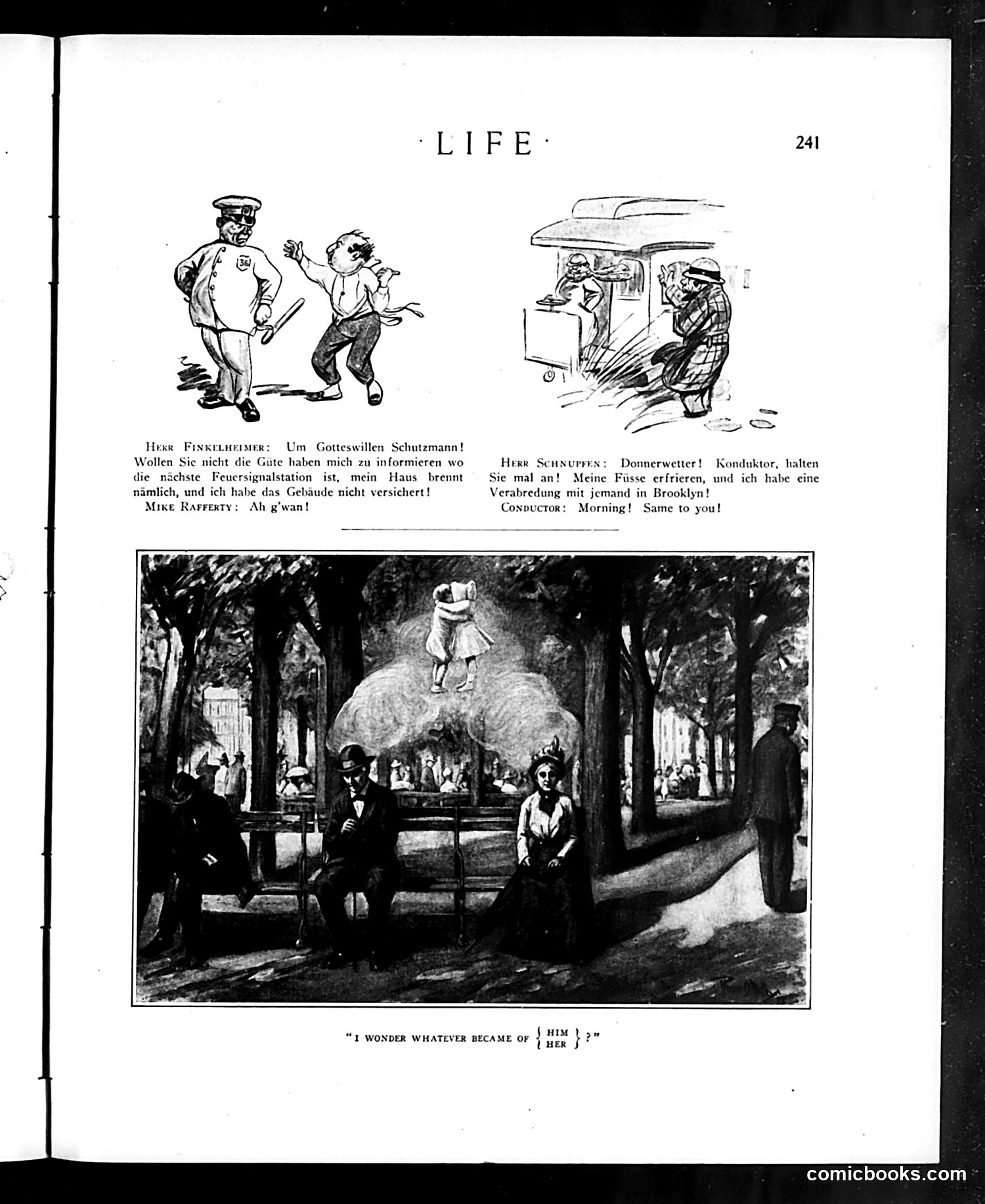
This page contains three separate comic vignettes satirizing urban life, likely from the early 20th century: **Top left:** A German-accented man (Herr Finkelheimer) frantically asks a policeman where the nearest fire station is—his house is burning and he hasn't insured it. The officer dismissively replies "Ah g'wan!" The joke mocks both the immigrant's panic and the cop's indifference. **Top right:** A conductor tells a complaining passenger (Herr Schnurren) to stop whining about his frozen feet since he has a date in Brooklyn. The humor lies in prioritizing romance over comfort. **Bottom illustration:** Shows people in a park gazing upward at what appears to be an enormous figure or apparition in the sky. The caption "I wonder whatever became of [him/her]?" suggests speculation about someone's mysterious fate or transformation—likely referencing a then-current public figure or scandal, though the specific reference is now unclear. The multilingual text reflects Life's audience diversity during the immigrant-heavy early American period.
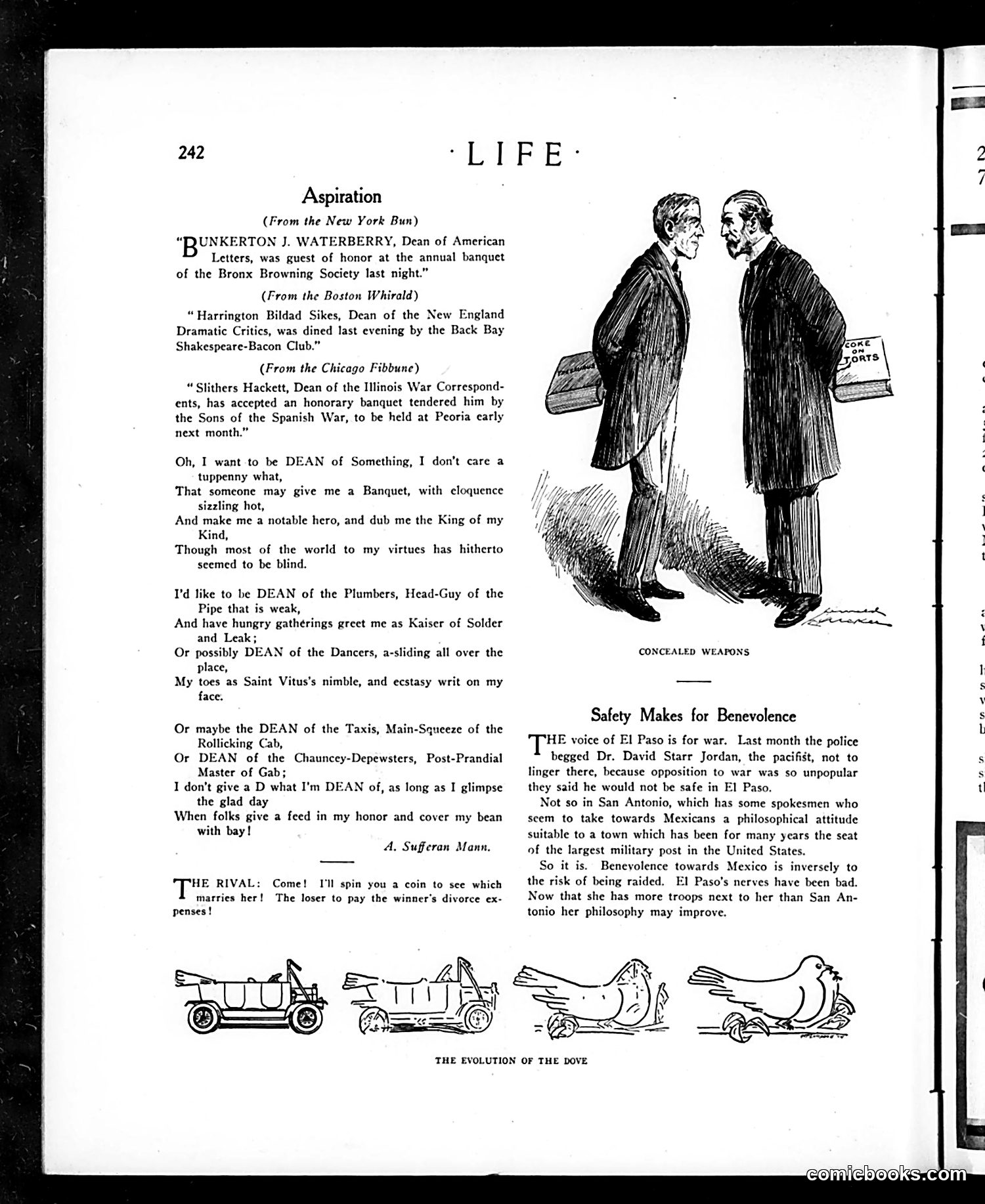
This page satirizes American pretension through two main pieces: **"Aspiration" (poem by A. Suferan Mann):** Mocks the widespread desire for honorific titles and ceremonial recognition. The poem parodies newspaper items about various minor figures being honored as "Dean" of their fields—a fictional "Dean of American Letters," "Dean of War Correspondents," etc. The speaker desperately wants *any* title ("I don't give a D what I'm DEAN of") if it means receiving a banquet in his honor. The satire targets both the vanity of those seeking such hollow titles and American culture's enthusiasm for bestowing them. **"Safety Makes for Benevolence":** Commentary on military presence affecting civic attitudes. It notes that El Paso's residents were hostile to pacifist Dr. David Starr Jordan, yet San Antonio—which hosts a major military post—takes a more "philosophical" stance toward Mexico. The joke: benevolence toward potential enemies increases when you have military superiority nearby. The accompanying cartoon "Concealed Weapons" appears to visualize hidden hostility masked by civility.
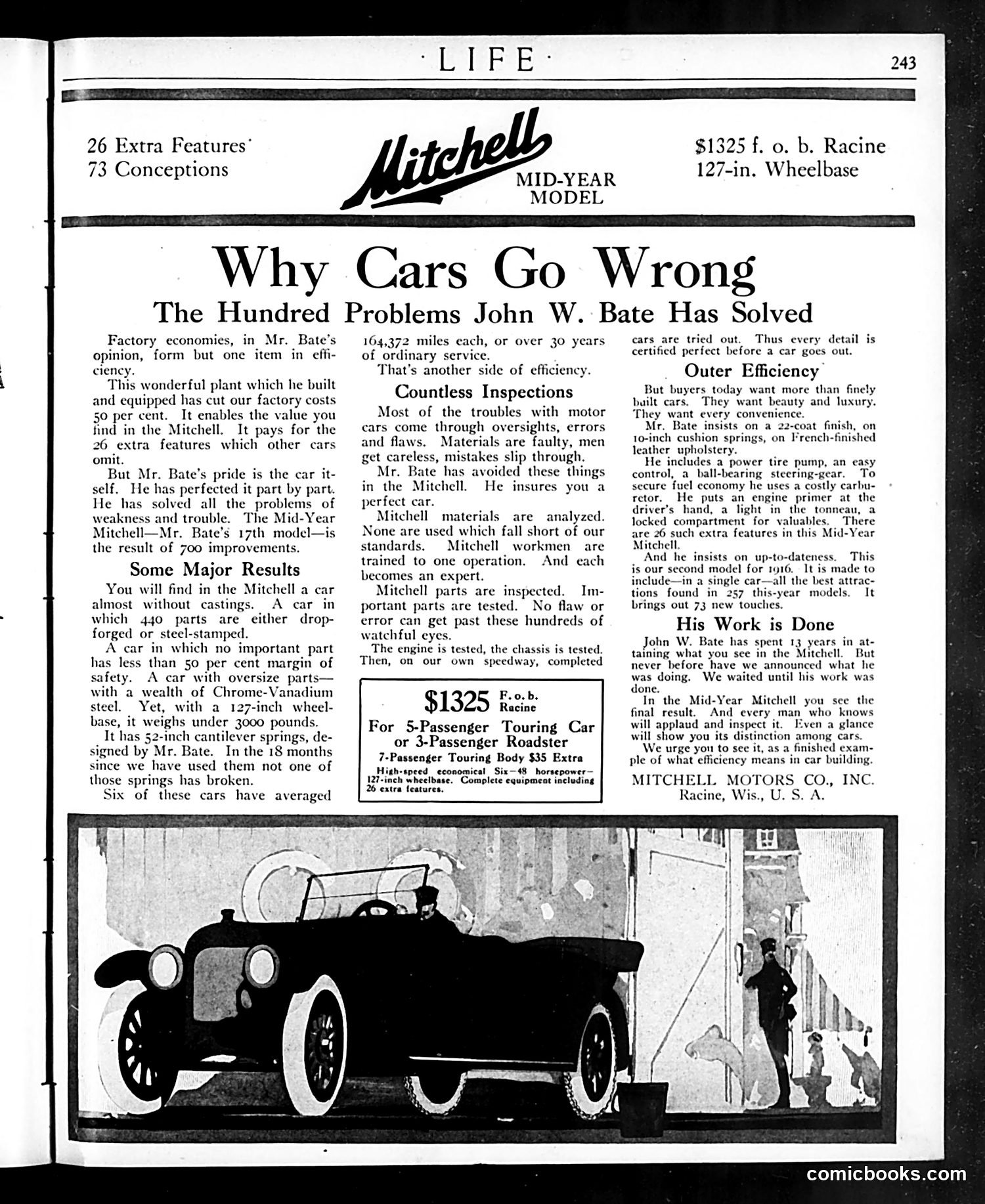
This is a car advertisement rather than political satire. It promotes Mitchell Motors' "Mid-Year Model," priced at $1,325, emphasizing engineering excellence under designer John W. Bate's direction. The ad's central claim: Mitchell cars are superior because of meticulous quality control—materials are analyzed, workers trained to single operations, parts inspected and tested multiple times, and completed cars road-tested on the company's own speedway. The accompanying illustration shows an early automobile (silhouetted) alongside a factory inspection scene, visualizing the "hundreds of watchful eyes" mentioned in the text. The rhetoric reflects early 1900s manufacturing pride: efficiency, precision, and elimination of "weakness and trouble." The "26 extra features" and "73 new touches" were selling points distinguishing Mitchell from competitors in a fragmented auto market before standardization. This represents aspirational marketing for a middle-class luxury vehicle.
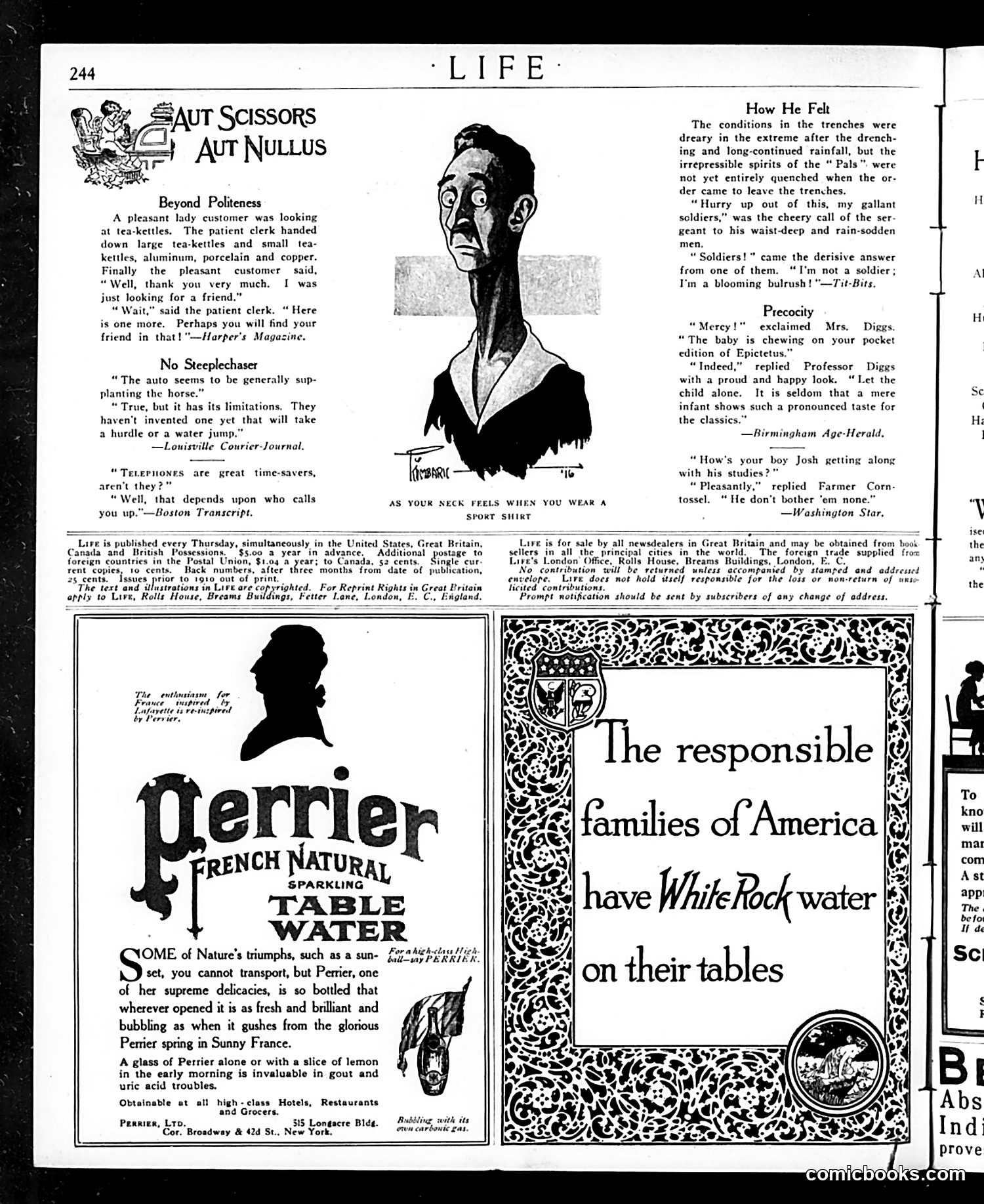
This page contains several short humorous anecdotes and advertisements typical of early 20th-century Life magazine. **The cartoons/jokes** are brief, genteel humor pieces: - A clerk's witty retort to a customer looking at teakettles (implying she resembles one) - A comparison of automobiles to horses regarding jumping ability - A joke about telephones depending on who calls **The main illustration** shows a caricatured male face in exaggerated style, captioned about wearing a sport shirt—likely mocking either the fashion or discomfort of the garment. **Advertisements** dominate the lower half: Perrier sparkling water (French luxury brand) and White Rock water, both marketed to "responsible families of America"—reflecting period assumptions about refined consumption. **The small anecdotes** at right ("How He Felt," "Precocity") are war-adjacent humor (trenches mentioned) and gentle domestic comedy about educated pretension. Overall, this reflects Life's satirical focus on American manners, fashion, and social aspiration in the World War I era.
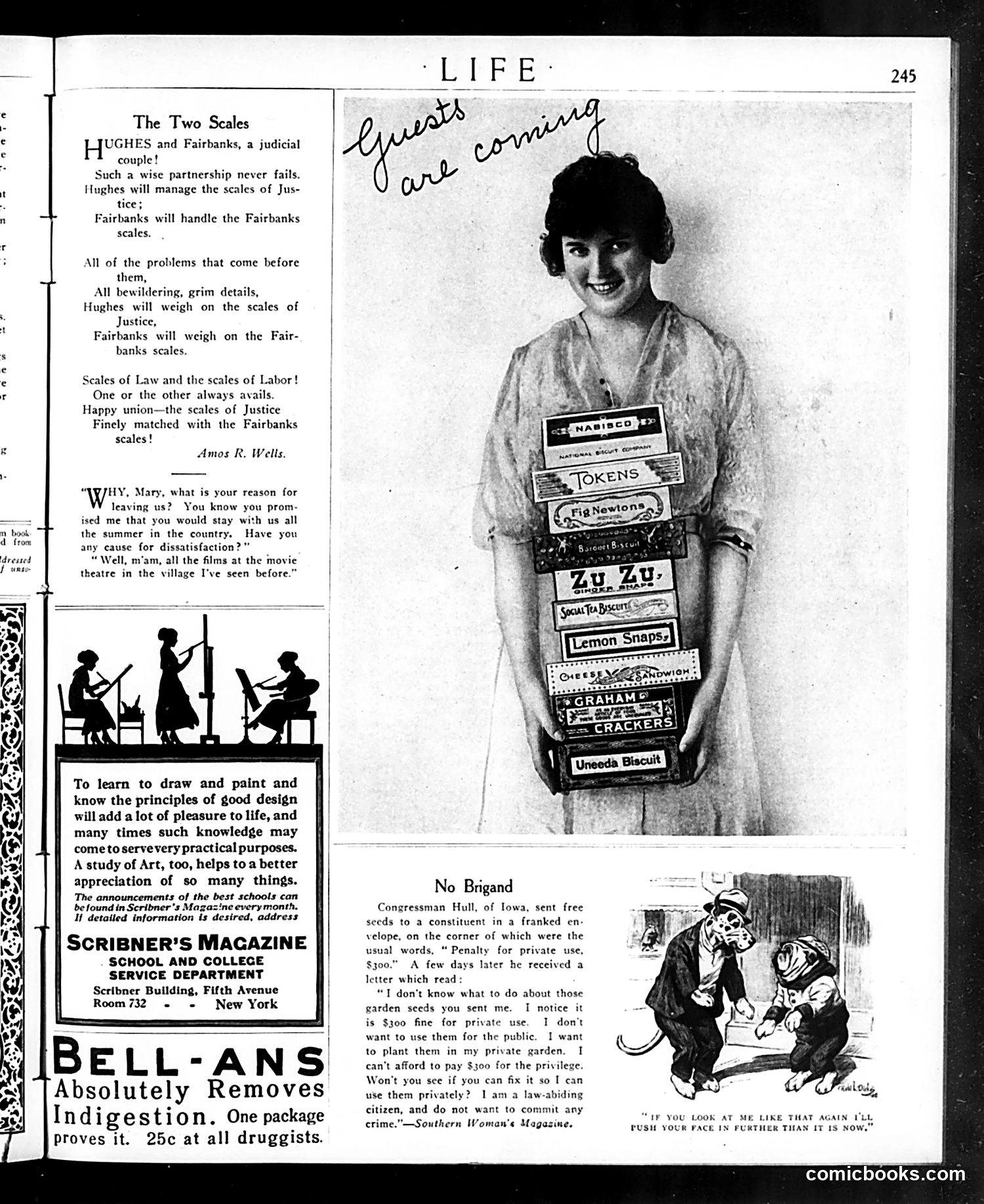
This page contains multiple satirical items from an early 20th-century American magazine: **"The Two Scales" poem:** A political jab at Charles Evans Hughes and James Sherman Fairbanks (likely Vice President James Sherman or similar figure), comparing them to scales of justice versus commercial "Fairbanks scales." The satire suggests one will handle justice while the other manages labor disputes—implying an imbalanced partnership. **Main photograph:** Shows a woman humorously stacked with candy/snack brand boxes (Haribo, Tokens, Fig Newtons, Zu Zu, Lemon Snaps, Graham Crackers, etc.), captioned "Guests are coming"—poking fun at excessive consumption or overprepared hospitality. **"No Brigand" anecdote:** A humorous story about a constituent confused by Congressional franking envelope warnings ("$300 fine for private use"), not realizing the warning applies to misusing the postal privilege, not the seeds themselves. The page is primarily **satirical social commentary** wrapped in period humor, mixed with advertisements.
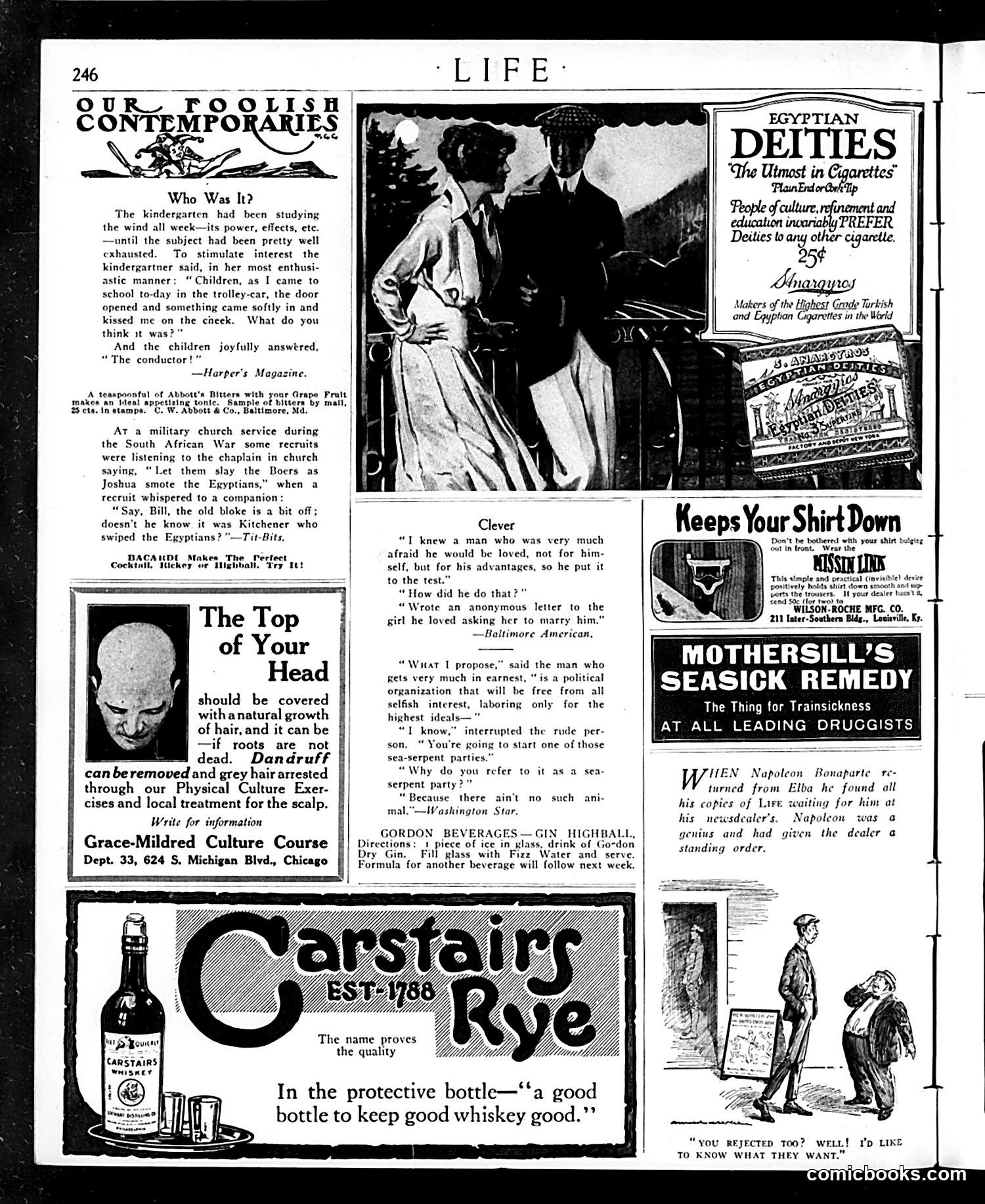
This is primarily an **advertising and humor page** from Life magazine (likely early 1900s, given references to South African War and trolley-cars). The "Our Foolish Contemporaries" section contains brief satirical anecdotes mocking: 1. **Kindergarten joke**: A trolley conductor kissing a schoolteacher—the children assume any man entering a trolley must be the conductor, a commentary on class and occupational stereotypes. 2. **Military chaplain joke**: A recruit mistakes Field Marshal Kitchener for Joshua, conflating Biblical and contemporary military history—satirizing soldiers' ignorance or the chaplain's anachronistic language. 3. **"Sea-serpent party" joke**: Mocking political idealists who claim to form selfless organizations while being transparently self-interested—"sea-serpent" means mythical/nonexistent. The page also includes product advertisements (Garstairs Rye whiskey, Mothersill's seasick remedy, Egyptian Deities cigarettes) and a cartoon about job rejection. No specific political figures are identifiable in the imagery.
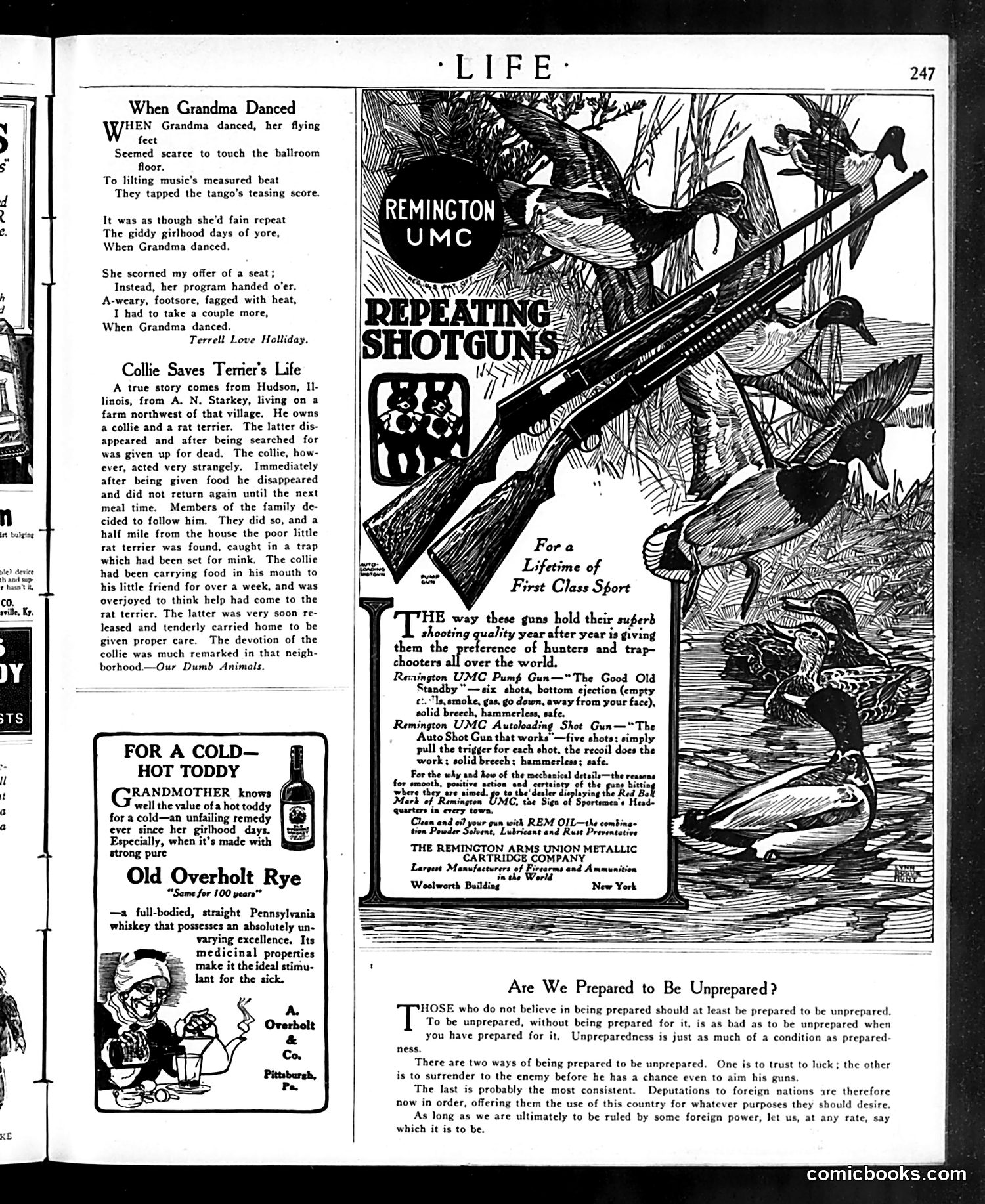
This page mixes lighthearted domestic content with serious political commentary disguised as satire. **Poetry & Anecdotes:** "When Grandma Danced" and "Collie Saves Terrier's Life" are nostalgic/heartwarming pieces typical of Life's humor section. **Advertisements:** Old Overholt Rye whiskey and Remington shotguns represent typical period advertising. **Political Satire:** The final essay "Are We Prepared to Be Unprepared?" is the page's sharp critique. Using circular, absurdist logic, it mocks American isolationism and military unpreparedness. The author sarcastically suggests surrendering to foreign powers or offering the country's use to them—since apparent American policy assumes defeat anyway. This appears to address pre-WWII anxieties about U.S. defensive capability and foreign aggression, suggesting that half-measures and indecision are worse than honest preparation or honest surrender. It's biting commentary on national vulnerability.
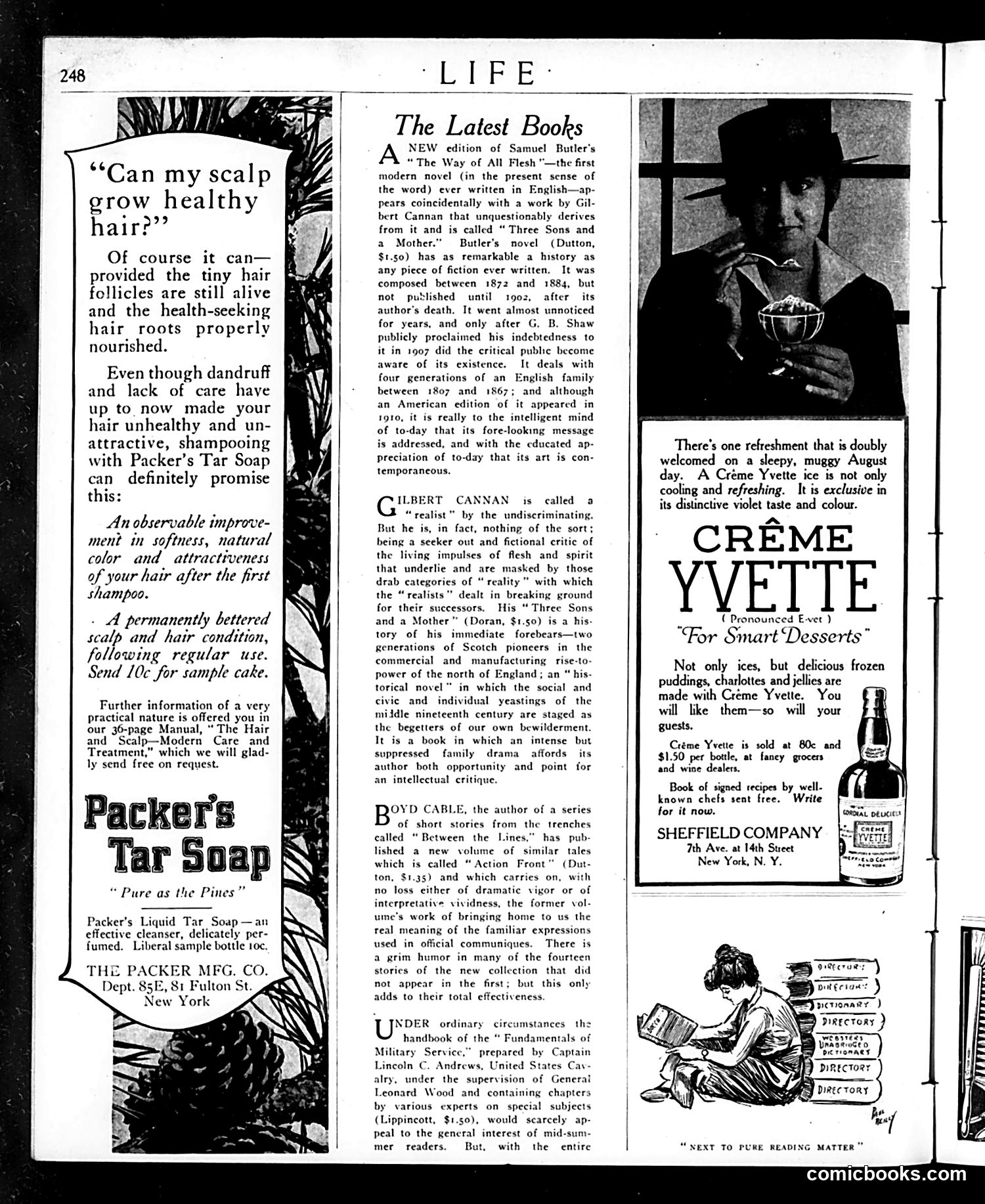
This is primarily a **book review and advertising page** from Life magazine, not a political cartoon page. The left side features an advertisement for **Packer's Tar Soap**, using a question-and-answer format to promote hair health remedies—typical early 20th-century patent medicine marketing. The central and right columns contain **book reviews** discussing recent publications: Samuel Butler's *The Way of All Flesh* (finally published in 1902 after being written decades earlier), Gilbert Cannan's *Three Sons and a Mother*, and Boyd Cable's *Action Front*. These reviews discuss literary merit and themes rather than satirizing anything. The bottom right shows an advertisement for **Crème Yvette**, a violet-flavored liqueur marketed as a dessert ingredient. There is no political satire, caricature, or cartoon humor present on this page—it's a standard magazine layout mixing book criticism with period product advertisements.
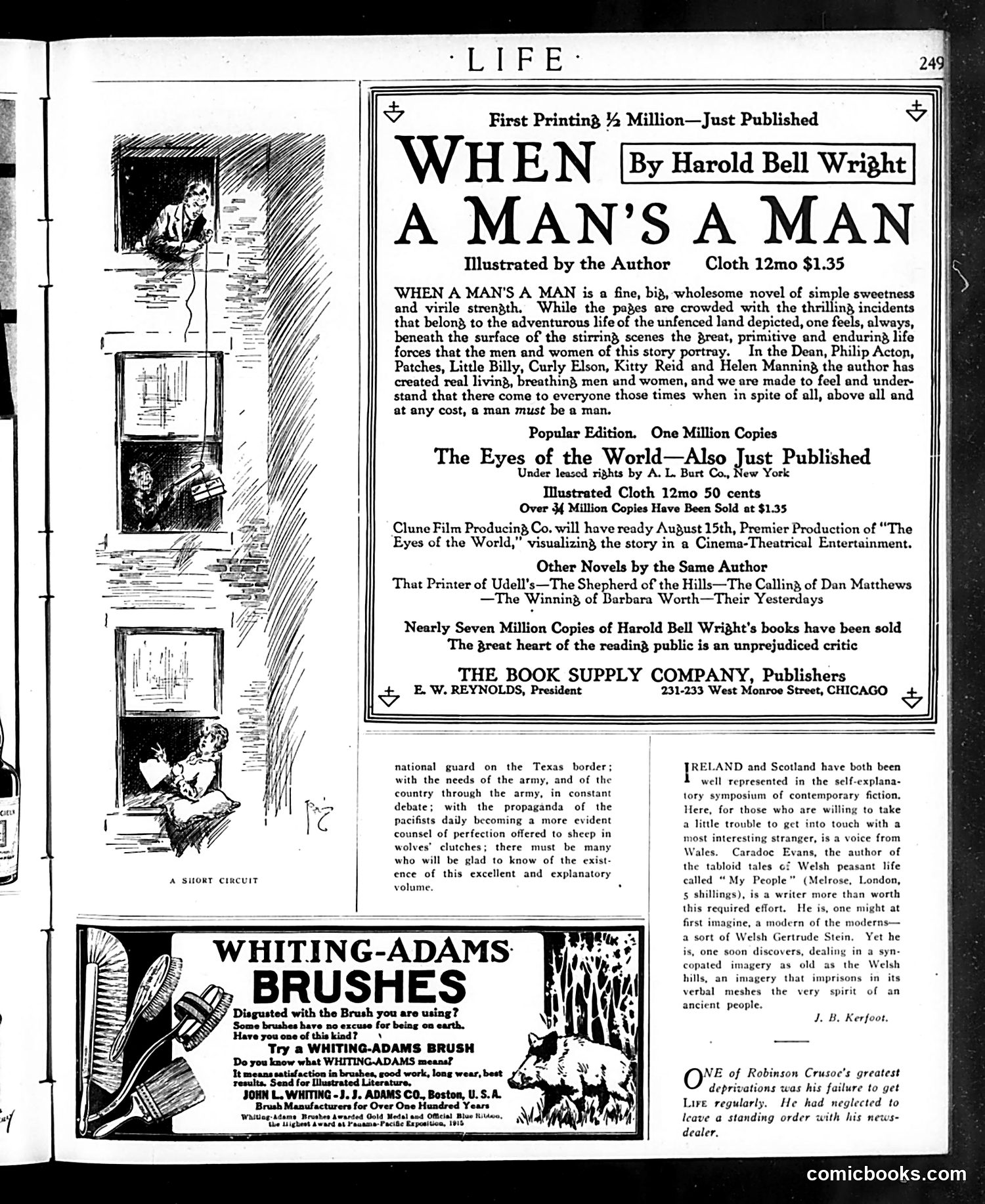
This page is primarily **advertising and book promotion**, not political satire. The main content advertises Harold Bell Wright's novels, particularly "When a Man's a Man" (first printing of 1.5 million copies). The left side contains a sketch titled "A Short Circuit"—appears to be an illustration of someone at a desk or window, but its meaning isn't clear from the image alone. Below that is an advertisement for **Whiting-Adams brushes**, using typical early 20th-century advertising copy ("Disgusted with the Brush you are using?"). The right side includes a literary review discussing Welsh author **Caradoc Evans** and his book "My People," comparing him to modern writers while noting his use of traditional Welsh imagery and dialect. The page reflects 1910s-era publishing and consumer advertising rather than political commentary or satire. No identifiable caricatures or political figures are present.
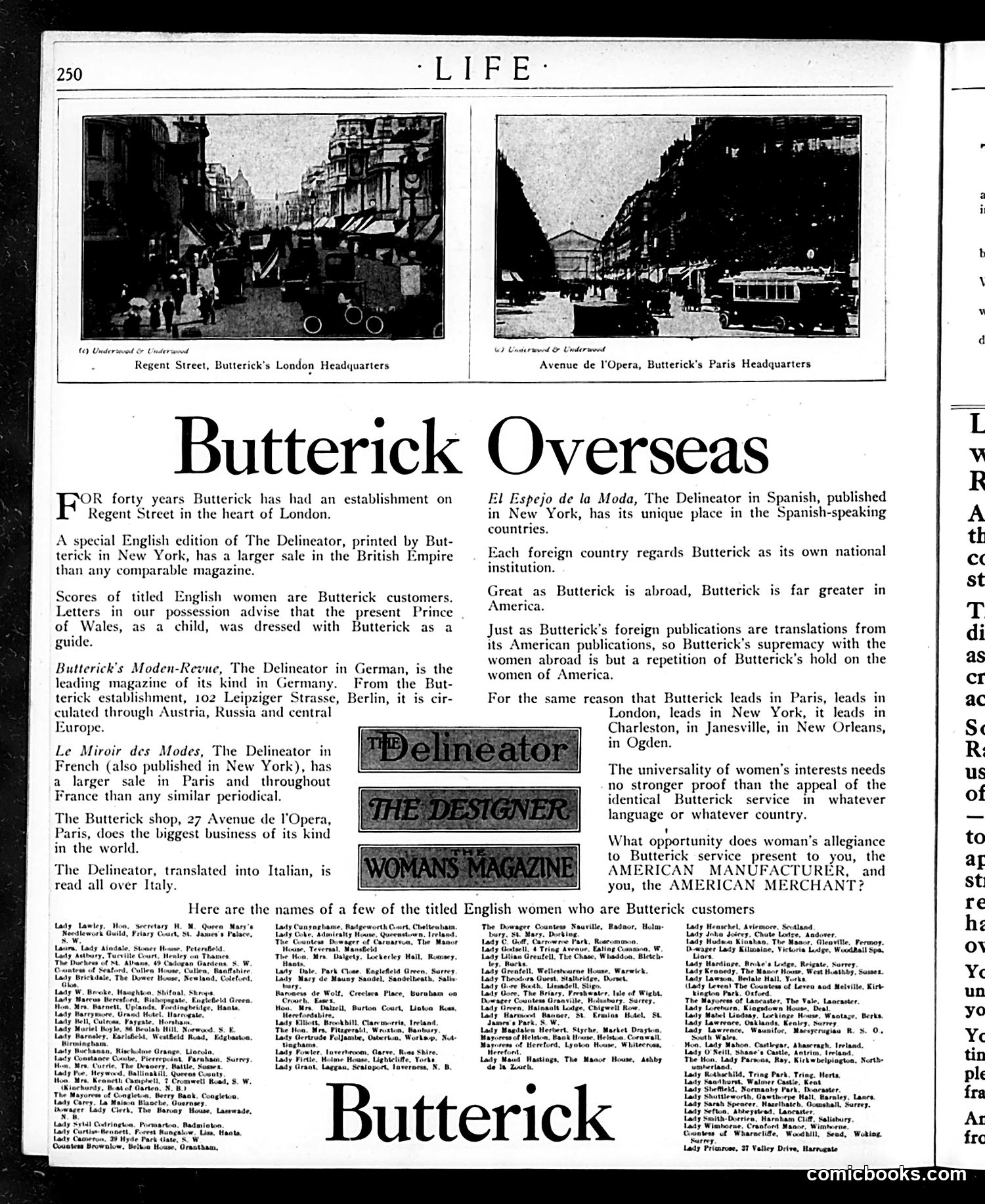
This is a **straightforward advertisement**, not a political cartoon or satire. It promotes Butterick, a major fashion pattern and women's magazine company, highlighting its international reach. The page features two photographs of Butterick's flagship stores (London and Paris) and argues that Butterick dominates women's fashion publishing globally—operating *The Delineator* in English, *Butterick's Moden-Revue* in German, *Le Miroir des Modes* in French, *El Espejo de la Moda* in Spanish, and Italian editions. It claims the company serves "titled English women" and even dressed the young Prince of Wales. The lengthy list of aristocratic female customers (Lady This, Countess That) functions as social proof—using British nobility's patronage to validate the brand's prestige and appeal to American manufacturers and merchants considering advertising in Butterick publications. There is **no satire or joke here**—it's purely commercial messaging using patriotic and aspirational language to position Butterick as an indispensable institution for women worldwide.
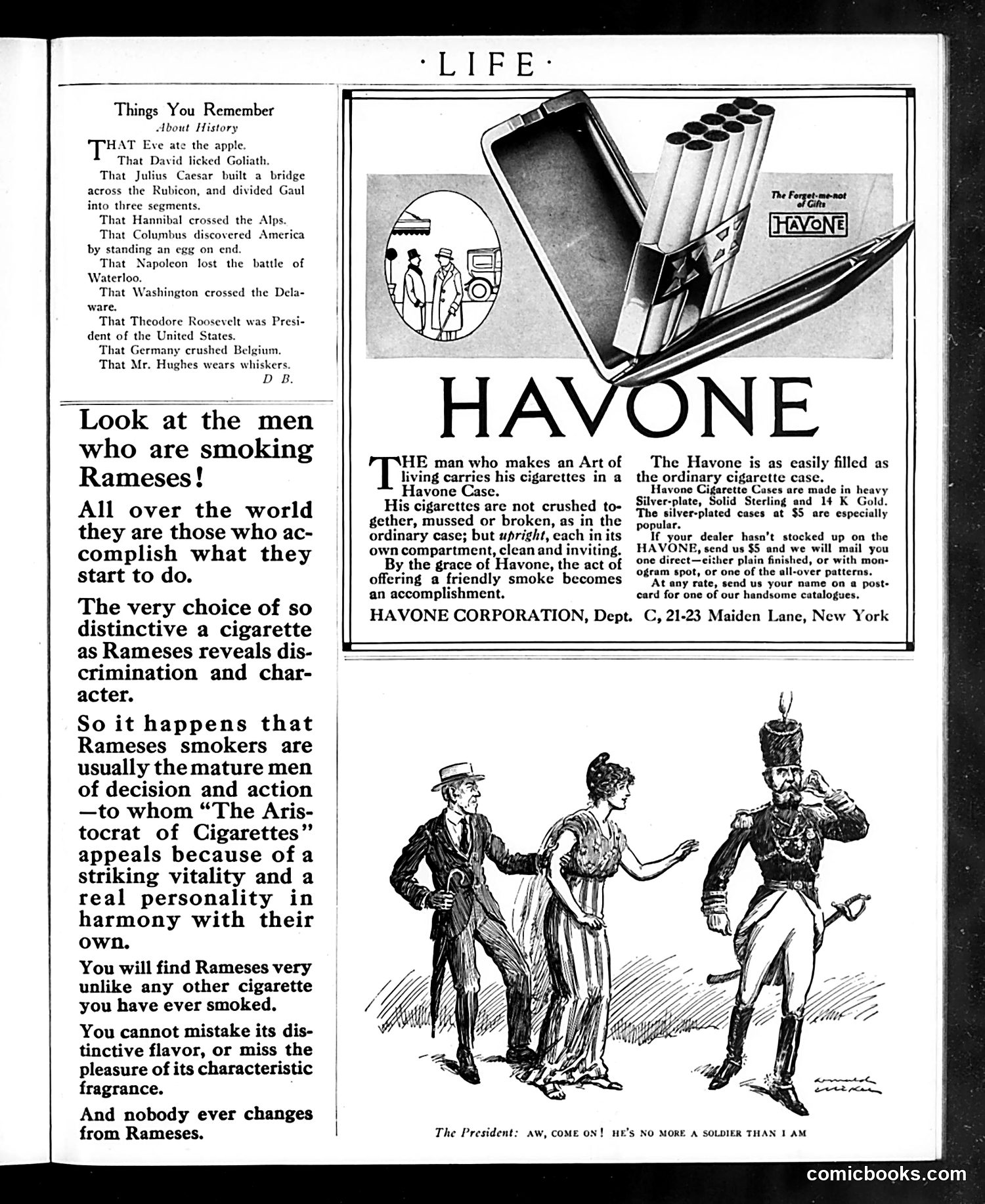
This page contains two cigarette/smoking-related advertisements alongside satirical content mocking historical knowledge and contemporary politics. The left side lists famous historical facts people "remember," many of which are actually legends or distortions (Eve's apple, Columbus's egg trick), establishing a theme of popular misconception. This frames the Rameses cigarette ad's claim that smoking this brand reveals "discrimination and character." The bottom cartoon appears to reference Theodore Roosevelt (mentioned in the history list as a U.S. President). The caption "He's no more a soldier than I am" suggests satirical commentary on Roosevelt's military credentials or persona—likely mocking his celebrated Rough Rider reputation. The figures in military dress suggest a political confrontation or debate about authenticity. The Havone cigarette case ad emphasizes refined presentation and sophistication. Overall, this page mixes vintage tobacco advertising with political satire typical of *Life* magazine's approach during the early-to-mid 20th century, though the specific historical moment remains unclear without the publication date.
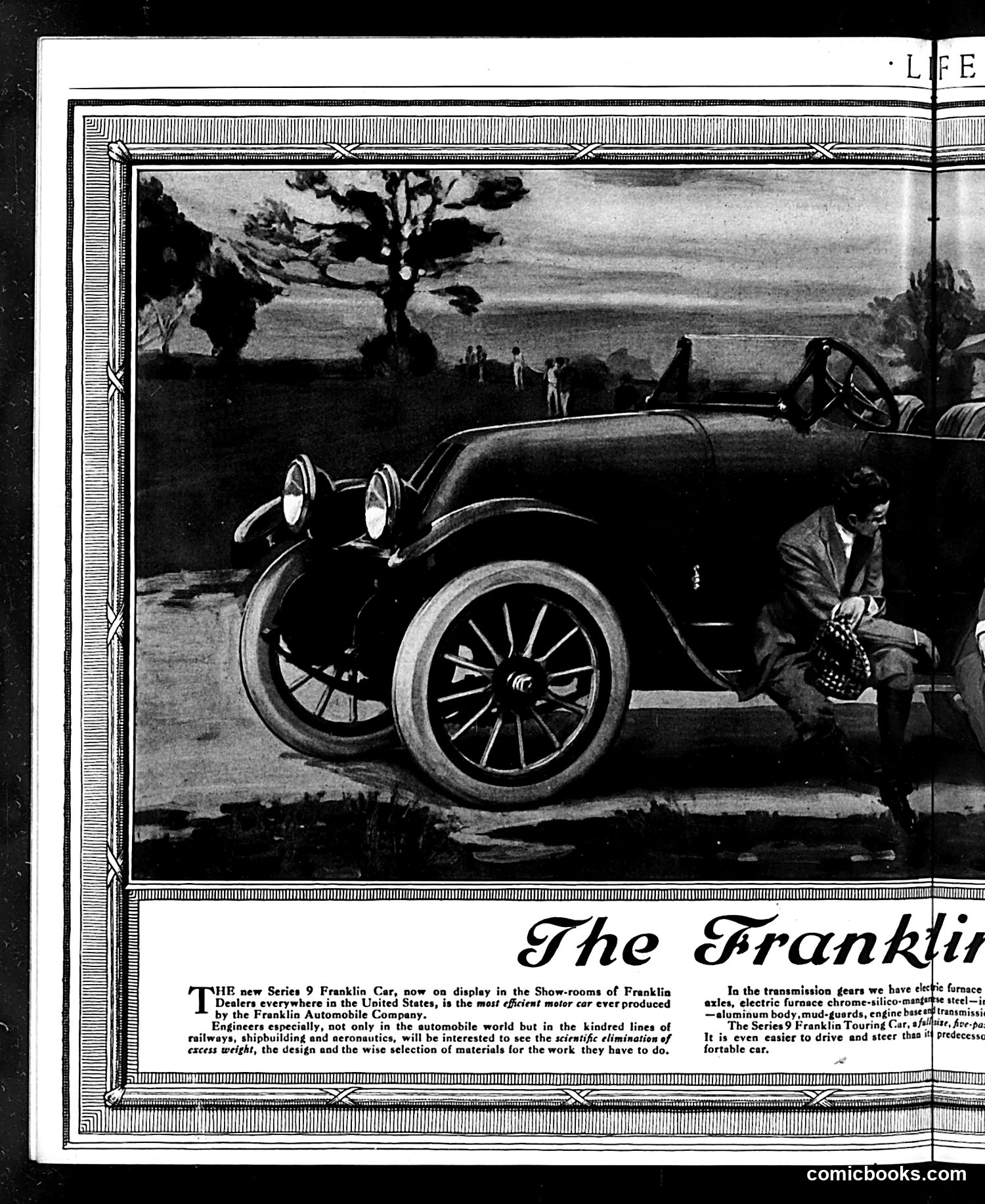
This is a **product advertisement**, not political satire. The page promotes the Series 9 Franklin automobile, highlighting its engineering features and design innovations. The image shows a vintage early-1900s open-air automobile displayed alongside a well-dressed man examining it. The text emphasizes the Franklin Car's technical superiority: its use of specialized materials (chrome-manganese steel, aluminum body), electric furnace transmission gears, and ease of operation. The advertisement targets engineers and technically-minded readers by emphasizing **scientific elimination of excess weight** and careful material selection—positioning the Franklin as the thinking person's automobile. The scenic background and composed presentation suggest luxury and modern progress. This represents typical early automotive advertising strategy: appealing to rational, technical expertise rather than speed or style alone.
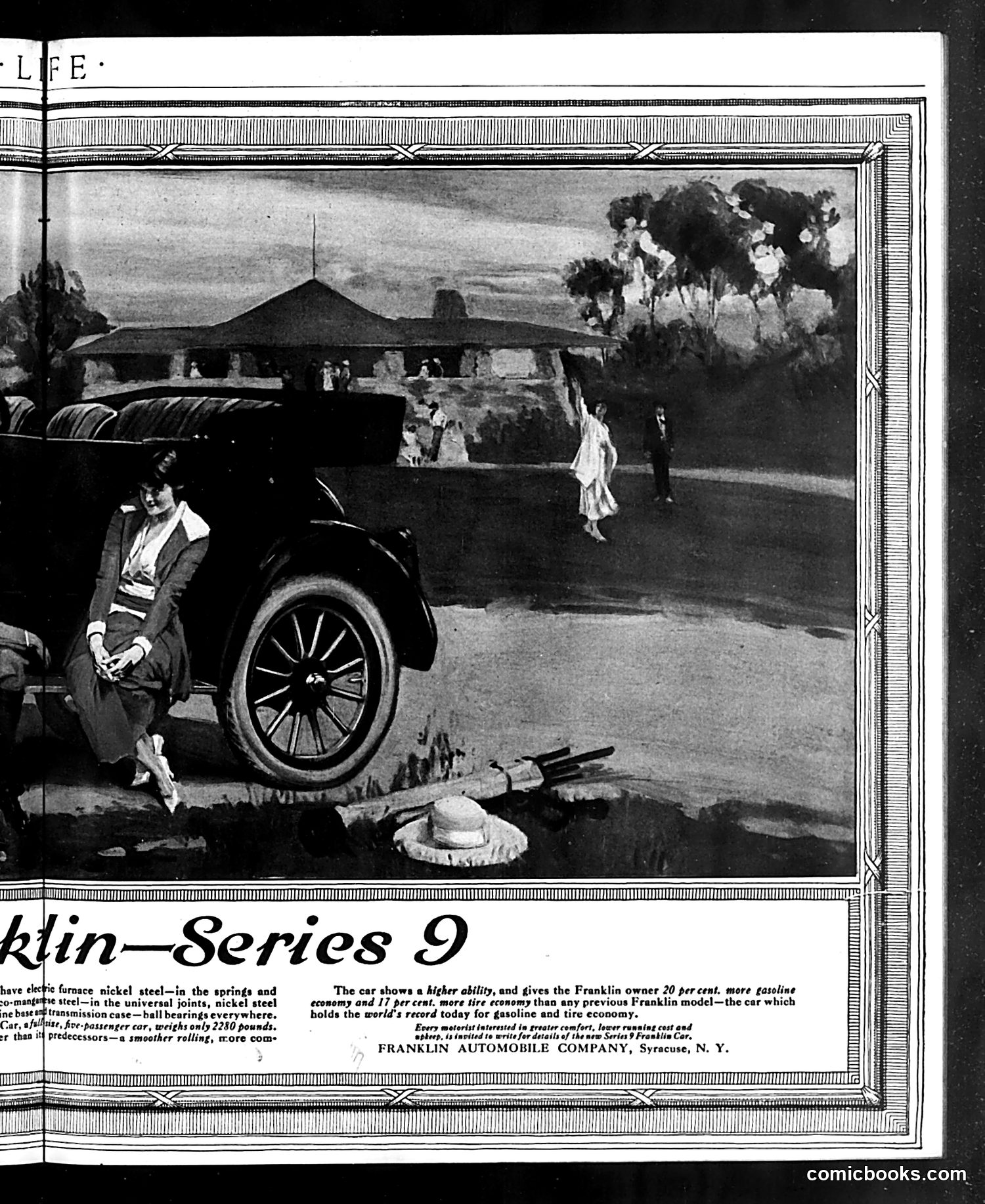
This is an advertisement for Franklin automobiles, not political satire. The image shows a 1920s-era Franklin car with well-dressed passengers at what appears to be an upscale venue or resort (note the building with columned structure in background). The "satire" is commercial rather than political: the ad uses aspirational lifestyle imagery to sell the Franklin's technical superiority. The text emphasizes engineering achievements—20% better gasoline economy, 17% better tire economy, lightweight construction (2,280 pounds), and a world record for fuel/tire efficiency. The visual message: owning a Franklin associates you with affluence, leisure, and modern comfort. The technical claims suggest this efficiency translates to lower operating costs—a practical selling point for the wealthy buyers depicted. This represents typical 1920s automotive advertising strategy: combine engineering boasts with status-signaling imagery.
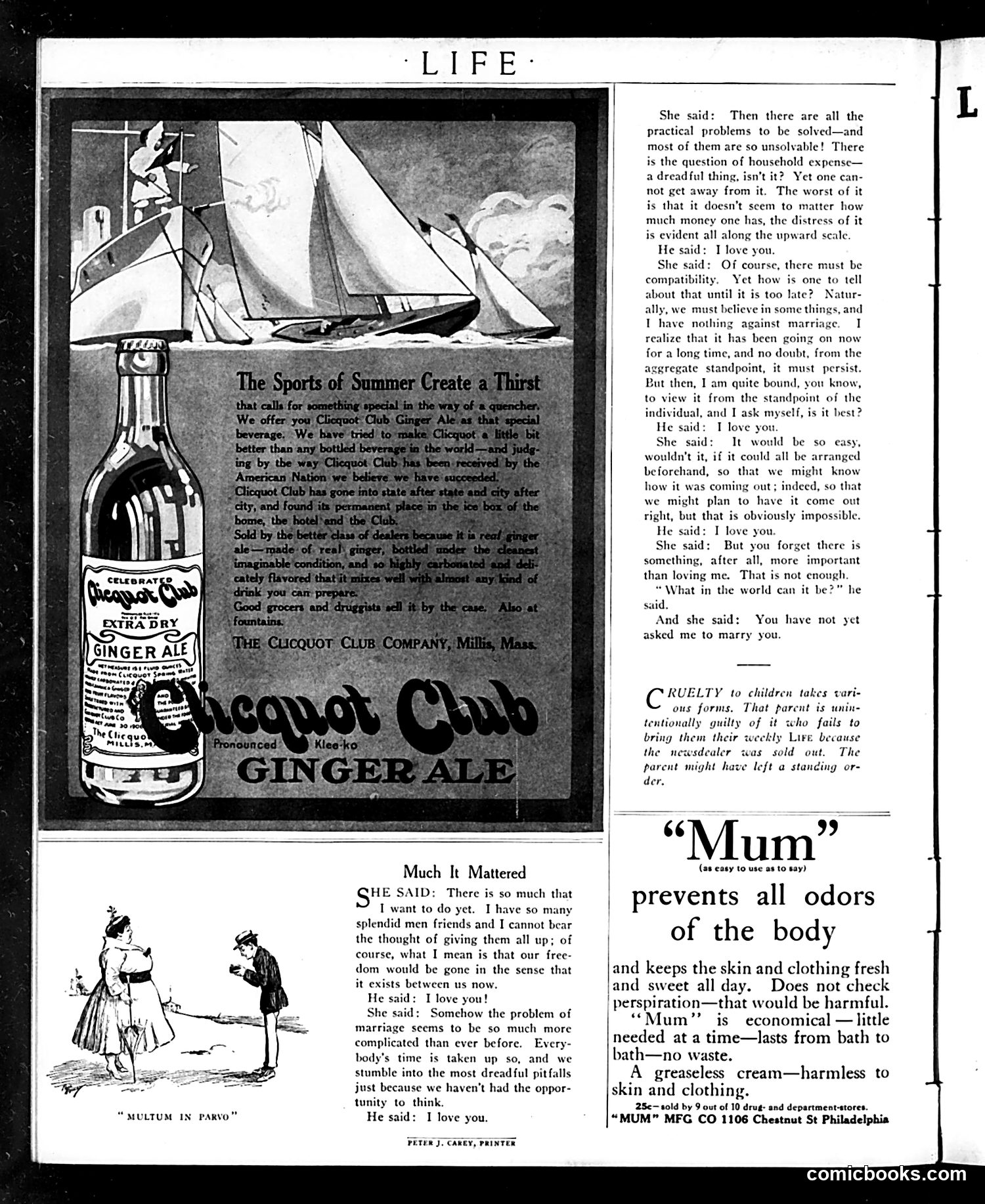
This cartoon satirizes modern women's hesitation about marriage through a repeated dialogue between a man and woman. He earnestly declares "I love you" multiple times, but she responds with increasingly elaborate objections: loss of freedom, practical problems (household expenses), compatibility concerns, and the inability to plan outcomes. The satire targets the "New Woman" of the early 20th century—educated, independent, concerned with rational decision-making rather than romantic impulse. She intellectualizes marriage into paralysis, raising legitimate concerns (financial strain, individual autonomy) that sound reasonable until his final exasperated question reveals the absurdity: she's discussed everything *except* actually accepting his proposal. The title "Multum in Parvo" (much in little) suggests volumes of modern complications mask a simple romantic situation. The joke lands on contemporary gender anxiety—women's increased autonomy creating new dating complications—while gently mocking her overthinking. The page also contains period advertising (Clicquot Club ginger ale, "Mum" deodorant), typical for Life magazine's format.