
Life, 1916-08-10 · page 17 of 38
Life — August 10, 1916 — page 17: what you’re looking at
What you’re looking at
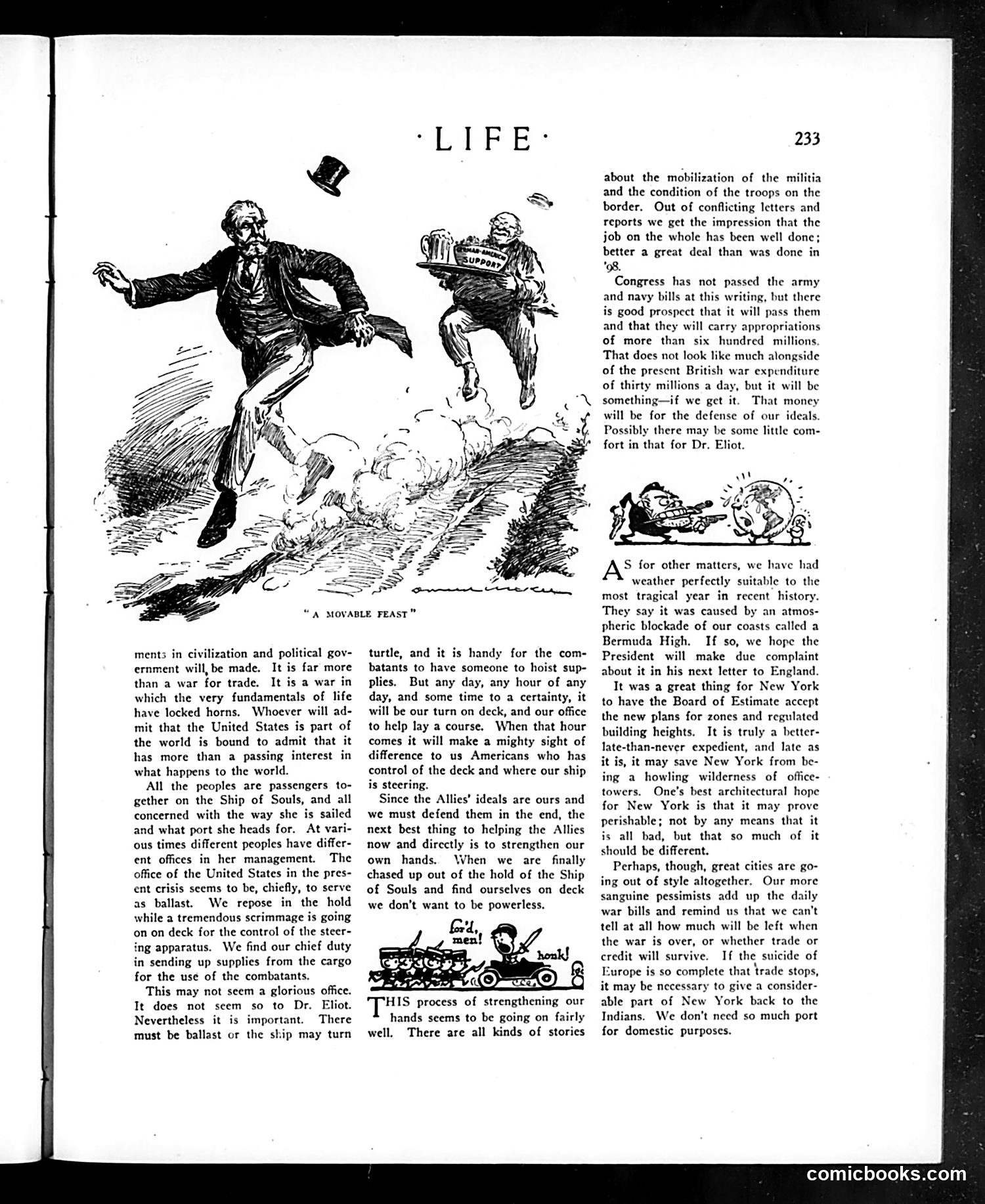
The main cartoon, titled "A Movable Feast," depicts two figures fleeing from an explosion—likely representing America and an Allied figure escaping conflict. The accompanying text uses a metaphor of the "Ship of Souls" to describe America's role in World War I. **Context:** This appears to be from around 1916, when America was still officially neutral but supplying the Allies. The satire critiques Dr. Eliot (likely Charles W. Eliot, Harvard president and peace advocate) for opposing military preparedness. **The argument:** The author contends America should strengthen its military capacity, using the ship metaphor—currently America serves as "ballast" below deck, supplying provisions, but will eventually be forced "on deck" to fight. Therefore, Americans should prepare now rather than remain powerless when directly involved. The piece argues that military spending isn't glorious but necessary, and that defending "the Allies' ideals" ultimately means defending American ideals. The satire mocks pacifist reluctance to prepare for inevitable military engagement.
📄 Transcribed text from this page (OCR, searchable)
Machine-transcribed from the original scan — historical spelling and the odd misread are preserved.
“\ MOVABLE FEAST” ments in civilization and political gov- ernment will, be made. It is far more than a war for trade. It is a war in which the very fundamentals of life have locked horns. Whoever will ad- mit that the United States is part of the world is bound to admit that it has more than a passing interest in what happens to the world. All the peoples are passengers to- gether on the Ship of Souls, and all concerned with the way she is sailed and what port she heads for. At vari- ous times different peoples have differ- ent offices in her management. The office of the United States in the pres- ent crisis seems to be, chiefly, to serve as ballast. We repose in the hold while a tremendous scrimmage is going on on deck for the control of the steer- ing apparatus. We find our chief duty in sending up supplies from the cargo for the use of the combatants. This may not seem a glorious office. It does not seem so to Dr. Eliot. Nevertheless it is important. There must be ballast or the ship may turn turtle, and it is handy for the com- batants to have someone to hoist sup- plies. But any day, any hour of any day, and some time to a certainty, it will be our turn on deck, and our office to help lay a course, When that hour comes it will make a mighty sight of difference to us Americans who has control of the deck and where our ship is steering. Since the Allies’ ideals are ours and we must defend them in the end, the next best thing to helping the Allies now and directly is to strengthen our own hands. When we are finally chased up out of the hold of the Ship of Souls and find ourselves on deck we don’t want to be powerless. HIS process of strengthening our hands seems to be going on fairly well. There are all kinds of stories 233 about the mobilization of the militia and the condition of the troops on the border. Out of conflicting letters and reports we get the impression that the job on the whole has been well done; better a great deal than was done in Congress has not passed the army and navy bills at this writing, but there is good prospect that it will pass them and that they will carry appropriations of more than six hundred millions. That does not look like much alongside of the present British war expenditure of thirty millions a day, but it will be something—if we get it. That money will be for the defense of our ideals. Possibly there may be some little com- fort in that for Dr. Eliot. S for other matters, we have had weather perfectly suitable to the most tragical year in recent history. They say it was caused by an atmos- pheric blockade of our coasts called a Bermuda High. If so, we hope the President will make due complaint about it in his next letter to England. It was a great thing for New York to have the Board of Estimate accept the new plans for zones and regulated building heights. It is truly a better- late-than-never expedient, and late as it is, it may save New York from be- ing a howling wilderness of office- towers. One's best architectural hope for New York is that it may prove perishable; not by any means that it is all bad, but that so much of it should be different. Perhaps, though, great cities are go- ing out of style altogether. Our more sanguine pessimists add up the daily war bills and remind us that we can't tell at all how much will be left when the war is over, or whether trade or credit will survive. If the suicide of Europe is so complete that trade stops, it may be necessary to give a consider- able part of New York back to the Indians. We don't need so much port for domestic purposes. comicbooks.com