
Life, 1916-08-10 · page 16 of 38
Life — August 10, 1916 — page 16: what you’re looking at
What you’re looking at
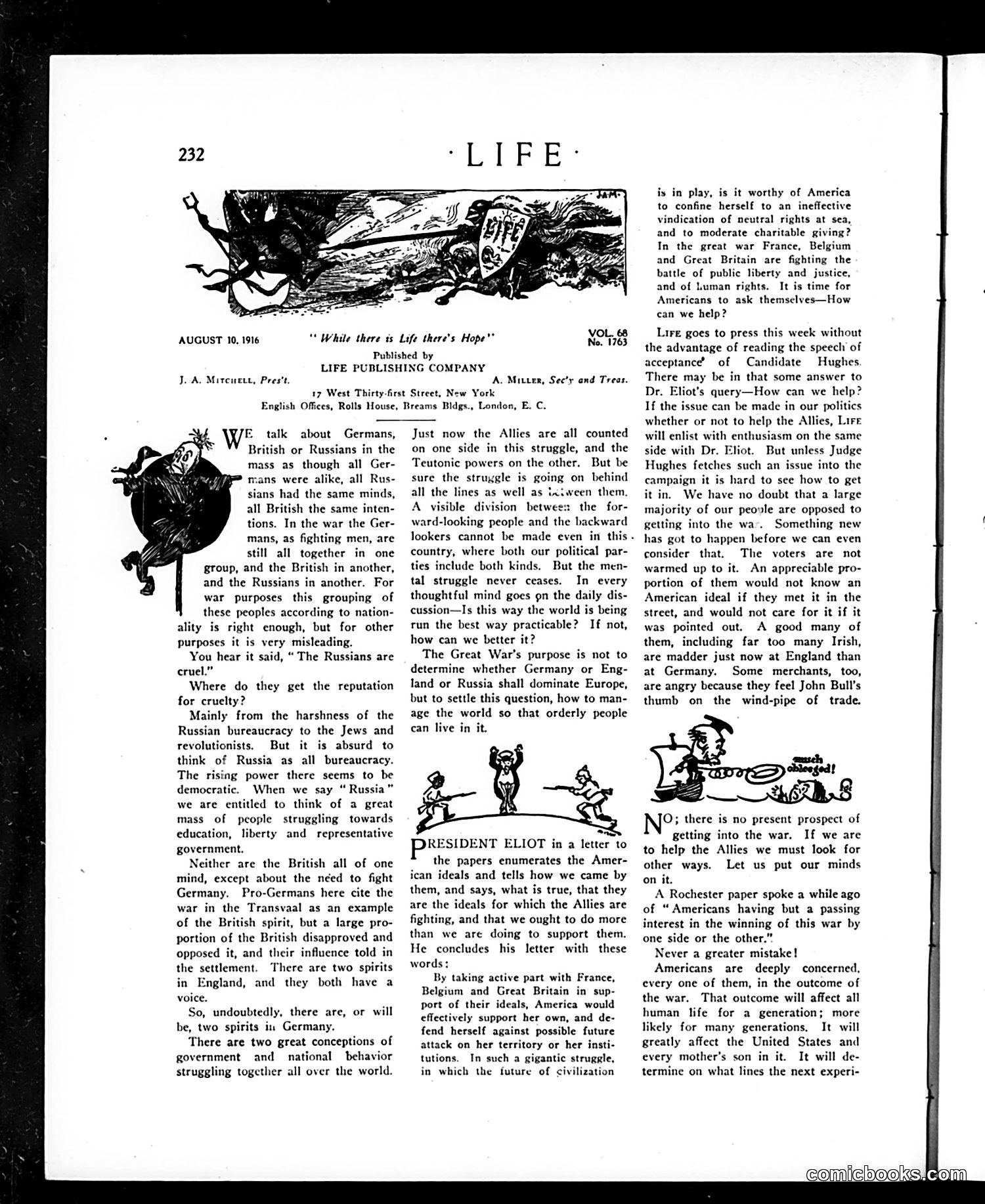
This editorial page argues against stereotyping entire nations during WWI. The writer contends that characterizing all Germans, Russians, or British as identical is misleading—each nation contains both progressive and backward-looking people. The "two great conceptions of government" span across borders, not align perfectly with them. The page quotes President Charles W. Eliot urging America to actively support the Allies (France, Belgium, Britain) rather than maintaining ineffective neutrality, as their fight represents universal ideals of liberty and justice America shares. The editorial suggests Presidential Candidate Hughes's acceptance speech might address whether America should enter the war—a major 1916 political question. This reflects the pre-U.S. entry debate when American involvement remained contested.
📄 Transcribed text from this page (OCR, searchable)
Machine-transcribed from the original scan — historical spelling and the odd misread are preserved.
AUGUST 10, 1916 “* While there ts Life there's Hope"’ Published by LIFE PUBLISHING COMPANY J. A. Mircuett, Pres’t. A. Miter, Sec’y and Treas. 17 West Thirty-first Street, New York English Offices, Rolls House, Rreams Bldgs., London, E. C. E talk about Germans, British or Russians in the mass as though all Ger- mans were alike, all Rus- sians had the same minds, all British the same inten- tions. In the war the Ger- mans, as fighting men, are still all together in one group, and the British in another, and the Russians in another. For war purposes this grouping of these peoples according to nation- ality is right enough, but for other purposes it is very misleading. You hear it said, “ The Russians are cruel.” Where do they get the reputation for cruelty? Mainly from the harshness of the Russian bureaucracy to the Jews and revolutionists. But it is absurd to think of Russia as all bureaucracy. The ng power there seems to be democratic. When we say “Russia” we are entitled to think of a great mass of people struggling towards education, liberty and representative government. ther are the British all of one mind, except about the need to fight Germany. Pro-Germans here cite the war in the Transvaal as an example of the British spirit, but a large pro- portion of the British disapproved and opposed it, and their influence told in the settlement. There are two spirits in England, and they both have a voice. So, undoubtedly, there are, or will be, two spirits in Germany. There are two great conceptions of government and national behavior struggling together all over the world. Just now the Allies are all counted on one side in this struggle, and the Teutonic powers on the other, But be sure the struggle is going on behind all the lines as well as ixiween them. A. visible division betw the for- ward-looking people and the backward lookers cannot be made even in this - country, where both our political par- ties include both kinds, But the men- tal struggle never ceases. In every thoughtful mind goes gn the daily dis- cussion—Is this way the world is being run the best way practicable? If not, how can we better it? The Great War's purpose is not to determine whether Germany or Eng- land or Russia shall dominate Europe, but to settle this question, how to man- age the world so that orderly people can live in it. IDENT ELIOT in a letter to the papers enumerates the Amer- ican ideals and tells how we came by them, and says, what is true, that they are the ideals for which the Allies are fighting, and that we ought to do more than we are doing to support them. He concludes his letter with these words: By taking active part with France, Belgium and Great Britain in sup- port of their ideals, America would effectively support her own, and de- fend herself against possible future attack on her territory or her insti- tutions. In such a gigantic struggle, in which the future of civilization is in play, is it worthy of America to confine herself to an ineffective vindication of neutral rights at sea, and to moderate charitable giving? In the great war France, Belgium and Great Britain are fighting the battle of public liberty and justice, and of Luman rights. It is time for Americans to ask themselves—How can we help? Lire goes to press this week without the advantage of reading the speech of acceptance’ of Candidate Hughes. There may be in that some answer to Dr. Eliot's query—How can we help? If the issue can be made in our politics whether or not to help the Allies, Lire will enlist with enthusiasm on the same side with Dr. Eliot. But unless Judge Hughes fetches such an issue into the campaign it is hard to see how to get it in. We have no doubt that a large majority of our peovle are opposed to getting into the wa. Something new has got to happen before we can even consider that. The voters are not warmed up to it. An appreciable pro- portion of them would not know an American ideal if they met it in the street, and would not care for it if it was pointed out. A good many of them, including far too many Irish, are madder just now at England than at Germany. Some merchants, too, are angry because they feel John Bull's thumb on the wind-pipe of trade. Segeat — 'O; there is no present prospect of getting into the war. If we are to help the Allies we must look for other ways. Let us put our minds on it. A Rochester paper spoke a while ago of “Americans having but a passing interest in the winning of this war by one side or the other.” Never a greater mistake! Americans are deeply concerned, every one of them, in the outcome of the war. That outcome will affect all human life for a generation; more likely for many generations, It will greatly affect the United States and every mother’s son in it. It will de- termine on what lines the next experi-