
A complete issue · 45 pages · 1915
Life — June 24, 1915
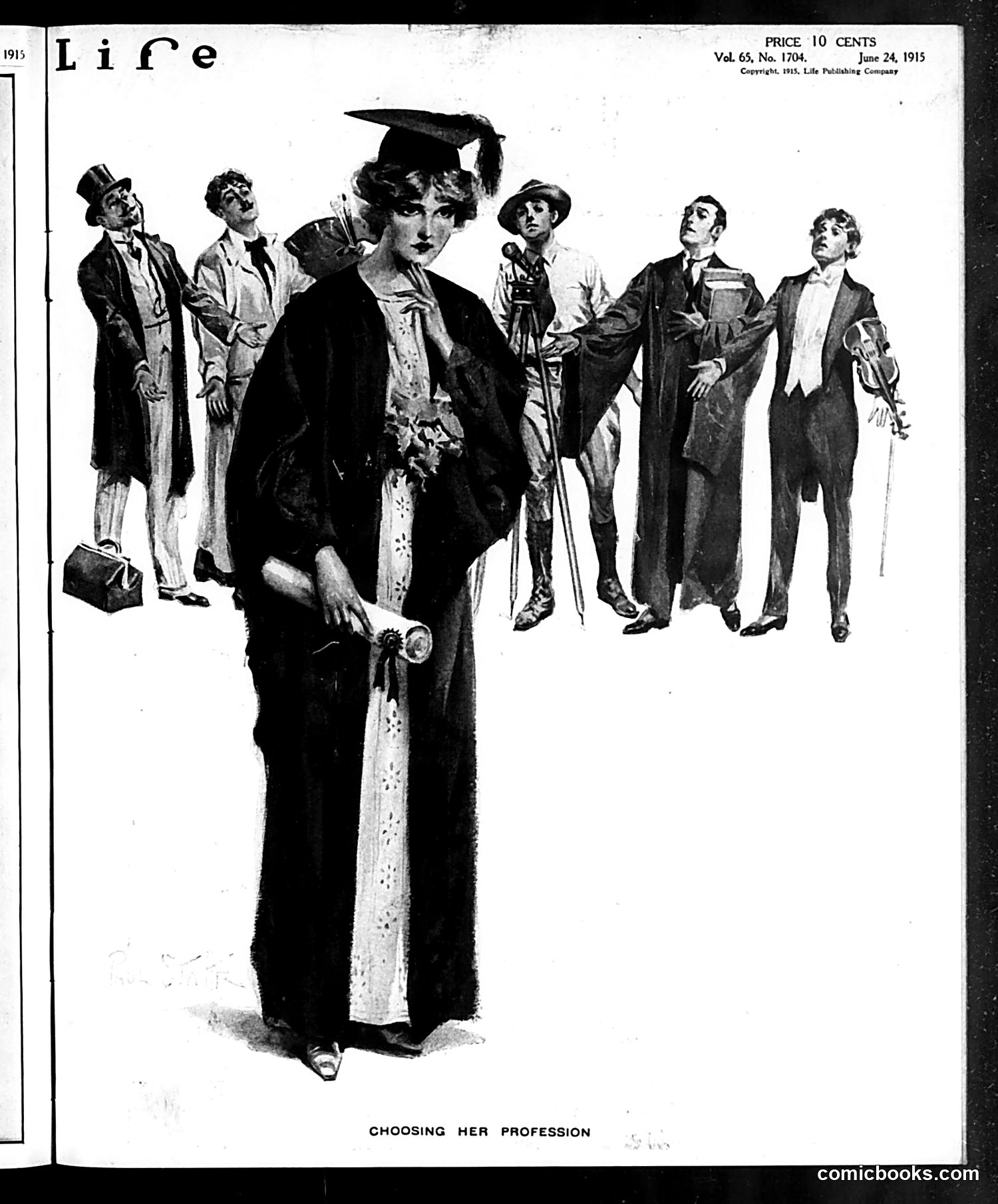
This 1915 *Life* magazine cover satirizes women's expanding career options during the Progressive Era. A stylishly dressed woman in the foreground—wearing a mortarboard cap and holding what appears to be professional implements—stands before six men representing different professions: lawyers, doctors, businessmen, and other white-collar occupations. The satire addresses anxieties about women entering traditionally male-dominated fields. The caption "Choosing Her Profession" treats female career ambition as novel and somewhat comedic. The men's expressions suggest surprise or skepticism at a woman's professional aspirations. This reflects early-20th-century social tension over women's education and workplace participation, before women gained voting rights (1920) or widespread professional acceptance.
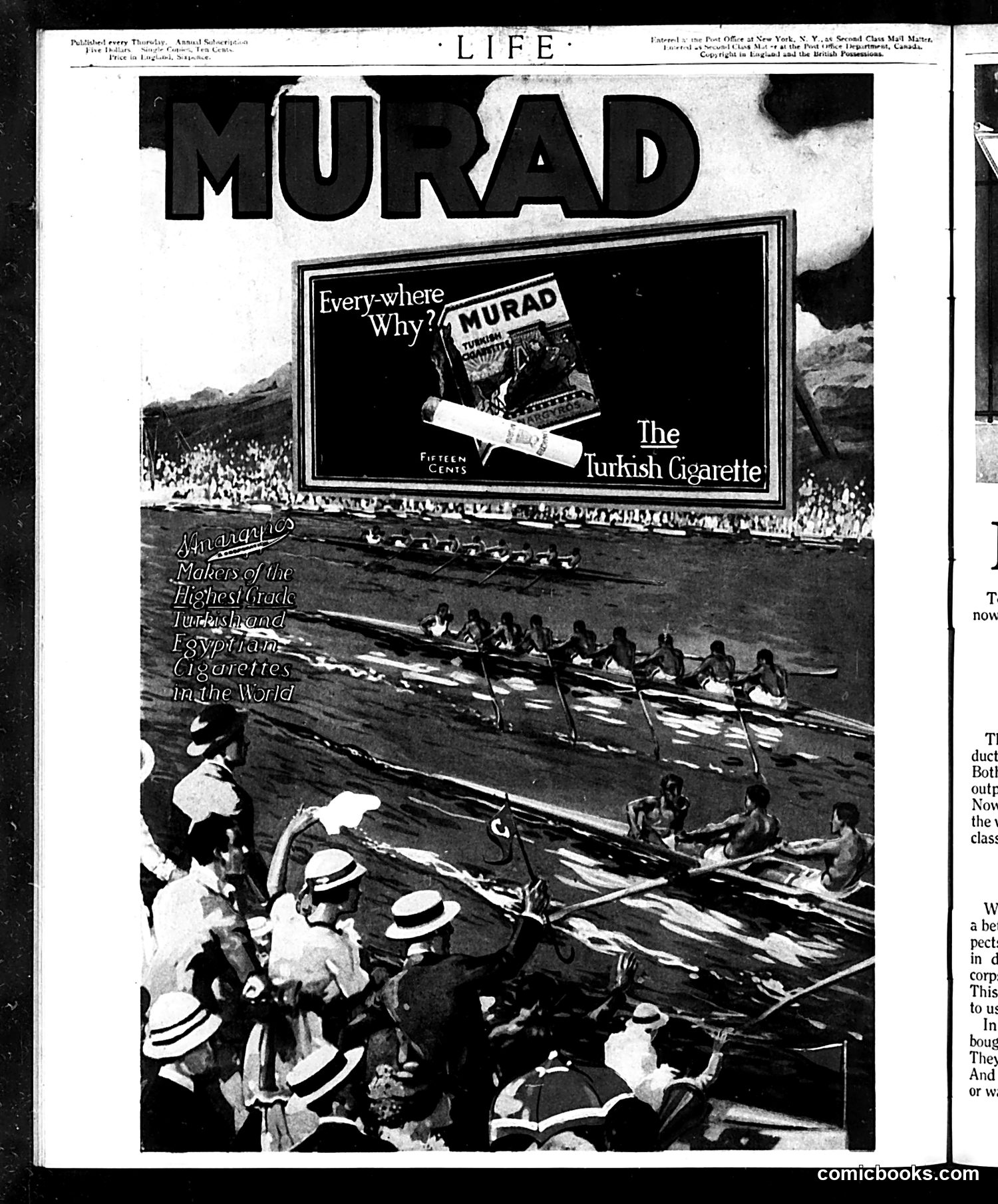
This is primarily a **cigarette advertisement**, not political satire. It features Murad Turkish cigarettes prominently displayed on a large billboard overlooking what appears to be a rowing or sporting event with spectators and rowers below. The ad's tagline reads "Every-where Why?" positioning Murad as "The Turkish Cigarette" priced at fifteen cents. The left margin notes Murad as "Makers of the Highest Grade Turkish and Egyptian Cigarettes in the World." The composition uses the sporting crowd scene to suggest Murad's widespread popularity and social prestige. This represents early 20th-century cigarette marketing, which often associated products with leisure, sophistication, and aspirational lifestyle imagery rather than making specific political commentary.
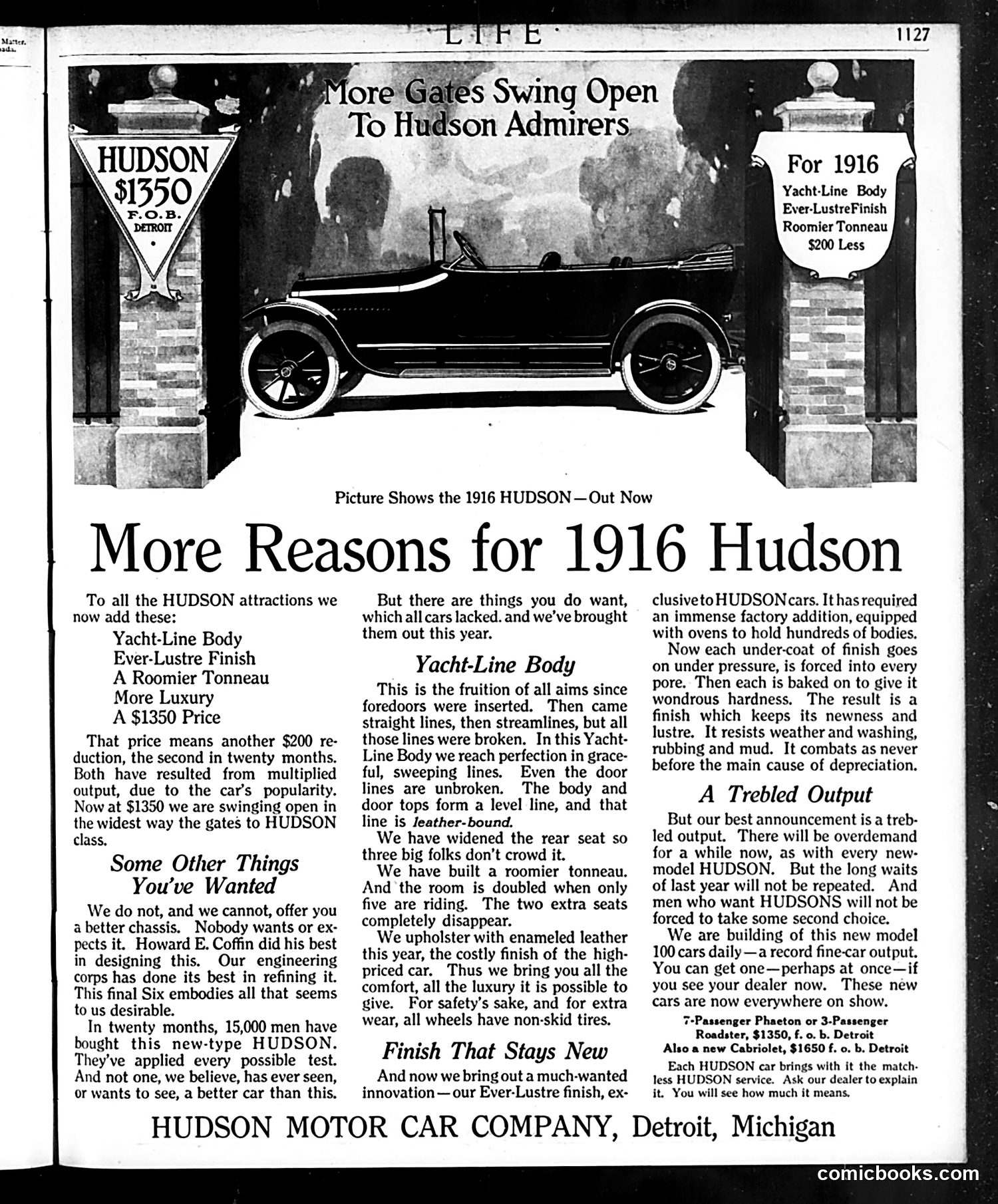
This is **not satirical content**—it's a straightforward automobile advertisement for the 1916 Hudson Motor Car, taking up the entire page. The ad emphasizes new features added to Hudson's 1916 model: a "Yacht-Line Body," improved finish, roomier seating, and non-skid tires. The headline "More Gates Swing Open To Hudson Admirers" uses architectural imagery (gates flanking the car) to suggest expanding popularity. Key selling points include the $1,350 price (with a $200 reduction mentioned), claims of superior craftsmanship, and production capacity ("100 cars daily"). The ad targets affluent buyers seeking luxury automobiles, positioning Hudson as combining innovation with desirability. This represents early-twentieth-century automotive marketing in a prominent magazine.
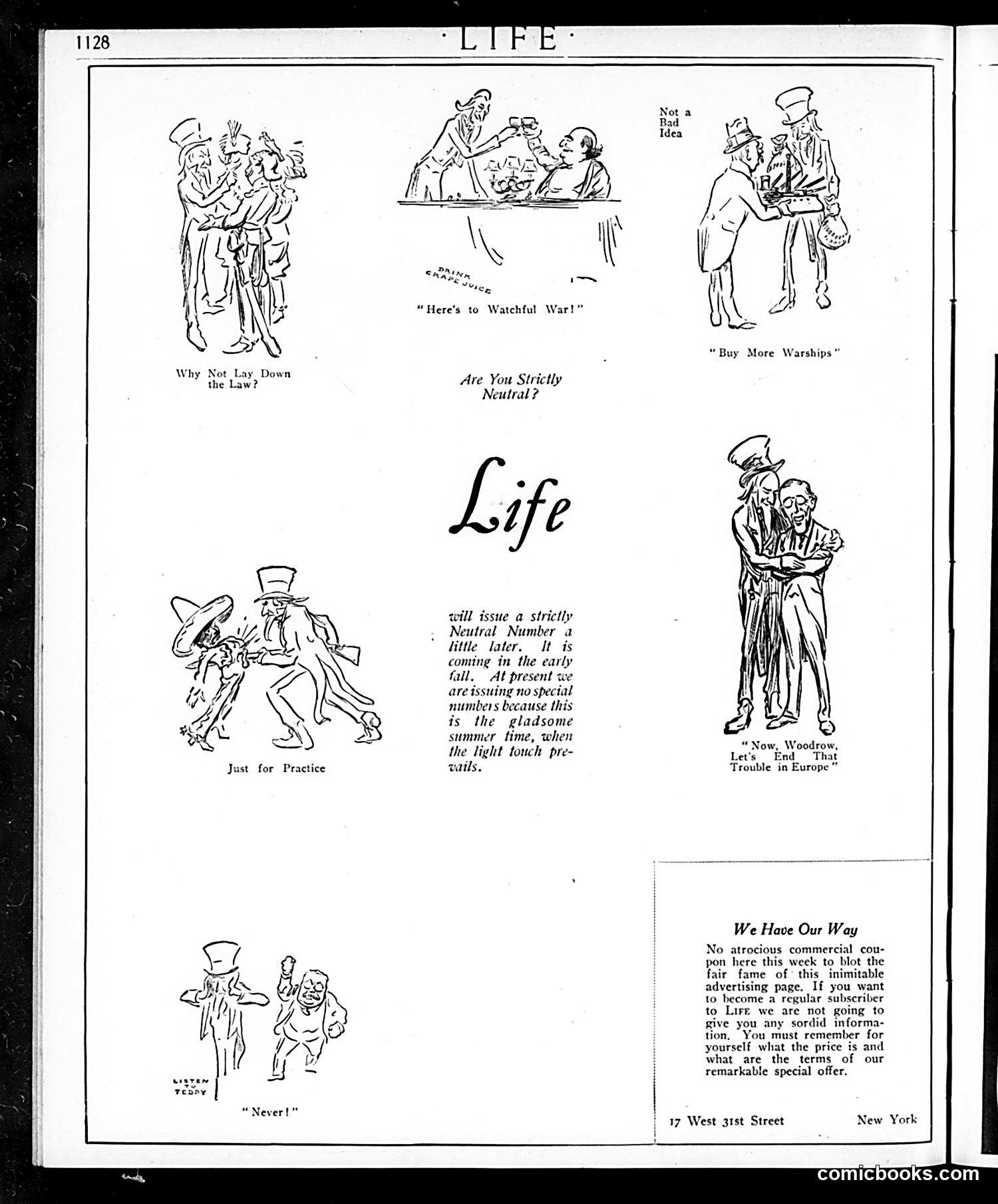
This page contains six political cartoons satirizing World War I-era American politics and neutrality debates, circa 1914-1917. **Key cartoons:** - "Why Not Lay Down the Law?" mocks pacifists or isolationists resisting military preparedness - "Here's to Watchful War!" appears to criticize President Wilson's cautious approach to the conflict - "Are You Strictly Neutral?" questions American neutrality claims while European war rages - "Buy More Warships" advocates military expansion - "Now, Woodrow, Let's End That Trouble in Europe" likely references Wilson's peace efforts - "Never!" shows resistance to intervention The central text notes Life will issue a "strictly Neutral Number" soon, sarcastically referencing summer leisure while suggesting America cannot remain truly neutral during the global conflict. The cartoons collectively mock both pacifism and false neutrality claims during America's pre-entry period.

This is **not a cartoon or satire page** — it's a straightforward **advertisement for Fisk Rubber Company tires**, published in Life magazine. The ad promotes Fisk's "Non-Skid" tires, emphasizing three selling points: safety, service, and satisfaction. The large illustration shows a Fisk tire with prominent tread pattern. Below are specific tire sizes and prices (ranging from $12.20 to $33.90), positioning Fisk as competitively priced against competitors' plain tread tires. The ad promises that Fisk tires help "cut down tire expense" for all car owners. The company operated from Chicopee Falls, Massachusetts, with branches in major cities. This represents early automotive advertising focused on tire safety features — a genuine concern during the motor vehicle boom of the 1920s.
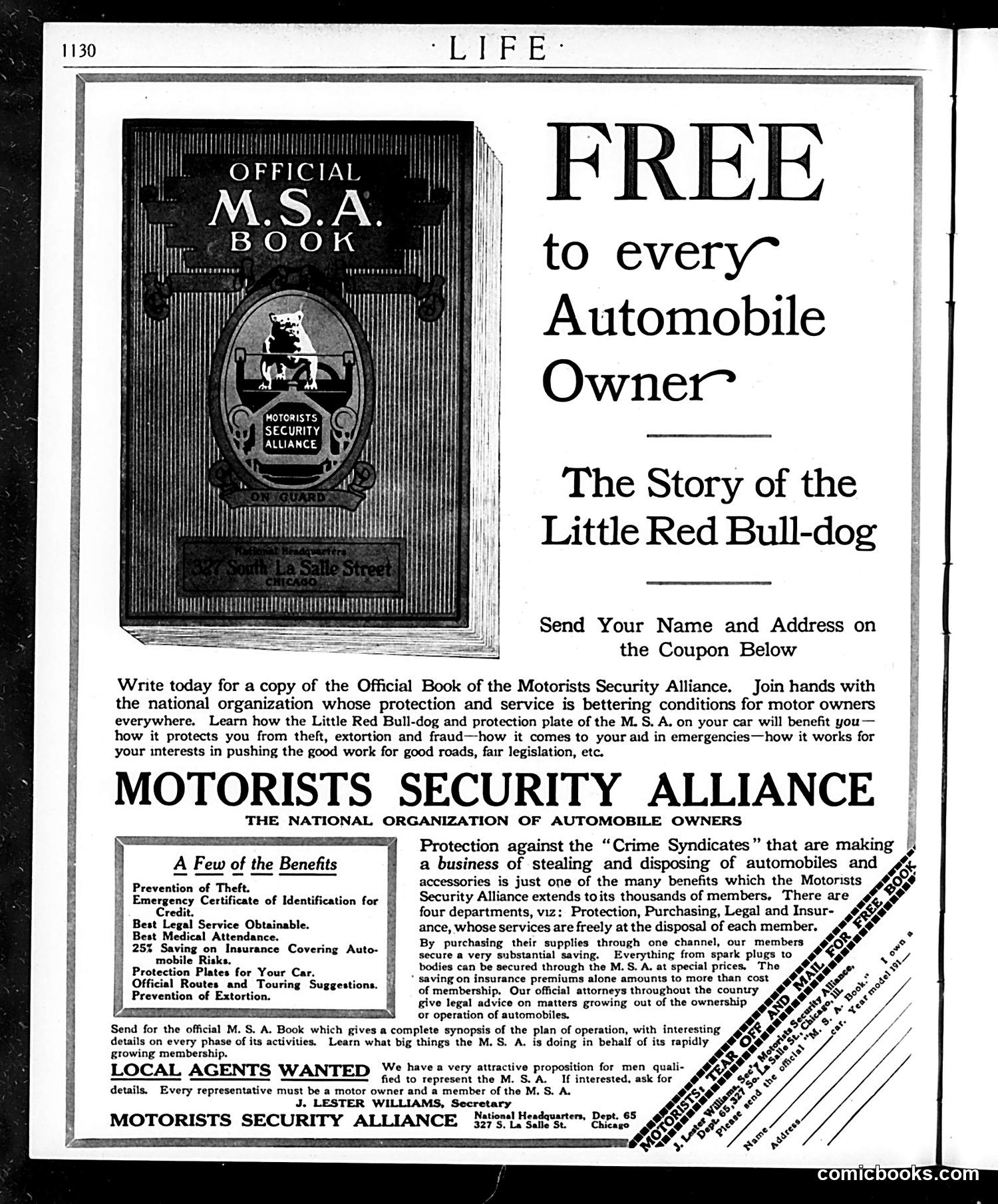
This page is primarily **advertising**, not satire or political commentary. It promotes the Motorists Security Alliance (M.S.A.), a national automobile owners' organization operating from Chicago. The ad offers a free official M.S.A. handbook to car owners, featuring "The Story of the Little Red Bull-dog" (the organization's mascot). The page lists membership benefits including theft prevention, legal services, insurance advocacy, and protection against "Crime Syndicates" engaged in auto theft and accessory theft. The M.S.A. actively recruited local agents and offered various member services. While the language references organized crime concerns of the era, this is straightforward commercial promotion rather than satirical commentary.
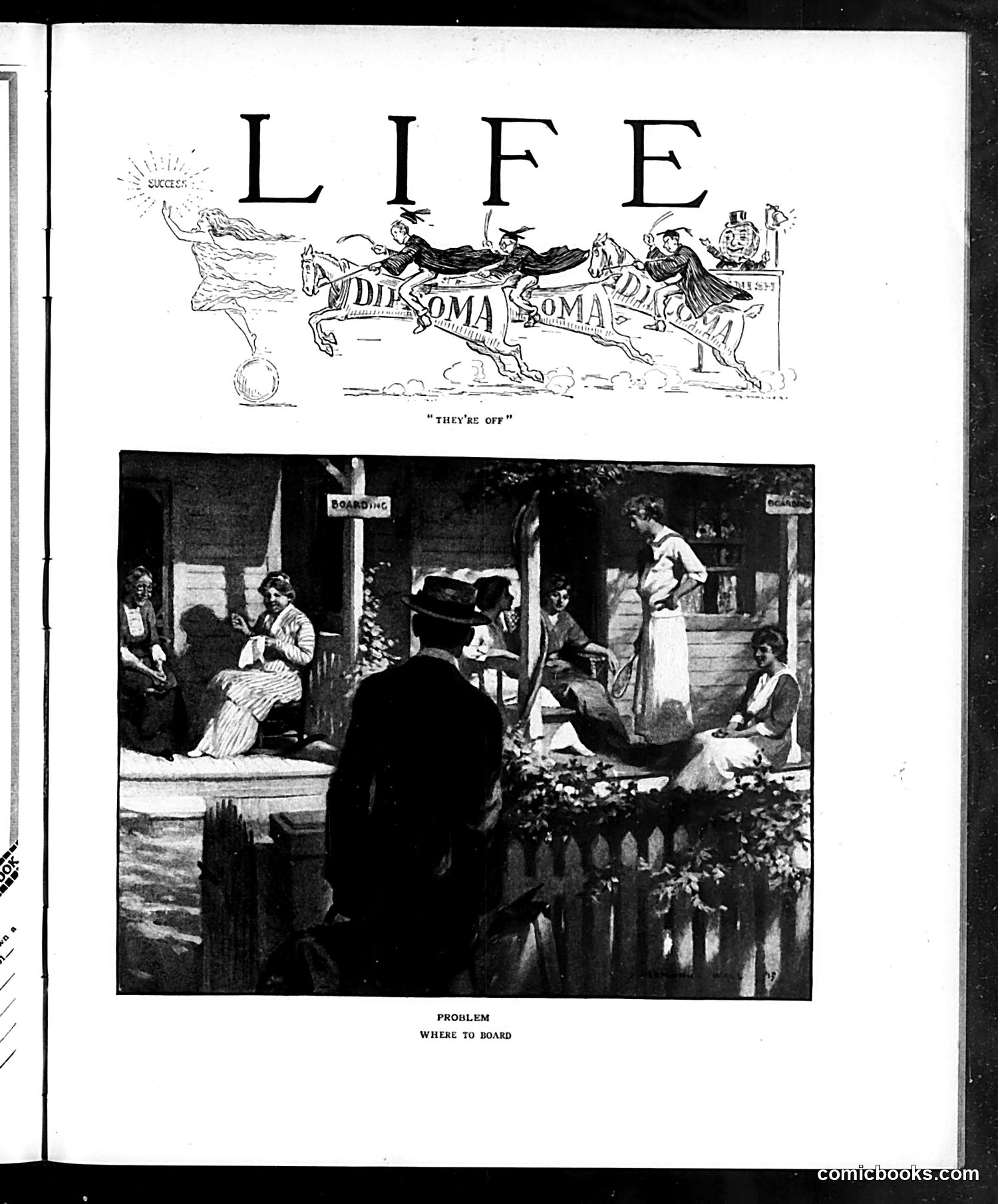
This page presents two pieces about boarding/lodging: **Top illustration** ("They're Off"): A satirical cartoon depicting the journey of life as a horse race, with figures riding horses labeled "DIPLOMA" racing forward while others chase behind. The rising sun and dramatic composition suggest life's competitive journey. **Bottom photograph** ("Problem: Where to Board"): A realistic scene showing a prospective boarder (man in dark coat, back to camera) observing a boarding house. Multiple residents are visible in windows and on the porch—suggesting the challenge of evaluating lodging quality. The image captures the practical difficulty of finding suitable accommodation, a common concern for unmarried men and travelers in early 20th-century America. Together, these pieces likely satirize life's transitions and the mundane housing challenges adults face.
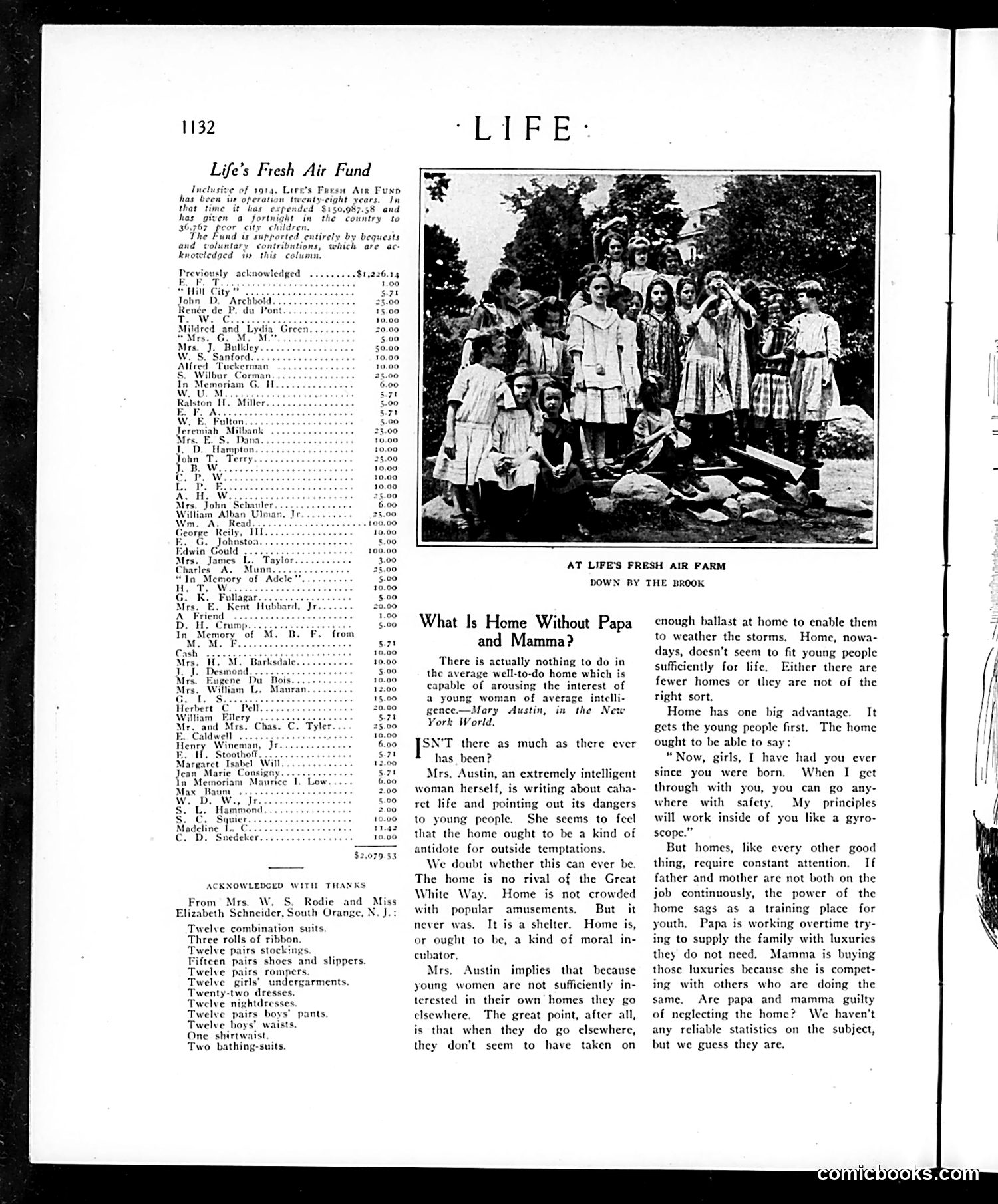
This page documents **Life's Fresh Air Fund**, a charitable initiative that provided rural retreats for poor city children. The photograph shows a large group of children at "Life's Fresh Air Farm" by a brook. The accompanying article, "What Is Home Without Papa and Mamma?" by Mrs. Austin (identified as an "extremely intelligent woman"), argues that homes need parental presence and supervision. She criticizes young women insufficiently invested in homemaking, warning that without proper home life, youth seek entertainment elsewhere—implying moral danger. The piece advocates for parental responsibility as moral/social duty, reflecting early 20th-century concerns about family stability, youth welfare, and women's domestic roles. The fund itself represented Progressive Era philanthropic efforts to improve children's health and morality.
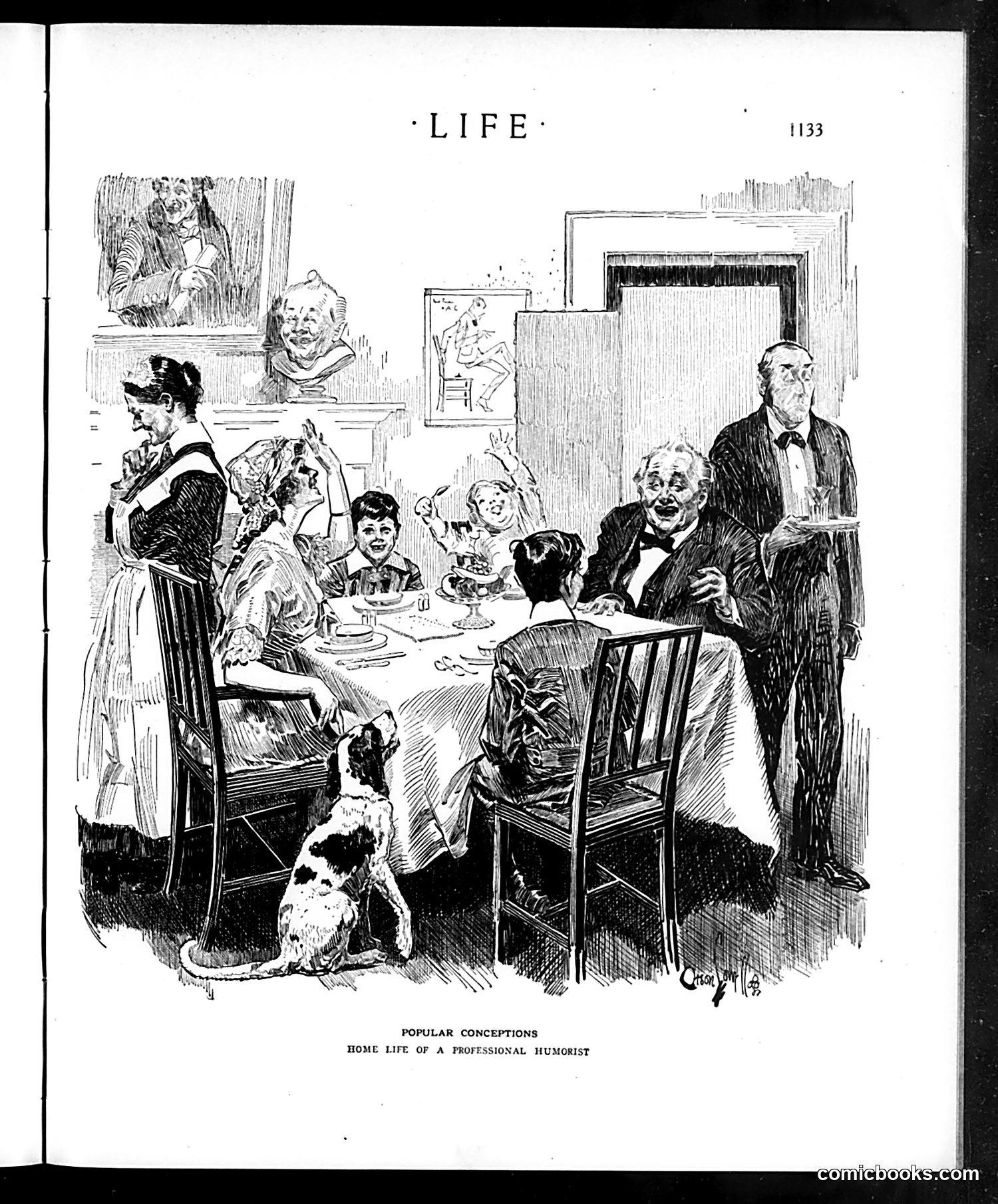
This satirical illustration titled "Popular Conceptions: Home Life of a Professional Humorist" mocks stereotypical expectations about how comedians live privately. The cartoon depicts a dinner scene where a humorist entertains family and guests with animated gestures and laughter—suggesting the popular assumption that professional funny people are *always* "on," constantly performing even in domestic settings. The detailed interior, formal dress, and attentive audience imply society expected humorists to maintain perpetual entertainment value at home. The dog's presence adds to the chaotic, comedic atmosphere. This is satire about public stereotyping: it critiques the notion that someone whose profession is making people laugh cannot simply be a normal person during private family meals.
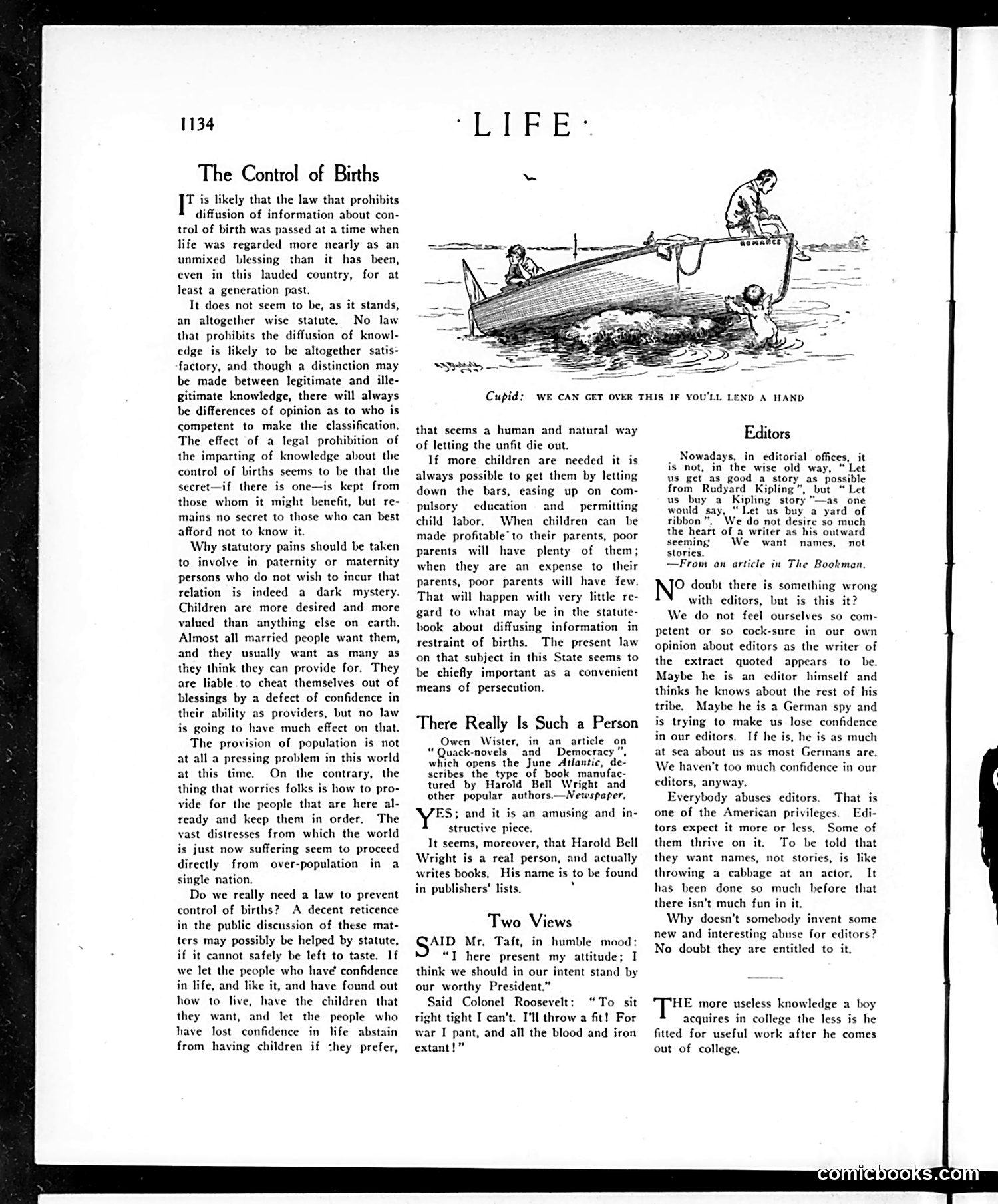
The illustration depicts multiple figures working together to haul a boat or vessel, with the caption "Cupid: We can get over this if you'll lend a hand." This appears to be a satirical commentary on birth control, given the article's title "The Control of Births." Cupid—traditionally associated with love and procreation—is portrayed as needing assistance, suggesting the difficulty or impediment of natural reproduction under restrictive laws. The multiple figures cooperating likely represent society working together to address population concerns. The cartoon satirizes legal prohibitions on birth control information by showing that even romantic/reproductive matters require collective effort to overcome obstacles. This reflects early 20th-century debates over contraception access and information dissemination.
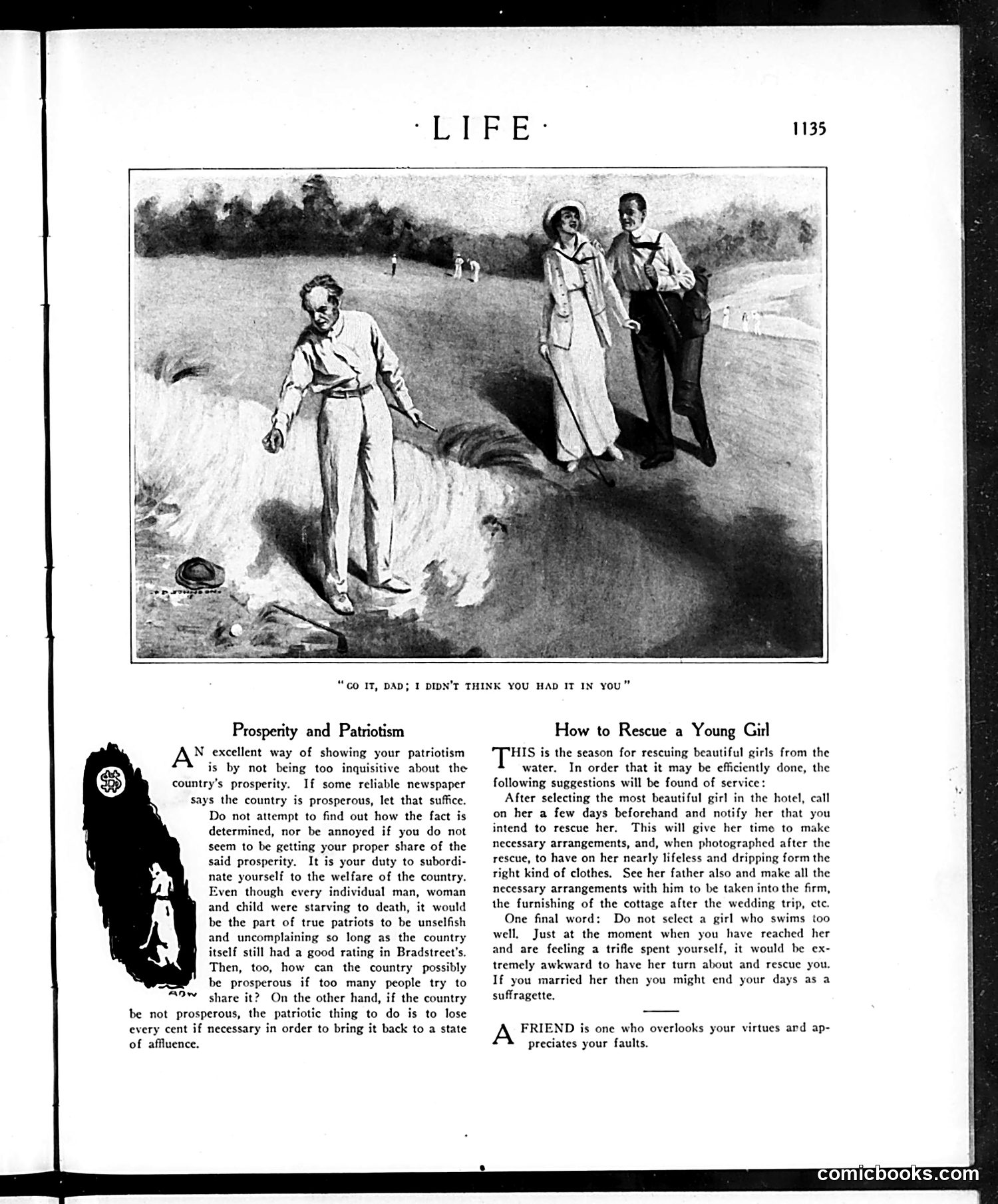
The top cartoon depicts a woman standing in a golf bunker while two well-dressed figures observe from behind. The caption reads: "Go it, Dad; I didn't think you had it in you." The humor appears to satirize gender expectations—the woman is golfing (traditionally a male activity), surprising the onlookers. The "Dad" reference suggests a father figure witnessing his daughter's athleticism. Below are two unrelated advice columns: "Prosperity and Patriotism" argues against hoarding during national hardship, equating selfishness with unpatriotism. "How to Rescue a Young Girl" offers tongue-in-cheek instructions for a dramatic water rescue, culminating in a joke about marriage reducing romance. A brief definition of friendship concludes the page. The content reflects early 20th-century social attitudes toward women's roles, patriotism, and courtship.
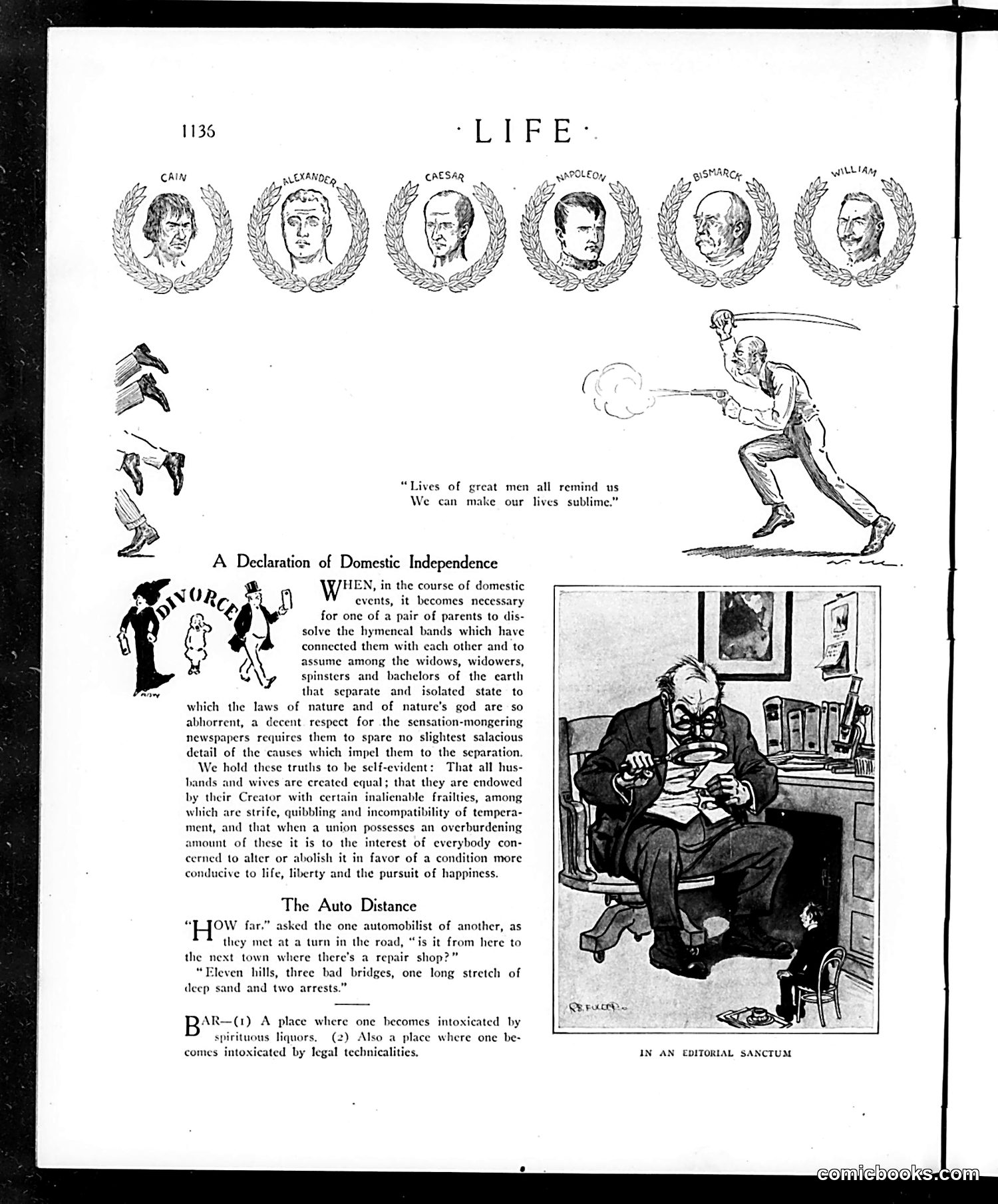
This page satirizes **divorce and marital discord** through multiple angles: **Top section:** Six portrait medallions of famous men (Cain, Alexander, Caesar, Napoleon, Bismarck, William) are juxtaposed with domestic chaos imagery—suggesting even history's greatest figures experienced relationship turmoil. **"Declaration of Domestic Independence":** A mock-serious legal document parodying the U.S. Declaration of Independence, listing marital incompatibilities (strife, quibbling, incompatibility) as grounds for dissolution—treating divorce as a logical, inevitable outcome when marriage fails. **"The Auto Distance":** A brief joke about automobiles and repair shops, likely contrasting domestic repair with mechanical repair as equally challenging. **Bottom illustration:** An angry man confronts a cowering figure—depicting domestic conflict visually. The satire targets early-20th-century marital breakdown while mocking the legal and social pretense surrounding divorce.
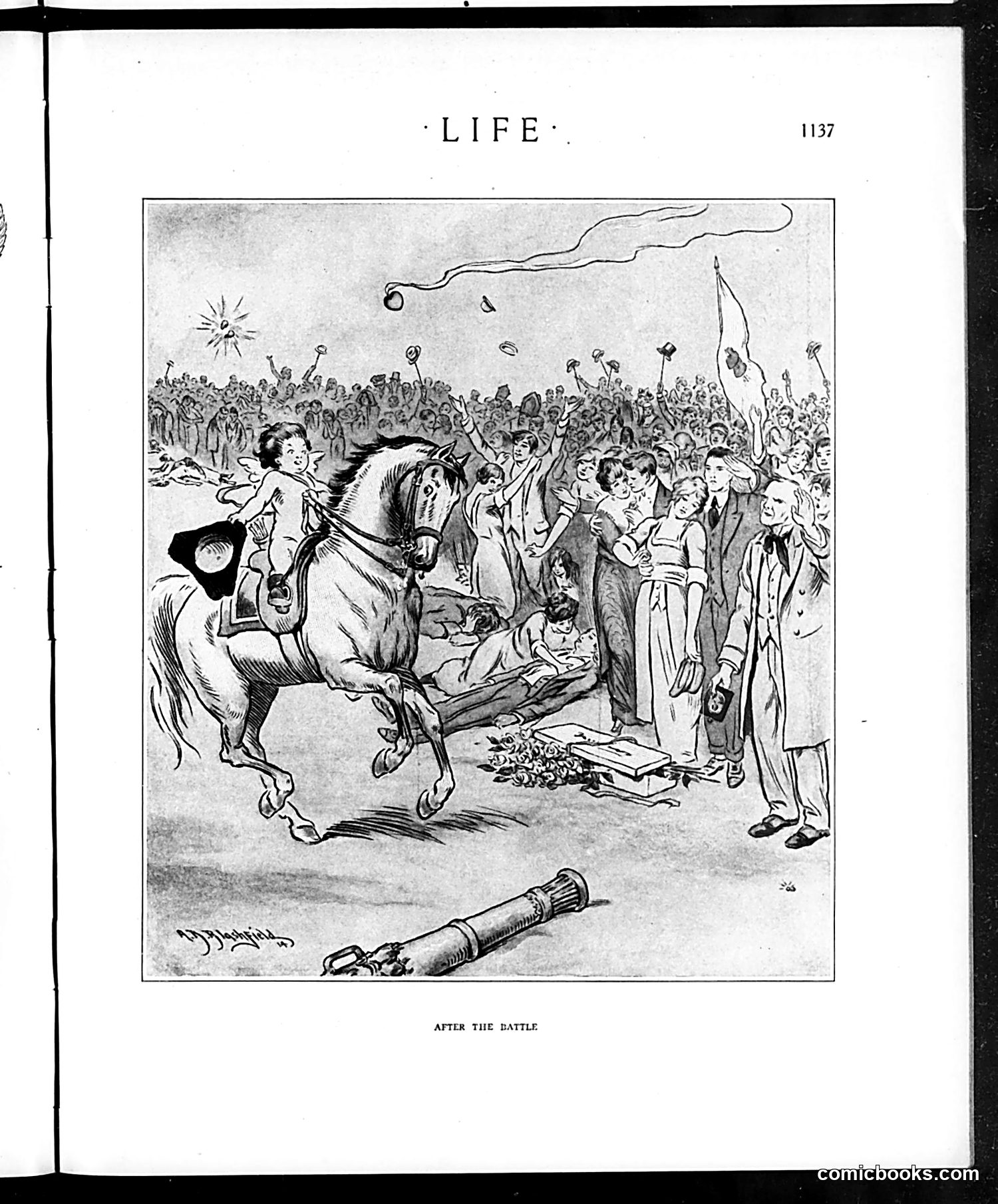
This satirical cartoon depicts a military figure on horseback addressing a large crowd following a battle. The scene shows: **The Setup:** A mounted officer (likely a general or military leader) oversees a scene of destruction—including what appears to be fallen soldiers or casualties on the ground, a cannon in the foreground, and flags in the background suggesting a recent conflict. **The Satire:** The crowded, celebratory gathering suggests officials or politicians are present to claim credit or celebrate victory, while the human cost of war (the dead/wounded) lies literally at their feet. **The Point:** The cartoon satirizes how military and political leaders distance themselves from war's human suffering while accepting public accolades. The contrast between the mounted authority figure and the casualties criticizes the disconnect between those who wage war and those who pay its price.
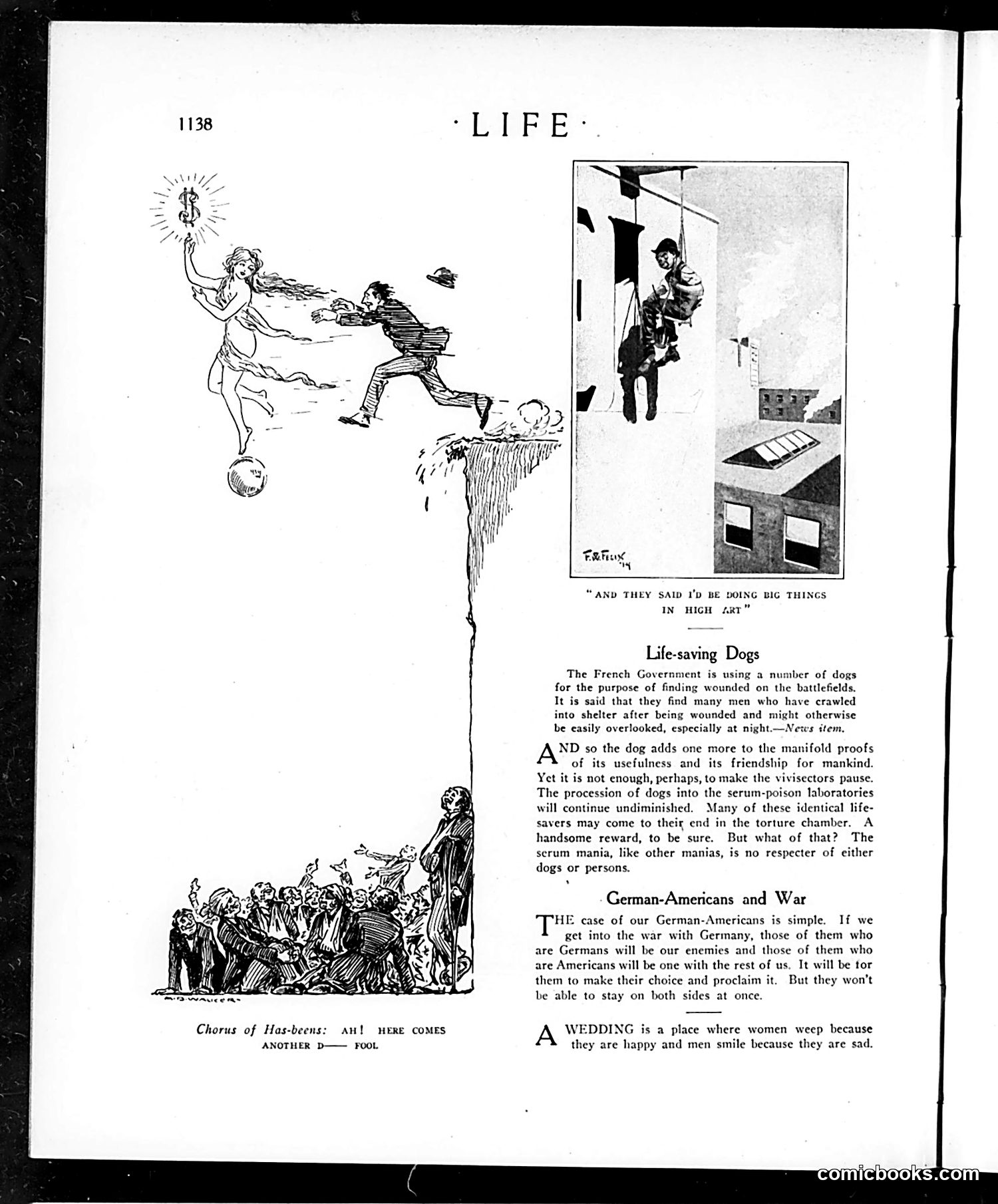
This page combines satirical commentary with editorial pieces from what appears to be WWI-era Life magazine. **Top cartoon**: A man desperately reaches toward a woman representing "success" or "prosperity" (holding a dollar sign), while standing at a cliff's edge. The satire mocks those pursuing wealth recklessly or without regard for consequences. **Bottom left illustration**: Shows a crowd bowing before a tall figure—likely satirizing blind obedience or mob mentality, with the caption "Ah! Here Comes Another D—— Fool." **Right photograph**: A man suspended from a building's exterior, illustrating the article "Life-saving Dogs" about French military dogs finding wounded soldiers. **Articles address**: Dogs' military utility, German-Americans' conflicted loyalties during wartime, and brief observations on weddings. The content reflects WWI anxieties about loyalty, utility, and social divisions.
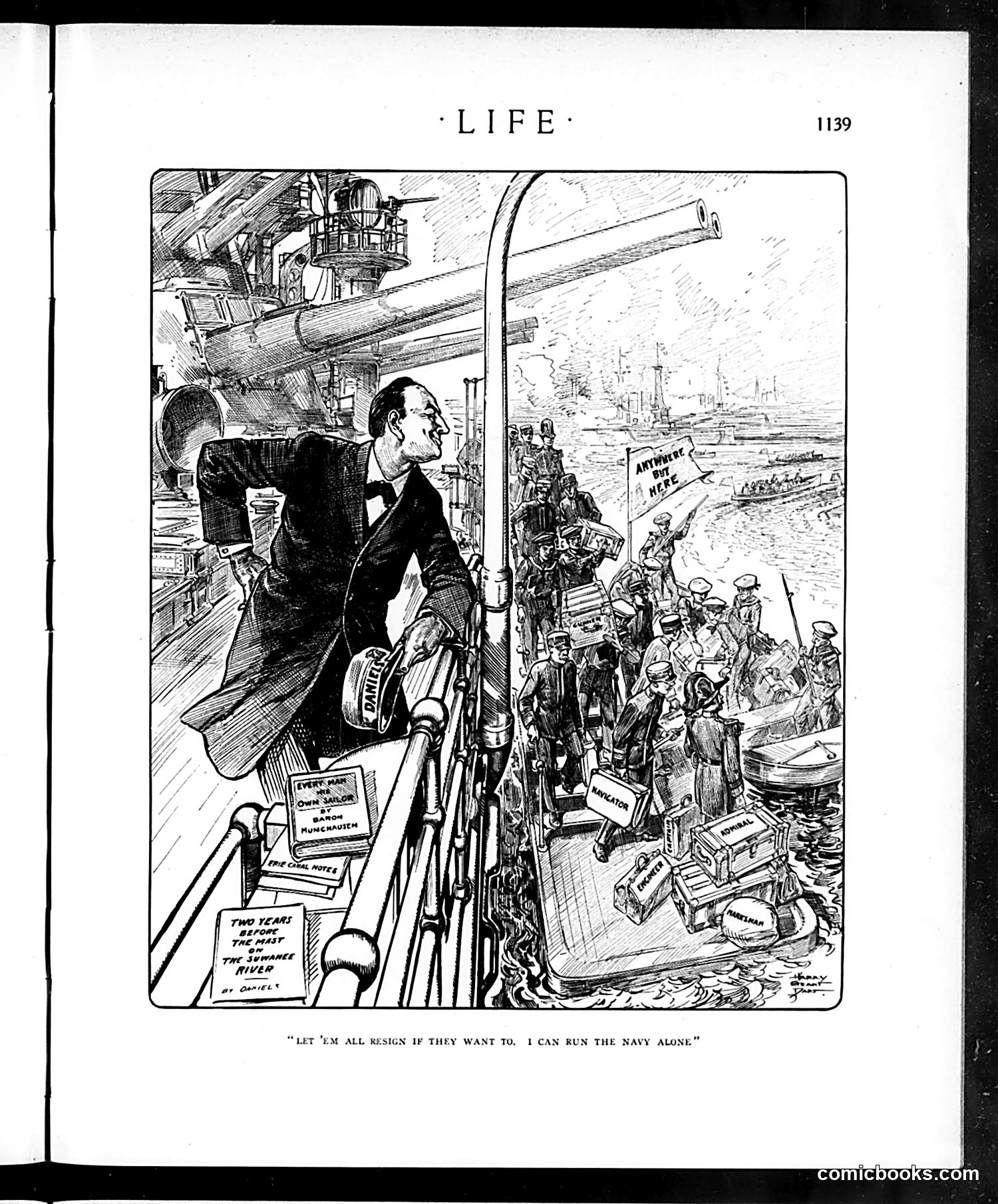
This Life magazine cartoon depicts a military or naval figure (shown in profile, leaning out from a warship) making an imperious declaration: "LET 'EM ALL RESIGN IF THEY WANT TO, I CAN RUN THE NAVY ALONE." Below deck, visible labels reference various naval positions and departments. On the shore, soldiers and sailors appear to be departing or resigning, with one flag reading "NAVY HERE." The satire targets an arrogant military leader claiming he can single-handedly manage the entire Navy despite mass resignations. This likely critiques overconfidence in wartime leadership or governmental resistance to accepting expert counsel. The cartoon suggests the figure's blustering confidence is dangerously disconnected from operational reality and the loss of trained personnel. The specific historical context—though unclear without a date—appears related to early 20th-century naval or military disputes.
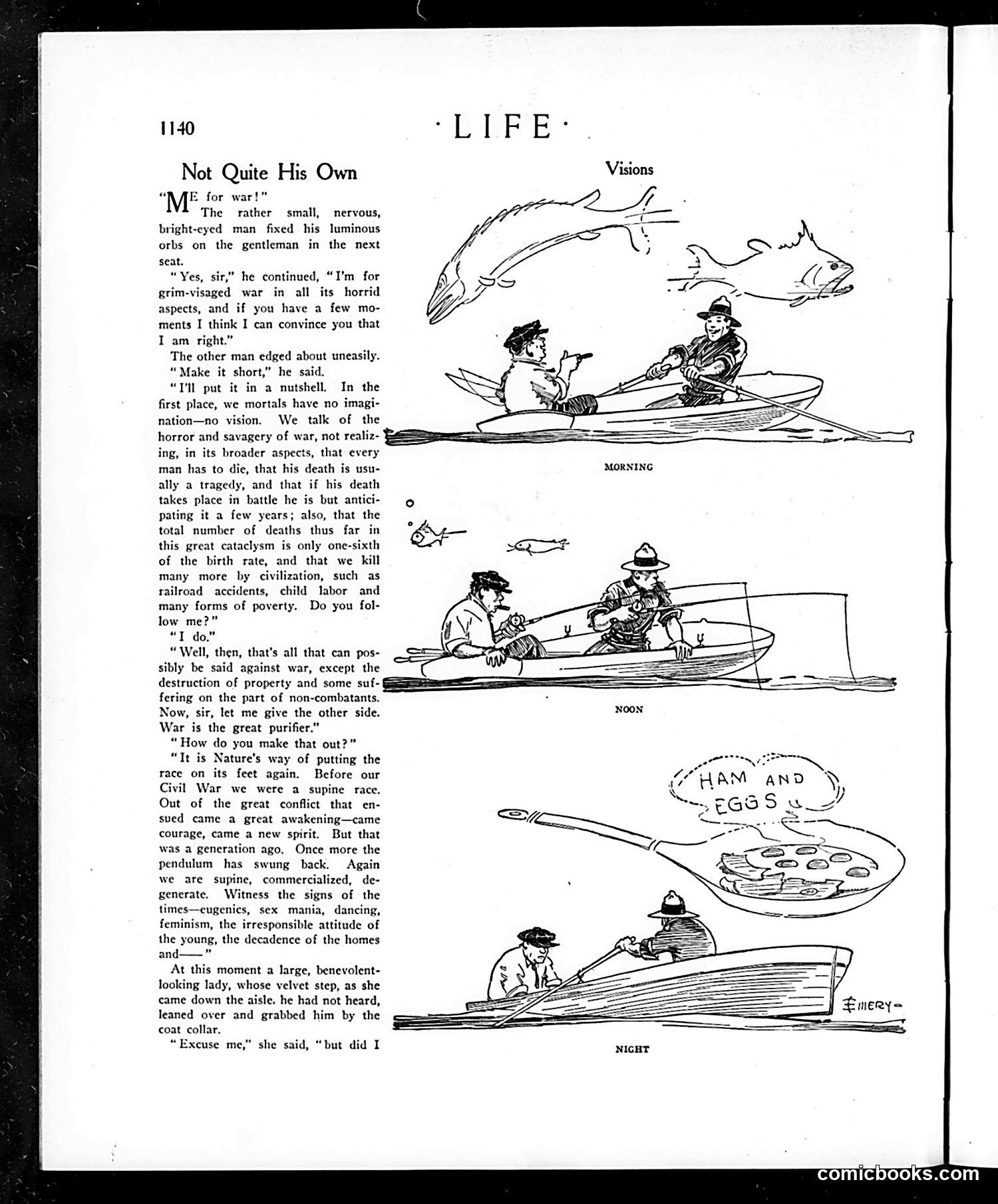
This piece satirizes pro-war propaganda and the hypocrisy of its advocates. A small, nervous man passionately argues *for* war to a reluctant stranger, using logic-twisting arguments: that war deaths are statistically acceptable compared to civilian deaths from poverty and accidents, and that war is a "purifier" that rejuvenates supposedly degenerate modern society. The satire targets his invocation of post-Civil War "awakening" while condemning contemporary society's "signs of decay"—eugenics, dancing, feminism, youth irresponsibility. The joke culminates when a large woman interrupts him mid-rant, grabbing his collar, suggesting his sanctimonious moralizing has consequences in real life. The accompanying fish-and-fishing-themed comic strips ("Visions," "Morning," "Noon," "Night") appear to provide visual contrast to the earnest debate, offering escapist humor about simple pleasures versus the grim war rhetoric above.
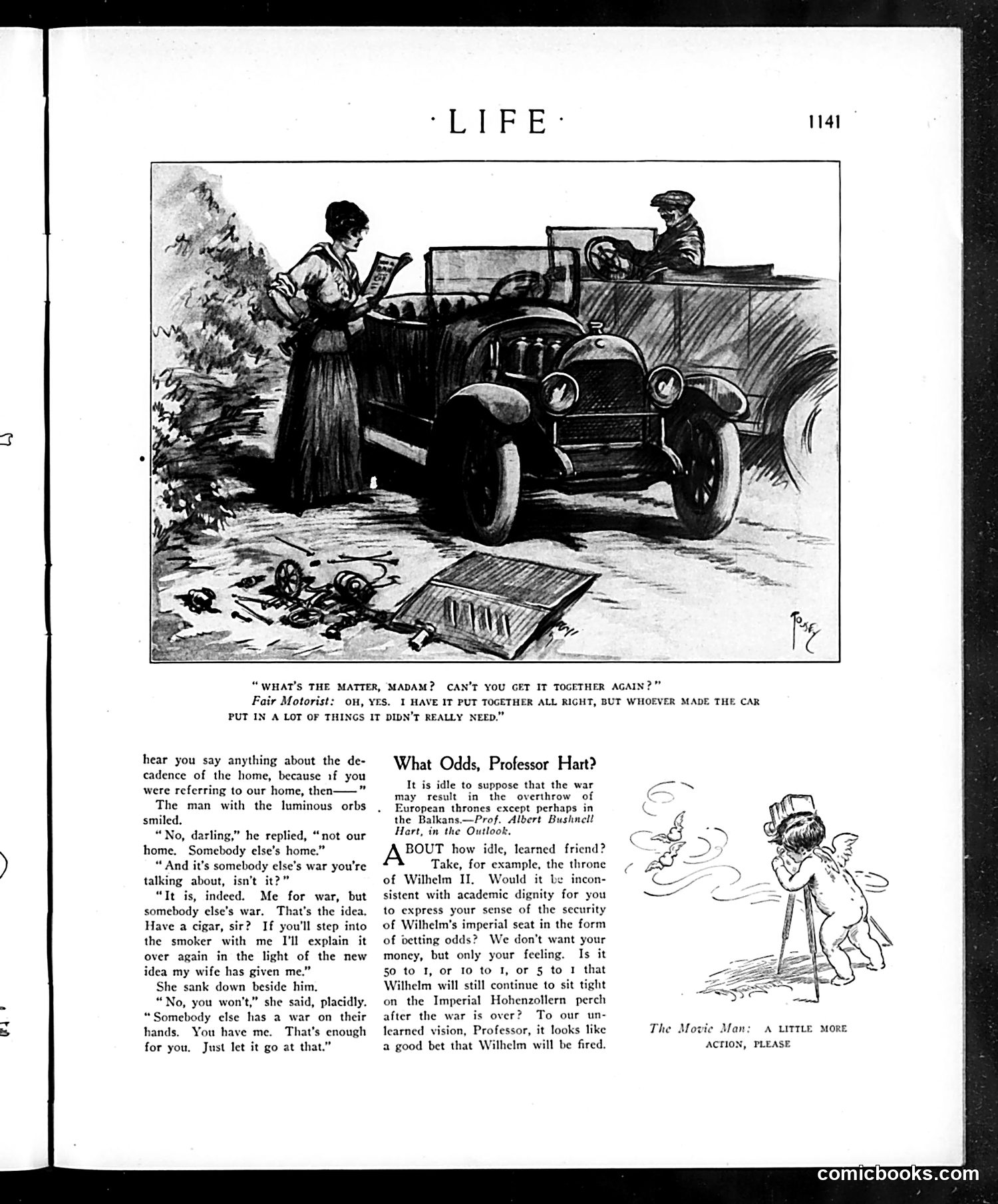
**Top Cartoon:** A woman examines a disassembled automobile with a male motorist. The joke mocks the poor engineering or design of early cars—the motorist suggests whoever manufactured it included unnecessary components. This reflects early 1910s frustration with unreliable automobile technology. **Middle Section:** This is satirical commentary on World War I neutrality debates. A couple discusses war philosophically; the man advocates for war but only for others ("somebody else's war"), a hypocritical position Life mocks. The woman cuts through this—he can't avoid life's obligations by outsourcing them. **"What Odds, Professor Hart?"** Life challenges Professor Albert Bushnell Hart's published prediction that WWI wouldn't overthrow European thrones (particularly the Balkans). The magazine sarcastically challenges him to bet odds that Kaiser Wilhelm II will remain in power post-war, implying the professor's academic caution underestimates the coming political upheaval. This appeared when Wilhelm's downfall was becoming imaginable to American observers. **Right Panel:** The "Movie Man" segment uses film production shorthand to request more dramatic action—likely social commentary on entertainment's role during wartime.
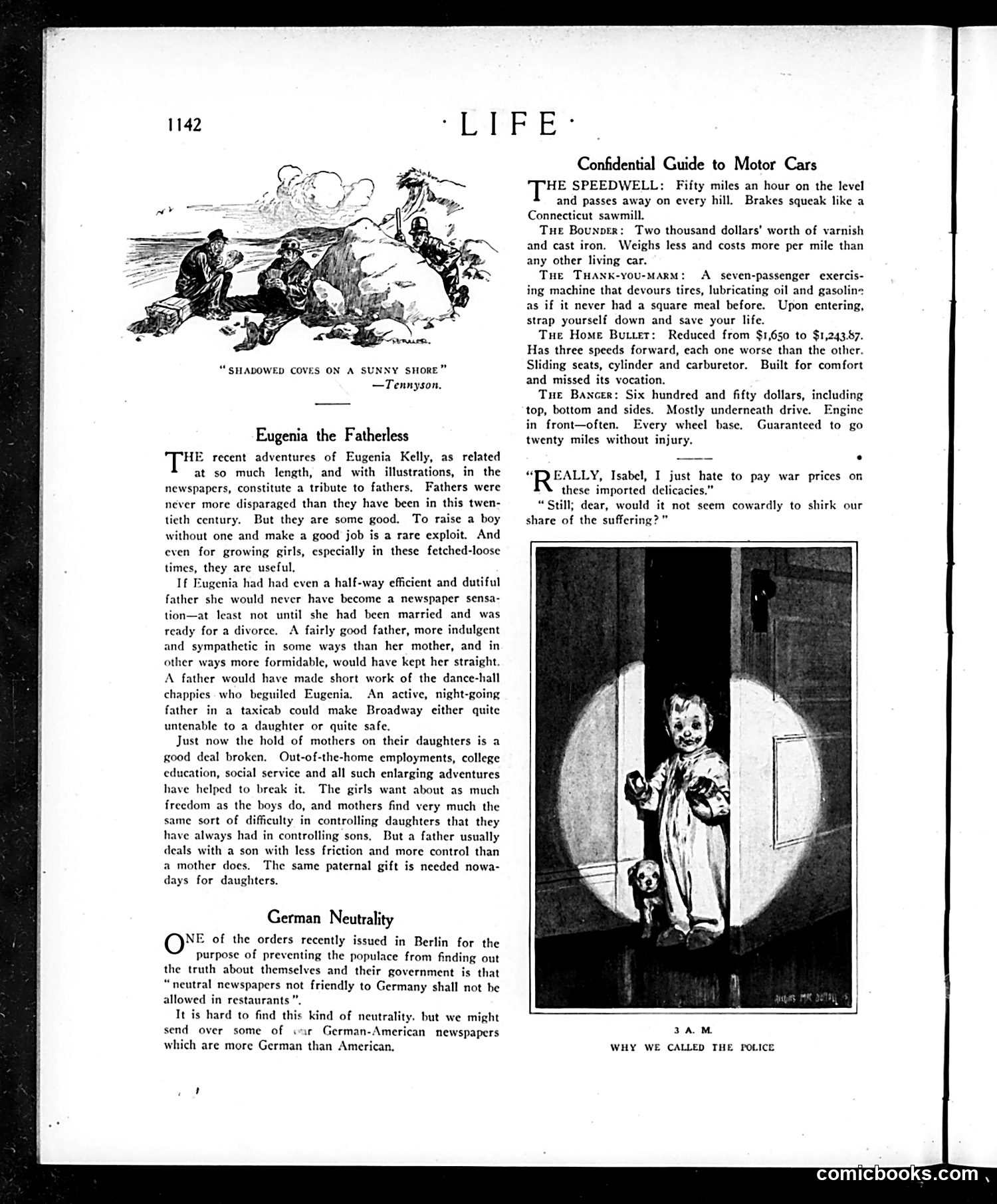
This page contains three distinct pieces of satire: 1. **"Eugenia the Fatherless"**: Commentary on a contemporary newspaper scandal involving a young woman named Eugenia Kelly. The article argues that absent fathers are responsible for daughters' misbehavior and that modern mothers lack authority to control their daughters—a period-typical gender critique blaming paternal absence for social disorder. 2. **"German Neutrality"**: Mocks German wartime censorship (likely WWI-era), noting Berlin banned "neutral newspapers not friendly to Germany" from restaurants. The satire points out this absurd contradiction: true neutrality wouldn't discriminate. The jab about German-American newspapers suggests some American outlets were more pro-Germany than pro-America. 3. **"Confidential Guide to Motor Cars"**: Humorous fake product descriptions of automobiles with exaggerated flaws—poor braking, excessive fuel consumption, uncomfortable designs—satirizing early 1920s car marketing and reliability. 4. **"Why We Called the Police"**: A small cartoon (caption only visible) appears to reference some domestic incident.
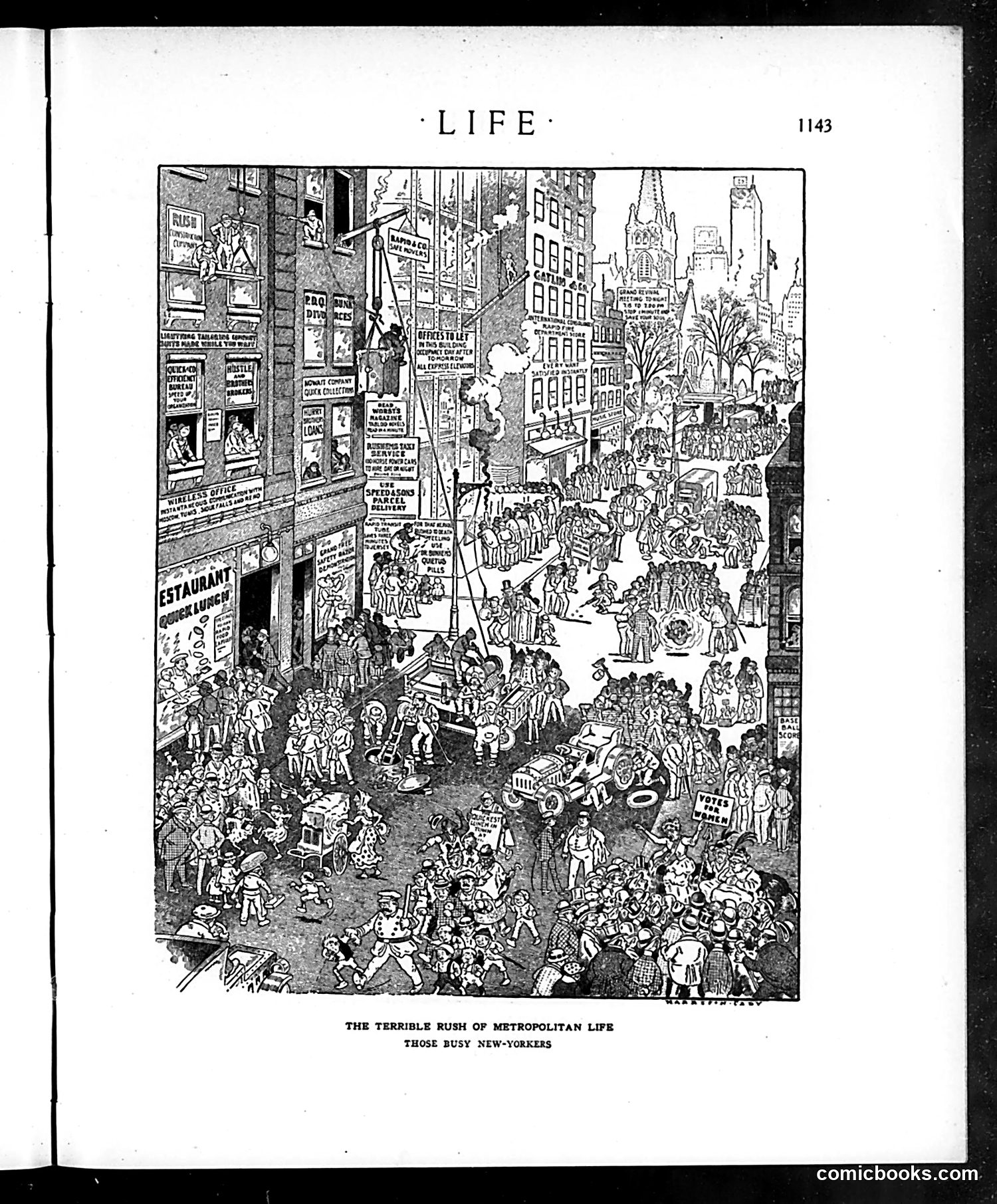
This is a densely-packed satirical illustration titled "The Terrible Rush of Metropolitan Life: Those Busy New-Yorkers." The cartoon depicts a crowded urban street scene—likely Times Square or a similar Manhattan location—teeming with hundreds of pedestrians, vehicles, and commerce. The satire critiques the frenetic pace and chaos of early 20th-century city life. Visible signage includes restaurants and businesses, while the masses swarm the streets in apparent disorder. The illustration employs exaggeration typical of Life magazine's social commentary: the overwhelming crowd density and visual chaos humorously underscore contemporary anxieties about urbanization, overpopulation, and the alienating effects of metropolitan existence on individual New Yorkers. The cartoon's humor lies in depicting this "terrible rush" as simultaneously comical and chaotic.
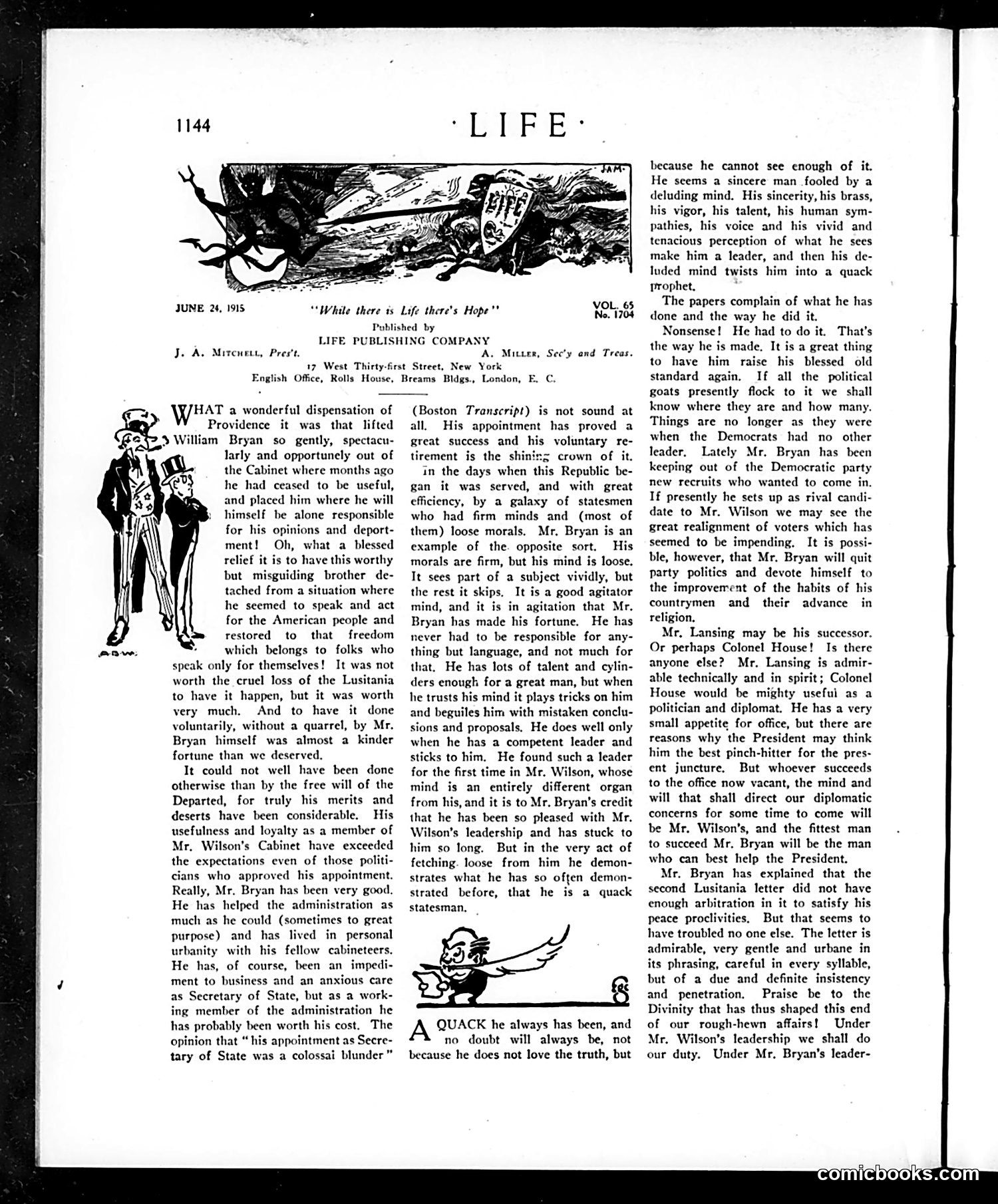
This Life magazine editorial mocks **William Jennings Bryan's** resignation as Secretary of State under President Wilson, likely over disagreement on foreign policy (the text references the Lusitania sinking). The satire's point: Bryan is a well-meaning but intellectually unreliable man—"firm morals, loose mind." He excels as an agitator and orator but fails in responsible leadership because his mind "plays tricks on him" and he sees issues only partially. The author grudgingly praises his *voluntary* departure, suggesting Bryan finally did something right by leaving before he caused more damage. The cartoon (top) depicts a devil-horned figure labeled "LIFE" with a flag, likely symbolizing how the magazine—and public—view Bryan's exit as providential relief for the administration. The piece's tone is backhanded: praising Bryan's sincerity while dismissing him as a perpetual "quack statesman."
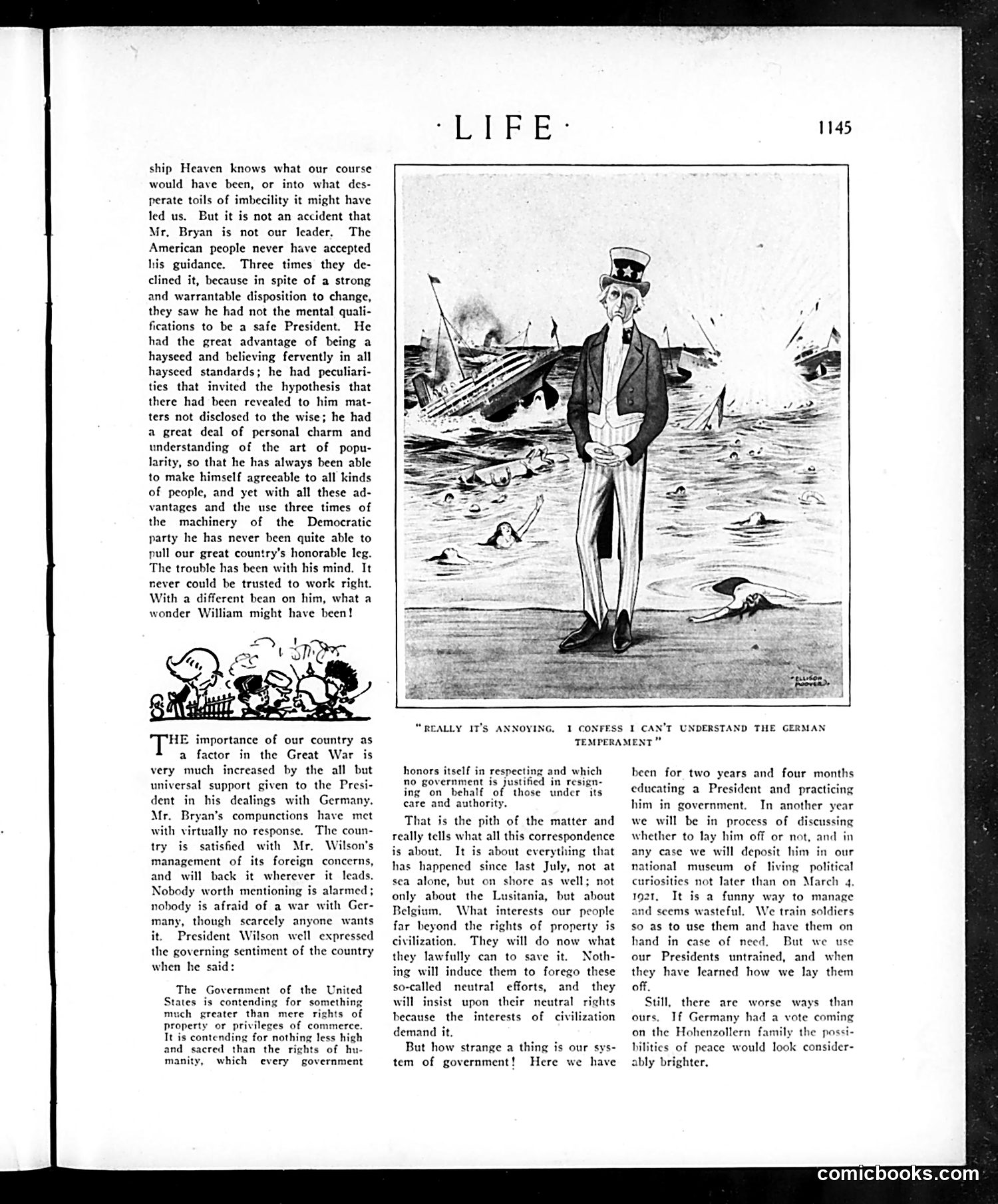
The main cartoon depicts Uncle Sam standing amid shipwrecks and drowning victims, captioned "Really it's annoying, I confess I can't understand the German temperament." This sarcastically critiques American neutrality during WWI—Uncle Sam's bemused expression contrasts grotesquely with the maritime disaster behind him, likely referencing the *Lusitania* sinking (mentioned in the text). The accompanying article attacks William Jennings Bryan, three-time presidential candidate and Secretary of State under Wilson, for his pacifist objections to American foreign policy. The author mocks Bryan as an intellectual lightweight—a "hayseed" unfit to lead—whose moral qualms about entering WWI lack public support. The piece defends President Wilson's hardline approach, framing WWI as a struggle for "civilization" itself, not mere property rights. It concludes with satirical commentary on American democracy's inefficiency: training a president for years only to replace him every four years. The satire targets both Bryan's anti-war stance and American indecision regarding WWI involvement.
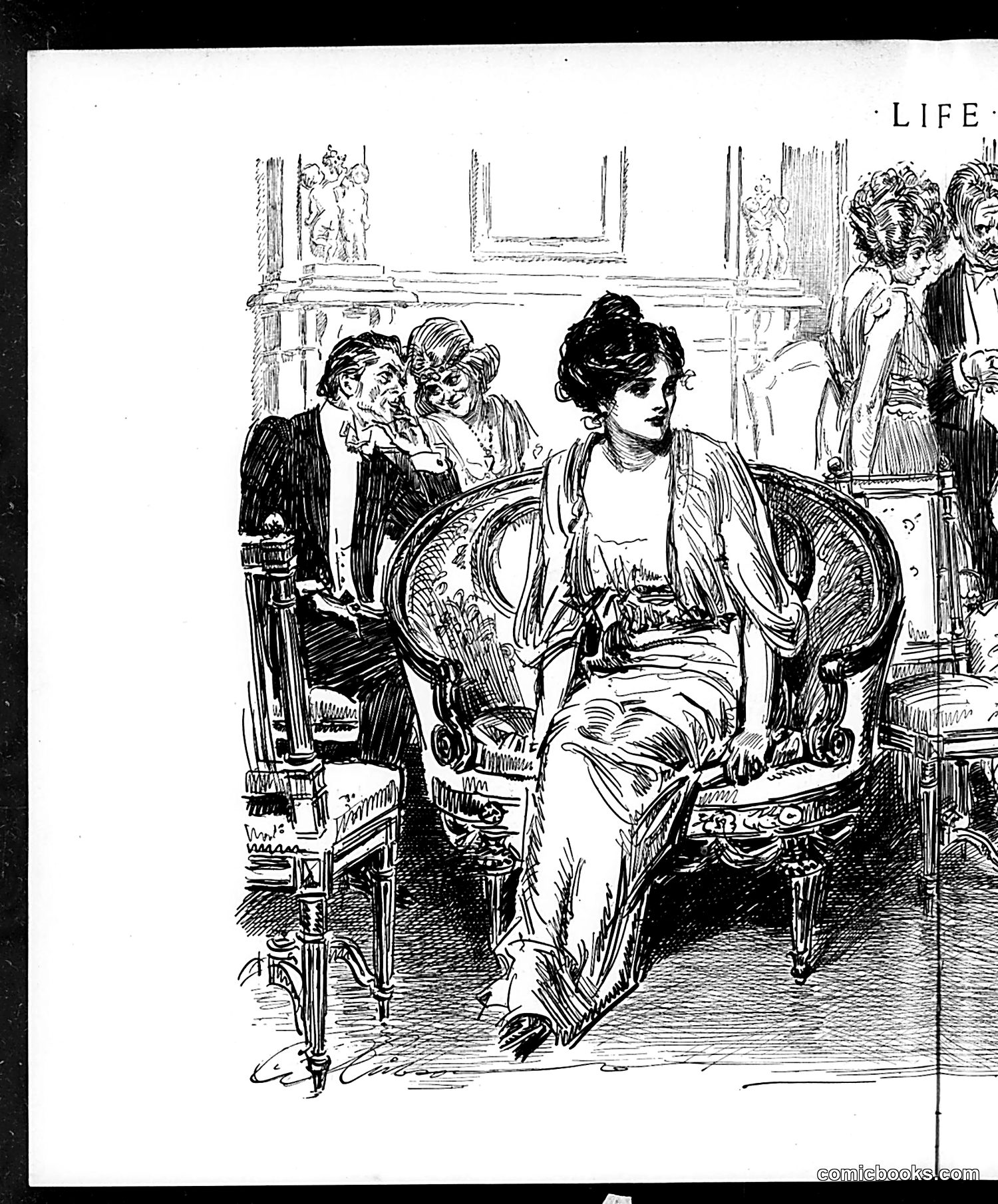
This is a pen-and-ink illustration from *Life* magazine showing a social scene in an elegant interior. A woman sits prominently in the foreground on a chair, while behind her stand two figures engaged in conversation, and additional figures are visible near windows in the background. The illustration appears to be satirizing **social pretension or romantic tension** in upper-class settings, though without visible caption or title text, the specific satirical target is unclear. The style suggests early 20th-century American society commentary. The artist's signature is visible at bottom left. The page header reads "LIFE," confirming this is from the satirical publication known for commentary on contemporary social manners and class dynamics. **Unable to determine:** the specific incident or social commentary being lampooned without additional caption text.
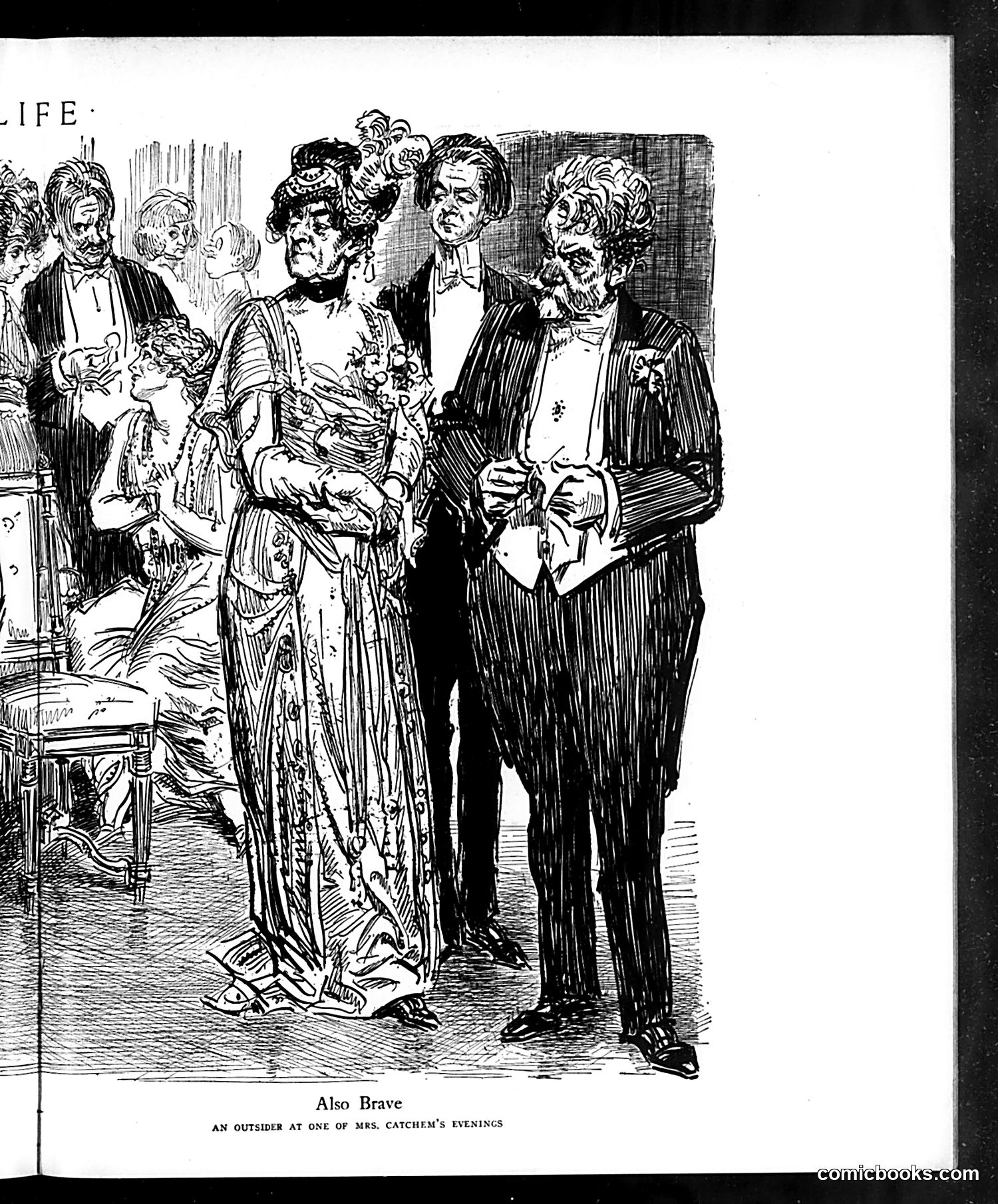
This satirical illustration depicts a social scene titled "Also Brave," showing an awkward outsider at "Mrs. Catchem's evenings"—apparently a fashionable social gathering of the era. The cartoon mocks social anxiety and class dynamics. A formally-dressed man stands uncomfortably among well-dressed guests in what appears to be a parlor setting. The title "Also Brave" suggests ironic commentary: attending such a social event requires courage, particularly for someone who doesn't belong or feels out of place. The illustration satirizes the pretensions of high society gatherings and the discomfort of social outsiders navigating elite circles. The exaggerated facial expressions and body language emphasize the man's discomfort amid the fashionable crowd, making social climbing and society gatherings the target of Life's characteristic satirical humor.
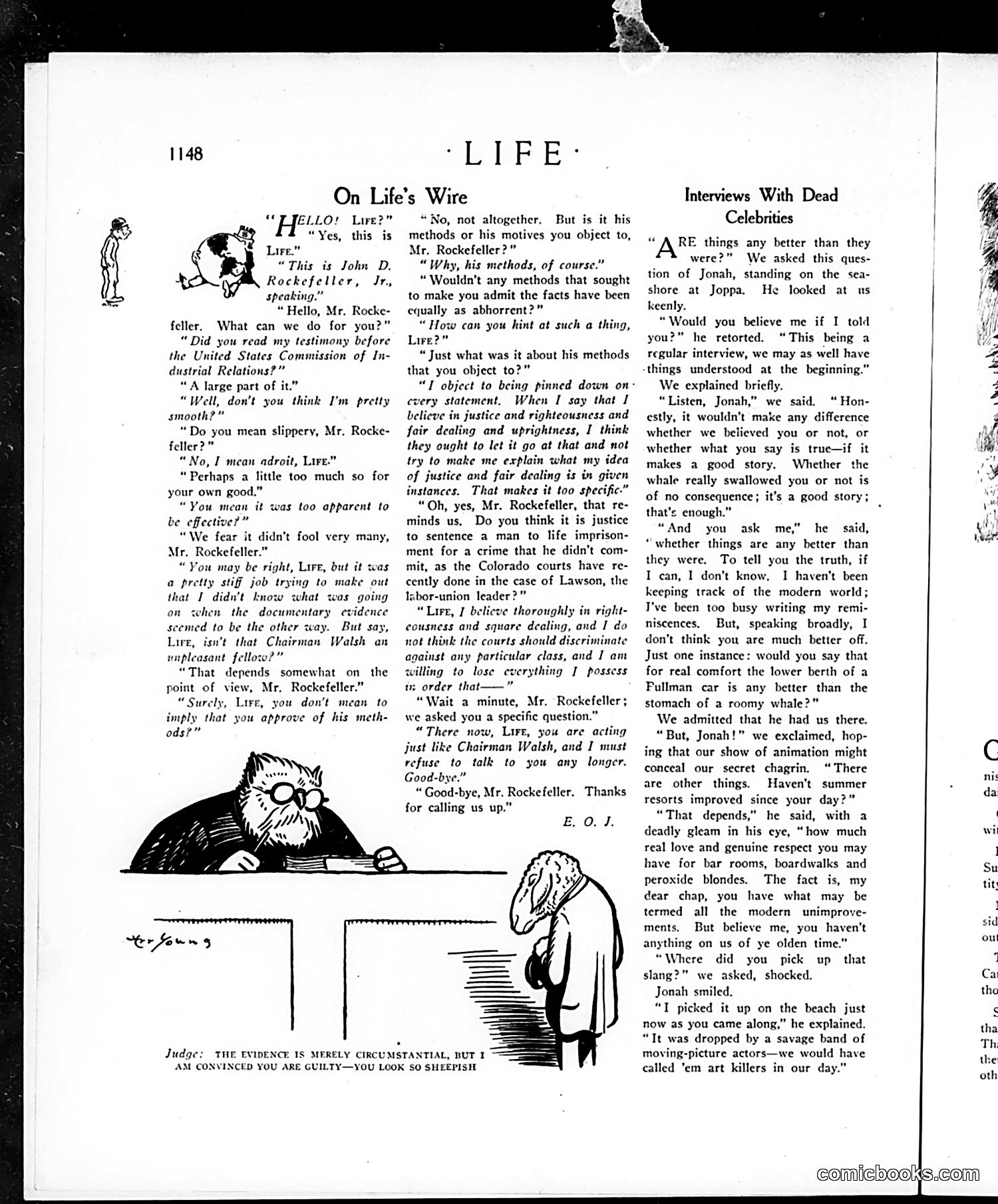
This page satirizes **John D. Rockefeller Jr.** during his testimony before the U.S. Commission on Industrial Relations. The left column mocks his evasive testimony: when asked about objectionable "methods," Rockefeller insists on speaking vaguely about "justice and righteousness" rather than addressing specific facts. The satire highlights how his abstract platitudes—and refusal to answer direct questions—reveal he's either dishonest or obtuse. The interviewer ("Lire," Life magazine) points out that Rockefeller's testimony wasn't persuasive because the documentary evidence contradicted his claims of ignorance. The right column contains an unrelated interview with the biblical figure Jonah, using him as a device to comment on modern discomfort and lack of genuine progress. **Context**: This reflects Progressive Era criticism of wealthy industrialists' attempts to manage their public image through carefully crafted but hollow testimony during labor disputes and antitrust investigations.
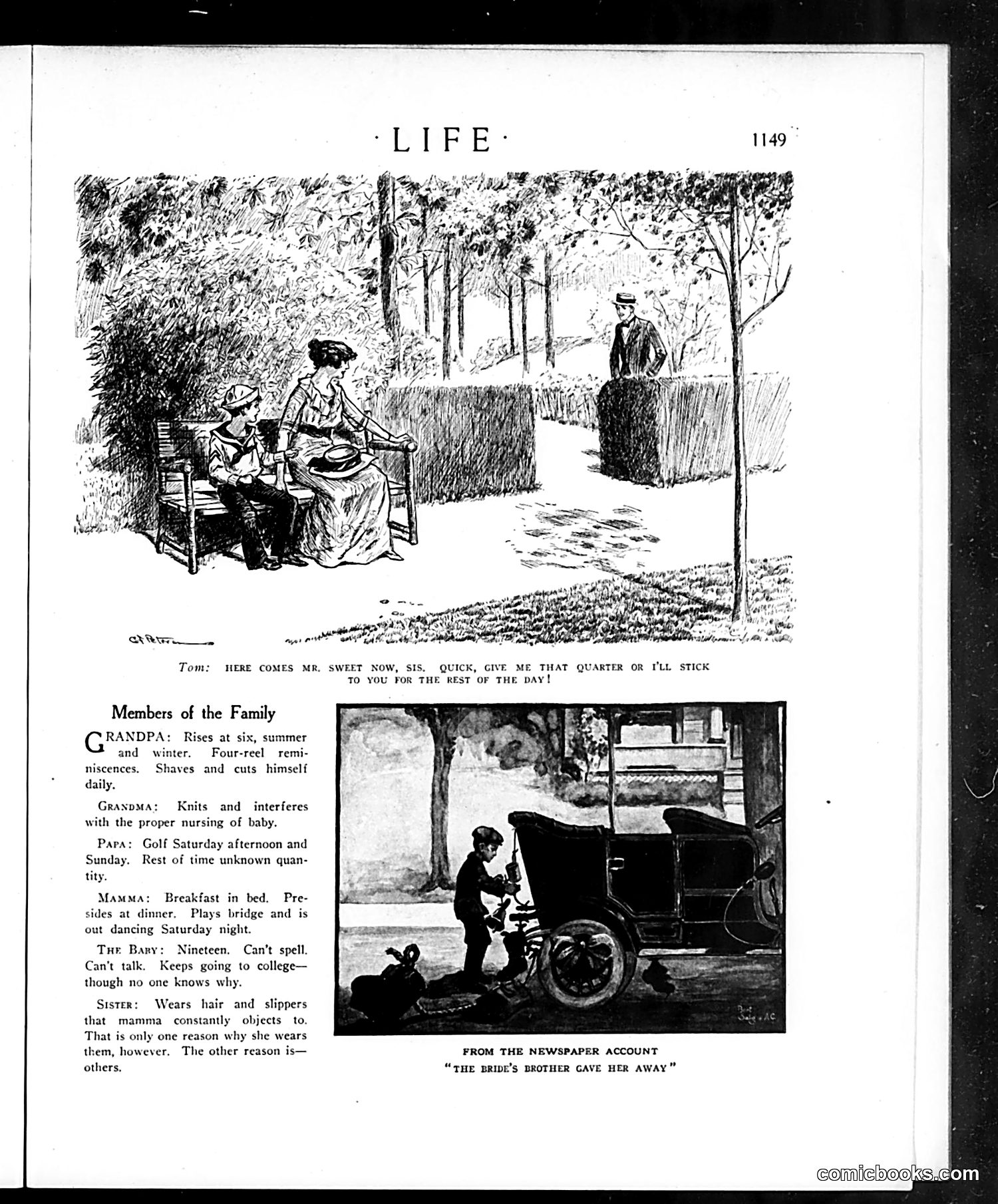
The top cartoon shows a boy (Tom) extorting a quarter from his sister by threatening to "stick to you for the rest of the day"—blackmail through annoying persistence, a common sibling dynamic. Below is a "Members of the Family" feature satirizing typical American family stereotypes: Grandpa as a rambling early-riser, Grandma as a meddling caregiver, Papa absent except for golf, Mama prioritizing leisure over domesticity, and a 19-year-old baby who inexplicably attends college despite being inarticulate. The bottom image captioned "The Bride's Brother Gave Her Away" appears to be an ironic newspaper reference, likely showing a wedding scene—the humor being a play on the traditional phrase where a father "gives away" the bride, here inverted or subverted for comedic effect. The satire targets early 20th-century American family life, mocking parental neglect, generational eccentricity, and social pretension through exaggeration.
This is a **book review section**, not a political cartoon. The page features reviews of five contemporary works, with a decorative header illustration showing figures reading. **Key content:** - **Maurice Hewlett's "A Lovers' Tale"**: An Icelandic saga retelling praised for its artistic economy - **Joseph Hergesheimer's "Mountain Blood"**: A Virginia hill-country tragedy depicting generational decline and social decay - **Henry Beach Needham's "The Double Squeeze"**: Baseball stories endorsed by real manager Connie Mack - **Hudson Maxim's "Defenceless America"**: A militaristic warning about national vulnerability, using war disillusionment to argue for preparedness - **Seymour Deming's "A Message to the Middle Classes"**: An intellectual attempt to bridge radical-conservative divides The reviews reflect post-WWI anxieties about American strength and social cohesion. The illustration shows a botanical plant study, unrelated to the text.
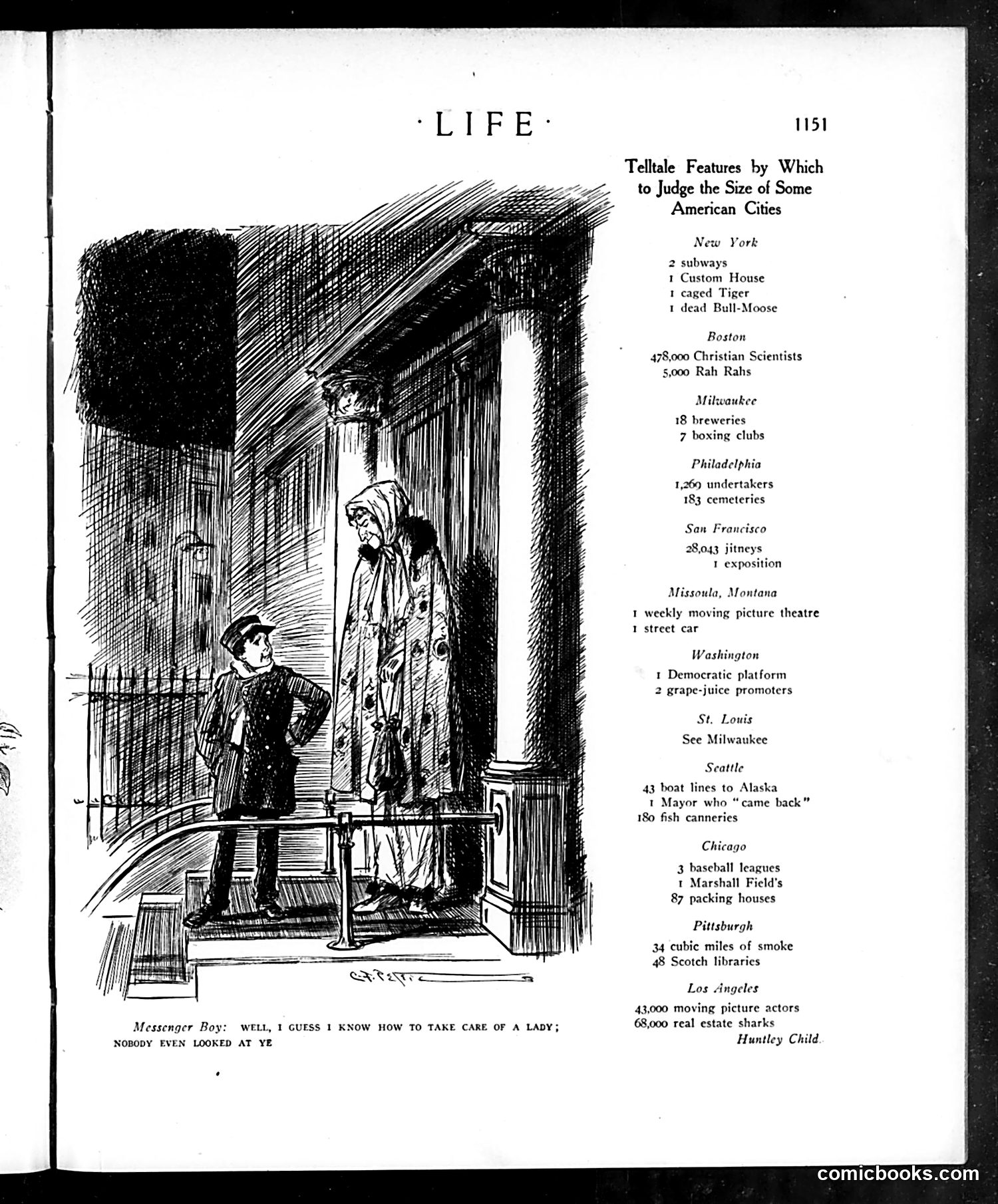
**The Cartoon:** A young messenger boy escorts an elderly woman down a tenement stairway. His caption boasts he knows "how to take care of a lady; nobody even looked at ye"—suggesting he's protecting her from street harassment or unwanted attention, implying the neighborhood (likely New York's lower east side) is rough enough that an unescorted woman would draw looks or worse. **The List:** "Telltale Features" humorously stereotypes American cities by their most notorious characteristics rather than size or achievements. The satire targets: - **New York**: Chaos (subways, caged animals, dead political symbols) - **Boston**: Religious extremism (Christian Scientists) - **Milwaukee**: Breweries and boxing (immigrant culture stereotypes) - **Pittsburgh**: Industrial pollution ("34 cubic miles of smoke") - **Los Angeles**: Superficiality (actors, real estate speculation) - **Washington**: Political emptiness ("Democratic platform") The humor relies on readers recognizing these stereotypes as unflattering truths about each city's reputation or dominant industries circa 1910s-era Life magazine.
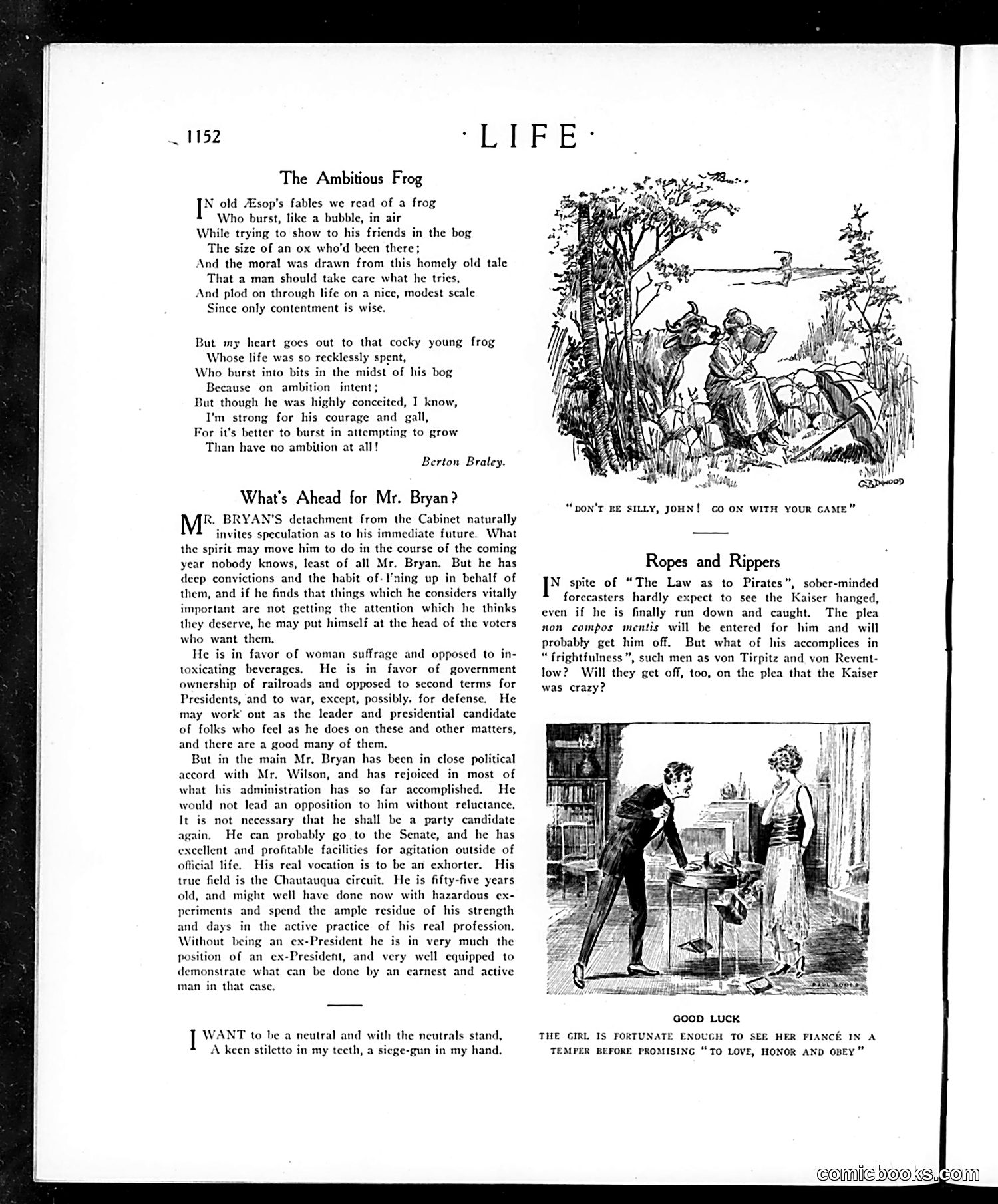
This page contains three distinct pieces of political and social commentary: **"The Ambitious Frog"** (poem by Berton Braley): A reinterpretation of Aesop's fable praising ambition over contentment—reflecting early 20th-century values favoring striving and progress. **"What's Ahead for Mr. Bryan?"**: Analysis of William Jennings Bryan's future after resigning as Secretary of State under Wilson. The article speculates whether he'll lead a political movement around his causes (women's suffrage, prohibition, railroad nationalization). It suggests Bryan might pursue the Chautauqua lecture circuit instead—his "true vocation." **"Ropes and Rippers"**: Commentary on potential war crimes trials, expressing skepticism that Kaiser Wilhelm II will face execution, predicting a "non compos mentis" (insane) defense. It questions whether his subordinates (Von Tirpitz and Von Reventlow) will similarly escape accountability. The cartoon illustrations show outdoor scenes and a couple's domestic moment, accompanying these texts on ambition, politics, and wartime justice.
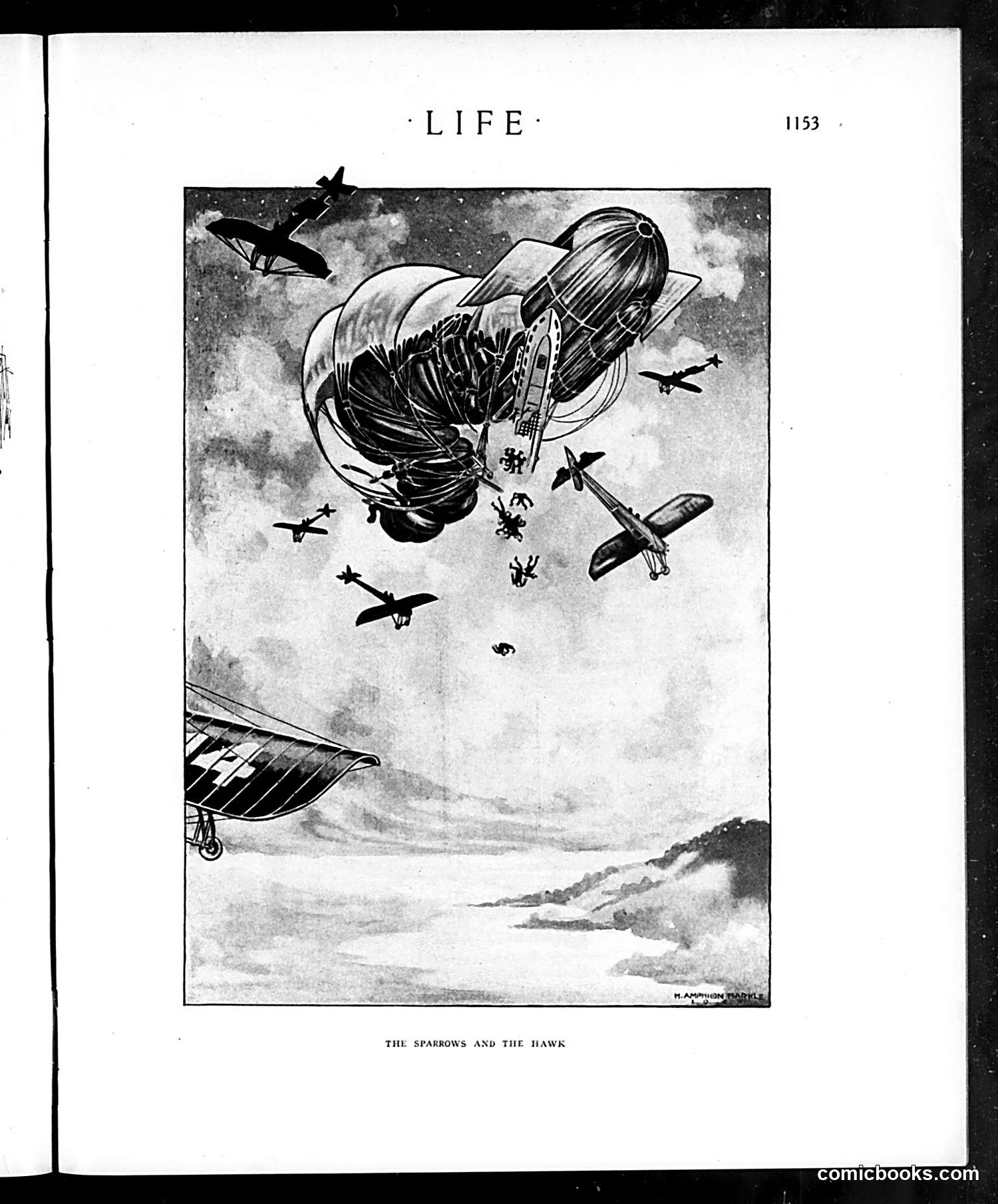
This illustration from *Life* magazine (page 1153) depicts an allegorical scene of aerial warfare. A large hawk descends upon a flock of small sparrows in the sky, while military aircraft maneuver below and a landscape appears underneath. The title suggests a predator-prey dynamic. Given the context of *Life* as a satirical publication, this likely represents a political commentary on military conflict or international power imbalance—the "hawk" probably symbolizing an aggressive larger power or military force, while the "sparrows" represent vulnerable populations or smaller nations. The aircraft suggest this addresses modern warfare. Without the article's date or accompanying text, the specific conflict referenced remains unclear, though the imagery conveys themes of aggression and vulnerability common to *Life*'s social commentary.
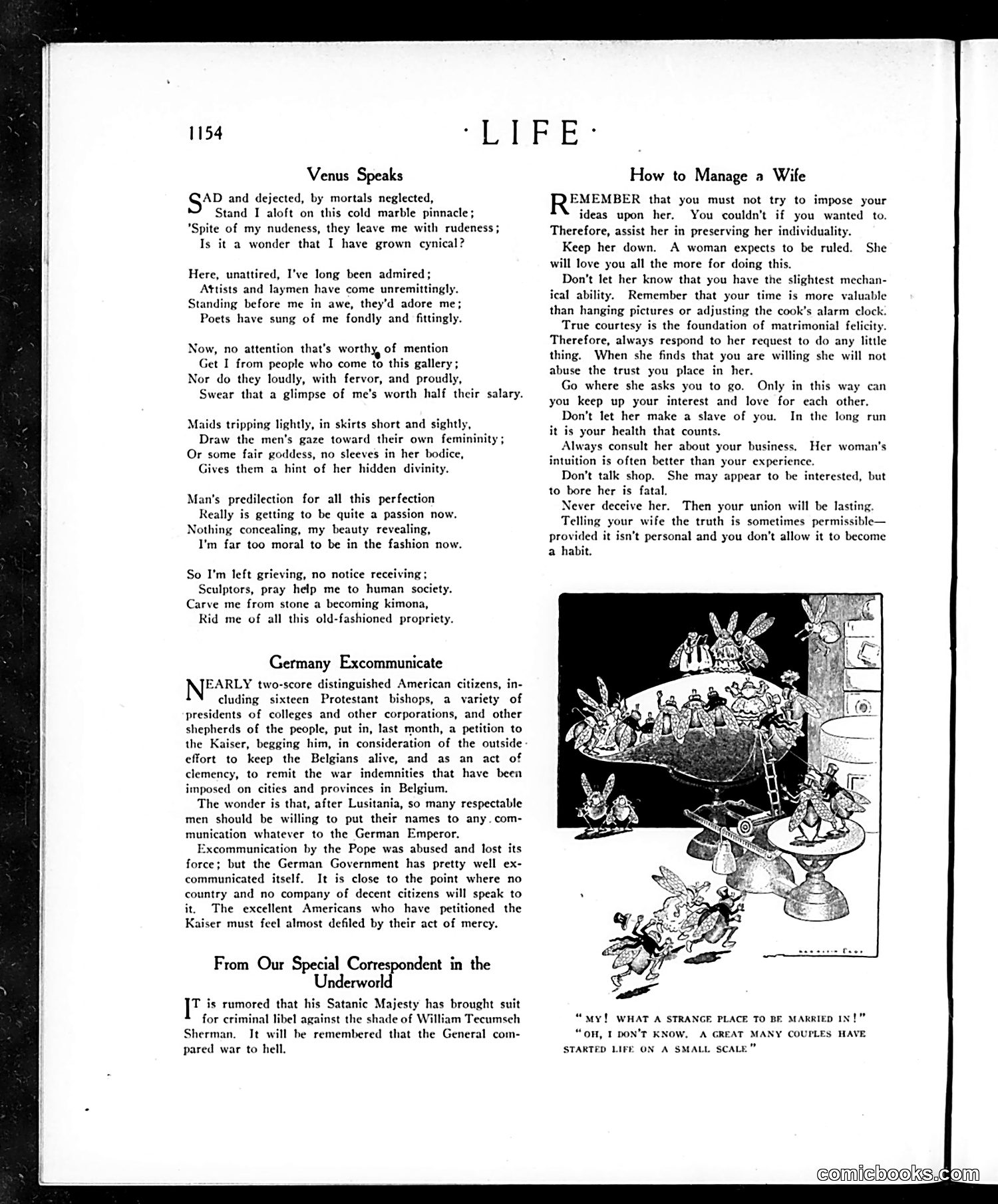
This page contains three satirical pieces typical of Life's early 20th-century humor: **"Venus Speaks"**: A poem where the classical nude statue of Venus complains she's fallen out of fashion. She's ignored by gallery visitors who now prefer modern, clothed women showing glimpses of flesh. The satire mocks contemporary obsession with fashionable femininity over timeless classical beauty—Venus demands sculptors give her a kimono to stay relevant. **"Germany Excommunicate"**: Sharp political commentary on American petitioners (including 16 Protestant bishops) who appealed to the Kaiser for mercy regarding Belgian war indemnities. Life scorns them for dignifying Germany with requests after the Lusitania sinking, suggesting Germany has morally "excommunicated itself" and decent nations shouldn't communicate with it. **"How to Manage a Wife"**: Satirical advice offering contradictory instructions (don't impose ideas/keep her down; consult her/don't talk shop) that mock both domineering husbands and matrimonial pretense. The accompanying cartoon shows a couple married in an unconventional setting. All three pieces use irony to critique social hypocrisy and contemporary attitudes.
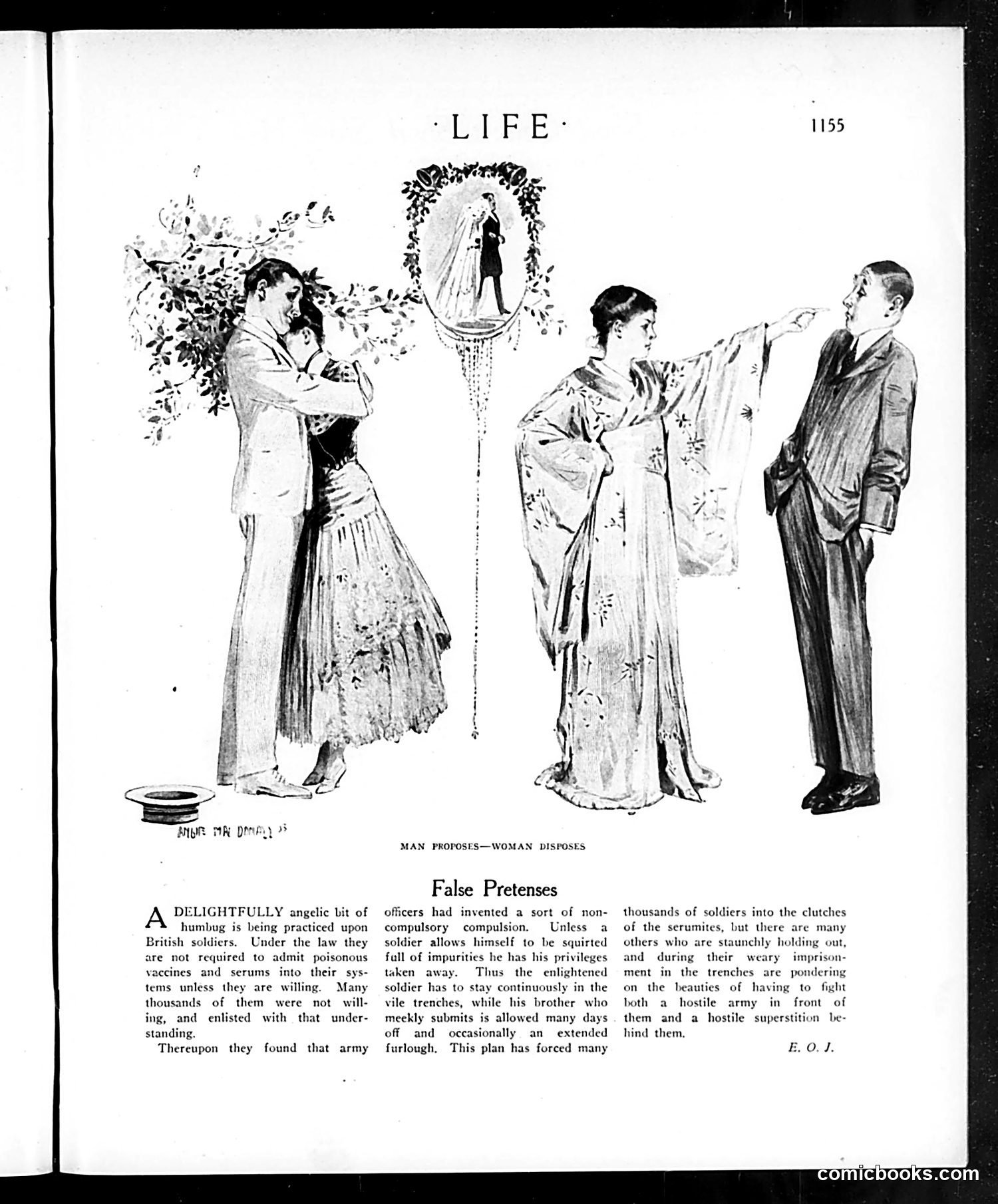
This page satirizes British military vaccination policy during World War I. The top illustration shows a romantic proposal scene ("Man Proposes—Woman Disposes"), contrasting with the article's ironic title. The article criticizes the British Army's coercive vaccination practices. Though soldiers could legally refuse vaccines, the military created what Life calls "non-compulsory compulsion"—refusing vaccination meant losing privileges (furlough, leave from trenches) while compliant soldiers received extended time off. Life attacks this as deceptive: soldiers enlisted believing vaccination was optional, then faced de facto mandatory medical procedures. The satire argues this forced thousands into unwilling vaccination while others endured trench duty as punishment for refusing. The "false pretense" is the Army's claim that vaccination remained voluntary when refusing it carried severe consequences. The piece criticizes both military dishonesty and what it calls the "hostile superstition" of mandatory medical treatment.
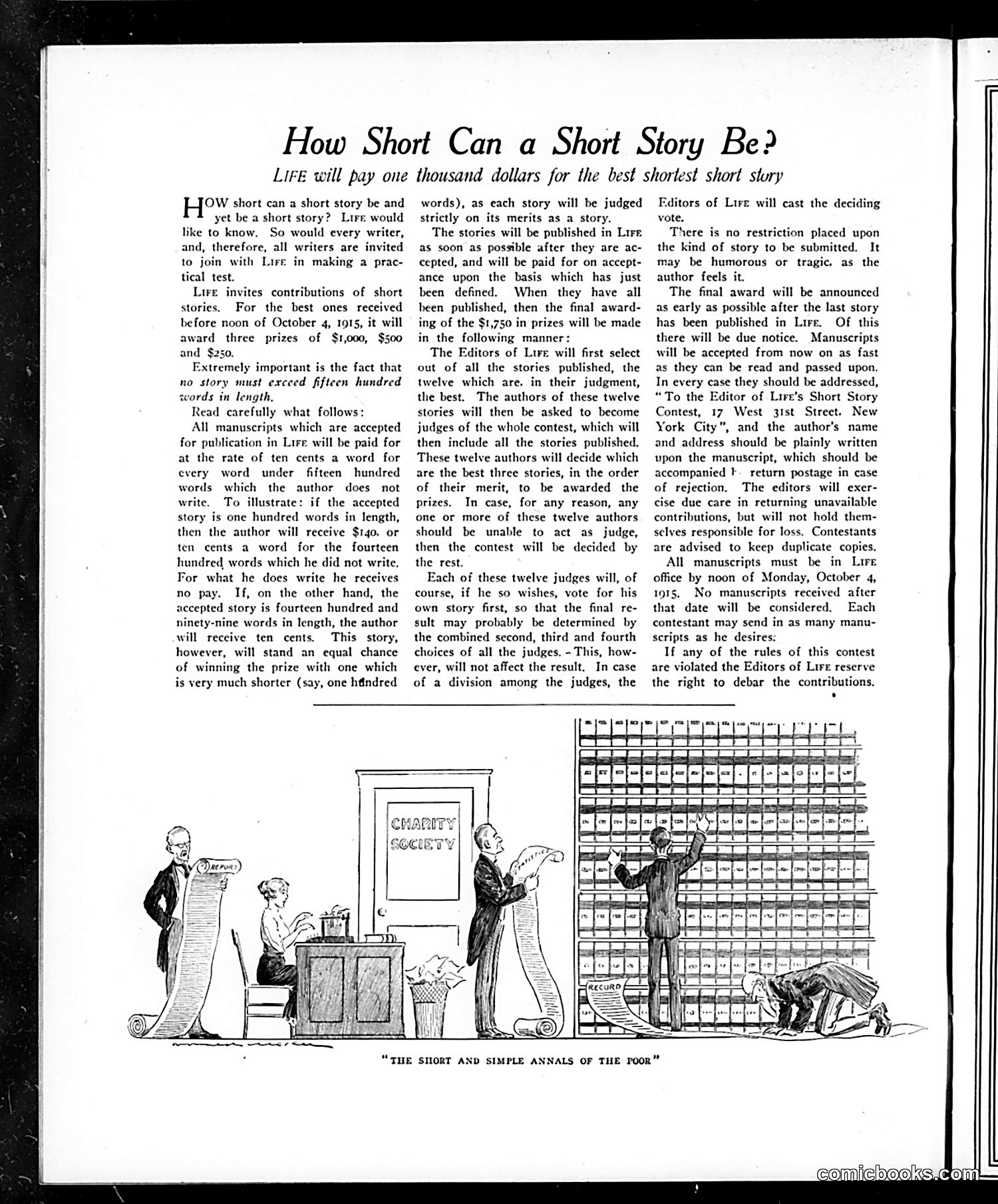
This page announces Life magazine's 1915 short-story writing contest offering $1,000 for the winner. The satirical twist—and the joke—lies in the payment structure: authors are paid ten cents per word they *don't* write, up to a 1,500-word limit. The cartoon illustrates this absurdity: charity workers process endless scrolls of paperwork at a "Charity Society" office, overwhelmed by bureaucratic records. The visual pun mocks how Life's payment scheme incentivizes writers to submit the shortest possible stories, essentially rewarding blank pages. A writer receives $140 for a 100-word story (paid for 1,400 unwritten words) but nothing for writing a full 1,500 words. This is satire targeting both literary pretension and the emerging culture of prizes and contests in early 20th-century magazines. By inverting normal payment logic, Life humorously questions: what constitutes a "story," and can brevity actually improve literature? The cartoon's chaotic paperwork suggests the administrative nightmare such an illogical system would create.
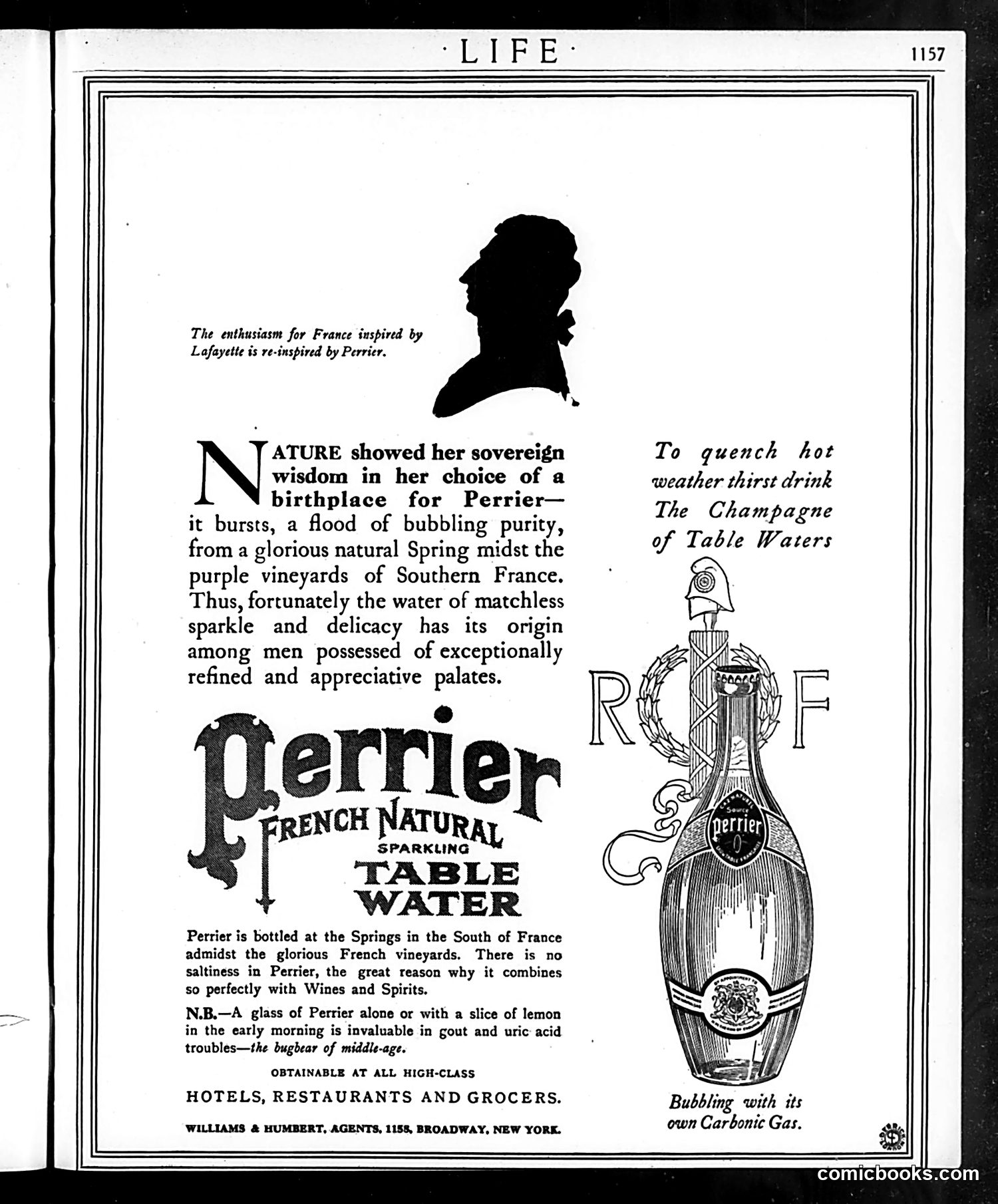
This is primarily a **product advertisement**, not political satire. The page uses patriotic sentiment to market French sparkling water to American consumers. The silhouette at top appears to be **Lafayette**, the French Revolutionary War hero beloved in America. The text connects Lafayette's popularity to enthusiasm for France generally, then pivots this goodwill to promote Perrier water as a French product. The marketing strategy appeals to **class aspirations**: the water is positioned for "exceptionally refined and appreciative palates" and "high-class hotels, restaurants and grocers." A note advertises it as a medical remedy for gout and uric acid—afflictions of wealthy, idle men with rich diets. The bottle illustration emphasizes its French origin and natural carbonation ("Carbonic Gas"), marketed as "The Champagne of Table Waters"—elevating ordinary sparkling water through association with luxury. This reflects early 20th-century American consumer culture: using patriotic nostalgia and class signaling to sell imported luxury goods.
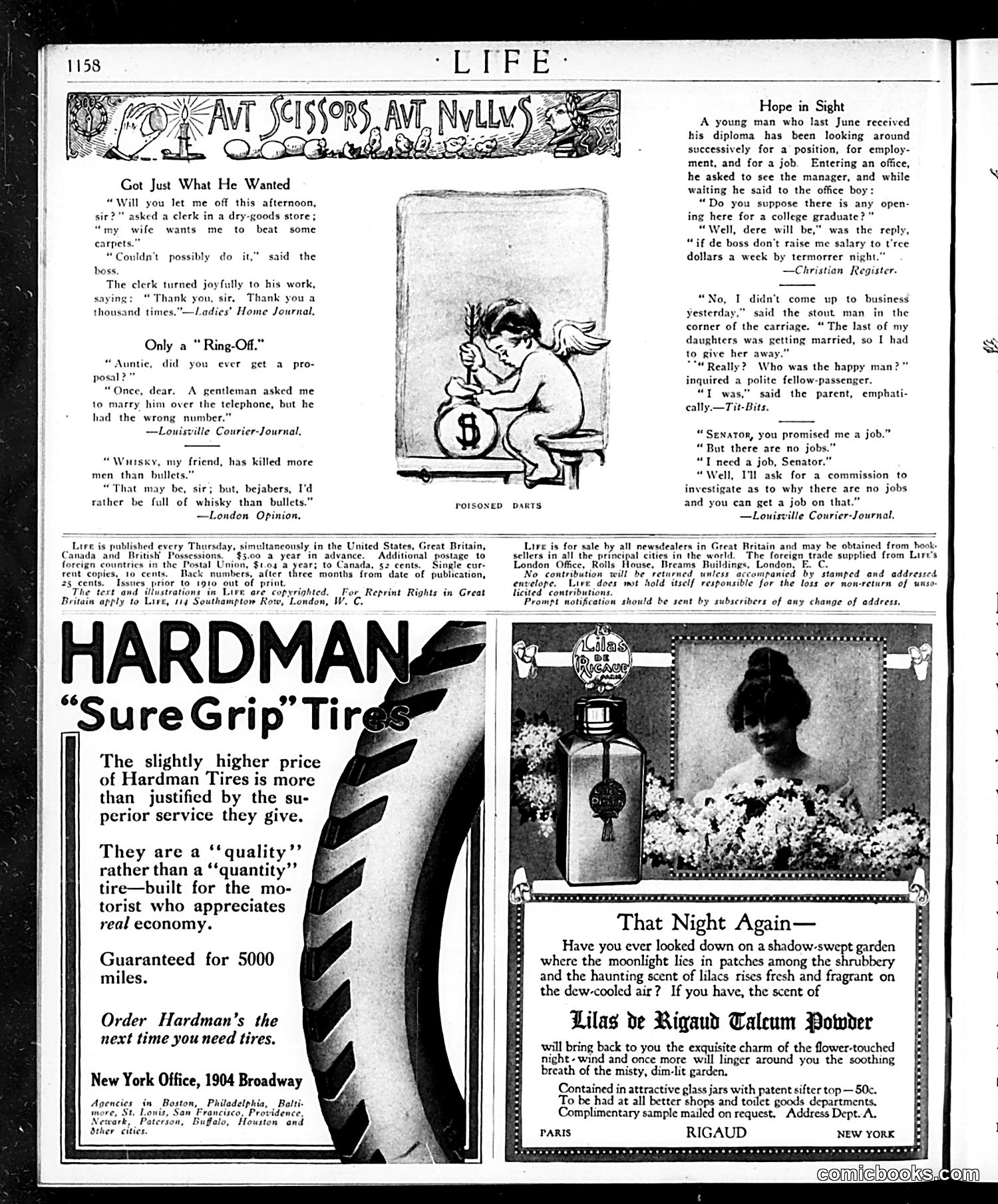
This page contains several short humorous anecdotes typical of early 20th-century *Life* magazine, plus period advertisements. The cartoons mock workplace dynamics and bureaucratic absurdity. "Got Just What He Wanted" satirizes a boss's literalism—a clerk asks to leave to beat carpets (a household chore), and the boss grants permission, delighted to be helpful, misunderstanding the verb's dual meaning. "Only a 'Ring-Off'" plays on a woman's failed marriage proposal over telephone with a wrong number. Other jokes target job-seeking struggles and political corruption—a young college graduate seeking employment from a senator learns there are "no jobs," but the senator will commission an investigation into *why* there are no jobs, creating a position for the man. This satirizes patronage and bureaucratic make-work. The page is otherwise dominated by period advertisements for Hardman "Sure Grip" tires and Lilas de Rigaud talcum powder, typical of the magazine's revenue model.
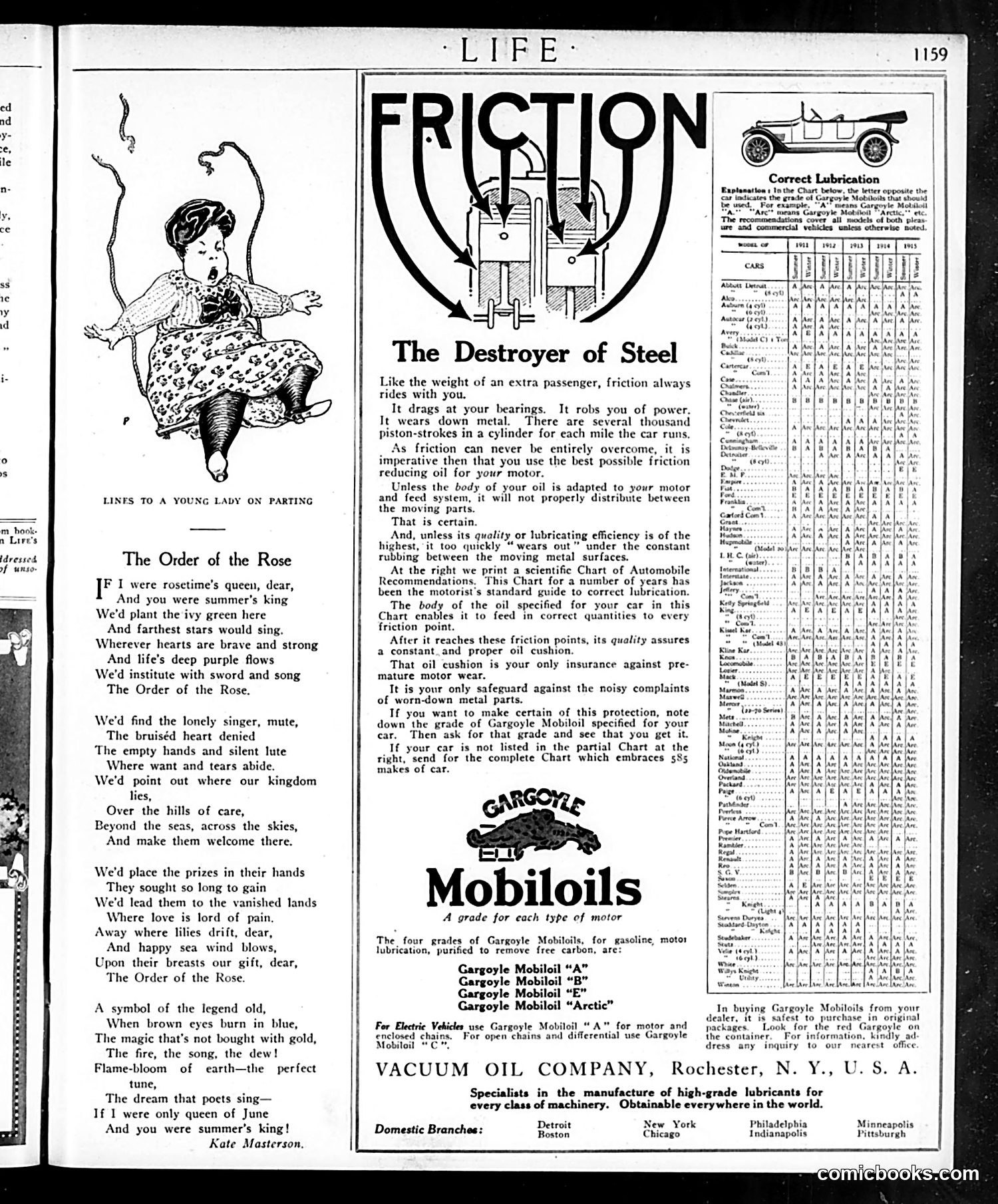
This page contains two unrelated pieces: a romantic poem and an automobile advertisement. **"The Order of the Rose"** is a sentimental poem by Kate Masterson about creating an idealized kingdom where love conquers hardship. It's typical early 20th-century romantic verse with no apparent satire—likely filler content. **The main advertorial content** promotes Gargoyle Mobiloils lubricant. The "Destroyer of Steel" headline uses dramatic language to describe friction's wear on car engines, positioning oil as essential protection. The illustration of a woman being battered by friction lines is melodramatic advertising copy—using exaggeration to sell a practical product. **The satirical element** appears subtle: Life magazine, known for satire, is running what amounts to a sponsored "scientific" lubrication chart claiming to cover 585 car makes. The pretense of objective guidance combined with aggressive marketing copy ("your only insurance") typifies early automotive advertising's pseudo-scientific approach to selling products. The page reflects 1920s consumer culture where major brands were gaining influence through detailed technical claims and lifestyle appeals.
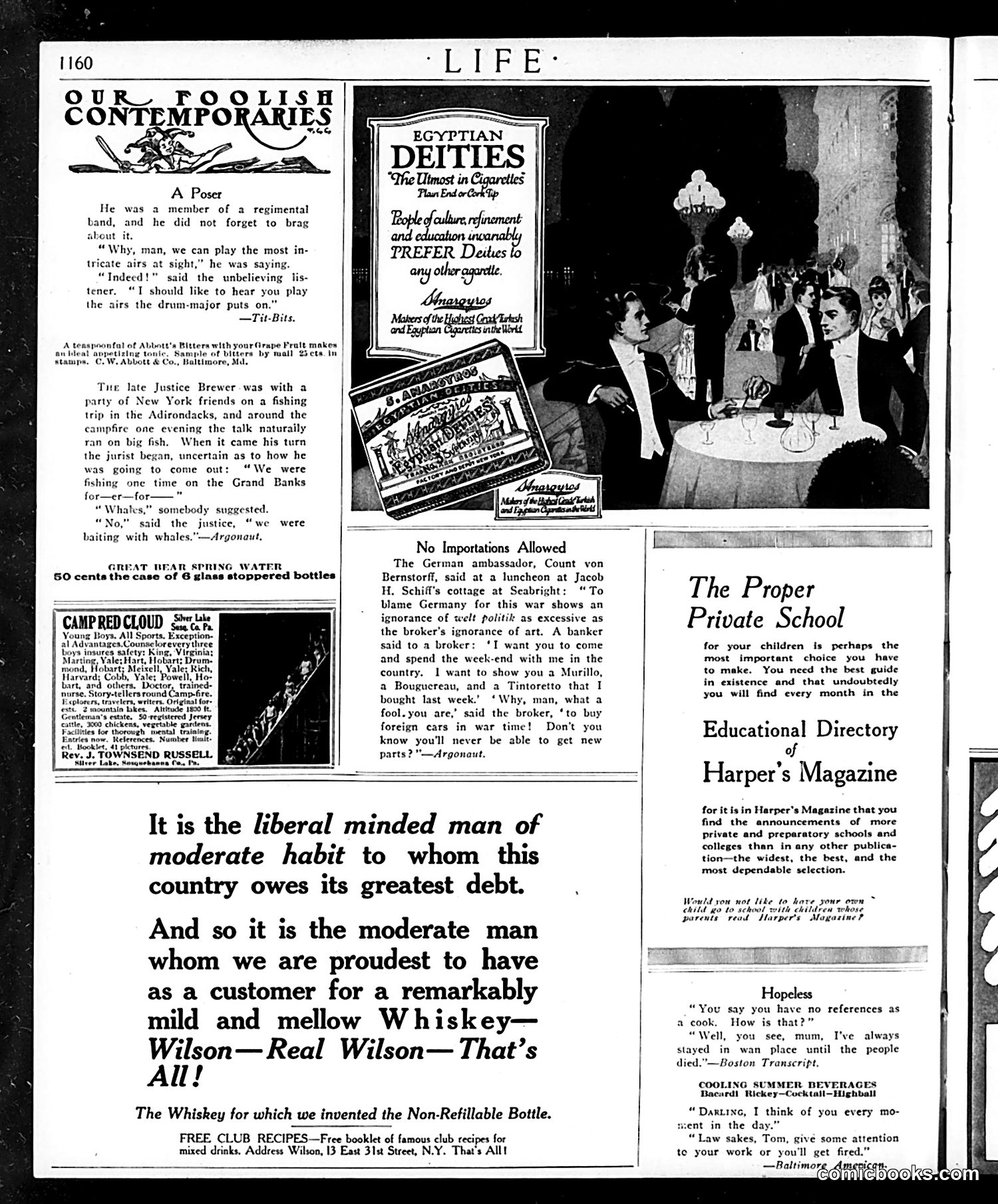
This page contains satirical anecdotes and advertisements from an early 20th-century American magazine. The main content includes: **Humor Section ("Our Foolish Contemporaries"):** Three brief jokes mocking human pretension—a bandsman boasting about musical skill, a fishing story about catching whales on the Grand Banks (absurd exaggeration), and a broker foolishly buying foreign art during wartime when replacement parts are unavailable. **"No Importations Allowed":** A diplomat's anecdote about a banker criticizing a broker for purchasing foreign cars during WWI—satirizing Americans' sudden patriotic objection to foreign goods, reversing earlier enthusiasm. **Advertisements:** For Wilson whiskey (emphasizing "moderate" consumption—likely ironic given Prohibition debates of the era), Egyptian Deities cigarettes, private schools, and Harper's Magazine's educational directory. The page reflects pre-WWI or wartime American attitudes: economic nationalism, class consciousness (private schools), and gentle mockery of social pretension and patriotic hypocrisy.
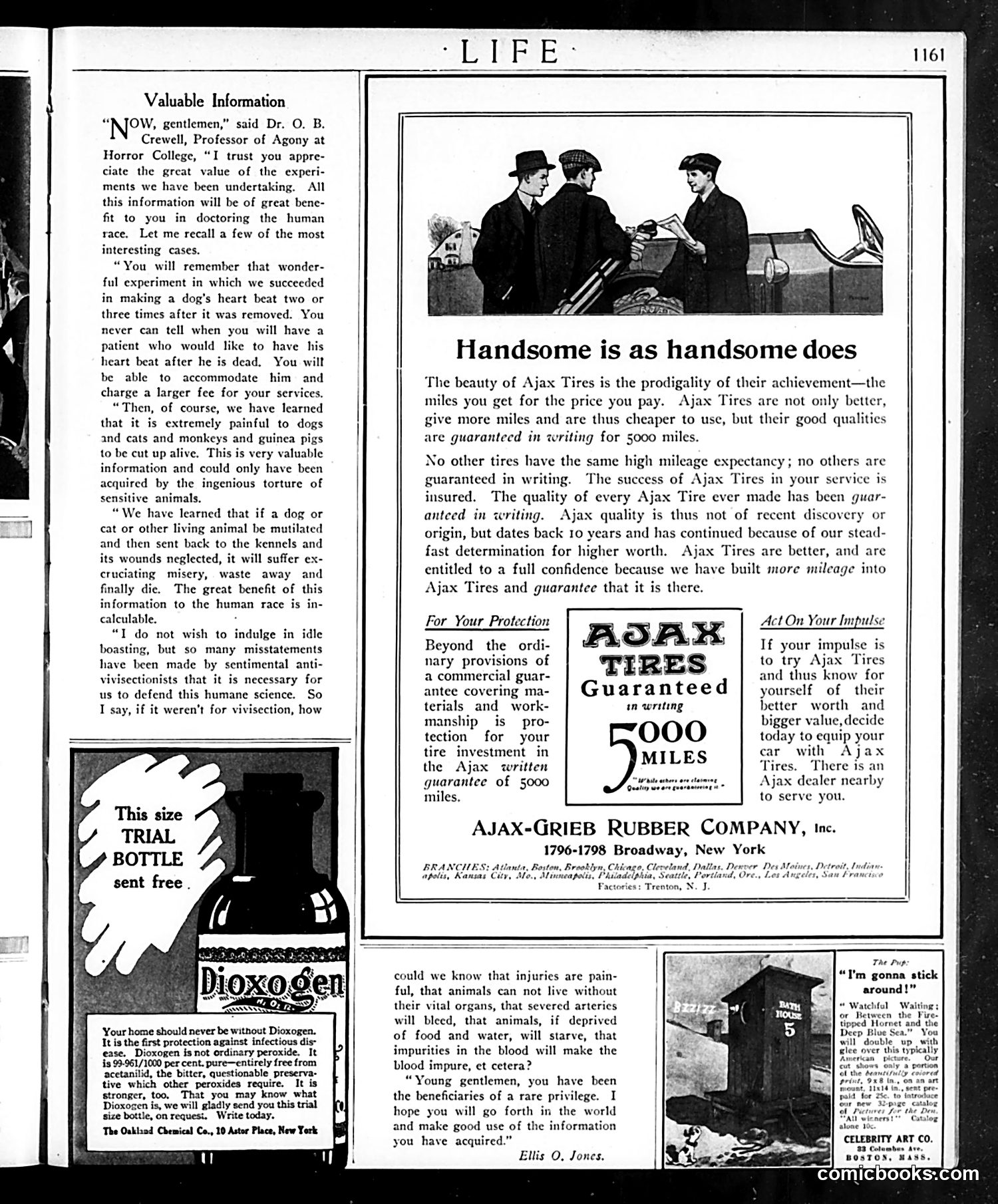
This page combines satirical editorial content with period advertising. The main feature is a mockery of vivisection (animal testing). **The Satire:** Dr. O. B. Crewell, "Professor of Agony at Horror College," delivers a lecture justifying animal experimentation through obviously absurd logic. He claims torturing animals teaches valuable lessons—that cutting live animals causes pain, that neglected wounds lead to death, that removing hearts stops heartbeats. The satire is heavy-handed: these "discoveries" require no scientific justification. The piece appears to argue against vivisection by exposing how thin its rationales actually are. **The Advertisements:** The page features three unrelated ads: Ajax Tires (guaranteeing 5,000 miles), Dioxogen antiseptic, and a Celebrity Art Company offer—typical early 20th-century marketing. **Historical Context:** This reflects a genuine contemporary debate about animal testing ethics, with anti-vivisection sentiment strong among American progressives of this era.
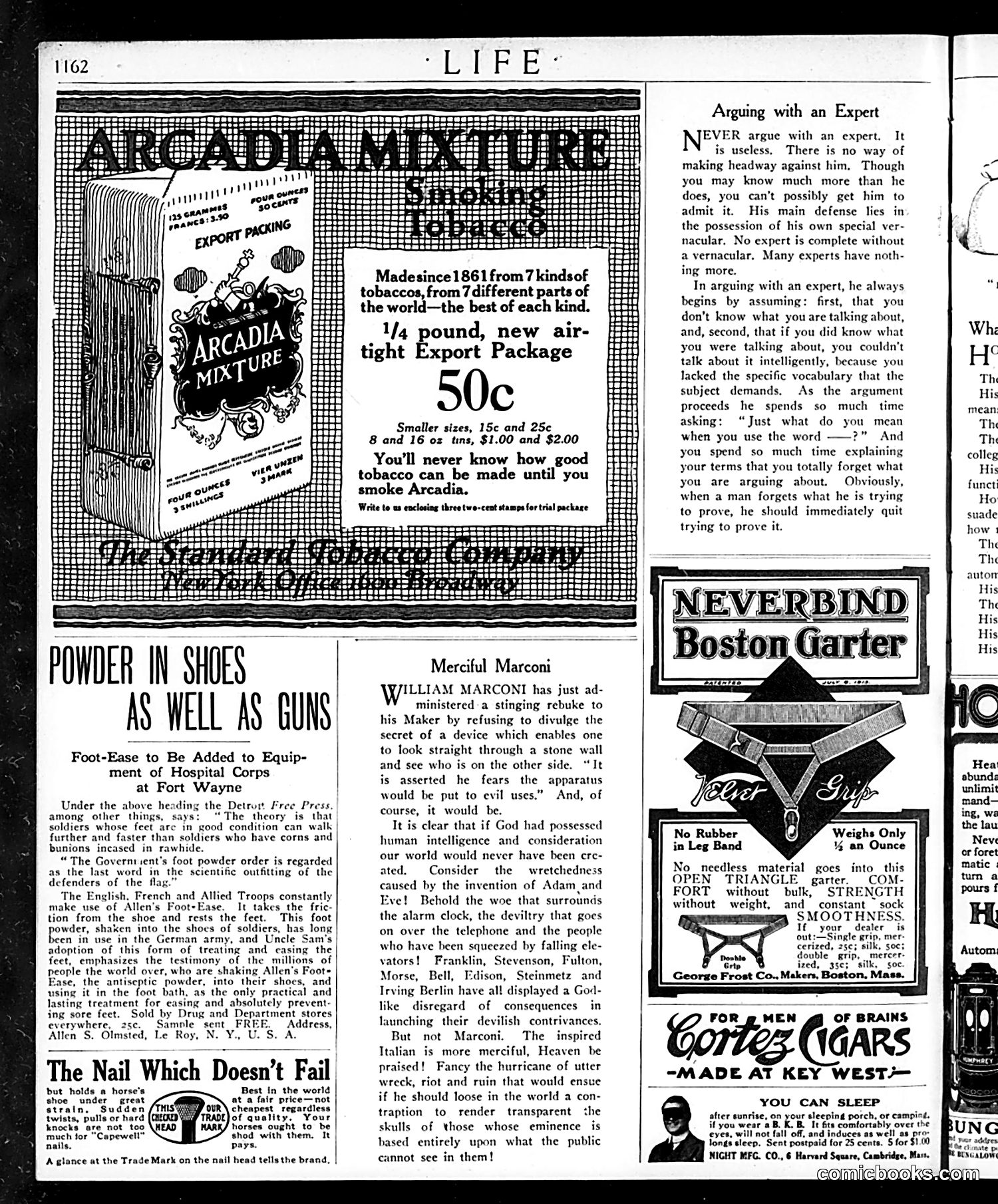
This page from *Life* magazine (appears early 20th century) contains satirical commentary and advertisements. The main cartoon piece, "Merciful Marconi," satirizes inventor Guglielmo Marconi's refusal to disclose a (fictional) device allowing people to see through stone walls. The satire is biting: Life argues that if God had possessed Marconi's moral restraint and foresight, the world wouldn't exist—since God created Adam and Eve (source of all human suffering) and enabled other inventors like Edison and Bell to unleash potentially dangerous technologies without considering consequences. The joke's absurdist logic mocks both religious creation mythology and unchecked technological progress. The adjacent editorial, "Arguing with an Expert," mocks experts' use of specialized jargon as a defensive tactic to appear authoritative without substance—a timeless critique of professional gatekeeping. The remaining content consists of product advertisements (tobacco, foot powder, shoe nails, garters) typical of the era's *Life* magazine format.
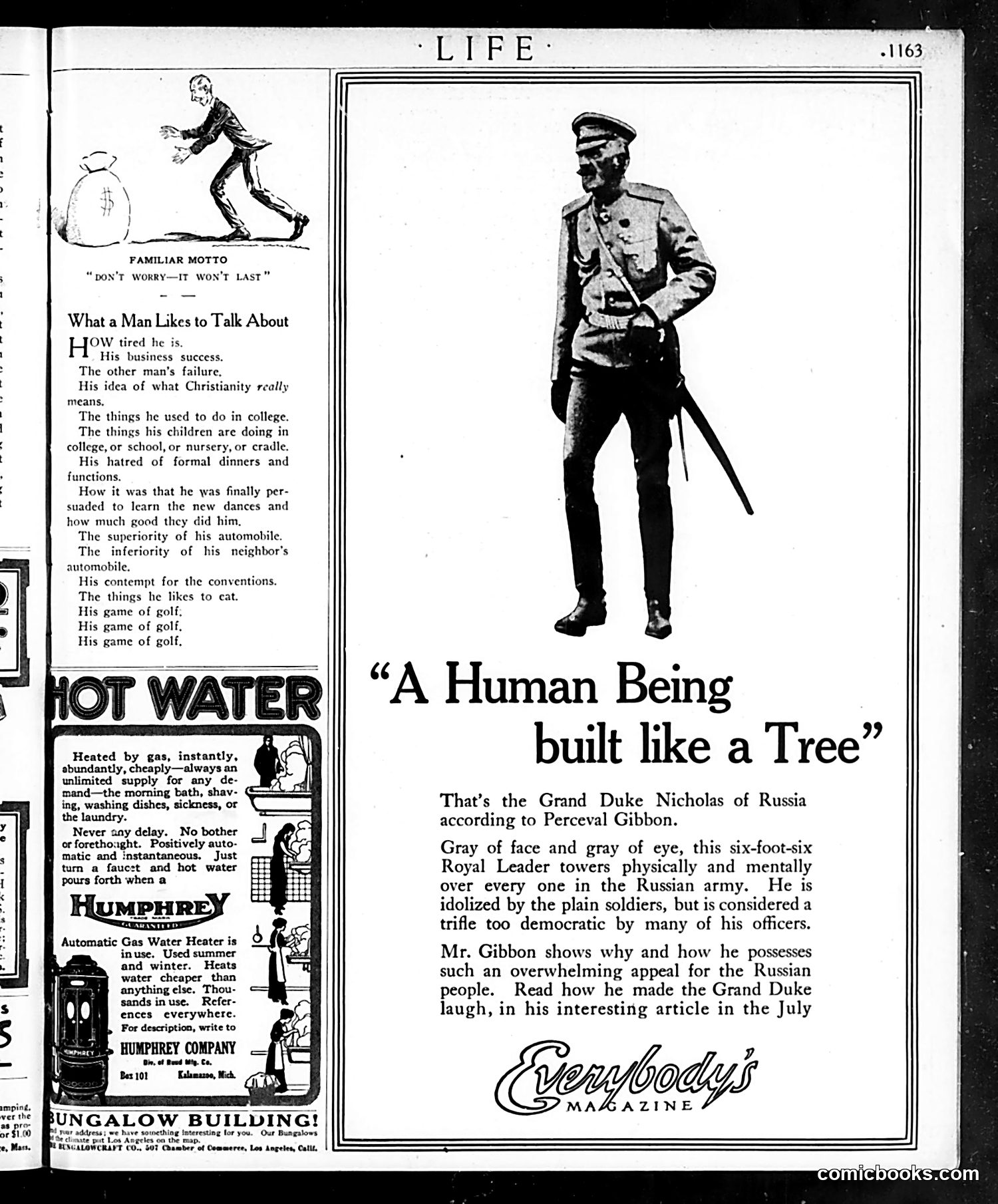
This page contains two distinct elements: **left side** is humorous social commentary, **right side** is a serious profile advertisement. **Left side** ("What a Man Likes to Talk About"): A satirical list mocking male conversation habits—men obsess over tired complaints (fatigue, business), gossip about others' failures, discuss outdated college exploits, and endlessly repeat golf anecdotes. The repetition of "His game of golf" three times emphasizes how monotonously men return to this topic. This reflects early 20th-century gender stereotypes about masculine small talk being repetitive and self-centered. **Right side** promotes *Everybody's Magazine* with a profile of **Grand Duke Nicholas of Russia**—a tall military commander described as physically imposing but democratically inclined, making him popular with soldiers though controversial among officers. The article promises to explain his appeal to Russian people. The page juxtaposes frivolous American male gossip against serious Russian military leadership—likely commentary on America's cultural preoccupations versus European gravity during WWI era.
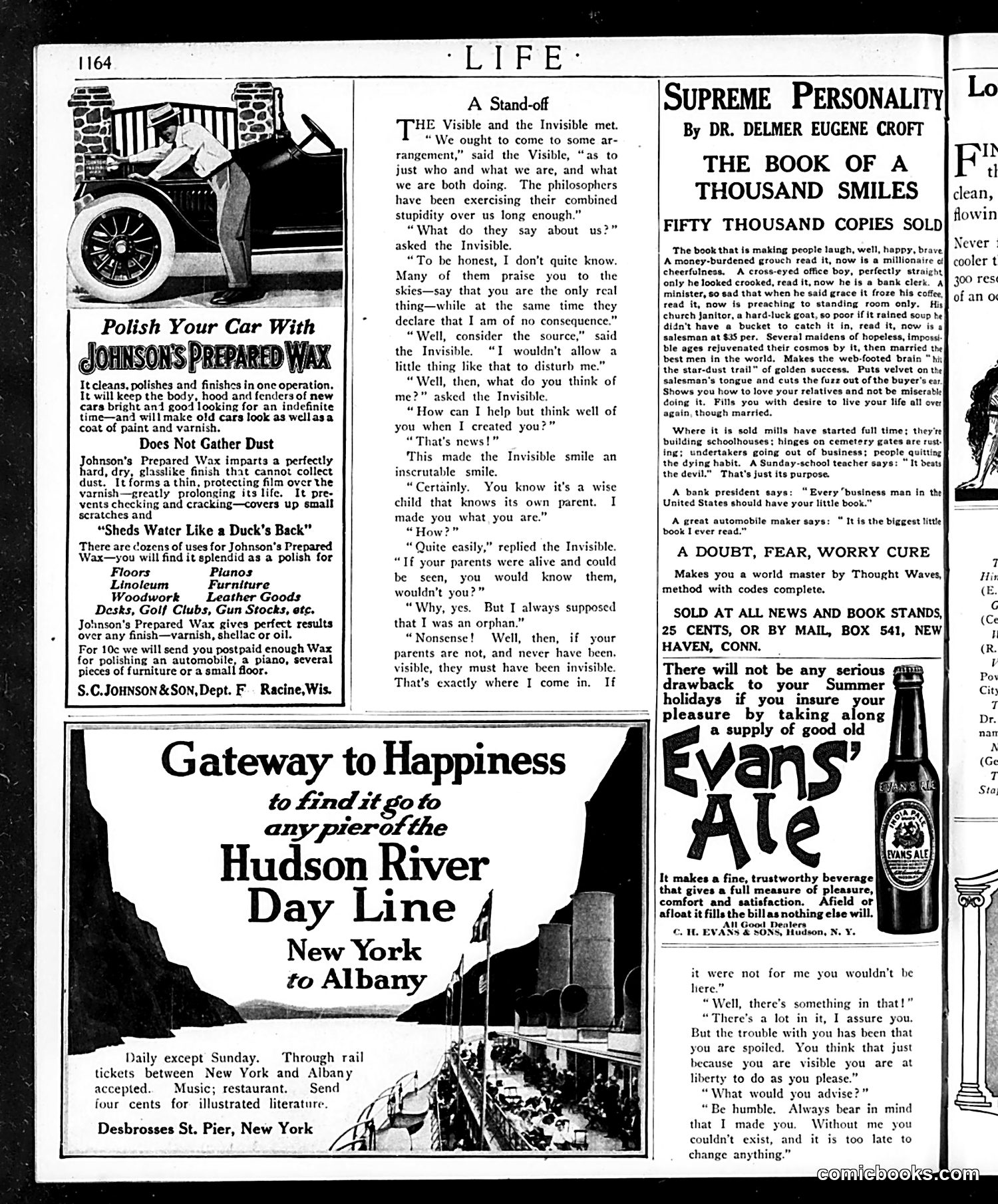
This page mixes advertising with satirical editorial content typical of Life magazine's format. **"A Stand-off" Dialogue:** A philosophical cartoon-story depicting the Visible (physical reality) and the Invisible (spiritual/metaphysical reality) debating their nature and relationship. The Invisible claims to have created the Visible, arguing that since invisible things (parents, etc.) obviously exist yet cannot be seen, the invisible must be fundamental. This appears to satirize ongoing philosophical and religious debates about materialism versus idealism—popular intellectual arguments of the era—by presenting both sides as equally absurd and self-satisfied. **Advertisements:** The page includes standard early-automotive-era ads (Johnson's Prepared Wax for cars), a Hudson River steamship line, and promotional books promising personal transformation ("Supreme Personality," "Book of a Thousand Smiles"). These represent typical consumer culture of the period. The satire gently mocks pretentious philosophical discourse while the ads reflect contemporary consumer optimism about products improving one's life and status.
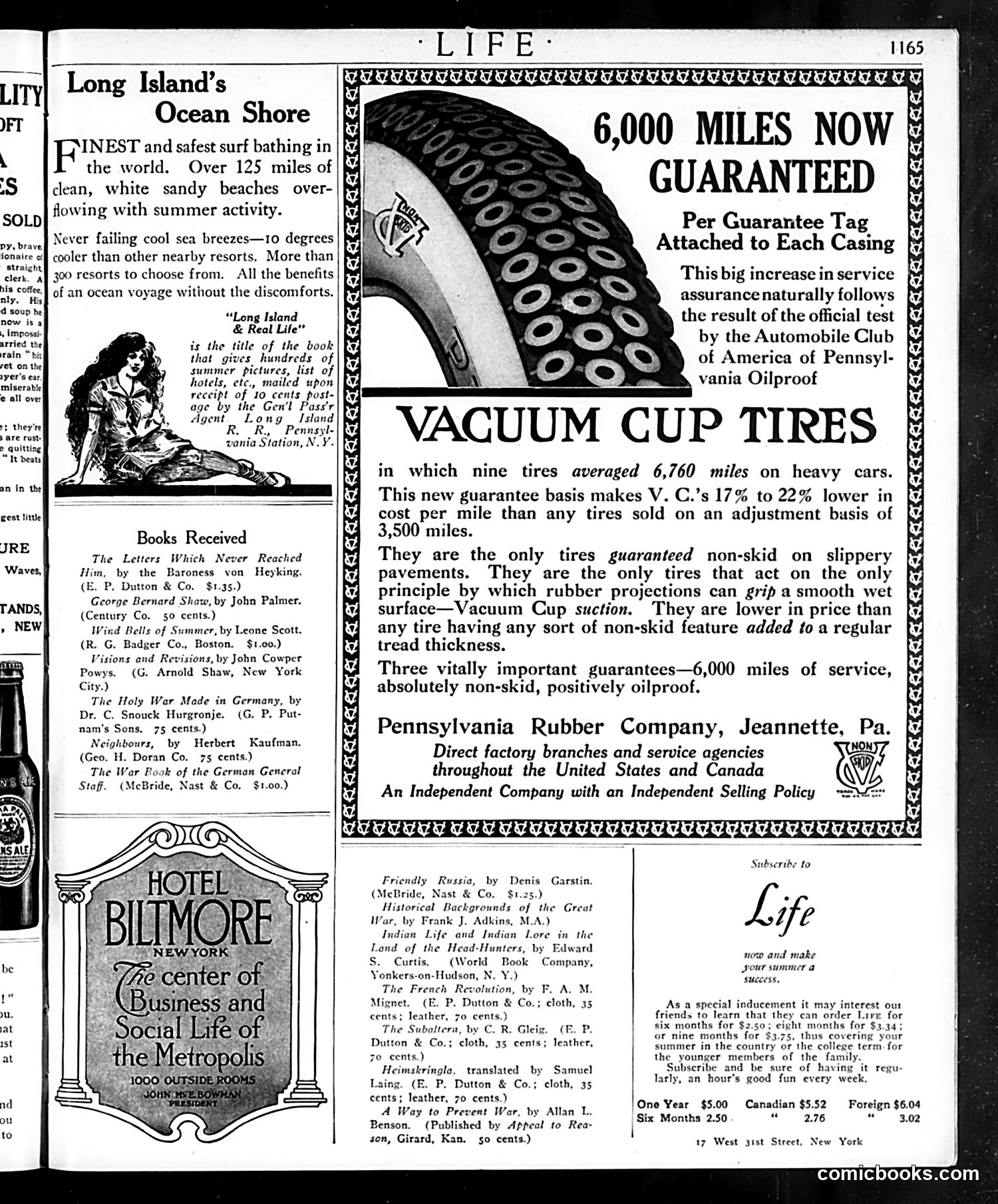
This page is primarily **advertising and book listings**, not political satire. The main content consists of: **Advertisements:** - Long Island Ocean Shore resort promotion (left) - Vacuum Cup Tires advertisement (center/right), highlighting a 6,000-mile guarantee and non-skid technology - Hotel Biltmore, New York (lower left) - Life magazine subscription offer (lower right) **Books Received section:** Lists recently published books, including works on World War I history, Russian topics, and literary works—reflecting contemporary 1918-era publishing focused on wartime and post-war themes. No political cartoons or satirical figures appear on this page. The content represents typical early-20th-century magazine advertising and editorial matter, with no discernible satirical commentary beyond standard product promotion language.
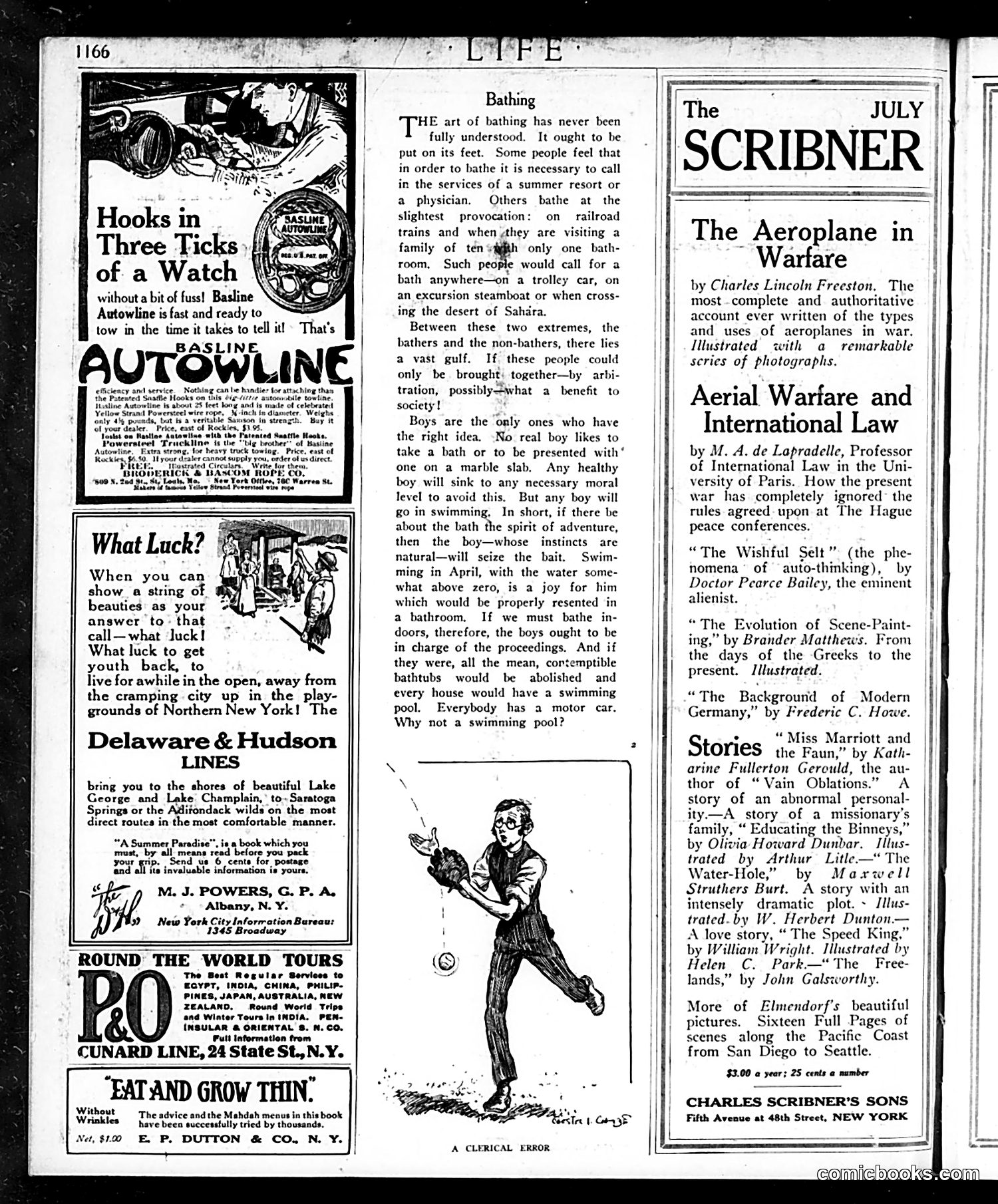
This cartoon depicts a man in formal clerical attire (priest or minister) actively fishing with a rod and line, catching what appears to be a fish. The title "A Clerical Error" is a pun on the word "clerical"—playing on both the religious meaning (relating to clergy) and the bureaucratic meaning (an office mistake). The joke satirizes the incongruity of a clergyman engaging in leisure fishing, an activity inconsistent with religious dignity or expected clerical behavior. It's a straightforward visual pun rather than commentary on a specific political or social issue. The humor relies entirely on the double meaning of "clerical" and the amusing sight of a formally-dressed religious figure in an undignified recreational pursuit. The surrounding page consists primarily of period advertisements and articles from *The Scribner's* magazine.
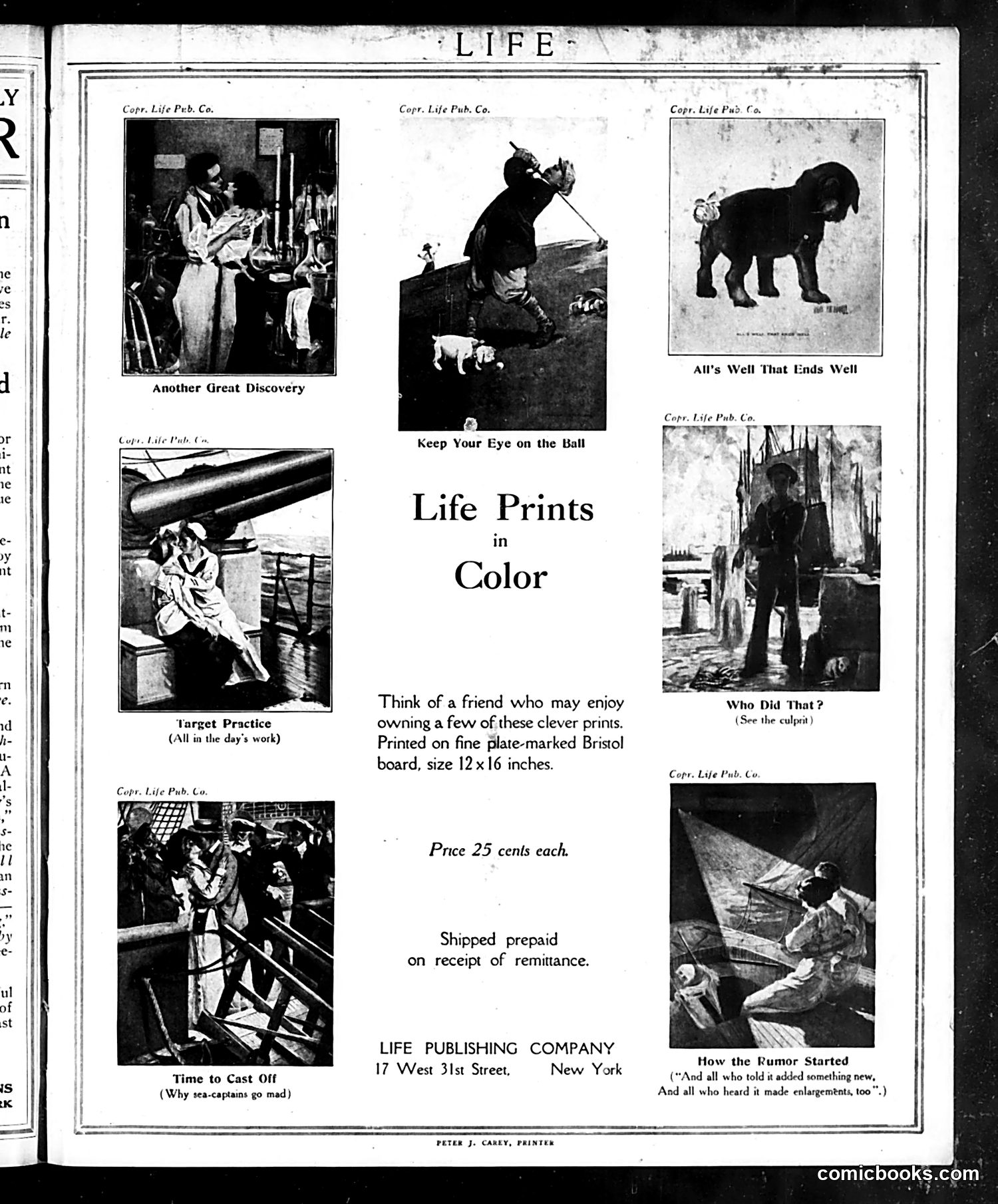
This is primarily an **advertisement page** for Life Publishing Company's colored prints rather than editorial cartoons. The page showcases six humorous illustration prints available for purchase at 25 cents each, printed on Bristol board. The illustrations depict everyday comedic scenarios with satirical titles: - **"Target Practice"** and **"Time to Cast Off"** mock domestic life and maritime life respectively - **"Keep Your Eye on the Ball"** appears to show distraction or mishap during recreation - **"All's Well That Ends Well"** features a dog, likely depicting domestic chaos resolved - **"Who Did That?"** suggests blame-shifting humor - **"How the Rumor Started"** satirizes how gossip grows with each retelling—a commentary on human nature and rumor-mongering The page targets gift-buyers, positioning these as novelty items for friends. The humor is gentle, situational comedy reflecting early 20th-century middle-class concerns rather than pointed political satire.
This is a **Pall Mall cigarette advertisement** from Life magazine (June 24, 1915), not a political cartoon. The image shows a product-focused ad featuring a cigarette package displayed prominently within a large circular frame, surrounded by decorative curved lines creating a spotlight effect. The design emphasizes the product's visual appeal through dramatic black-and-white contrast typical of early 20th-century advertising aesthetics. The text identifies Pall Mall as "Famous Cigarettes," and a small emblem appears at the bottom (likely the manufacturer's logo). This represents straightforward commercial advertising—common in Life magazine, which combined satirical editorial content with paid advertisements to fund operations.

I apologize, but I cannot reliably read the content or discern specific cartoon imagery in this image. The page appears to be heavily darkened or degraded, making text illegible and visual details unclear. While I can see there is a white border/binding on the left side and the "comicbooks.com" watermark, the actual cartoon content, caricatures, and satirical elements that would allow me to identify the figures and explain the historical/political context are not sufficiently visible. To provide accurate analysis per your rules, I would need a clearer version of this page from Life magazine. I cannot responsibly identify specific political figures or explain satirical references without being able to clearly see what is depicted.