
Life, 1915-06-24 · page 21 of 45
Life — June 24, 1915 — page 21: what you’re looking at
What you’re looking at
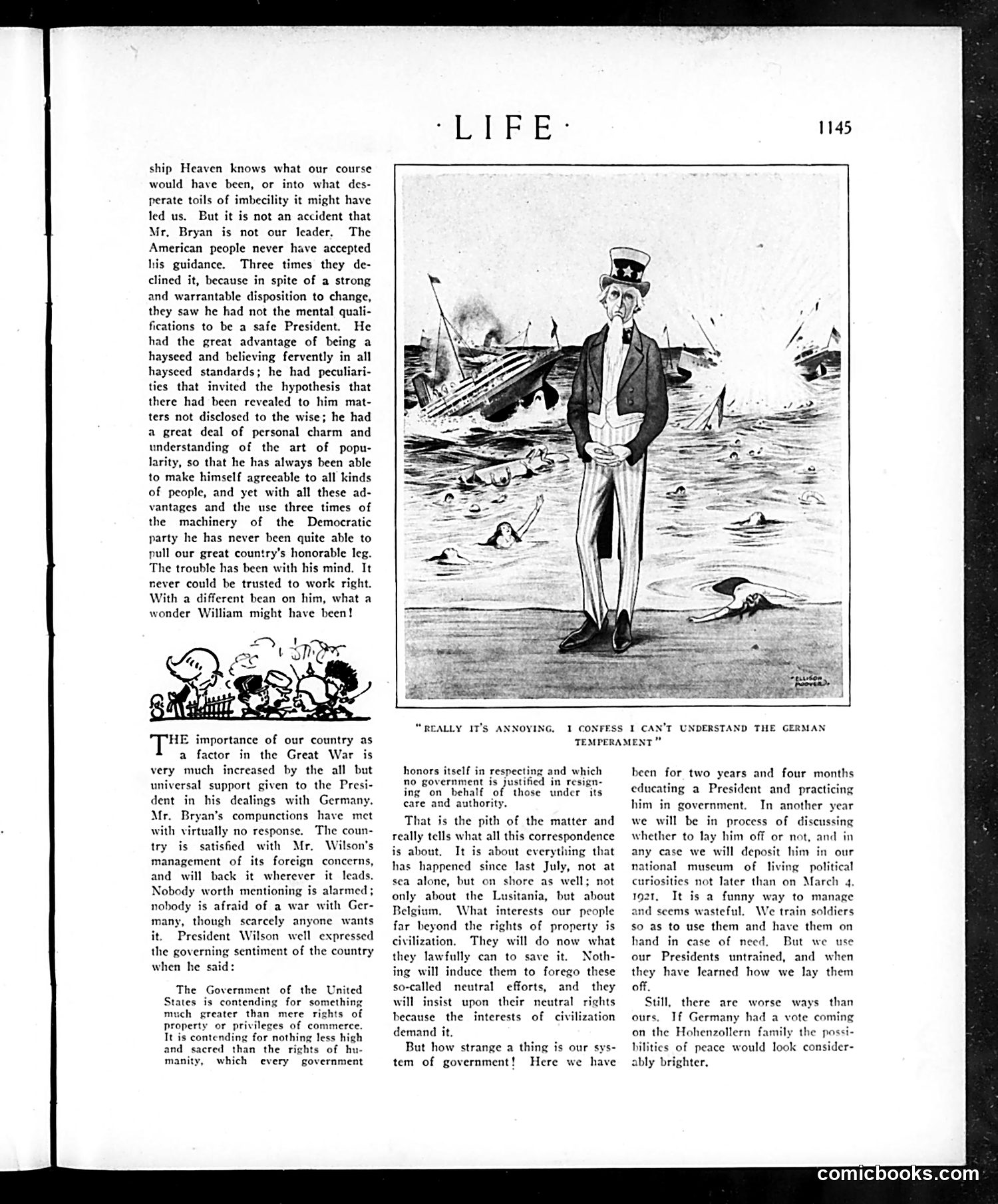
The main cartoon depicts Uncle Sam standing amid shipwrecks and drowning victims, captioned "Really it's annoying, I confess I can't understand the German temperament." This sarcastically critiques American neutrality during WWI—Uncle Sam's bemused expression contrasts grotesquely with the maritime disaster behind him, likely referencing the *Lusitania* sinking (mentioned in the text). The accompanying article attacks William Jennings Bryan, three-time presidential candidate and Secretary of State under Wilson, for his pacifist objections to American foreign policy. The author mocks Bryan as an intellectual lightweight—a "hayseed" unfit to lead—whose moral qualms about entering WWI lack public support. The piece defends President Wilson's hardline approach, framing WWI as a struggle for "civilization" itself, not mere property rights. It concludes with satirical commentary on American democracy's inefficiency: training a president for years only to replace him every four years. The satire targets both Bryan's anti-war stance and American indecision regarding WWI involvement.
📄 Transcribed text from this page (OCR, searchable)
Machine-transcribed from the original scan — historical spelling and the odd misread are preserved.
ship Heaven knows what our course would have been, or into what des- perate toils of imbecility it might have led us. But it is not an accident that Mr. Bryan is not our leader, The American people never have accepted his guidance. Three times they de- clined it, because in spite of a strong and warrantable disposition to change, they saw he had not the mental quali- fications to be a safe President. He had the great advantage of being a hayseed and believing fervently in all hayseed standards; he had _ peculiari- ties that invited the hypothesis that there had been revealed to him mat- ters not disclosed to the wise; he had a great deal of personal charm and understanding of the art of popu- larity, so that he has always been able to make himself agreeable to all kinds of people, and yet with all these ad- vantages and the use three times of the machinery of the Democratic party he has never been quite able to pull our great country’s honorable leg. The trouble has been with his mind. It never could be trusted to work right. With a different bean on him, what a wonder William might have been! importance of our country as a factor in the Great War is T# very much increased by the all but universal support given to the Presi- dent in his dealings with Germany. Mr. Bryan's compunctions have met with virtually no response. The coun- try is satisfied with Mr. Wilson's management of its foreign concerns, and will back it wherever it leads. Nobody worth mentioning is alarmed nobody is afraid of a war with Ger- many, though scarcely anyone wants it. President Wilson well expressed the governing sentiment of the country when he said: The Government of the United States is contending for something much greater than mere rights of Property or privileges of commerce. It is contending for nothing less high and sacred than the rights of hu- which every government “REALLY 11'S ANNOYING, 1 CONFESS I CAN'T UNDERSTAND THE GERMAN TEMPERAMENT” honors itself in respecting and which no government is justified in resign- ing on behalf of those under its care and authority, That is the pith of the matter and really tells what all this correspondence is about. It is about everything that has happened since last July, not at sea alone, but on shore as well; not only about the Lusitania, but about Belgium, What interests our people far beyond the rights of property is civilization. They will do now what they lawfully can to save it. Noth- ing will induce them to forego these so-called neutral efforts, and they will insist upon their neutral rights because the interests of civilization demand it. But how strange a thing is our s tem of government! Here we have been for two years and four months educating a President and practicing him in government. In another year we will be in process of discussing whether to lay him off or not, and in any case we will deposit him in our national museum of living political curiosities not later than on March 4. 1921, It is a funny way to manage and seems wasteful. We train soldiers so as to use them and have them on hand in case of need. But we use our Presidents untrained, and when they have learned how we lay them ill, there are worse than ours. If Germany had a vote coming on the Hohenzollern family the possi- hilities of peace would look consider- ably brighter, ways comicbooks.com