
Life, 1915-06-24 · page 10 of 45
Life — June 24, 1915 — page 10: what you’re looking at
What you’re looking at
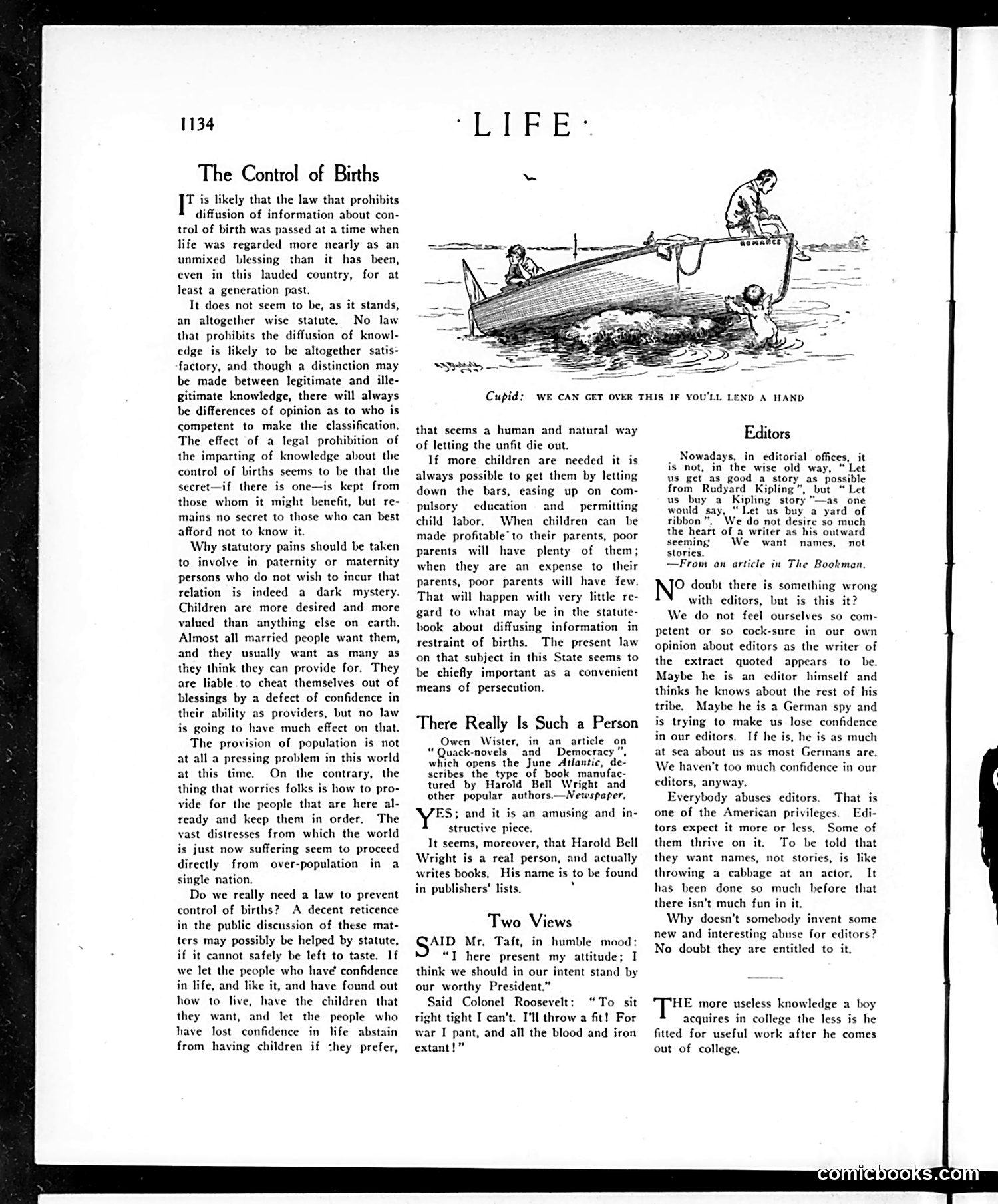
The illustration depicts multiple figures working together to haul a boat or vessel, with the caption "Cupid: We can get over this if you'll lend a hand." This appears to be a satirical commentary on birth control, given the article's title "The Control of Births." Cupid—traditionally associated with love and procreation—is portrayed as needing assistance, suggesting the difficulty or impediment of natural reproduction under restrictive laws. The multiple figures cooperating likely represent society working together to address population concerns. The cartoon satirizes legal prohibitions on birth control information by showing that even romantic/reproductive matters require collective effort to overcome obstacles. This reflects early 20th-century debates over contraception access and information dissemination.
📄 Transcribed text from this page (OCR, searchable)
Machine-transcribed from the original scan — historical spelling and the odd misread are preserved.
1134 The Control of Births I" is likely that the law that prohibits diffusion of information about con- trol of birth was passed at a time when life was regarded more nearly as an unmixed blessing than it has been, even in this lauded country, for at least a generation past. It does not seem to be, as it stands, an altogether wise statute. No law that prohibits the diffusion of knowl- edge is likely to be altogether satis- factory, and though a distinction may be made between legitimate and ille- gitimate knowledge, there will always be differences of opinion as to who is competent to make the classification. The effect of a legal prohibition of the imparting of knowledge about the control of births seems to be that the secret there is one—is kept from those whom it might benefit, but re- mains no secret to those who can best afford not to know it. Why statutory pains should be taken to involve in paternity or maternity persons who do not wish to incur that relation is indeed a dark mystery. Children are more desired and more valued than anything else on earth. Almost all married people want them, and they usually want as many as they think they can provide for. They are liable.to cheat themselves out of Dlessings by a defect of confidence in their ability as providers, but no law is going to have much effect on that. The provision of population is not at all a pressing problem in this world at this time. On the contrary, the thing that worries folks is how to pro- vide for the people that are here al- ready and keep them in order. The vast distresses from which the world is just now suffering seem to proceed directly from over-population in a single nation. Do we really need a law to prevent control of births? A decent reticence in the public discussion of these mat- ters may possibly be helped by statute, if it cannot safely be left to taste. If we let the people who have confidence in life, and like it, and have found out how to live, have the children that they want, and let the people who have lost confidence in life abstain from having children if they prefer, Cupid: that seems a human and natural way of letting the unfit die out. If more children are needed it is always possible to get them by letting down the bars, easing up on com- pulsory education and __ permitting child labor. When children can be made profitable’ to their parents, poor parents will have plenty of them; when they are an expense to their Parents, poor parents will have few. That will happen with very little re- gard to what may be in the statute- book about diffusing information in restraint of births. The present law on that subject in this State seems to be chiefly important as a convenient means of persecution. There Really Is Such a Person Owen Wister, in an article on “ Quack-novels and Democracy”, which opens the June Atlantic, de- scribes the type of book manufac- tured by Harold Bell Wright and other popular authors.—Newspaper, ES; and it is an amusing and in- structive piece. It seems, moreover, that Harold Bell Wright is a real person, and actually writes books. His name is to be found in publishers’ lists. i Two Views AID Mr, Taft, in humble mood: “I here present my attitude; I think we should in our intent stand by our worthy President.” Said Colonel Roosevelt: “To sit right tight I can’t. I'll throw a fit! For war I pant, and all the blood and iron extant!” WE CAN GET OVER THIS IF YO ‘LL LEND A HAND Editors _ Nowadays, in editorial offices, it is not, in the wise old way, “Let us get_as good a story from Rudyard Kipling”, us buy a Kipling story would say, “Let us buy a yard of ribbon”. We do not desire so much the heart of a writer as his outward seeming We want names, not stories. —From an article in The Bookman, N° doubt there is something wrong with editors, but is this it? We do not feel ourselves so com- petent or so cock-sure in our own opinion about editors as the writer of the extract quoted appears to be. Maybe he is an editor himself and thinks he knows about the rest of his tribe. Maybe he is a German spy and is trying to make us lose confidence in our editors. If he is, he is as much at sea about us as most Germans are. We haven't too much confidence in our editors, anyway, Everybody abuses editors. That is one of the American privileges. Edi- tors expect it more or less, Some of them thrive on it. To be told that they want names, not stories, is like throwing a cabbage at an actor. It has been done so much before that there isn’t much fun in it. Why doesn’t somebody invent some new and interesting abuse for editors? No doubt they are entitled to it. THE more useless knowledge a boy acquires in college the less is he fitted for useful work after he comes out of college.