
Life, 1915-06-24 · page 24 of 45
Life — June 24, 1915 — page 24: what you’re looking at
What you’re looking at
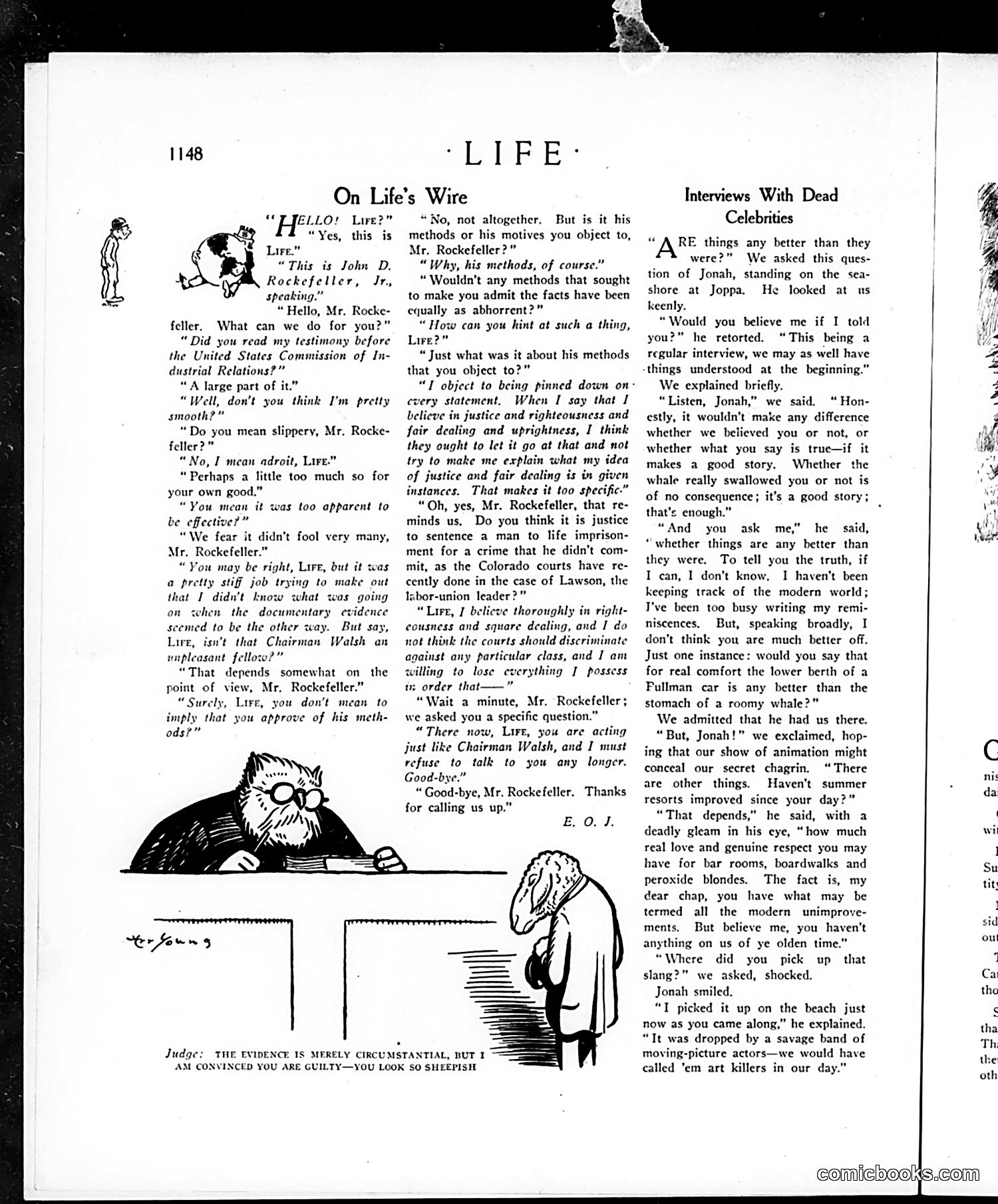
This page satirizes **John D. Rockefeller Jr.** during his testimony before the U.S. Commission on Industrial Relations. The left column mocks his evasive testimony: when asked about objectionable "methods," Rockefeller insists on speaking vaguely about "justice and righteousness" rather than addressing specific facts. The satire highlights how his abstract platitudes—and refusal to answer direct questions—reveal he's either dishonest or obtuse. The interviewer ("Lire," Life magazine) points out that Rockefeller's testimony wasn't persuasive because the documentary evidence contradicted his claims of ignorance. The right column contains an unrelated interview with the biblical figure Jonah, using him as a device to comment on modern discomfort and lack of genuine progress. **Context**: This reflects Progressive Era criticism of wealthy industrialists' attempts to manage their public image through carefully crafted but hollow testimony during labor disputes and antitrust investigations.
📄 Transcribed text from this page (OCR, searchable)
Machine-transcribed from the original scan — historical spelling and the odd misread are preserved.
1148 nile leak On Life’s Wire LO! Lire?” “H Yes, this is & Li “This is John D. Rockefeller, Ir, speaking.” “Hello, Mr. Rocke- feller, What can we do for you?” “Did you read my testimony before the United States Commission of In- dustrial Relations?” “A large part of it.” “Well, don't you think I’m pretty smooth?” “Do you mean slippery, Mr. Rocke- feller?” “No, I mean adroit, Lire.” “Perhaps a little too much so for your own good,” “You mean it was too apparent to be effective?” “We fear it didn’t fool very many, Mr. Rockefeller.” “You may be right, Lire, but it was a pretty stiff job trying to make out that I didn't know what was going on when the documentary evidence seemed to be the other way. But say, Lire, isn’t that Chairman Walsh an inpleasant fellow?” “That depends somewhat on the point of view, Mr. Rockefeller.” “Surely, Lire, you don’t mean to imply that you approve of his meth- ods?” Judge: THE EVIDENCE IS MERELY CIRCUMSTANTIAL, BUT I AM CONVINCED YOU ARE GUILTY—YOU LOOK SO SHEEPISH “No, not altogether. But is it his methods or his motives you object to, Mr. Rockefeller?” “Why, his methods, of course.” “Wouldn’t any methods that sought to make you admit the facts have been equally as abhorrent?” “How can you hint at such a thing, Lire?” “ Just what was it about his methods that you object to?” “T object to being pinned down on: every statement, When I say that I believe in justice and righteousness and fair dealing and uprightness, I think they ought to let it go at that and not try to make me explain what my idea of justice and fair dealing is in given instances. That makes it too specific.” “Oh, yes, Mr. Rockefeller, that re- minds us, Do you think it is justice to sentence a man to life imprison- ment for a crime that he didn’t com- mit, as the Colorado courts have re- cently done in the case of Lawson, the labor-union leader?” “Lire, J believe thoroughly in right- cousness and square dealing, and I do not think the courts should discriminate against any particular class, and I am willing to lose everything I] possess t order that——” “Wait a minute, Mr. Rockefeller; we asked you a specific question.” “There now, Lire, you are acting just like Chairman Walsh, and I must refuse to talk to you any longer. Good-bye.” “Good-bye, Mr. Rockefeller. Thanks for calling us up.” E,.0. J: Interviews With Dead Celebrities SARE things any better than they were?” We asked this ques- tion of Jonah, standing on the sea- shore at Joppa. He looked at us keenly, “Would you believe me if I told you?” he retorted. “This being a regular interview, we may as well have things understood at the beginning.” We explained briefly. “Listen, Jonah,” we said. “ Hon- estly, it wouldn’t make any difference whether we believed you or not, or whether what you say is true—if it makes a good story. Whether the whale really swallowed you or not is of no consequence; it's a good story; that’s enough.” “And you ask me,” he said, “whether things are any better than they were. To tell you the truth, if IT can, I don't know, I haven't been keeping track of the modern world; I've been too busy writing my remi- niscences. But, speaking broadly, I don’t think you are much better off. Just one instance: would you say that for real comfort the lower berth of a Pullman car is any better than the stomach of a roomy whale?” We admitted that he had us there. “But, Jonah!” we exclaimed, hop- ing that our show of animation might conceal our secret chagrin. “There are other things. Haven’t summer resorts improved since your day?” “That depends,” he said, with a deadly gleam in his eye, “how much real love and genuine respect you may have for bar rooms, boardwalks and peroxide blondes. The fact is, my dear chap, you have what may be termed all the modern unimprove- ments, But believe me, you haven't anything on us of ye olden time.” “Where did you pick up that slang?” we asked, shocked. Jonah smiled. “T picked it up on the beach just now as you came along,” he explained. “It was dropped by a savage band of moving-picture actors—we would have called ‘em art killers in our day.” comichoo!