
Life, 1915-06-24 · page 26 of 45
Life — June 24, 1915 — page 26: what you’re looking at
What you’re looking at
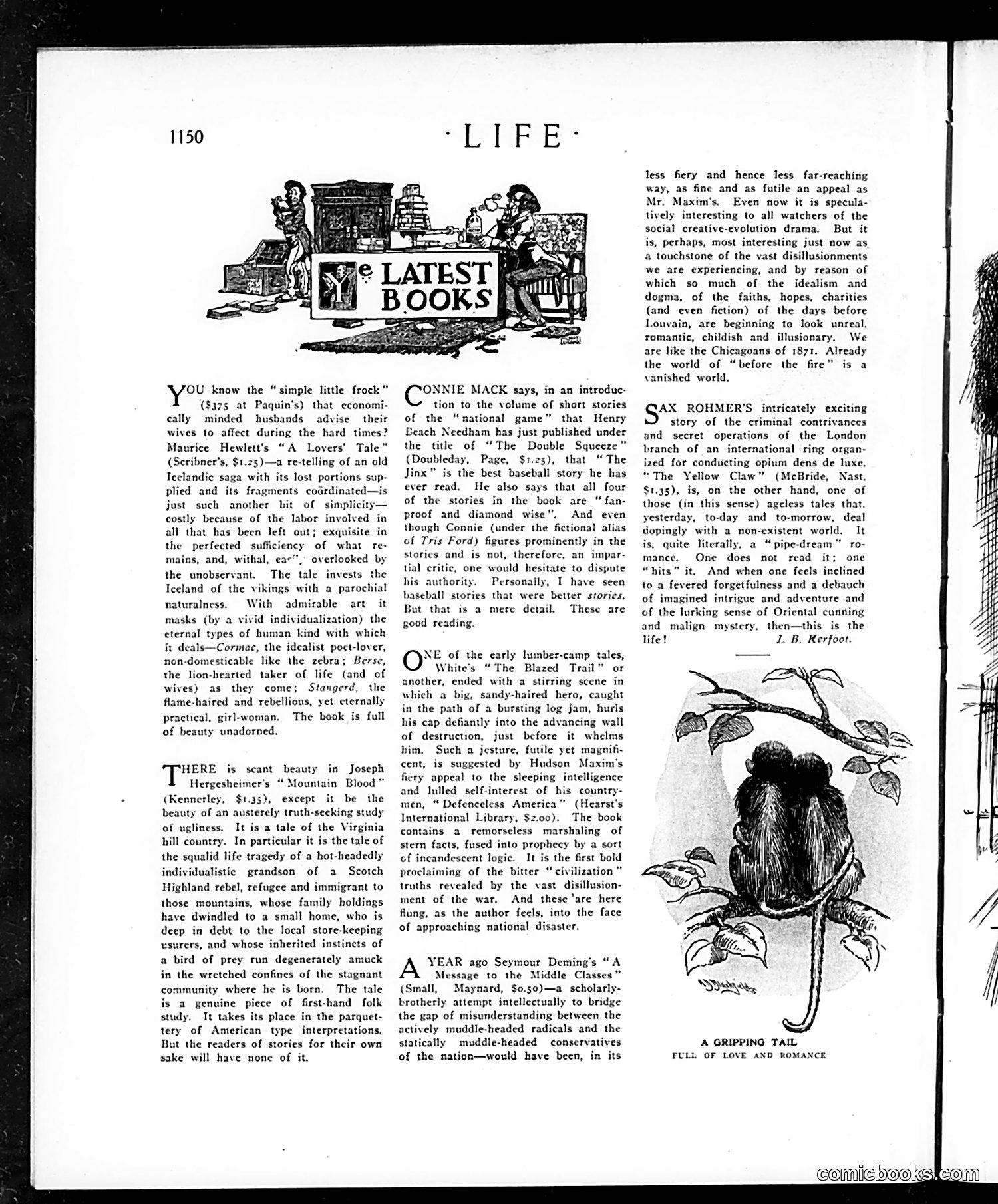
This is a **book review section**, not a political cartoon. The page features reviews of five contemporary works, with a decorative header illustration showing figures reading. **Key content:** - **Maurice Hewlett's "A Lovers' Tale"**: An Icelandic saga retelling praised for its artistic economy - **Joseph Hergesheimer's "Mountain Blood"**: A Virginia hill-country tragedy depicting generational decline and social decay - **Henry Beach Needham's "The Double Squeeze"**: Baseball stories endorsed by real manager Connie Mack - **Hudson Maxim's "Defenceless America"**: A militaristic warning about national vulnerability, using war disillusionment to argue for preparedness - **Seymour Deming's "A Message to the Middle Classes"**: An intellectual attempt to bridge radical-conservative divides The reviews reflect post-WWI anxieties about American strength and social cohesion. The illustration shows a botanical plant study, unrelated to the text.
📄 Transcribed text from this page (OCR, searchable)
Machine-transcribed from the original scan — historical spelling and the odd misread are preserved.
‘OU know the “simple little frock” ($375 at Paquin’s) that economi- cally minded husbands advise their wives to affect during the hard times? Maurice Hewlett’s “A Lovers’ Tale” (Scribner's, $1.25)—a re-telling of an old Teclandic saga with its lost portions sv plied and its fragments codrdinated—is just such another bit of simplicity costly because of the labor involved in all that has been left out; exquisite in the perfected sufficiency of what re- mains, and, withal, ear’, overlooked by the unobservant. The tale invests Tceland of the vikings with a parochial naturalness. With admirable art it masks (by a vivid individualization) the eternal types of human kind with which it deals—Cormac, the idealist poct-lover, non-domesticable like the zebra; Berse, the lion-hearted taker of life (and of wives) as they come; Stangerd, the flame-haired and rebellious, yet eternally practical, girl-woman. The book is full of beauty unadorned. beauty in Joseph Hergesheimer’s “ Mountain Blood” (Kennerley, $1.35), except it be the beauty of an austerely truth-seeking study of ugliness. It is a tale of the Virginia hill country. In particular it is the tale of the squalid life tragedy of a hot-headedly individualistic grandson of a Scotch Highland rebel, refugee and immigrant to those mountains, whose family holdings have dwindled to a small home, who is deep in debt to the local store-keeping usurers, and whose inherited instincts of a bird of prey run degenerately amuck in the wretched confines of the stagnant community where he is born. The tale is a genuine piece of first-hand folk study. It takes its place in the parquet- tery of American type interpretations. But the readers of stories for their own sake will have none of it. HERE is scant ONNIE MACK says, in an introduc- tion to the volume of short stories of the “national game” that Henry Beach Needham has just published under the title of “The Double Squeeze” (Doubleday, Page, $1.25), that “The Jinx” is the best baseball story he has ever read. He also says that all four of the stories in the book are “ fan- proof and diamond wise". And even though Connie (under the fictional alias of Tris Ford) figures prominently in the stories and is not, therefore, an impar- tial critic, one would hesitate to dispute his authority. Personally, I have seen baseball stories that were better stories, But that is a mere detail. These are good reading. NE of the early lumber-camp tales, White's he Blazed Trail” or another, ended with a stirring scene in which a big, sandy-haired hero, caught in the path of a bursting log jam, hurls his cap defiantly into the advancing wall of destruction, just before it whelms him. Such a jesture, futile yet magnifi- cent, is suggested by Hudson Maxim's fiery appeal to the sleeping intelligence and lulled self-interest of his country- men, “Defenceless America” (Hearst's International Library, $2.00), The book contains a remorseless marshaling of stern facts, fused into prophecy by a sort of incandescent logic. It is the first bold proclaiming of the bitter “ civilization” truths revealed by the vast disillusion- ment of the war. And these ‘are here flung, as the author feels, into the face of approaching national disaster. YEAR ago Seymour Deming’s “A Message to the Middle Classes” (Small, Maynard, $0.50)—a scholarly- brotherly attempt intellectually to bridge the gap of misunderstanding between the actively muddle-headed radicals and the statically muddle-headed conservatives of the nation—would have been, in its less fiery and hence less far-reaching way, as fine and as futile an appeal as Mr, Maxim's. Even now it is specula- tively interesting to all watchers of the social creative-evolution drama. But it is, perhaps, most interesting just now as a touchstone of the vast disillusionments we are experiencing, and by reason of which so much of the idealism and dogma, of the faiths, hopes, charities (and even fiction) of the days before Louvain, are beginning to look unreal, romantic, childish and illusionary, We are like the Chicagoans of 1871. Already the world of “before the fire” is a vanished world. AX ROHMER'S intricately exciting story of the criminal contrivances and secret operations of the London branch of an international ring organ- ized for conducting opium dens de luxe, “The Yellow Claw” (McBride, Nast. $1.35), is, on the other hand, one of those (in this sense) ageless tales that, yesterday, to-day and to-morrow, deal dopingly with a non-existent world. It is, quite literally, a “pipe-dream” ro- mance, One does not read it; one “hits” it. And when one feels inclined to a fevered forgetfulness and a debauch of imagined intrigue and adventure and of the lurking sense of Oriental cunning and malign mystery, then—this is the life! J. B. Kerfoot. A GRIPPING TAIL FULL OF LOVE AND ROMANCE comichoo!