
Life, 1915-06-24 · page 8 of 45
Life — June 24, 1915 — page 8: what you’re looking at
What you’re looking at
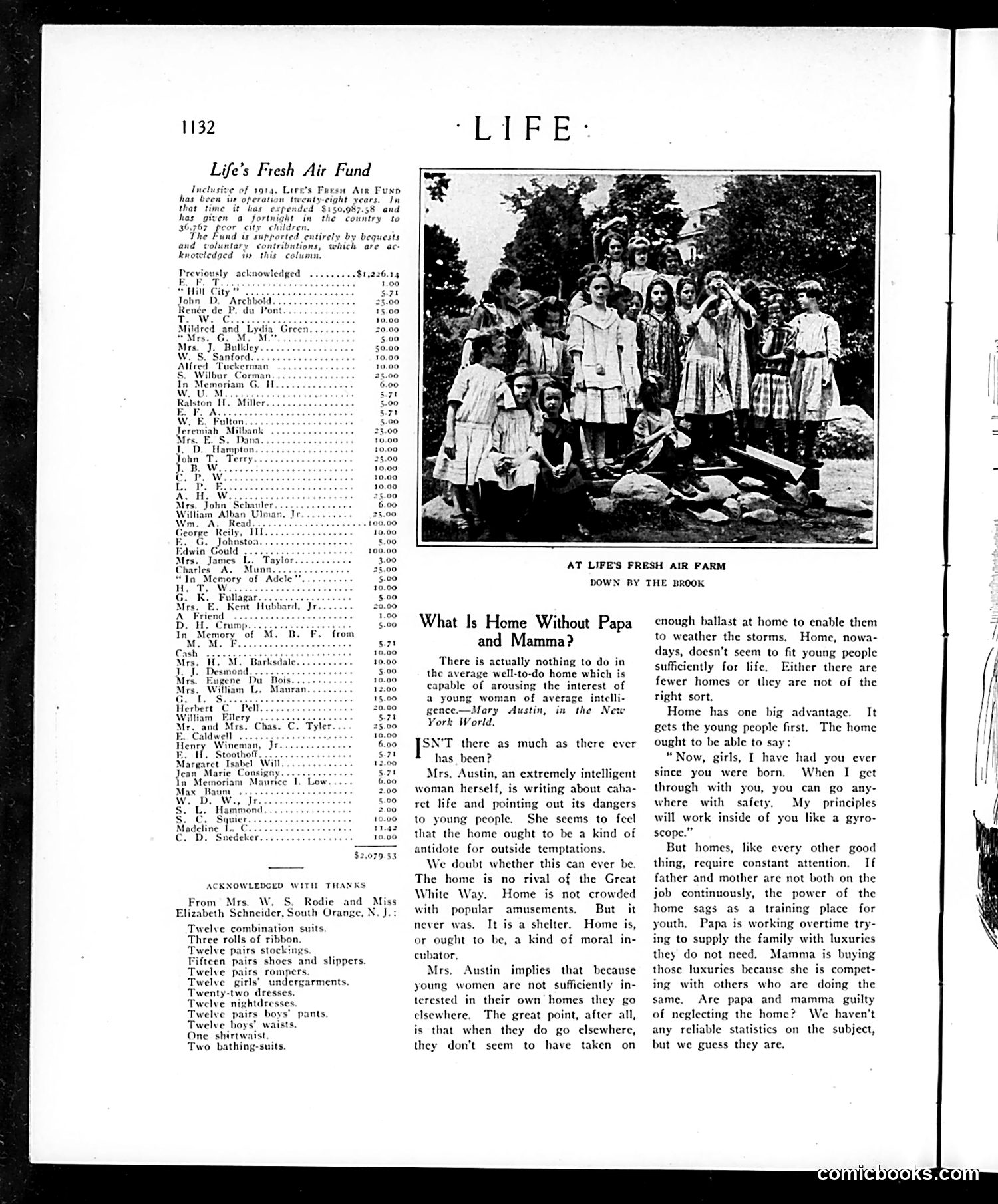
This page documents **Life's Fresh Air Fund**, a charitable initiative that provided rural retreats for poor city children. The photograph shows a large group of children at "Life's Fresh Air Farm" by a brook. The accompanying article, "What Is Home Without Papa and Mamma?" by Mrs. Austin (identified as an "extremely intelligent woman"), argues that homes need parental presence and supervision. She criticizes young women insufficiently invested in homemaking, warning that without proper home life, youth seek entertainment elsewhere—implying moral danger. The piece advocates for parental responsibility as moral/social duty, reflecting early 20th-century concerns about family stability, youth welfare, and women's domestic roles. The fund itself represented Progressive Era philanthropic efforts to improve children's health and morality.
📄 Transcribed text from this page (OCR, searchable)
Machine-transcribed from the original scan — historical spelling and the odd misread are preserved.
1132 Life’s Fresh Air Fund of 1904, Li Furst Aix Fuxp iv operation In ith @ fortni poor city ch The Fund is éu country to y by bequests 1) which are ace column. Previously acknowledged “Hill City wipe s7t I Dz aeeee tees 25.00 13.00 10.00 3.00 30.00 10.00 Ralston IT. Miller. - E. J.D. Ha John T. JeBow si. CUP IWe sas eA i. “Ta, Memory of Ad TW 5.00 s.71 10.00 toothof. Tsabel Will ACKNOWLEDGED WITH THANKS From Mrs. W. Elizabeth Schneider, Twelve combination suits. Three rolls of ribbon. Twelve pairs stocking Fifteen pairs shoes and slippers. Twelve pairs, romp welve girls’ under ‘0. dresses. tdresses. Twelve pairs boys’ pants. Twelve hoys’ wai One shirt Two bathing-suits. Rodie and Miss outh Orange, N. J. arments. AT LIFE’S FRESH AIR FARM DOWN BY THE BROOK What Is Home Without Papa and Mamma? There is actually nothing to do in the average well-to-do home which is capable of arousing the interest of a young woman of average intel gence—Mary Austin, in the New York World. ‘T there as much as there ever has_been? Mrs, Austin, an extremely intelligent woman herself, is writing about caba- ret life and pointing out its dangers to young people. She seems to feel that the home ought to be a kind of antidote for outside temptations, We doubt whether this can ever be. The home is no rival of the Great White Way. Home is not crowded with popular amusements. But it never was. It is a shelter. Home is, or ought to be, a kind of moral in- cubator. Mrs, Austin implies that because young women are not sufficiently in- terested in their own homes they go elsewhere. The great point, after all, is that when they do go elsewhere, they don’t seem to have taken on enough ballast at home to enable them to weather the storms, Home, nowa- days, doesn’t seem to fit young people sufficiently for life. Either there are fewer homes or they are not of the right sort. Home has one big advantage. It gets the young people first. The home ought to be able to say: “Now, girls, I have had you ever since you were born. When I get through with you, you can go any- where with safety. My principles will work inside of you like a gyro- scope. But homes, like every other good thing, require constant attention. If father and mother are not both on the job continuously, the power of the home sags as a training place for youth, Papa is working overtime try- ing to supply the family with luxuries they do not need. Mamma is buying those luxuries because she is compet- ing with others who are doing the same. Are papa and mamma guilty of neglecting the home? We haven't any reliable statistics on the subject, but we guess they are.