
A complete issue · 52 pages · 1915
Life — May 13, 1915
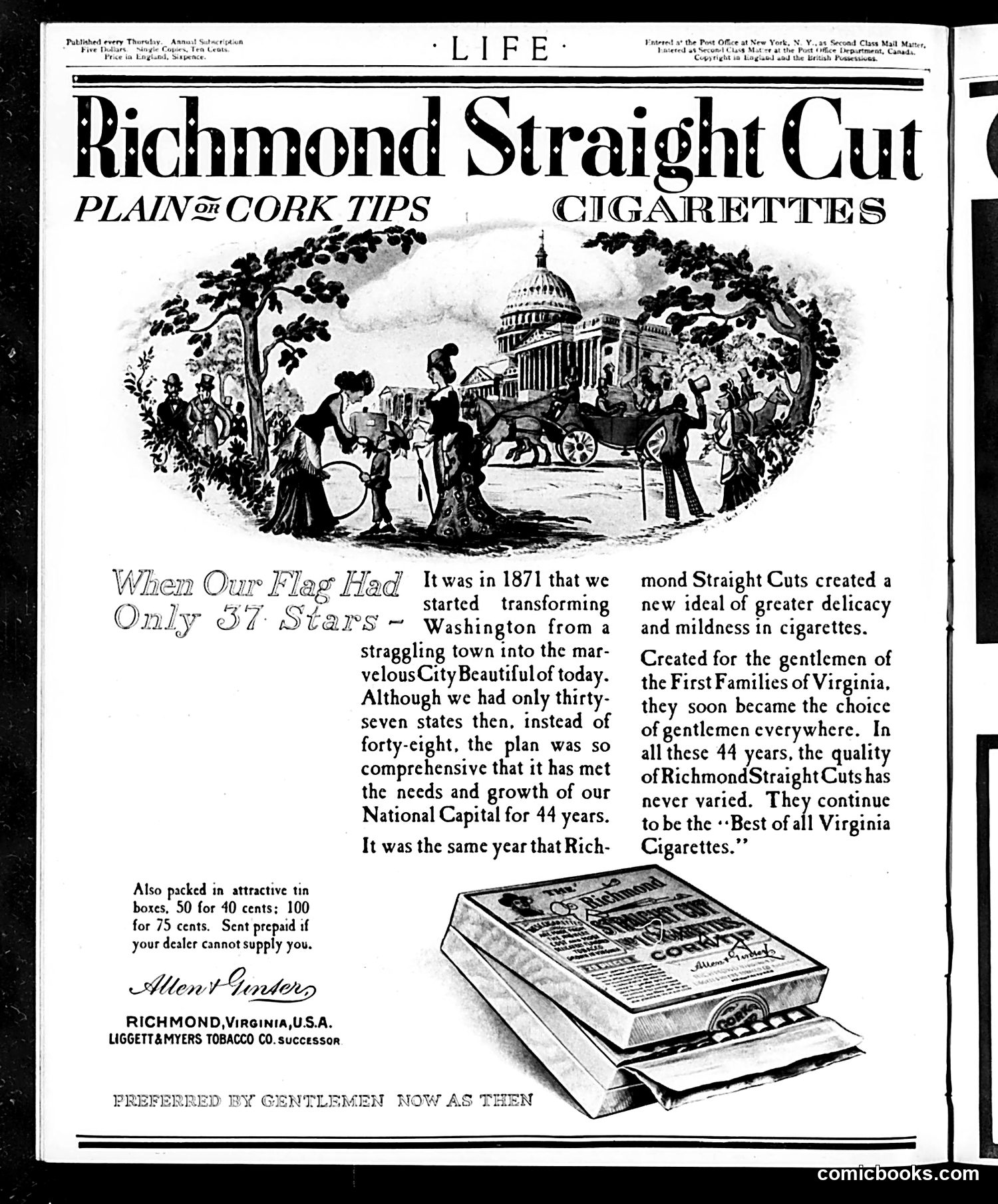
This is primarily a **cigarette advertisement**, not political satire. The page celebrates Richmond Straight Cut cigarettes, produced by Allen & Ginter (Liggett & Myers successor) in Richmond, Virginia. The advertisement uses patriotic imagery—showing the U.S. Capitol Building and referencing America's founding—to market the product. It claims the cigarettes were created in 1871, the same year Washington D.C. began major development, and boasts 44 years of consistent quality. The ad targets "gentlemen of the First Families of Virginia," appealing to regional pride and social status. The packaging shown includes a tin box option (50 for 40 cents; 100 for 75 cents). This reflects late-19th/early-20th-century advertising practices: linking consumer products to nationalism and social prestige.
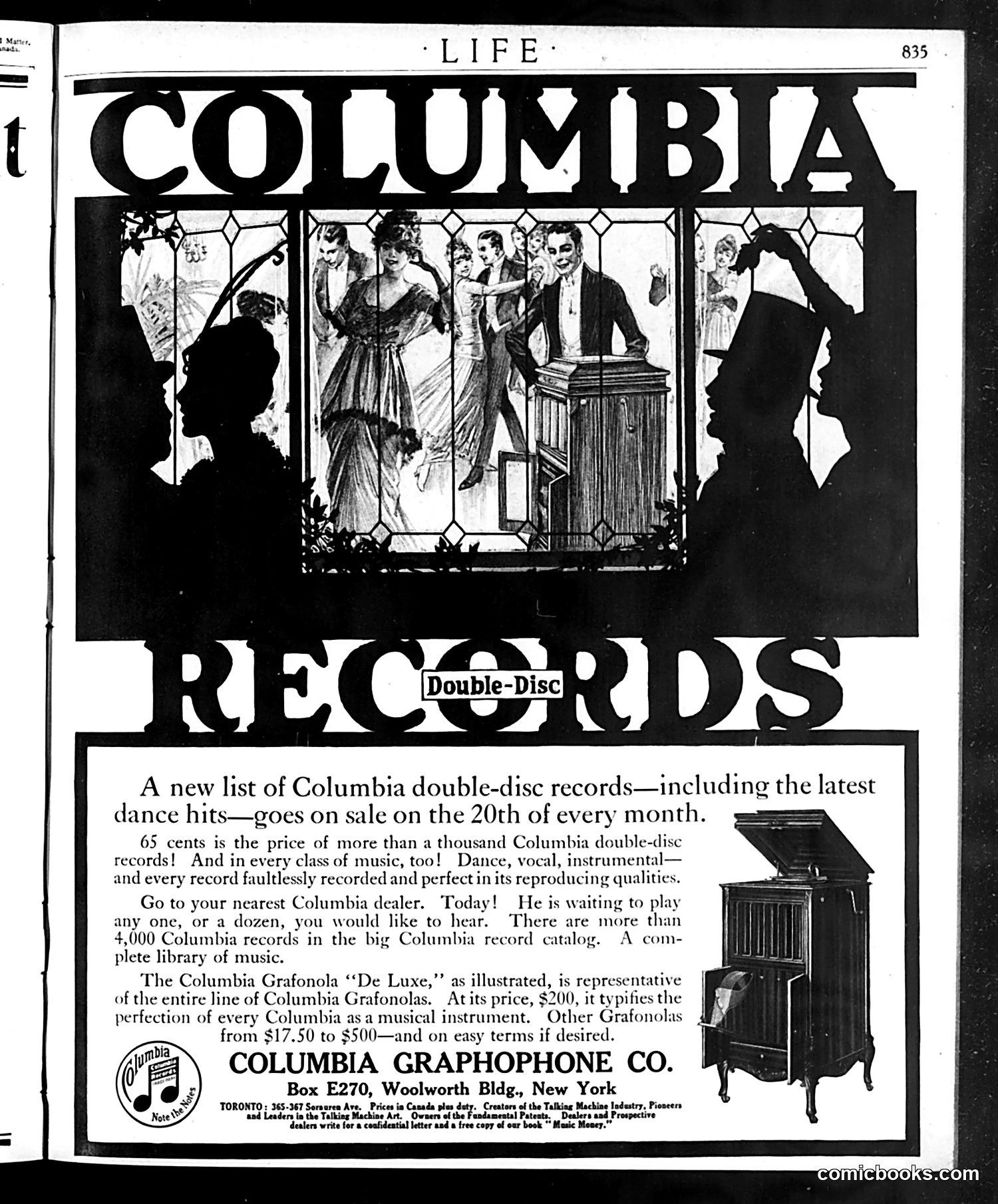
This page is primarily **advertising, not satire or political commentary**. It's a Columbia Records advertisement for double-disc phonograph records and gramophones. The visual element at the top shows silhouettes of people in formal attire viewing what appears to be an elegant social gathering through window panes—a stylized, decorative design meant to suggest sophistication and refinement. The ad highlights Columbia's product offerings: double-disc records selling for 65 cents, with a catalog of over 4,000 titles across dance, vocal, and instrumental music. It promotes the "De Luxe" Grafonola model at $200, with cheaper options from $17.50, available on payment plans. The address (Box E270, Woolworth Building, New York) and multiple Canadian locations suggest this targets North American consumers during the early phonograph era.
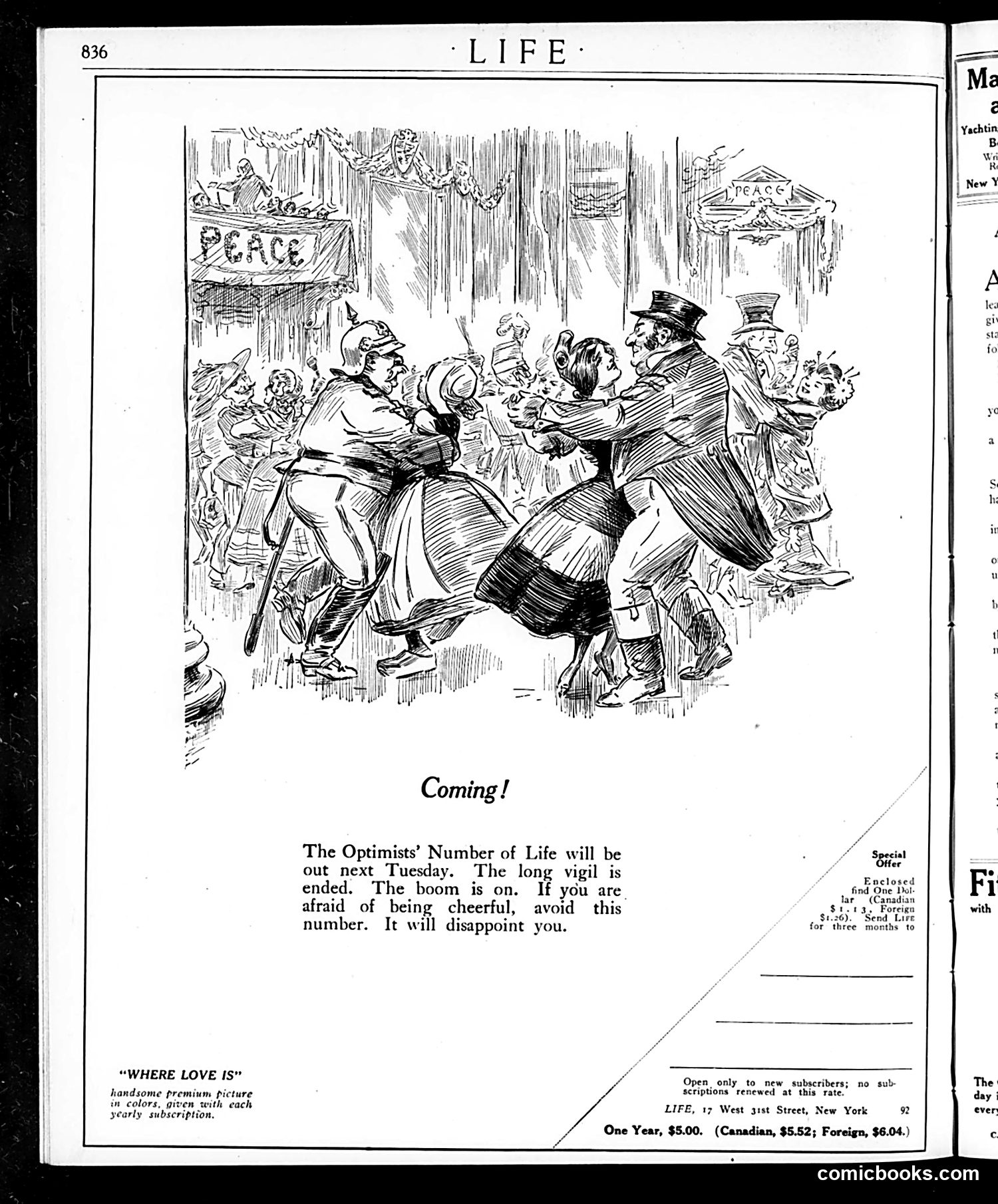
This page features a satirical cartoon titled "Coming!" that mocks post-World War I peace negotiations. The illustration shows caricatured figures in formal dress at what appears to be a diplomatic gathering, with "PEACE" banners visible overhead. The accompanying text announces "The Optimists' Number of Life will be out next Tuesday," sarcastically noting that "the long vigil is ended. The boom is on." It then warns readers: "If you are afraid of being cheerful, avoid this number. It will disappoint you." The satire appears to target naive optimism about post-war prosperity and peace. The exaggerated, chaotic gestures of the figures suggest skepticism that diplomatic efforts would actually produce meaningful peace or economic improvement. The ironic tone implies the author expects the "Optimists' Number" will prove premature or misguided.
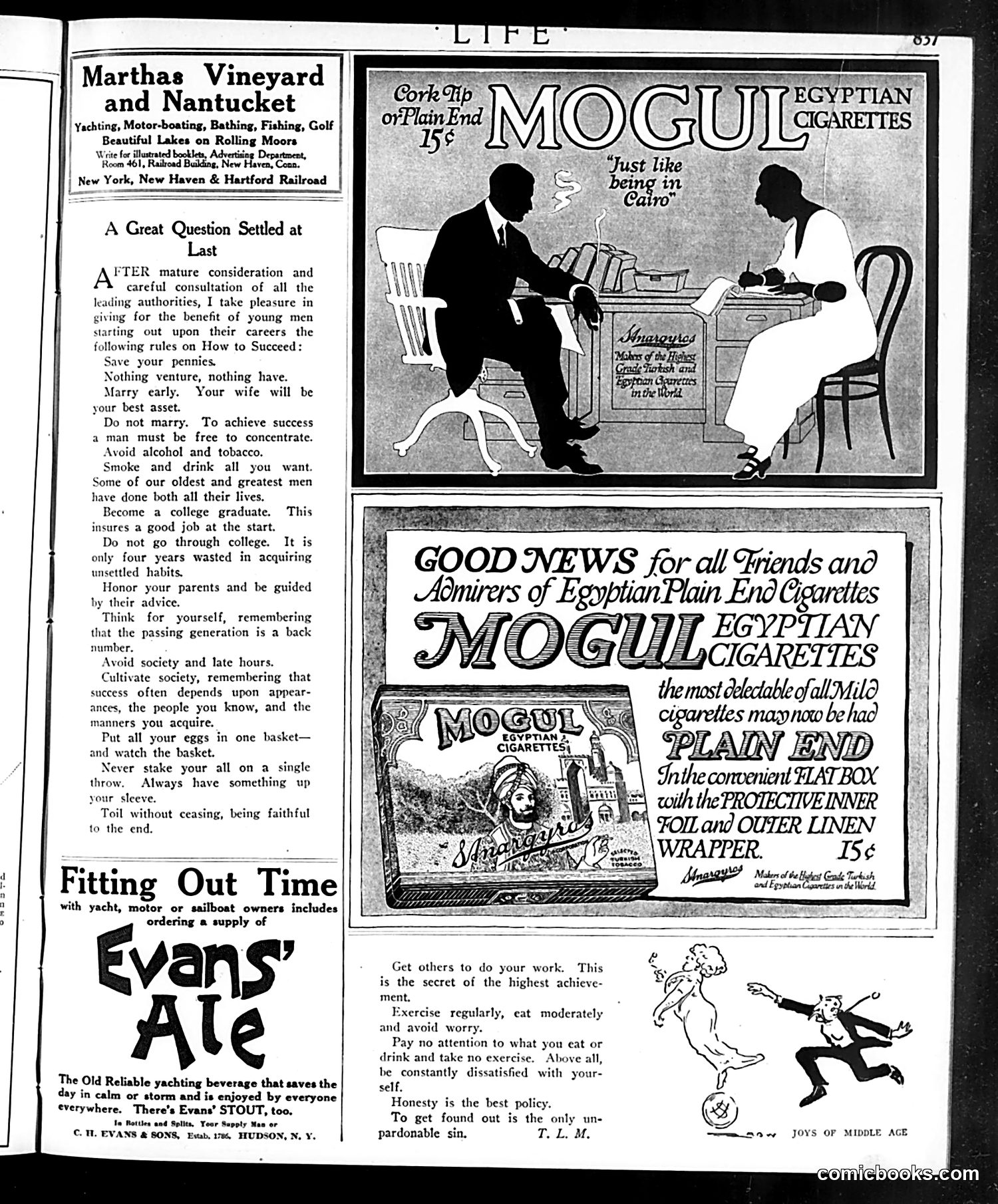
This page is primarily **advertising**, not editorial content or satire. The dominant advertisements are for **Mogul Egyptian Cigarettes** (15¢), which occupy roughly half the page with illustrations of men in business/leisure settings and promotional copy emphasizing the product's quality. The left column contains generic life advice ("A Great Question Settled at Last") and advertisement for **Evans' Ale**, a brewing product marketed to "yacht, motor or sailboat owners." The small illustration labeled "Joys of Middle Age" at bottom right appears to be humorous filler rather than political commentary. **This is not satirical content**—it's a commercial page from an era when magazines relied heavily on advertising revenue, with minimal editorial material.
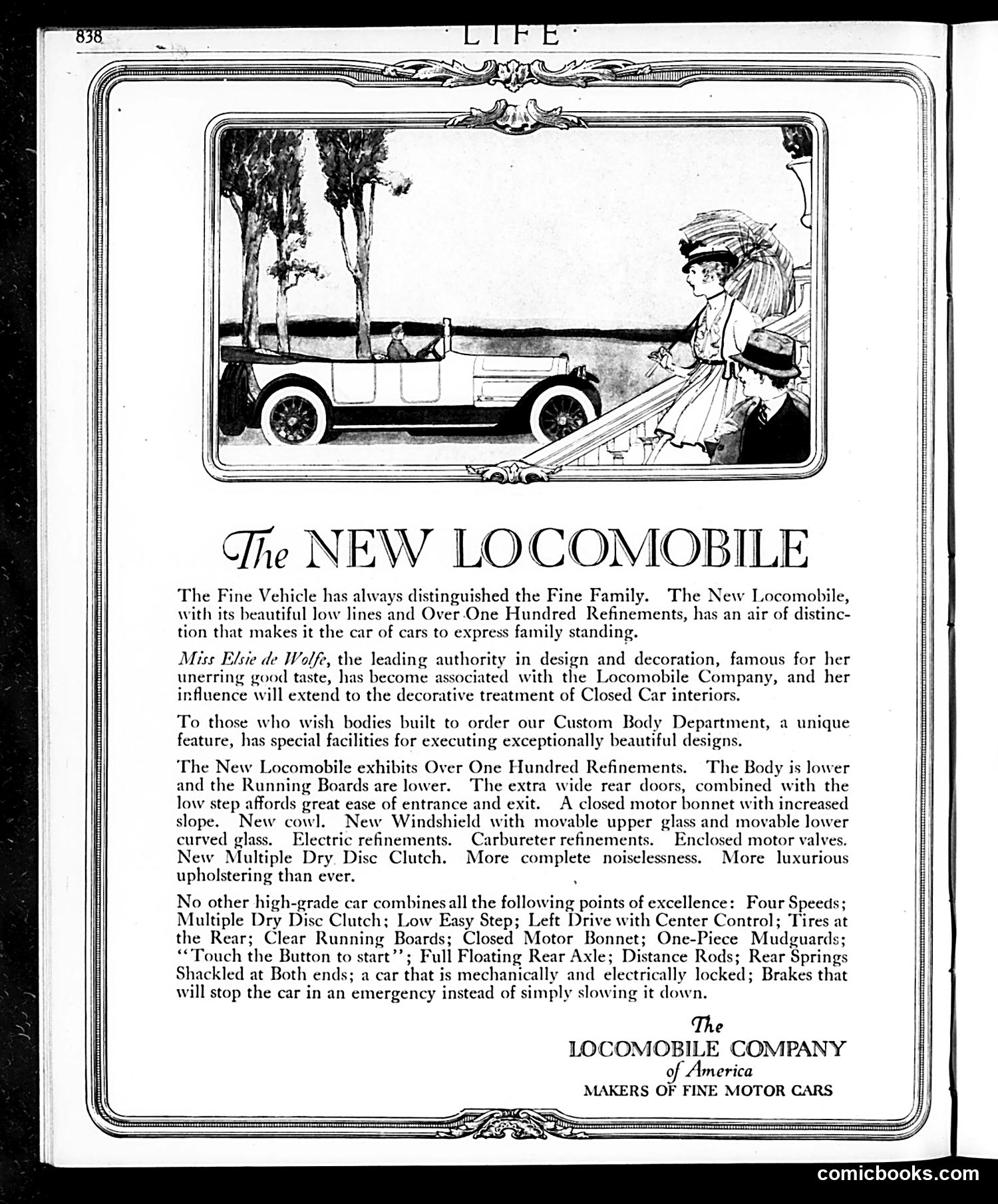
This page is **primarily an advertisement**, not satire or political commentary. It's a full-page ad for the Locomobile automobile, published in *Life* magazine (page 838). The image shows a stylized illustration of a well-dressed couple—a woman with a parasol and a man in a hat—observing a Locomobile car. The ad emphasizes luxury and refinement, naming "Miss Elsie de Wolfe," a famous interior designer of the era, as associated with the brand. The advertisement highlights technical features (Multiple Dry Disc Clutch, floating rear axle, electric refinements) while marketing the car as a status symbol for "fine families." The elegant illustration style and emphasis on design reflect early-20th-century automotive advertising targeting wealthy consumers.
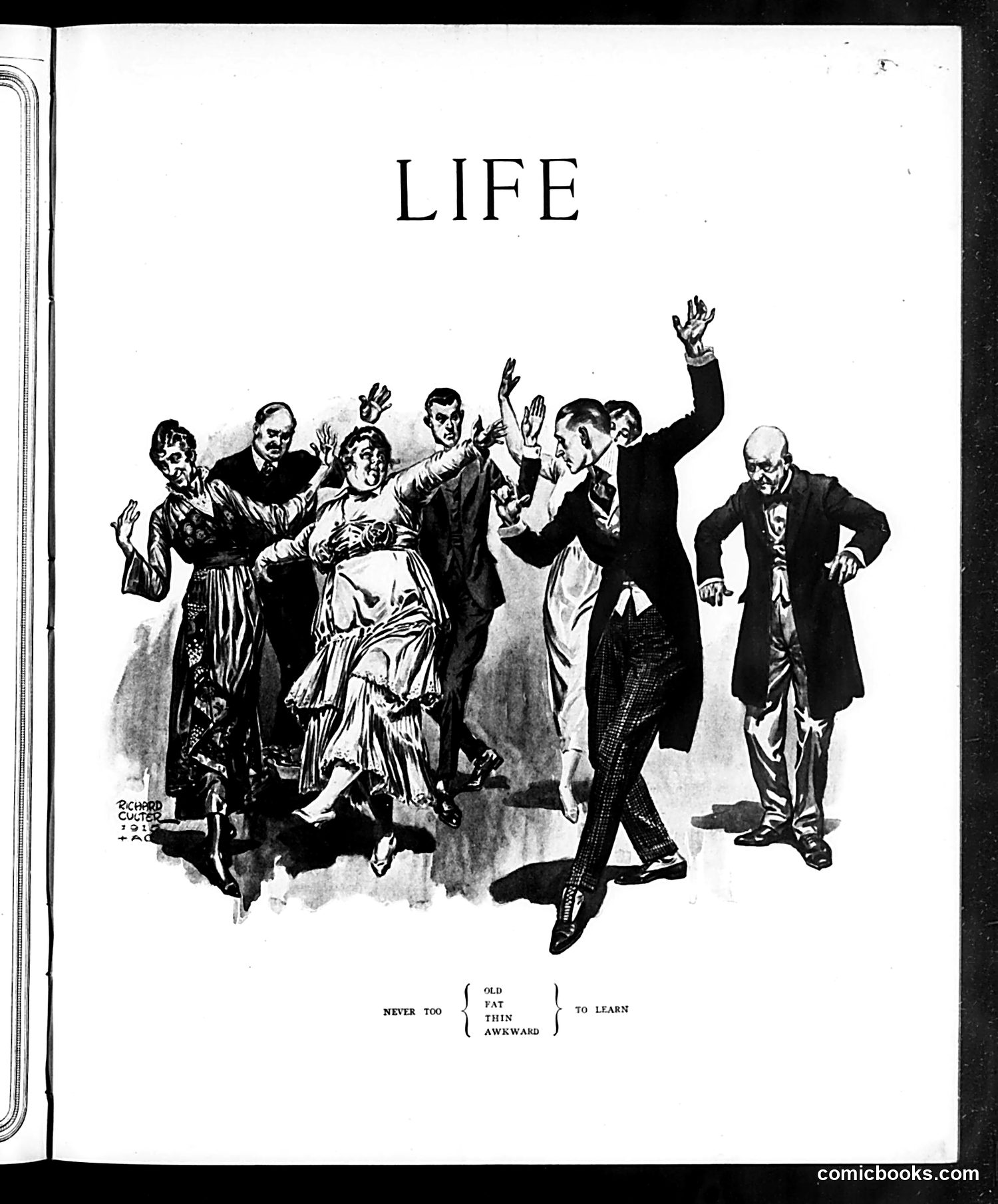
This is a title page for an article or section titled "LIFE," featuring an illustration by Cesare Cultor (signed lower left). The image depicts a group of people—men in formal attire and at least one woman in a dress—engaged in what appears to be dancing or energetic movement, with raised arms and animated poses. The caption reads: "NEVER TOO {OLD / FAT / THIN / AWKWARD} TO LEARN" The satire targets social pretension and self-improvement culture. The figures' exaggerated poses and mixed physical types suggest mockery of dance classes or deportment lessons marketed to adults regardless of their suitability. The humor lies in implying that even the most unpromising candidates pursue fashionable self-improvement, highlighting the absurdity of social conformity and vanity among the middle and upper classes.
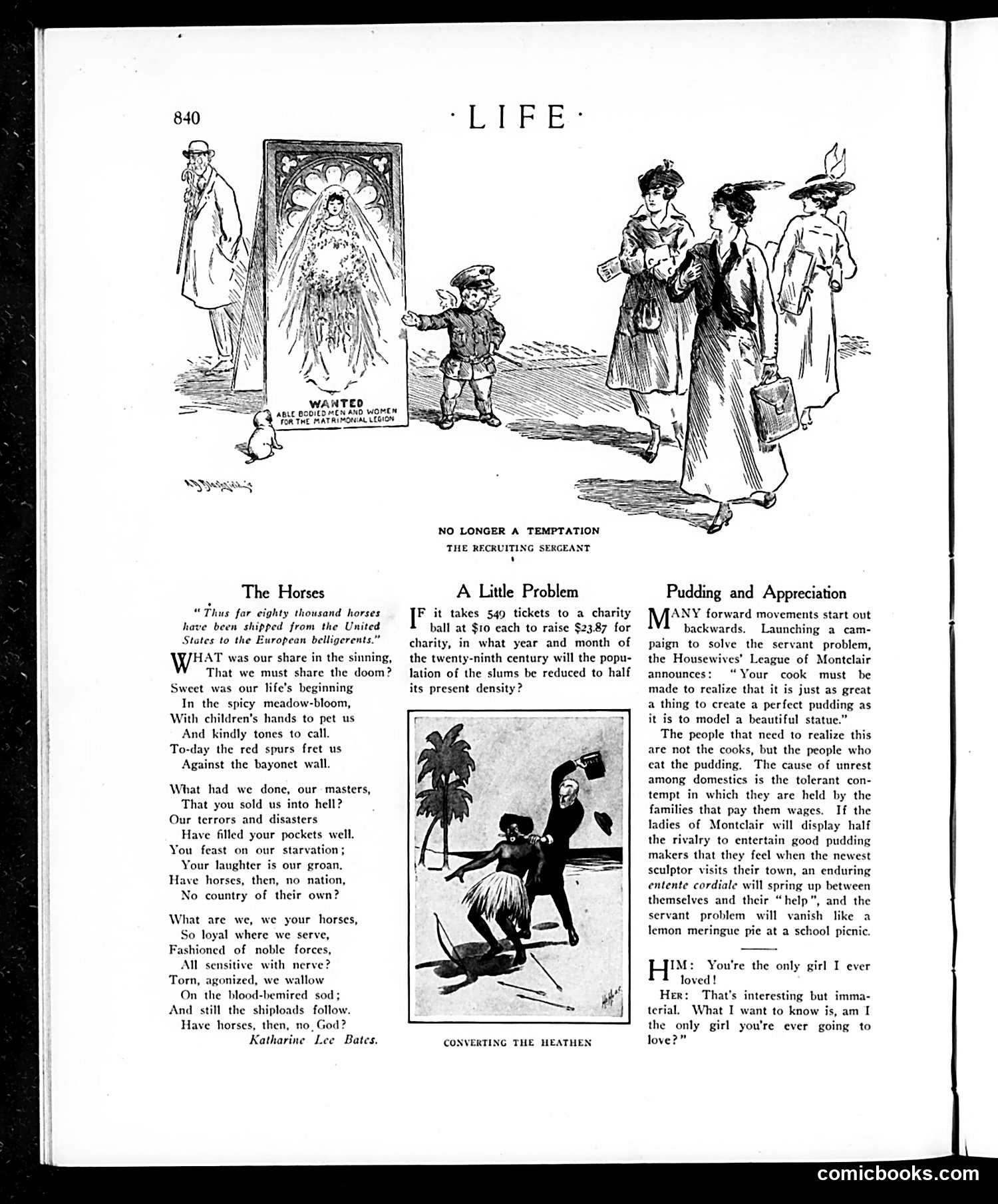
This page contains three distinct pieces satirizing early 20th-century social issues: **Top illustration**: Shows a recruitment poster ("Wanted: Able-bodied men and women for the matrimonial legion") alongside women passing by, satirizing marriage as military conscription—a commentary on women viewing matrimony skeptically. **"The Horses" poem** by Katharine Lee Bates: A soldier's lament comparing horses' loyalty to human sacrifice in war, critiquing the treatment of enlisted men. **"A Little Problem"** and **"Pudding and Appreciation"**: Mock the servant problem (domestic labor shortage) and class tensions between employers and working-class household staff, suggesting rivalry over who makes the best pudding represents deeper anxieties about social hierarchy and domestic authority. The page overall reflects pre-WWI anxieties about gender roles, class relations, and military service.
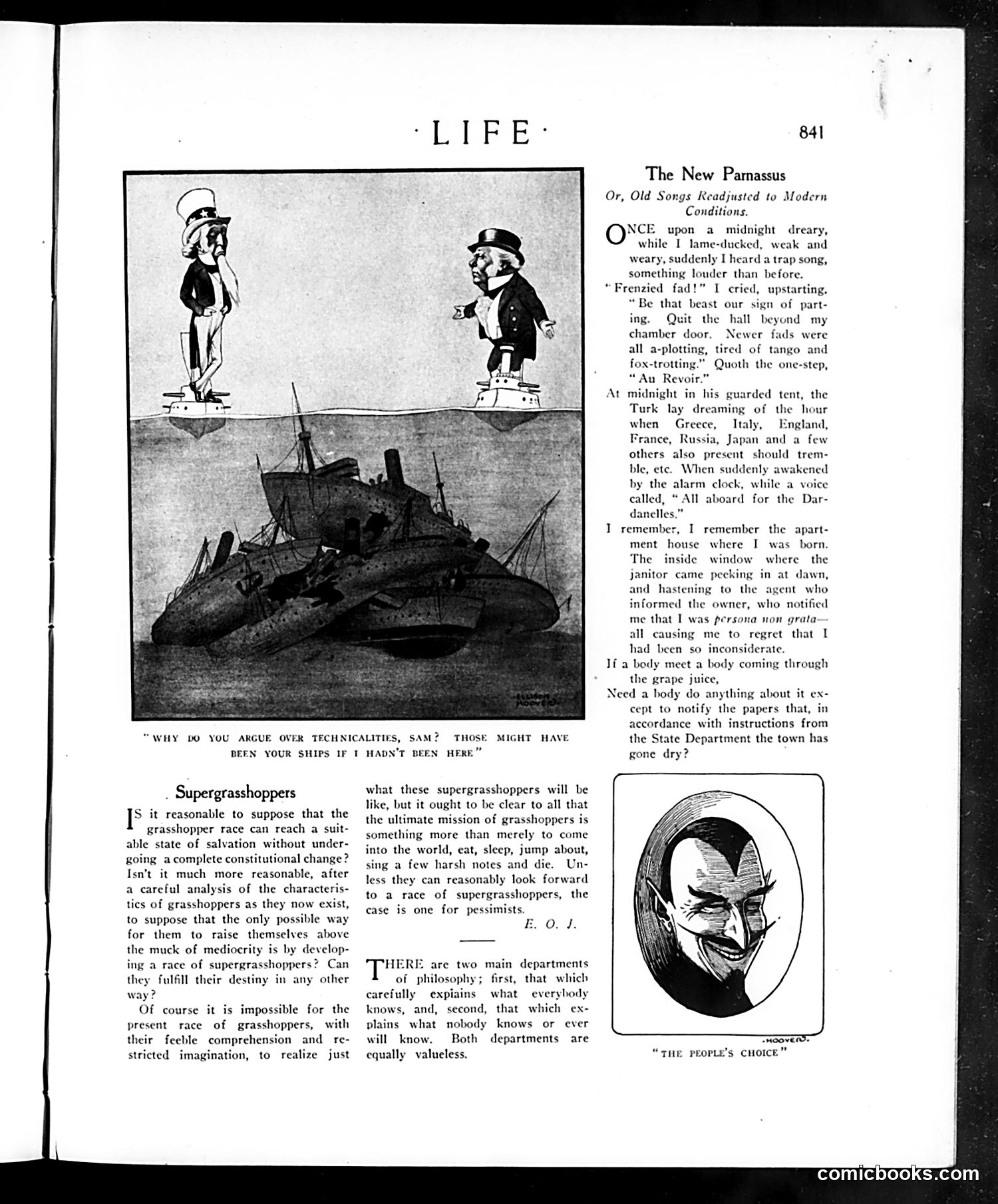
This page contains two separate pieces: **Top cartoon**: Shows two figures standing on a ship labeled "Why do you argue over technicalities, Sam? Those might have been your ships if I hadn't been here." This appears to reference a naval or military dispute, with one figure seemingly preventing the other from claiming ships. Without clearer identifying marks or date context, the specific historical incident is unclear. **"Supergrasshoppers" article**: A satirical philosophical piece by E.O.J. arguing that grasshoppers could theoretically evolve into "supergrasshoppers" through constitutional change. It's absurdist humor mocking both evolutionary theory and the notion that self-improvement requires fundamental transformation. **"The People's Choice" portrait**: A caricatured face in an oval, likely political commentary, though the specific subject isn't identified on this page.
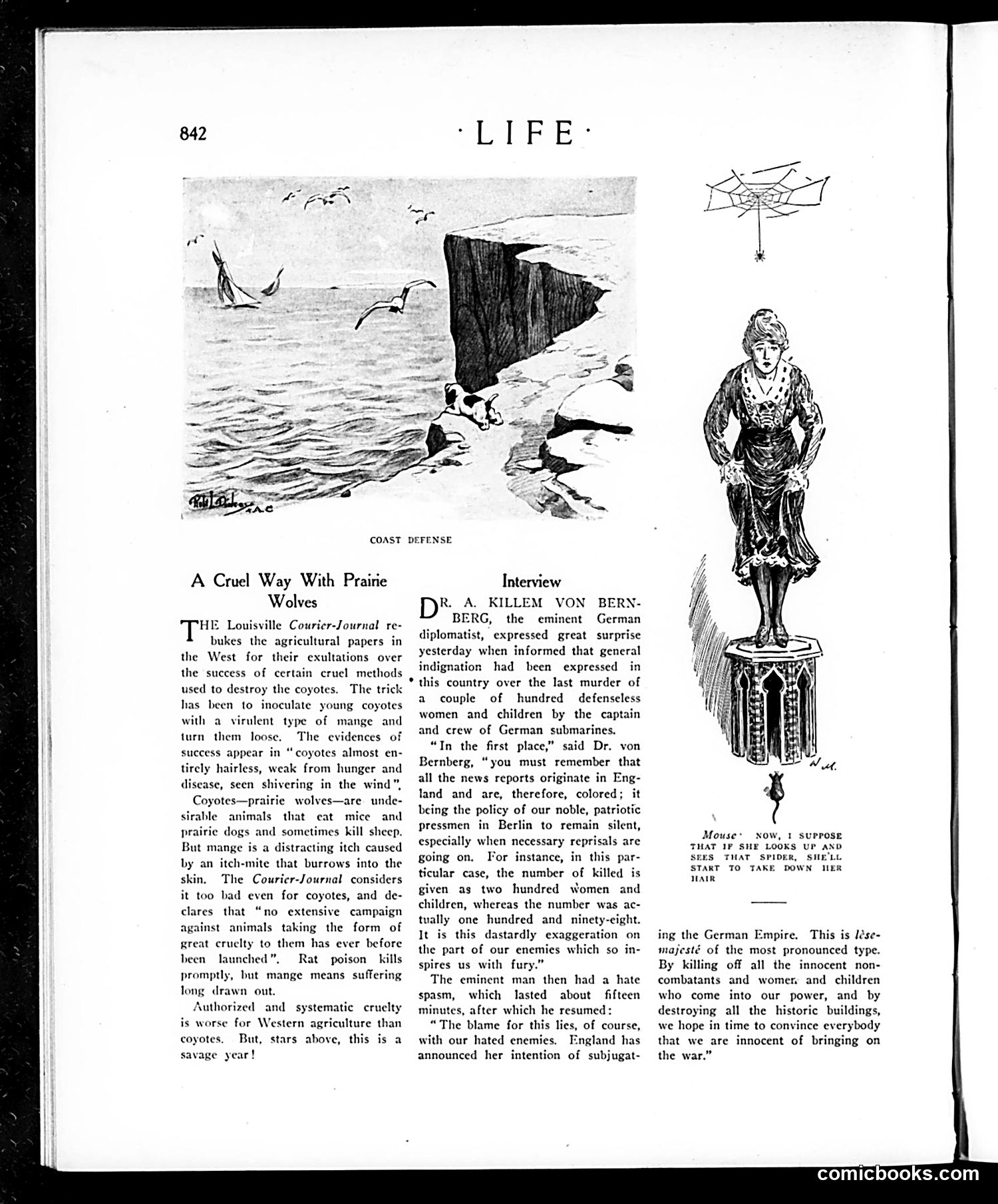
This page contains two distinct items from a WWI-era *Life* magazine: **Left cartoon ("Coast Defense")**: Shows a figure on a beach cliff confronting coyotes—a satirical commentary on methods used to control prairie wolves by inoculating them with disease. The text criticizes this as excessively cruel, even by agricultural standards. **Right section**: An interview with "Dr. A. Killem von Bernberg," a German diplomat. The name itself is satirical ("Killem" being a pun). He defends German submarine attacks that killed civilians, claiming exaggerated casualty figures originate from English propaganda. The figure depicted appears to be mocking German justifications for wartime atrocities. The accompanying illustration of a woman with the caption about "her hair" likely references German brutality narratives circulating during the war.
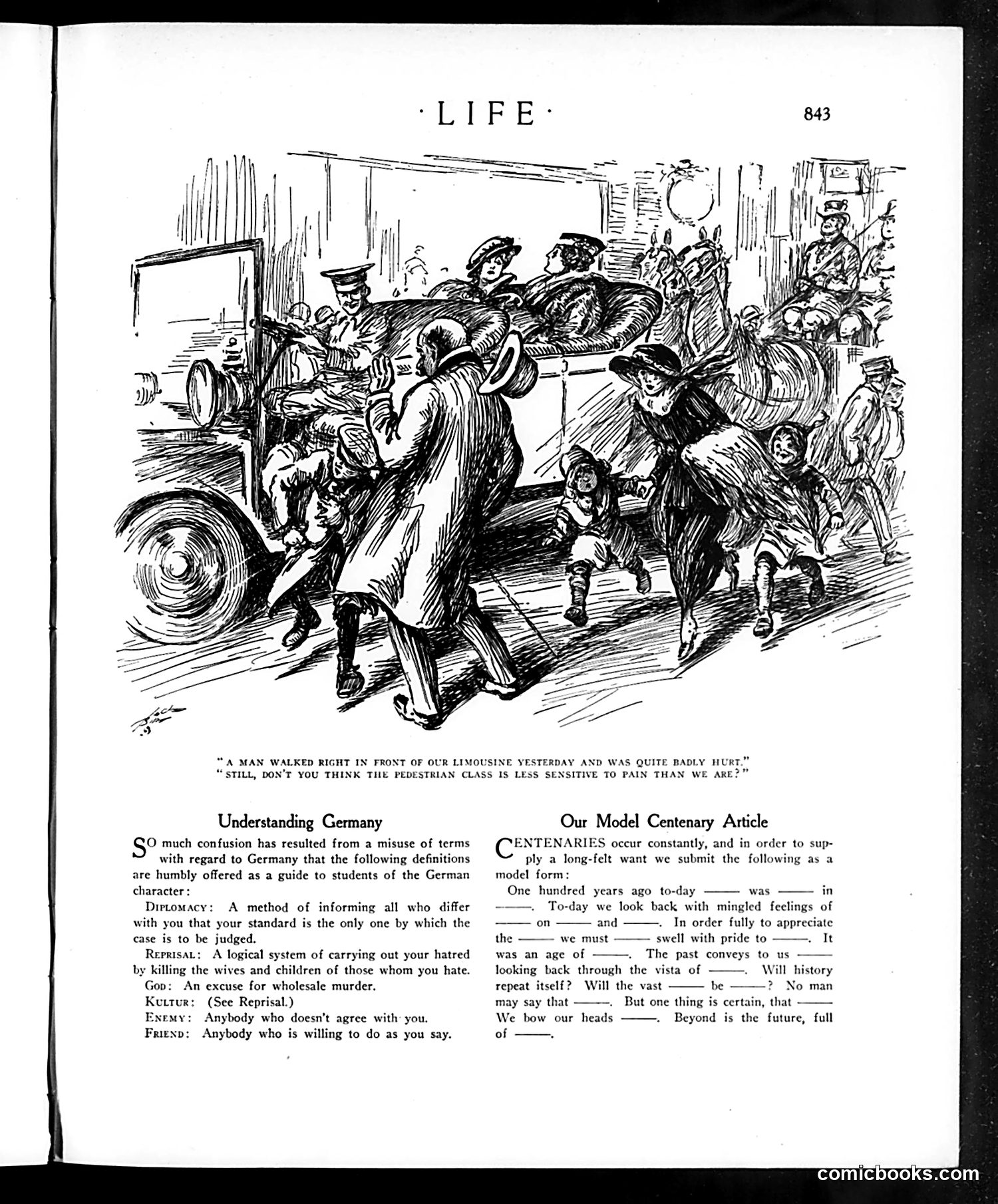
**The Cartoon:** The illustration depicts a chaotic street scene where a limousine has struck a pedestrian. Well-dressed figures in the expensive car appear indifferent to the injured person, while working-class pedestrians and children react with concern below. **The Satire:** The caption quotes dialogue about whether "the pedestrian class is less sensitive to pain than we are?"—sarcastically suggesting wealthy automobile owners view poor people as less deserving of sympathy. This critiques the callousness of the wealthy toward working-class victims of traffic accidents, a growing concern as automobiles became prevalent in early 20th-century cities. **The Point:** The cartoon mocks aristocratic indifference and class inequality, suggesting the rich dismiss harm to ordinary people with dismissive rationalization rather than genuine concern.
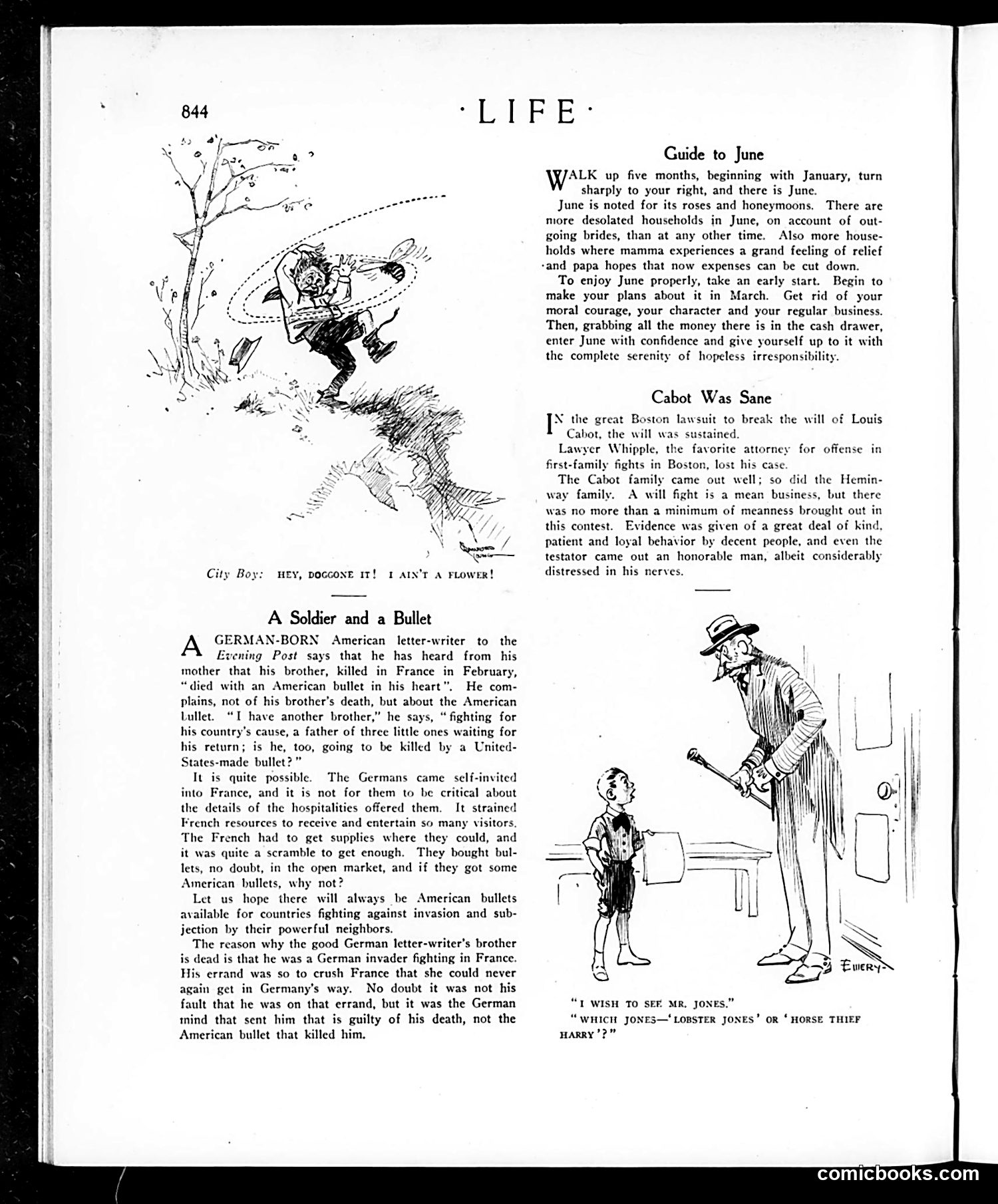
This page contains three distinct pieces: 1. **"Guide to June"** - advice column encouraging readers to plan ahead for the month, emphasizing weddings and domestic life. 2. **"Cabot Was Sane"** - brief article about a Boston lawsuit involving the Cabot and Heminway families, discussing a will contest. It mentions "Lawyer Whipple" arguing the case and notes the proceedings involved disputes over family honor and inheritance. 3. **"A Soldier and a Bullet"** - commentary on a German-American soldier killed in France during WWI. The piece argues the soldier died due to German invasion/military decisions, not American bullets, expressing hope American munitions will protect against future invasion. 4. **Cartoon** (bottom right) - shows a man asking to see "Mr. Jones," with the caption suggesting confusion about which "Jones" (implying multiple criminal variations: "Lobster Jones" or "Horse Thief Harry"). The humor plays on common criminal nicknames and identity confusion.
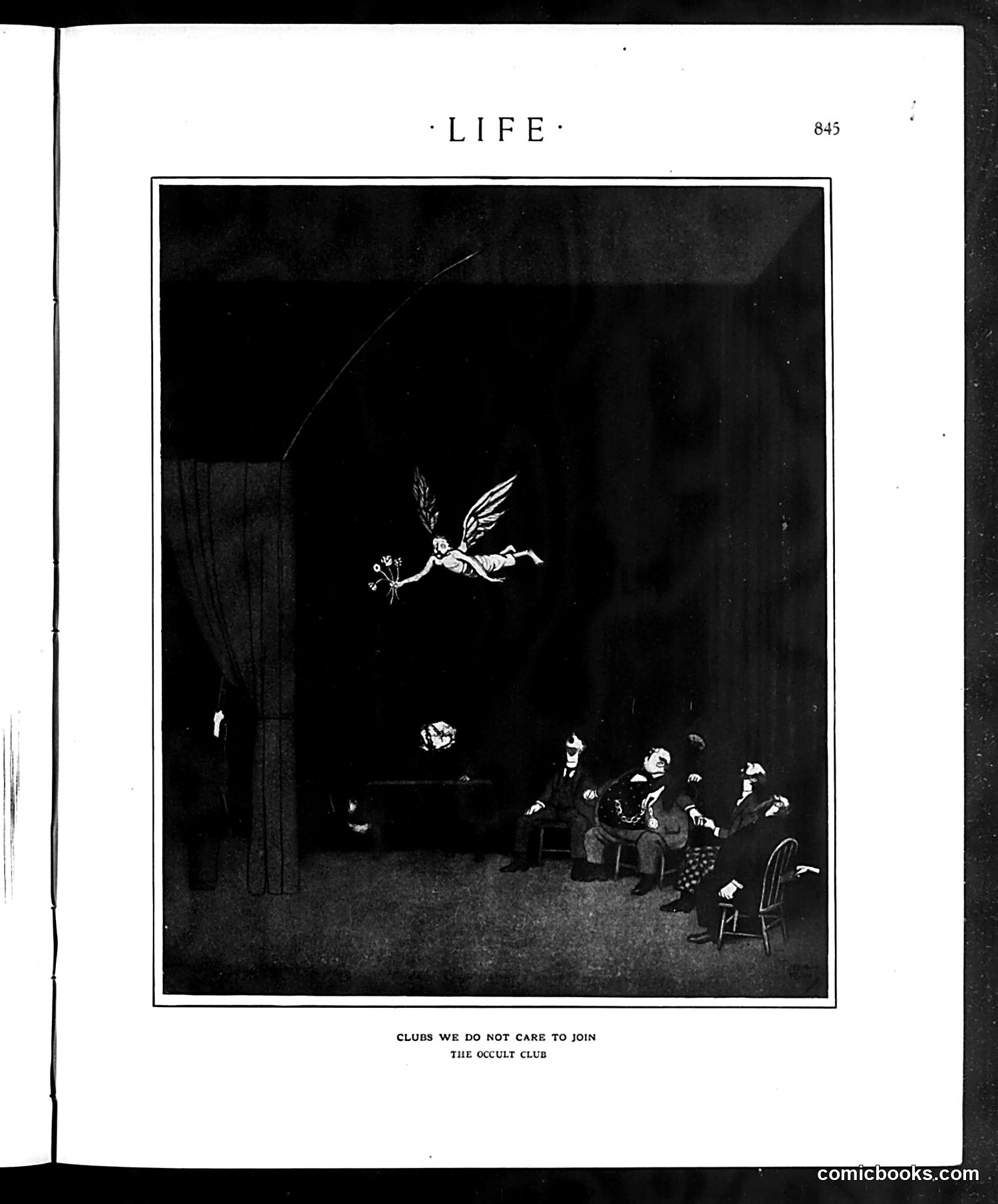
This cartoon satirizes wealthy or elite social clubs by depicting "The Occult Club" — a darkly humorous visual pun. The image shows a demonic or supernatural figure hovering above a group of well-dressed men seated in what appears to be an exclusive club setting. The satire works on multiple levels: the title suggests these clubs operate with secrecy and hidden agendas (the "occult" meaning hidden knowledge), while the supernatural imagery implies their true nature or activities are sinister or otherworldly. The well-dressed attendees appear indifferent to the demonic presence, suggesting hypocrisy — that respectable society ignores or tolerates morally questionable behavior within exclusive institutions. The caption "Clubs We Do Not Care to Join" positions this as social commentary on exclusionary elite institutions.
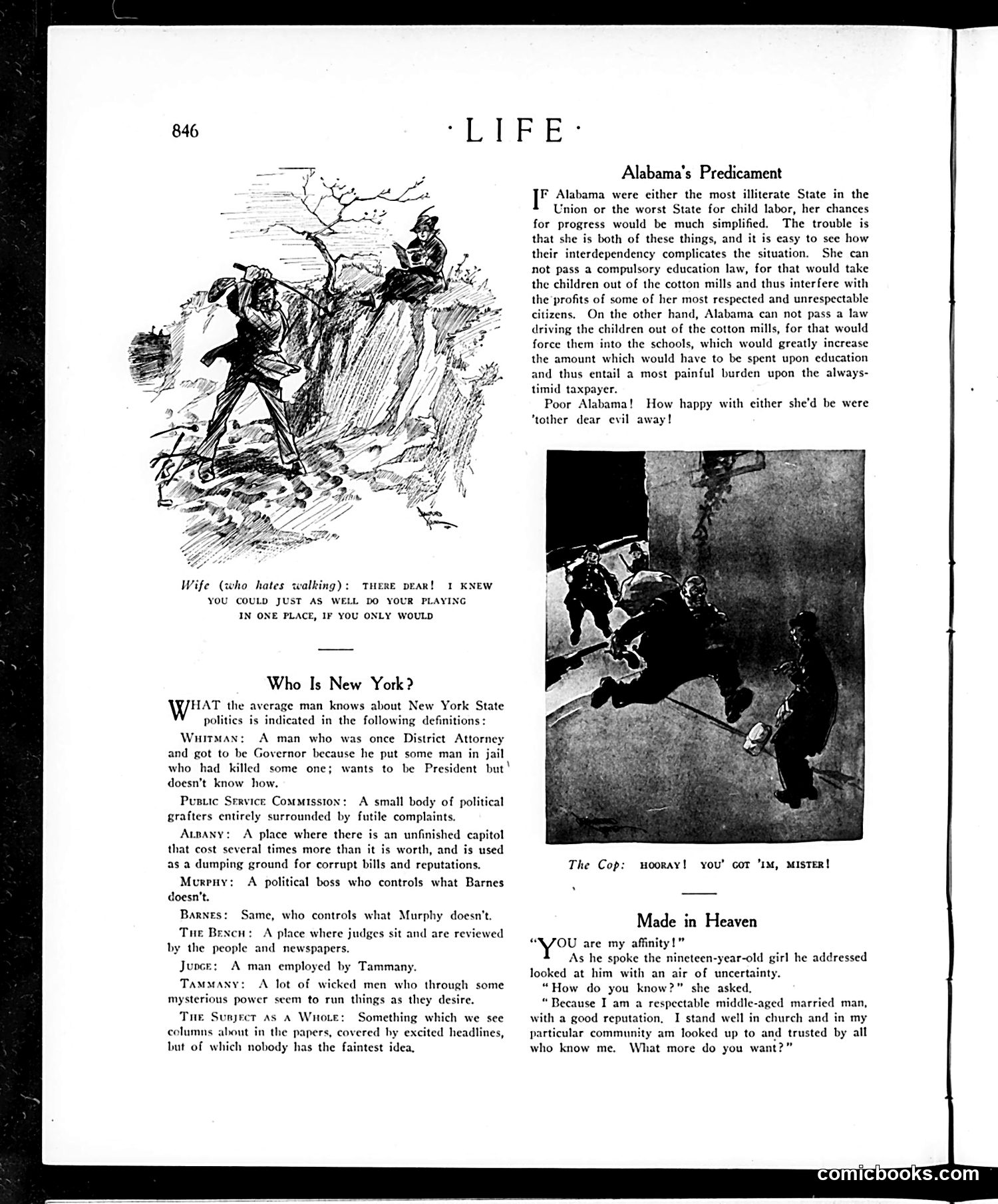
This page contains three separate satirical pieces: 1. **Top cartoon**: Shows a couple on a hillside with a wife scolding her husband for choosing an inconvenient location for their activities. The humor relies on marital conflict over practicality. 2. **"Who Is New York?"**: A satirical glossary defining New York State political figures and institutions through cynical definitions. It mocks politicians (Whitman, Murphy, Barnes), the Public Service Commission as corrupt, Albany's wasteful capitol building, Tammany Hall as controlling hidden power, and judges as tools of the system. This attacks New York's political machine and corruption. 3. **"Made in Heaven"**: A short story excerpt about a respectable middle-aged married man being approached by a teenage girl. The darker implications suggest commentary on moral hypocrisy or inappropriate relationships. The overall tone is anti-establishment and cynical about politics and society.
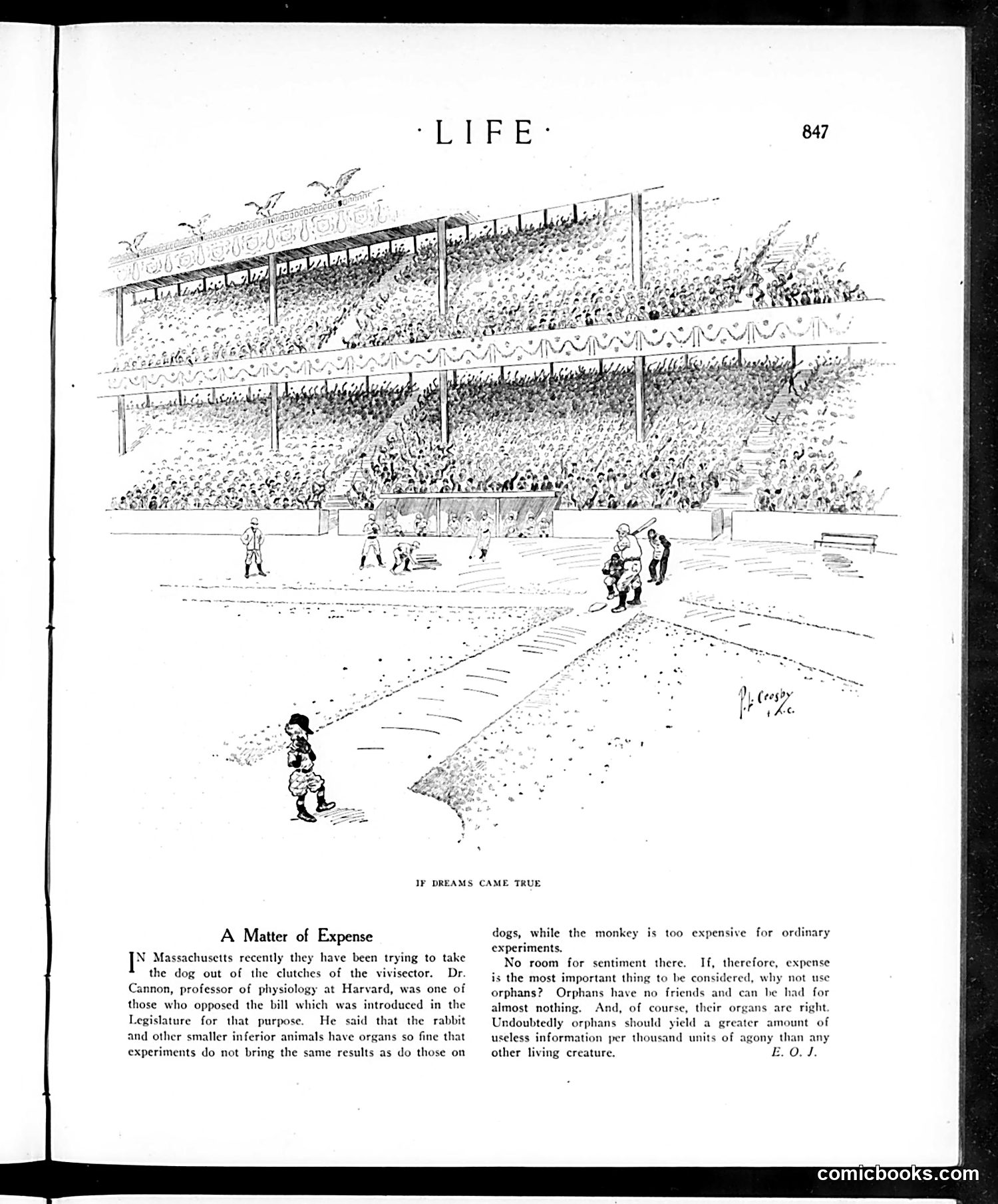
This page satirizes opposition to anti-vivisection legislation in Massachusetts. Dr. William Cannon of Harvard opposed a bill restricting animal experimentation, arguing that dogs were necessary because smaller animals and expensive monkeys wouldn't yield comparable results. The cartoon's brutal satire imagines a baseball stadium filled with orphans instead of spectators—visualizing the author's (E.O.J.'s) scathing reductio ad absurdum argument: if cost and organ similarity are the only ethical considerations, why not experiment on orphans instead of animals? They're "free" and have "no friends." The piece mercilessly exposes the logical callousness of privileging expense over suffering. By depicting orphans as replacements for animal test subjects in a crowded stadium, it condemns both the vivisection practice and the cold utilitarian reasoning used to justify it. The satire works by taking Cannon's economic argument to its horrifying conclusion.
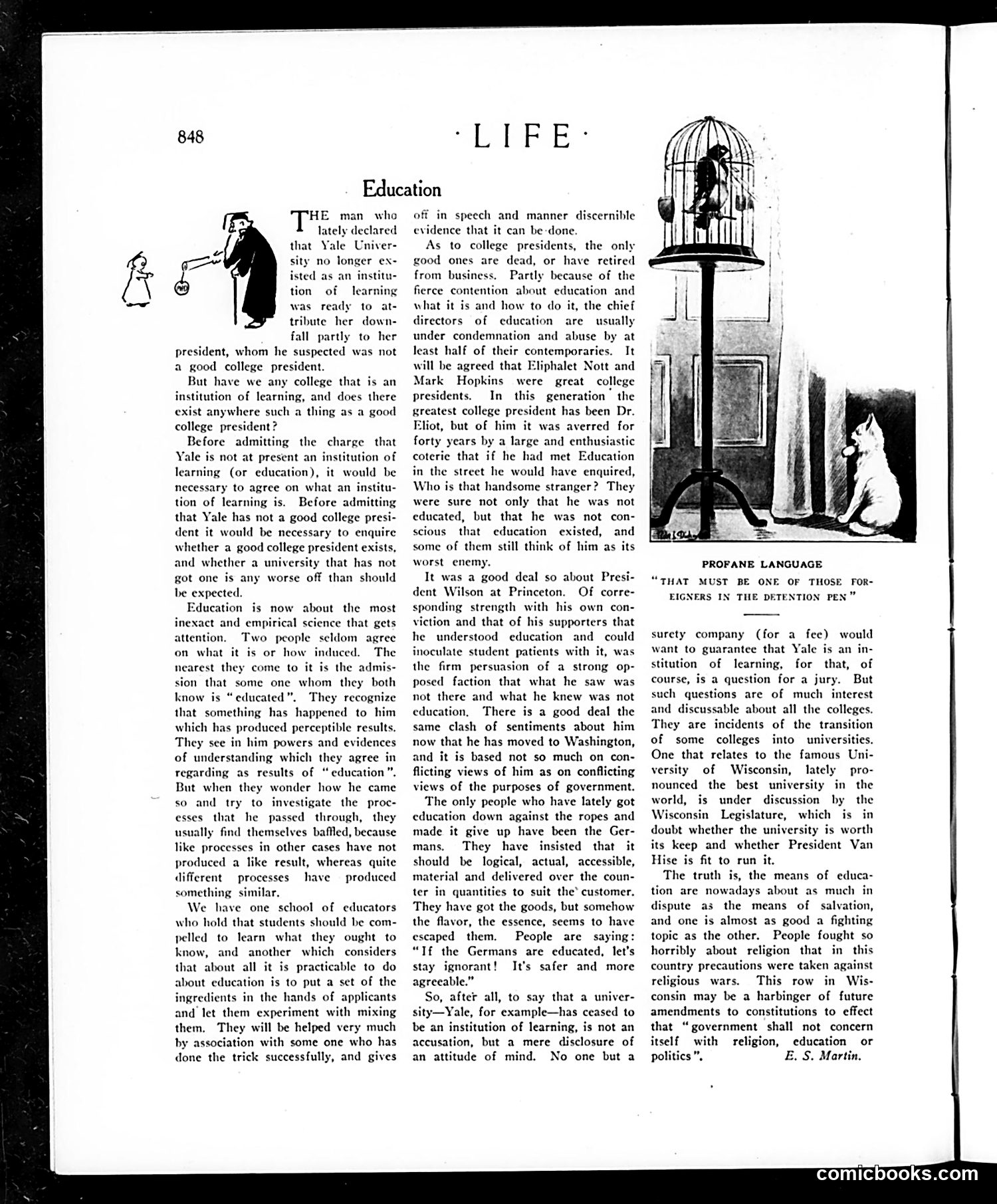
This essay satirizes American higher education and college presidents through a dialectical argument. The author mockingly notes that people universally praise only *dead* college presidents—citing the historically respected Eliphalet Nott and Mark Hopkins—while living presidents face constant criticism. The satire targets specific contemporary figures: **Dr. Charles Eliot** (Harvard president) and **Woodrow Wilson** (then Princeton president, later U.S. President). For forty years, critics claimed Eliot wouldn't recognize education if he met it in the street, yet he's now considered the era's greatest president. Wilson faces similar contradictions: supporters credit him with understanding education; opponents insist he doesn't. The author's point: educators perpetually disagree about what education *is*, making it impossible to fairly evaluate presidents. The only group achieving educational clarity, the essay concludes with ironic timing, are the Germans—a pointed reference to pre-WWI Prussian educational systematization, suggesting American education lacks comparable rigor or definition.
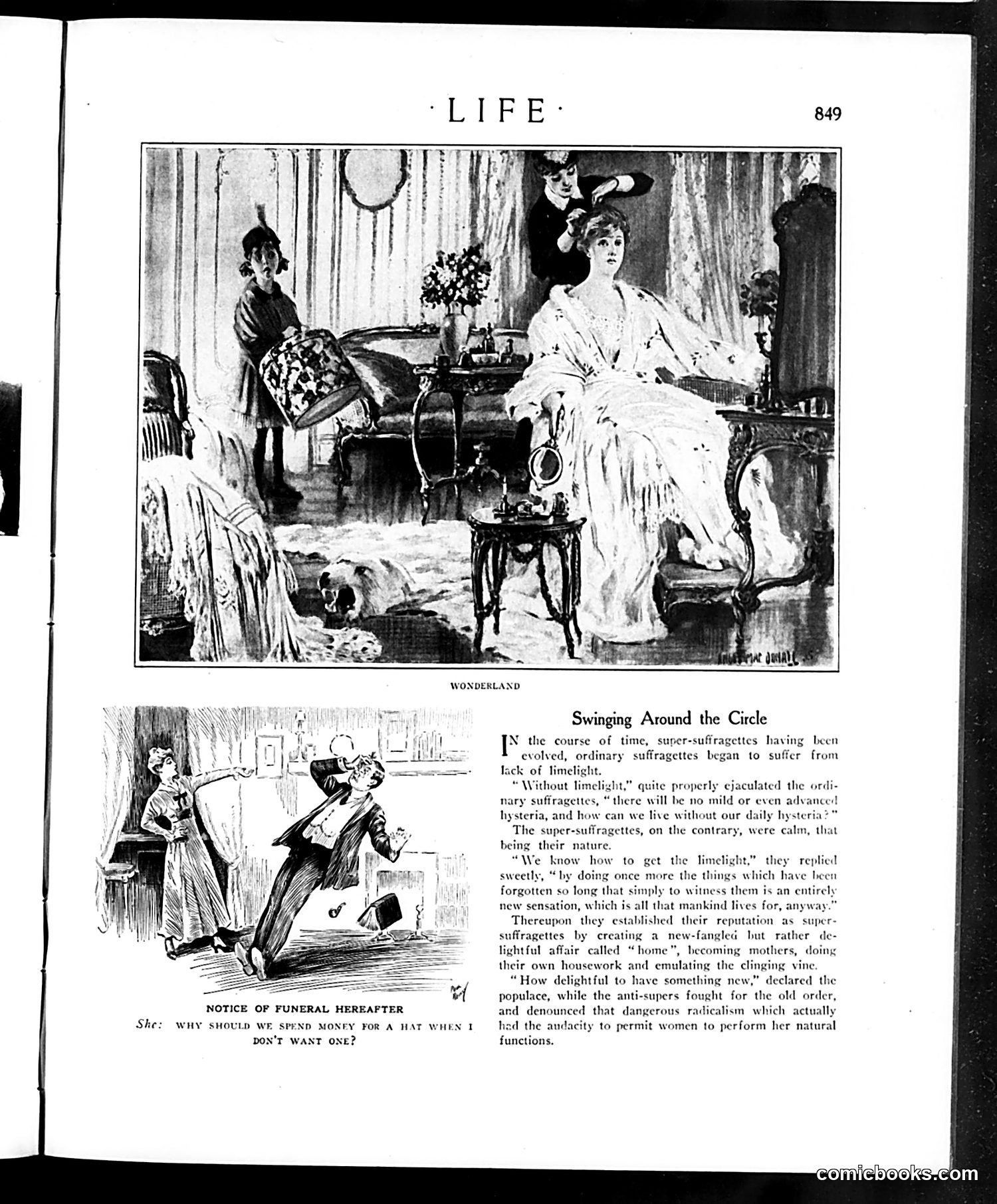
This page satirizes early 20th-century debates over women's suffrage and feminism. The article "Swinging Around the Circle" mocks suffragettes through ironic inversion: it suggests that "super-suffragettes" discovered that performing *traditional* domestic roles—housekeeping, motherhood, "the clinging vine"—becomes radical and attention-getting precisely because suffragettes had abandoned these duties. The satire targets both sides: militant suffragettes seeking "limelight" through confrontation, and conservatives defending "natural functions" (women's domestic role). The cartoon below, titled "Notice of Funeral Hereafter," appears to joke about a woman rejecting hat purchases—possibly mocking the suffragette cause as absurdist or trivial. The piece suggests that women's activism had become so extreme that simply returning to housework counts as shocking novelty, implying suffragettes were ridiculous in either direction.
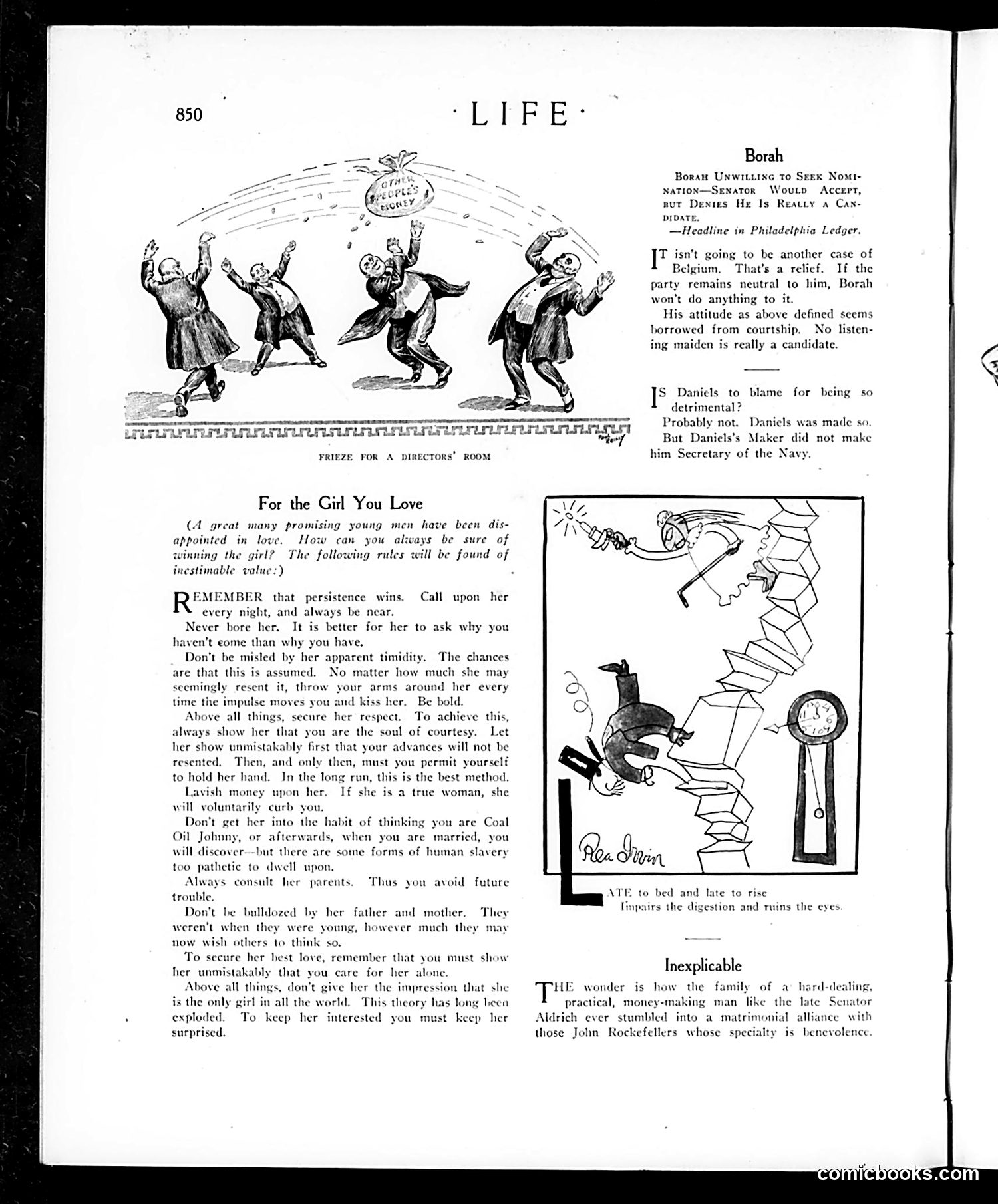
**Top Cartoon ("Frieze for a Directors' Room"):** Four figures in formal dress leap and gesture upward toward a bag of money, depicting corporate greed and the scramble for wealth among business leaders—a common Progressive-era critique of capitalist excess. **Borah Section:** This mocks Senator William E. Borah's refusal to seek the presidential nomination while claiming neutrality. The satire suggests his passive stance on political involvement mirrors courtship behavior—he won't commit but remains positioned to be "chosen," making him an unreliable political actor. **"For the Girl You Love":** A tongue-in-cheek advice column ironically presenting contradictory dating rules (be persistent yet never bore her; show respect yet grab her without permission). The satire exposes the era's confused, often controlling attitudes toward courting—advice that simultaneously emphasizes courtesy while condoning physical presumption. **"Inexplicable":** A brief political jab questioning how Senator Aldrich's practical, wealthy family connected through marriage to the Rockefeller family, implying surprise at such alliances among the ultra-wealthy elite.
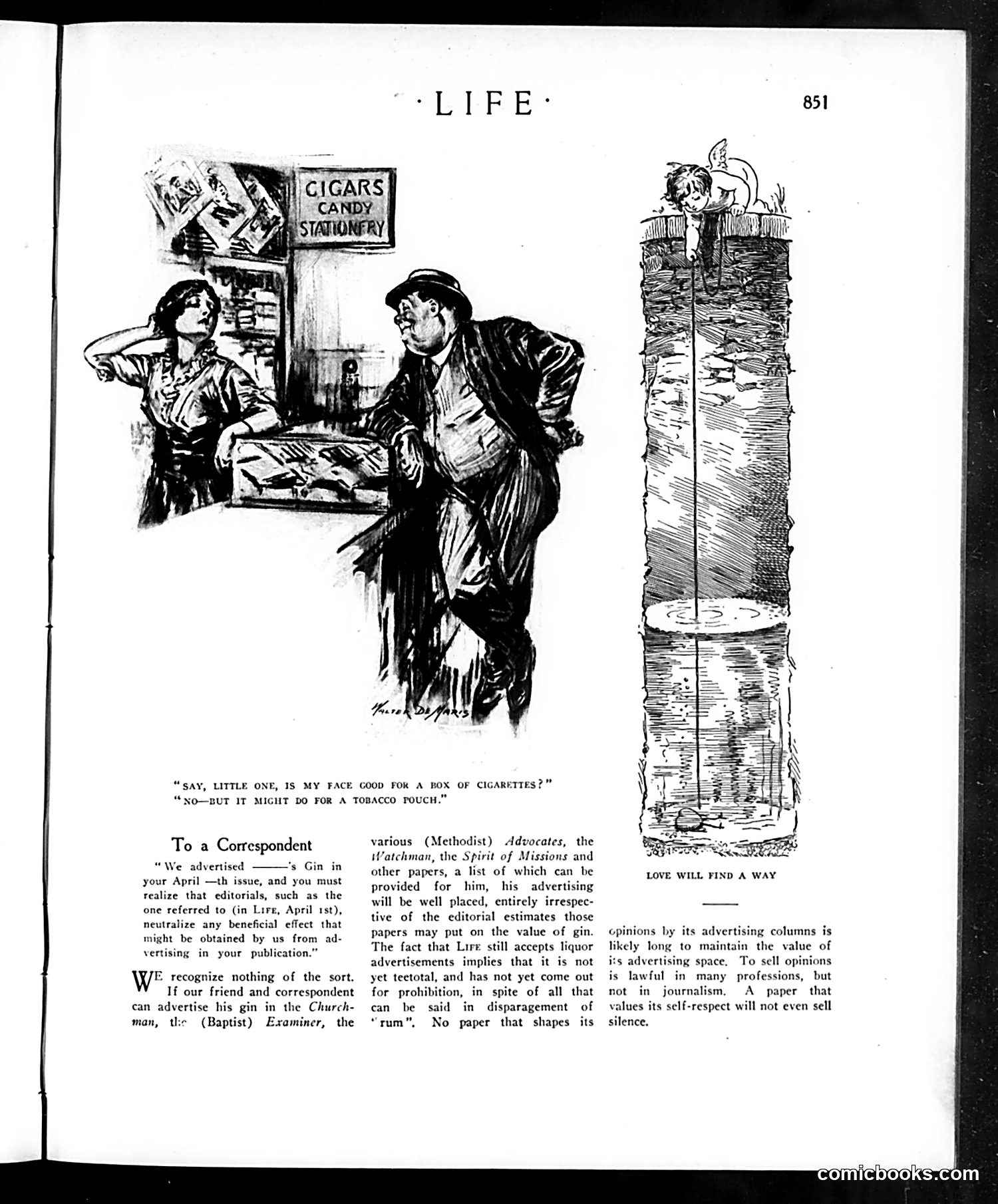
**The Cartoon (left):** A man at a cigarette/candy/stationery kiosk asks a woman if his face is "good for a box of cigarettes." She retorts his face might be better suited for a "tobacco pouch"—a crude insult implying his face is ugly and leathery. **The Editorial Letter (main text):** An advertiser complains that *Life* magazine's anti-alcohol editorial (April 1st) undermines his gin advertisement's effectiveness. **The Magazine's Response:** *Life* defends its editorial independence, arguing that newspapers maintaining self-respect don't let advertisers dictate content. The editors pointedly note that *Life* still accepts liquor ads despite running temperance critiques—proving it hasn't been corrupted by advertising pressure. The implicit point: editorial integrity matters more than advertiser comfort. **Historical Context:** This likely reflects Progressive Era debates over prohibition and journalistic ethics during a period when alcohol advertising was increasingly controversial.
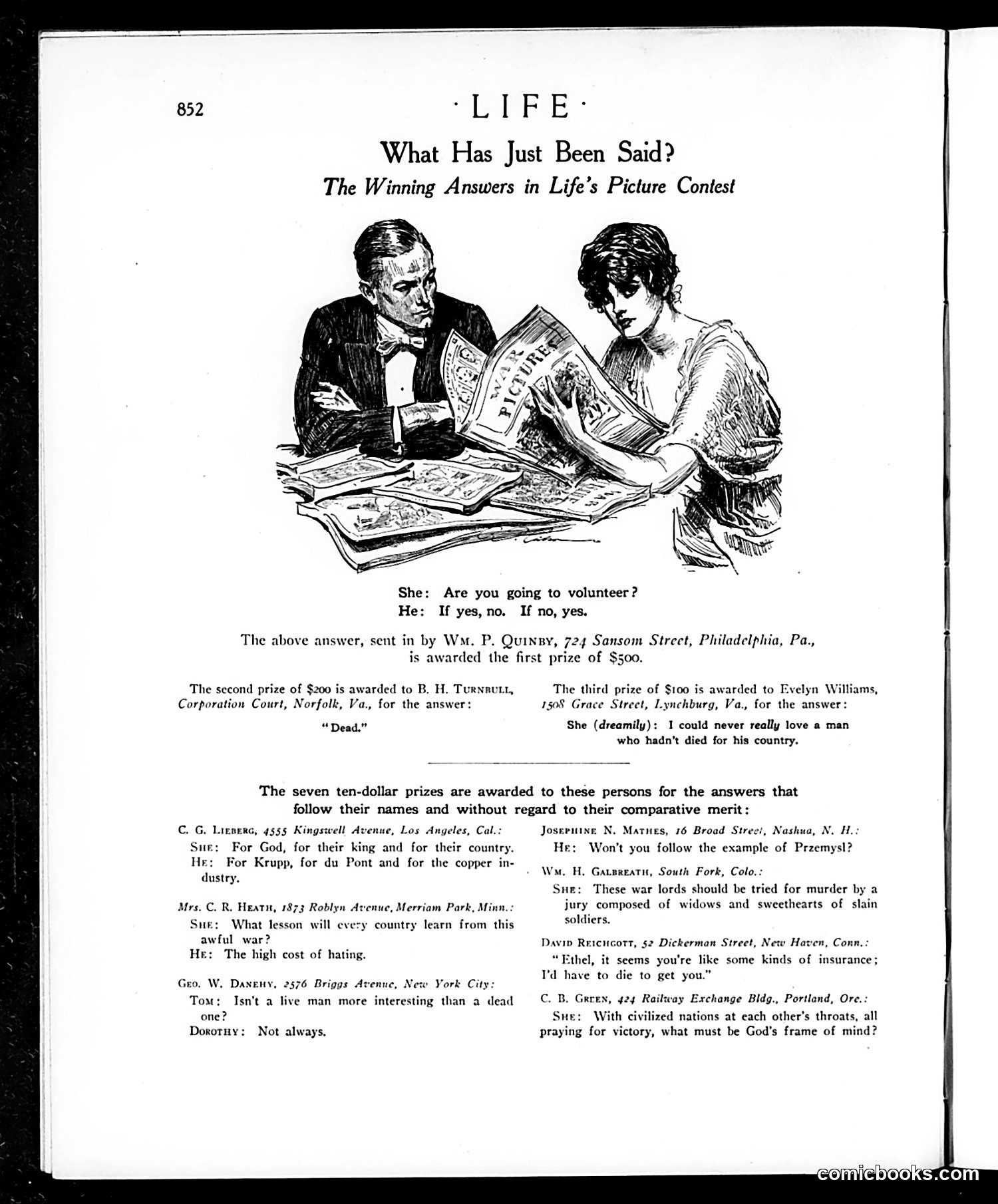
This is Life magazine's contest featuring humorous picture captions about World War I. The illustration shows a man and woman examining magazines together, with the winning response playing on ambiguous logic: when she asks "Are you going to volunteer?" he replies "If yes, no. If no, yes"—a paradoxical non-answer that won $500. Other entries satirize war's grim realities: one submits simply "Dead," another depicts a woman who won't love a man unless he dies for his country. The $10 prize entries mock military-industrial profiteering, suggest trying war leaders for murder, and question God's perspective on nations praying for victory while killing each other. The satire reflects American public debate over World War I (then ongoing), targeting both romantic nationalism and the economic interests driving the conflict.
This page reports results from a **Life magazine caption contest** held February-April (year unclear, but likely WWI-era based on content). Readers submitted answers to "What has just been said?" — presumably a cartoon showing two characters in conversation. The article catalogs popular contestant responses, revealing contemporary concerns: **anti-war sentiment** ("I will not raise my boy to be a soldier"), **feminism and suffrage debates** (women's voting would prevent war), **Red Cross nursing**, and **military recruitment themes**. Frequent submissions included variations on **Sherman's famous quote** ("War is hell"), wordplay on the magazine's title, and references to popular songs like "Tipperary." The tone suggests **satirical social commentary** on entering WWI, with contestants using humor to debate pacifism, women's roles, and military duty—core anxieties of the era. The editorial process is described in detail: 121,299 total entries were narrowed through seven judges selecting the best responses by mathematical consensus.
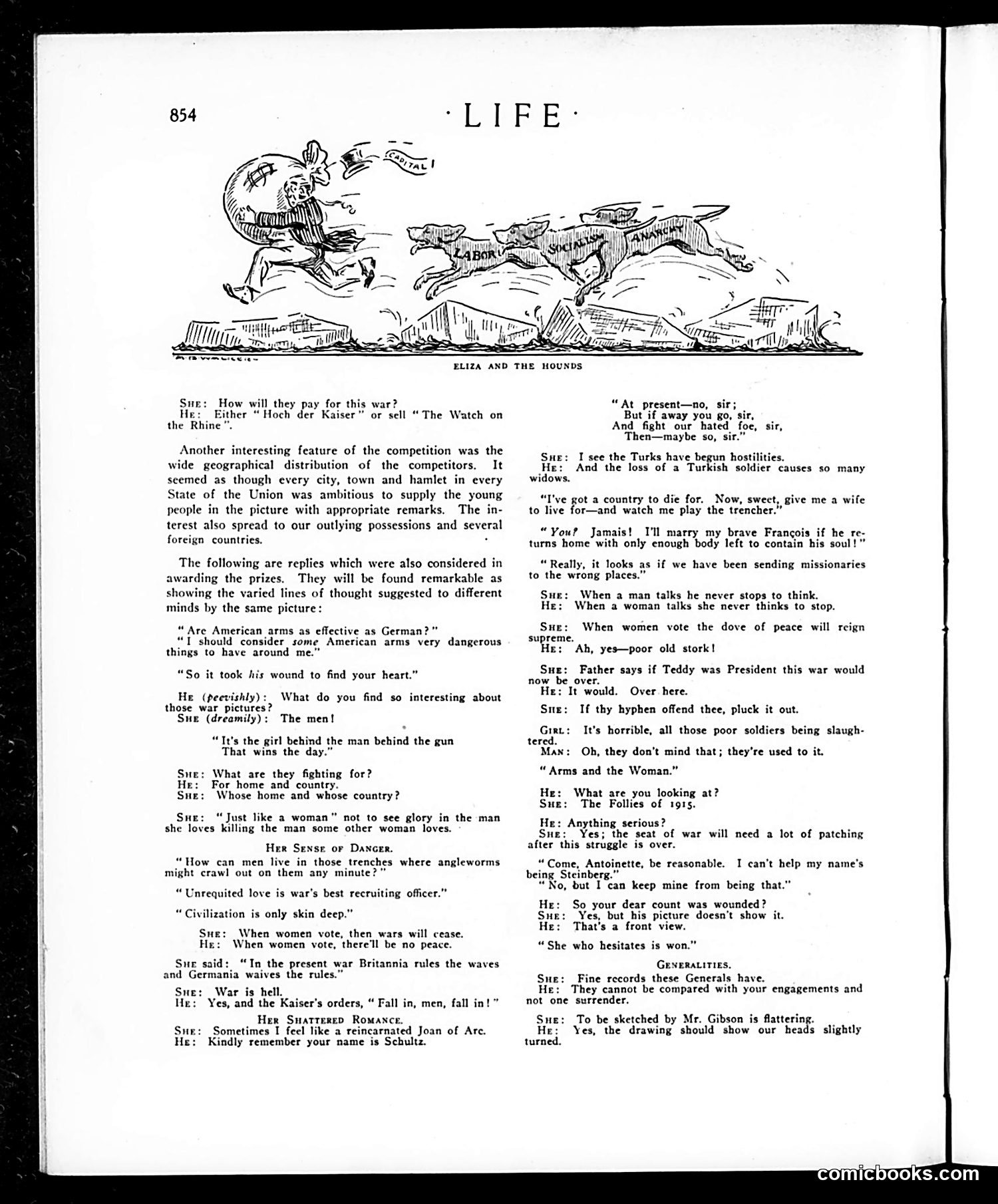
This page from *Life* magazine presents satirical commentary on World War I through a competition requesting witty captions for an illustration (titled "Eliza and the Hounds," likely depicting someone fleeing pursuits). The selected captions and runners-up mock various aspects of the war: **Anti-German sentiment**: References to "the Kaiser" and "Germania" reflect American hostility toward Germany, while jibes at "Teddy" (Theodore Roosevelt) suggest debate over U.S. involvement. **Gender politics**: Multiple jokes pit men's and women's perspectives on war—women questioning its purpose while men cite duty, and a sardonic exchange about a woman named "Schultz" feeling like Joan of Arc (suggesting suspicion of German-Americans). **War absurdities**: Jokes about trench conditions, casualty indifference, and soldiers' motivations expose the conflict's harsh realities through dark humor. The "hyphen" reference targets hyphenated Americans (German-Americans), reflecting anxiety about divided loyalties during WWI.
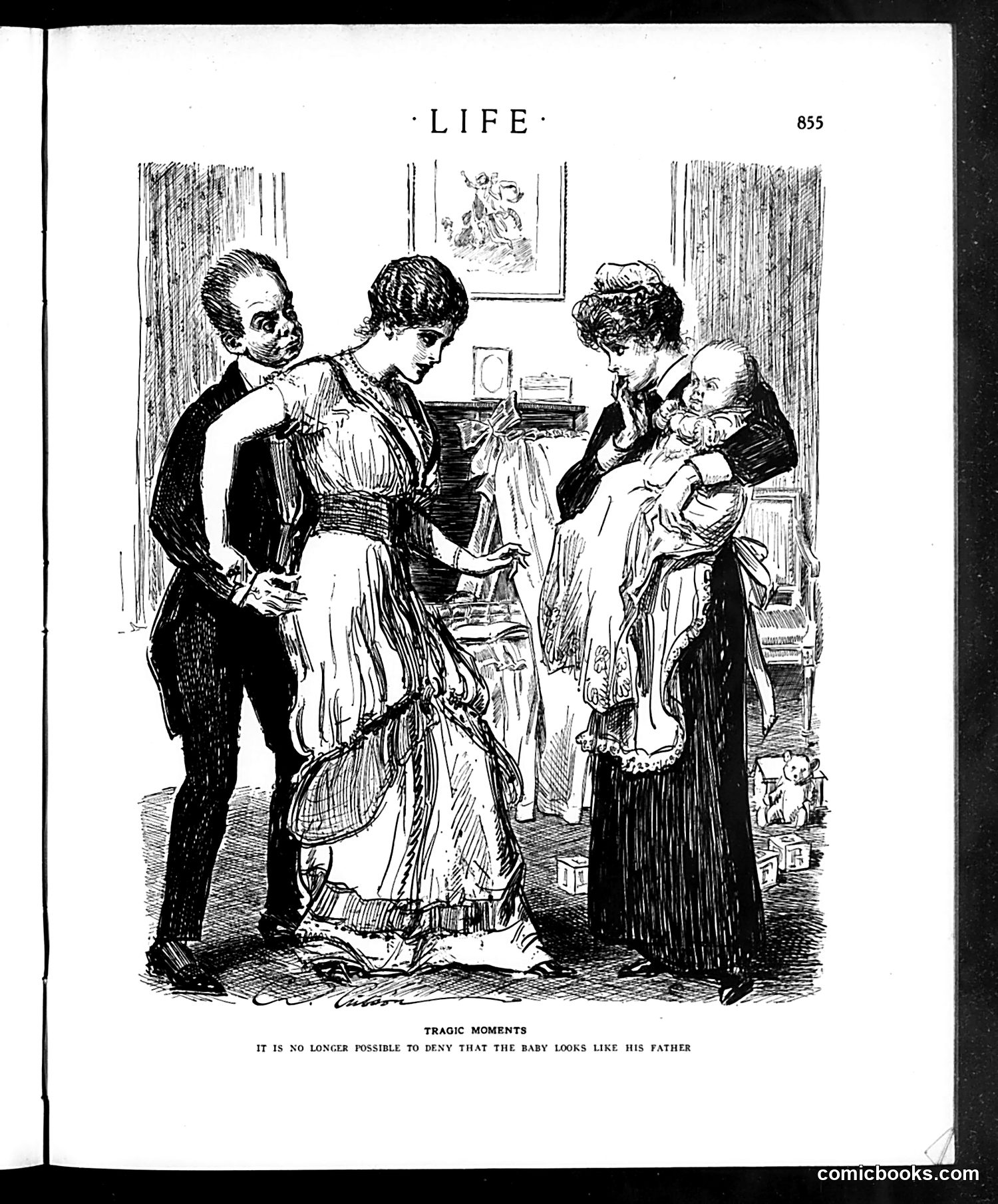
This is a satirical cartoon from *Life* magazine titled "Tragic Moments." It depicts a social scene where a woman presents a baby to gathered adults. The caption reads: "It is no longer possible to deny that the baby looks like his father." The joke is about **paternity acknowledgment**. In the era this was published, there was social pressure to deny or avoid admitting an illegitimate child resembled its biological father. The humor lies in the "tragedy" that the baby's appearance has now made such denial impossible—the resemblance is undeniable, forcing an awkward social acknowledgment. The cartoon satirizes Victorian-era hypocrisy around illegitimacy and the social discomfort surrounding paternity issues that had previously been deniable or hidden.
This page discusses an ongoing libel suit in Syracuse involving former President Theodore Roosevelt and Republican politician William Barnes. Roosevelt testified for a week defending himself, with Barnes's testimony still pending. The article satirizes Roosevelt's courtroom performance and unwavering self-righteousness—his conviction that "Whatever I did was right." While acknowledging his entertaining qualities as a performer, the writer criticizes his inability to admit error. The piece frames the lawsuit as symptomatic of deeper Republican Party dysfunction in New York. The satire cuts both ways: Roosevelt is mocked for his absolutism, yet Barnes (representing the party's conservative "invisible" machine politics) is depicted as worse. The columnist suggests the lawsuit, though entertaining, reflects genuine damage to the Republican Party from internal corruption and legislative excess under Governor Whitman. The cartoon's caption—"While there is Life there's Hope"—appears ironic given the party's troubles.
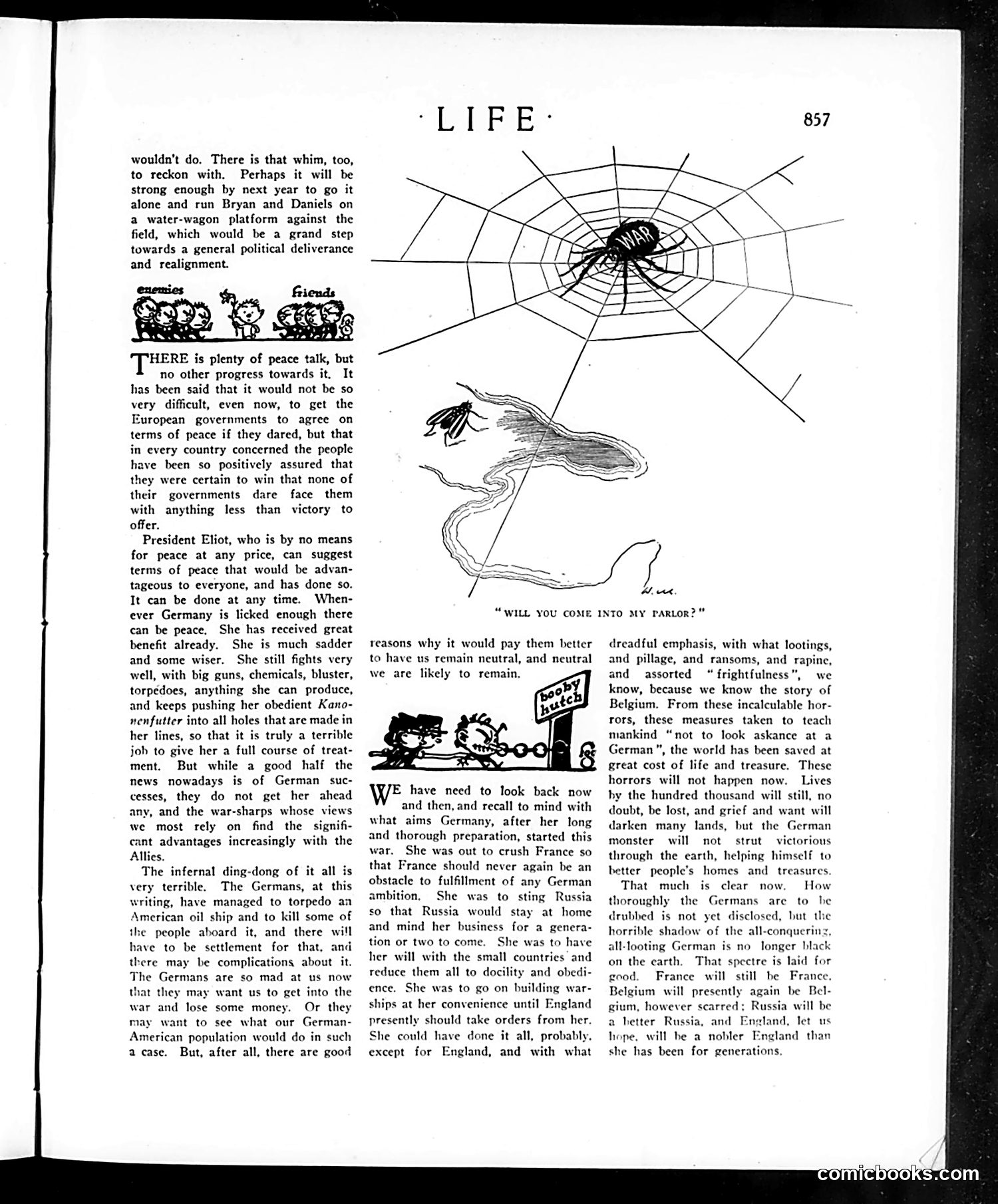
This page discusses **World War I peace negotiations and German war aims**, circa 1915-1916. **The cartoons illustrate:** 1. **Top right**: A spider web with "WAR" at the center and a fly caught in it—representing Germany's trap for neutral nations, particularly the United States. 2. **Bottom left**: Captioned "WILL YOU COME INTO MY PARLOR?"—alludes to the predatory poem "The Spider and the Fly," suggesting Germany is luring America into the conflict. **Key political content:** - The text references President **Eliot** (Harvard's Charles W. Eliot), discussing peace terms - Mentions **Bryan and Daniels** (likely William Jennings Bryan and Josephus Daniels), suggesting a "water-wagon platform" (anti-war stance) - Describes Germany's aims: crushing France, intimidating Russia, dominating small nations, and building naval supremacy - References Belgium's suffering under German occupation ("frightfulness") - Argues the Allies, not Germany, will ultimately prevail The satire criticizes German aggression while addressing American neutrality debates—a central issue before U.S. entry in 1917.
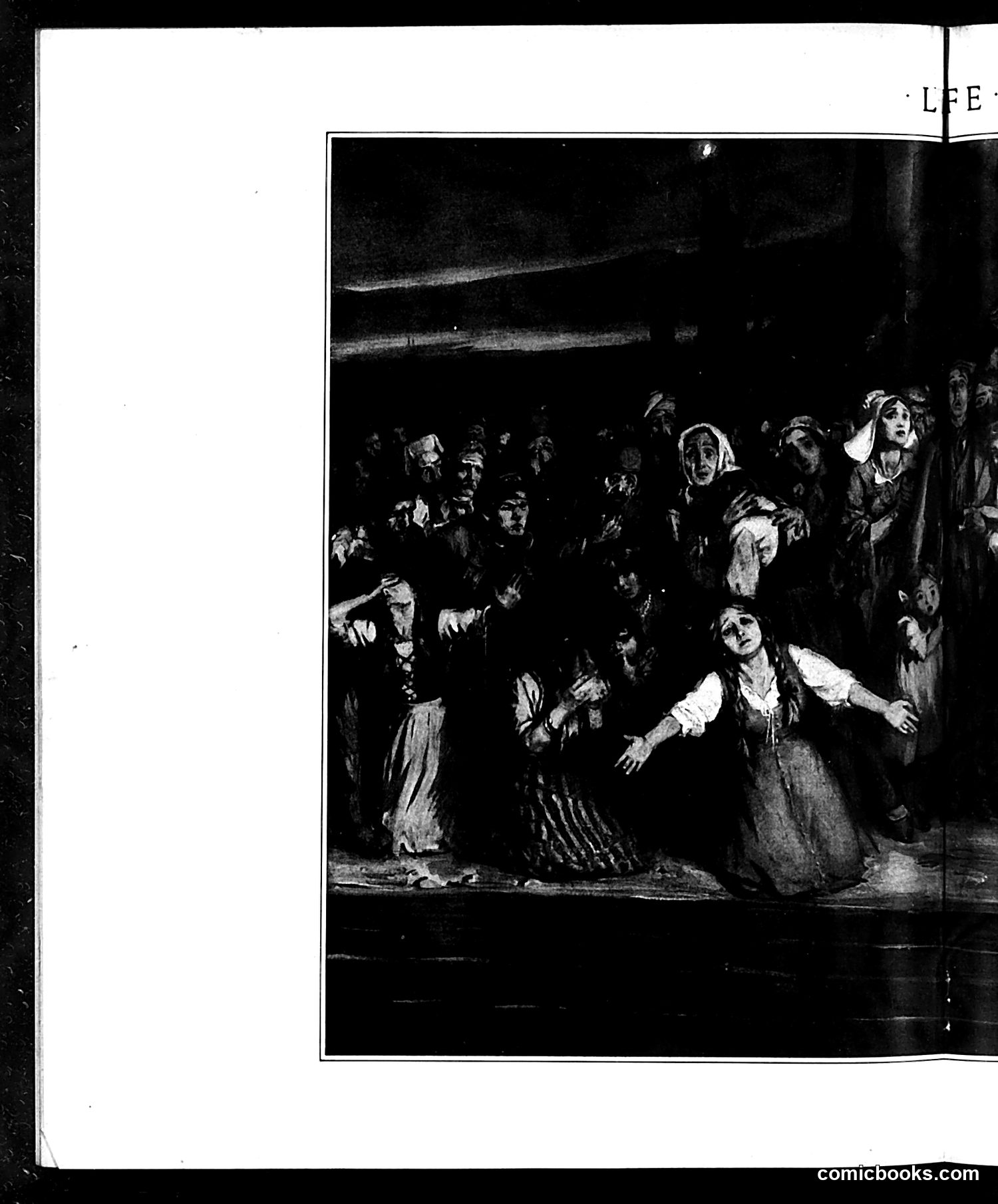
This appears to be a dramatic theatrical or operatic scene rather than a political cartoon. The black and white image shows a group of people in period costume (late 19th or early 20th century dress) gathered on a stage, with one figure kneeling prominently in the foreground with arms outstretched in an emotional gesture, while others around them appear distressed or reacting with intensity. Without additional context from the article text or caption, I cannot definitively identify which specific opera, play, or historical event is being depicted. The page header reads "LIFE" and appears to be from the public-domain satirical magazine, but the OCR text provided only shows "comicbooks.com" as a source attribution. To accurately explain the satire or commentary intended, I would need the accompanying article text or illustration caption.
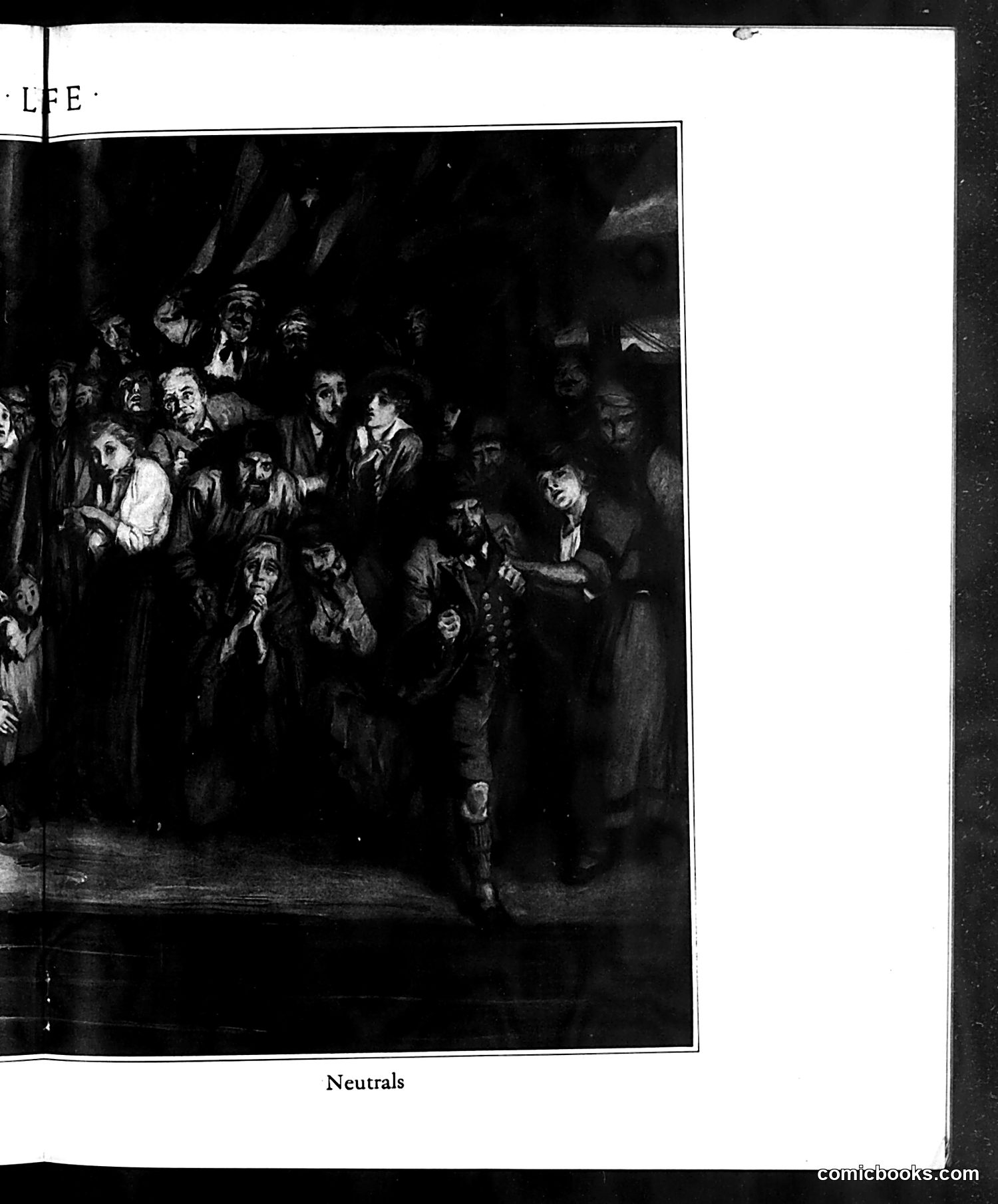
This appears to be a dark, dramatic illustration depicting a crowd of figures in what looks like an underground or shadowy setting. The caption "Neutrals" suggests this is political satire about people claiming neutrality during a conflict—likely from World War I era, when "Life" magazine frequently satirized American neutrality debates. The packed, anxious crowd of varied figures may represent different American groups or politicians claiming neutral positions while surrounded by the chaos of war. The shadowy, cramped composition emphasizes how difficult or uncomfortable true neutrality was becoming as global conflict escalated. Without more context or visible signatures, I cannot identify the specific artist or pinpoint the exact historical moment this references.
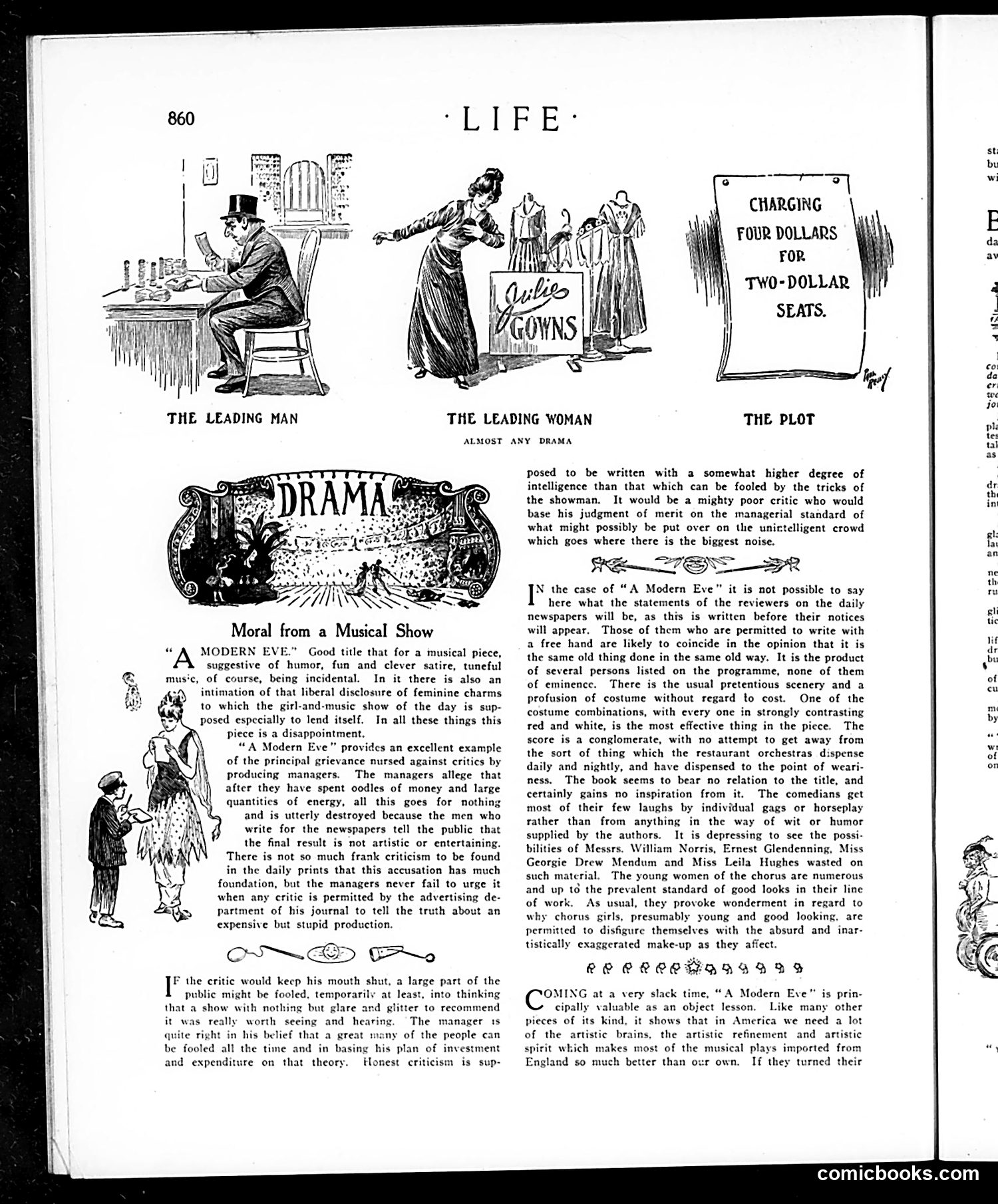
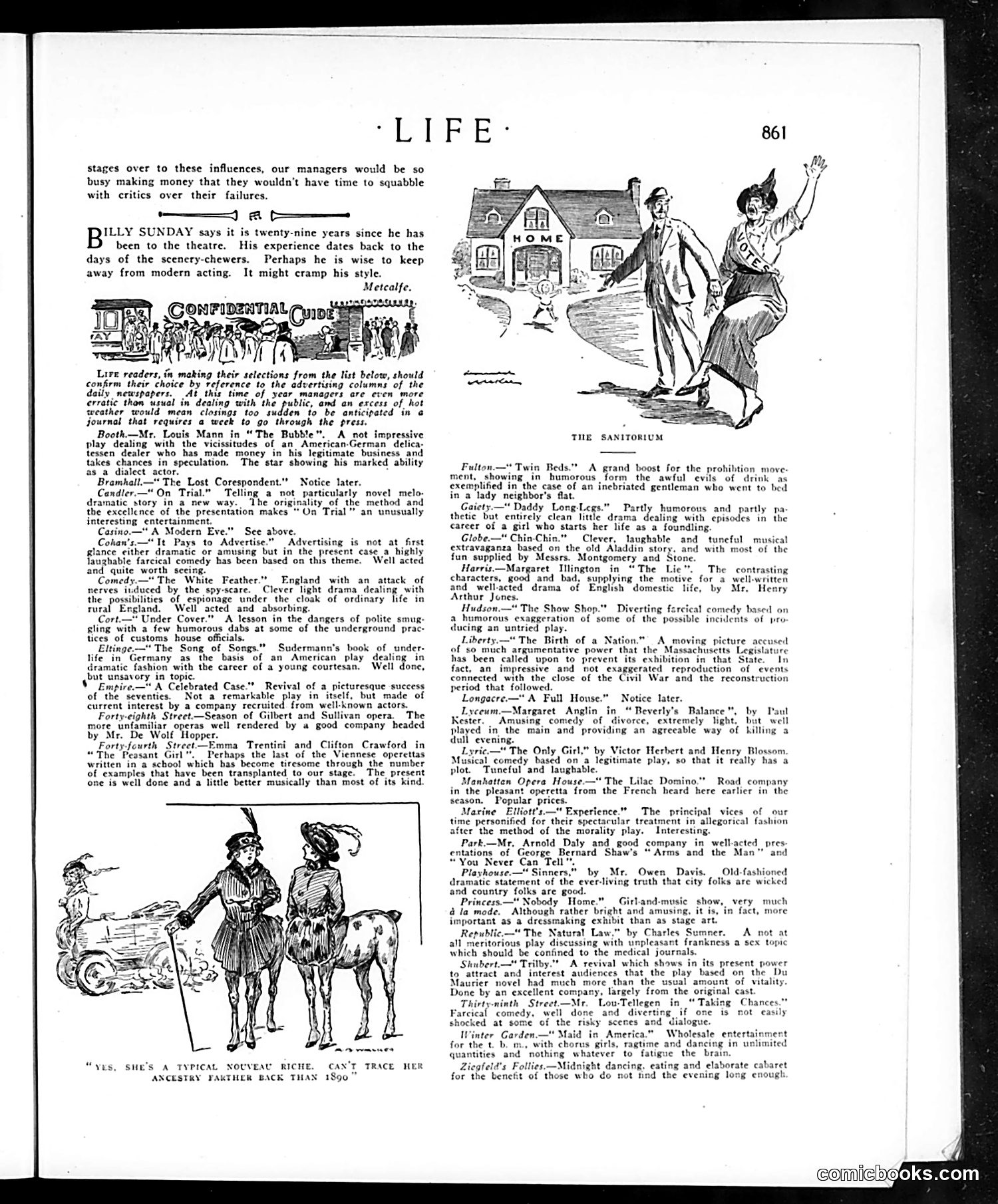
This page from *Life* magazine contains theater reviews and satirical commentary on early 20th-century Broadway productions. The key cartoons illustrate social satire: **Upper cartoon ("The Sanitorium"):** Shows two well-dressed figures outside a house, mocking nouveau riche (newly wealthy) pretentiousness—a common *Life* theme targeting the socially ambitious middle class. **Lower cartoon ("Yes, she's a typical nouveau riche"):** Depicts a woman in fashionable dress with companions and a horse, captioned with a joke about tracing ancestry "no further back than 1890"—mocking new wealth lacking old-family credentials. Both cartoons target the same target audience anxiety: Americans of modest origin who had recently acquired money and tried to claim social respectability. The satire assumes readers share contempt for social climbing and value established class status. The theater reviews are straightforward entertainment criticism, listing current Broadway shows with brief evaluations of their merit.
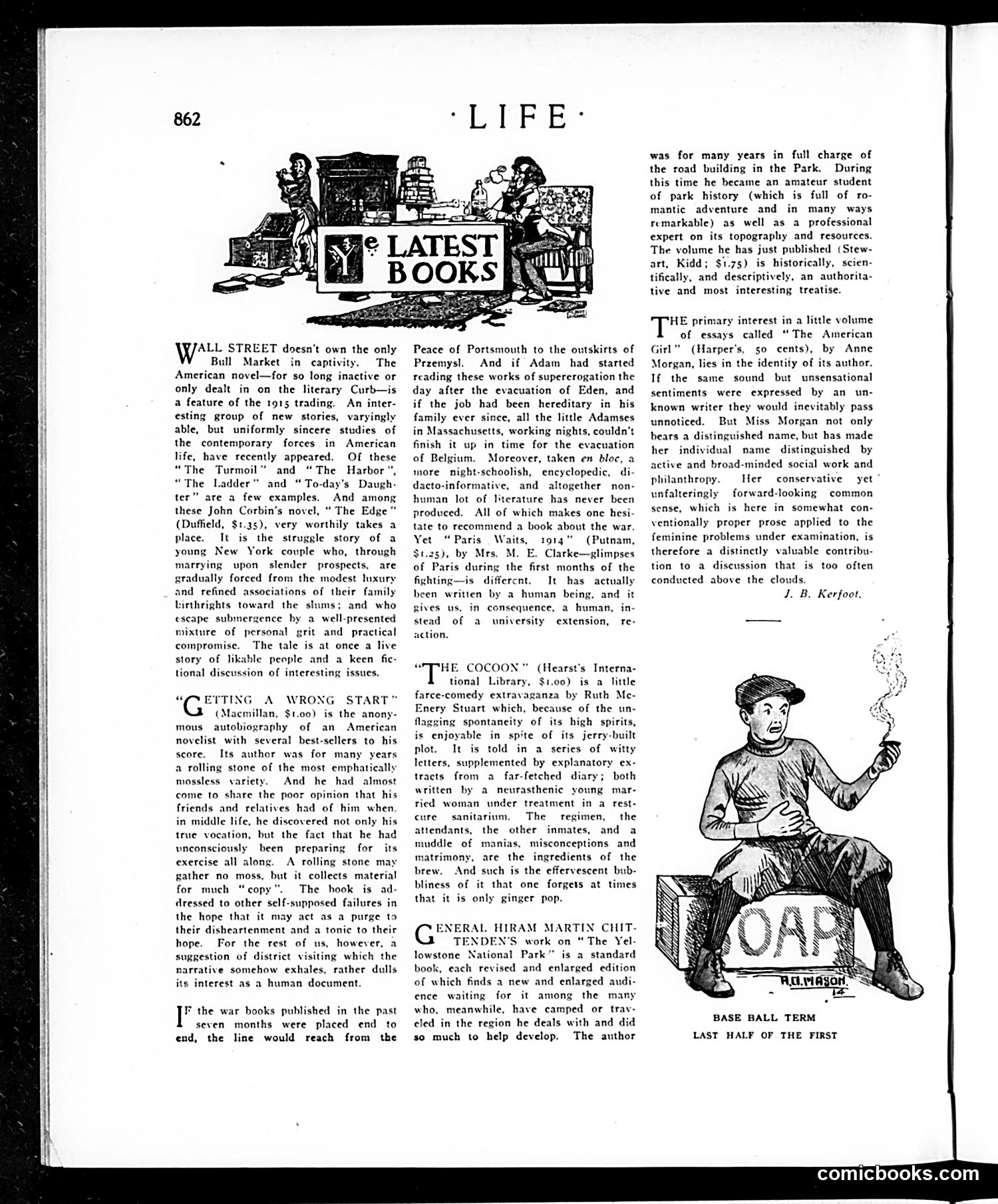
This is a literary review section from Life magazine discussing recent American novels published in 1915. The page contains five book reviews covering contemporary fiction and non-fiction. The only illustration is a cartoon labeled "BASE BALL TERM / LAST HALF OF THE FIRST" showing a figure in a baseball stance holding what appears to be a bat or club. This is a visual pun or section header, likely connecting baseball terminology to the literary reviews that follow. The reviews themselves discuss novels addressing contemporary American social issues—economic struggle, personal ambition, and the ongoing World War. One review sardonically criticizes the flood of war books being published, using exaggerated comparisons about their length and dullness. The overall tone is witty and evaluative rather than promotional. The page demonstrates how Life functioned as a satirical literary and cultural commentary magazine for educated American readers in the early 20th century.
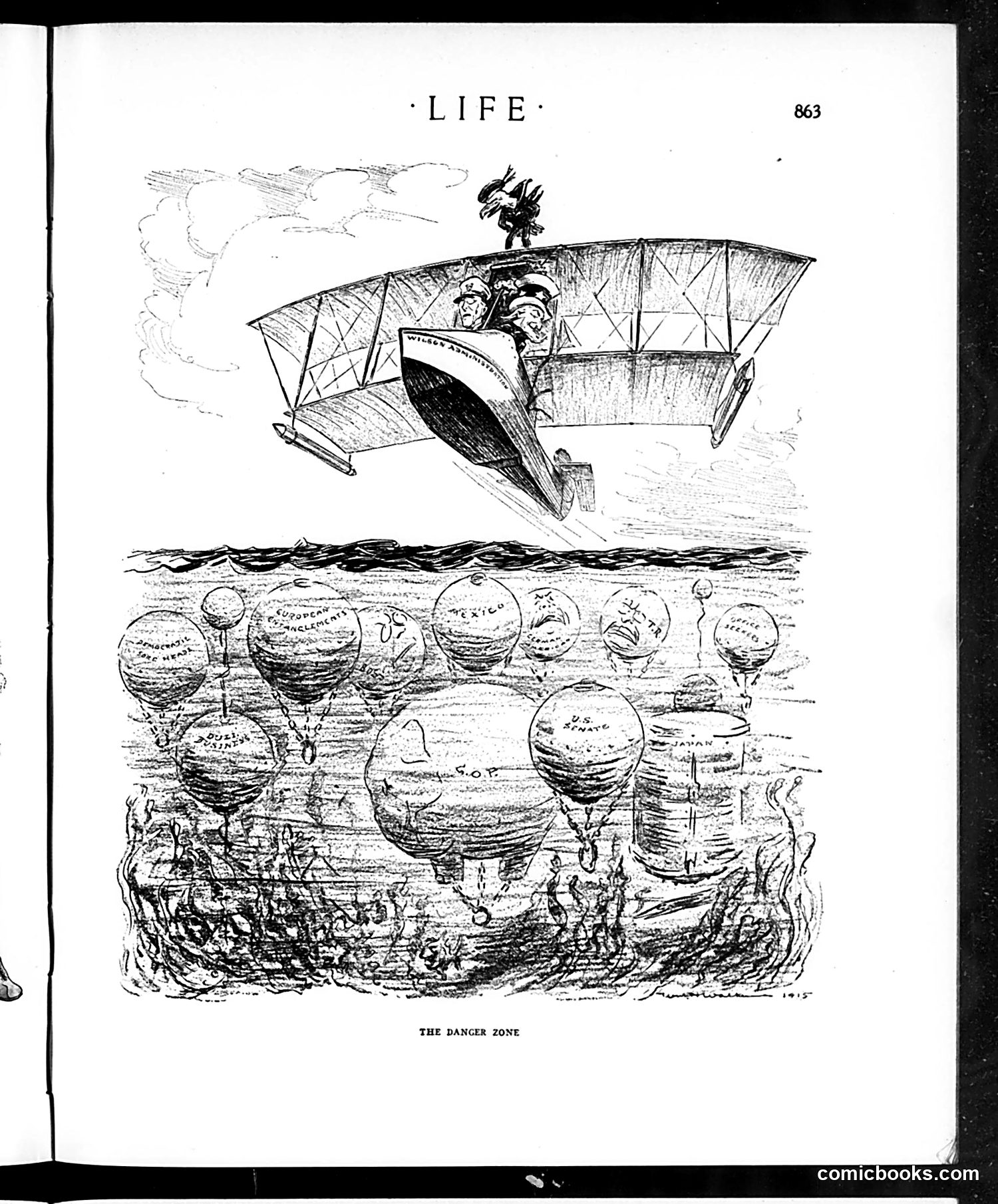
This satirical illustration depicts an airship or early aircraft suspended above water, carrying two figures inside a cabin. Below the waterline, the image reveals what appears to be mines or explosive devices tethered to the seafloor, with demonic or monstrous figures among them. The cartoon satirizes the hazards of early aviation and naval travel during a period of military tension (likely WWI era, given the airship design). "The Danger Zone" refers to the vulnerability of these new transportation technologies to submarine warfare and naval mines—real threats during this period. The juxtaposition of the airship's passengers obliviously traveling above while deadly weapons lurk below mocks the false sense of security travelers might feel, emphasizing the hidden dangers of modern warfare beneath peaceful-seeming skies.
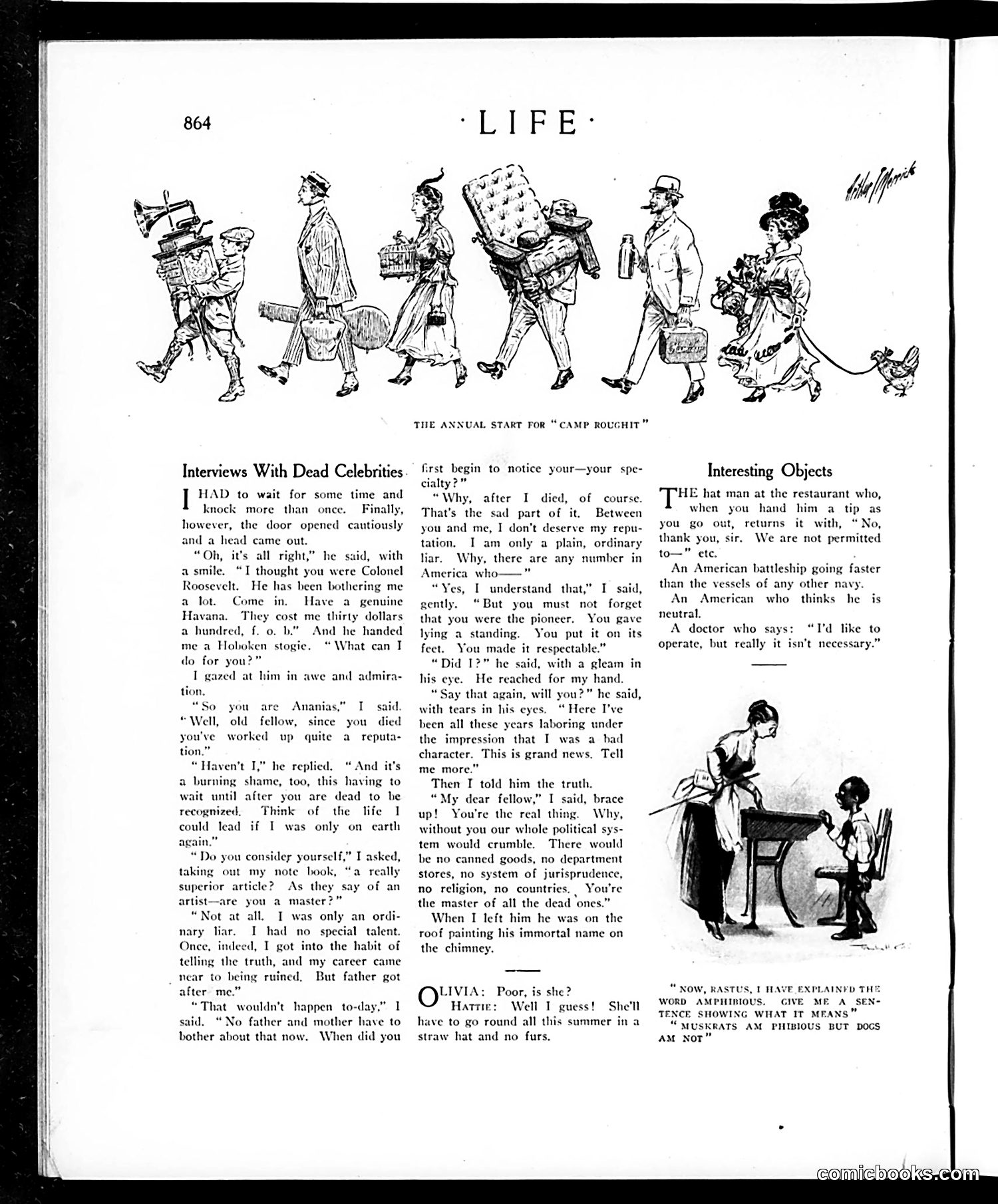
**Main Cartoon ("The Annual Start for 'Camp Roughit'"):** This depicts seven figures departing for summer camp, laden with absurd amounts of luggage and provisions. The satire mocks wealthy Americans' excessive materialism and overpreparation for leisure activities—a common target of early 20th-century satirists concerned with upper-class excess. **"Interviews with Dead Celebrities":** A humorous column where the narrator interviews a deceased figure (identity unclear, though context suggests a famous liar or fraud). The satire argues that lying—once socially condemned—became foundational to American institutions: politics, commerce, religion, and law. This is dark social commentary suggesting systemic corruption has normalized dishonesty at the highest levels. **"Interesting Objects":** A brief satirical list mocking American pretense: hat-check men refusing tips, American naval power, American neutrality (likely referencing WWI debates), overly cautious doctors, and concluding with a racial dialect joke typical of the era. The page's overarching theme critiques American society's hypocrisy, materialism, and institutionalized dishonesty.
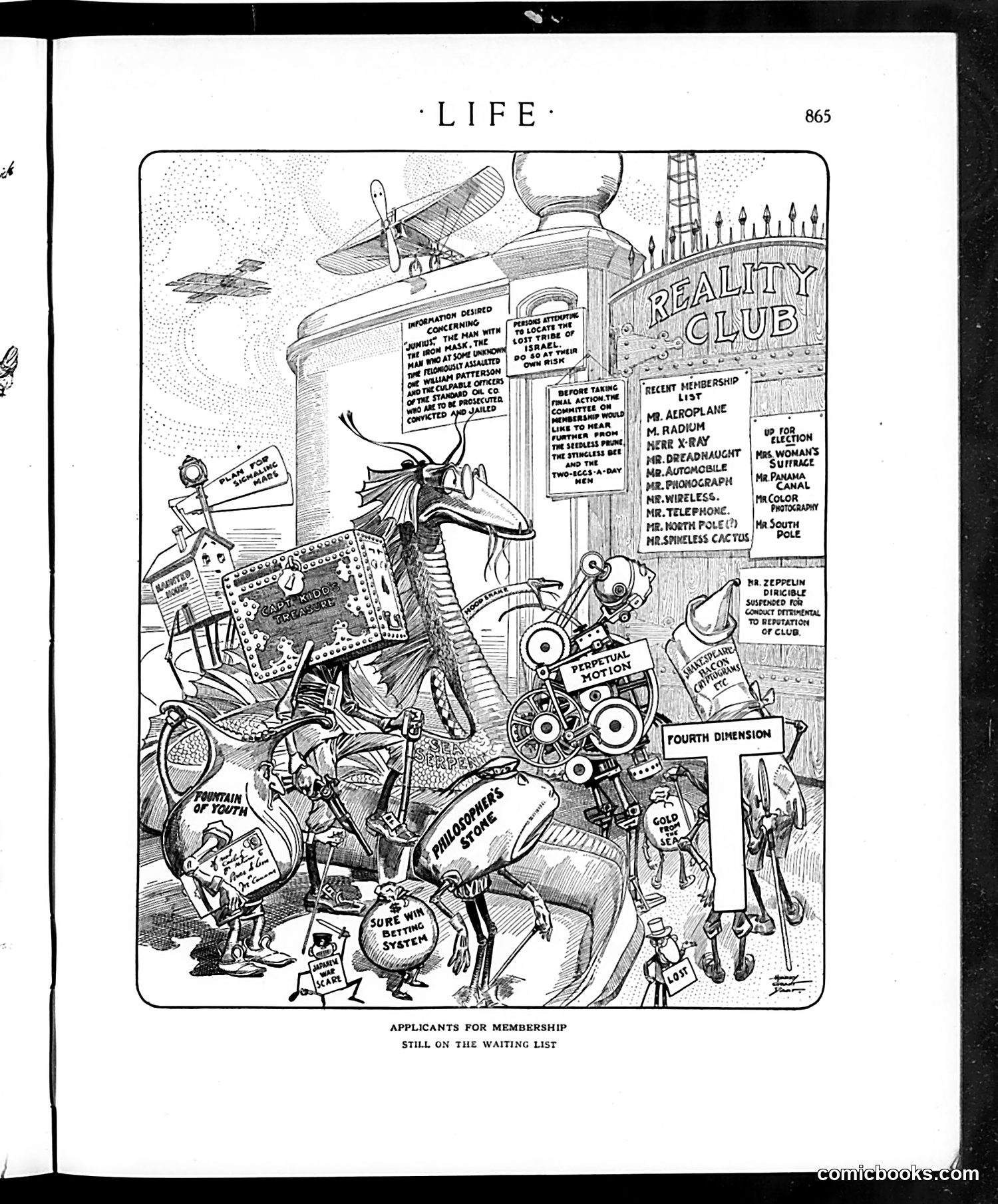
This cartoon satirizes the "Reality Club"—a fictional exclusive organization with an enormous backlog of membership applicants. The membership list includes personified modern inventions and technologies: the Aeroplane, Radium, X-Ray, Dreadnaught (battleship), Automobile, Phonograph, Wireless, and Zeppelin. The joke targets early 20th-century technological enthusiasm and the faddish club culture of the era. These cutting-edge innovations are depicted as aspiring members whose "conduct" is deemed "detrimental to reputation"—a satirical jab suggesting these new technologies are considered socially disruptive or morally questionable by society's establishment gatekeepers. The "waiting list" caption underscores the cartoon's commentary: despite their transformative impact on modern life, these innovations remain excluded from respectable society, reflecting the tension between technological progress and social conservatism of the period.
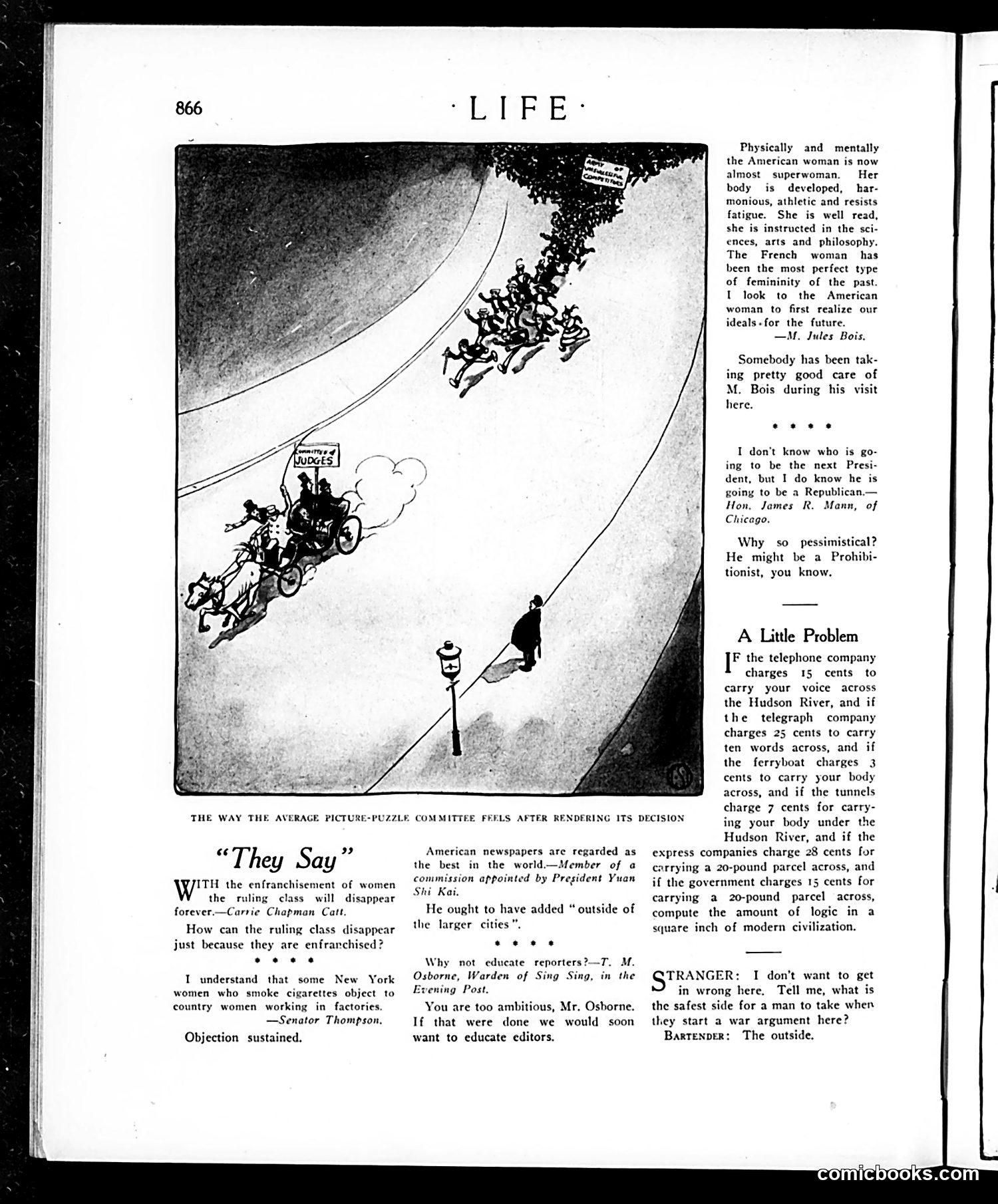
This Life magazine page (page 866) contains satirical commentary on early 20th-century American politics and society, centered around women's suffrage and social reform. **Main Cartoon:** "The Way the Average Picture-Puzzle Committee Feels" depicts a chaotic roller coaster or slide with figures tumbling downward—likely satirizing the confusion and upheaval caused by women gaining voting rights. The caption mocks the naïve logic that women's enfranchisement will automatically eliminate the "ruling class." **"They Say" Section:** A series of brief satirical quotes puncture pretensions: - Women smoking cigarettes objecting to factory workers (hypocrisy) - American newspapers being "the best in the world" (clearly false outside major cities) - Suggesting educating newspaper *reporters* is too ambitious—if educated, they'd demand editor education too (mockery of intellectual resistance to reform) **Other Jokes:** Political cynicism about the next president; a mathematical puzzle exposing the illogical cost structure of Hudson River transportation companies; and a bar-room quip about staying neutral in arguments. The overall tone: skeptical of progressive claims while satirizing establishment resistance to reform.
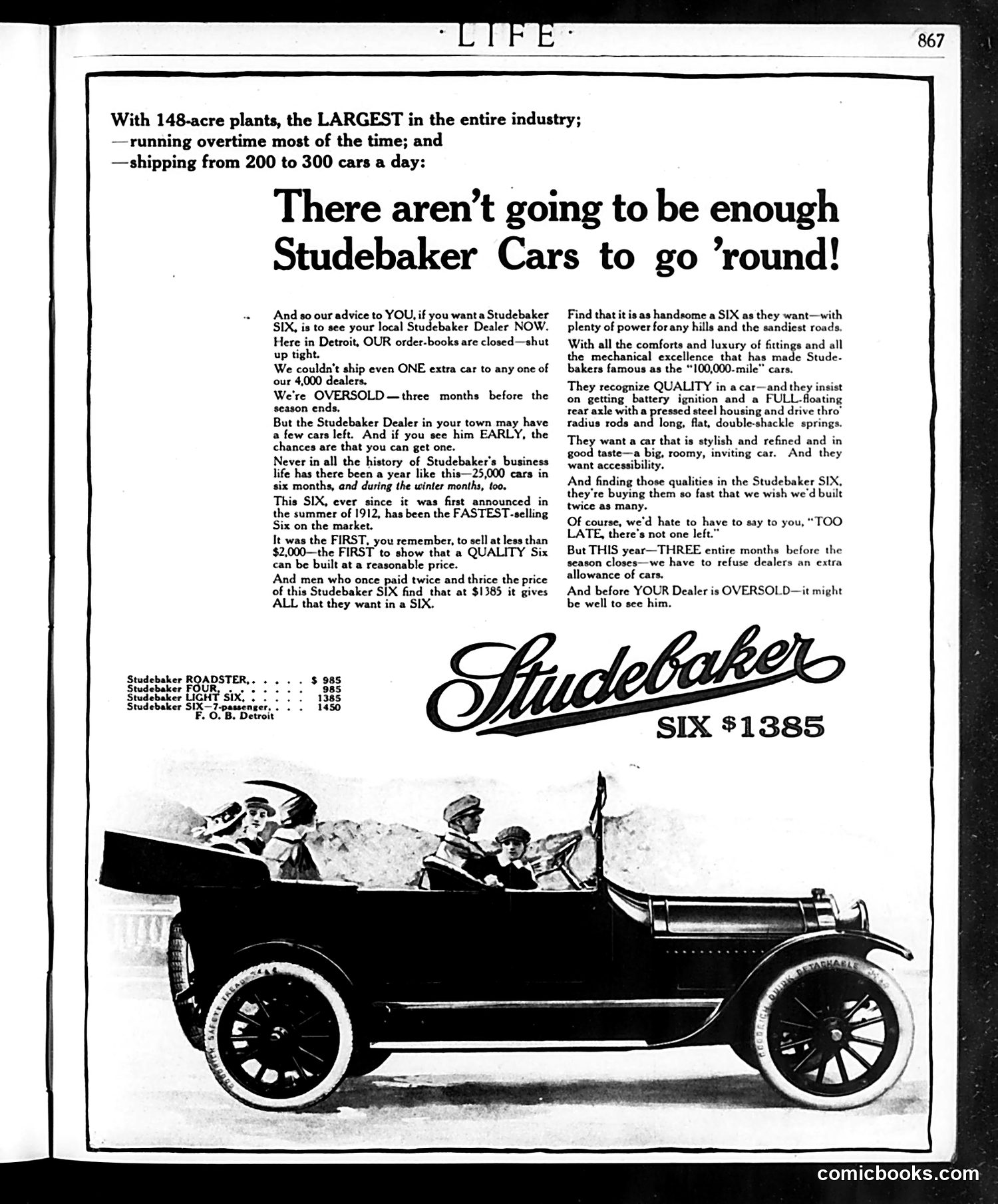
This is a **full-page automobile advertisement**, not political satire. It promotes the Studebaker Six automobile at $1385 (F.O.B. Detroit). The advertisement uses a boastful, tongue-in-cheek tone to claim overwhelming demand: the manufacturer's 148-acre plant operates overtime, shipping 200-300 cars daily, yet cannot meet demand. The copywriter urges readers to purchase immediately from local dealers before inventory sells out completely. The pitch emphasizes the car's quality features—battery ignition, floating rear axle, sturdy springs—and its reputation for durability ("100,000-mile" cars). It highlights the Six's historical significance: first to sell below $2,000 while maintaining quality. The period illustration shows the open-air roadster style typical of 1910s automobiles, with passengers enjoying a leisurely drive. This reflects genuine post-WWI economic optimism and strong consumer demand for automobiles during the automotive industry's rapid expansion.
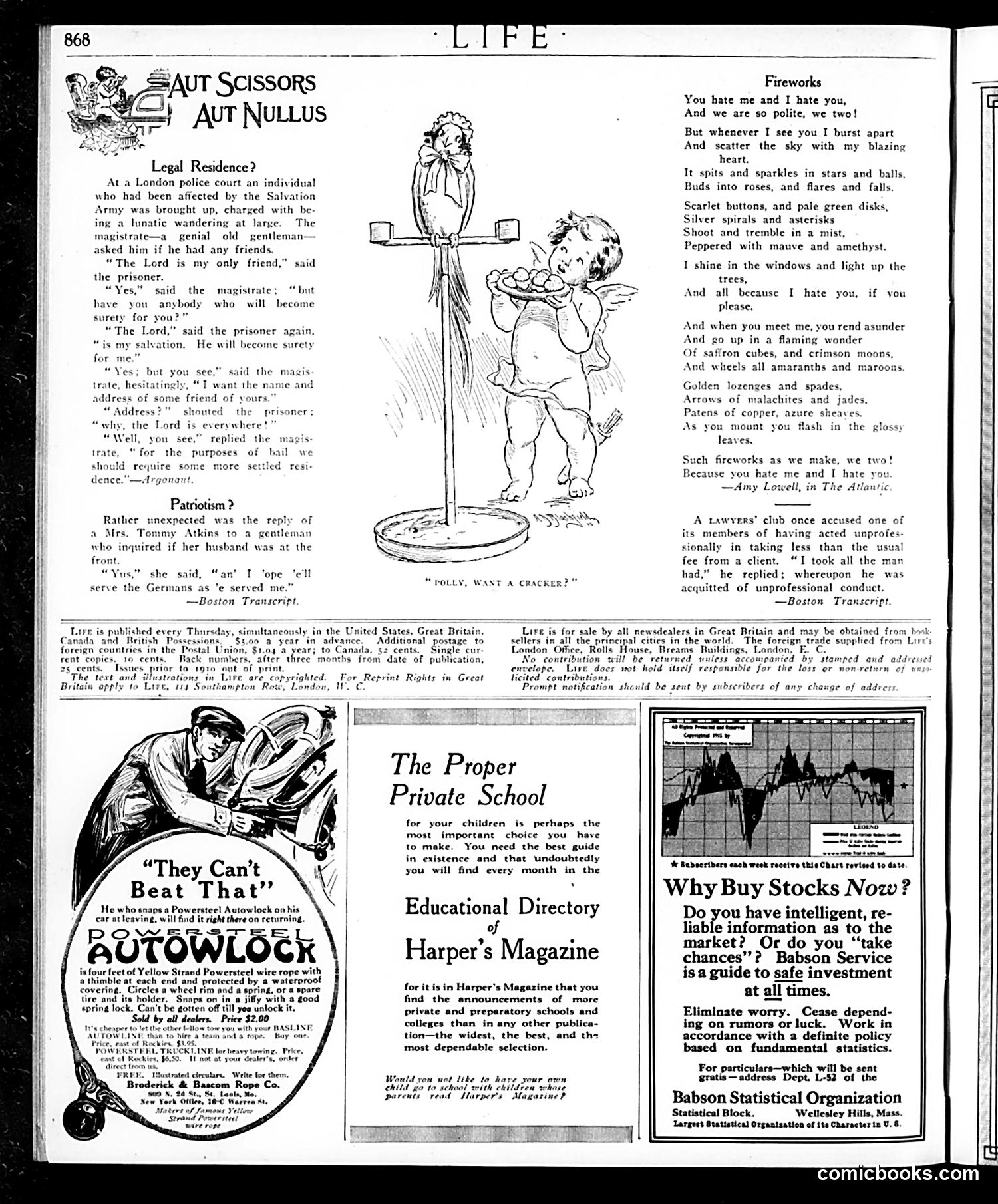
This page contains several satirical pieces typical of early 20th-century Life magazine: **"Legal Residence"** mocks religious extremism by depicting a Salvation Army convert in court who insists "the Lord" is his only friend and surety. The magistrate's exasperation—needing an actual earthly address for legal purposes—satirizes impractical piety colliding with bureaucratic reality. **"Patriotism"** quotes a working-class woman (Mrs. Tommy Atkins, a generic British soldier's wife) saying she hopes her husband serves Germans "as 'e served me"—crude innuendo suggesting marital discord, satirizing hollow patriotic sentiment. **The parrot cartoon** ("Polly, Want a Cracker?") likely references contemporary politics, though the specific target is unclear from the image alone. **"Fireworks"** is Amy Lowell poetry about mutual hatred expressed through pyrotechnic metaphor—likely unrelated to satire. The page also includes period advertisements (Powerlock auto-lock, rope company) and educational directory notices, typical of Life's mixed-content format.
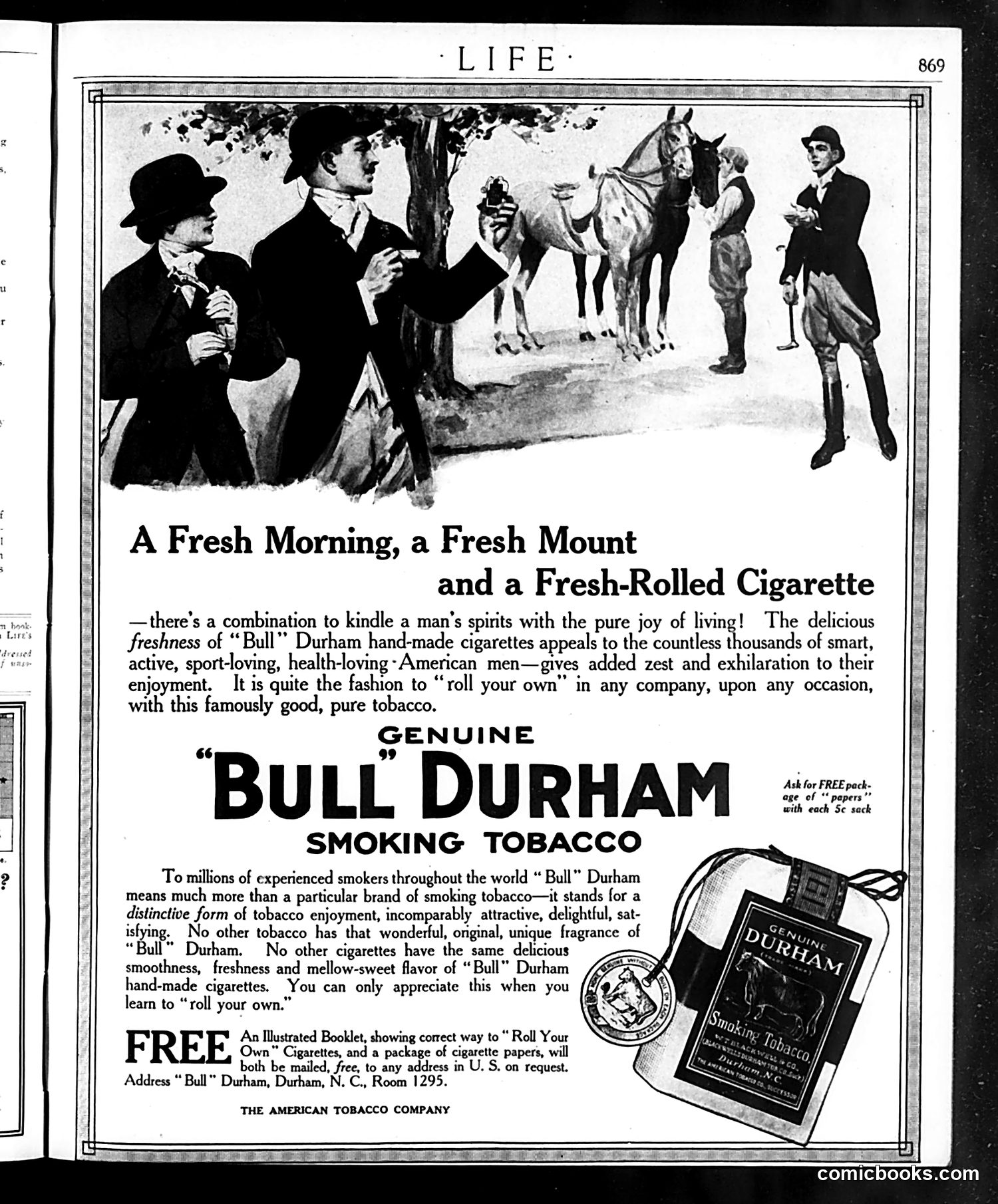
This is **not a cartoon or satire**, but a straightforward **cigarette advertisement** from Life magazine's advertising pages. The illustration depicts gentlemen in early 20th-century attire (bowler hats, formal coats) engaged in outdoor leisure activities—horseback riding and socializing. The ad promotes "Bull" Durham smoking tobacco, emphasizing the fashionable practice of rolling one's own cigarettes. Key marketing appeals: - **"Fresh"** imagery (morning, new mounts, hand-rolled cigarettes) suggests vitality and modernity - **Class aspirations**: the well-dressed, active "American men" depicted represent an idealized masculine lifestyle - **DIY appeal**: "roll your own" positioned as both economical and fashionable - **Free offer**: distribution of rolling instructions and cigarette papers For modern readers: this normalizes smoking as a desirable social practice associated with health, vigor, and sophistication—claims that would be illegal in contemporary advertising. The American Tobacco Company clearly targeted middle and upper-class men through lifestyle branding.
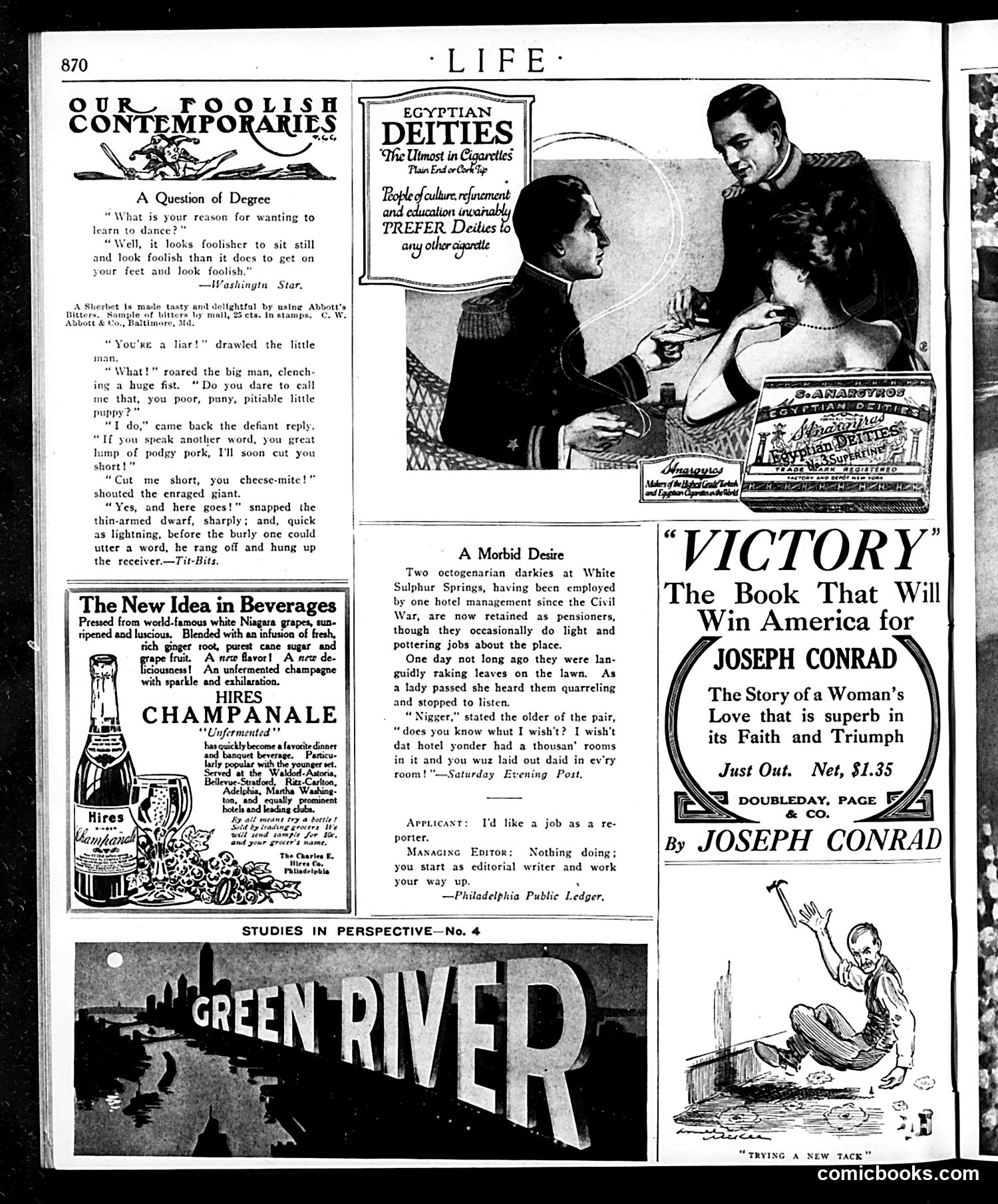
This page contains multiple satirical pieces typical of early 20th-century Life magazine: **"A Question of Degree"** presents a humorous dialogue about learning to dance—the joke being that dancing poorly while moving is no more foolish than sitting still looking foolish, so one might as well dance. **The violent quarrel anecdote** is a setup-and-punchline about two men escalating insults until the smaller man simply hangs up a telephone—deflating the confrontation through an absurdist twist. **"A Morbid Desire"** uses dialect humor (common but now offensive) featuring elderly Black workers at a resort wishing harm on each other in exaggerated terms—the satire targeting the characters' dark wishes rather than race itself, though the presentation is deeply dated. The page is primarily **advertising and filler content**—Egyptian Deities cigarettes, Hires Champanale beverage, and a Joseph Conrad book promotion dominate the layout. These reflect commercial Life's dual nature as both satirical publication and advertising vehicle.
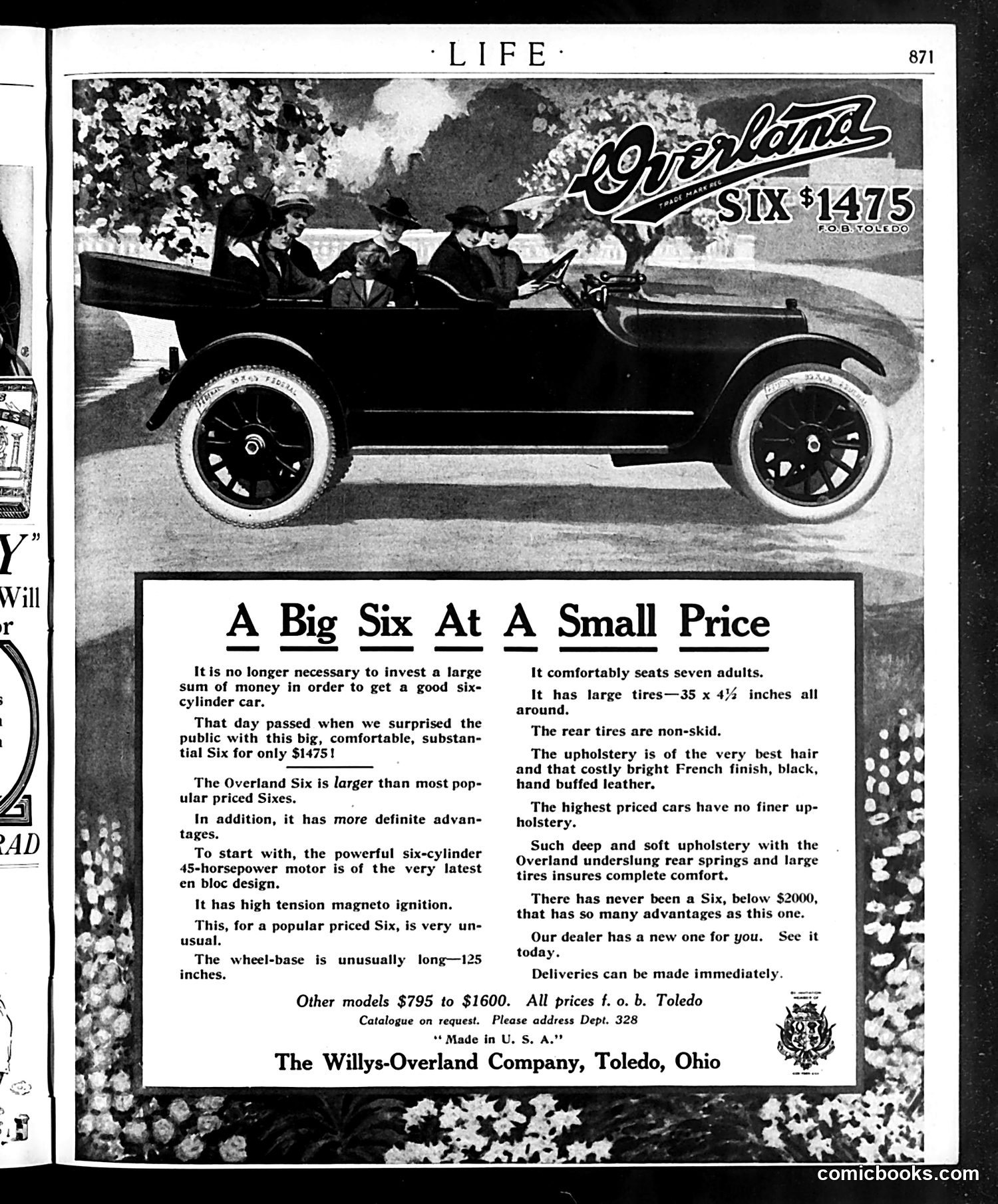
This page is **not a cartoon or satire**—it's a straightforward automobile advertisement from the Willys-Overland Company for their Overland Six automobile priced at $1,475. The ad emphasizes value: a six-cylinder car (typically expensive) at an accessible price point. It highlights technical features (45-horsepower motor, high-tension magneto ignition, 125-inch wheelbase) and comfort details (seats seven, quality leather upholstery, non-skid tires) to justify the price. The tagline "A Big Six At A Small Price" is the sales pitch. The illustration shows well-dressed passengers in the open-air vehicle, suggesting prosperity and modern convenience. This reflects early 1910s automotive marketing, when six-cylinder cars represented technological advancement and status symbols. There is no political commentary, caricature, or hidden satire—this is period advertising in *Life* magazine, used as a revenue source alongside the publication's actual editorial content.
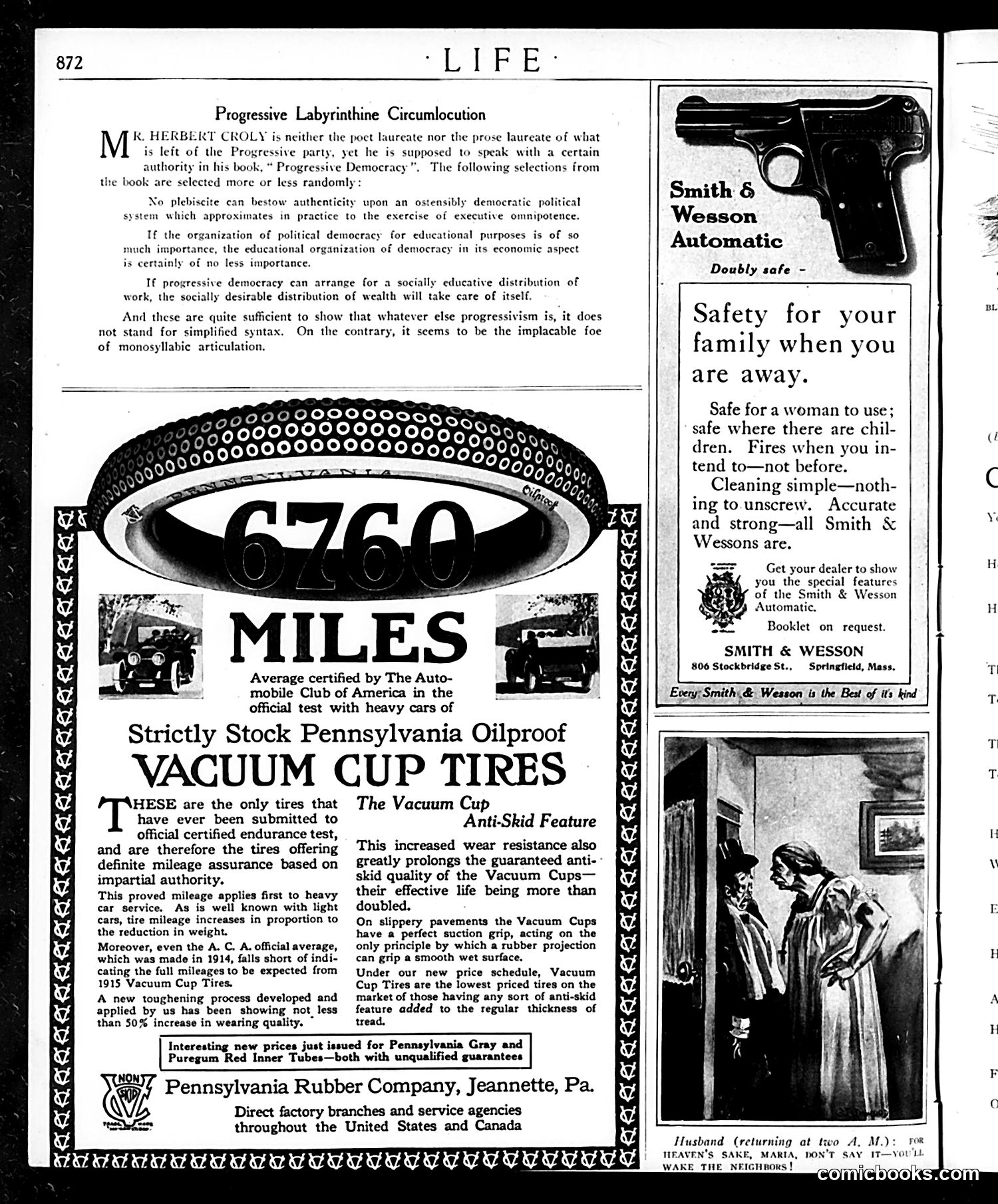
This page satirizes Herbert Croly's book *Progressive Democracy*. The satire mocks progressive political writing for its deliberately obscure, jargon-filled language. The four quoted passages exemplify this—each makes simple points through needlessly complex syntax. The headline itself parodies this style: "Progressive Labyrinthine Circumlocution" means progressives speak in confusing, roundabout ways. The joke is that Croly, despite claiming to advance democratic education, writes in deliberately opaque language that ordinary citizens cannot understand. This contradicts progressivism's stated goal of making politics accessible. The satire suggests progressive intellectuals are more interested in sounding sophisticated than communicating clearly—the opposite of simplified, democratic discourse. The advertisements (Smith & Wesson pistol, Vacuum Cup tires) are typical period content unrelated to the satire.
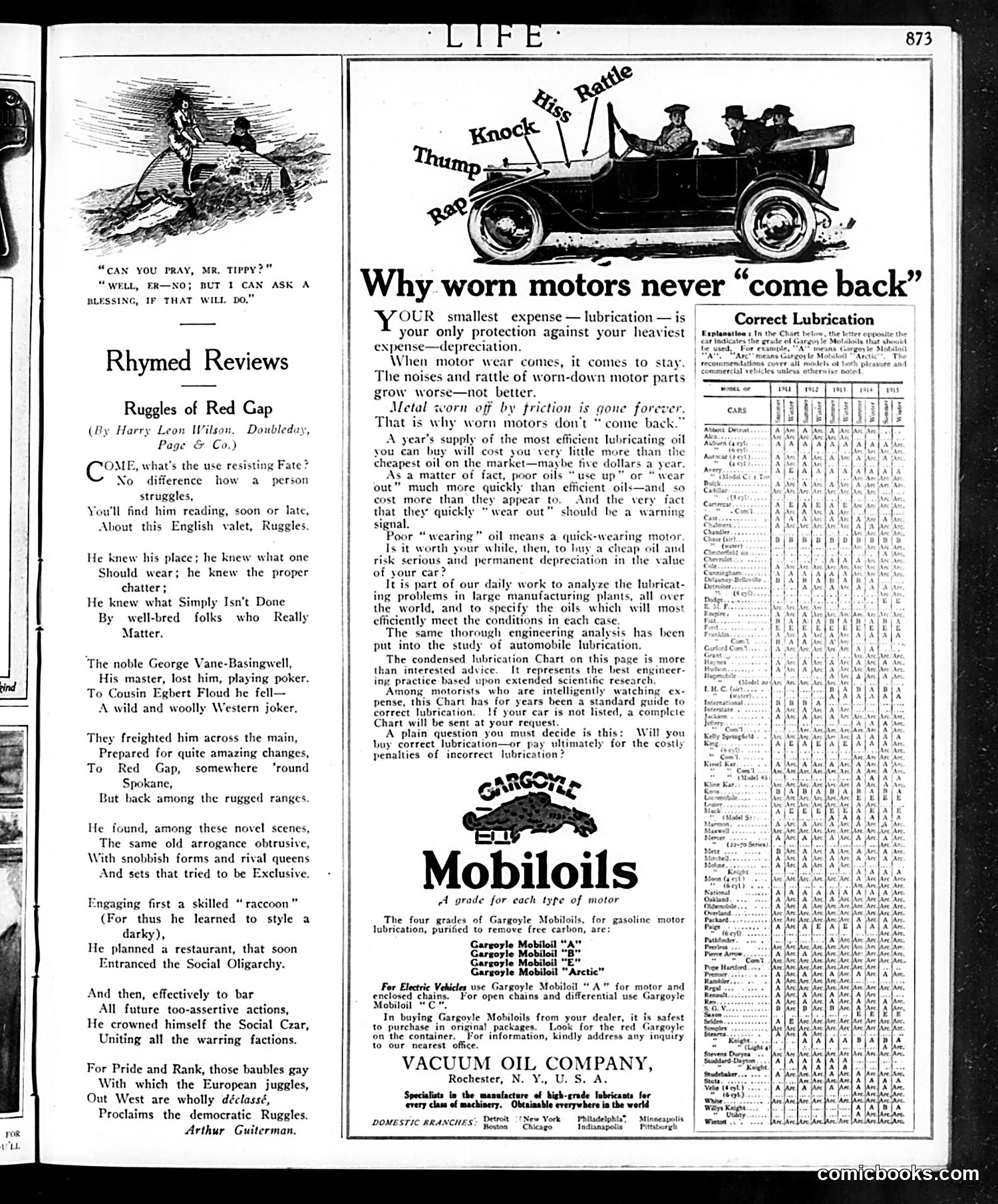
**The Cartoon (Top Left):** A simple two-panel joke labeled "Can you pray, Mr. Tippy?" The humor appears to turn on a servant or subordinate character unable to pray properly, offering instead to provide a "blessing" if that will suffice—likely satirizing either religious pretension or class-based deference in speech. **"Rhymed Reviews" - Ruggles of Red Cap:** A book review in verse about a novel by Harry Leon Wilson. The plot: a proper English valet gets lost in a poker game and ends up in the American West (near Spokane). Among rough westerners, his rigid class-consciousness and European pretensions prove useless. He ultimately thrives by abandoning snobbery, suggesting the American frontier has no use for Old World hierarchies—a common Progressive-era theme celebrating American democracy over European aristocracy. **The Mobiloils Advertisement:** The remainder is a lengthy advertisement for motor oil, featuring a lubrication chart and technical specifications—typical commercial content for Life magazine during this period. The page contrasts democratic American themes with period commercial interests.
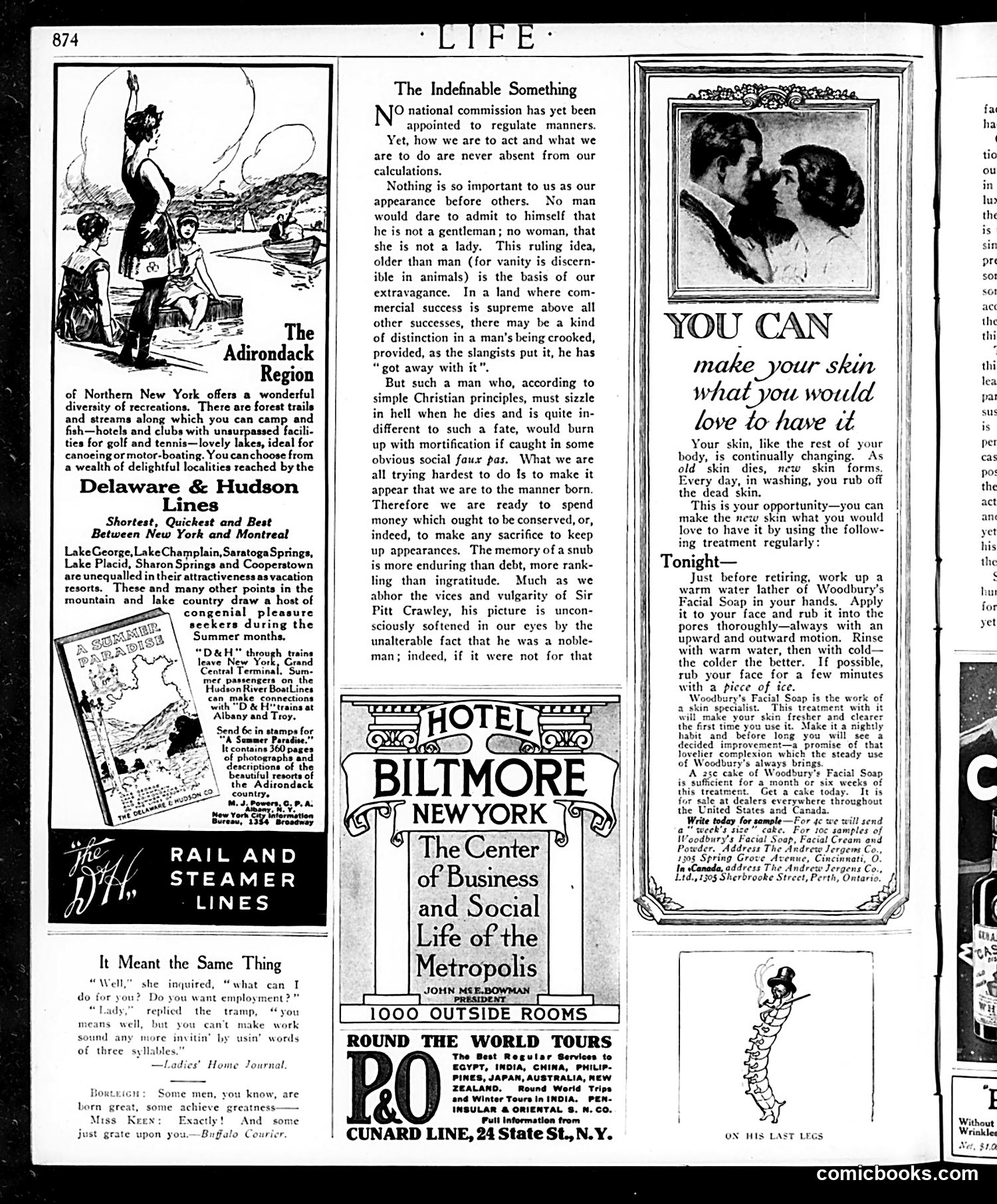
This page is primarily **advertising and travel promotion**, not political satire. The dominant content includes: **"The Indefinable Something"** — an essay on social appearance and class anxiety. It argues that Americans obsess over appearing genteel and respectable, willing to hide moral failings (being "crooked") rather than suffer social embarrassment. The piece critiques how commercial success and vanity drive wasteful spending on maintaining appearances. **Advertisements dominate the layout:** - Delaware & Hudson railroad promoting Adirondack vacation destinations - Hotel Biltmore in New York - P&O Cunard steamship lines offering world tours - **Woodbury's Facial Soap** (largest ad) — a skin-care product using pseudo-scientific claims about daily skin renewal The cartoon illustration (left) appears to show leisure activities in the Adirondacks, supporting the travel promotion. **For modern readers:** This reflects early 20th-century anxieties about social climbing and consumer culture—the idea that appearance and consumption signal respectability. The soap ad exemplifies how advertising exploited these insecurities.
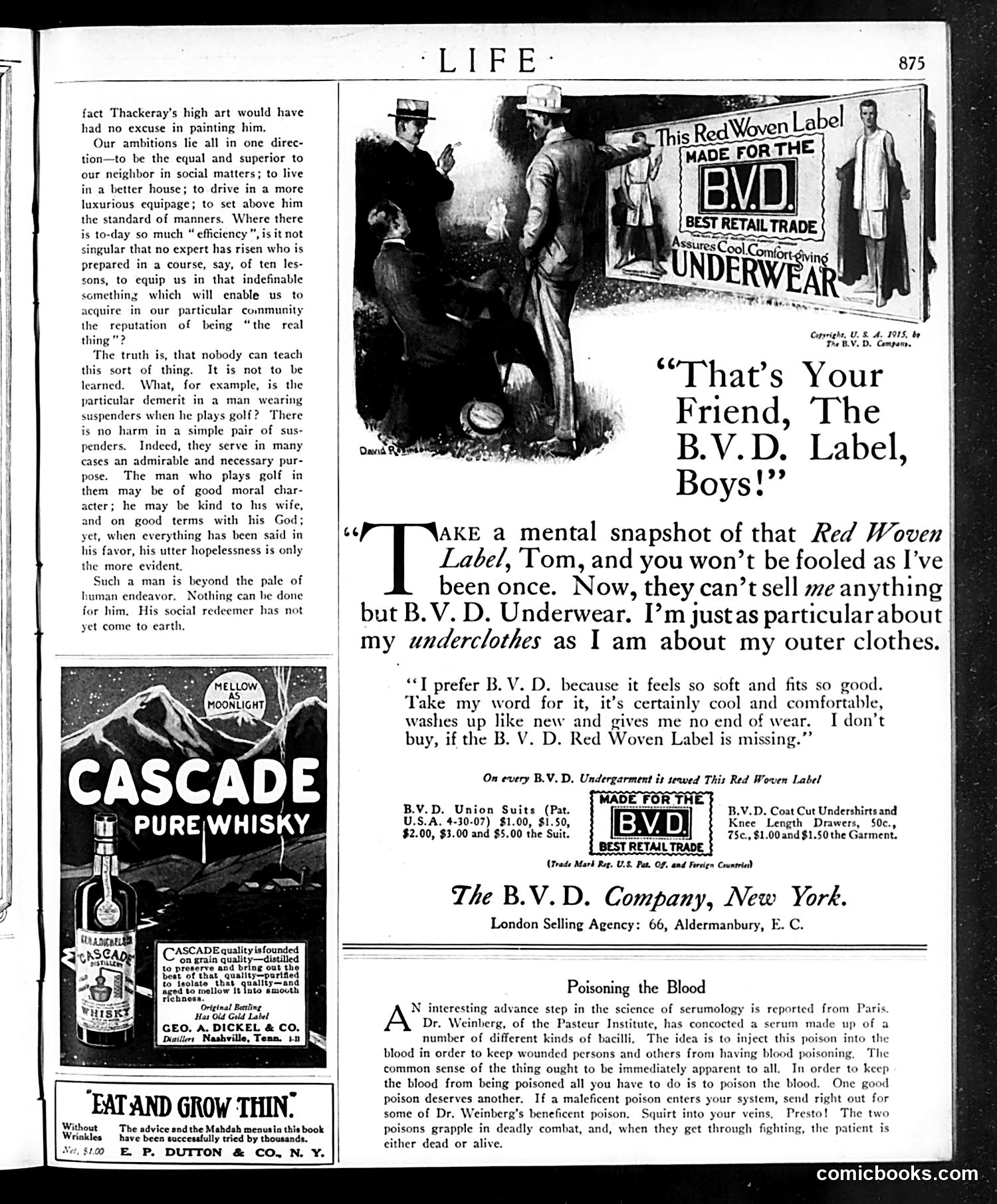
This page contains **editorial commentary and advertisements** rather than political cartoons. The main text satirizes social climbing and class anxiety: it mocks people obsessed with acquiring markers of respectability—better houses, luxurious possessions, proper manners—to impress neighbors. The example about suspenders while playing golf illustrates the author's point: no amount of instruction can teach the indefinable "something" that separates the socially acceptable from the hopelessly beyond redemption. The satire targets American social pretension and the futility of trying to purchase or learn one's way into genuine respectability. The advertisements include **B.V.D. underwear** (emphasizing the Red Woven Label as a quality guarantee), **Cascade Pure Whisky**, and **"Eat and Grow Thin"** diet advice. The final item, "Poisoning the Blood," is satirical commentary on a Paris medical development: Dr. Weinberg's serum injected poison into blood to prevent blood poisoning—the irony being that fighting poison with poison may leave the patient "dead or alive."
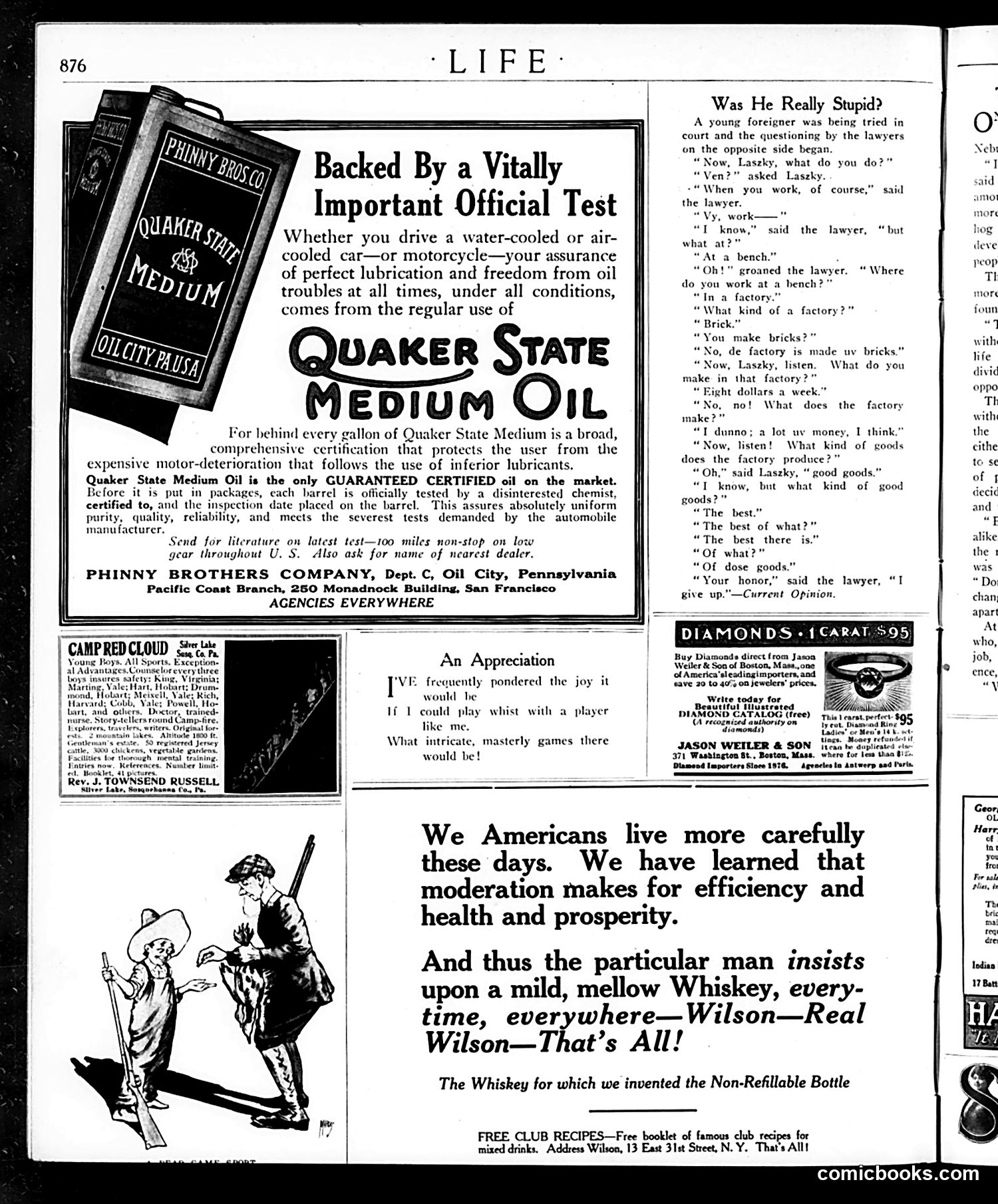
This page contains three distinct pieces of content: **"Was He Really Stupid?"** - A humorous dialect joke featuring a character named Laszky (Eastern European immigrant, based on spelling and accent), being questioned in court. A lawyer becomes increasingly frustrated trying to extract simple answers about Laszky's factory work. The joke plays on miscommunication: Laszky answers literally and evasively, seemingly obtuse but actually clever—he makes "$eight dollars a week" (wages), not goods. The humor derives from ethnic stereotype humor common to early 20th-century American magazines, where immigrants' accented English and alleged dim-wittedness were stock comedic material. **Advertisements** dominate the page—Quaker State Motor Oil (emphasizing certified purity), diamonds from Jason Weiler & Son, and Wilson Whiskey. **"An Appreciation"** - A brief, self-aware poem about the pleasure of playing cards with someone of equal skill. The page is primarily advertising-driven, with the immigrant joke serving as filler content typical of Life's satirical humor of this era.
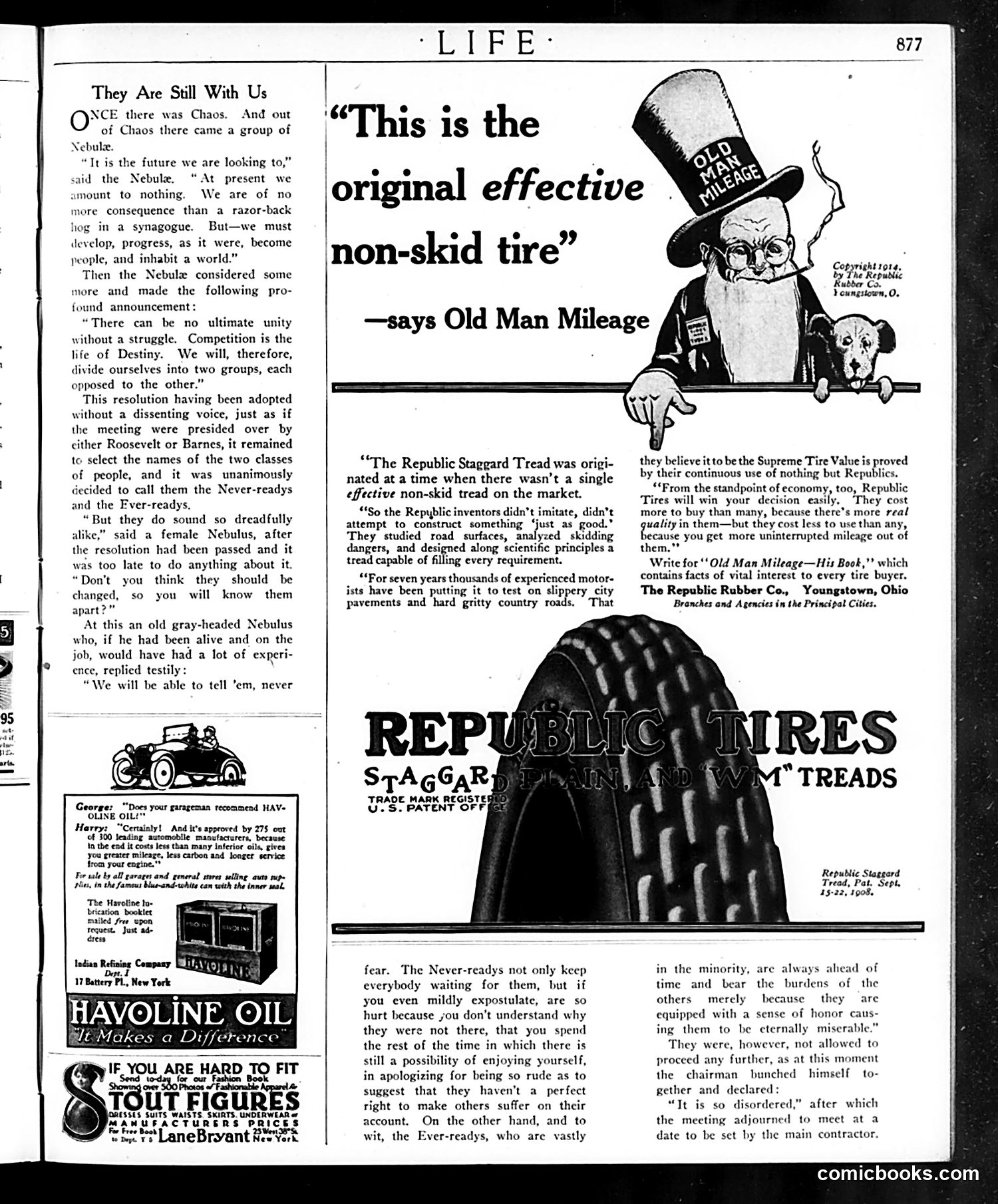
This page mixes satirical fiction with advertising. The main story, "They Are Still With Us," is a philosophical allegory: primordial beings called "Nebulae" divide themselves into two human types—the "Never-readys" (chronically late, defensive) and the "Ever-readys" (punctual, reliable). The satire targets universal personality types and social friction, appearing to reference contemporary political divisions (mentioning "Roosevelt or Barnes," likely TR and William Barnes Jr., a Republican politician involved in factional disputes). The central irony: the characters acknowledge these groups will be "dreadfully alike" yet indistinguishable—suggesting human conflicts over personality are inherently absurd. The page is dominated by a **Republic Tires advertisement** featuring "Old Man Mileage" (a mascot character), emphasizing tire durability and value. Additional ads promote Havoline Oil and Lane Bryant clothing—typical early 1900s magazine filler.
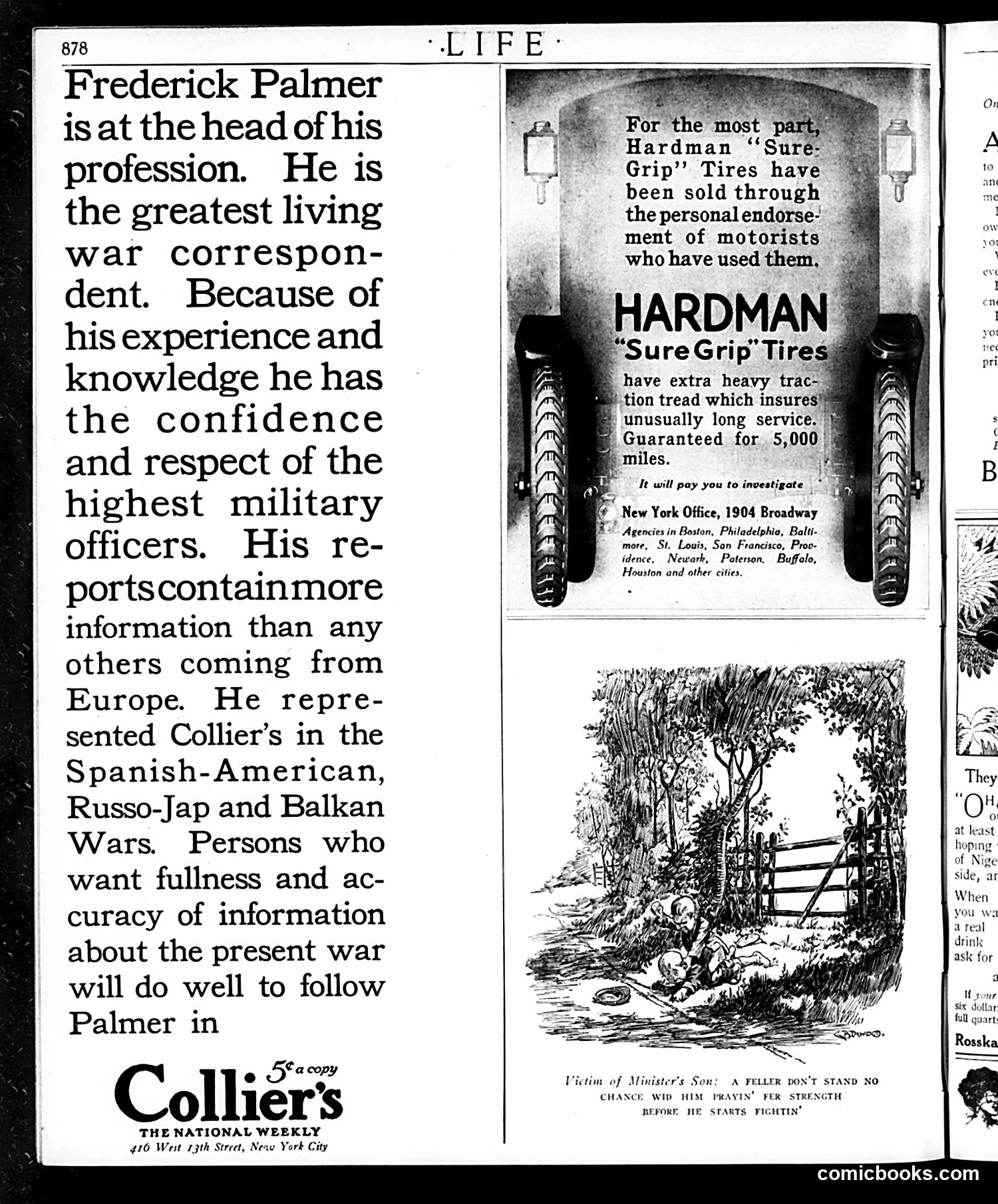
This page is primarily **advertising and promotional content**, not political satire. The left column promotes **Frederick Palmer**, described as the greatest living war correspondent, endorsing *Collier's* magazine as the source for accurate WWI reporting. Palmer had covered previous conflicts (Spanish-American War, Russo-Japanese War, Balkan Wars) and was respected by military officers. The right side contains two advertisements: one for **Hardman "Sure-Grip" Tires** (emphasizing durability and traction) and below it, a **cartoon illustration** labeled "Victim of Minister's Son," depicting a rural scene with the caption: "A feller don't stand no chance wid him prayin' fer strength before he starts fightin'." This appears to be a humorous social commentary on rural/working-class life—the joke being that facing someone praying for divine strength before a fight is an unfair advantage. The page mixes serious war journalism promotion with light entertainment and consumer goods advertising typical of early 20th-century magazines.
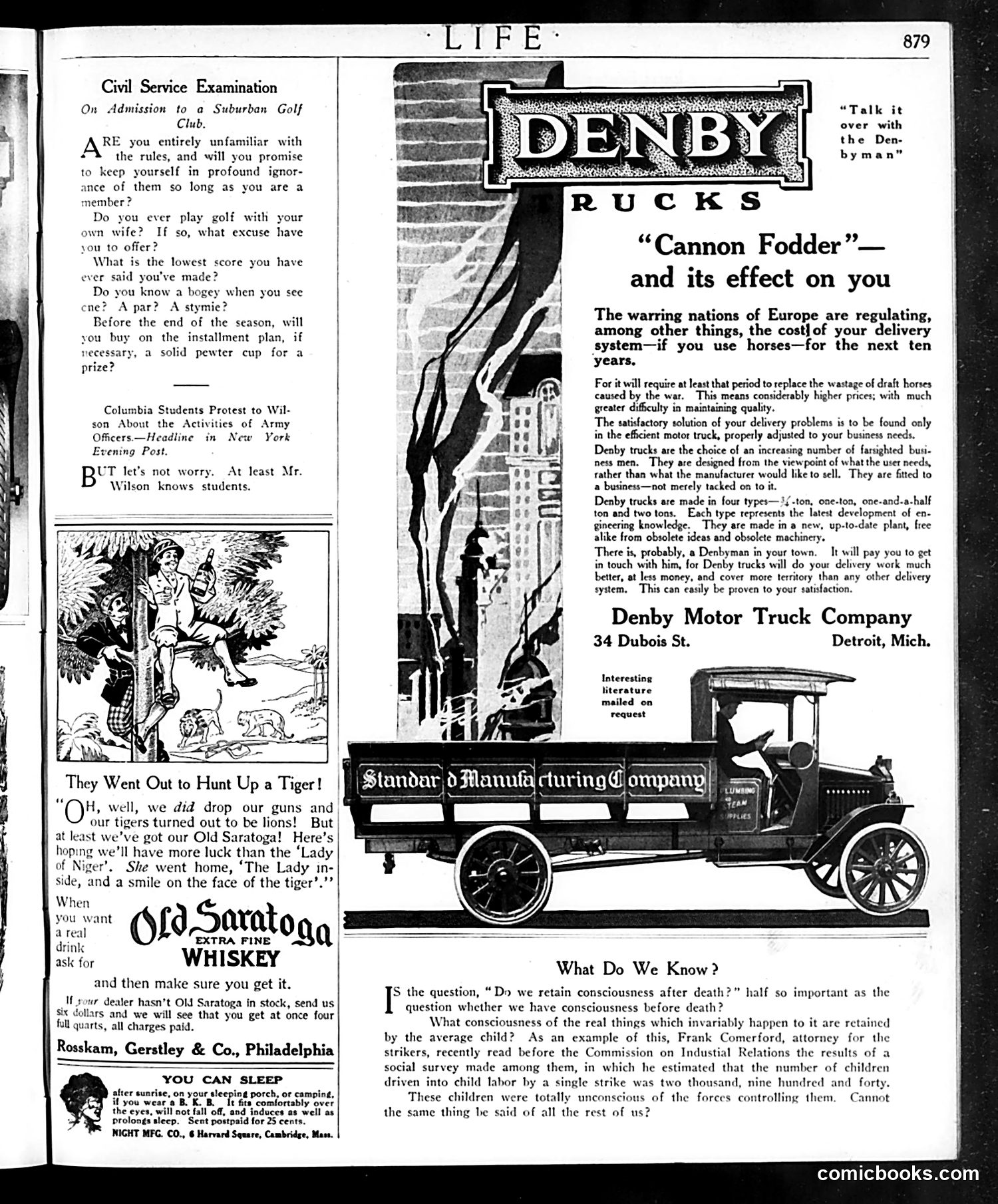
This page contains satirical commentary on American social and political issues circa 1910s-1920s. The **"Civil Service Examination"** cartoon mocks exclusive golf clubs by presenting absurd membership questions—asking if applicants will remain ignorant of rules, whether they cheat on their scores, and if they'll buy expensive trophies. It satirizes the pretension and dishonesty of elite suburban leisure culture. The **"They Went Out to Hunt Up a Tiger"** section ridicules military incompetence, referencing a headline about Columbia students protesting Army officers' activities. The poem mockingly suggests soldiers confused lions for tigers, playing on the notion of military bungling. The remaining content comprises **advertisements** (Old Saratoga Whiskey, Denby Motor Trucks, bedding) interspersed with a serious article titled **"What Do We Know?"** discussing child labor. This final piece uses a philosophical question about consciousness after death to pivot toward examining awareness of real social harms—specifically, thousands of children driven into labor by strikes, suggesting the public remains unconscious of actual injustices.
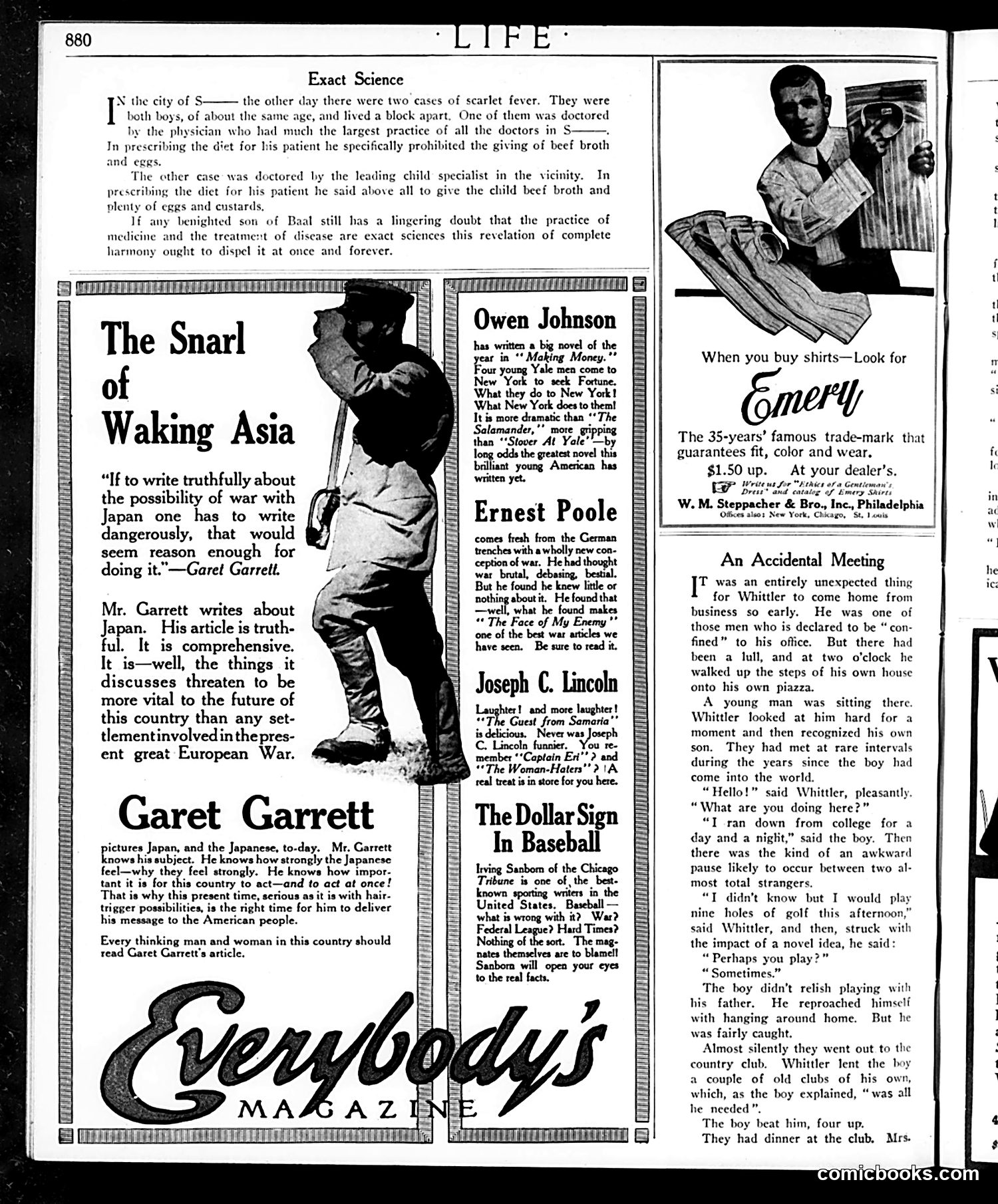
This page from Life magazine (circa 1915, based on references) contains satirical commentary and advertisements rather than political cartoons. The main satire, "Exact Science," mocks medical practice by contrasting two scarlet fever cases treated by prominent doctors in the same city. One physician prohibits beef broth and eggs; the other prescribes them abundantly. The piece sarcastically suggests this contradiction proves medicine lacks scientific rigor, implying doctors disagree fundamentally on treatment despite claiming expertise. "The Snarl of Waking Asia" promotes Garet Garrett's article on Japan as a serious threat to America, positioning it as urgent reading during the European War period. The page also advertises novels by Owen Johnson and Ernest Poole, plus Emery brand shirts (with their "35-years' famous trade-mark"). A short story, "An Accidental Meeting," depicts a businessman unexpectedly encountering his estranged son at home—exploring themes of family distance and separation. The overall tone reflects pre-WWI American concerns about geopolitical threats while satirizing professional incompetence.
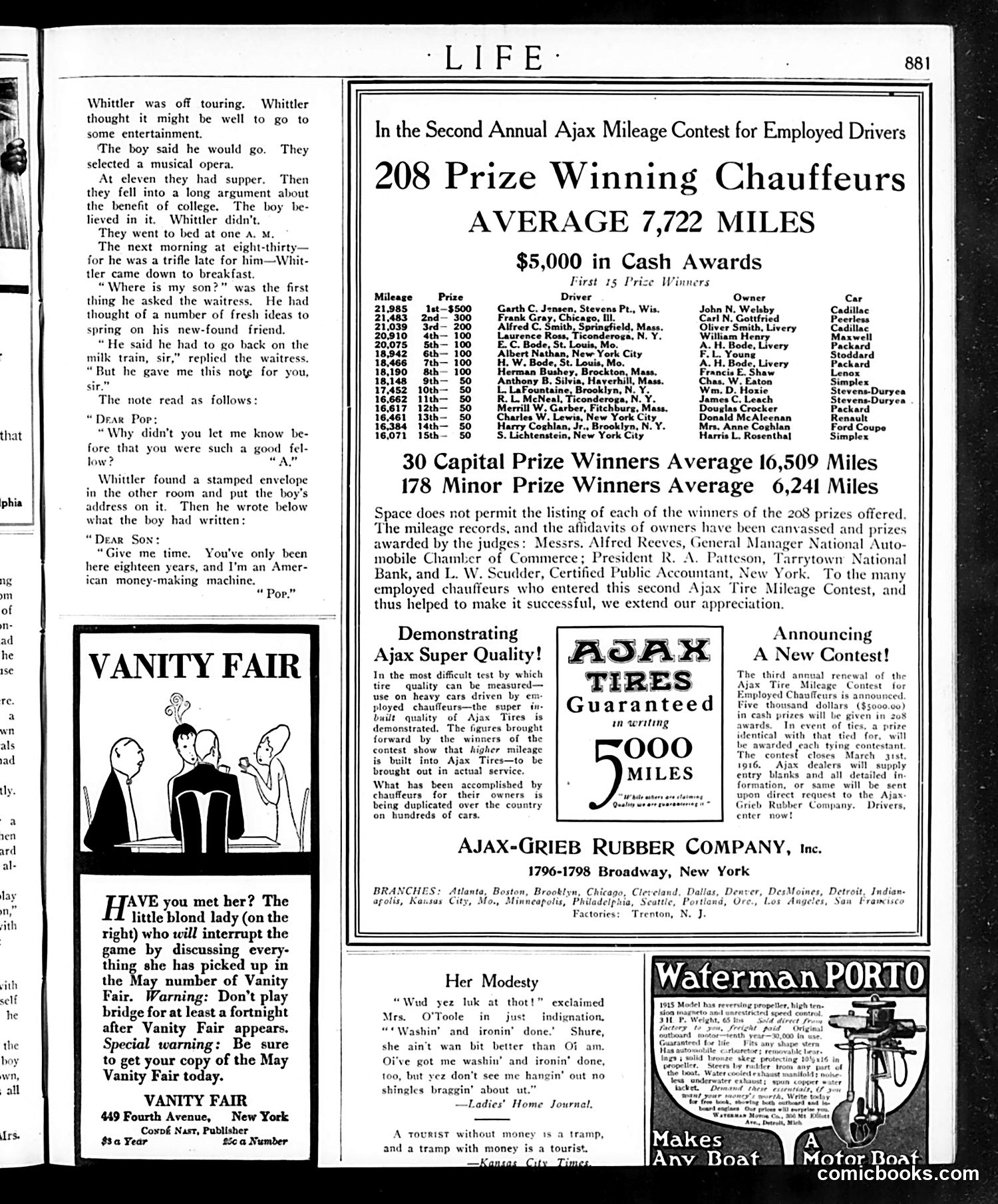
**The Whittler Story**: This appears to be a sentimental short story about a father (presumably nicknamed "Whittler") and his son. The father, skeptical of college, argues with his young son about its value. The son leaves early the next morning, but leaves a note asking why his father never revealed his more likeable, open-minded side earlier in their relationship. The father's reply—that he's only been "an American money-making machine" for eighteen years—suggests satire of American materialism and parental emotional distance. **Vanity Fair Advertisement**: Below this story runs a tongue-in-cheek advertisement warning readers (especially bridge players) about "the little blond lady" who interrupts games by pontificating about articles she's read in *Vanity Fair* magazine. This mocks certain women as superficial, trend-following, and socially disruptive—a period stereotype typical of early 20th-century humor. The page is primarily **advertising** for Ajax Tires and *Vanity Fair* magazine.
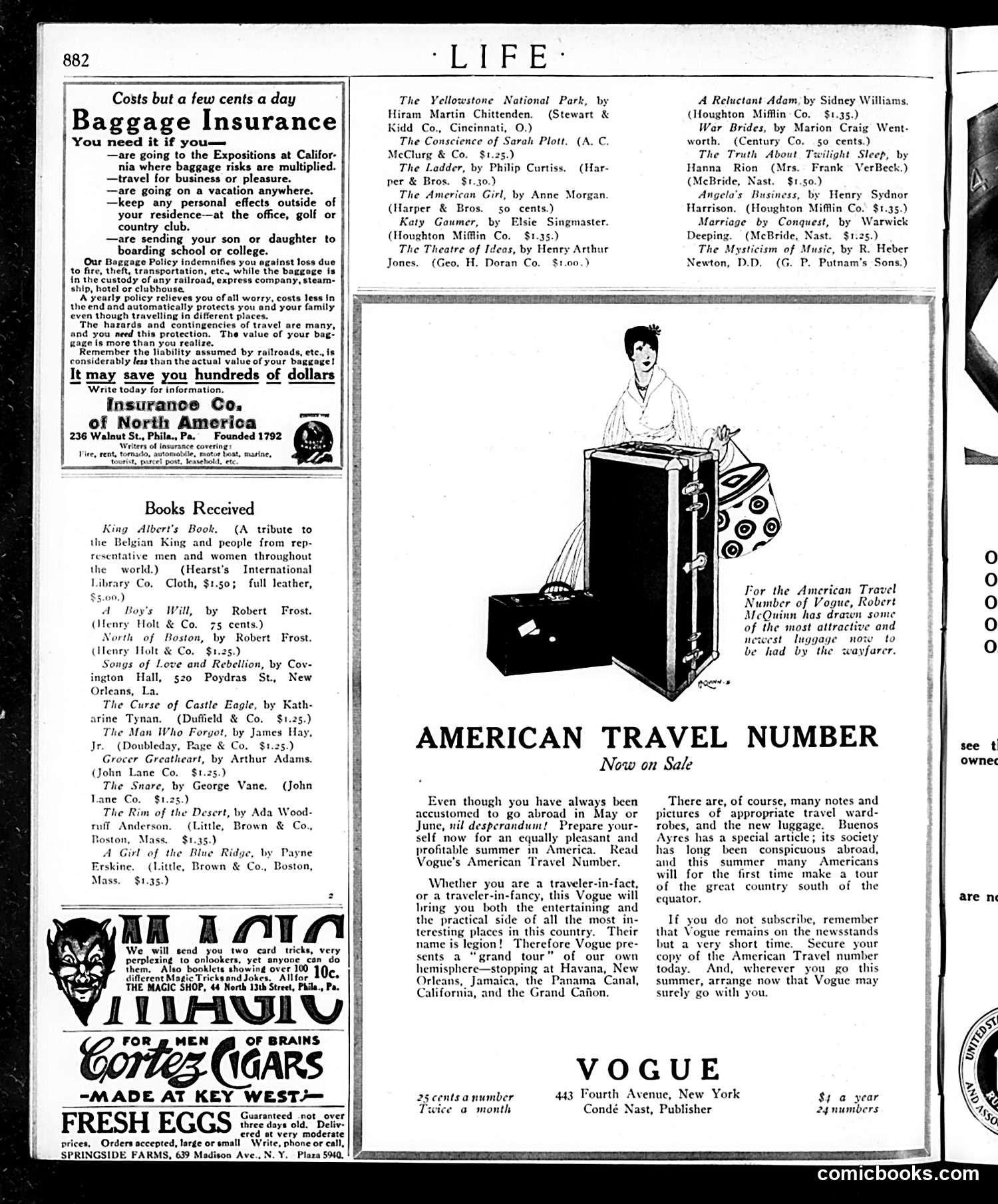
This is primarily a **advertising and book-review page** from Life magazine, not a political cartoon page. The main content advertises baggage insurance and promotes Vogue's "American Travel Number." The illustrated central image shows a stylish woman with fashionable luggage, promoting travel within America—likely during World War I era when European travel was disrupted. The surrounding text encourages Americans to vacation domestically instead of abroad, mentioning stops at "Havana, New Orleans, Jamaica, the Panama Canal, California, and the Grand Canon [sic]." **Minor elements**: Small ads appear at bottom (Cortez cigars, Magic Shop, Fresh Eggs), along with a lengthy "Books Received" section listing recent publications. There is **no political satire or cartoon content** visible on this page—it's fundamentally commercial, promoting domestic tourism and travel products to an American audience.
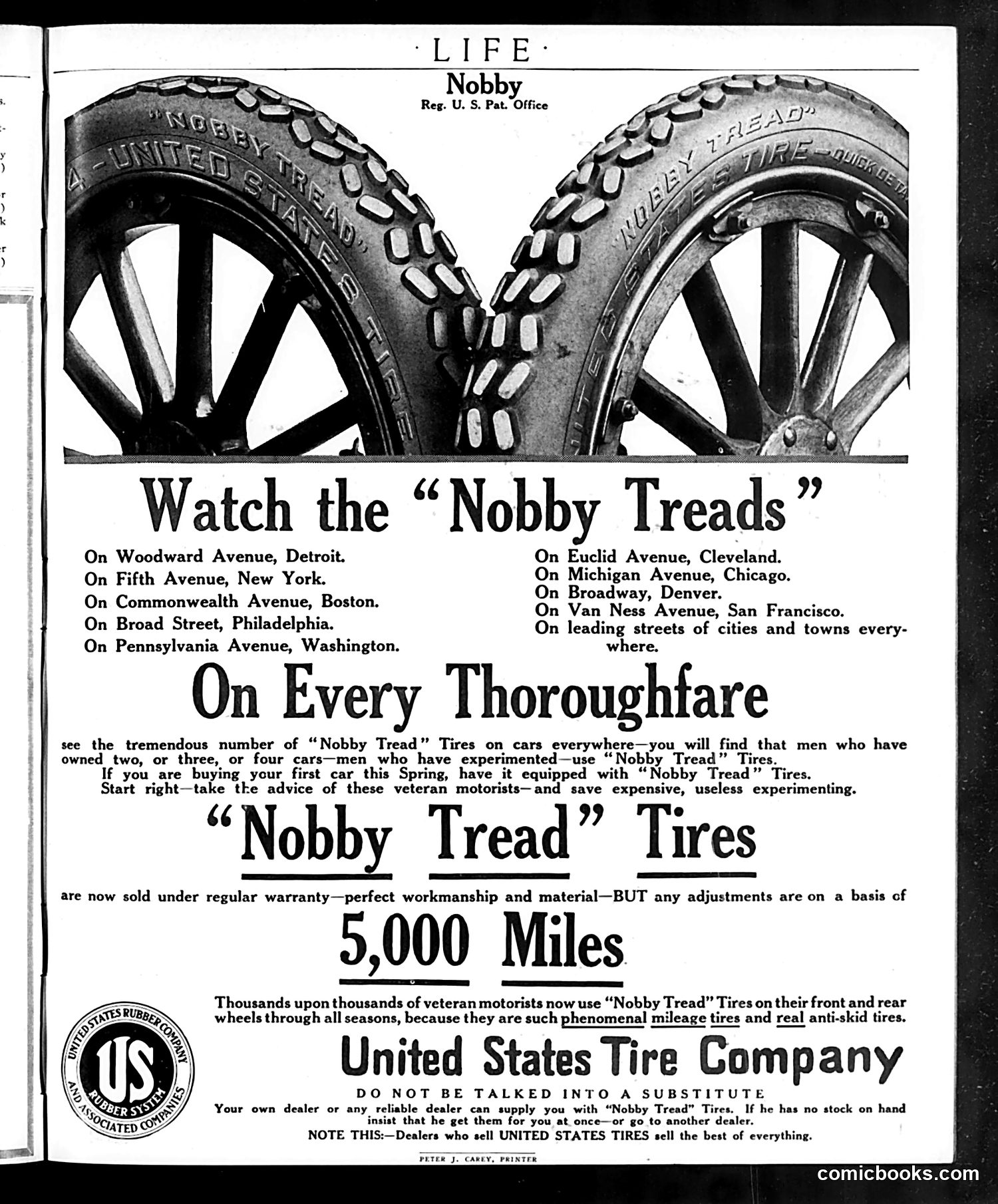
This is a full-page advertisement, not satire or political commentary. It promotes "Nobby Tread" tires manufactured by United States Tire Company, featuring two tire images showing the distinctive tread pattern. The ad targets early automobile owners (spring car-buying season), emphasizing that experienced motorists repeatedly choose this brand. Key sales points include a 5,000-mile warranty and anti-skid capability—significant selling features for 1910s-era vehicles. The advertisement lists major American city locations where the product is visible on cars, establishing ubiquity and credibility through social proof. The closing section aggressively warns dealers against substituting competing brands, instructing consumers to demand "Nobby Tread" specifically or visit another dealer. This reflects early automotive-era marketing emphasizing durability and safety features to a still-skeptical car-buying public.
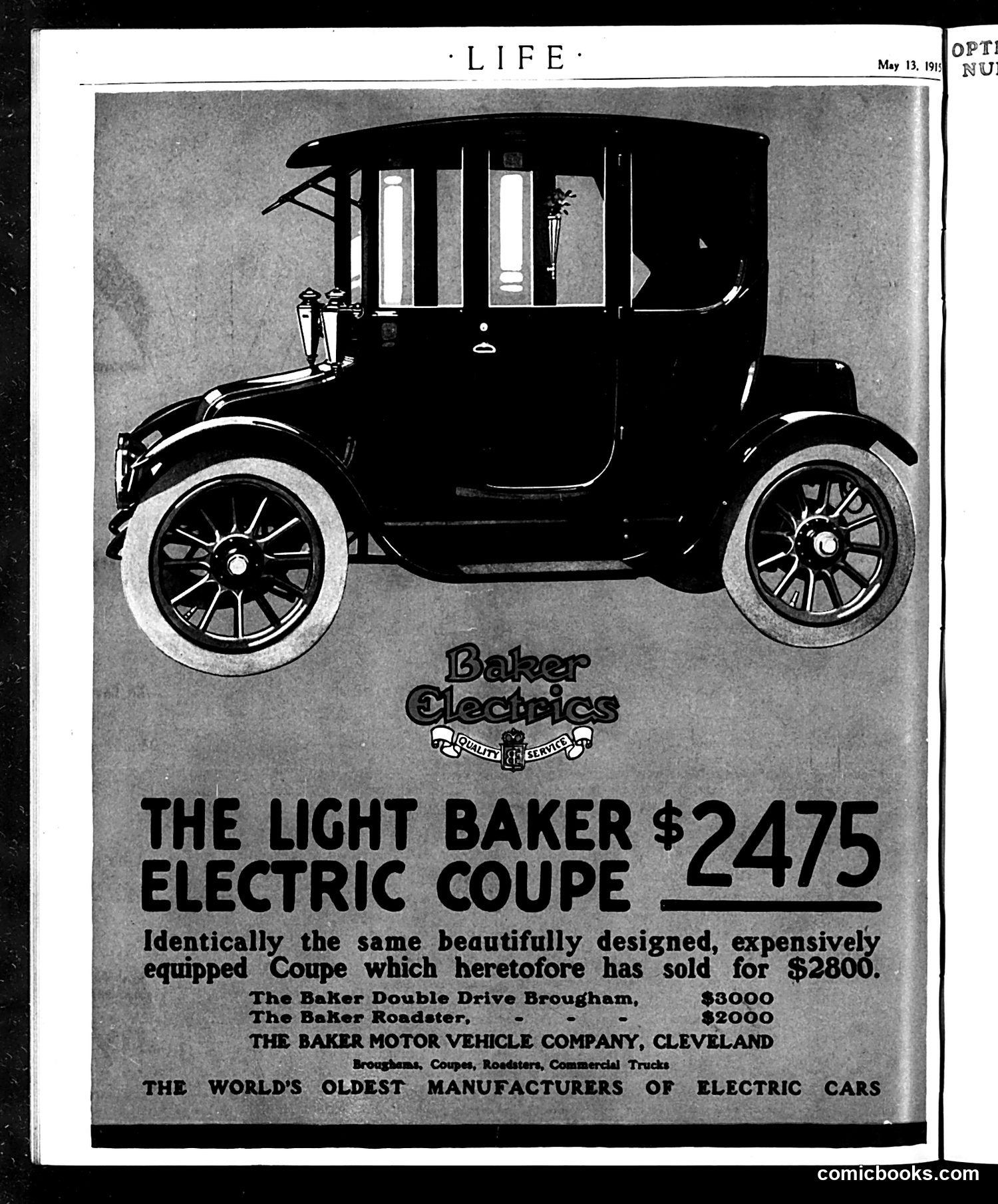
This is a **product advertisement**, not political satire. It appears in *Life* magazine from May 13, 1914, promoting the Baker Electric Coupe at $2,475. The ad emphasizes value: the vehicle is "identically the same beautifully designed, expensively equipped Coupe which heretofore has sold for $2800"—a significant price reduction. Baker Motor Vehicle Company of Cleveland, claiming to be "the world's oldest manufacturers of electric cars," lists competing models (Double Drive Brougham at $3,000; Roadster at $2,000). **Context for modern readers**: This reflects the early automotive era when **electric cars competed seriously with gasoline vehicles**. Electric cars were considered reliable, quiet, and prestigious—particularly appealing to wealthy buyers. The price-cutting strategy suggests market pressure, likely from Ford's mass-produced gasoline Model T (introduced 1908), which eventually displaced electrics by the 1920s.