
Life, 1915-05-13 · page 17 of 52
Life — May 13, 1915 — page 17: what you’re looking at
What you’re looking at
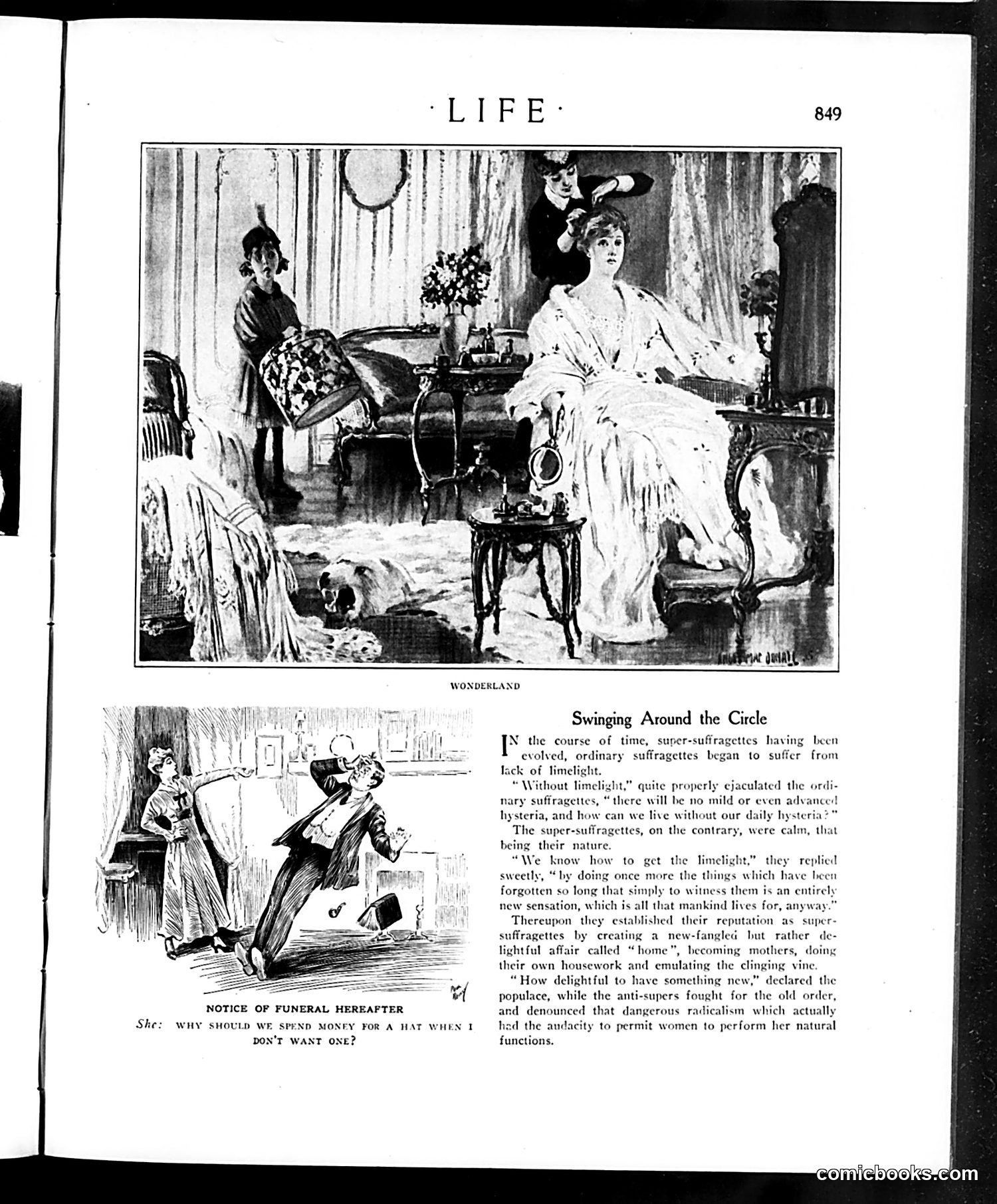
This page satirizes early 20th-century debates over women's suffrage and feminism. The article "Swinging Around the Circle" mocks suffragettes through ironic inversion: it suggests that "super-suffragettes" discovered that performing *traditional* domestic roles—housekeeping, motherhood, "the clinging vine"—becomes radical and attention-getting precisely because suffragettes had abandoned these duties. The satire targets both sides: militant suffragettes seeking "limelight" through confrontation, and conservatives defending "natural functions" (women's domestic role). The cartoon below, titled "Notice of Funeral Hereafter," appears to joke about a woman rejecting hat purchases—possibly mocking the suffragette cause as absurdist or trivial. The piece suggests that women's activism had become so extreme that simply returning to housework counts as shocking novelty, implying suffragettes were ridiculous in either direction.
📄 Transcribed text from this page (OCR, searchable)
Machine-transcribed from the original scan — historical spelling and the odd misread are preserved.
She: “LIFE: 849 WONDERLAND NOTICE OF FUNERAL HEREAFTER WHY SHOULD Wr PEND MONEY FOR A HAT WHEN I DON'T WANT ONE? Swinging Around the Circle N the course of time, super-suffragettes having been evolved, ordinary suffragettes began to suffer from Tack of limelight. “Without limelight,” quite properly ejaculated the ord nary suffragettes, “there will be no mild or even advanc hysteria, and how can we live without our daily hyster The super-suffragettes, on the contrary, were calm, that being their nature. “We know how to get the limelight,” they replied sweetly, “hy doing once more the things which have been forgotten so long that simply to witness them is an entire new sensation, which is all that mankind lives for, anyw Thereupon they established their reputation as super- suffragettes by creating a new-fangled but rather de- lightful affair called “home”, becoming mothers, doing their own housework and emulating the clinging vine. “How delightful to have something new," declared the populace, while the anti-supers fought for the old order, and denounced that dangerous radicalism which actually had the audacity to permit women to perform her natural functions.