
Life, 1915-05-13 · page 29 of 52
Life — May 13, 1915 — page 29: what you’re looking at
What you’re looking at
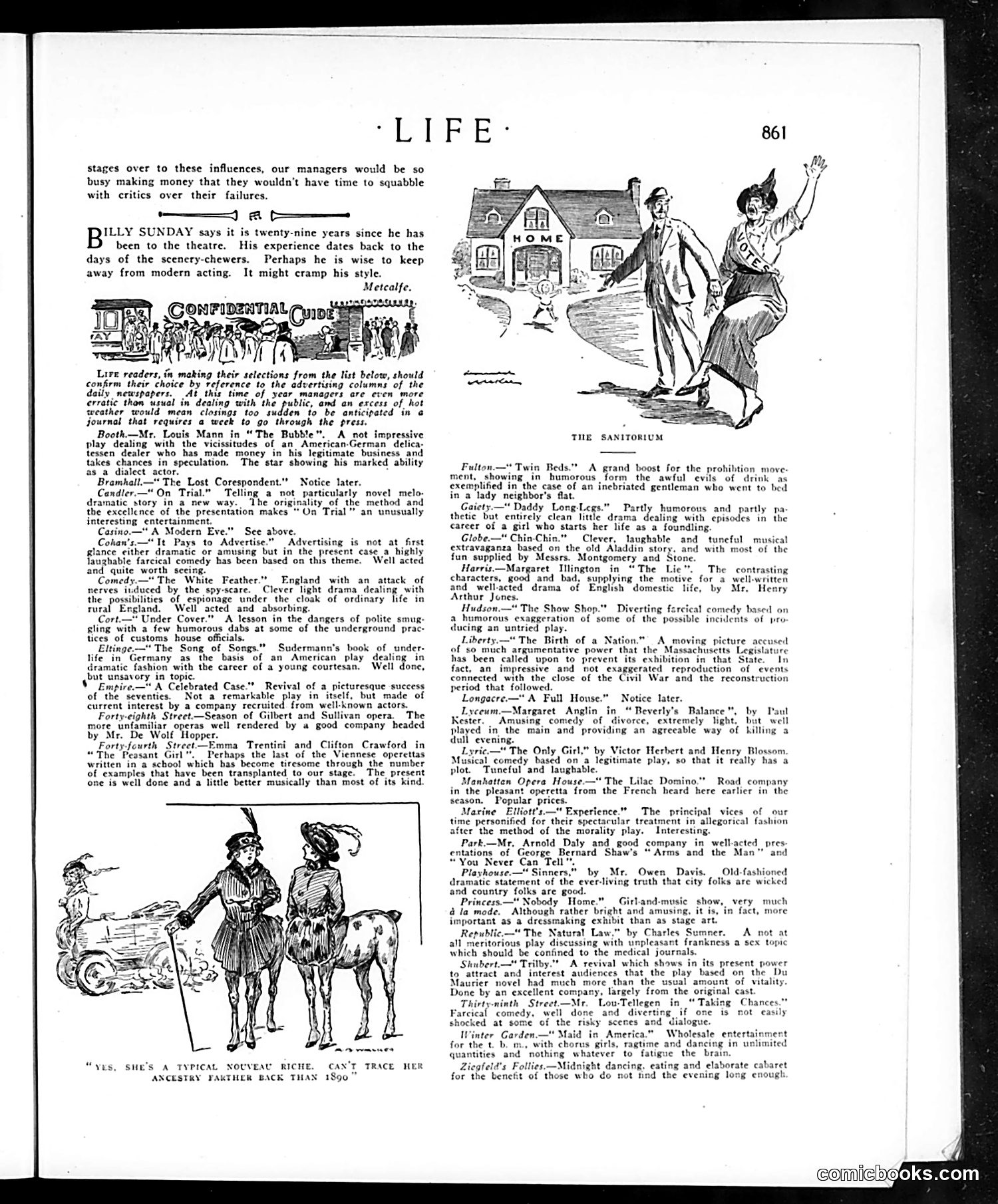
This page from *Life* magazine contains theater reviews and satirical commentary on early 20th-century Broadway productions. The key cartoons illustrate social satire: **Upper cartoon ("The Sanitorium"):** Shows two well-dressed figures outside a house, mocking nouveau riche (newly wealthy) pretentiousness—a common *Life* theme targeting the socially ambitious middle class. **Lower cartoon ("Yes, she's a typical nouveau riche"):** Depicts a woman in fashionable dress with companions and a horse, captioned with a joke about tracing ancestry "no further back than 1890"—mocking new wealth lacking old-family credentials. Both cartoons target the same target audience anxiety: Americans of modest origin who had recently acquired money and tried to claim social respectability. The satire assumes readers share contempt for social climbing and value established class status. The theater reviews are straightforward entertainment criticism, listing current Broadway shows with brief evaluations of their merit.
📄 Transcribed text from this page (OCR, searchable)
Machine-transcribed from the original scan — historical spelling and the odd misread are preserved.
7 EGE * stages over to these influences, our managers would be so busy making money that they wouldn't have time to squabble with critics over their failures. ——<—=J a Buy SUNDAY says it is twenty-nine years since he has been to the theatre. His experience dates back to the days of the scenery-chewers. Perhaps he is wise to keep away from modern acting. It might cramp his style. Metcalfe. ConFIDZATIAL Cy iH Suit Ravi Lire readers, in making their selections from the list below, should confirm their choice by reference to the advertising columns of the daily newspapers. At this time of year managers are even more erratic than usual in dealing with the public, amd an excess of hot weather would mean closings too sudden to be anticipated in @ journal that requires a week to go through the press. Booth—Mr. Louis Mann in “The Bubble". A not impressive play dealing with the vicissitudes of an American-German delica- tessen dealer who has made money in his legitimate business and takes chances in speculation. The star showing his marked ability as a dialect actor. . Bramhall.—" The Lost Corespondent."" Notice later. Candler.—“ On Trial.’ Telling a not particularly novel melo- dramatic story in a new way. The originality of the method and the excellence of the presentation makes “On Trial” an unusually interesting entertainment. Casino.—" A Modern Eve.” See above. Cohan's.—‘ It Pays to Advertise.” Advertising is not at first giance either dramatic or amusing but in the present case a highly laughable farcical comedy has been based on this theme. Well acted and quite worth seeing. Comedy.—" The White Feather." England with an attack of nerves itduced by the spy-scare. Clever light drama dealing with the possibilities of espionage under the cloak of ordinary life in rural England. Well acted and absorbing. Cort.—* Under Cover.” A lesson in the dangers of polite smug- gling with a few humorous dabs at some of the underground prac- tices of customs house officials. Eltinge.—" The Song of Songs. Sudermann’s book of under- life in Germany as the basis of an American play dealing in dramatic fashion with the career of a young courtesan. Well done, but unsavory in topic. Y Empire—* A Celebrated Case.” Revival of a picturesque success of the seventies. r current interest by a company recruited Not a remarkable play in itself, but made of from well-known actors. Forty-eighth Street.—Season of Gilbert and Sullivan opera. The more unfamiliar operas well rendered by a good company headed by Mr. De Wolf Hopper. Forty-fourth Street-—Emma Trentini and Clifton Crawford in “The Peasant Girl”. Perhaps the last of the Viennese operettas written in a school which bas become tiresome through the number of examples that have been transplanted to our stage. The present one is well done and a little better musically than most of its kind. YES, SHE'S A TYPICAL NOUVEAU RICHE. CAN'T TRACE HER ANCESTRY FAKTHER BACK THAN 1890 THE SANITORIUM Fulton.—* Twin Reds." A grand boost for the prohibition. move- pent, showing in humorous form the awful evils of drink. as exemplified in the case of an inebriated gentleman who went to bed in a lady neighbor's flat. Gaiety.—" Daddy Long-Legs.” Partly humorous and partly pa thetic but entirely clean little drama dealing with episodes in the career of a girl who starts her life as a foundling. Globe-—" Chin-Chin.” Clever, laughable and tuneful musical extravaganza based on the old Aladdin story, and with most of the fun supplied by Messrs. Montgomery and Stone Harris.—Margaret Ilington in “The Lie". The contrasting characters, good and bad, supplying the motive for a well-written and well-acted drama of English domestic life, by Mr, Henry Arthur Jones. Hudson.—" The Show Shop." Diverting forcical comedy based on a humorous exaggeration of some of the possible incidents of pro. ducing an untried play. Liberty.—" The Birth of a Nation.” A. moving picture accused of so much argumentative power that the Massachusetts Legislatu has been called upon to prevent its exhibition in that State. In fact, an impressive and not exaggerated reproduction of events connected with the close of the Civil War and the reconstruction period that followed. Longacre.—" A Full House.” Notice later. Lyceum.—Margaret Anglin in.“ Beverly's Balance", by I Kester. Amusing comedy of divorce, extremely light, but well played in the main and providing an’ agreeable way of killing a dull evening. Lyric.—" The Only Girl,” by Victor Herbert and Henry Blossom. Musical comedy based ona legitimate play, so that it really has a plot. Tuneful and laughable. Manhatten Opera House—" The Lilac Domino." Road company in the pleasant operetta from the French heard here earlier in the season. Popular prices. Marine Elliott's.—" Experience.” The principal vices of our time personified for their spectacular treatment in allegorical fashion after the method of the morality play. Interesting. Park.—Mr, Arnold Daly and good company in well-acted entations of George Bernard Shaw’s “Arms and the Man” “You Never Can Tell Playhouse.—" Sinners,” by Mr. Owen Davis. Old-fashioned dramatic statement of the ever-living truth that city folks are wicked and country folks are good. Princess —" Nobody Home." Girl-and-music show, very much @ la mode. Although rather bright and amusing, it is,'in fact, m important as a dressmaking exhibit than as stage art. Republic.—" The Naturat Law,” by Charles Sumner. A not at all meritorious play discussing with unpleasant frankness a sex topic which should be confined to the medical journals. Shubert.—" Trilby.” A revival which shows in its present power to attract and interest audiences that the play based on the Du Maurier novel had much more than the usual amount of vitality. Done by an excellent company, largely from the original cast Thirty-ninth Street.—Mr. Lou-Tellegen in “Taking Chances.” Farcical comedy, well done and diverting if one is not easily shocked at some of the risky scenes and dialogue. Winter Garden. faid in America.” Wholesale entertainment for the t. b. m d with chorus girls, ragtime and dancing in unlimited quantities and nothing whatever to fatigue the brain. Ziegfeld’s Follies.—Midnight dancing, eating and elaborate cabaret for the benefit of those who do not tind the evening long enough. comicbooks.com