
Life, 1915-05-13 · page 30 of 52
Life — May 13, 1915 — page 30: what you’re looking at
What you’re looking at
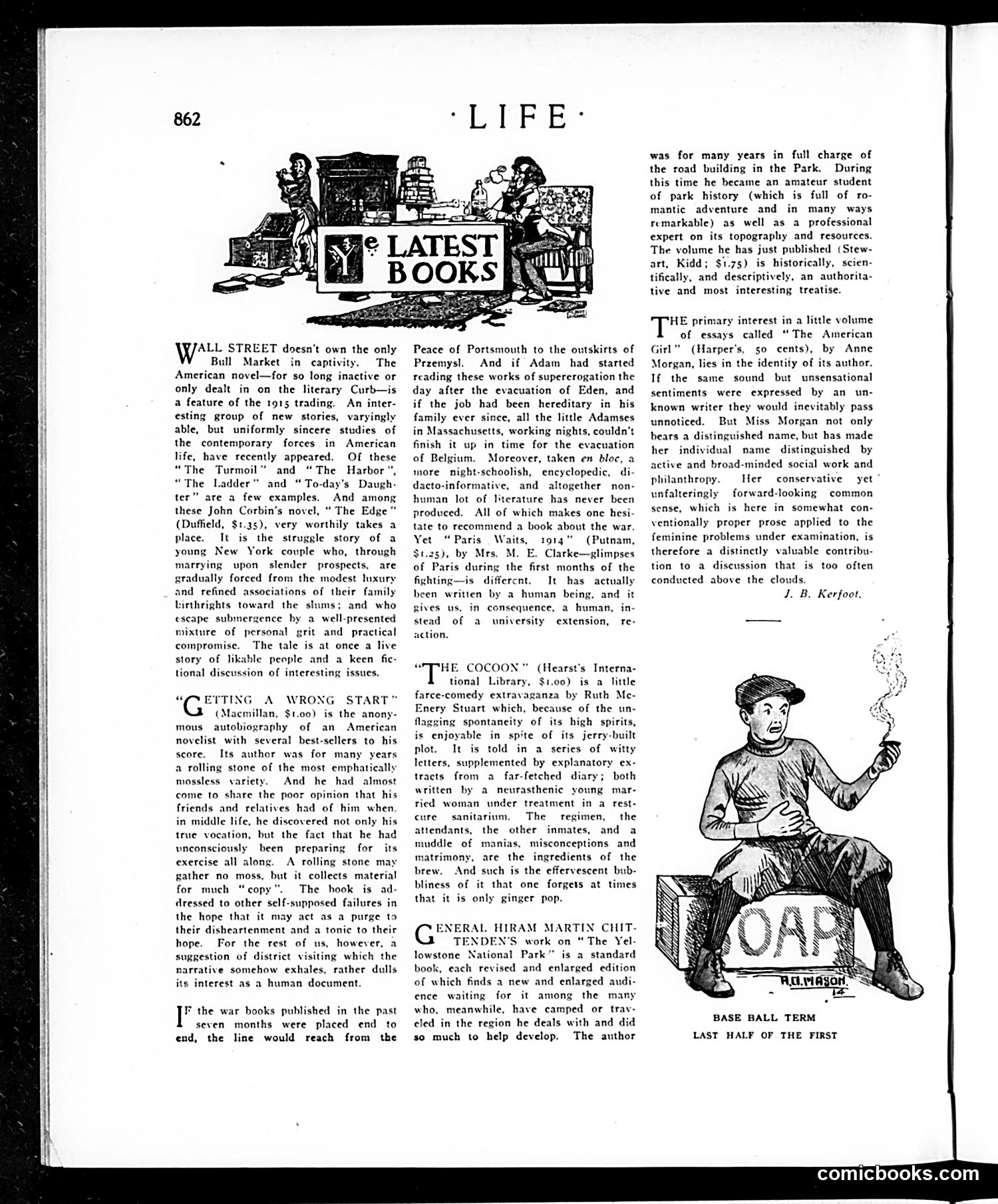
This is a literary review section from Life magazine discussing recent American novels published in 1915. The page contains five book reviews covering contemporary fiction and non-fiction. The only illustration is a cartoon labeled "BASE BALL TERM / LAST HALF OF THE FIRST" showing a figure in a baseball stance holding what appears to be a bat or club. This is a visual pun or section header, likely connecting baseball terminology to the literary reviews that follow. The reviews themselves discuss novels addressing contemporary American social issues—economic struggle, personal ambition, and the ongoing World War. One review sardonically criticizes the flood of war books being published, using exaggerated comparisons about their length and dullness. The overall tone is witty and evaluative rather than promotional. The page demonstrates how Life functioned as a satirical literary and cultural commentary magazine for educated American readers in the early 20th century.
📄 Transcribed text from this page (OCR, searchable)
Machine-transcribed from the original scan — historical spelling and the odd misread are preserved.
ALL STREET doesn’t own the only Bull Market in captivity. The American novel—for so long inactive or only dealt in on the literary Curb—is a feature of the 1915 trading. An inter- esting group of new stories, varyingly able, but uniformly sincere studies of the contemporary forces in American life, have recently appeared. Of these “The Turmoil” and “The Harbor”, “The Ladder” and “ To-day’s Daugh- ter” are a few examples. And among these John Corbin’s novel, “ The Edge” (Duffield, $1.35), very worthily takes a place. It is the struggle story of a young New York couple who, through marrying upon slender prospects, are gradually forced from the modest luxury and refined associations of their family irthrights toward the slums; and who escape submergence by a well-presented mixture of personal grit and practical compromise. The tale is at once a live story of likable people and a keen fic- tional discussion of interesting issues. ‘cE PIN (Macmillan, $1.00) is the anony- mous autobiography of an American novelist with several best-sellers to his score. Its author was for many years a rolling stone of the most emphatically mossless variety. And he had almost come to share the poor opinion that his friends and relatives had of him when in middle life, he discovered not only his true vocation, but the fact that he had unconsciously been preparing for its exercise all along. A rolling stone may gather no moss, but it collects material for much “copy”. The hook is ad- dressed to other self-supposed failures in the hope that it may act as a purge to their disheartenment and a tonic to their hope. For the rest of us, however, a suggestion of district visiting which the narrative somehow exhales, rather dulls its interest as a human document. A WRONG START” F the war books published in the past seven months were placed end to end, the line would reach from the Peace of Portsmouth to the outskirts of Przemysl. And if Adam had started reading these works of supererogation the day after the evacuation of Eden, and if the job had been hereditary in his family ever since, all the little Adamses in Massachusetts, working nights, couldn't finish it up in time for the evacuation of Belgium. Moreover, taken en bloc, a tore night-schoolish, encyclopedic, di- dacto-informative, and altogether non- human lot of Mterature has never been produced. All of which makes one hesi- tate to recommend a book about the war. Yet “Paris Waits, 1914" (Putnam, $1.25), by Mrs. M. E. Clarke—glimpses of Paris during the first months of the fighting—is differcnt, It has actually been written by a human being, and it Rives us, in consequence, a human, in- stead of a university extension, re- action, “THE COCOON” (Hearst's Interna- tional Library, $1.00) is a little farce-comedy extravaganza by Ruth Me- Enery Stuart which, because of the un- flagging spontaneity of its high spirits, is enjoyable in spite of its jerry-built plot. It is told in a series of witty letters, supplemented by explanatory ex- tracts from a far-fetched diary; both written by a neurasthenic young mar- ried woman under treatment in a rest- cure sanitarium. The regimen, the attendants, the other inmates, and a muddle of manias, misconceptions and matrimony, are the ingredients of the bre And such is the effervescent bub- bliness of it that one forgets at times that it is only ginger pop. G ERAL HIRAM MARTIN CHIT- TENDEN’S work on “The Yel- lowstone National Park” is a standard book, each revised and enlarged edition of which finds a new and enlarged audi- ence waiting for it among the many who, meanwhile, have camped or trav- cled in the region he deals with and did so much to help develop. The author was for many years in full charge of the road building in the Park. During this time he became an amateur student of park history (which is full of ro- mantic adventure and in many ways remarkable) as well as a professional expert on its topography and resources. The volume he has just published (Stew- art, Kidd; $1.75) is historically, scien- tifically, and descriptively, an authorita- tive and most interesting treatise. HE primary interest in a little volume of essays called “The American Girl” (Harper's, so cents), by Anne Morgan, lies in the identity of its author. If the same sound but unsensational sentiments were expressed by an un- known writer they would inevitably pass unnoticed. But Miss Morgan not only bears a distinguished name, but has made her individual name distinguished by active and broad-minded social work and philanthropy. Her conservative yet unfalteringly forward-looking common sense, which is here in somewhat con- ventionally proper prose applied to the feminine problems under examination, is therefore a distinctly valuable contribu- tion to a discussion that is too often conducted above the clouds. J. B. Kerfoot. LLL Z BASE BALL TERM LAST HALF OF THE FIRST comicbooks.com