
Life, 1915-05-13 · page 24 of 52
Life — May 13, 1915 — page 24: what you’re looking at
What you’re looking at
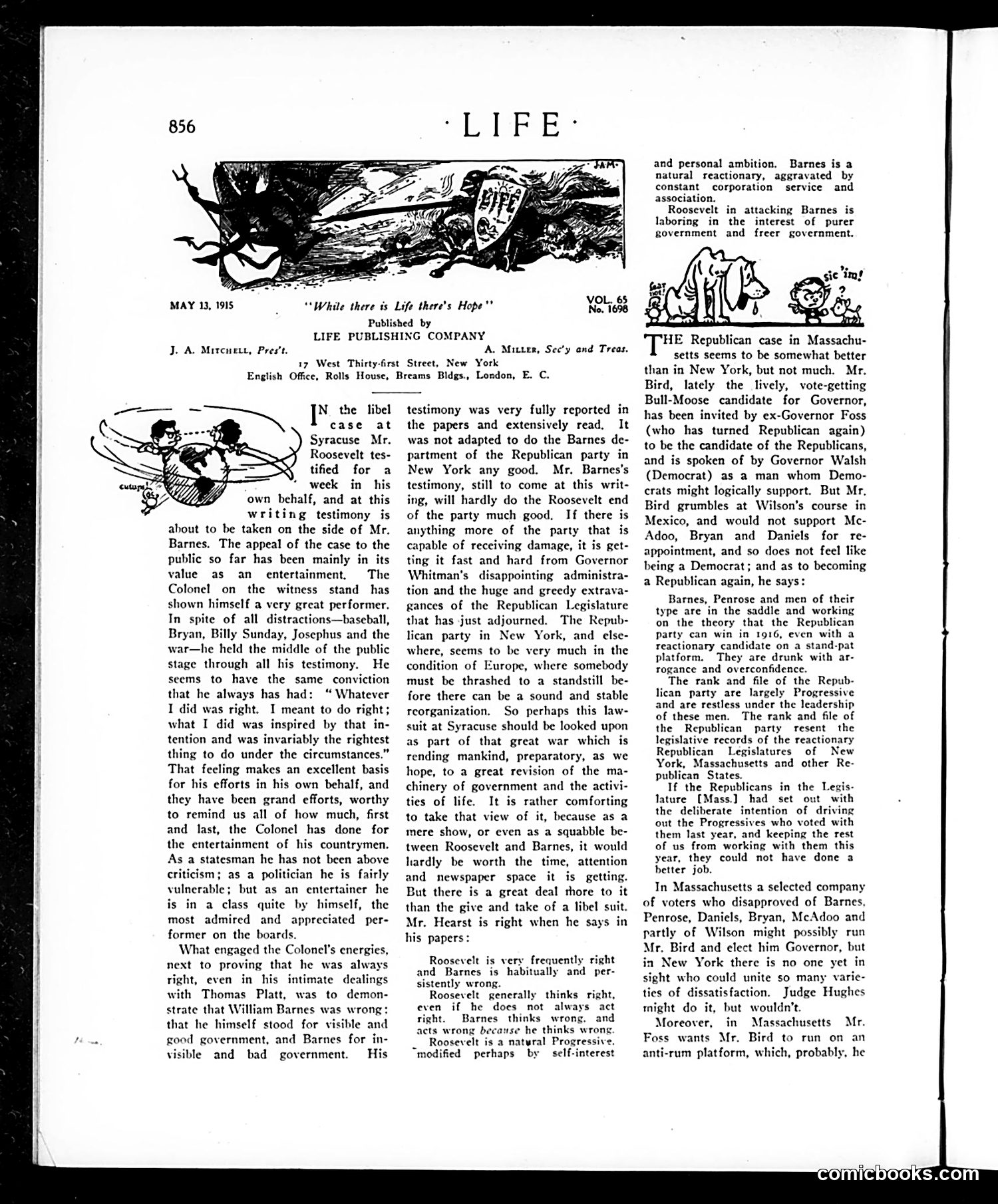
This page discusses an ongoing libel suit in Syracuse involving former President Theodore Roosevelt and Republican politician William Barnes. Roosevelt testified for a week defending himself, with Barnes's testimony still pending. The article satirizes Roosevelt's courtroom performance and unwavering self-righteousness—his conviction that "Whatever I did was right." While acknowledging his entertaining qualities as a performer, the writer criticizes his inability to admit error. The piece frames the lawsuit as symptomatic of deeper Republican Party dysfunction in New York. The satire cuts both ways: Roosevelt is mocked for his absolutism, yet Barnes (representing the party's conservative "invisible" machine politics) is depicted as worse. The columnist suggests the lawsuit, though entertaining, reflects genuine damage to the Republican Party from internal corruption and legislative excess under Governor Whitman. The cartoon's caption—"While there is Life there's Hope"—appears ironic given the party's troubles.
📄 Transcribed text from this page (OCR, searchable)
Machine-transcribed from the original scan — historical spelling and the odd misread are preserved.
MAY 13, 1915 “While there is Life there's Hope" No, 1696 Published by LIFE PUBLISHING COMPANY J. A. Mitcnett, Pres’t. A. Miter, Sec’y and Treas. 17 West Thirty-first Street, New York English Office, Rolls House, Breams Bldgs., London, E. C. N_ the libel case at Syracuse Mr. Roosevelt tes- tified for a week in his own behalf, and at this writing testimony is about to be taken on the side of Mr. Barnes. The appeal of the case to the public so far has been mainly in its value as an entertainment, The Colonel on the witness stand has shown himself a very great performer. In spite of all distractions—baseball, Bryan, Billy Sunday, Josephus and the war—he held the middle of the public stage through all his testimony. He seems to have the same conviction that he always has had: “ Whatever I did was right. I meant to do right; what I did was inspired by that in- tention and was invariably the rightest thing to do under the circumstances.” That feeling makes an excellent basis for his efforts in his own behalf, and they have been grand efforts, worthy to remind us all of how much, first and last, the Colonel has done for the entertainment of his countrymen. As a statesman he has not been above criticism; as a politician he is fairly vulnerable; but as an entertainer he is in a class quite by himself, the most admired and appreciated per- former on the boards. What engaged the Colonel's energies, next to proving that he was always right, even in his intimate dealings with Thomas Platt, was to demon- strate that William Barnes was wrong: that he himself stood for visible and good government, and Barnes for in- visible and bad government. His testimony was very fully reported in the papers and extensively read. It was not adapted to do the Barnes de- partment of the Republican party in New York any good. Mr. Barnes's testimony, still to come at this writ- ing, will hardly do the Roosevelt end of the party much good. If there is anything more of the party that is capable of receiving damage, it is get- ting it fast and hard from Governor Whitman's disappointing administra- tion and the huge and greedy extrava- gances of the Republican Legislature that has just adjourned. The Repub- lican party in New York, and else- where, seems to be very much in the condition of Europe, where somebody must be thrashed to a standstill be- fore there can be a sound and stable reorganization. So perhaps this law- suit at Syracuse should be looked upon as part of that great war which is rending mankind, preparatory, as we hope, to a great revision of the ma- chinery of government and the act ties of life. It is rather comforting to take that view of it, because as a mere show, or even as a squabble be- tween Roosevelt and Barnes, it would hardly be worth the time, attention and newspaper space it is getting. But there is a great deal thore to it than the give and take of a libel suit. Mr. Hearst is right when he says in his papers: Roosevelt is very frequently right and Barnes is habitually and per- sistently wrong. Roosevelt generally thinks right, even if he does not always act right. Barnes thinks wrong. and acts wrong beca:tse he thinks wrong. Roosevelt is a natvral Progressi modified perhaps by self-interest and personal ambition. Barnes is a natural reactionary, aggravated by constant corporation service and association. Roosevelt in attacking Barnes is laboring in the interest of purer government and freer government. yaar TH Republican case in Massachu- setts seems to be somewhat better than in New York, but not much. Mr. Bird, lately the lively, vote-getting Bull-Moose candidate for Governor, has been invited by ex-Governor Foss (who has turned Republican again) to be the candidate of the Republicans, and is spoken of by Governor Walsh (Democrat) as a man whom Demo- crats might logically support. But Mr. Bird grumbles at Wilson’s course in Mexico, and would not support Mc- Adoo, Bryan and Daniels for re- appointment, and so does not feel like being a Democrat; and as to becoming a Republican again, he says: Barnes, Penrose and men of their type are in the saddle and working on the theory that the Republican party can win in 1916, even with a reactionary candidate on a stand-pat platform. They are drunk with ar- rogance and overconfidence. The rank and file of the Repub- lican party are largely Progressive and are restless under the leadership of these men. The rank and file of the Republican party resent the legislative records of the reactionary Republican Legislatures of New York, Massachusetts and other Re- publican States. If the Republicans in the Legis- lature ([Mass.] had set out with the deliberate intention of driving out the Progressives who voted with them last year, and keeping the rest of us from working with them this year, they could not have done a better job. In Massachusetts a selected company of voters who disapproved of Barnes, Penrose, Daniels, Bryan, McAdoo and partly of Wilson might possibly run Mr. Bird and elect him Governor, but in New York there is no one yet in sight who could unite so many varie- ties of dissatisfaction. Judge Hughes might do it, but wouldn't. Moreover, in Massachusetts Mr. Foss wants Mr. Bird to run on an anti-rum platform, which, probably, he