
Life, 1915-05-13 · page 16 of 52
Life — May 13, 1915 — page 16: what you’re looking at
What you’re looking at
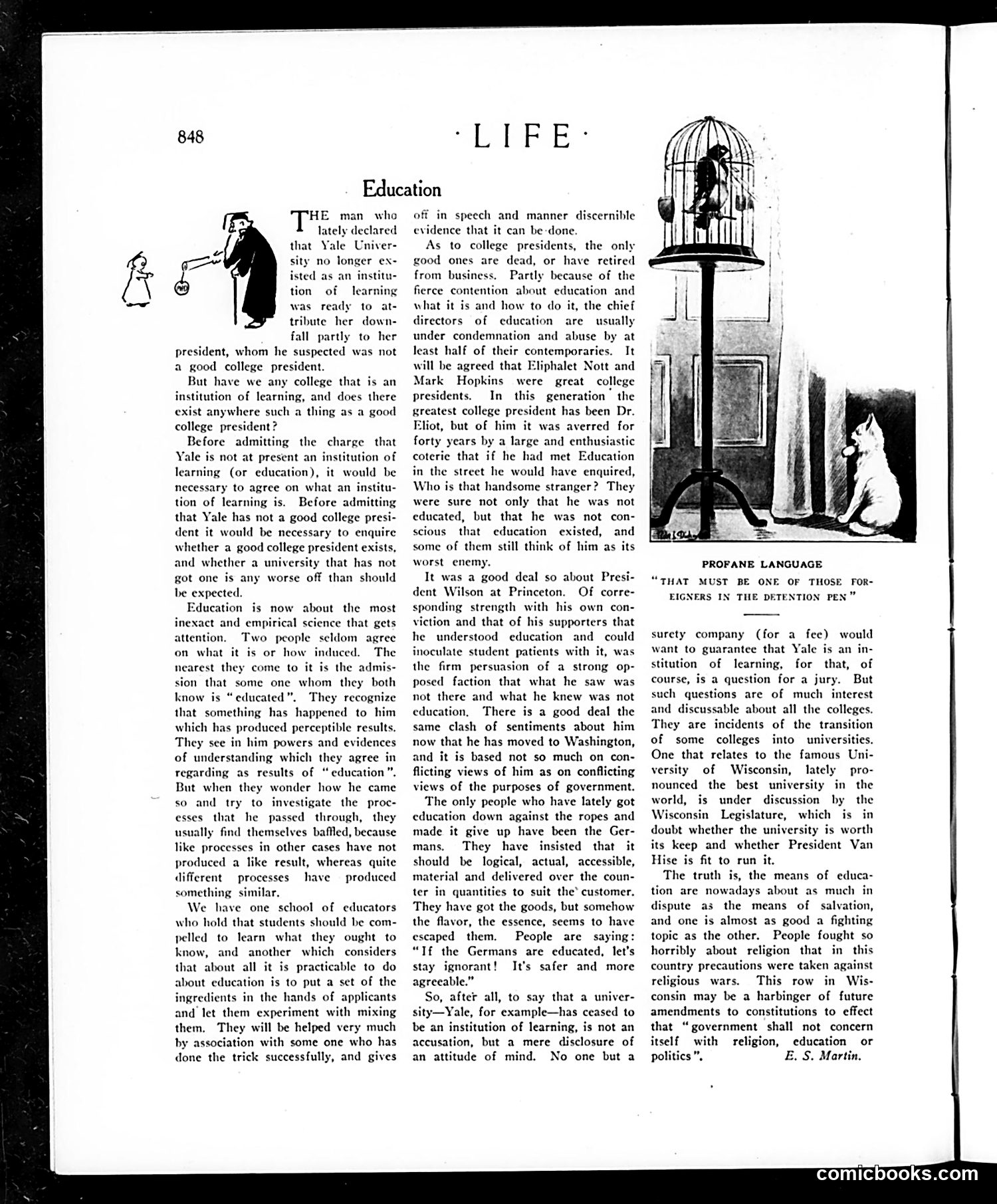
This essay satirizes American higher education and college presidents through a dialectical argument. The author mockingly notes that people universally praise only *dead* college presidents—citing the historically respected Eliphalet Nott and Mark Hopkins—while living presidents face constant criticism. The satire targets specific contemporary figures: **Dr. Charles Eliot** (Harvard president) and **Woodrow Wilson** (then Princeton president, later U.S. President). For forty years, critics claimed Eliot wouldn't recognize education if he met it in the street, yet he's now considered the era's greatest president. Wilson faces similar contradictions: supporters credit him with understanding education; opponents insist he doesn't. The author's point: educators perpetually disagree about what education *is*, making it impossible to fairly evaluate presidents. The only group achieving educational clarity, the essay concludes with ironic timing, are the Germans—a pointed reference to pre-WWI Prussian educational systematization, suggesting American education lacks comparable rigor or definition.
📄 Transcribed text from this page (OCR, searchable)
Machine-transcribed from the original scan — historical spelling and the odd misread are preserved.
Education HE man who lately declared od that Yale Univer- 2, — sity no longer ex- isted as an institu- \ ) tion of learning ae was ready to at- tribute her down- fall partly to her president, whom he suspected was not a good college president. But have we any college that is an institution of learning, and does there exist anywhere such a thing as a good college president? Before admitting the charge that Yale is not at present an institution of learning (or education), it would be necessary to agree on what an institu- tion of learning is. Before admitting that Yale has not a good college presi- dent it would be necessary to enquire whether a good college president exists, and whether a university that has not got one is any worse off than should be expected. Education is now about the most inexact and empirical science that gets attention. Two people seldom agree on what it is or how induced. The nearest they come to it is the admis- n that some one whom they both know is “educated”. They recognize that something has happened to him which has produced perceptible results. They sce in him powers and evidences of understanding which they agree in regarding as results of “education”. But when they wonder how he came so and try to investigate the proc- esses that he passed through, they usually find themselves baffled, because like processes in other cases have not produced a like result, whereas quite different processes have produced something similar, We have one school of educators who hold that students should be com- pelled to learn what they ought to know, and another which considers that about all it is practicable to do about education is to put a set of the ingredients in the hands of applicants and let them experiment with mixing them. They will be helped very much by association with some one who has done the trick successfully, and gives off in speech and manner discernible evidence that it can be-done. As to college presidents, the only good ones are dead, or have retired from business. Partly because of the fierce contention about education and what it is and how to do it, the chief directors of education are usually under condemnation and abuse by at least half of their contemporaries. It will be agreed that Eliphalet Nott and Mark Hopkins were great college presidents. In this generation’ the greatest college president has been Dr. Eliot, but of him it was averred for forty years by a large and enthusiastic coteric that if he had met Education in the street he would have enquired, Who is that handsome stranger? They were sure not only that he was not educated, but that he was not con- scious that education existed, and some of them still think of him as its worst enemy. It was a good deal so about Presi- dent Wilson at Princeton. Of corre- sponding strength with his own con- viction and that of his supporters that he understood education and could inoculate student patients with it, was the firm persuasion of a strong op- posed faction that what he saw was not there and what he knew was not education, There is a good deal the same clash of sentiments about him now that he has moved to Washington, and it is based not so much on con- flicting views of him as on conflicting views of the purposes of government. The only people who have lately got education down against the ropes and made it give up have been the Ger- mans. They have insisted that it should be logical, actual, accessible, material and delivered over the coun- ter in quantities to suit the’ customer. They have got the goods, but somehow the flavor, the essence, seems to have escaped them. People are saying: “Tf the Germans are educated, let's stay ignorant! It's safer and more agreeable.” So, after all, to say that a univer- sity—Yale, for example—has ceased to be an institution of learning, is not an accusation, but a mere disclosure of an attitude of mind. No one but a PROFANE LANGUAGE “THAT MUST BE ONE OF THOSE FOR- EIGNERS IN THE DETENTION PEN surety company (for a fee) would want to guarantee that Yale is an in- stitution of learning, for that, of course, is a question for a jury. But such questions are of much interest and discussable about all the colleges. They are incidents of the transition of some colleges into universities. One that relates to the famous Uni- versity of Wisconsin, lately pro- nounced the best university in the world, is under discussion by the Wisconsin Legislature, which is in doubt whether the university is worth its keep and whether President Van Hise is fit to run it. The truth is, the means of educa- tion are nowadays about as much in dispute a3 the means of salvation, and one is almost as good a fighting topic as the other. People fought so horribly about religion that in this country precautions were taken against religious wars. This row in Wis- consin may be a harbinger of future amendments to constitutions to effect that “government shall not concern itself with religion, education or politics”, E. S. Martin. comicbooks.com