
Life, 1915-05-13 · page 25 of 52
Life — May 13, 1915 — page 25: what you’re looking at
What you’re looking at
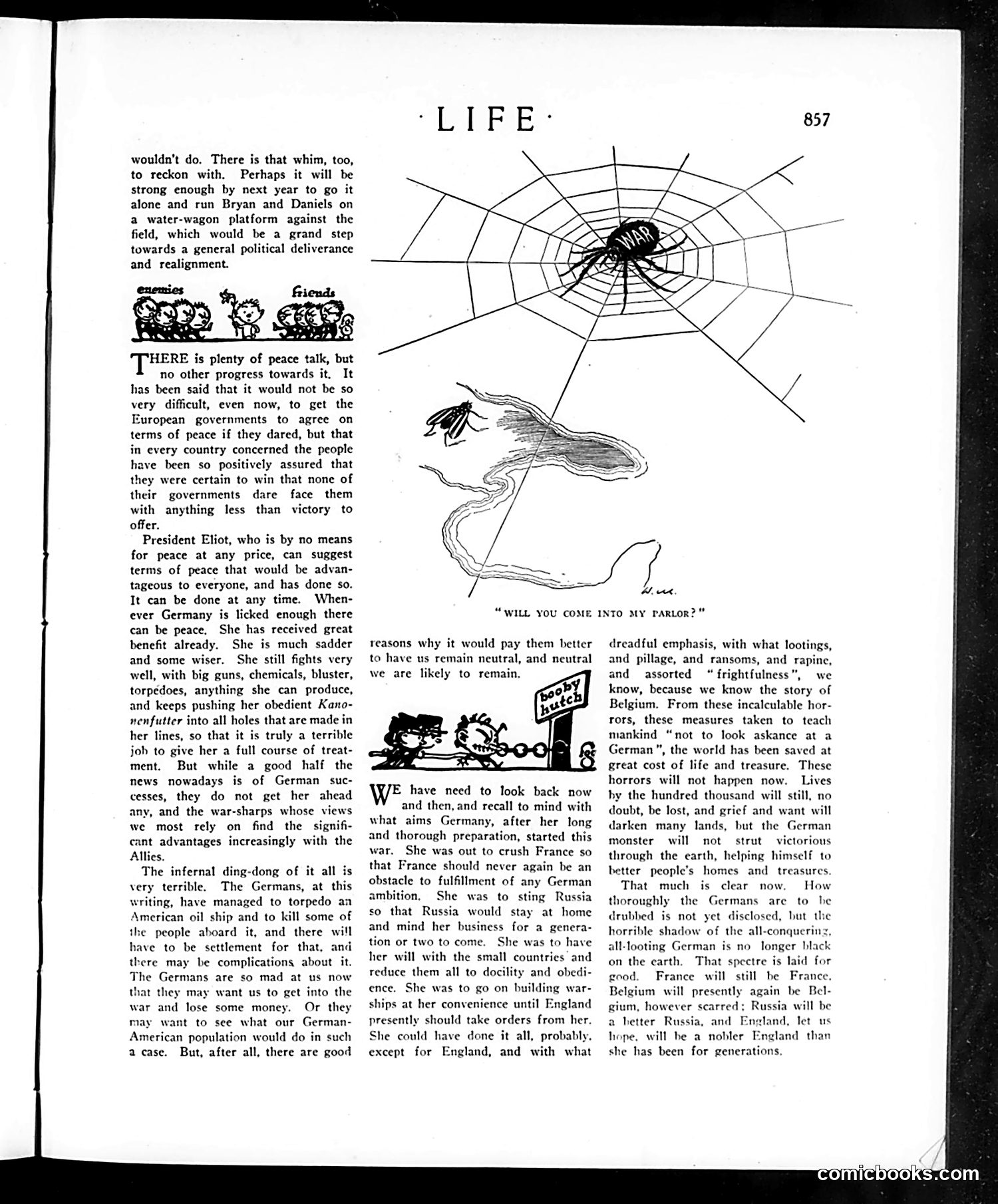
This page discusses **World War I peace negotiations and German war aims**, circa 1915-1916. **The cartoons illustrate:** 1. **Top right**: A spider web with "WAR" at the center and a fly caught in it—representing Germany's trap for neutral nations, particularly the United States. 2. **Bottom left**: Captioned "WILL YOU COME INTO MY PARLOR?"—alludes to the predatory poem "The Spider and the Fly," suggesting Germany is luring America into the conflict. **Key political content:** - The text references President **Eliot** (Harvard's Charles W. Eliot), discussing peace terms - Mentions **Bryan and Daniels** (likely William Jennings Bryan and Josephus Daniels), suggesting a "water-wagon platform" (anti-war stance) - Describes Germany's aims: crushing France, intimidating Russia, dominating small nations, and building naval supremacy - References Belgium's suffering under German occupation ("frightfulness") - Argues the Allies, not Germany, will ultimately prevail The satire criticizes German aggression while addressing American neutrality debates—a central issue before U.S. entry in 1917.
📄 Transcribed text from this page (OCR, searchable)
Machine-transcribed from the original scan — historical spelling and the odd misread are preserved.
wouldn't do. There is that whim, too, to reckon with. Perhaps it will be strong enough by next year to go it alone and run Bryan and Daniels on a water-wagon platform against the field, which would be a grand step towards a general political deliverance and realignment. THERE is plenty of peace talk, but no other progress towards it. It has been said that it would not be so very difficult, even now, to get the European governments to agree on terms of peace if they dared, but that in every country concerned the people have been so positively assured that they were certain to win that none of their governments dare face them with anything less than victory to offer. President Eliot, who is by no means for peace at any price, can suggest terms of peace that would be advan- tageous to everyone, and has done so. It can be done at any time. When- ever Germany is licked enough there can be peace, She has received great benefit already. She is much sadder and some wiser. She still fights very well, with big guns, chemicals, bluster, torpedoes, anything she can produce, and keeps pushing her obedient Kano- nenfutter into all holes that are made in her lines, so that it is truly a terrible job to give her a full course of treat- ment. But while a good half the news nowadays is of German suc- cesses, they do not get her ahead any, and the war-sharps whose views we most rely on find the signifi- cant advantages increasingly with the Allies. The infernal ding-dong of it all is very terrible. The Germans, at this writing, have managed to torpedo an American oil ship and to kill some of ne people aboard it, and there will have to be settlement for that, and there may be complications about it. The Germans are so mad at us now that they may want us to get into the war and lose some money. Or they may want to see what our German- American population would do in such acase. But, after all, there are good Ae. “WILL YOU COME INTO MY PARLOR?" reasons why it would pay them better to have us remain neutral, and neutral we are likely to remain. E have need to look back now and then, and recall to mind with what aims Germany, after her long and thorough preparation, started this war, She was out to crush France so that France should never again be an obstacle to fulfillment of any German ambition. She was to sting Russia so that Russia would stay at home and mind her business for a genera- tion or two to come. She was to have her will with the small countries and reduce them all to docility and obedi- ence. She was to go on building war- ships at her convenience until England presently should take orders from her. She could have done it all, probably, except for England, and with what dreadful emphasis, with what lootings, and pillage, and ransoms, and rapinc, and assorted “ frightfulness”, we know, because we know the story of Belgium. From these incalculable hor- rors, these measures taken to teach mankind “not to look askance at a German”, the world has been saved at great cost of life and treasure. These horrors will not happen now. Lives by the hundred thousand will still, no doubt, be lost, and grief and want will darken many lands, but the German monster will not strut victorious through the earth, helping himself to better people’s homes and_ treasures. That much is clear now. How thoroughly the Germans are to he drubbed is not yet disclosed, but the horrible shadow of the all-conquerinz, all-looting German is no longer black on the earth. That spectre is laid for good. France will still be France, Belgium will presently again be Bel- gium, however scarred; Russia will be a hetter Russia, and England, let us hope, will be a nobler England than has been for gene ns,