
A complete issue · 48 pages · 1915
Life — March 11, 1915
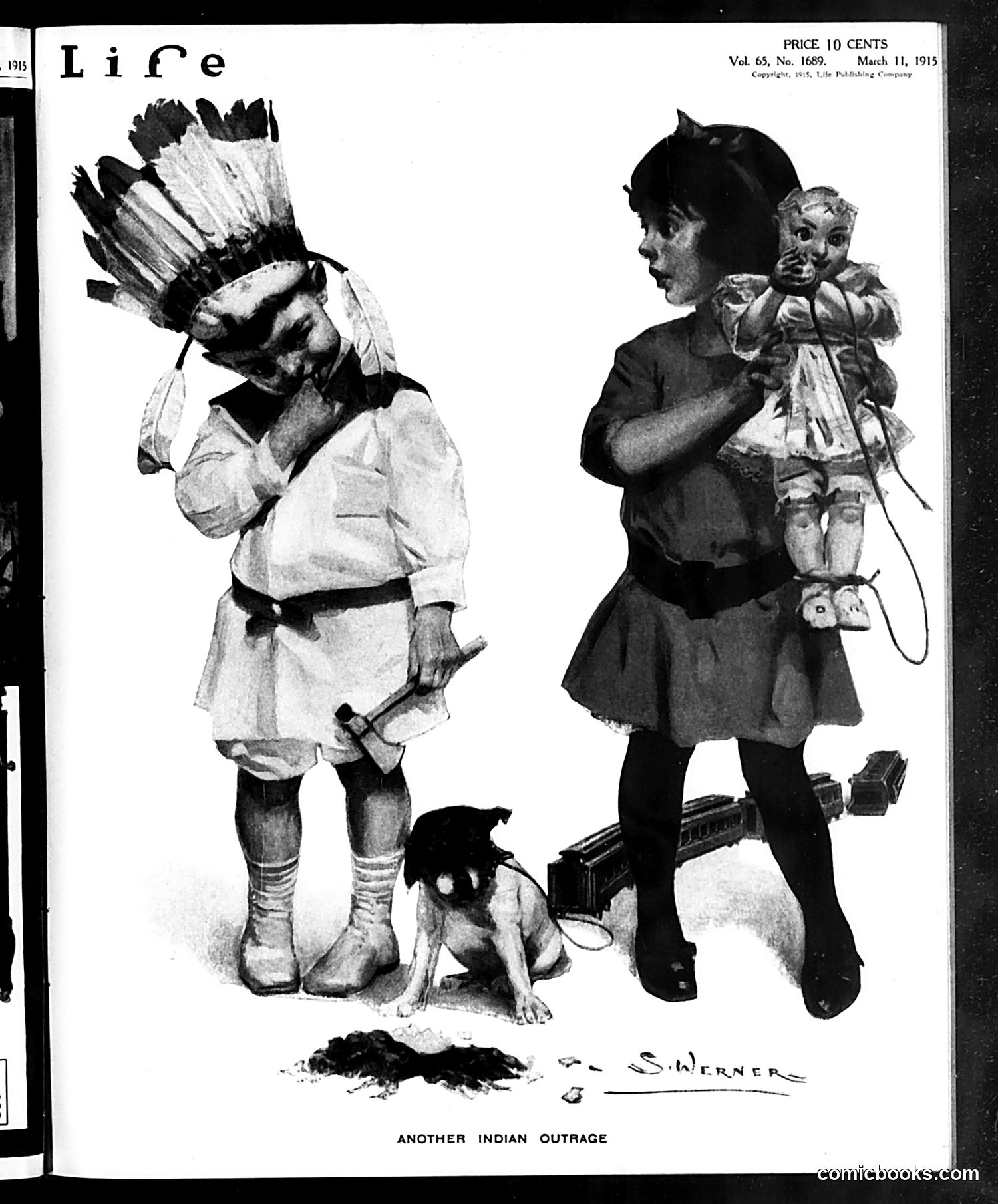
This satirical cartoon by S. Werner depicts what appears to be a commentary on Native American stereotypes and treatment. The left figure wears exaggerated "Indian" costume with a feathered headdress and holds a tomahawk, while the right figure is a woman holding a doll and toy gun. A small dog stands between them. The caption "Another Indian Outrage" suggests the cartoon is satirizing sensationalized newspaper coverage of Native Americans, likely referencing conflicts or incidents portrayed as "outrages" in contemporary media. The juxtaposition of the caricatured "Indian" with domestic figures (woman, child's toys, pet) appears to mock either the absurdity of such coverage or prevailing racial anxieties of the era. The exact referenced incident remains unclear without additional context.
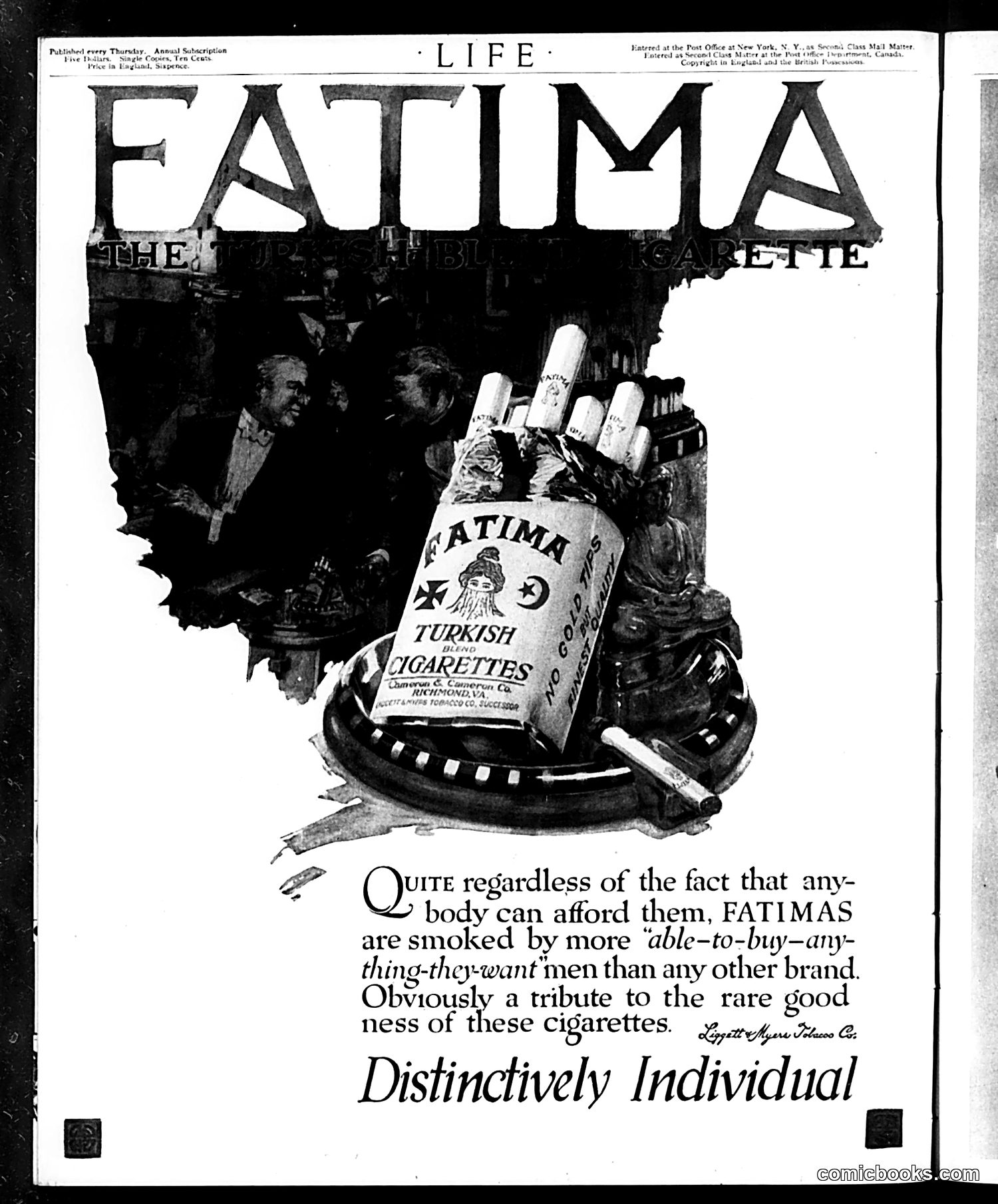
This page is primarily **advertising**, not satire or editorial content. It's a Fatima Turkish Cigarettes advertisement from Life magazine. The ad features an illustration of two men in what appears to be a shop or establishment, with a large package of Fatima cigarettes prominently displayed. The advertising copy emphasizes that Fatimas are "smoked by more 'able-to-buy-anything-they-want' men than any other brand," positioning them as a luxury product accessible to wealthy consumers. The phrase "Distinctly Individual" serves as the campaign's tagline. There is **no political satire** present—this is straightforward commercial advertising leveraging aspirational messaging and class positioning typical of early 20th-century cigarette marketing. The imagery suggests affluence and sophistication to appeal to the target demographic.
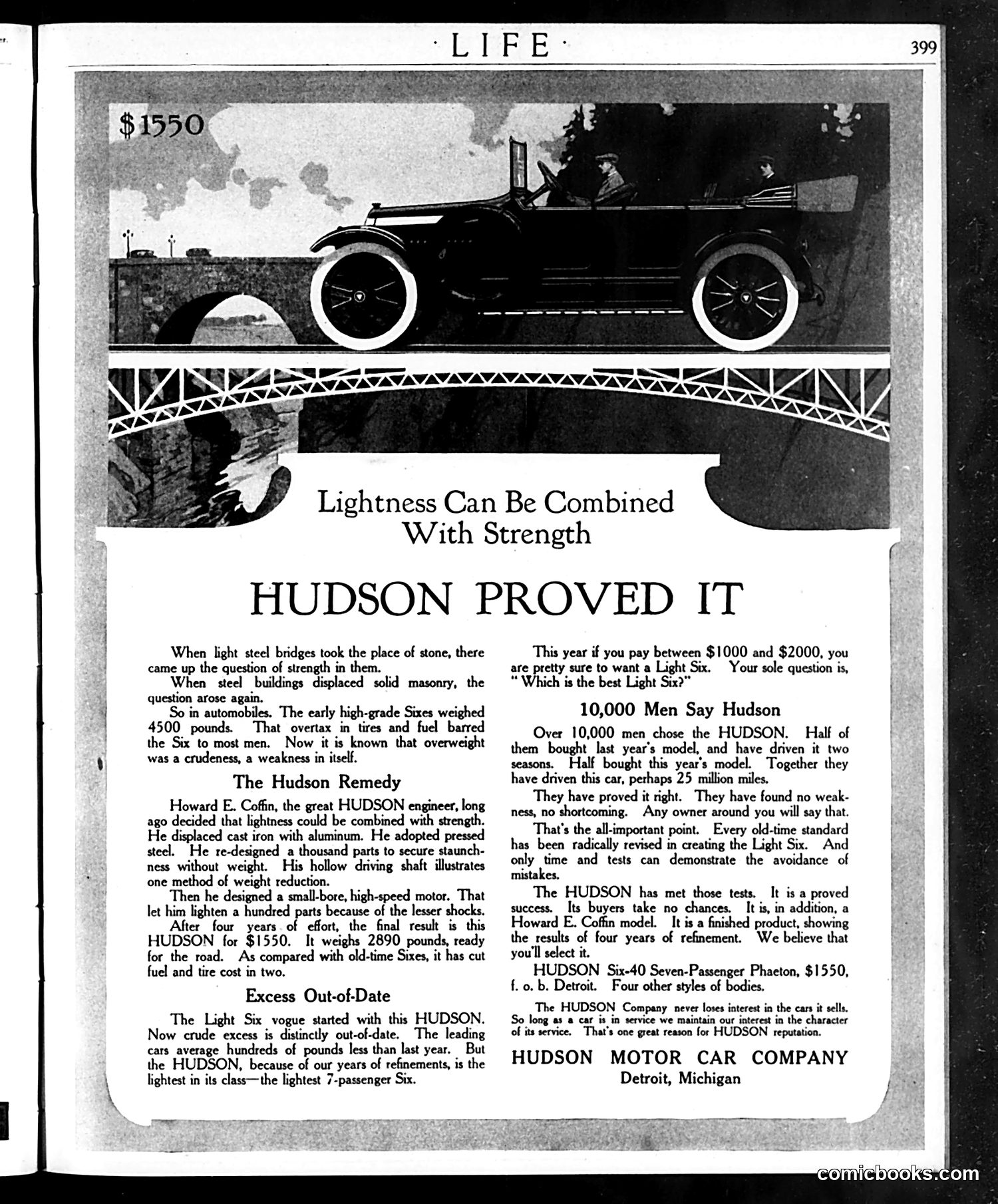
This page is primarily a **car advertisement**, not satire or political commentary. It appears in *Life* magazine (page 399) and promotes the Hudson Motor Car Company's "Light Six" automobile priced at $1550. The ad uses comparative engineering claims rather than humor: it argues that Hudson combined "lightness with strength" through innovative design by engineer Howard E. Coffin. The illustration shows the car crossing a steel bridge, visually representing durability. The text emphasizes that 10,000+ owners validate Hudson's quality and reliability compared to competing "Light Sixes." The marketing strategy appeals to practical buyers seeking value between $1000-$2000. This is straightforward early-1900s automotive advertising emphasizing technical specifications and testimonials—not satirical content.
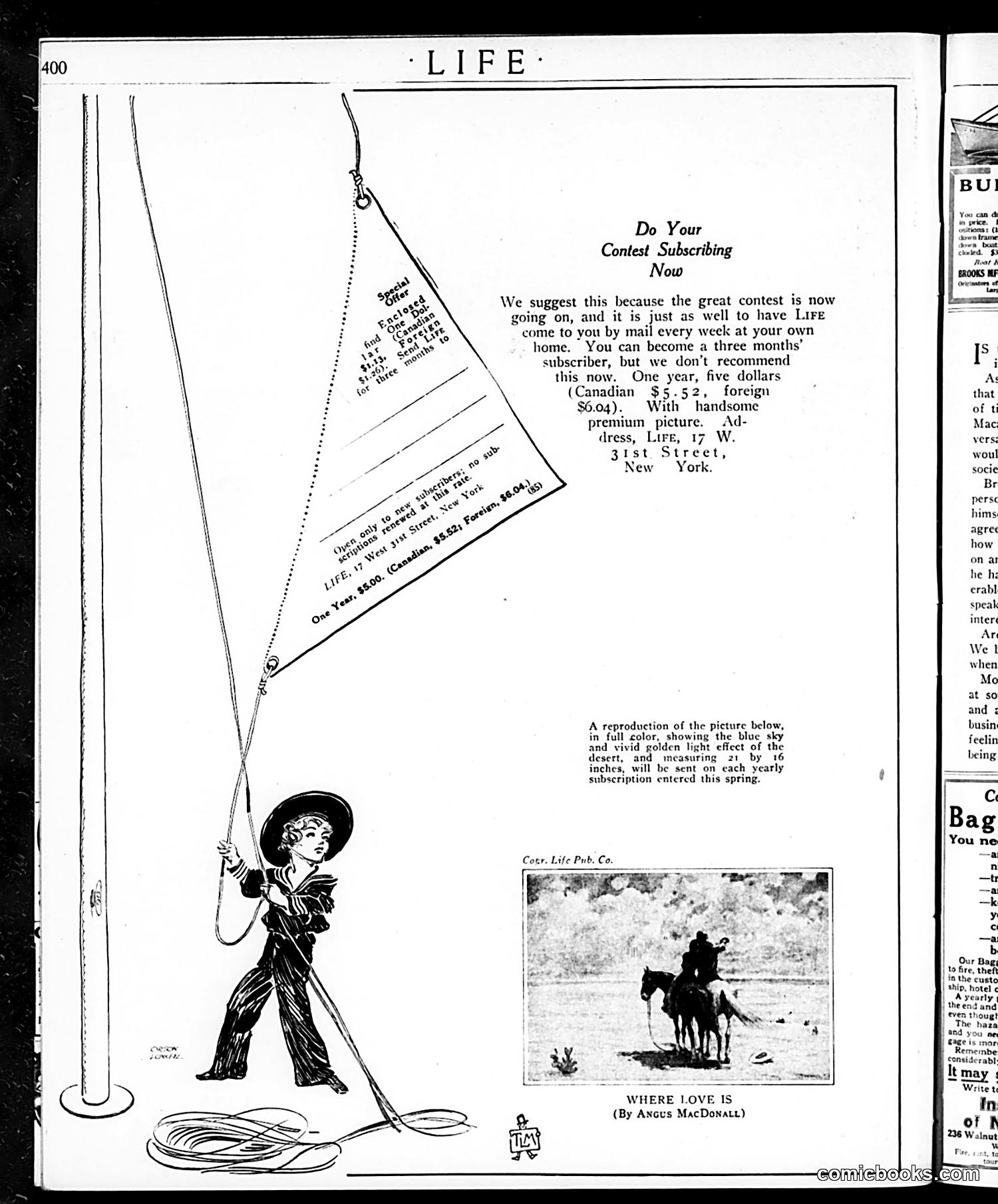
This page is primarily a **subscription advertisement** for Life magazine, not a political cartoon. The illustration shows a stylized woman in 1920s attire flying a kite labeled with subscription details and pricing information ($5 for one year, $5.52 Canadian). The accompanying photograph titled "WHERE LOVE IS (By Angus MacDonald)" depicts a figure on horseback in a desert landscape, likely accompanying a serialized story or feature. The page's humor is gentle and commercial rather than satirical—it uses the whimsical kite-flying imagery to make the subscription pitch visually appealing to readers. The woman's fashionable dress and confident pose reflect 1920s-era advertising aesthetics designed to attract contemporary magazine subscribers.
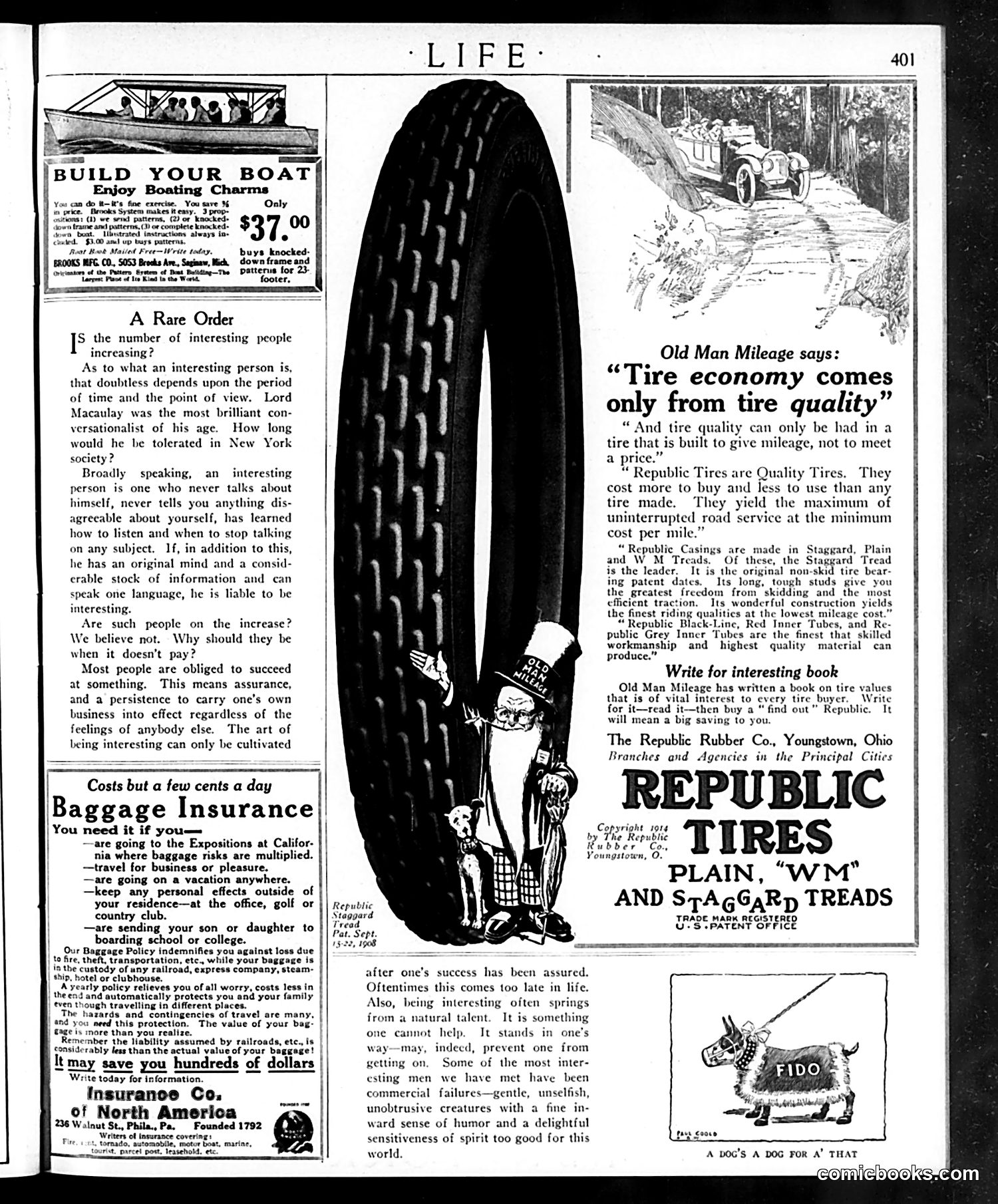
This page is primarily **advertising content** with minimal satirical elements. The main advertisements are: 1. **"Build Your Boat"** kit ($37) - a DIY boat construction offer 2. **Baggage Insurance** - promoting travel protection 3. **Republic Tires** - featuring "Old Man Mileage," a personified character endorsing tire quality and economy The only editorial content is a brief essay titled "A Rare Order" discussing what makes people interesting—emphasizing good listening skills, original thinking, and not being tedious. The cartoon element is minimal: the tire advertisement uses an anthropomorphic "Old Man Mileage" figure as a spokesperson, and there's a small illustration of "Fido" (a dog mascot) at bottom right. These are commercial mascots rather than political satire. This represents typical 1920s magazine layout mixing editorial and advertising content.
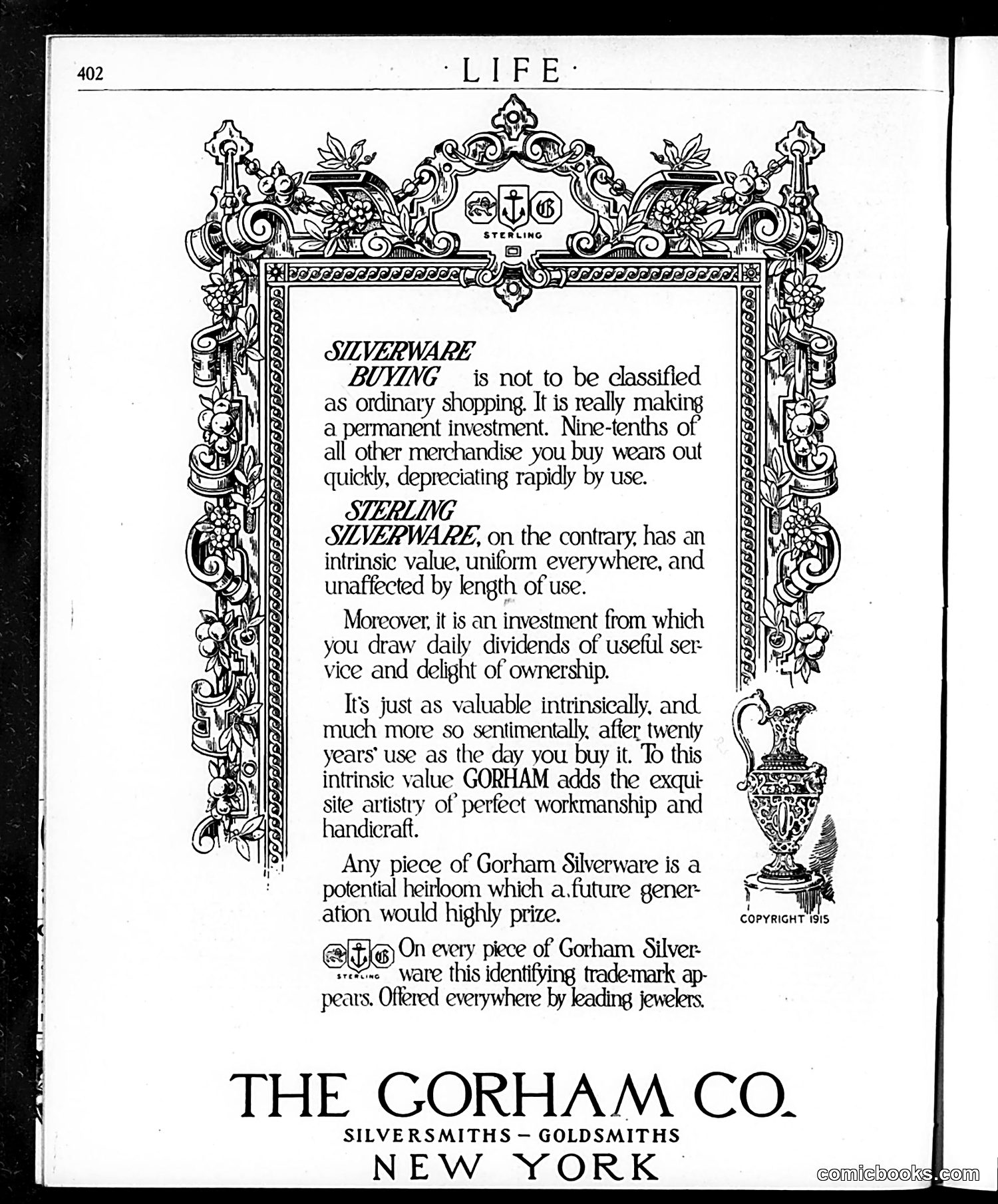
This page is **primarily an advertisement**, not satirical content. It's a 1915 Gorham Company ad for sterling silverware, positioned in Life magazine. The ad argues that silverware purchasing differs from ordinary shopping—it's an "investment" with lasting intrinsic value, unlike other goods that depreciate through use. Sterling silver maintains uniform value everywhere and provides "daily dividends of useful service." The ornate decorative border and illustrated silver pitcher are typical of luxury goods advertising from this era. The copy emphasizes craftsmanship and heirloom quality—that Gorham pieces become more sentimentally valuable over time and could pass to future generations. The trademark symbol (anchor, lion, G) authenticates the product for "leading jewelers." This is straightforward commercial persuasion, not political satire.
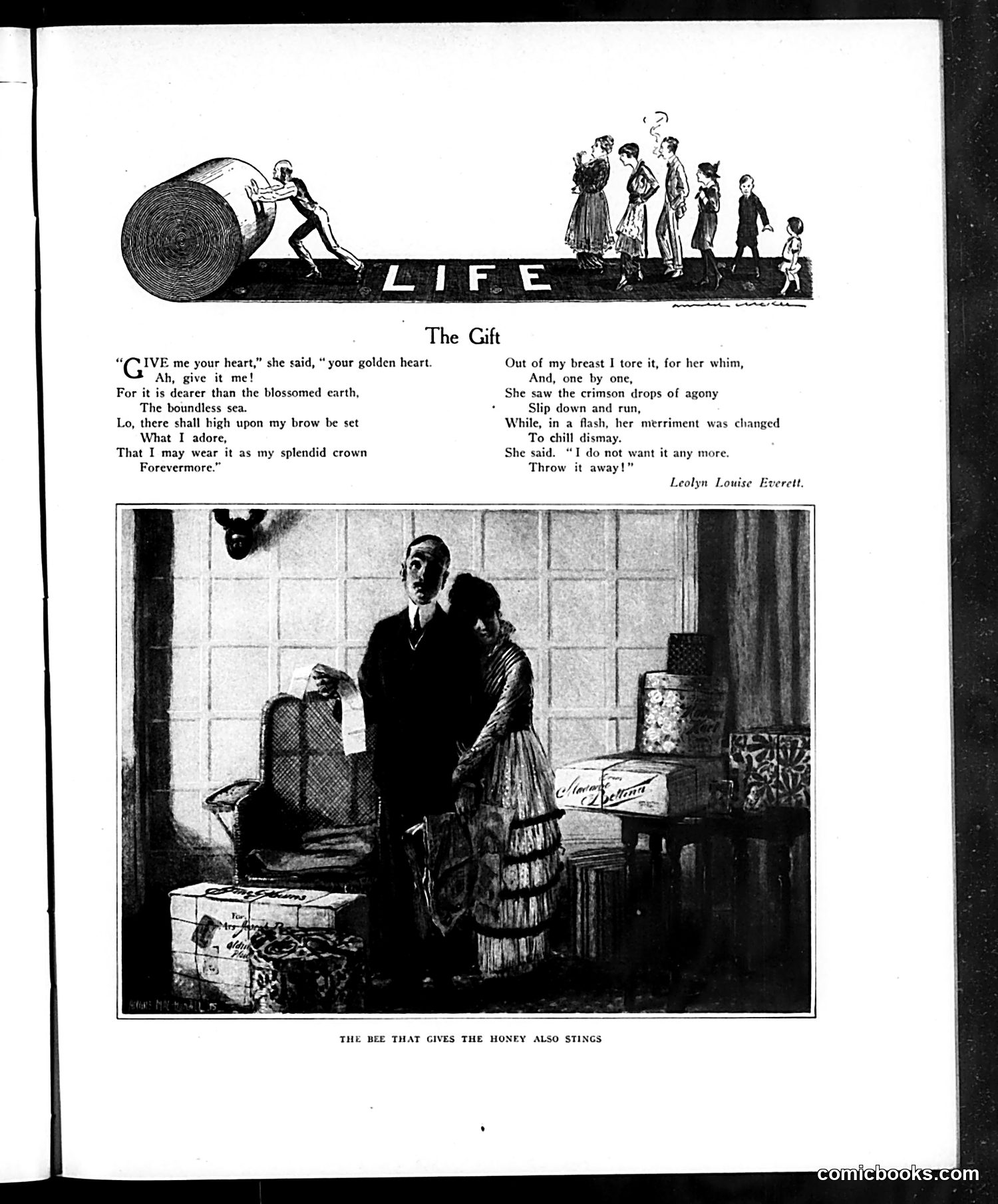
This page contains a poem titled "The Gift" by Leolyn Louise Everett, accompanied by an illustration captioned "The Bee That Gives the Honey Also Stings." **The Satire:** The poem satirizes romantic sacrifice and its consequences. A woman demands her suitor's "golden heart" as proof of love. He tears it from his chest, but she witnesses the "crimson drops of agony" and realizes the gift's terrible cost—his suffering transforms her joy to despair. She rejects it: "I do not want it any more. Throw it away!" **The Point:** The illustration and poem together mock the romantic ideal of absolute self-sacrifice. The satire suggests that love demands that appear noble actually inflict harm, and that receiving such a gift creates guilt rather than happiness. It's social commentary on excessive romantic sentiment and its destructive consequences.
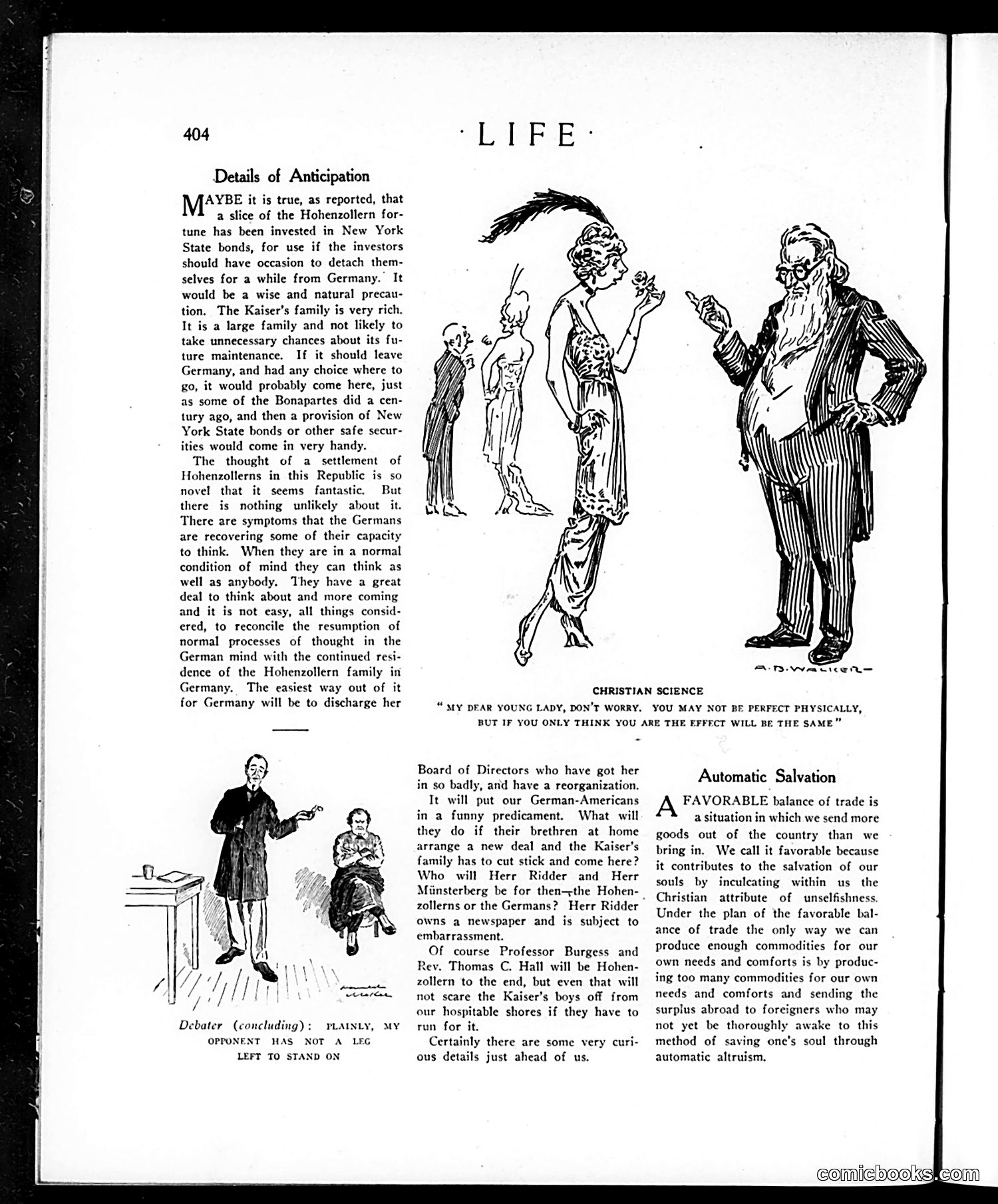
This page satirizes German financial anxieties during World War I. The main article "Details of Anticipation" discusses rumors that the Hohenzollern family (German royal house) has invested in New York State bonds as a financial escape plan, should Germany lose the war. The text mockingly suggests this mirrors the Bonapartes' flight a century earlier. The cartoon above depicts figures in classical/allegorical dress, captioned "CHRISTIAN SCIENCE," sardonically commenting on German delusions of financial security. Below, a sketch shows a "Debater" making a dismissive political argument with the caption "PLAINLY, MY OPPONENT HAS NOT A LEG LEFT TO STAND ON"—a visual pun undermining the debate itself. The page reflects American wartime skepticism toward German financial planning and propaganda.
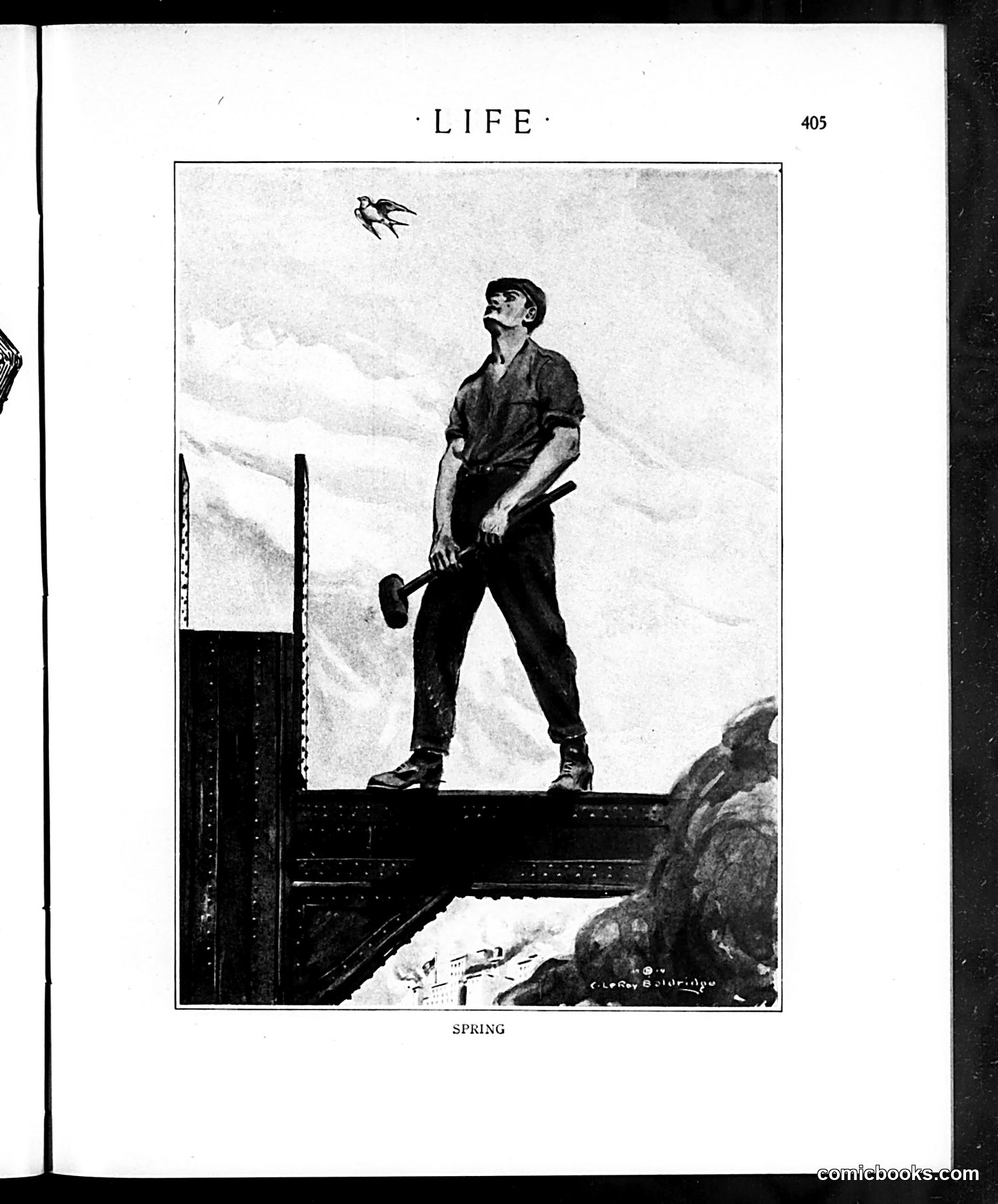
This illustration depicts a working man in dark clothing standing on wooden construction or dock materials, holding an axe and gazing upward at birds flying in a spring sky. The image is titled "SPRING" and appears to be a seasonal commentary. The satire likely contrasts the idealized notion of spring—typically associated with renewal, leisure, and natural beauty—with the harsh reality of manual labor. The worker, equipped with tools, remains bound to backbreaking work even as nature awakens. The birds represent freedom and the carefree pleasures of the season that remain inaccessible to laborers. This reflects early 20th-century social commentary on class divisions and the working poor's inability to enjoy life's natural rewards.
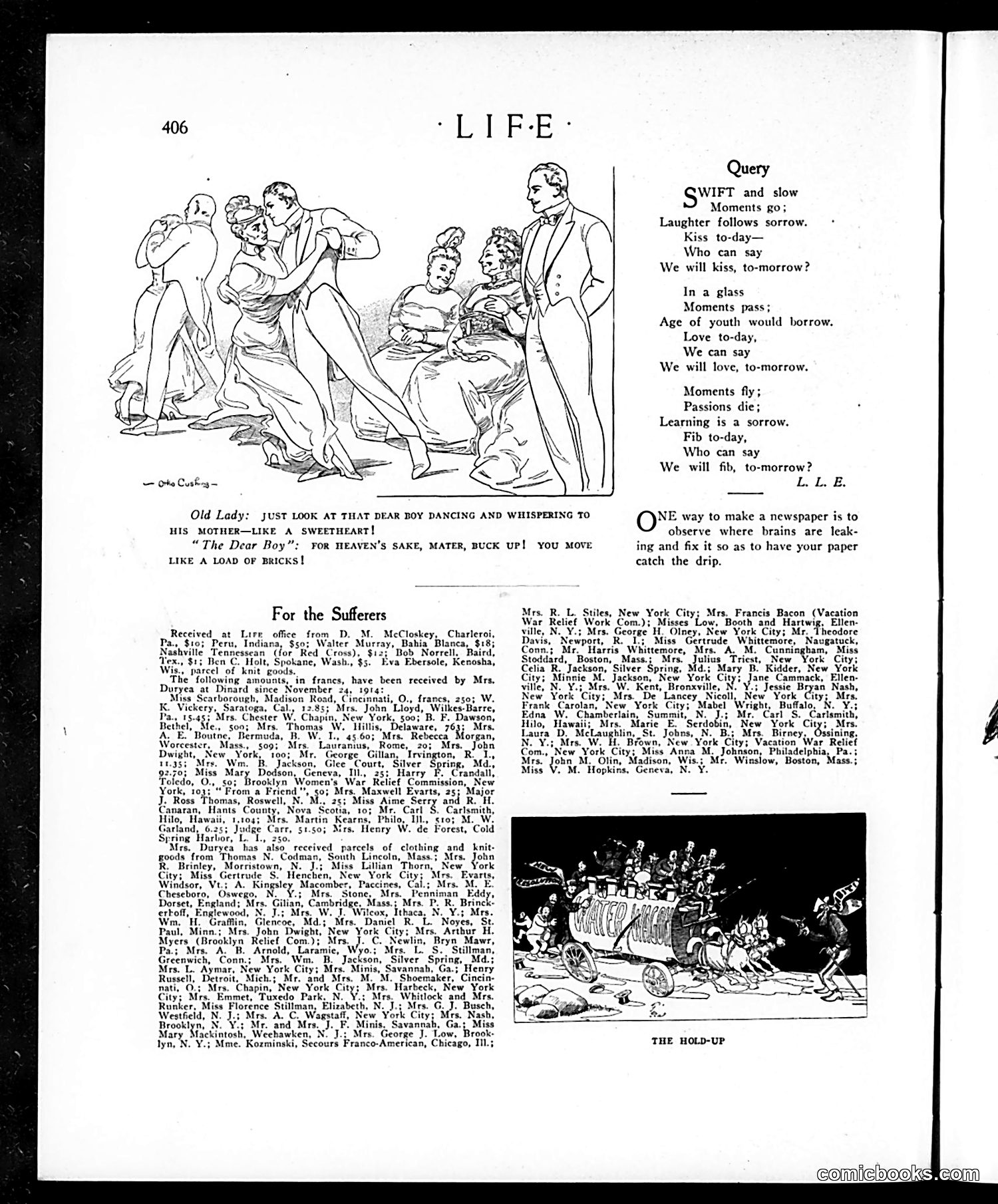
This page from *Life* magazine (page 406) contains three distinct elements: **Top Cartoon ("Old Lady")**: An elderly woman observes a young boy dancing energetically while whispering to his mother, remarking he moves "like a load of bricks"—a sarcastic jab at his clumsy dancing. The humor relies on the contrast between the boy's enthusiasm and his apparent lack of grace. **"Query" Poem**: A philosophical meditation on fleeting moments, sorrow, and love's transience, attributed to L.L.E. **"For the Sufferers"**: A charity relief list naming donors who contributed money and goods (clothing, knitted items) to war relief efforts, likely from World War I based on the reference to "War Relief Work Com." **Bottom Illustration ("The Hold-Up")**: An unclear cartoon, possibly depicting a robbery or crime scene with multiple figures and a cart.
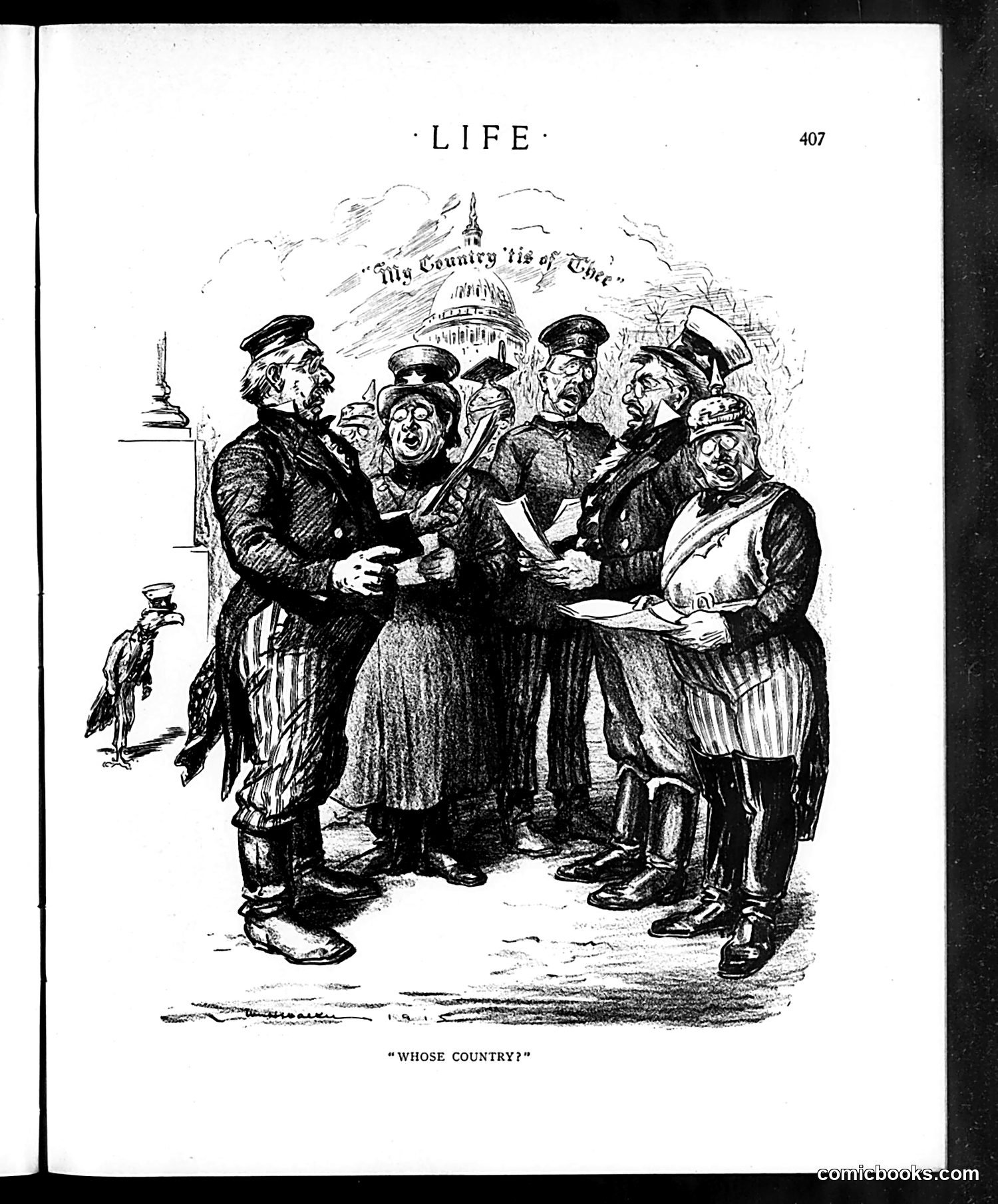
This political cartoon depicts a group of men in late 19th or early 20th-century dress confronting each other before the U.S. Capitol. The banner reading "My Country 'tis of Thee" appears above, while the caption asks "Whose Country?" The cartoon appears to satirize disputes over American identity and belonging—likely referencing immigration debates, political factionalism, or questions about who rightfully "owns" America. The various caricatured figures suggest different groups or interests (possibly immigrants, politicians, or rival factions) all claiming ownership of the nation. The small figure on the left appears detached from the main group, emphasizing the exclusionary nature of the debate. The satire critiques how different groups contest national belonging and patriotic claims during a period of significant American social tension.
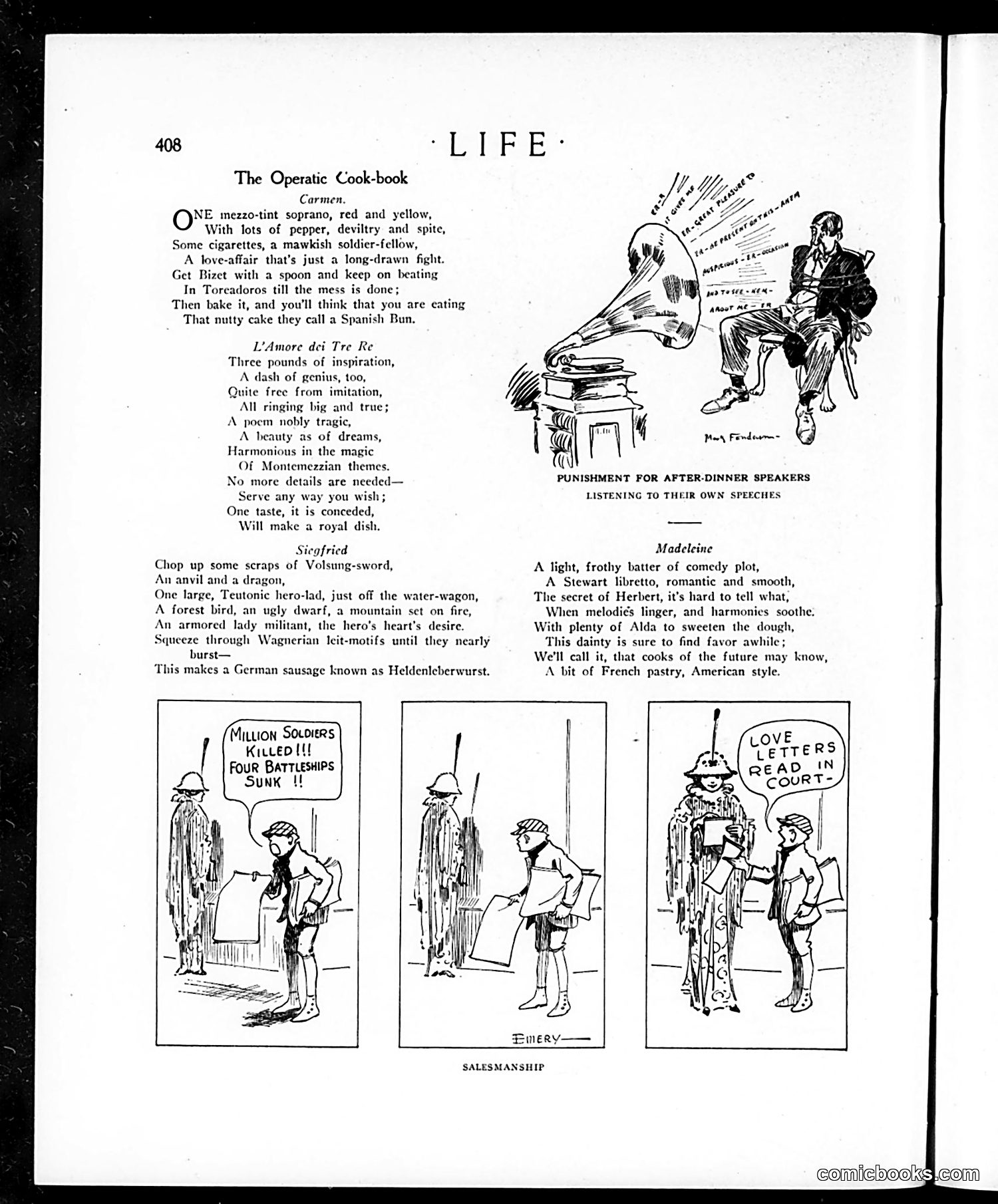
This page contains humorous recipes presented as operatic titles, mocking both grand opera and cooking pretension. "Carmen," "L'Amore dei Tre Re," "Siegfried," and "Madeleine" are real operas reimagined as dish instructions—a satirical jab at overwrought artistic pretension. The three-panel "Salesmanship" cartoon below depicts a soldier attempting to impress a woman by exaggerating war achievements. In successive panels, his claims escalate from "million soldiers killed" to her romantic interest only when he switches tactics to discussing "love letters read in court"—suggesting women respond better to romantic scandal than military boasting. The satire mocks both masculine posturing and female fickleness, typical of early 20th-century gender humor.
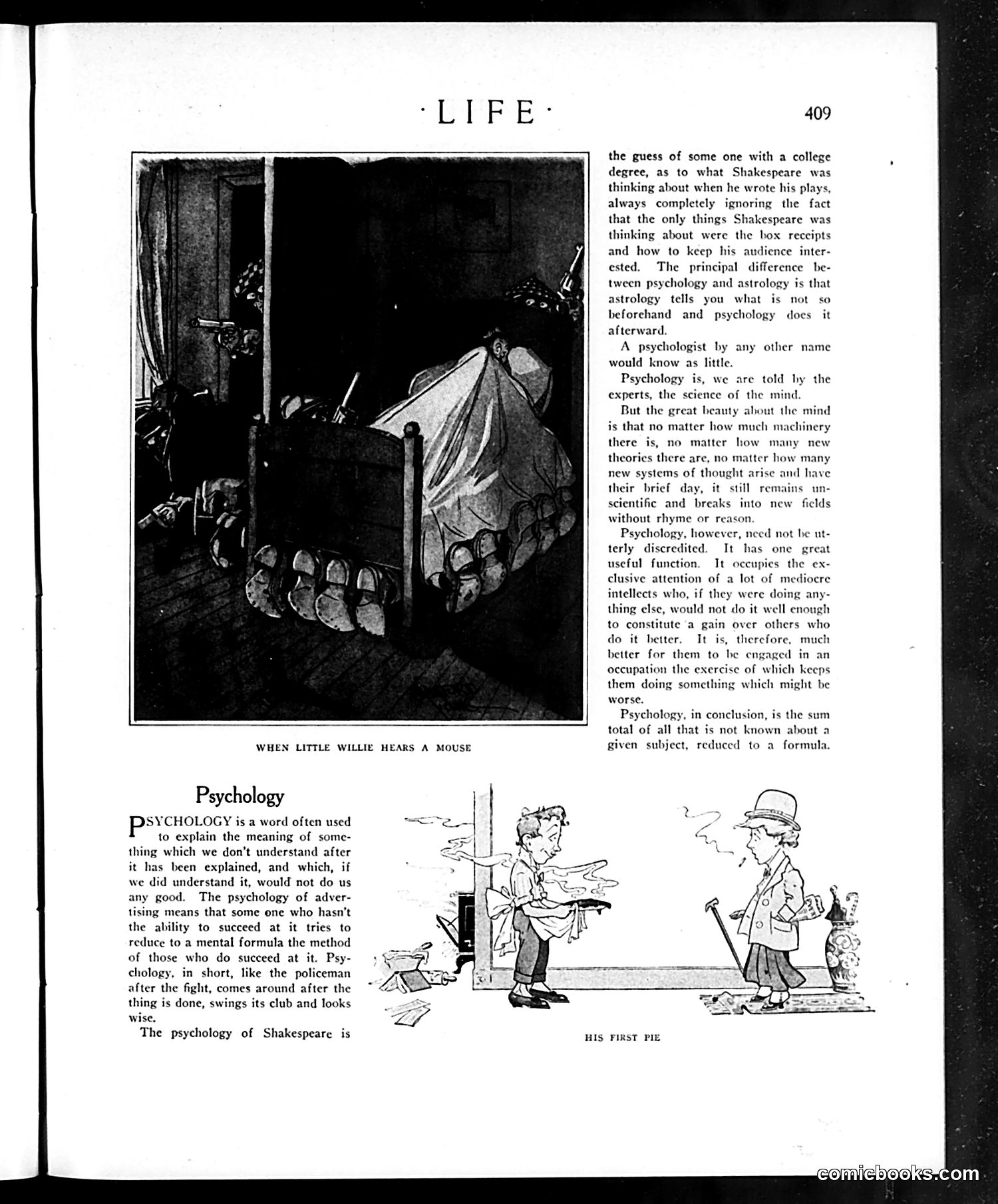
This page contains an essay titled "Psychology" that critiques the field itself as largely useless—a "sum total of all that is not known about a given subject, reduced to a formula." The text sarcastically notes that psychology occupies mediocre intellects who would accomplish little else. The cartoon "His First Pie" illustrates a child's psychological reaction: a young boy eagerly reaches for pie while an adult (likely a parent or authority figure) watches. This humorous illustration supports the essay's point that psychology merely describes obvious human behaviors after the fact—here, a child's predictable desire for food—rather than providing genuine insight. The upper photograph "When Little Willie Hears a Mouse" similarly depicts a child's straightforward, instinctive reaction, reinforcing the satire that psychology claims to study what is already self-evident.
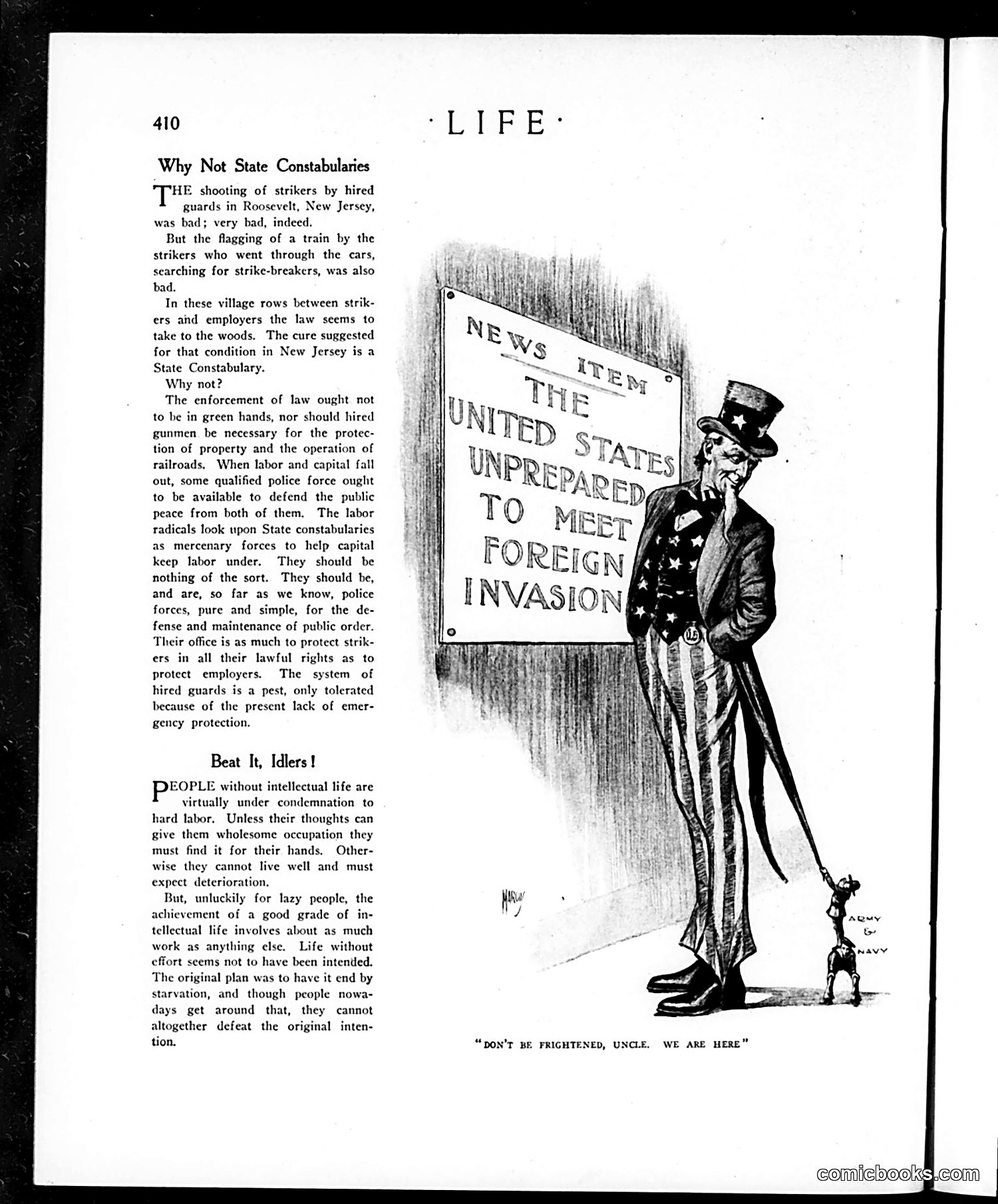
This Life magazine page features a satirical cartoon addressing American military preparedness during what appears to be a WWI-era discussion of foreign invasion threats. The central figure is **Uncle Sam** (identifiable by his characteristic top hat with stars and stripes), holding a newspaper headline reading "NEWS ITEM: THE UNITED STATES UNPREPARED TO MEET FOREIGN INVASION." A small, anxious military figure (labeled "ARMY" and "NAVY") cowers beside Uncle Sam's leg, representing America's undersized military forces. The caption reads: "Don't be frightened, Uncle. We are here." The satire mocks the inadequacy of American military defenses while attempting false reassurance. The cartoon critiques the nation's unpreparedness for potential conflict, a common concern during the 1910s debate over military expansion.
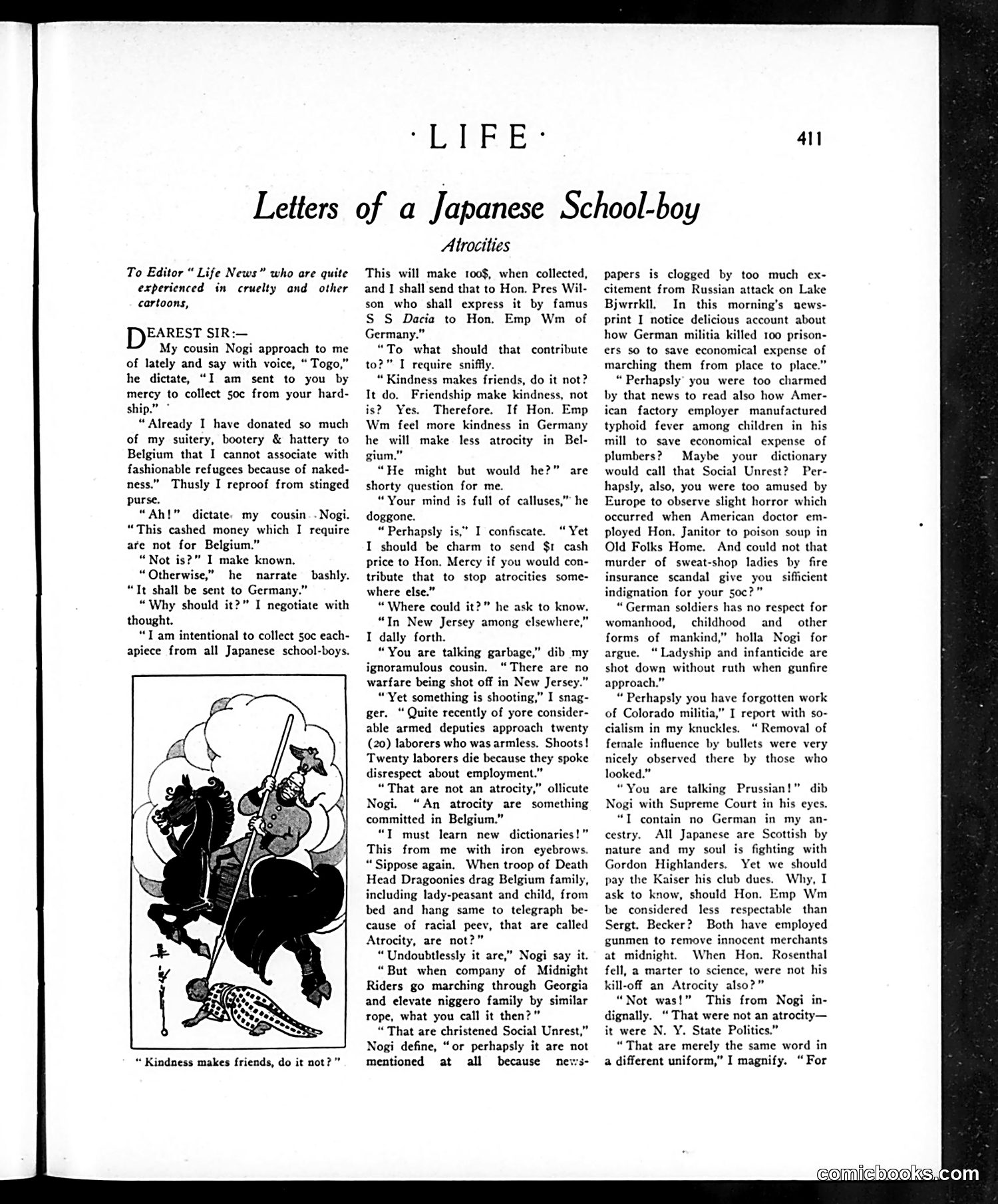
This satirical piece uses a deliberately fractured English-speaking Japanese character to critique American hypocrisy regarding wartime atrocities. The crude illustration shows figures in exaggerated, stereotypical style typical of early 20th-century Life magazine. The satire's central point: A Japanese schoolboy collects money ostensibly for Belgian relief (victims of German WWI atrocities), but the narrator challenges the selective moral outrage. He argues Americans condemn German brutality in Belgium while ignoring comparable American violence—specifically lynching in the South ("Midnight Riders") and workplace deaths in mills and factories. The "atrocity" debate exposes the magazine's critique: calling only Belgian suffering "atrocity" while dismissing American racial violence and industrial deaths as mere "Social Unrest" reveals racist double standards and complicit media silence. The broken English reinforces the satire's bite—the "foreigner" sees American contradictions more clearly than Americans themselves.
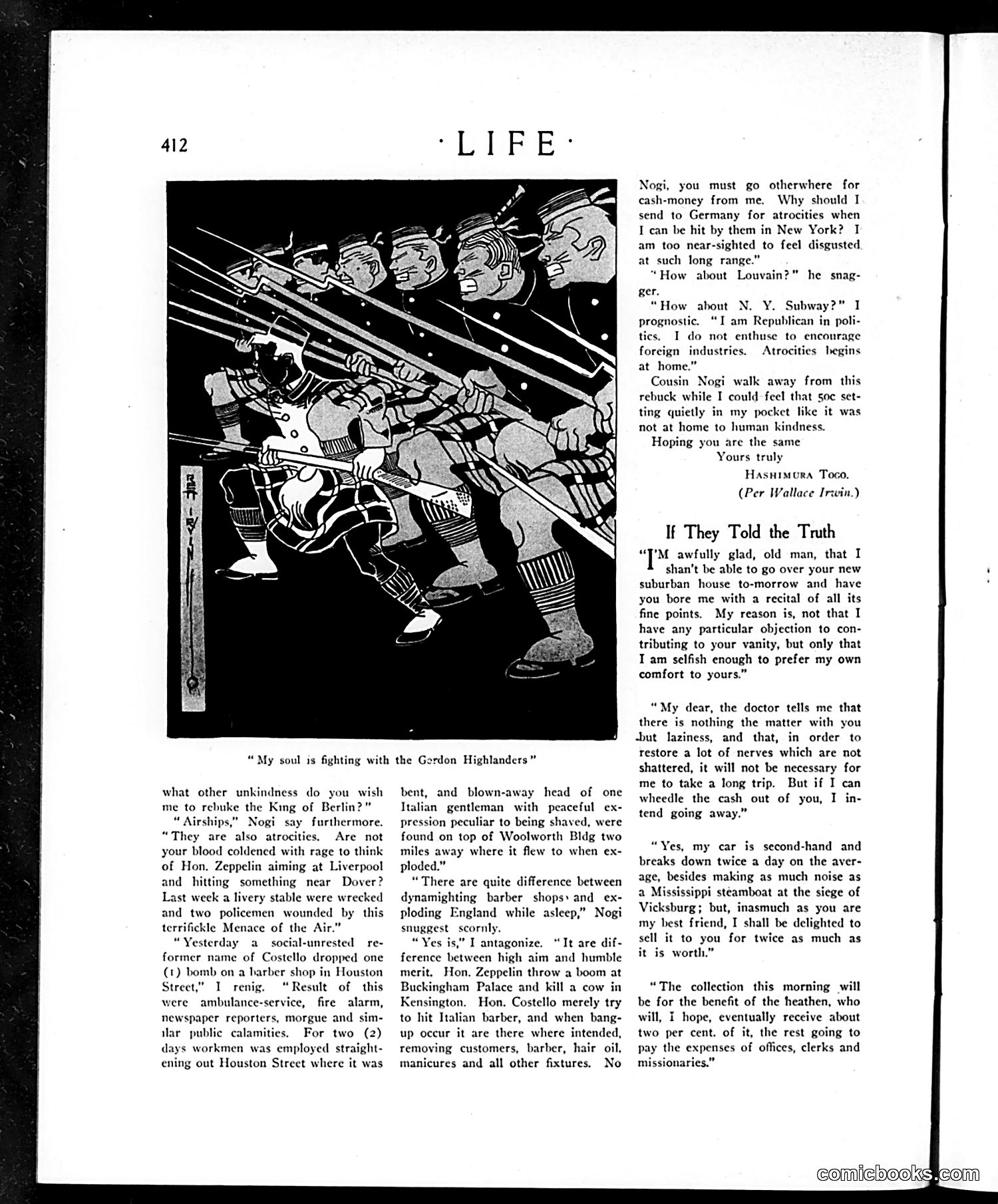
This page contains satirical commentary on World War I-era anxieties, presented through two distinct pieces. The main cartoon "My soul is fighting with the Gordon Highlanders" depicts a comedic dialogue between an American narrator and "Cousin Nogi" (apparently Japanese, per the byline crediting Wallace Irwin). Nogi requests money for atrocities abroad, specifically referencing German Zeppelin airship attacks on England. The narrator's response mocks American isolationism and self-interest: why worry about distant European horrors when American cities face domestic threats? He cites a bomb attack on a Houston Street barbershop as proof atrocities happen locally too. The satire targets American reluctance to engage with foreign conflicts while claiming Republican politics justifies prioritizing domestic industry. "If They Told the Truth" is a separate humor piece offering blunt, honest versions of polite social excuses—a wealthy neighbor declining a house tour, a doctor's diagnosis of laziness, car-sale dishonesty, and charitable donation misappropriation. It satirizes hypocrisy in everyday social interactions through brutal candor. Both pieces use exaggeration and irony to critique American attitudes and social conventions circa 1910s.
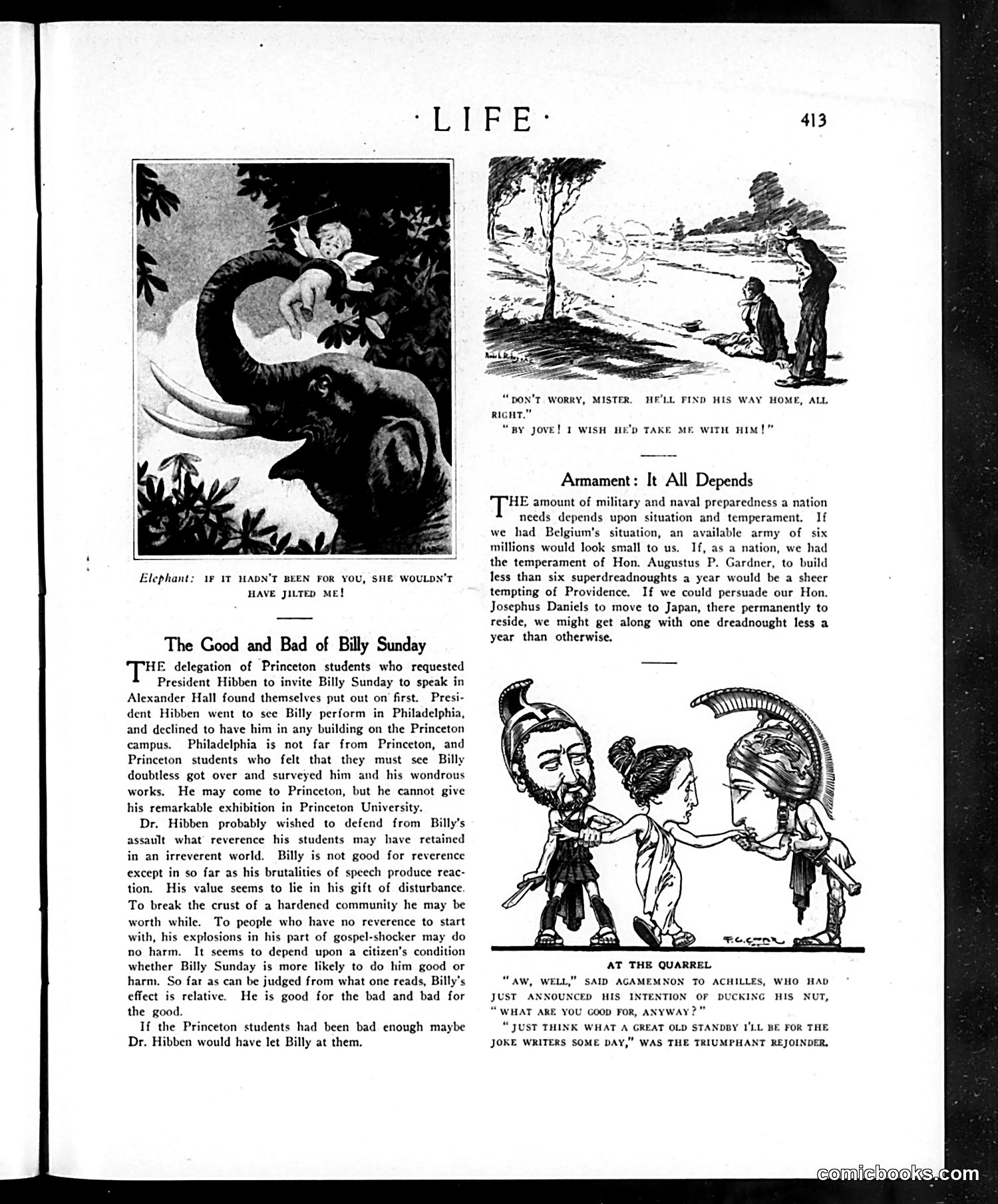
This page contains three separate satirical pieces from an era when Life was a humor magazine (not a lifestyle publication). **"The Good and Bad of Billy Sunday"** discusses Princeton's President Hibben rejecting evangelist Billy Sunday's campus speaking request. The satire argues Sunday's value is relative—he helps "the bad" but harms "the good," suggesting his crude revivalist methods disturb rather than uplift. **"Armament: It All Depends"** mocks American military preparedness debates by naming specific politicians: Augustus P. Gardner (a naval hawk) and Josephus Daniels (Secretary of the Navy). The satire suggests military needs depend absurdly on individual temperaments rather than rational policy. **"At the Quarrel"** offers a classical joke: Achilles boasts to Agamemnon that future joke-writers will treasure their dispute, making even Homer's heroes seem like fodder for comedy rather than tragedy. The elephant cartoon's caption is unclear without fuller context.
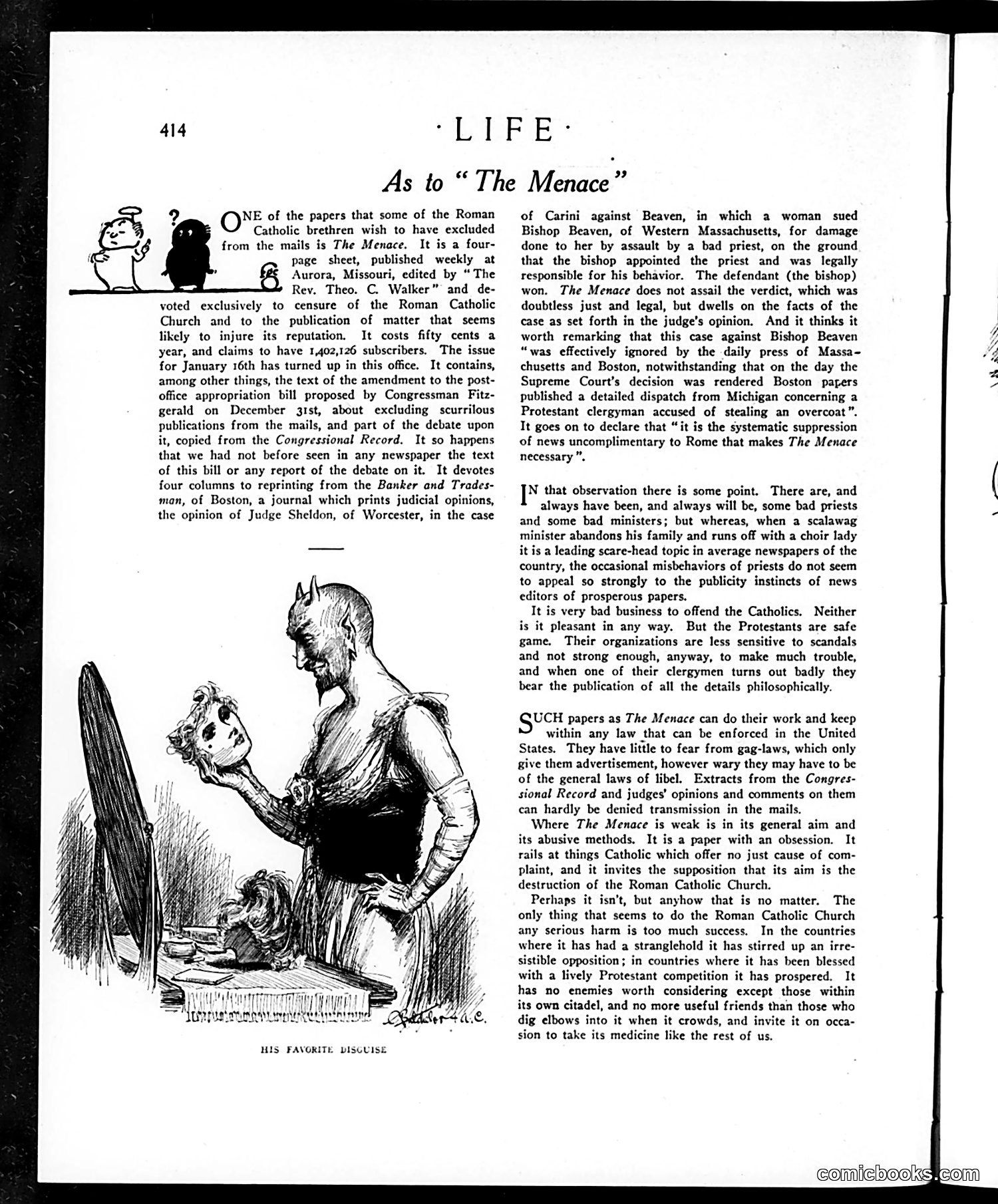
This article critiques *The Menace*, a weekly anti-Catholic publication from Aurora, Missouri, edited by "Rev. Theo. C. Walker." Life acknowledges the paper's valid point: American newspapers suppress scandals involving Catholic priests while sensationalizing Protestant clergy misconduct—demonstrating institutional bias favoring Catholics. However, Life attacks *The Menace*'s credibility, calling it obsessively anti-Catholic with an apparent goal of destroying the Church rather than pursuing balanced journalism. The accompanying cartoon (captioned "His Favorite Disguise") depicts a demonic or grotesque figure—apparently representing *The Menace*'s hidden anti-Catholic agenda—disguised as something respectable. Life's position: while *The Menace* raises legitimate concerns about press bias, its inflammatory methods and single-minded obsession undermine its effectiveness and reveal it as propaganda rather than journalism. The satire suggests the publication's true nature lurks beneath a veneer of respectability.
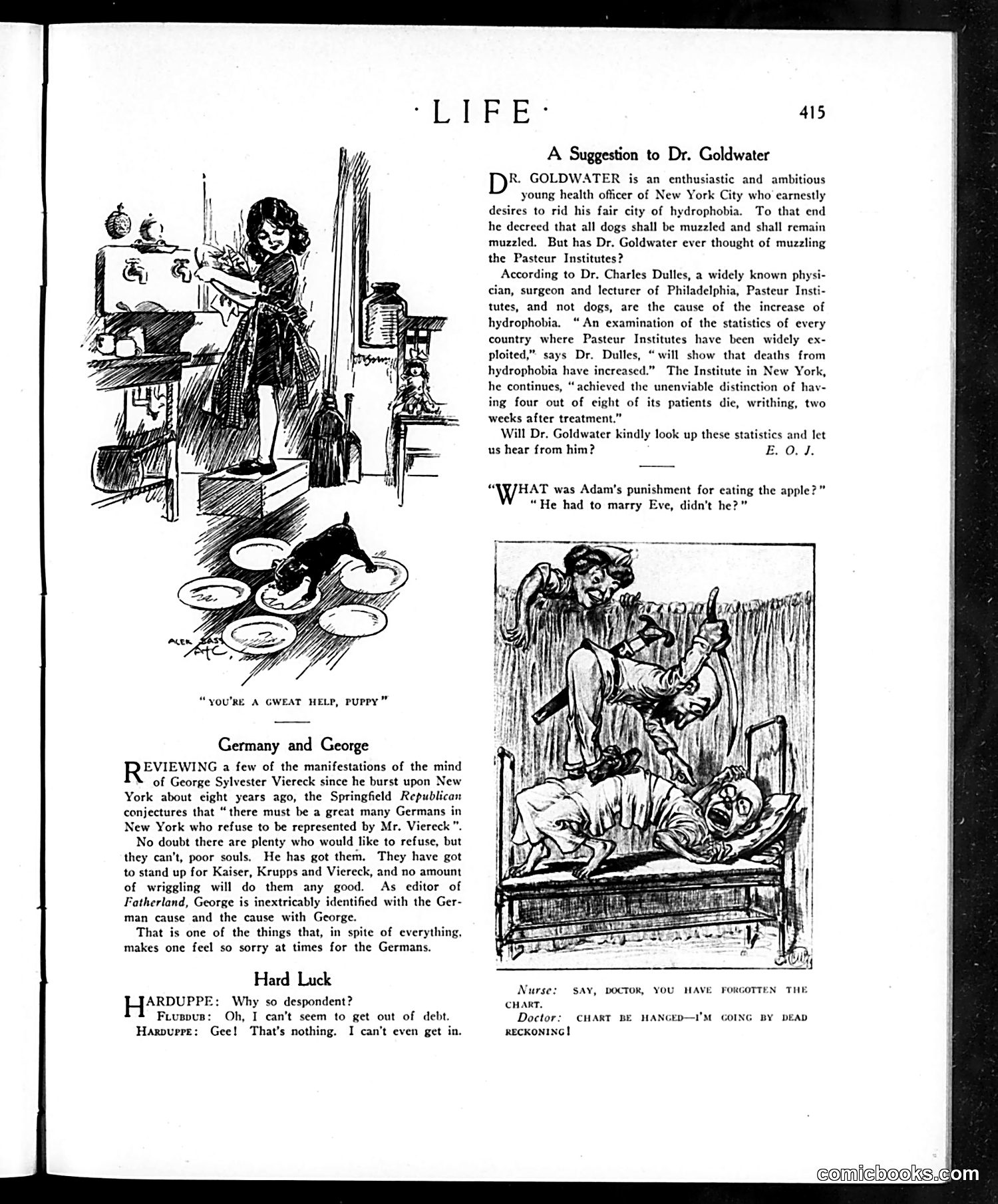
This page contains multiple satirical pieces from an early 20th-century American magazine: **"A Suggestion to Dr. Goldwater"** criticizes New York's health officer for muzzling dogs to prevent rabies while ignoring Pasteur Institutes, which the writer claims—citing Dr. Dulles—actually *increase* hydrophobia deaths. The satire suggests the real problem isn't dogs but the medical institution itself. **"Germany and George"** attacks George Sylvester Viereck, editor of *Fatherland* magazine, as a German propagandist during WWI. The piece sarcastically claims German-Americans in New York are forced to support him and Kaiser/Krupps, implying Viereck controls German-American opinion through nationalist rhetoric. **"Hard Luck"** is a simple joke about debt and poverty. **The bottom cartoon** shows a doctor who forgot his patient's chart but proceeds anyway, joking he'll use "dead reckoning"—dark medical humor about patient mortality. The illustrations include domestic scenes and a biblical/classical reference (Adam and Eve joke).
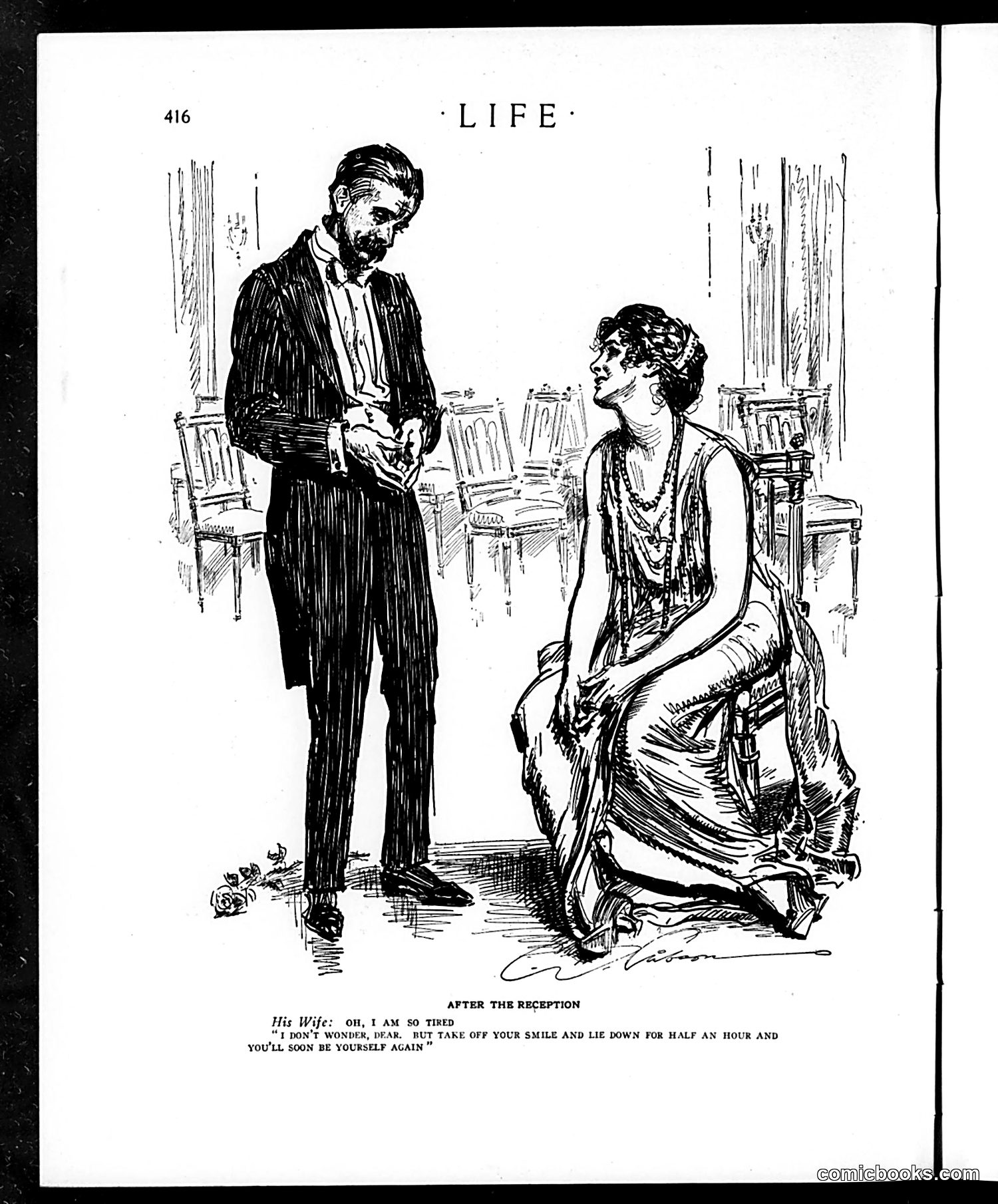
This is a satirical cartoon about social exhaustion after hosting a formal reception. The drawing shows a standing man in formal evening wear and a seated woman in an elegant gown, positioned in what appears to be an upper-class interior with chairs visible in the background. The joke centers on the wife's advice: her husband should remove his forced smile (literally) and rest, after which he'll "be yourself again." The satire targets the artificiality of high-society entertaining—the performance and fakery required to maintain proper appearances during formal social events. The cartoon suggests that the couple's "real selves" are fundamentally different from their public personas, and that socializing in this context is an exhausting performance rather than genuine interaction. This reflects early 20th-century middle and upper-class anxieties about social performance and authenticity.
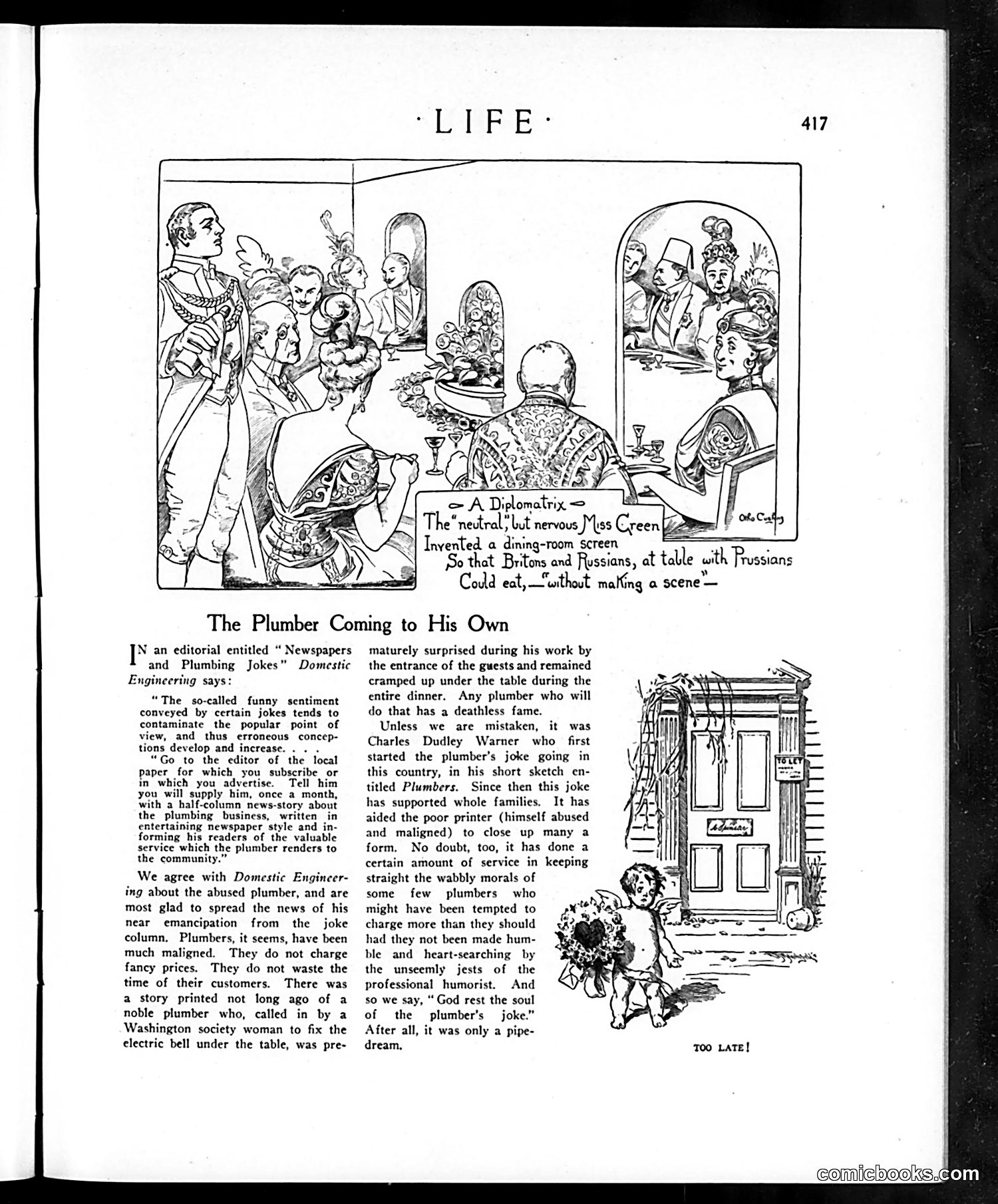
This 1910s Life magazine piece defends plumbers against a long-standing joke tradition in American humor. The editorial criticizes how plumbers have been routinely mocked in newspapers and comic sketches, attributing the "plumber joke" tradition to writer Charles Dudley Warner's story *Plumbers*. Life argues plumbers deserve respect: they charge fair prices, don't waste customers' time, and perform essential services. The accompanying cartoon shows a plumber finally being treated with dignity at a formal dinner, rather than hidden under tables or ridiculed. The piece's irony lies in mocking the very joke tradition it discusses while advocating the plumber's rehabilitation from American popular culture's contempt. The "Diplomatrix" cartoon above jokes about awkward social situations during WWI—a parallel to the plumber's social awkwardness being finally overcome.
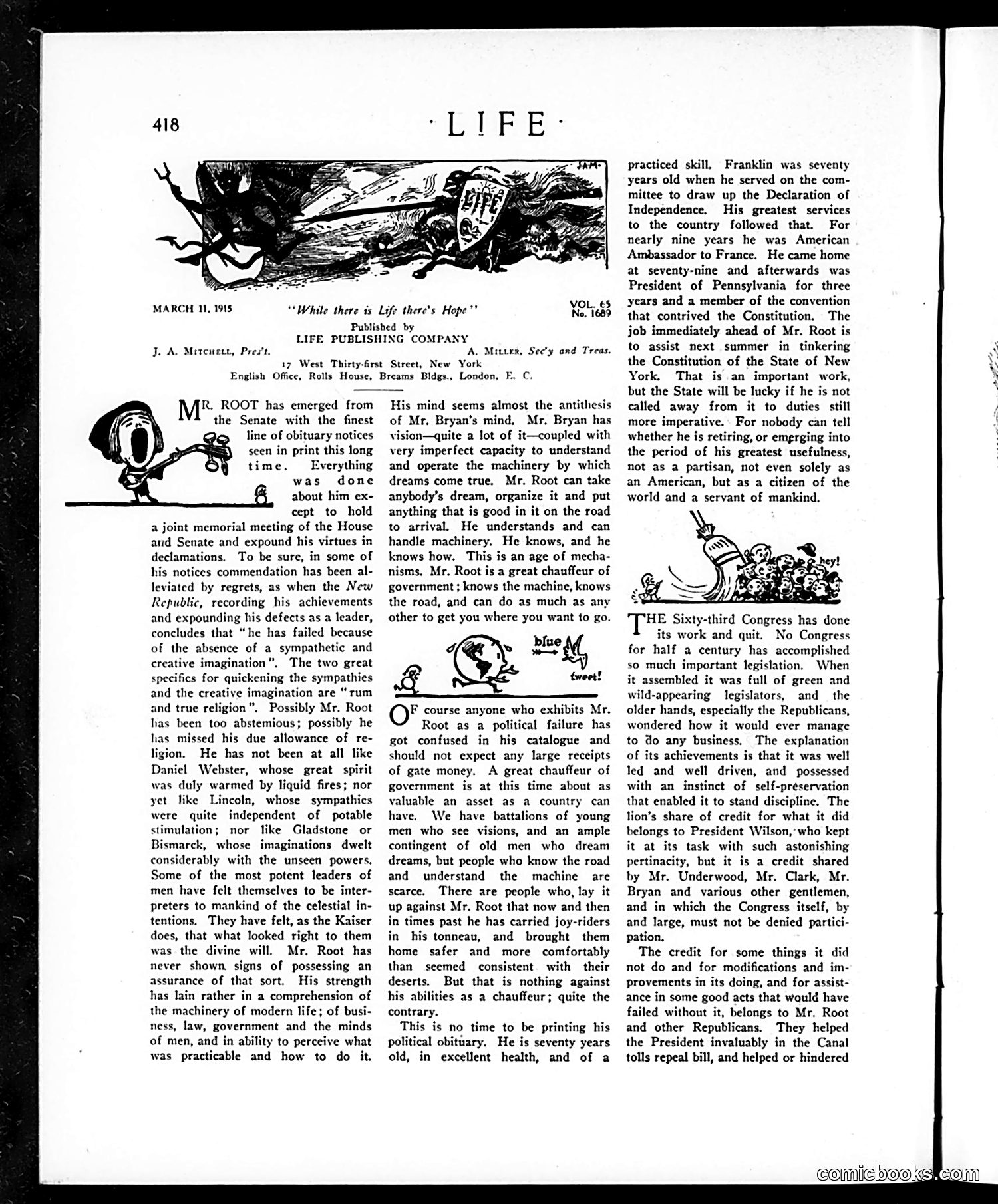
This page satirizes Elihu Root's recent Senate departure. The article frames Root as a practical "chauffeur of government"—a skilled mechanic who operates the machinery of state effectively, unlike visionary politicians like William Jennings Bryan who dream without executing. The satire's point: Life magazine defends Root against critics (like the *New Republic*) who claim he lacks imagination and sympathy. Instead, the author argues Root's real strength is *pragmatism*—understanding how to make things work. The piece dismisses premature "obituary notices" about his political career, comparing him to Benjamin Franklin, who accomplished great things after age seventy. The cartoon (top) shows a figure labeled "Life" with a torch—the magazine's masthead personification—reinforcing their hopeful message that Root's career isn't finished. The political context: Root was a prominent Republican statesman and diplomat whose practical, legalistic approach contrasted with Bryan's idealistic progressivism.
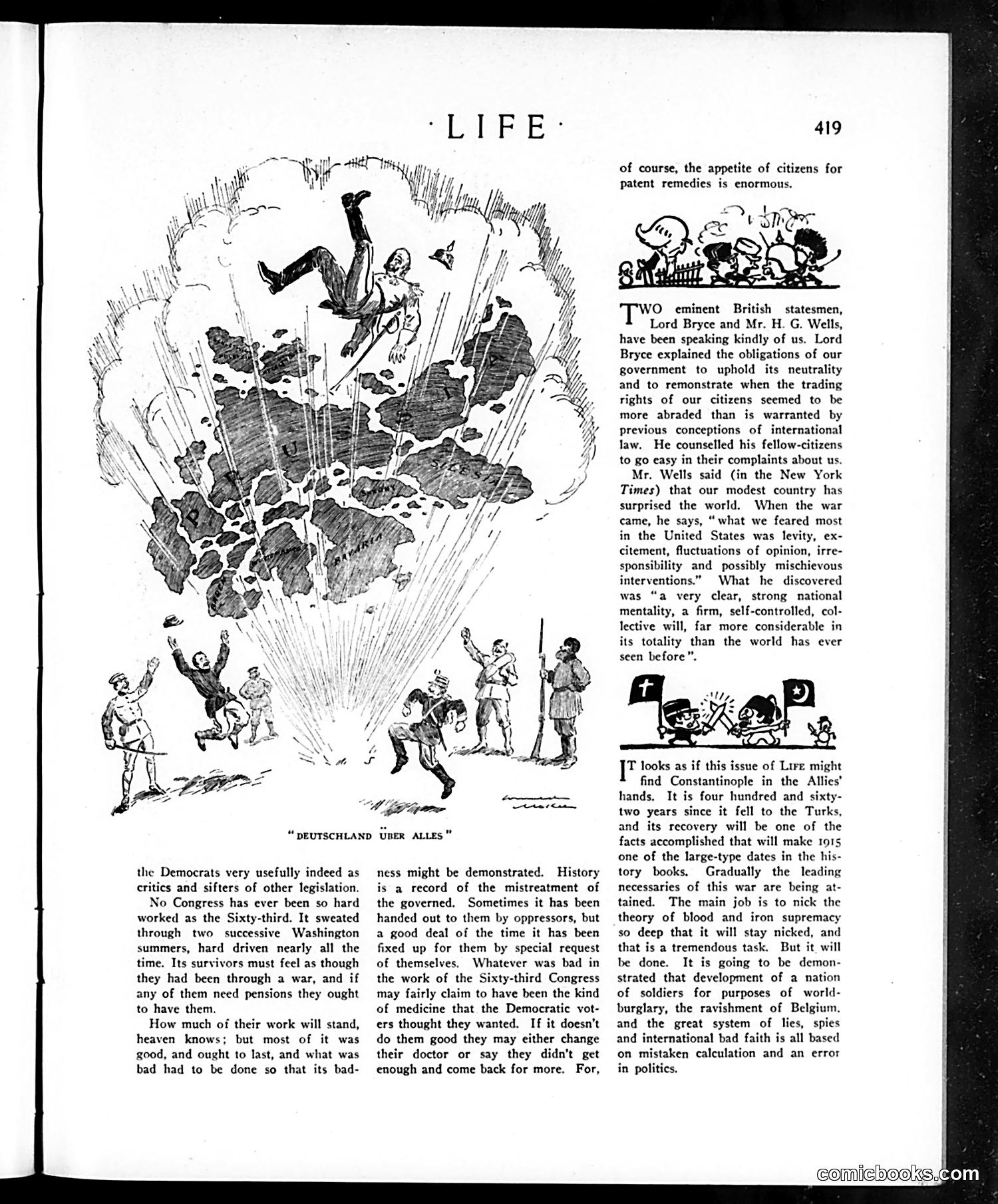
This cartoon satirizes German militarism during World War I. The title references the German nationalist phrase meaning "Germany Above All." The image depicts an explosion or violent upheaval, with figures being thrown violently into the air—likely representing the chaos and destruction resulting from Germany's aggressive military philosophy. The soldiers and civilians tumbling chaotically illustrate the consequences of the German doctrine of military supremacy ("blood and iron") that Life's accompanying text condemns. The editorial commentary explicitly criticizes Germany's theory that "development of a nation of soldiers for purposes of world-burglary, the ravishment of Belgium, and the great system of lies, spies and international bad faith" is based on "mistaken calculation and an error in politics." The cartoon mocks how this German ideology, despite appearing powerful, ultimately produces only destruction and failure. It's Cold War-era American propaganda supporting the Allied position against Germany.
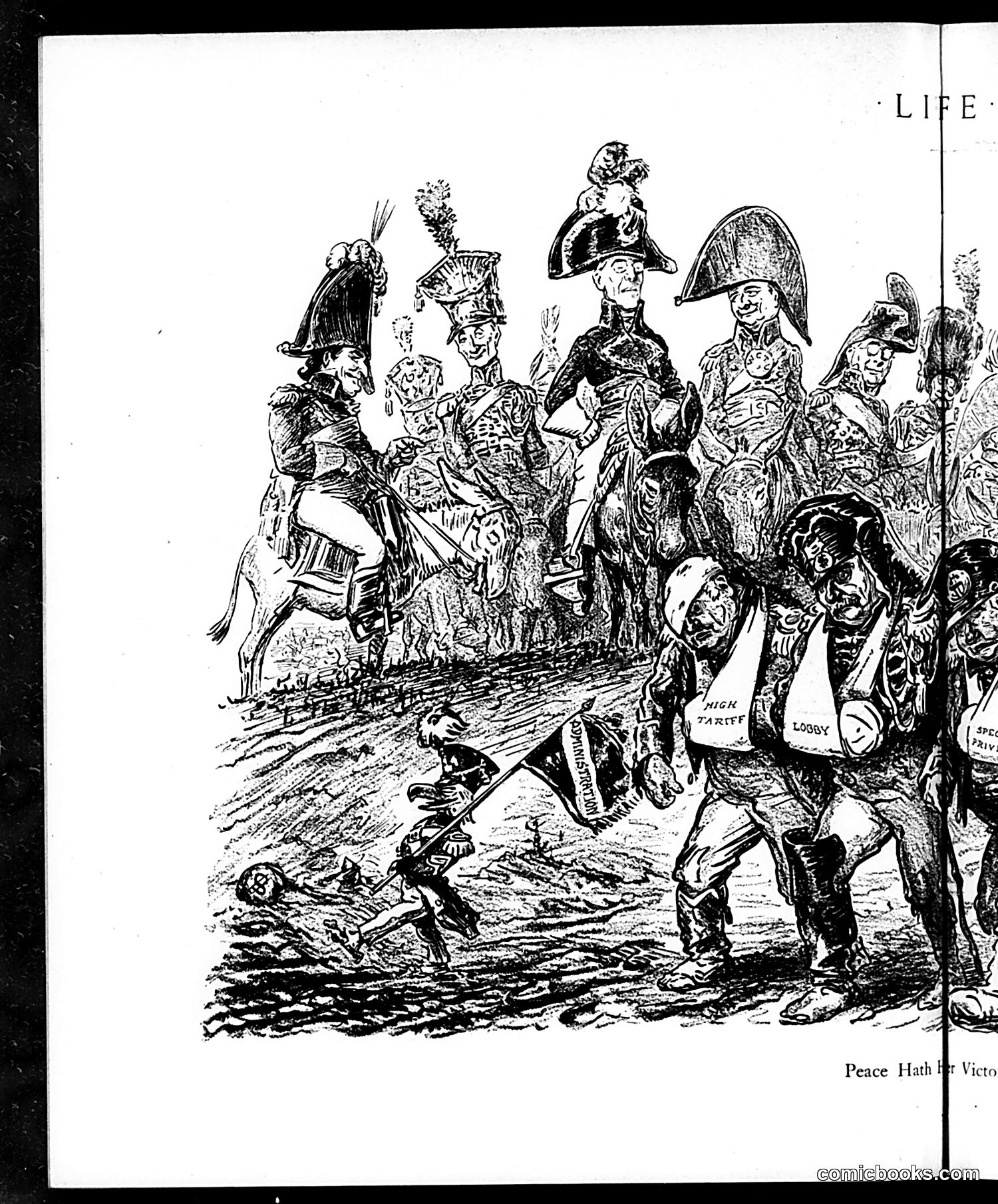
This satirical cartoon depicts a military procession of elaborately uniformed officers on horseback, viewed from below by common soldiers and civilians. The composition suggests a critique of military hierarchy and pomp. The caption "Peace Hath It Victo[ry]" (likely "Peace Hath Its Victory") appears to be ironic commentary. The visible labels on figures include "HIGH TARIFF," "LOBBY," and "SPEC[ulation]"—suggesting the cartoon satirizes how peacetime politics is dominated by special interests, tariff lobbyists, and speculators rather than democratic principles. The contrast between the grandiosely dressed officers and the diminished common people below emphasizes the cartoon's message: that while military glory passes, the real "victors" of peace are corrupt financial and political interests exploiting the system.
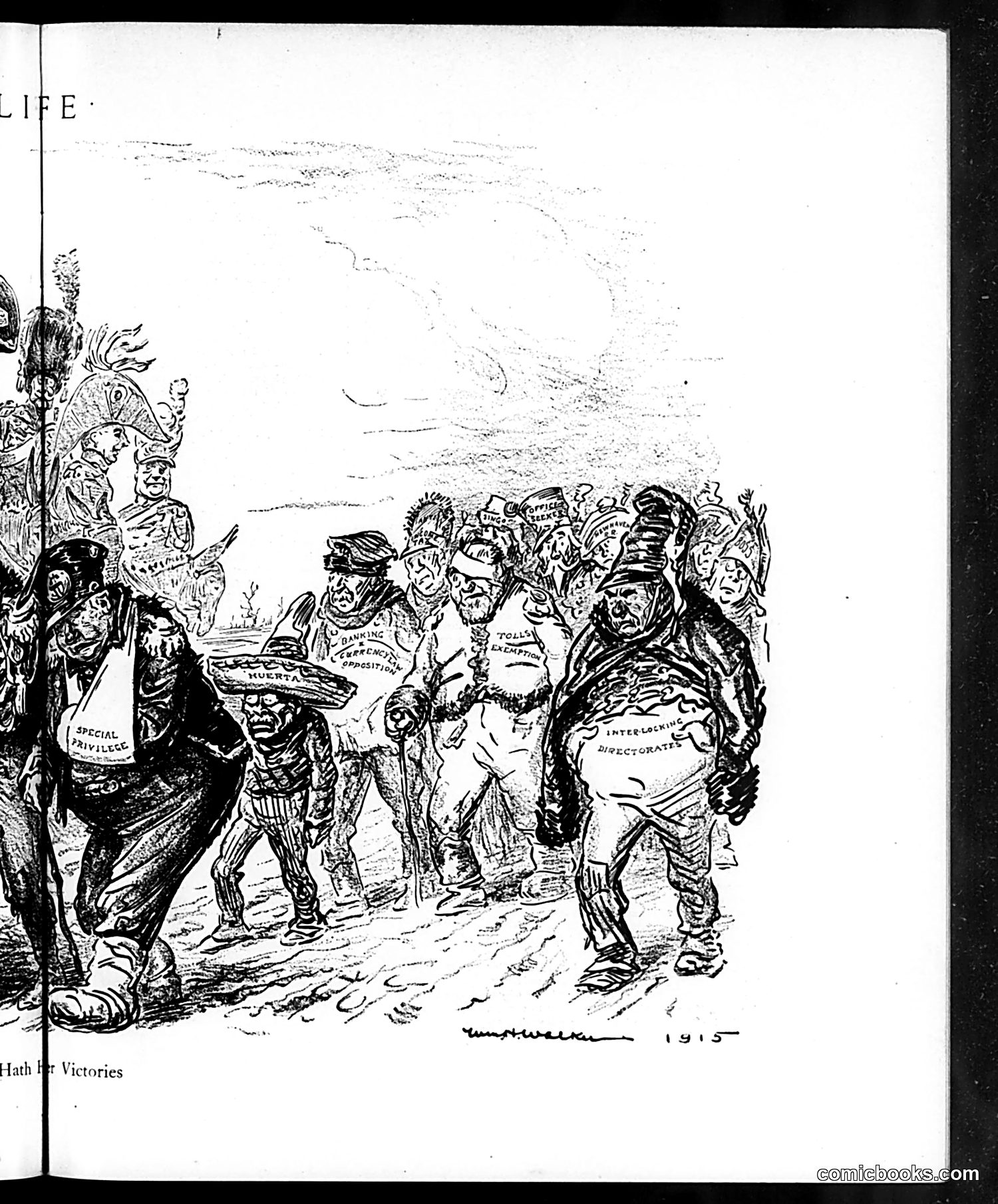
This is a satirical cartoon dated 1915 depicting what appears to be military or political figures in caricatured form. On the left stands a tall figure labeled "Special Privilege," while the group on the right includes figures with labels like "Toll Exemption," "Reciprocal Arrangement," and "Intercollegial Directorate." The cartoon satirizes what the artist sees as corrupt dealings among privileged elites—military officers, politicians, or business leaders—who benefit from special exemptions and backroom agreements. The exaggerated facial features and body shapes are typical of early 20th-century political caricature meant to ridicule these figures as morally grotesque. The specific context (which groups or legislation are targeted) remains unclear without additional publication information, though the general theme condemns elite corruption and favoritism.
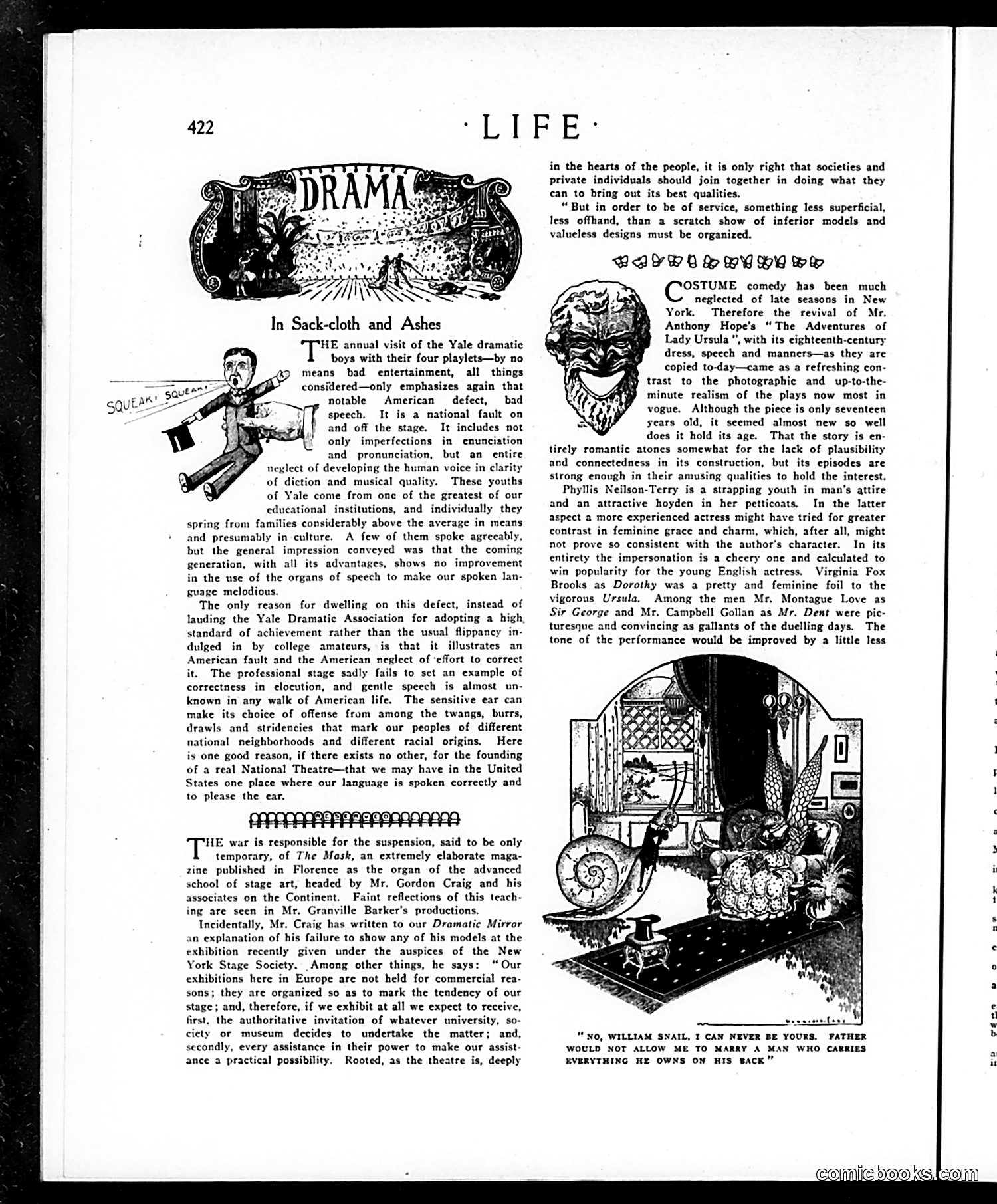
This page critiques American cultural defects through theater commentary. The main article attacks the Yale Dramatic Association's performance, not for entertainment value but as evidence of a broader national problem: poor speech and diction among Americans across all social classes. The author argues that even Yale students—from educated, affluent families—demonstrate "bad speech" including twangs, burrs, and unclear enunciation. Rather than praising the theater group, the critic uses their performance as a launching point for advocating a National Theatre where American English would be spoken correctly. The page also discusses Gordon Craig's advanced Continental stage design theories and praises a revival of Anthony Hope's costume comedy as a refreshing alternative to contemporary realistic plays. The cartoon (left) appears to mock poor elocution through visual comedy, supporting the article's central complaint about American speech quality.
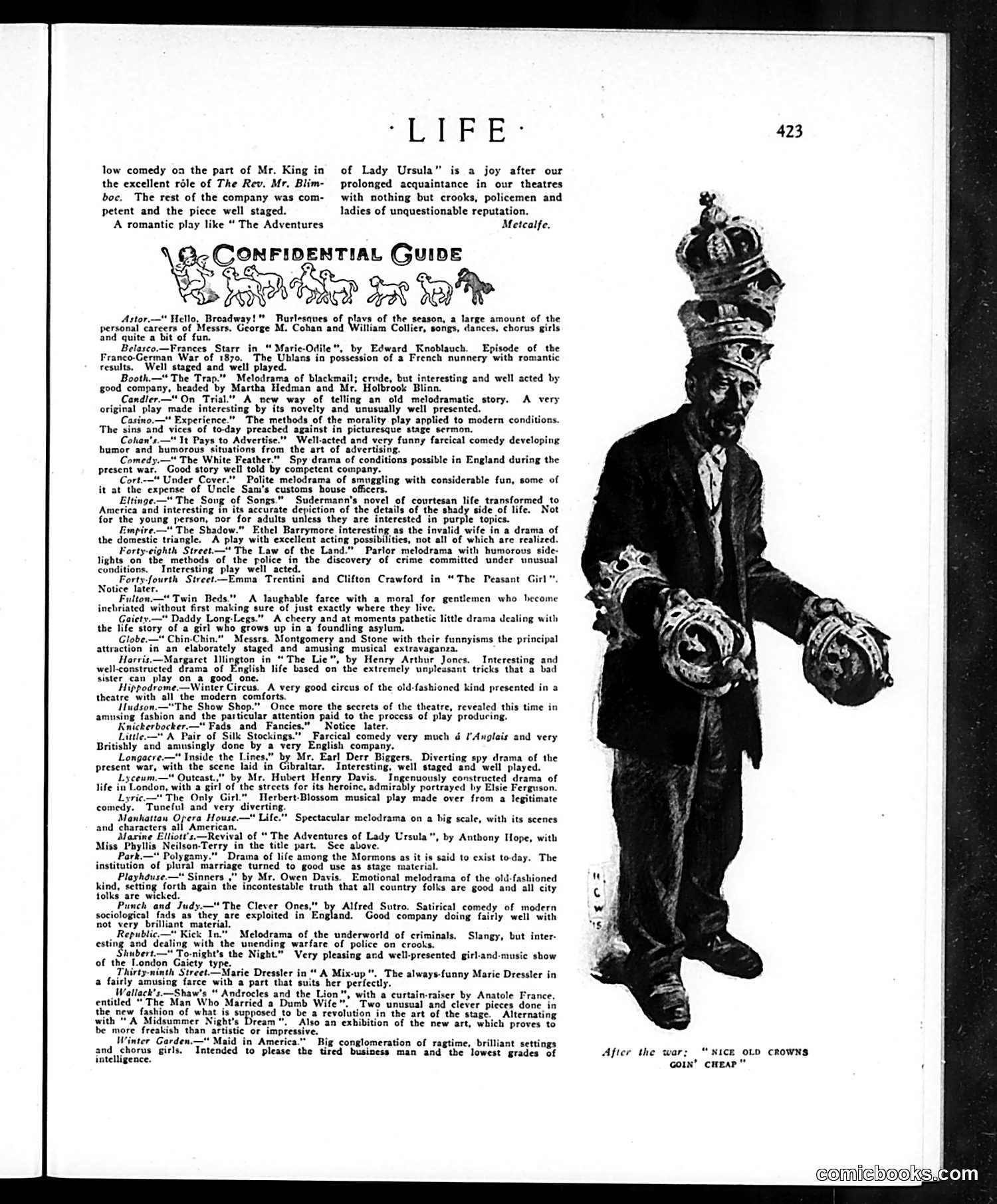
This page is primarily a theatre review section titled "Confidential Guide," listing Broadway productions with brief critiques. However, the striking right-side illustration depicts stacked royal crowns appearing worn, damaged, or discarded—likely European monarchical symbols. The caption "Nice Old Crowns Goin' Cheap" suggests satirical commentary on the devaluation of European monarchy, probably referencing World War I (ongoing when this was published). The image implies that traditional royal authority is becoming obsolete or cheapened by modern warfare and political upheaval. The juxtaposition of frivolous theatre reviews against this serious political imagery creates ironic contrast—American audiences distracted by entertainment while European thrones literally crumble. This reflects early-20th-century American perspectives on the war's destruction of the old European order.
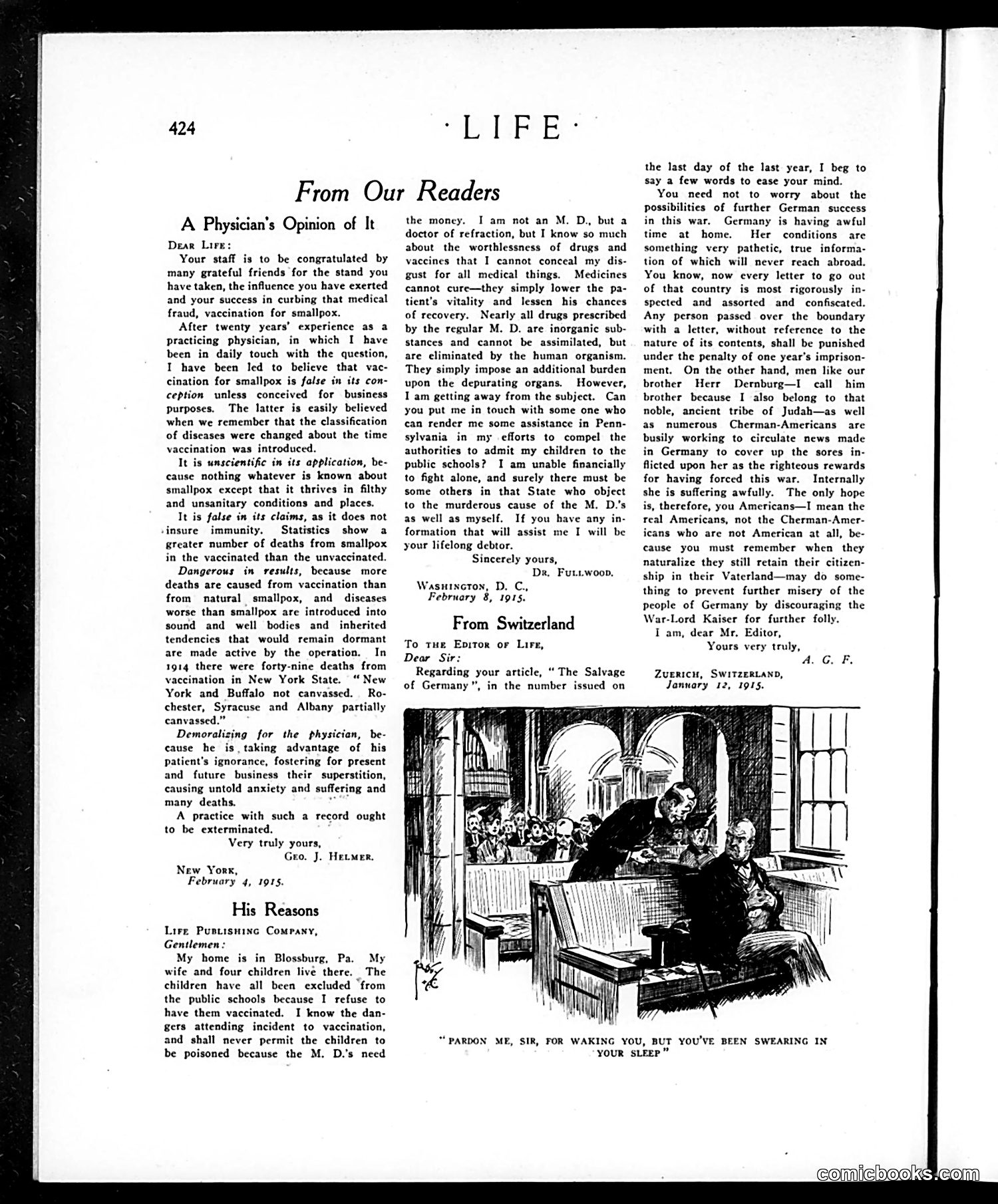
This page documents reader responses to Life's anti-vaccination editorial campaign. Two letters from American physicians and a doctor of refraction express strong opposition to mandatory smallpox vaccination, claiming it causes more deaths than it prevents and serves only to generate physician income. The cartoon depicts a domestic scene where a man in bed has apparently been swearing in his sleep, with his wife (or partner) apologizing to a visitor. The caption reads: "PARDON ME, SIR, FOR WAKING YOU, BUT YOU'VE BEEN SWEARING IN YOUR SLEEP." **Historical context:** This 1915 page reflects genuine anti-vaccination sentiment that existed in America, though the claims made by the letter writers—that vaccination caused more deaths than smallpox and was a medical fraud—were scientifically false. Life magazine's platform for these views represents a darker chapter in the publication's history, when it promoted medical misinformation. The cartoon appears unrelated to vaccination; it's simply domestic humor about embarrassing sleep behavior.
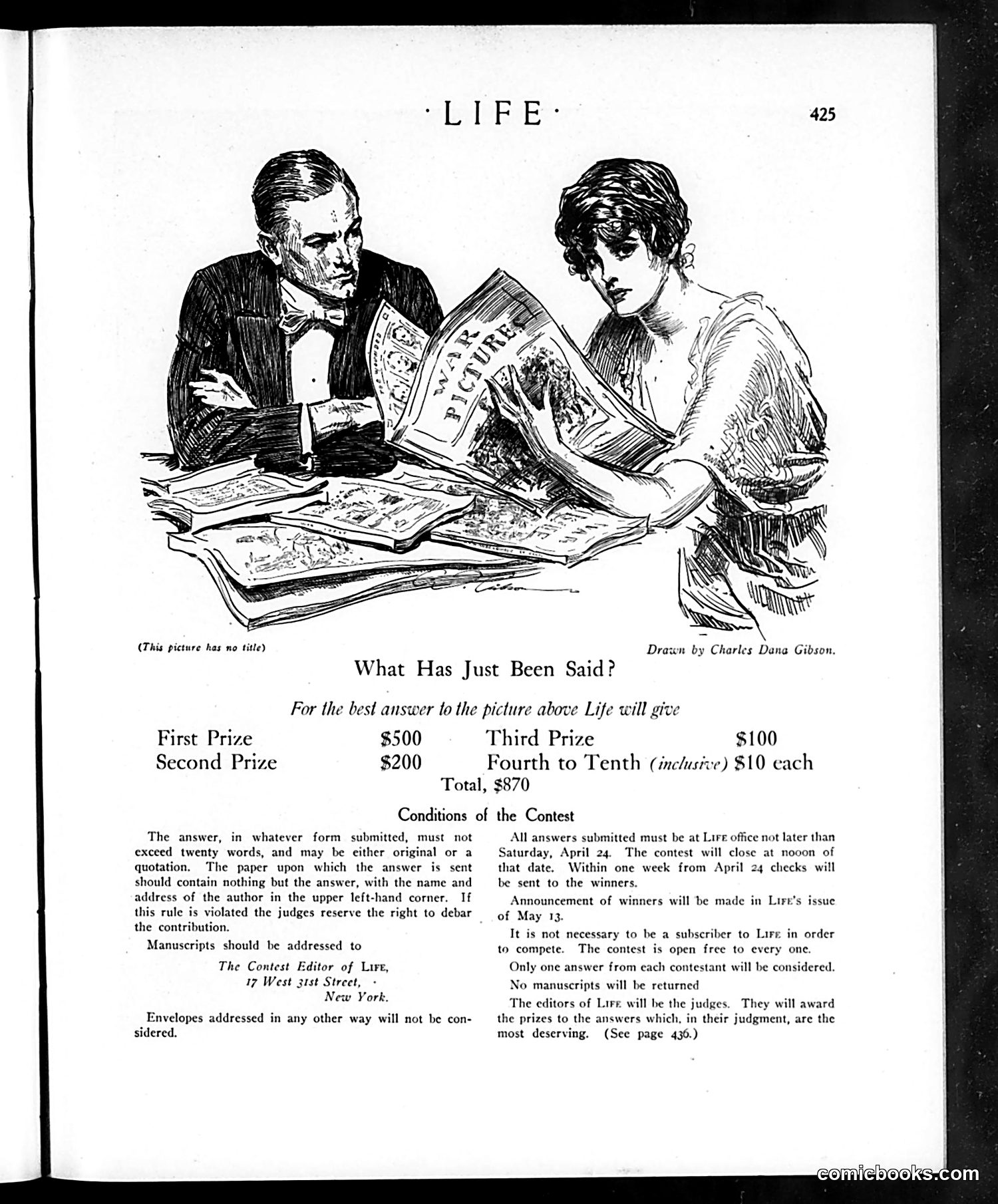
This page features a Charles Dana Gibson illustration showing a well-dressed couple examining magazines and illustrated materials together. The cartoon depicts a genteel domestic scene of shared reading and conversation—likely a commentary on courtship, marriage, or the relationship between educated companions. Life magazine is running a contest asking readers to caption or interpret the image in twenty words or fewer. The substantial prize pool ($870 total, with $500 first prize) reflects the magazine's popularity and engagement with its audience during this era. The satire appears to hinge on the ambiguous moment captured: what has "just been said" between these figures? Without knowing the specific context or date, the humor likely involves either the awkwardness of polite social interaction, romantic tension, or some contemporary social commentary about gender relations and shared intellectual pursuits—typical Gibson territory.
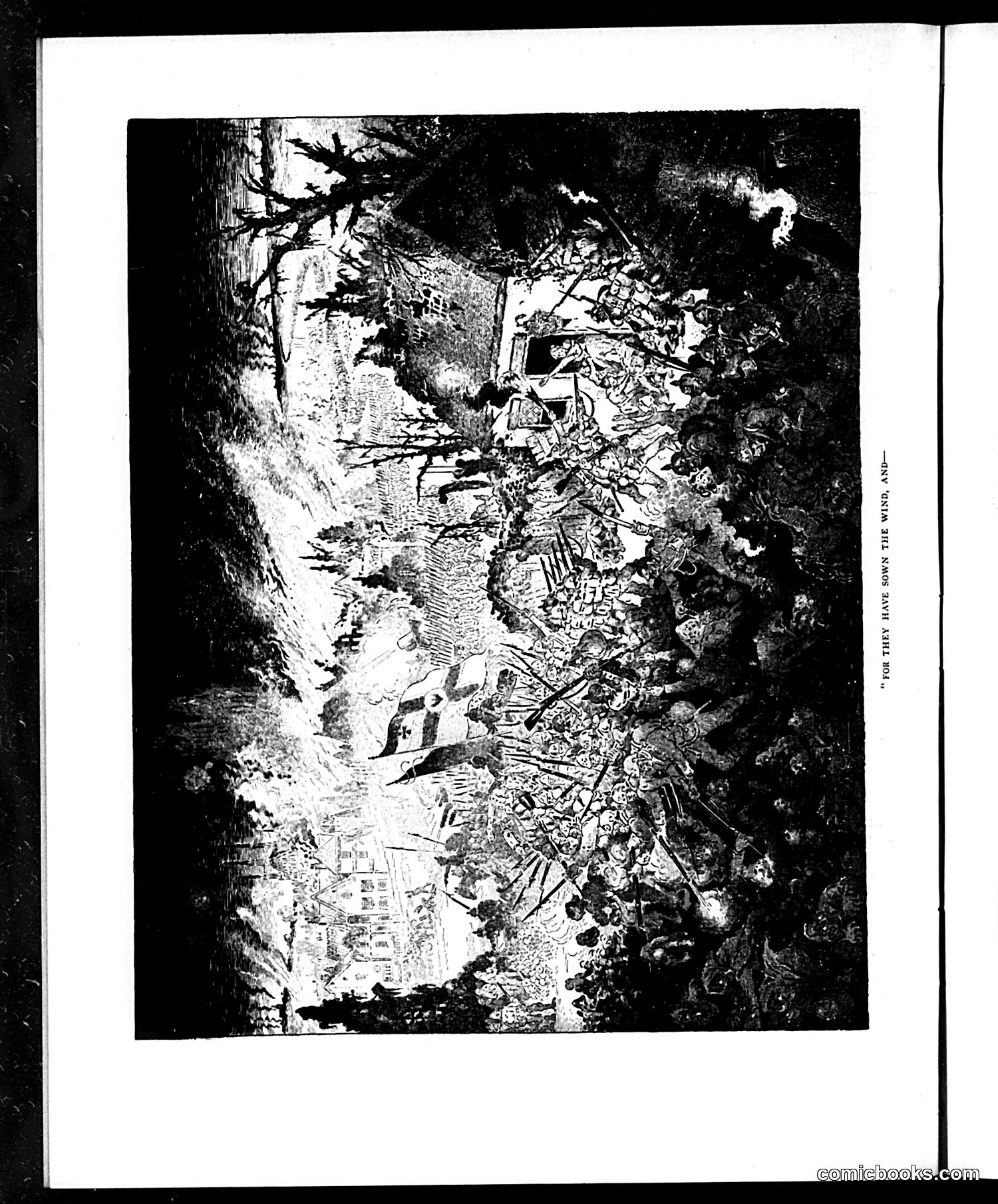
I can see this is a black and white illustration from Life magazine, but the image quality and orientation make it difficult to discern specific details with confidence. The OCR text appears to be corrupted symbols rather than actual readable content, which suggests a scanning or processing error. What is visible is what appears to be a detailed satirical illustration with multiple figures and scenes, rendered in a dense, intricate style typical of Life magazine's political cartoons. However, without being able to read the caption or clearly identify the specific figures and their caricatures, I cannot accurately explain the political or social references intended. To properly analyze this cartoon's meaning for a modern reader, I would need either clearer image resolution or legible text identifying the subjects and context.
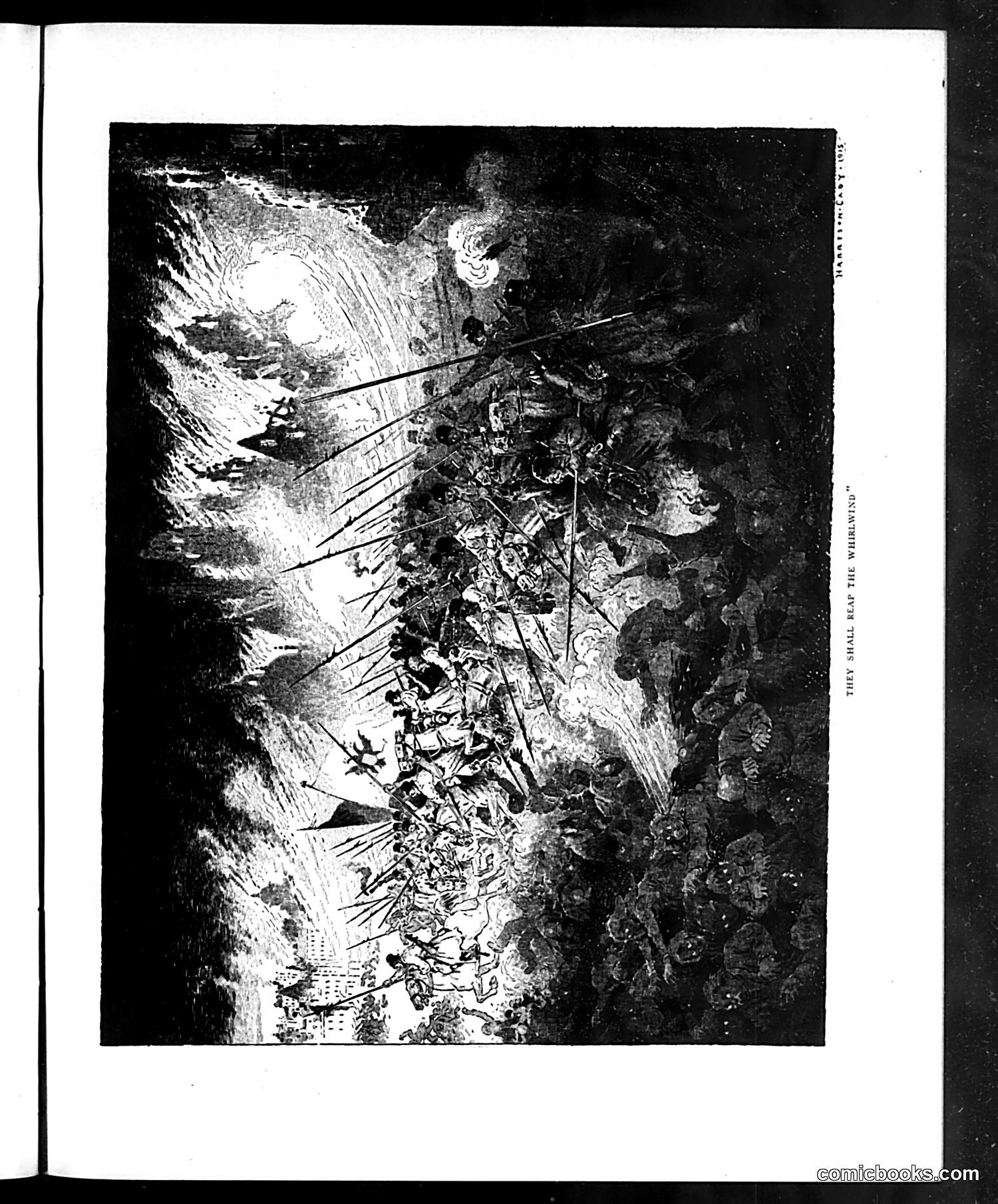
I can see this is a black and white illustration that appears to be rotated or inverted on the page, making it difficult to interpret clearly. The image shows what seems to be a landscape or outdoor scene with various figures and possibly military or conflict-related imagery, given the lines that could represent weapons or fortifications. However, the OCR text "Siol hevo-mesivuvit" appears to be corrupted or unreadable, providing no clear context about the cartoon's subject, historical reference, or satirical point. Without legible text or caption identifying the figures, events, or political references involved, I cannot accurately explain what this cartoon means or what it's satirizing. I'd need clearer source material to provide the historical context a modern reader would need.
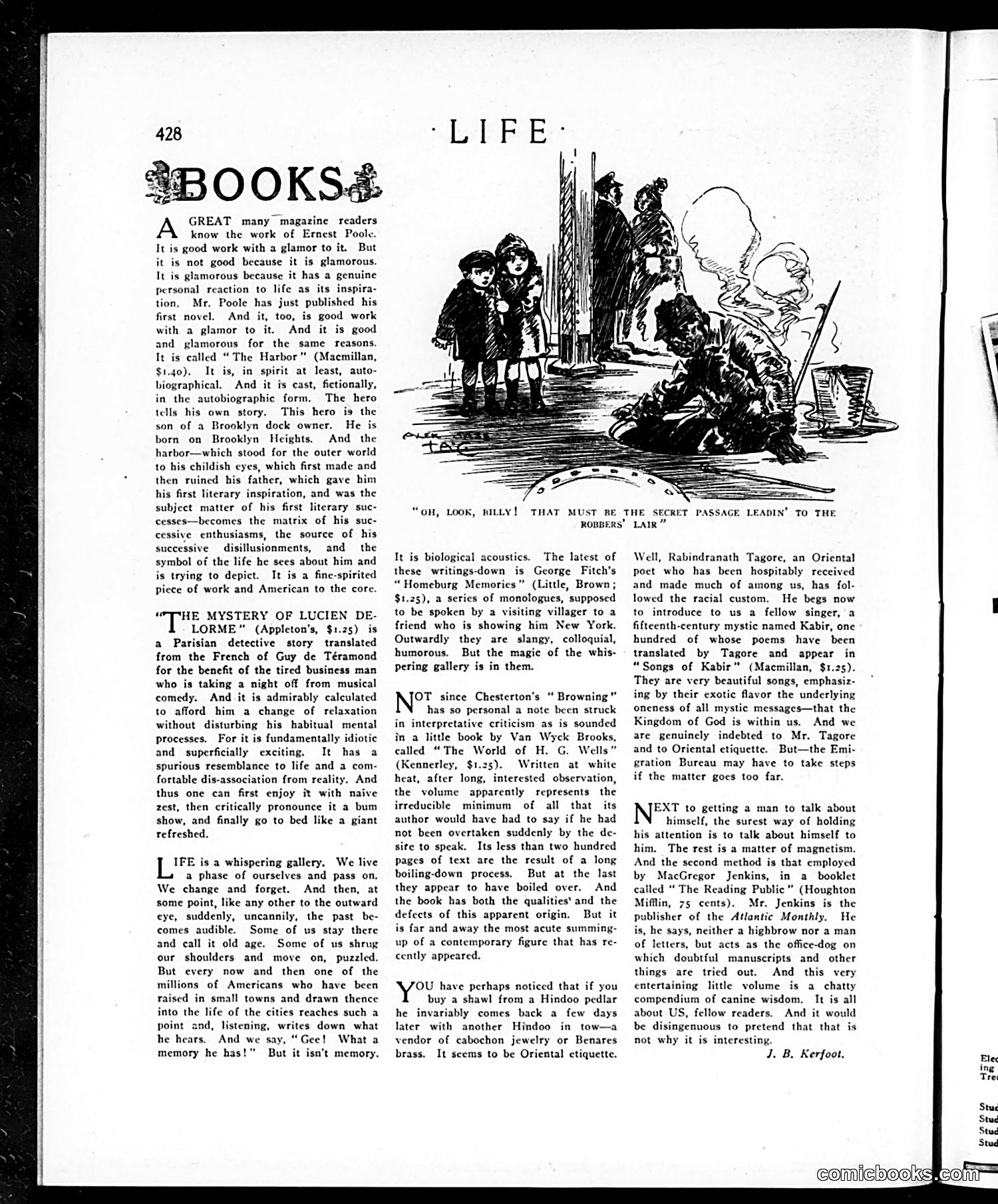
This page from Life magazine contains book reviews and a single cartoon illustration. The cartoon shows children on a street discovering what appears to be a hidden passageway or hideout, with one child exclaiming "Oh, look, Billy! That must be the secret passage leadin' to the robbers' lair!" The illustration likely accompanies discussion of adventure or mystery fiction popular with young readers of the era. The cartoon humorously depicts children's imaginative interpretation of ordinary urban spaces—viewing a mundane alley or architectural feature as a thrilling secret passage. The rest of the page reviews several books, including Ernest Poole's novel "The Harbor" and George Fitch's "Homeburg Memories." The reviews focus on literary merit and authenticity rather than plot summaries, reflecting early 20th-century magazine criticism that valued genuine personal insight over mere entertainment value.
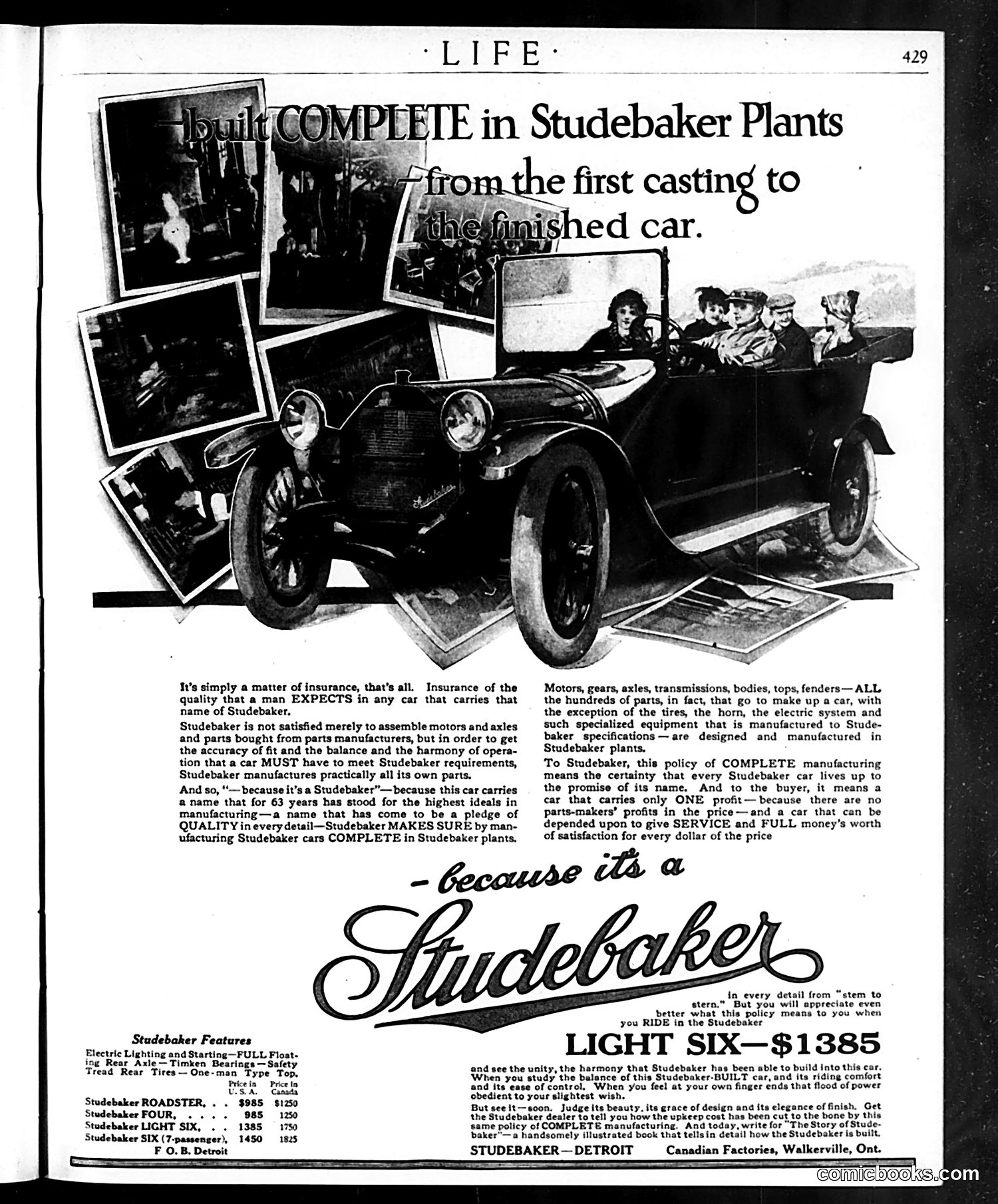
This is a **Studebaker automobile advertisement**, not political satire. The page promotes the "Light Six" model ($1385) by emphasizing the company's manufacturing philosophy. The central image shows a stylized Studebaker car with satisfied passengers and smaller photographs of factory operations arranged behind it—a visual claim to quality control and complete in-house manufacturing. The ad's argument: Studebaker manufactures nearly all components itself (motors, gears, axles, bodies, etc.) rather than assembling parts from multiple suppliers. This supposedly ensures consistency, quality, and eliminates middlemen profits, allowing lower consumer prices. The text repeatedly emphasizes "COMPLETE" manufacturing and "QUALITY"—language intended to reassure buyers during an era when automobile reliability was uncertain and brand reputation mattered greatly for such major purchases. This represents early 20th-century advertising strategy: building consumer confidence through claims of vertical integration and manufacturing control.
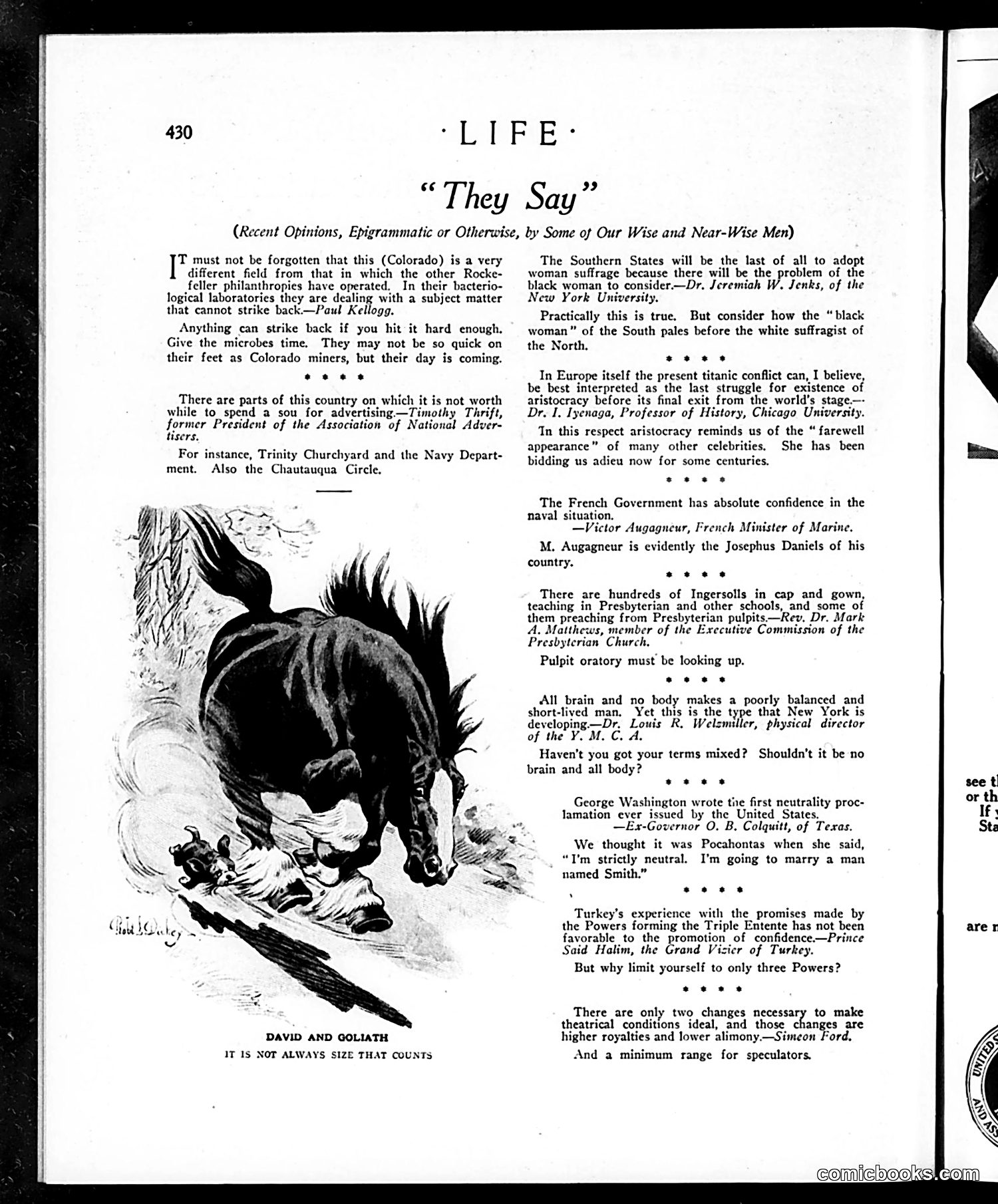
The cartoon depicts a figure labeled "David and Goliath—It Is Not Always Size That Counts," illustrating the accompanying aphorism beneath it. The image shows a small figure (David) confronting a massive opponent (Goliath), visually representing the page's theme: that physical size or resources don't guarantee victory. This likely references the Rockefeller philanthropies mentioned in the opening text. Paul Kellogg had criticized Colorado's Rockefeller operations, noting microbes "cannot strike back"—implying the Rockefellers faced organized labor resistance (the Colorado miners' strikes). The cartoon sardonically suggests that even vast wealth (Goliath) can be challenged by determined smaller forces (David), echoing labor disputes of the era. The page itself collects satirical quotations from prominent figures, critiquing their statements on suffrage, WWI, French naval confidence, clergy education, and other contemporary issues.
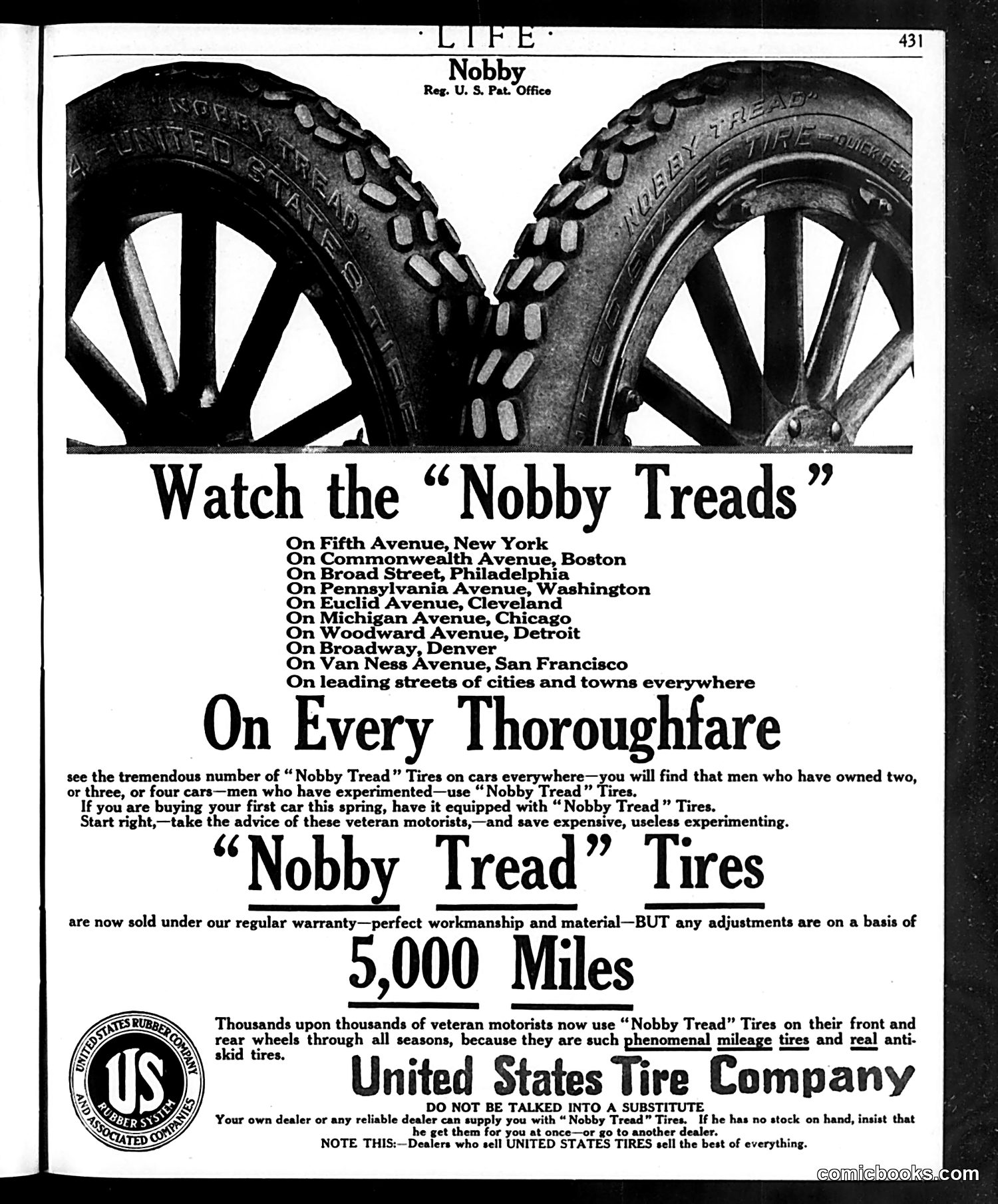
This is a full-page **advertisement, not satire or a cartoon**. It promotes "Nobby Tread" tires manufactured by the United States Tire Company. The image shows two automobile wheels with treaded tires, visually demonstrating the product's tread pattern design. The ad targets first-time car buyers in the early automotive era, using testimonial marketing: it claims experienced motorists who've owned multiple vehicles repeatedly choose "Nobby Tread" tires, suggesting this validates the product's quality. Key selling points emphasized: - 5,000-mile warranty coverage - Anti-skid properties - Exceptional mileage performance - Availability at major dealers nationwide The advertisement's tone warns against substitutes and positions the tire as essential for those "buying your first car this spring," reflecting the era when automobile ownership was still relatively new and consumers needed guidance on components and reliability.
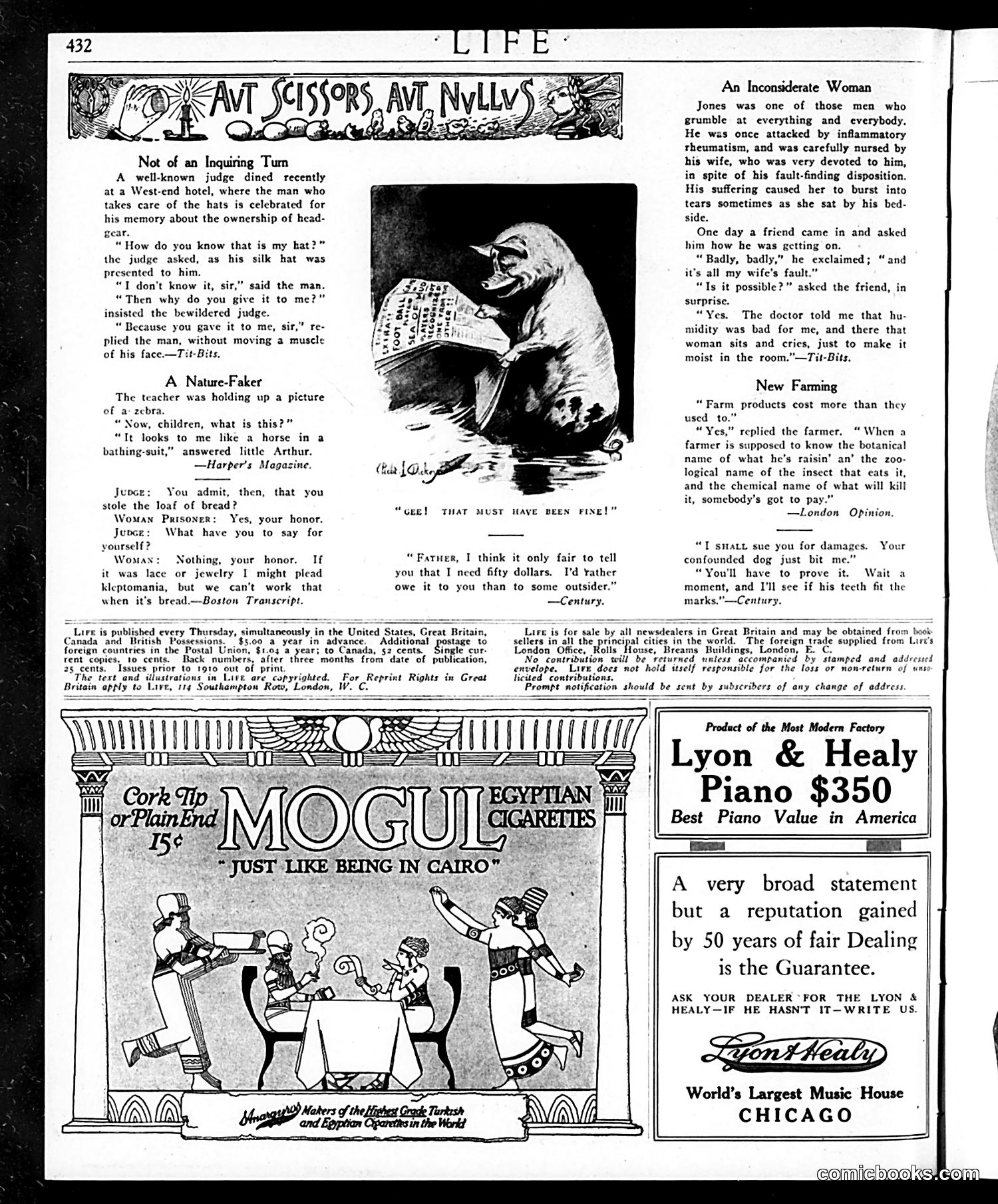
This page contains five brief humorous anecdotes typical of early 20th-century American satirical humor: 1. **"Not of an Inquiring Turn"**: A judge is outwitted by a hat-check attendant who logically explains he knows the hat belongs to the judge because the judge gave it to him—a joke about circular reasoning and the judge's false sense of superiority. 2. **"A Nature-Faker"**: A child compares a zebra to "a horse in a bathing-suit"—gentle humor about childish literal thinking and innocent misdescription. 3. **Courtroom scene**: A woman prisoner convicted of stealing bread can't claim kleptomania (psychological compulsion) as an excuse—satire on how the wealthy use medical justifications for crimes while the poor have no such luxury. 4. **"An Inconsiderate Woman"**: A chronically complaining man blames his wife's tears for worsening his humidity-sensitive rheumatism—ironic criticism of male ingratitude toward devoted caregiving. 5. **"New Farming"**: A farmer notes modern agriculture requires learning scientific names, suggesting farmers must now possess educated knowledge previously unnecessary. The page also contains period advertisements for Mogul cigarettes and Lyon & Healy pianos.
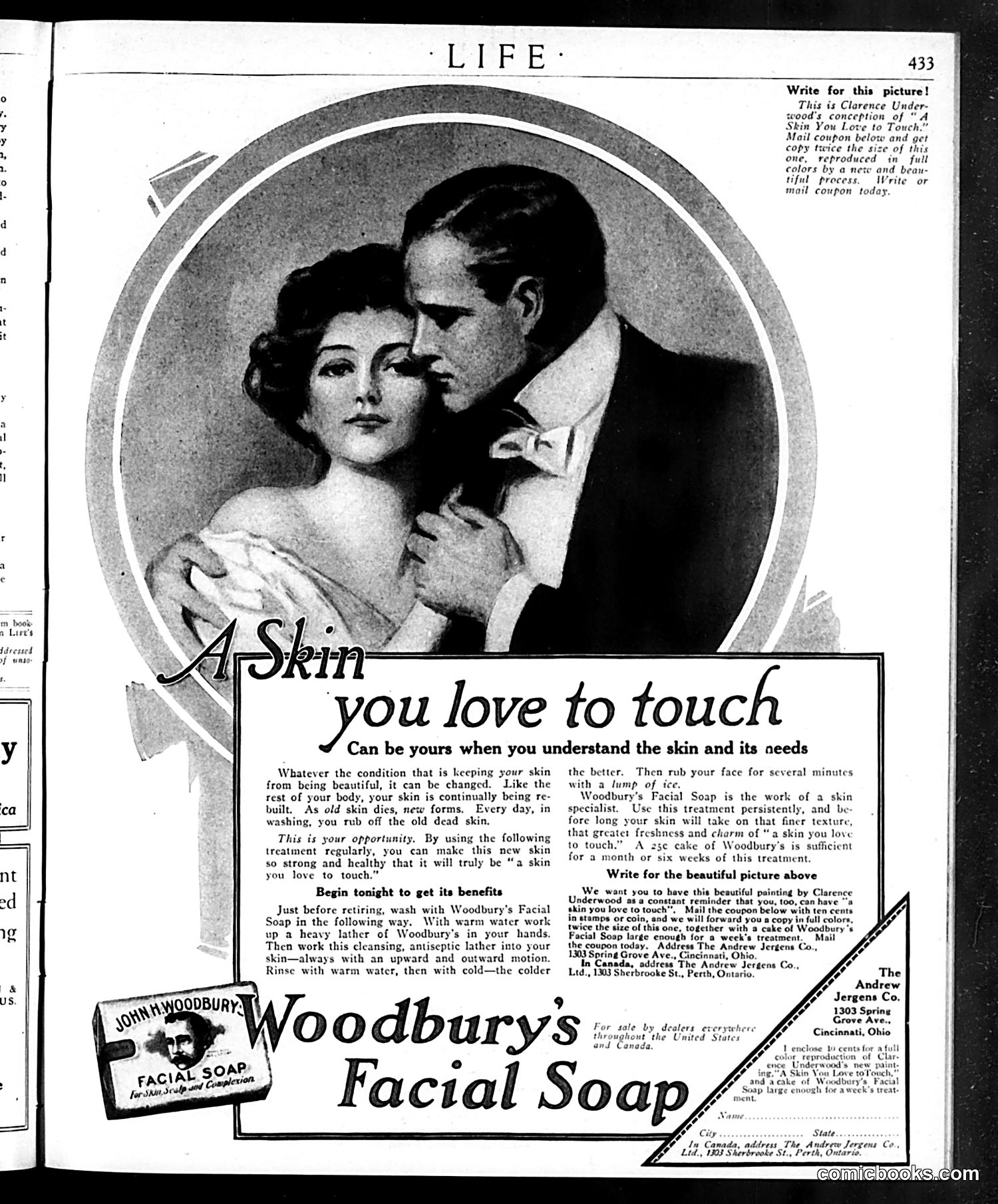
This is a **Woodbury's Facial Soap advertisement**, not satire or political commentary. The page features a romantic illustration by artist Clarence Underwood depicting an intimate couple—a woman gazing forward while a man leans close behind her—accompanying promotional text for skincare. The advertisement uses the phrase "a skin you love to touch" as its marketing slogan, positioning the soap as a solution for maintaining youthful, attractive skin through nightly cleansing routines (warm water, lather massage, ice-water rinse). The ad offers readers a larger, full-color reproduction of the Underwood painting for ten cents plus the soap's cost. This reflects early 20th-century advertising strategy: coupling product promotion with desirable lifestyle imagery and offering premium visual content as incentive. The romantic imagery suggests that beautiful skin enhances romantic appeal—a common advertising trope connecting cosmetics to social success and attractiveness.
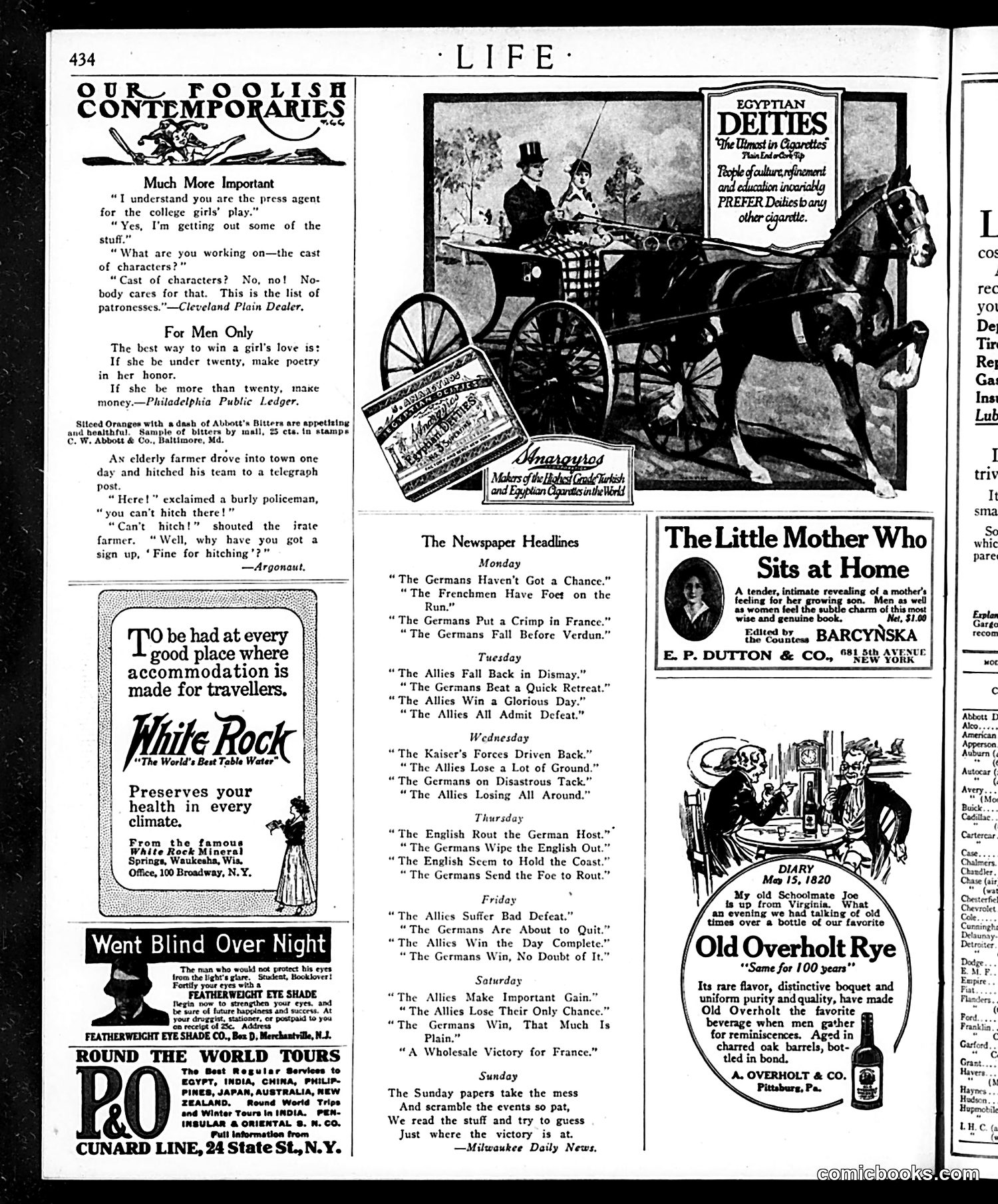
This page satirizes World War I newspaper coverage. The central feature, "The Newspaper Headlines," lists conflicting front-page claims across a single week—Monday's papers declare "The Germans Haven't Got a Chance" while the same day other papers report "The Germans Put a Crimp in France." The pattern repeats daily: Tuesday papers simultaneously claim "The Allies Fall Back in Dismay" and "The Allies Win a Glorious Day." By Sunday, the satirist despairs that readers "try to guess / Just where the victory is at." The joke targets sensationalist war journalism of 1920 (the page date). Competing newspapers printed wildly contradictory headlines to sell copies, leaving the public confused about actual military progress. The satire suggests that newspapers weren't reporting facts but rather manufacturing competing narratives—a damning critique of press reliability during wartime.
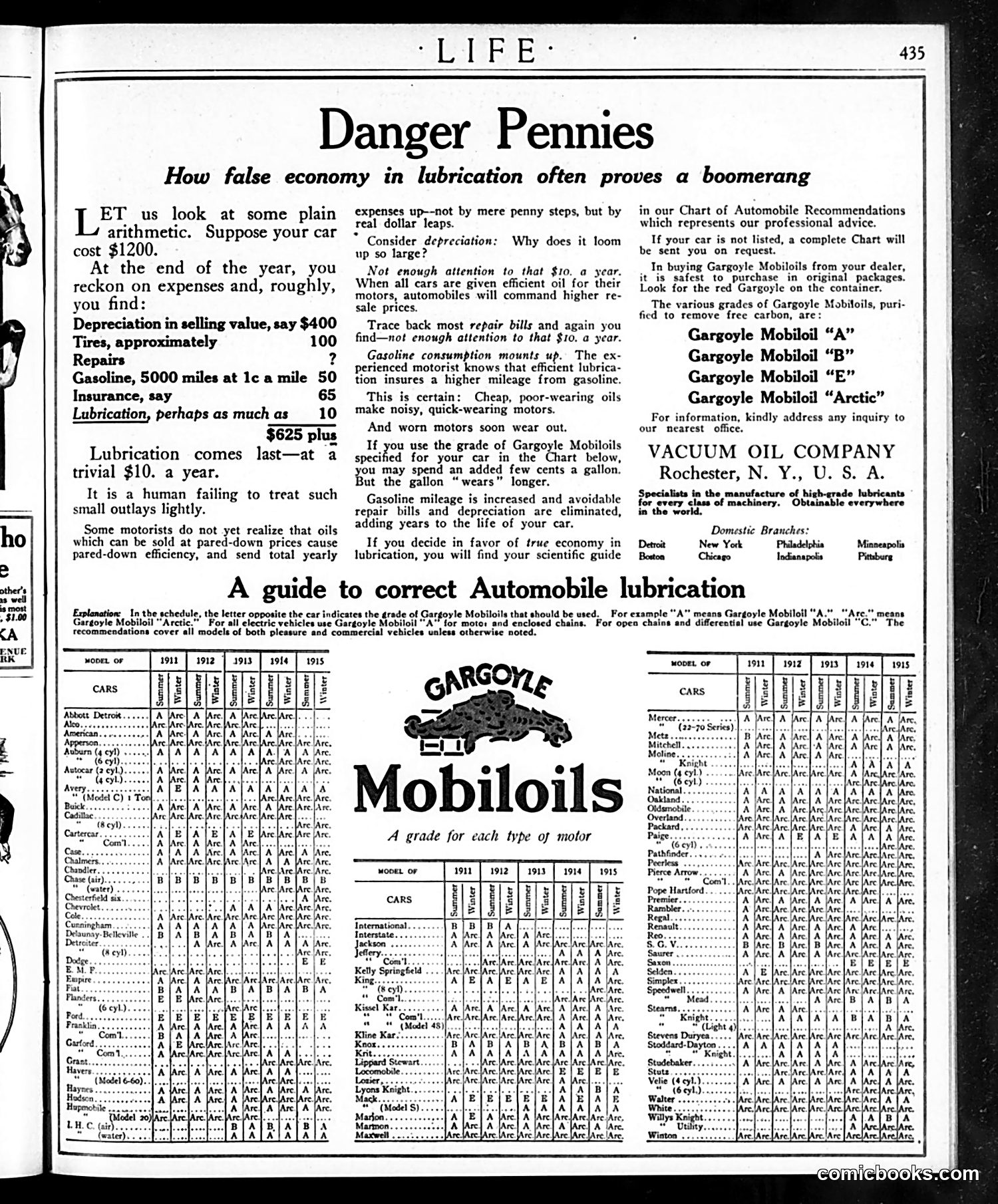
This is primarily a **product advertisement**, not a political cartoon. It uses the rhetorical framing of a cautionary tale to market motor oil. The "danger" described is **false economy in car maintenance**. The ad argues that skimping on the $10 annual lubrication cost (using cheap oils) causes major expenses elsewhere—higher depreciation, repair bills, and fuel consumption—ultimately costing "real dollar leaps" rather than "penny steps." The satire is gentle and self-interested: it positions the reader as foolishly penny-pinching, then sells the solution—Gargoyle Mobiloil, the advertiser's premium product. The extensive charts below recommend specific Mobiloil grades for dozens of car models. For modern readers: this reflects 1910s-1920s advertising strategy, where educational messaging about product quality masked sales pitches. The arithmetic is designed to manipulate: acknowledging a small expense to justify a larger one.
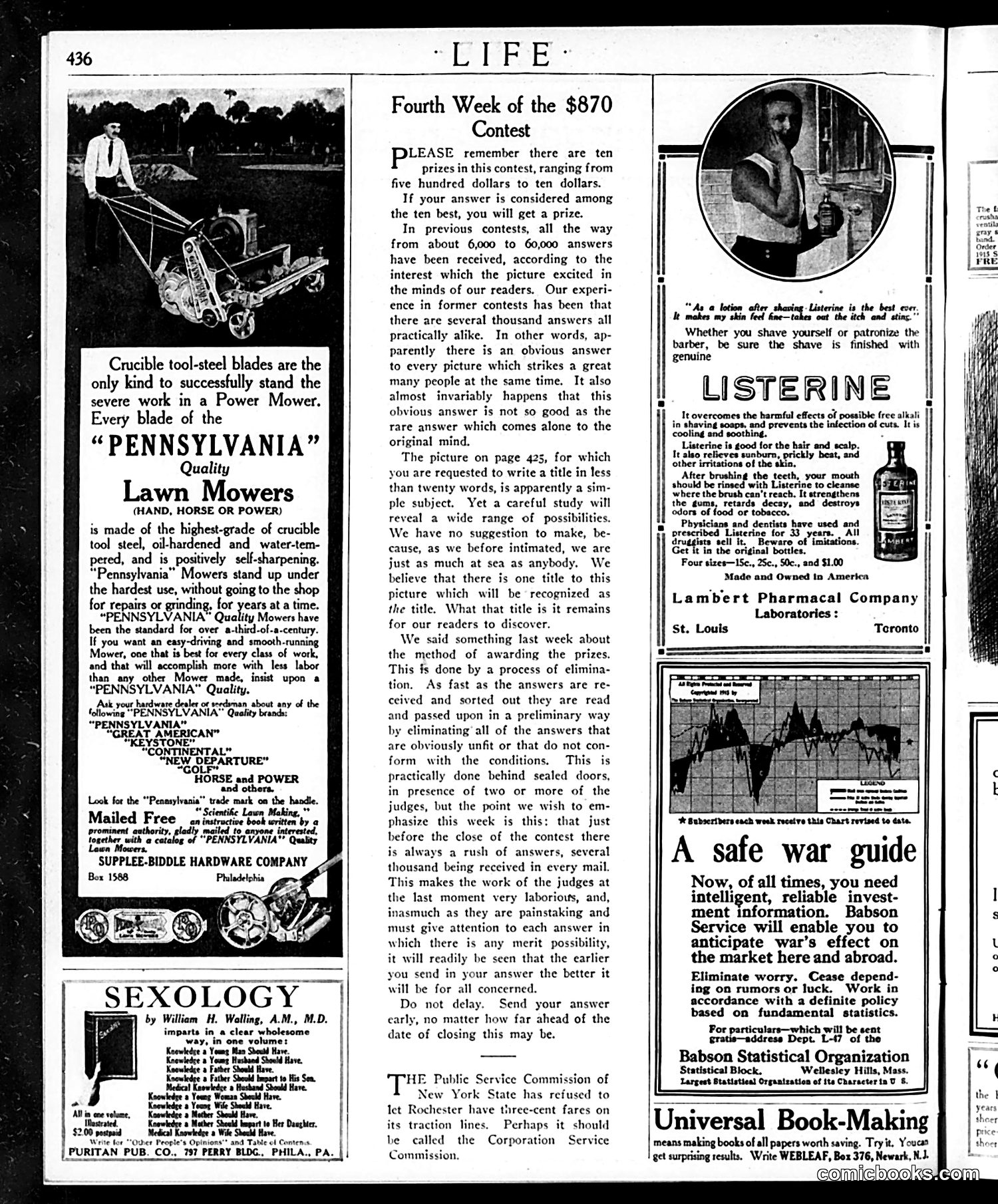
This is primarily an **advertising and contest page** rather than a political cartoon page. The main content is: 1. **"Fourth Week of the $870 Contest"** — Life magazine's ongoing reader contest offering ten prizes for writing picture titles. The text explains the judging process: answers are eliminated in preliminary rounds, with obvious answers typically ranked lower than unique ones. The magazine notes thousands of entries arrive near deadlines, making final judging laborious. 2. **Pennsylvania Quality Lawn Mowers advertisement** — promoting crucible steel blades for power mowers, emphasizing durability and self-sharpening properties. 3. **Listerine advertisement** — showing an aftershave product for men, with copy about skin comfort after shaving. 4. **Sexology book advertisement** — promoting William H. Walling's instructional volume. 5. **Babson Statistical Organization and Universal Book-Making advertisements** — investment/business services. No political satire or cartoon commentary is evident on this page. It's a straightforward commercial and contest information page from what appears to be an early 20th-century issue of Life magazine.
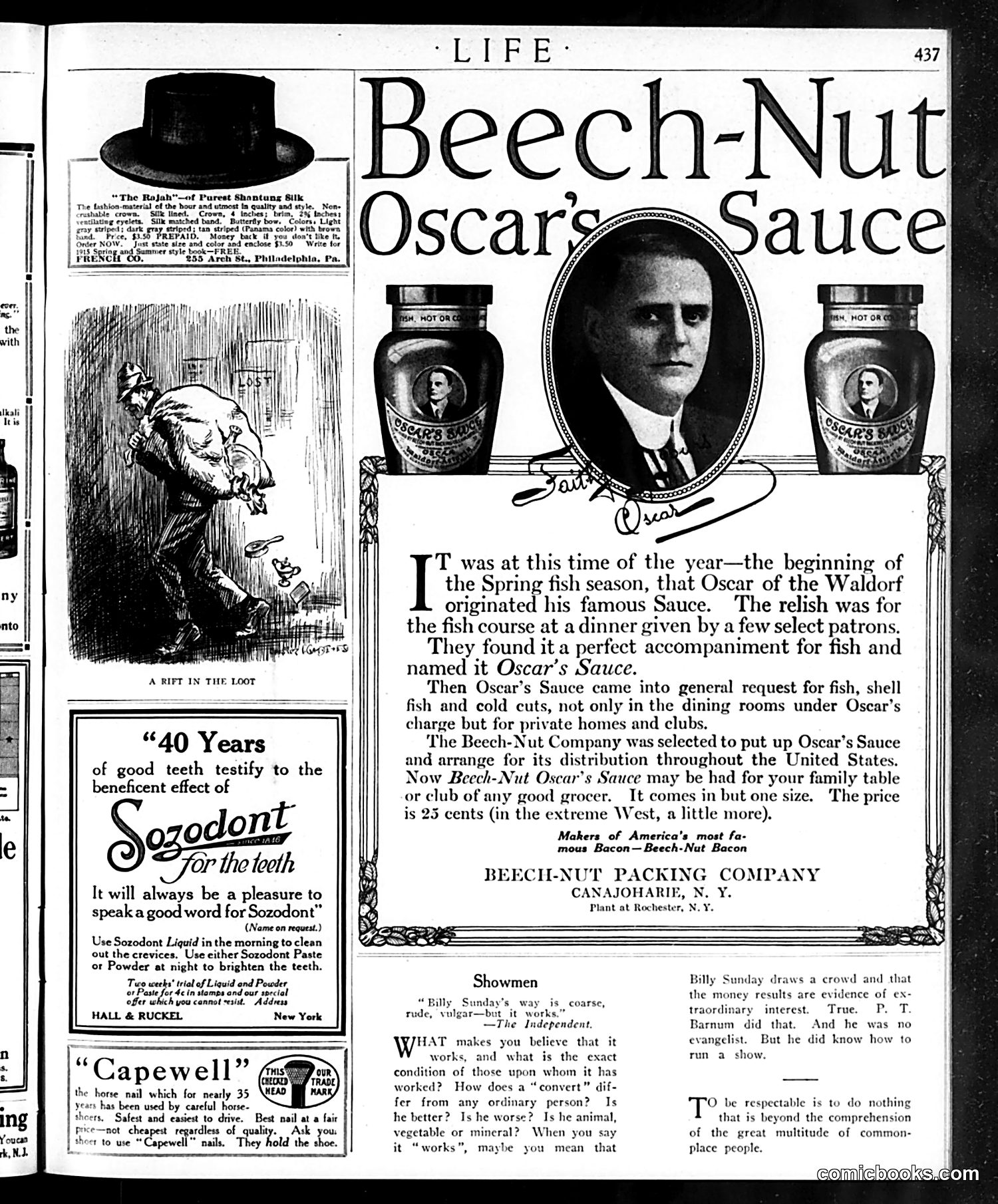
This page is primarily **advertising**, with a small satirical section. The main feature is a full-page ad for **Beech-Nut Oscar's Sauce**, featuring a man identified as "Oscar" (likely a chef from the Waldorf Hotel) and his portrait signature. The ad promotes this condiment for fish and cold cuts, priced at 25 cents. The cartoon titled **"A Rift in the Loot"** (upper left) depicts a ragged figure, likely representing poverty or a beggar, examining something on the ground—a visual pun on finding or losing money. Below are additional product ads: **Sozodont toothpaste** (testimonial-style advertising about dental care) and **Capewell horse nails** (emphasizing durability and safety). A short editorial piece discusses **Billy Sunday**, the famous evangelist, questioning whether his revival methods actually produce genuine spiritual conversion or merely theatrical excitement comparable to P.T. Barnum's showmanship—a critique of superficial religiosity masquerading as genuine faith.
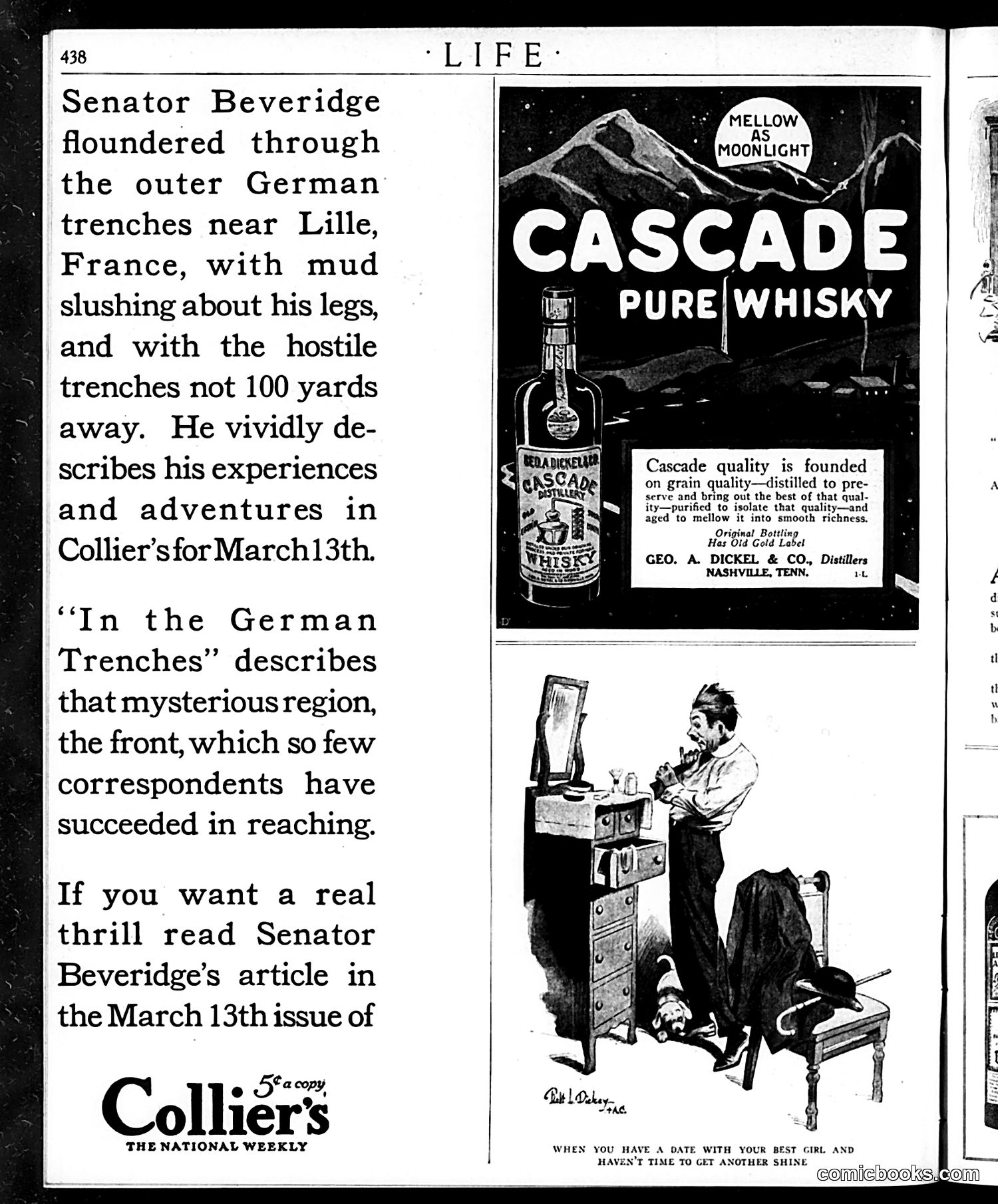
This page combines editorial promotion with advertising. The left side promotes Senator Beveridge's article about firsthand WWI trench experiences near Lille, France, positioning it as rare war correspondence. This appeals to readers hungry for authentic front-line accounts during the war. The upper right advertises Cascade Pure Whisky with moonlit mountain imagery and quality claims. The lower cartoon depicts a humorous domestic scene: a man hastily preparing for a date, using a shoe-shining apparatus while a woman waits impatiently. The joke plays on time pressure—he wants to look presentable but lacks time for proper grooming. This reflects early-20th-century courtship culture where appearance mattered significantly for romantic encounters. The cartoon's title suggests the whisky advertisement's tagline about urgency connects to dating anxieties, though the connection feels tangential—typical of period advertising's loose logic.
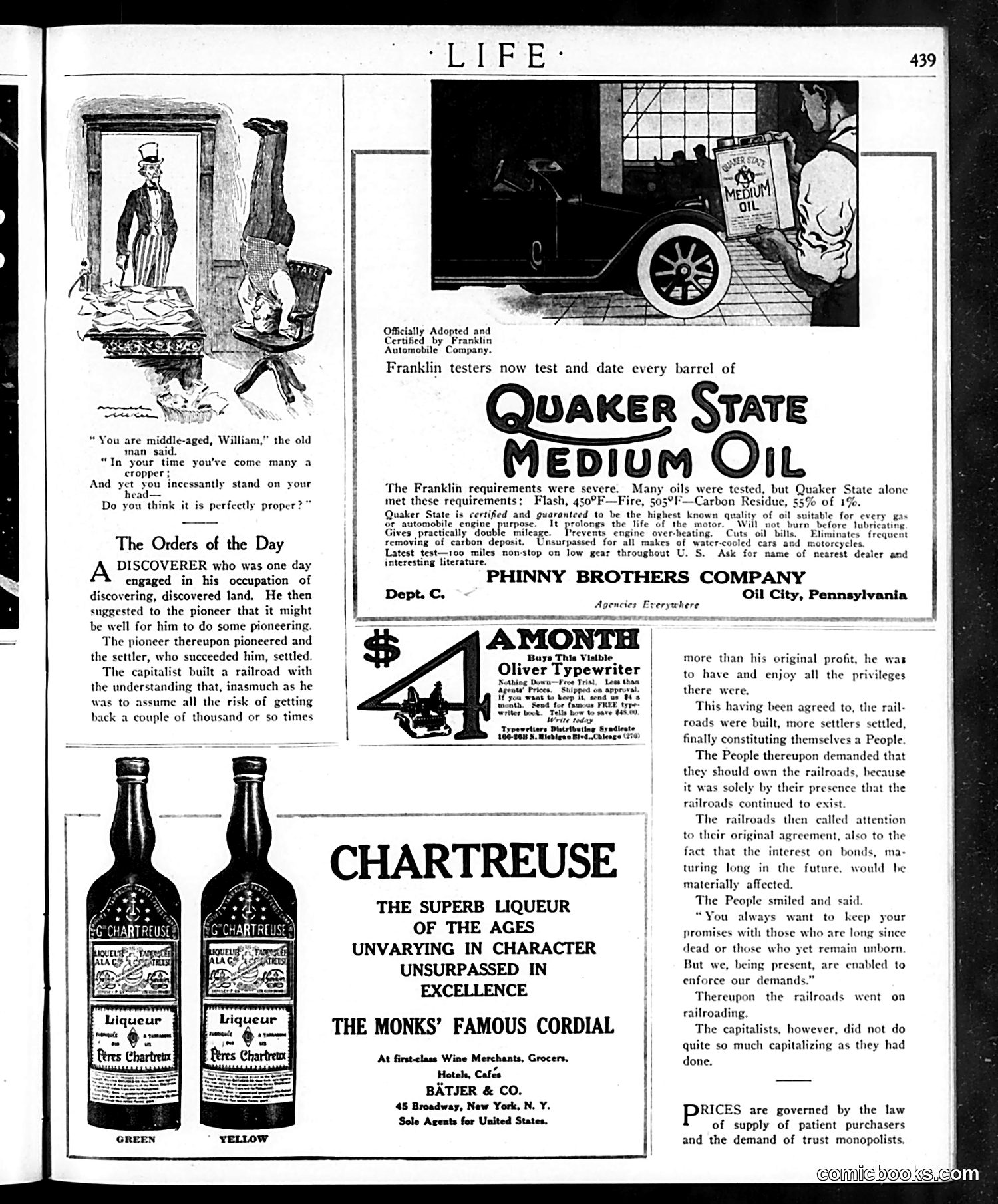
This cartoon-essay traces American economic development from discovery through industrialization to labor conflict. It depicts the progression: a discoverer finds land, pioneers settle it, a capitalist builds railroads assuming all risk, and finally "the People" emerge demanding ownership. The satire centers on a broken social contract. The capitalist agreed to build railroads in exchange for profit and control. When settlers become a collective "People," they demand the railroads be publicly owned—since their presence makes them profitable. The railroad owners invoke bond obligations (future financial commitments) as justification for refusing. The punchline—"The capitalists, however, did not do quite so much capitalizing"—suggests the compromise satisfied neither side: workers couldn't seize the railroads, but capitalists lost their anticipated monopoly profits. This likely reflects early 20th-century American debates over railroad regulation, public ownership versus private enterprise, and labor's growing political power.
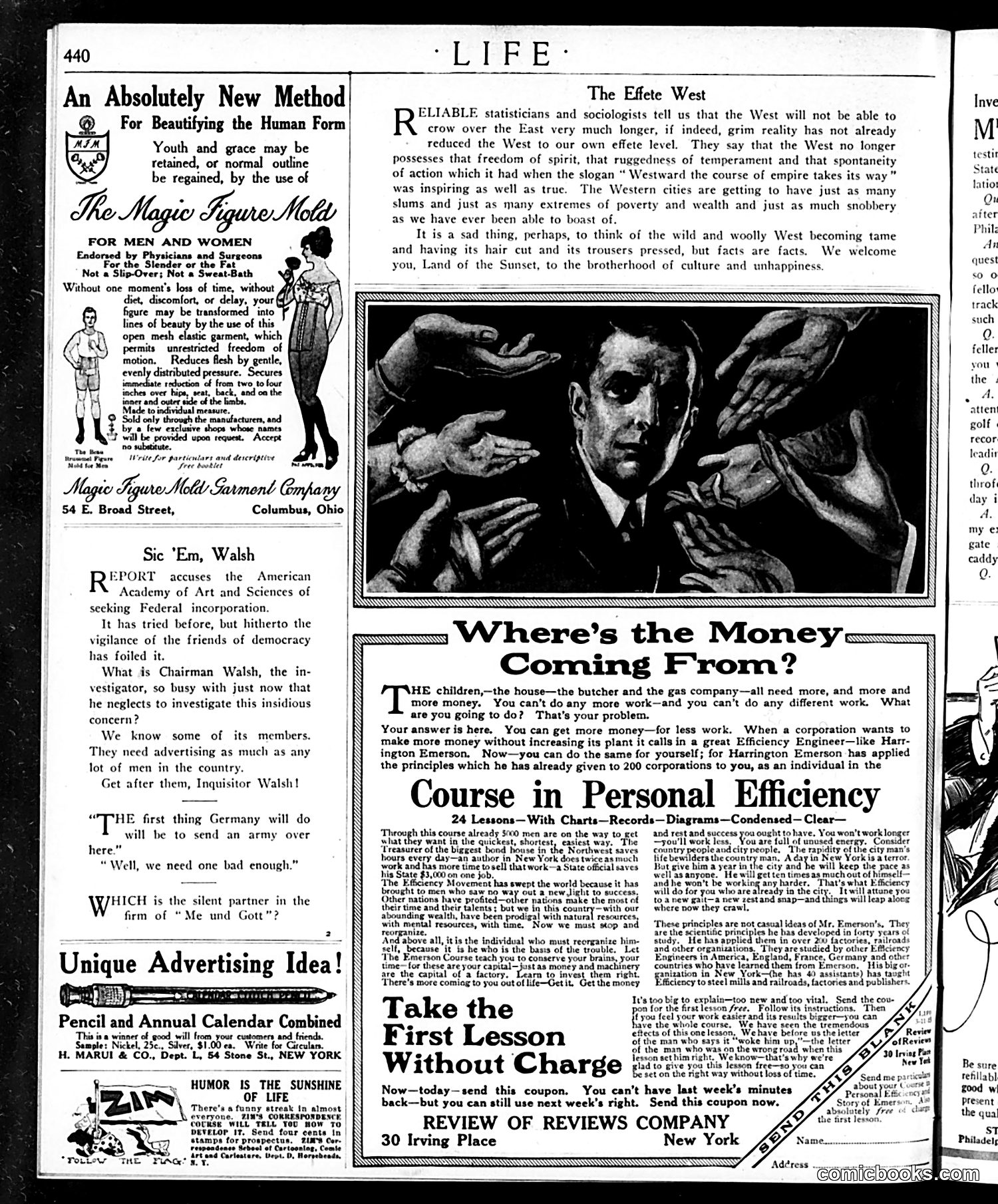
This page contains primarily **advertisements and satirical commentary** rather than political cartoons. The main satirical piece is "Sic 'Em, Walsh," criticizing Chairman Walsh (appears to be a government investigator) for neglecting to investigate the American Academy of Art and Sciences' alleged bid for Federal incorporation, while focusing elsewhere. It's a jab at selective oversight by authorities. Another brief satire jokes about German military threats: when someone warns "Germany will send an army over here," the response is "Well, we need one bad enough"—likely pre-WWI commentary on American military preparedness or internal conflict. The page is dominated by **period advertisements**: the "Magic Figure Mold" (a corset/body shaper), a combined pencil-calendar promotional item, and a "Course in Personal Efficiency" promising better income with less work. One brief item mocks "Me und Gott" (seemingly a reference to German arrogance or authority). Overall, this is a typical early-20th-century magazine mix of light satire and commercial promotion rather than hard-hitting political cartooning.
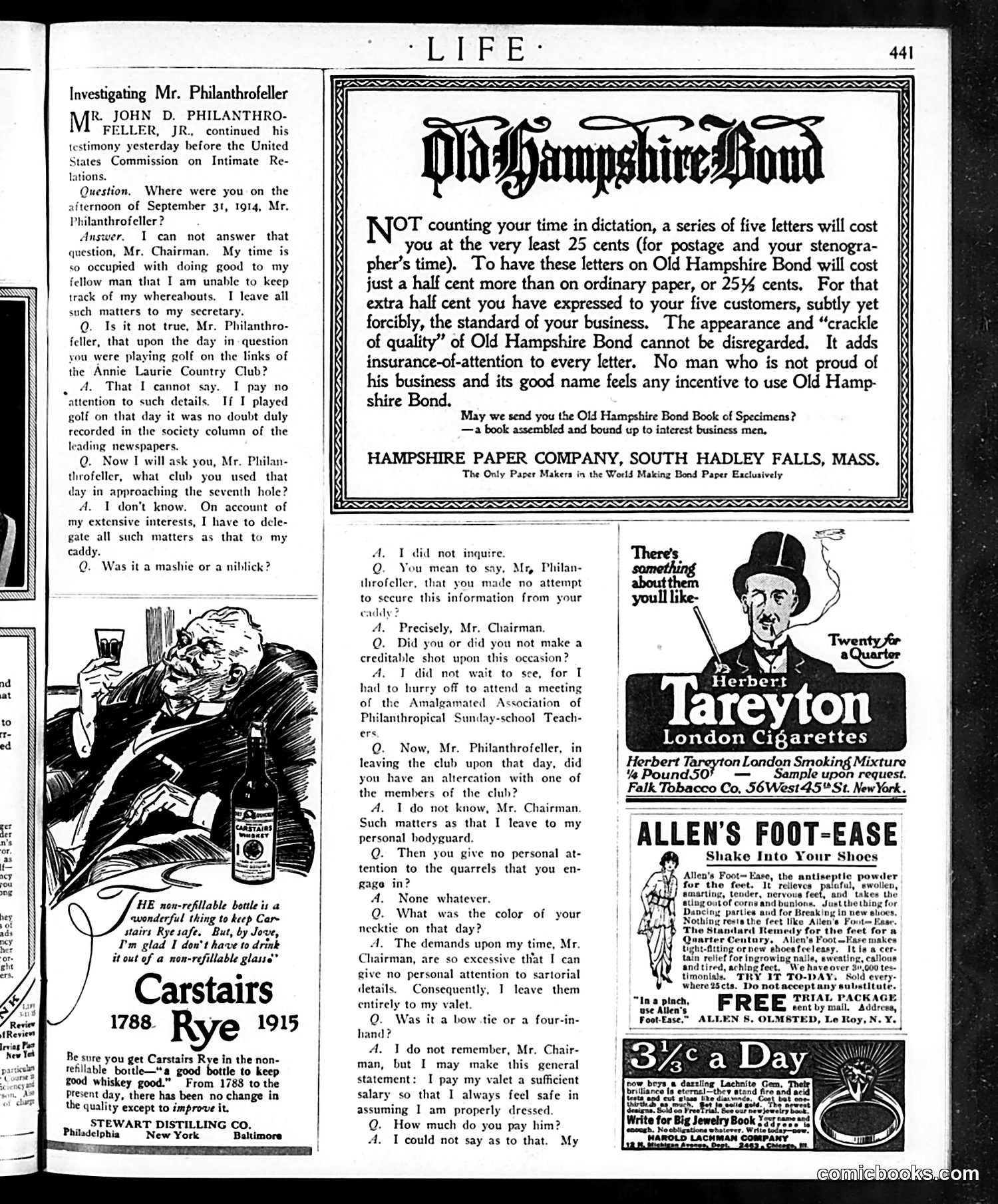
This satirical cartoon mocks wealthy industrialists (likely referencing Rockefeller) who claim to be philanthropists while remaining willfully ignorant of everyday matters. The joke: "Mr. Philanthrofeller" cannot account for his own whereabouts, golf game, or clothing because he claims excessive charitable work demands consume all his time. He delegates everything—even noticing what tie he wore—to employees. The satire exposes hypocrisy: while publicly performing generosity (attending "Amalgamated Association of Philanthropical Sunday-school Teachers"), he actually pays no attention to his own actions or those around him, including quarrels he engages in. The absurd interrogation reveals how billionaires used philanthropy as reputation management while remaining conveniently detached from accountability. The impossible date (September 31) underscores the cartoon's satirical exaggeration of his obliviousness.
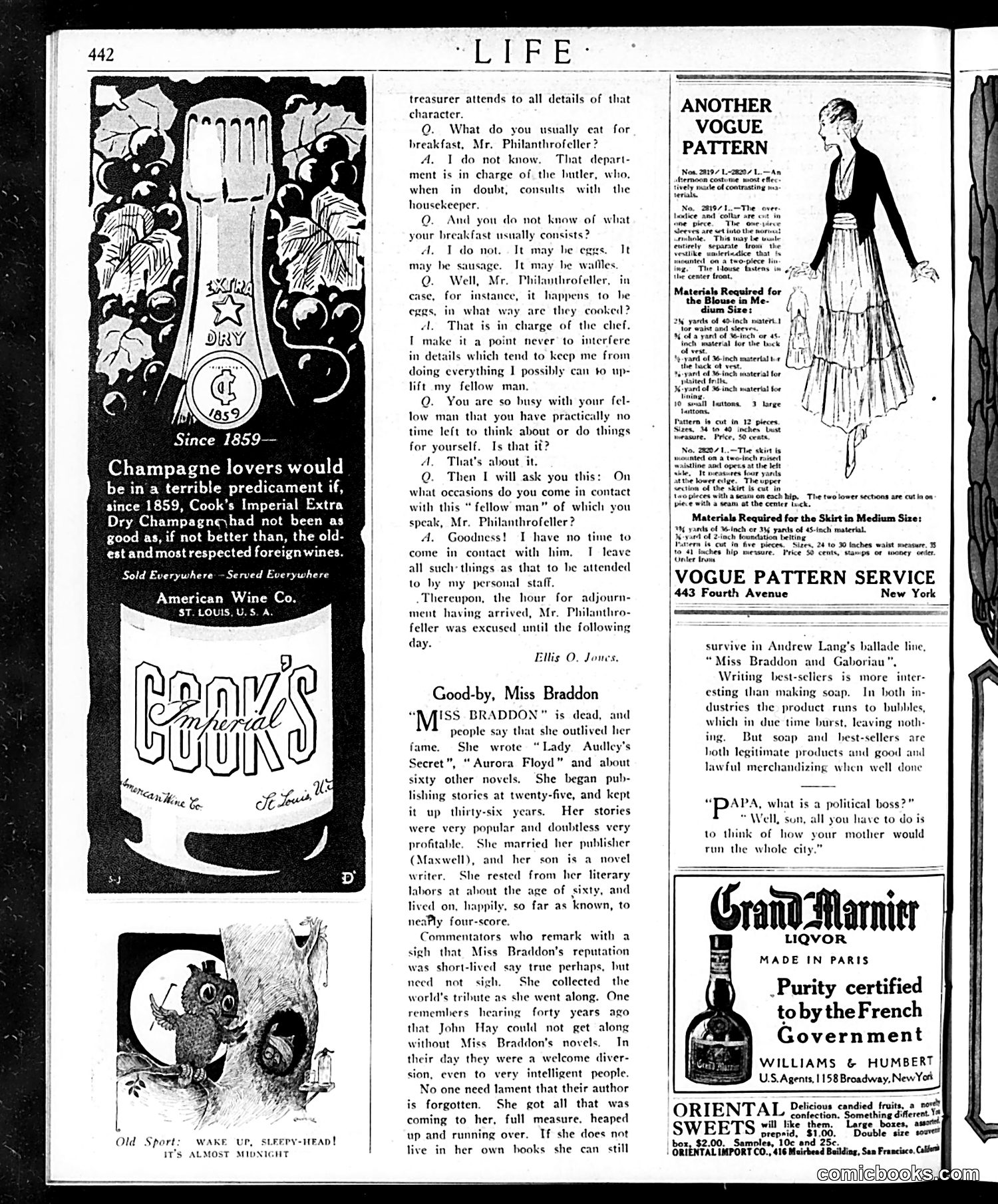
This page mixes advertisements with satirical commentary on wealth and celebrity. **The "Philanthrofeller" Interview** (center text): A biting satire on wealthy philanthropists who delegate all personal decisions—even breakfast—to servants while claiming to "uplift" fellow men. The joke: this nameless rich man never actually encounters the "fellow man" he supposedly helps, leaving everything to his personal staff. It's a critique of disconnected, performative charity by the ultra-wealthy. **"Good-by, Miss Braddon"** (lower section): An obituary-style tribute to novelist Miss Braddon, who wrote popular Victorian novels like *Lady Audley's Secret*. The piece notes she was hugely popular for 36 years but her reputation didn't endure—yet she "got all that was coming to her." It's a reflection on literary fame's impermanence. **The cartoons** (decorative ornamental designs with an owl marked "Wake up, sleepy-head! It's almost midnight") appear to be unrelated decorative elements. The page primarily advertises champagne, liquor, and Vogue sewing patterns alongside the editorial content.
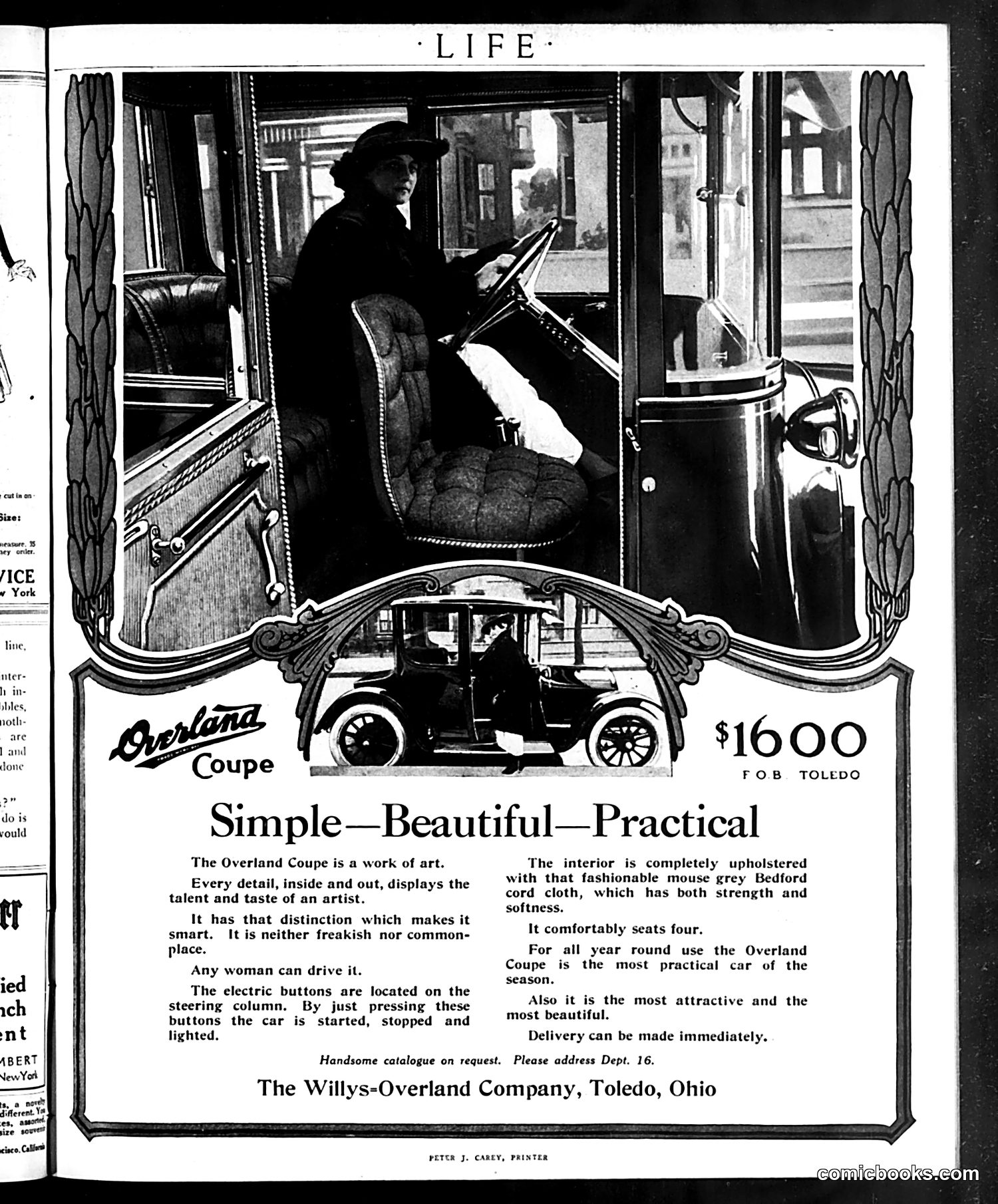
This page is primarily a **car advertisement**, not a political cartoon. It advertises the Overland Coupe automobile for $1,600 (FOB Toledo) from the Willys-Overland Company. The advertisement's humor and sales appeal lies in its **gendered marketing**: the tagline "Any woman can drive it" emphasizes the car's ease of operation through electric buttons on the steering column for starting, stopping, and lighting—positioning this as a practical vehicle for female drivers during an era when cars required significant mechanical knowledge. The large photograph shows a woman at the steering wheel, reinforcing this marketing angle. The copy emphasizes the car as "Simple—Beautiful—Practical," appealing to affluent consumers seeking both aesthetic sophistication and functionality. This reflects early 1900s automotive marketing that targeted women as an emerging consumer demographic, framing technological simplification as appealing to female drivers specifically.
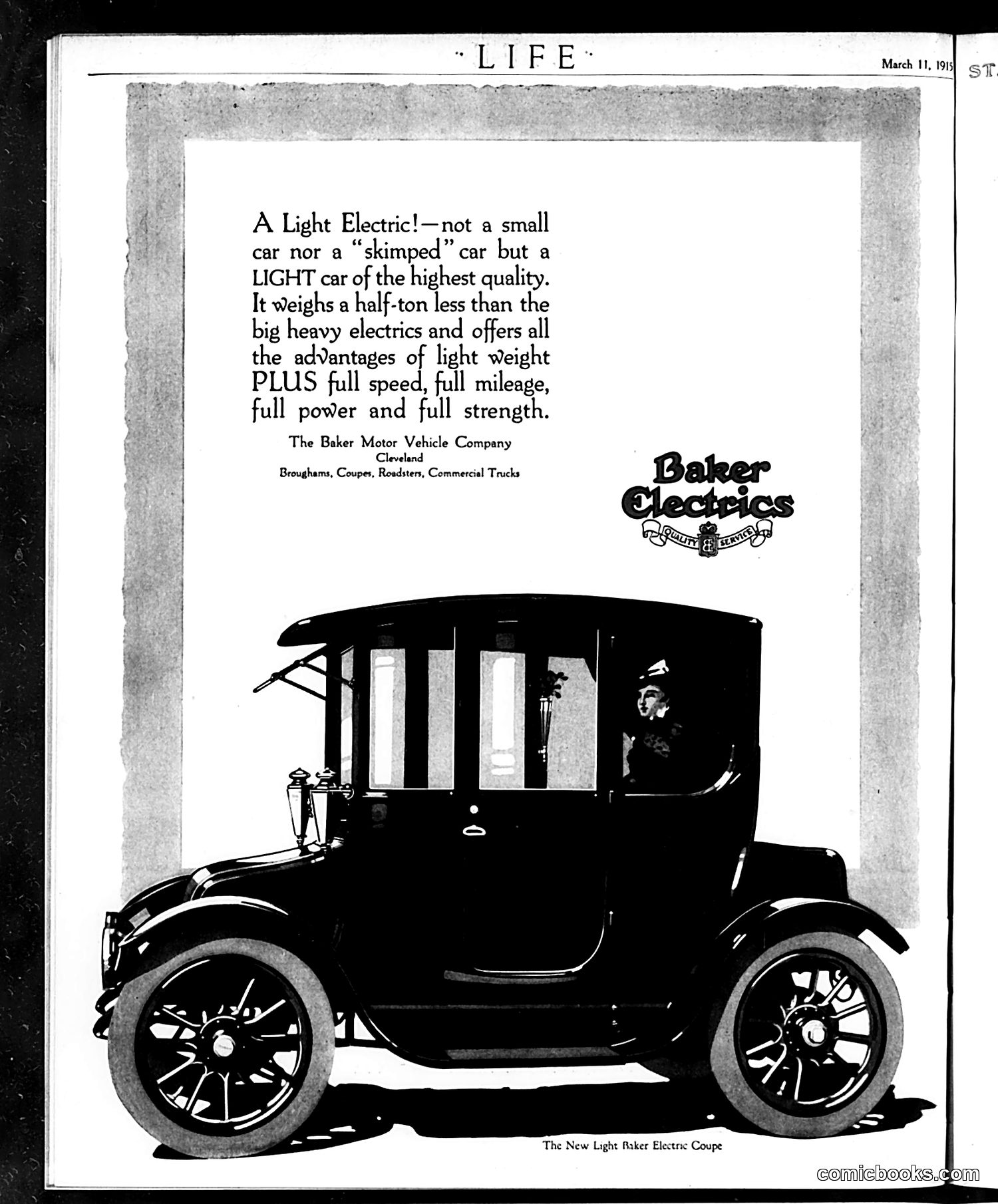
This is primarily **advertising, not satire or editorial content**. It's a 1915 Baker Motor Vehicle Company advertisement for an electric automobile. The ad emphasizes that their "Light Electric" is a quality vehicle—not cheaply made—while being lighter than competing electric cars. It highlights practical advantages: reduced weight combined with full speed, mileage, power, and strength. **Historical context for modern readers**: Electric vehicles were a viable alternative to gasoline cars in the early 1900s, competing seriously in the market. This ad targets affluent buyers (noting models like "Broughams" and "Coupes") concerned about performance and reliability. The emphasis on being "light" but not "skimped" suggests competitors were making compromises. Baker was an actual Cleveland-based manufacturer of electric vehicles active during this period.