
Life, 1915-03-11 · page 18 of 48
Life — March 11, 1915 — page 18: what you’re looking at
What you’re looking at
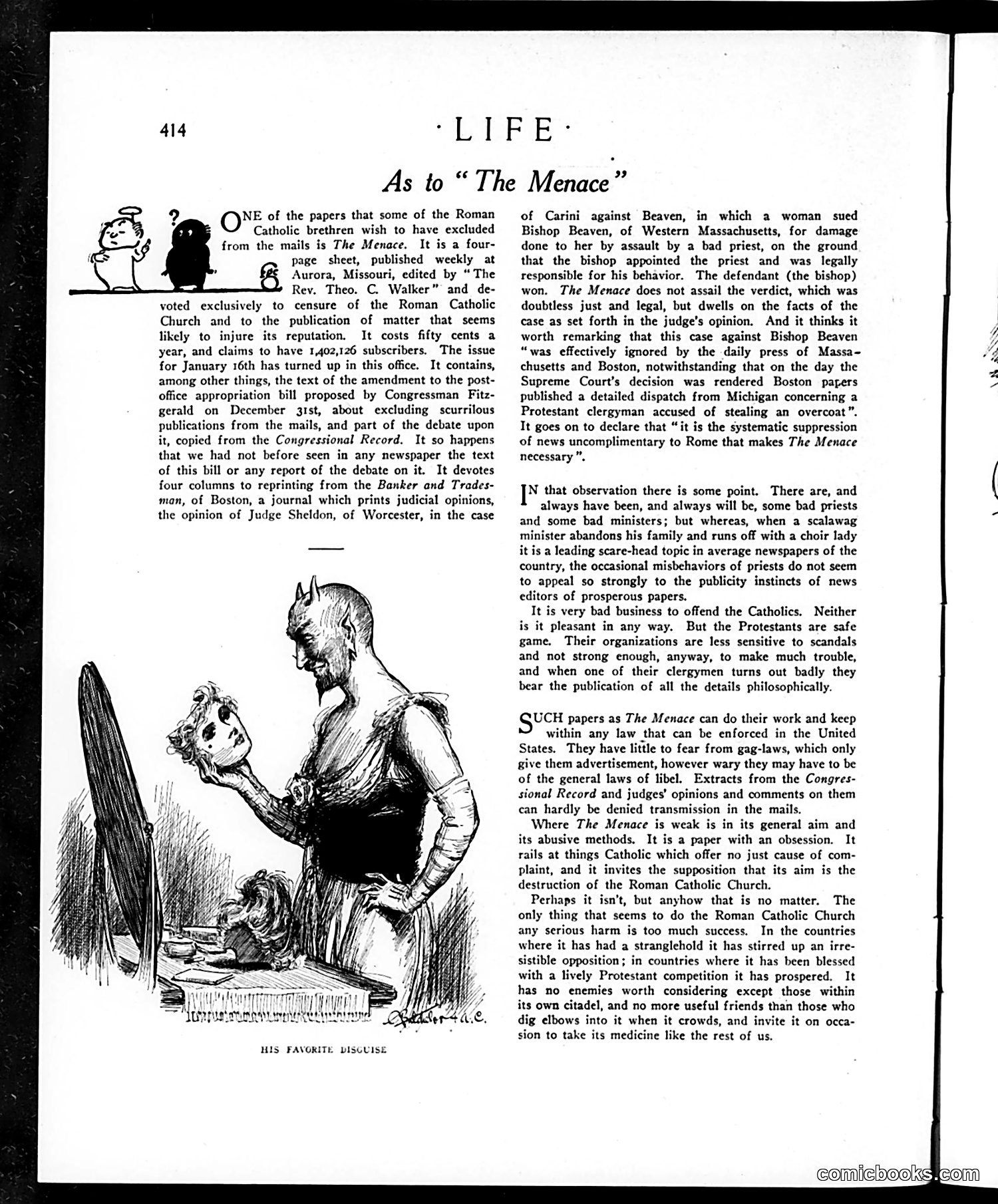
This article critiques *The Menace*, a weekly anti-Catholic publication from Aurora, Missouri, edited by "Rev. Theo. C. Walker." Life acknowledges the paper's valid point: American newspapers suppress scandals involving Catholic priests while sensationalizing Protestant clergy misconduct—demonstrating institutional bias favoring Catholics. However, Life attacks *The Menace*'s credibility, calling it obsessively anti-Catholic with an apparent goal of destroying the Church rather than pursuing balanced journalism. The accompanying cartoon (captioned "His Favorite Disguise") depicts a demonic or grotesque figure—apparently representing *The Menace*'s hidden anti-Catholic agenda—disguised as something respectable. Life's position: while *The Menace* raises legitimate concerns about press bias, its inflammatory methods and single-minded obsession undermine its effectiveness and reveal it as propaganda rather than journalism. The satire suggests the publication's true nature lurks beneath a veneer of respectability.
📄 Transcribed text from this page (OCR, searchable)
Machine-transcribed from the original scan — historical spelling and the odd misread are preserved.
“LIFE: As to “ The Mites” ONE of the papers that some of the Roman Catholic brethren wish to have excluded from the mails is The Menace. It is a four- page sheet, published weekly at Aurora, Missouri, edited by “ The Rev. Theo. C. Walker” and de- voted exclusively to censure of the Roman Catholic Church and to the publication of matter that seems likely to injure its reputation. It costs fifty cents a year, and claims to have 1,402,126 subscribers. The issue for January 16th has turned up in this office. It contains, among other things, the text of the amendment to the post- office appropriation bill proposed by Congressman Fitz- gerald on December 31st, about excluding scurrilous publications from the mails, and part of the debate upon it, copied from the Congressional Record. It so happens that we had not before seen in any newspaper the text of this bill or any report of the debate on it. It devotes four columns to reprinting from the Banker and Trades- man, of Boston, a journal which prints judicial opinions, the opinion of Judge Sheldon, of Worcester, in the case HIS FAVORITE DISGUISE of Carini against Beaven, in which a woman sued Bishop Beaven, of Western Massachusetts, for damage done to her by assault by a bad priest, on the ground that the bishop appointed the priest and was legally responsible for his behavior. The defendant (the bishop) won. The Menace does not assail the verdict, which was doubtless just and legal, but dwells on the facts of the case as set forth in the judge’s opinion. And it thinks it worth remarking that this case against Bishop Beaven “was effectively ignored by the daily press of Massa- chusetts and Boston, notwithstanding that on the day the Supreme Court’s decision was rendered Boston papers published a detailed dispatch from Michigan concerning a Protestant clergyman accused of stealing an overcoat”. It goes on to declare that “it is the systematic suppression of news uncomplimentary to Rome that makes The Menace necessary ”. IX that observation there is some point. There are, and always have been, and always will be, some bad priests and some bad ministers; but whereas, when a scalawag minister abandons his family and runs off with a choir lady it is a leading scare-head topic in average newspapers of the country, the occasional misbehaviors of priests do not seem to appeal so strongly to the publicity instincts of news editors of prosperous papers. It is very bad business to offend the Catholics. Neither is it pleasant in any way. But the Protestants are safe game. Their organizations are less sensitive to scandals and not strong enough, anyway, to make much trouble, and when one of their clergymen turns out badly they bear the publication of all the details philosophically. Set Papers as The Menace can do their work and keep within any law that can be enforced in the United States. They have little to fear from gag-laws, which only give them advertisement, however wary they may have to be of the general laws of libel. Extracts from the Congres- sional Record and judges’ opinions and comments on them can hardly be denied transmission in the mails. Where The Menace is weak is in its general aim and its abusive methods. It is a paper with an obsession. It rails at things Catholic which offer no just cause of com- plaint, and it invites the supposition that its aim is the destruction of the Roman Catholic Church. Perhaps it isn’t, but anyhow that is no matter. The only thing that seems to do the Roman Catholic Church any serious harm is too much success. In the countries where it has had a stranglehold it has stirred up an irre- sistible opposition; in countries where it has been blessed with a lively Protestant competition it has prospered. It has no enemies worth considering except those within its own citadel, and no more useful friends than those who dig elbows into it when it crowds, and invite it on occa- sion to take its medicine like the rest of us. comichookss