
Life, 1915-03-11 · page 13 of 48
Life — March 11, 1915 — page 13: what you’re looking at
What you’re looking at
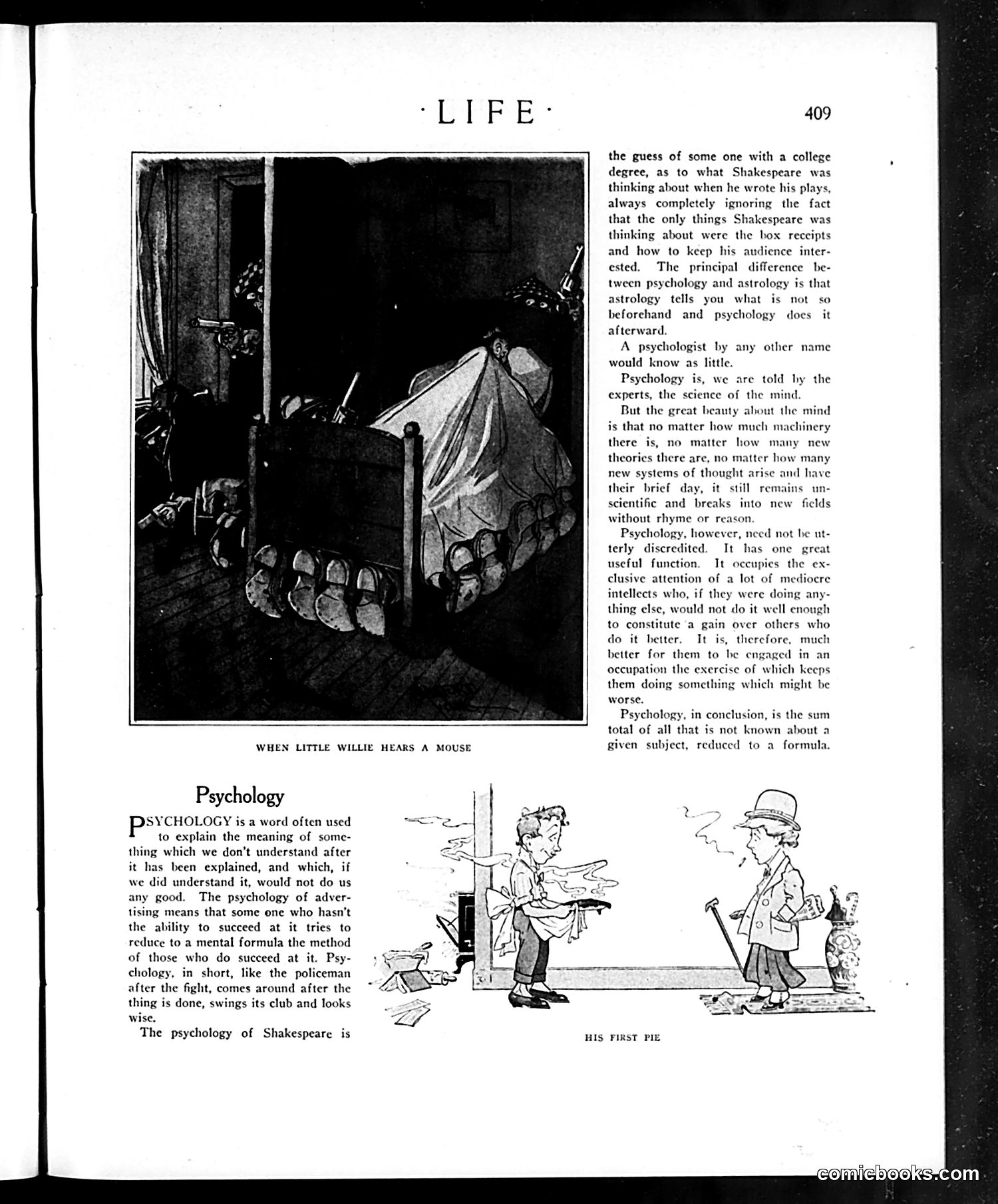
This page contains an essay titled "Psychology" that critiques the field itself as largely useless—a "sum total of all that is not known about a given subject, reduced to a formula." The text sarcastically notes that psychology occupies mediocre intellects who would accomplish little else. The cartoon "His First Pie" illustrates a child's psychological reaction: a young boy eagerly reaches for pie while an adult (likely a parent or authority figure) watches. This humorous illustration supports the essay's point that psychology merely describes obvious human behaviors after the fact—here, a child's predictable desire for food—rather than providing genuine insight. The upper photograph "When Little Willie Hears a Mouse" similarly depicts a child's straightforward, instinctive reaction, reinforcing the satire that psychology claims to study what is already self-evident.
📄 Transcribed text from this page (OCR, searchable)
Machine-transcribed from the original scan — historical spelling and the odd misread are preserved.
409 the guess of some one with a college degree, as to what Shakespeare was thinking about when he wrote his plays, always completely ignoring the fact that the only things Shakespeare was thinking about were the box reccipts and how to keep his audience inter- ested. The principal difference be- tween psychology and astrology is that astrology tells you what is not so beforehand and psychology does it afterward A psychologist by any other name would know as little. Psychology is, we are told hy the experts, the science of the mind. But the great beauty about the mind is that no matter how much machinery there is, no matter how many new theories there are, no matter how many new systems of thought arise and have their brief day, it still remains un- scientific and breaks into new fields without rhyme or reason. Psychology, however, need not he ut- terly discredited. It has one great useful function. It occupies the ex- clusive attention of a lot of mediocre intellects who, if they were doing any- thing else, would not do it well enough to constitute a gain over others who do it better. It is, therefore, much better for them to be engaged in an occupation the exercise of which keeps them doing something which might be worse. Psychology, in conclusion, is the sum total of all that is not known about a WHEN LITTLE WILLIE HEARS A MOUSE given subject, reduced to a formula. Psychology SYCHOLOGY is a word often used to explain the meaning of some- thing which we don’t understand after it has been explained, and which, if we did understand it, would not do us any good. The psychology of adver- lising means that some one who hasn't the ability to succeed at it tries to reduce to a mental formula the method of those who do succeed at it. Psy- chology, in short, like the policeman after the fight, comes around after the thing is done, swings its club and looks wise. The psychology of Shakespeare is HIS FIRST PIE