
Life, 1915-03-11 · page 32 of 48
Life — March 11, 1915 — page 32: what you’re looking at
What you’re looking at
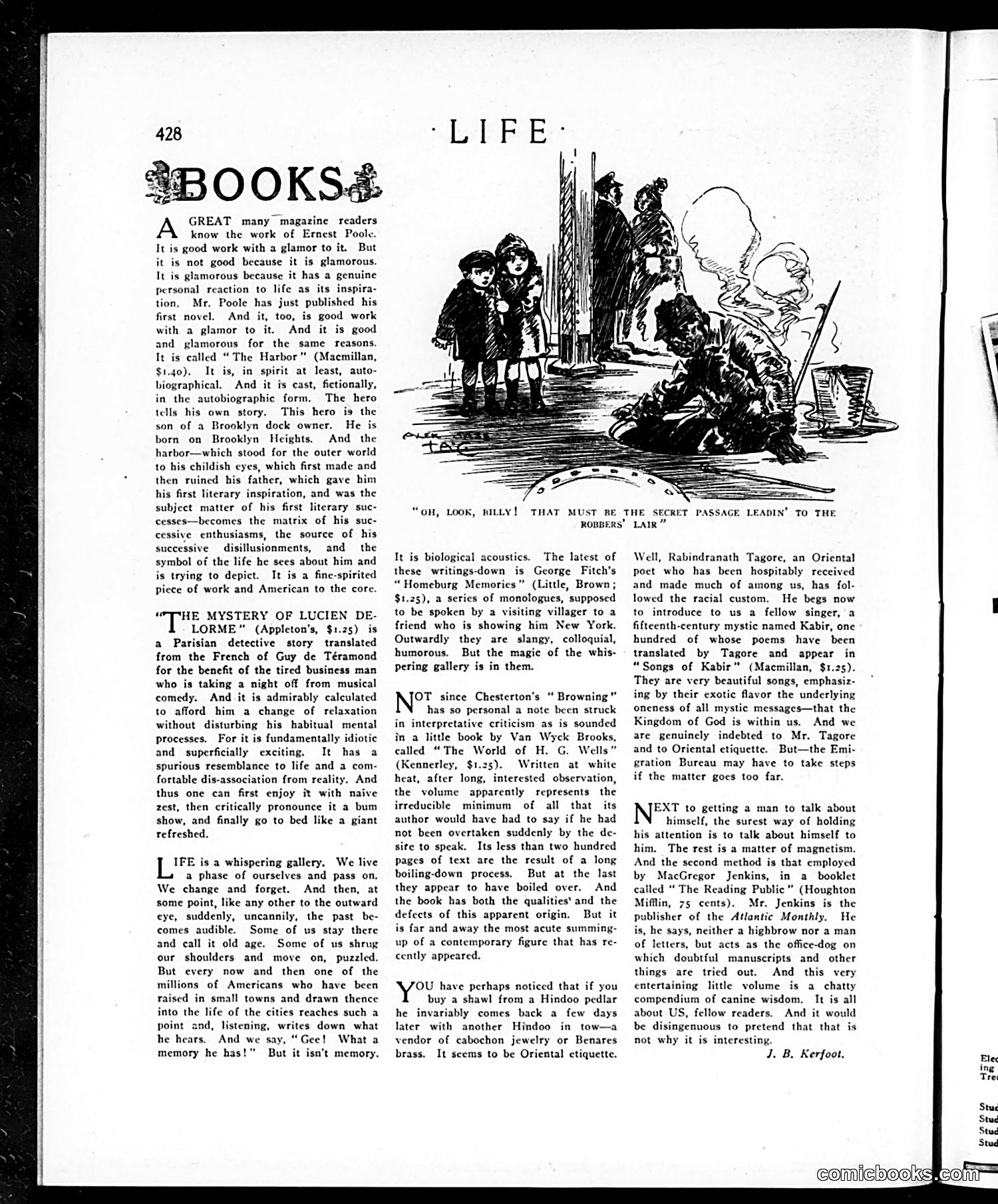
This page from Life magazine contains book reviews and a single cartoon illustration. The cartoon shows children on a street discovering what appears to be a hidden passageway or hideout, with one child exclaiming "Oh, look, Billy! That must be the secret passage leadin' to the robbers' lair!" The illustration likely accompanies discussion of adventure or mystery fiction popular with young readers of the era. The cartoon humorously depicts children's imaginative interpretation of ordinary urban spaces—viewing a mundane alley or architectural feature as a thrilling secret passage. The rest of the page reviews several books, including Ernest Poole's novel "The Harbor" and George Fitch's "Homeburg Memories." The reviews focus on literary merit and authenticity rather than plot summaries, reflecting early 20th-century magazine criticism that valued genuine personal insight over mere entertainment value.
📄 Transcribed text from this page (OCR, searchable)
Machine-transcribed from the original scan — historical spelling and the odd misread are preserved.
428 &BOOKSS GREAT many magazine readers know the work of Ernest Poole. It is good work with a glamor to it. But it is not good because it is glamorous. It is glamorous because it has a genuine personal reaction to life as its inspira- tion, Mr. Poole has just published his first novel. And it, too, is good work with a glamor to it. And it is good and glamorous for the same reasons. It is called “ The Harbor” (Macmillan, $1.40). It is, in spirit at least, auto- biographical. And it is cast, fictionally, in the autobiographic form. The hero tells his own story, This hero is the son of a Brooklyn dock owner. He is born on Brooklyn Heights. And the harbor—which stood for the outer world to his childish eyes, which first made and then ruined his father, which gave him his first literary inspiration, and was the subject matter of his first literary suc- cesses—becomes the matrix of his suc- cessive enthusiasms, the source of his successive disillusionments, and the symbol of the life he sees about him and is trying to depict. It is a fine-spirited piece of work and American to the core. ‘. HE MYSTERY OF LUCIEN DE- LORME” (Appleton’s, $1.25) is a Parisian detective story translated from the French of Guy de Téramond for the benefit of the tired business man who is taking a night off from musical comedy. And it is admirably calculated to afford him a change of relaxation without disturbing his habitual mental Processes. For it is fundamentally idiotic and superficially exciting. It has a spurious resemblance to life and a com- fortable dis-association from reality. And thus one can first enjoy it with naive zest, then critically pronounce it a bum show, and finally go to bed like a giant refreshed. IFE is a whispering gallery. We live a phase of ourselves and pass on, We change and forget. And then, at some point, like any other to the outward eye, suddenly, uncannily, the past be- comes audible. Some of us stay there and call it old age. Some of us shrug our shoulders and move on, puzzled. But every now and then one of the millions of Americans who have been raised in small towns and drawn thence into the life of the cities reaches such a point and, listening, writes down what he hears. And we say, “Gee! What a memory he has!" But it isn't memory. THAT MUST BE T ROBBERS’ “on, Look, HILLY! It is biological acoustics. The latest of these writings-down is George Fitch's “Homeburg Memories” (Little, Brown ; $1.25), a series of monologues, supposed to be spoken by a visiting villager to a friend who is showing him New York. Outwardly they are slangy, colloquial, humorous. But the magic of the whis- pering gallery is in them. OT since Chesterton's “ Browning” has so personal a note been struck in interpretative criticism as is sounded in a little book by Van Wyck Brooks, called “The World of H. G. Wells” (Kennerley, $1.25). Written at white heat, after long, interested observation, the volume apparently represents the irreducible minimum of all that its author would have had to say if he had not been overtaken suddenly by the de- site to speak. Its less than two hundred pages of text are the result of a long boiling-down process. But at the last they appear to have boiled over. And the book has both the qualities’ and the defects of this apparent origin. But it is far and away the most acute summing- up of a contemporary figure that has re- cently appeared. ‘OU have perhaps noticed that if you buy a shawl from a Hindoo pedlar he invariably comes back a few days later with another Hindoo in tow—a vendor of cabochon jewelry or Benares brass. It seems to be Oriental ctiquette. Well, Rabindranath Tagore, an Oriental poct who has been hospitably received and made much of among us, has fol- lowed the racial custom. He begs now to introduce to us a fellow singer, a fifteenth-century mystic named Kabir, one hundred of whose poems have been translated by Tagore and appear in “Songs of Kabir” (Macmillan, $1.25). They are very beautiful songs, emphasiz- ing by their exotic flavor the underlying oneness of all mystic messages—that the Kingdom of God is within us. And we are genuinely indebted to Mr. Tagore and to Oriental etiquette. But—the Emi- gration Bureau may have to take steps if the matter goes too far. XT to getting a man to talk about himself, the surest way of holding his attention is to talk about himself to him. The rest is a matter of magnetism. And the second method is that employed by MacGregor Jenkins, in a booklet called “ The Reading Public” (Houghton Mifflin, 75 cents). Mr. Jenkins is the publisher of the Atlantic Monthly, He is, he says, neither a highbrow nor a man of letters, but acts as the office-dog on which doubtful manuscripts and other things are tried out. And this very entertaining little volume is a chatty compendium of canine wisdom. It is all about US, fellow readers. And it would be disingenuous to pretend that that is not why it is interesting. J. B. Kerfoot.