
Life, 1915-03-11 · page 22 of 48
Life — March 11, 1915 — page 22: what you’re looking at
What you’re looking at
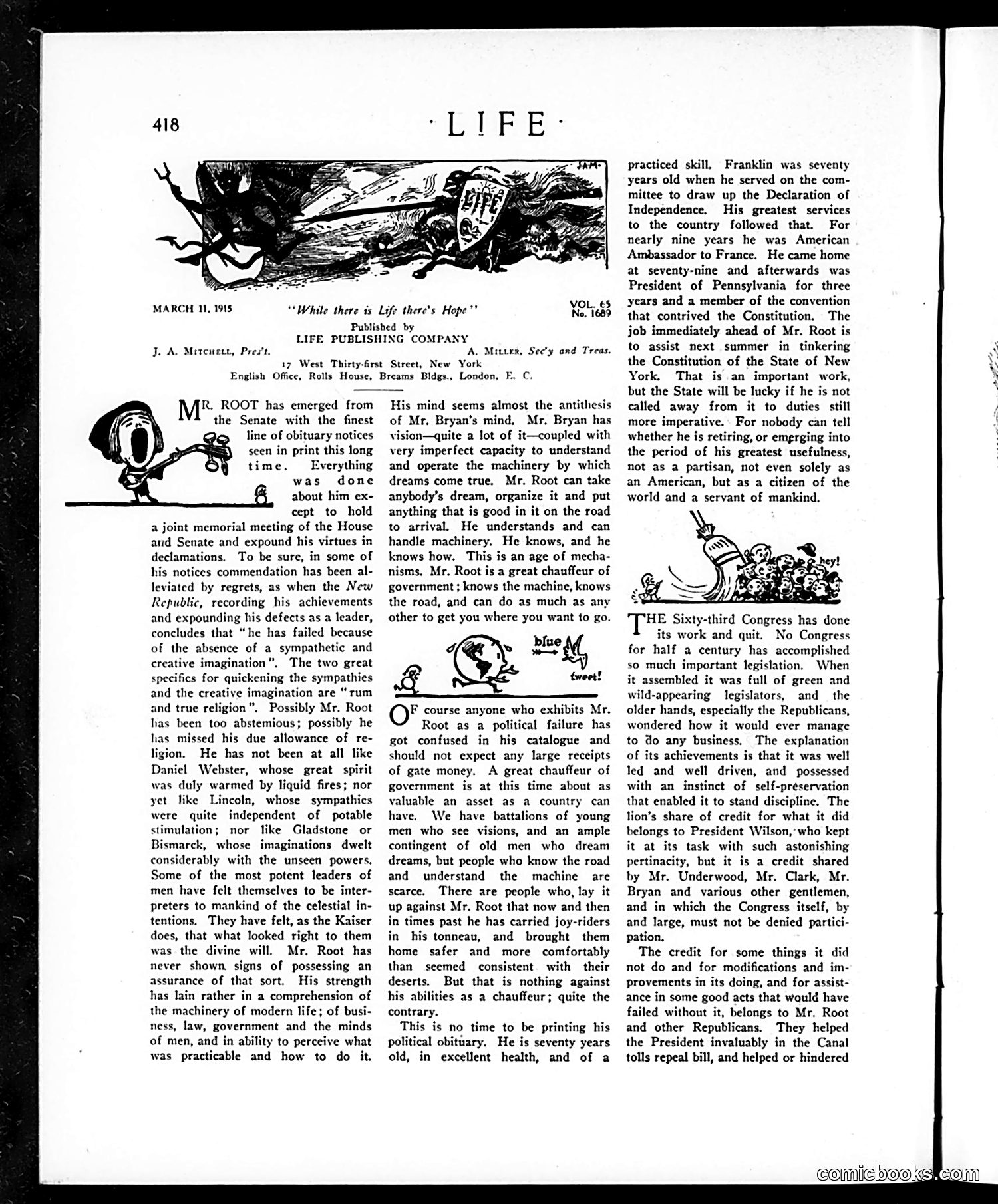
This page satirizes Elihu Root's recent Senate departure. The article frames Root as a practical "chauffeur of government"—a skilled mechanic who operates the machinery of state effectively, unlike visionary politicians like William Jennings Bryan who dream without executing. The satire's point: Life magazine defends Root against critics (like the *New Republic*) who claim he lacks imagination and sympathy. Instead, the author argues Root's real strength is *pragmatism*—understanding how to make things work. The piece dismisses premature "obituary notices" about his political career, comparing him to Benjamin Franklin, who accomplished great things after age seventy. The cartoon (top) shows a figure labeled "Life" with a torch—the magazine's masthead personification—reinforcing their hopeful message that Root's career isn't finished. The political context: Root was a prominent Republican statesman and diplomat whose practical, legalistic approach contrasted with Bryan's idealistic progressivism.
📄 Transcribed text from this page (OCR, searchable)
Machine-transcribed from the original scan — historical spelling and the odd misread are preserved.
MARCH 11, 1915 ‘While there is Life there's Hope"’ No, 1689 Published by LIFE PUBLISHING COMPANY J. A. Miteuctt, Pres’t, A. Mitier, Sec’y and Treas. 17 West Thirty-first Street, New York English Office, Rolls House, Breams Bldgs, London, EF. C. R. ROOT has emerged from the Senate with the finest line of obituary notices seen in print this long time. Everything was done about him ex- cept to hold a joint memorial meeting of the House and Senate and expound his virtues in declamations. To be sure, in some of his notices commendation has been al- leviated by regrets, as when the New Republic, recording his achievements and expounding his defects as a leader, concludes that “he has failed because of the absence of a sympathetic and creative imagination”. The two great specifics for quickening the sympathies and the creative imagination are “rum and true religion”. Possibly Mr. Root has been too abstemious; possibly he has missed his due allowance of re- ligion. He has not been at all like Daniel Webster, whose great spirit was duly warmed by liquid fires; nor yet like Lincoln, whose sympathics were quite independent of potable stimulation; nor like Gladstone or Bismarck, whose imaginations dwelt considerably with the unseen powers. Some of the most potent leaders of men have felt themselves to be inter- preters to mankind of the celestial in- tentions. They have felt, as the Kaiser does, that what looked right to them was the divine will. Mr. Root has never shown signs of possessing an assurance of that sort. His strength has lain rather in a comprehension of the machinery of modern life; of busi- ness, law, government and the minds of men, and in ability to perceive what was practicable and how to do it. His mind seems almost the antithesis of Mr. Bryan’s mind. Mr. Bryan has vision—quite a lot of it—coupled with very imperfect capacity to understand and operate the machinery by which dreams come true. Mr. Root can take anybody’s dream, organize it and put anything that is good in it on the road to arrival, He understands and can handle machinery. He knows, and he knows how. This is an age of mecha- nisms. Mr. Root is a great chauffeur of government ; knows the machine, knows the road, and can do as much as any other to get you where you want to go. F course anyone who exhibits Mr. Root as a political failure has got confused in his catalogue and should not expect any large receipts of gate money. A great chauffeur of government is at this time about as valuable an asset as a country can have. We have battalions of young men who see visions, and an ample contingent of old men who dream dreams, but people who know the road and understand the machine are scarce. There are people who, lay it up against Mr. Root that now and then in times past he has carried joy-riders in his tonneau, and brought them home safer and more comfortably than seemed consistent with their deserts. But that is nothing against his abilities as a chauffeur; quite the contrary. This is no time to be printing his political obituary. He is seventy years old, in excellent health, and of a practiced skill, Franklin was seventy years old when he served on the com- mittee to draw up the Declaration of Independence. His greatest services to the country followed that. For nearly nine years he was American Ambassador to France. He came home at seventy-nine and afterwards was President of Pennsylvania for three years and a member of the convention that contrived the Constitution. The job immediately ahead of Mr. Root is to assist next summer in tinkering the Constitution of the State of New York. That is an important work, but the State will be lucky if he is not called away from it to duties still more imperative. For nobody can tell whether he is retiring, or emerging into the period of his greatest usefulness, not as a partisan, not even solely as an American, but as a citizen of the world and a servant of mankind. THE Sixty-third Congress has done its work and quit. No Congress for half a century has accomplished so much important legislation. When it assembled it was full of green and wild-appearing legislators, and the older hands, especially the Republicans, wondered how it would ever manage to do any business. The explanation of its achievements is that it was well led and well driven, and possessed with an instinct of self-préservation that enabled it to stand discipline. The lion’s share of credit for what it did belongs to President Wilson, who kept it at its task with such astonishing pertinacity, but it is a credit shared by Mr. Underwood, Mr. Clark, Mr. Bryan and various other gentlemen, and in which the Congress itself, b and large, must not be denied partici- pation, The credit for some things it did not do and for modifications and im- provements in its doing, and for assist- ance in some good acts that wauld have failed without it, belongs to Mr. Root and other Republicans. They helped the President invaluably in the Canal tolls repeal bill, and helped or hindered