
Life, 1915-03-11 · page 23 of 48
Life — March 11, 1915 — page 23: what you’re looking at
What you’re looking at
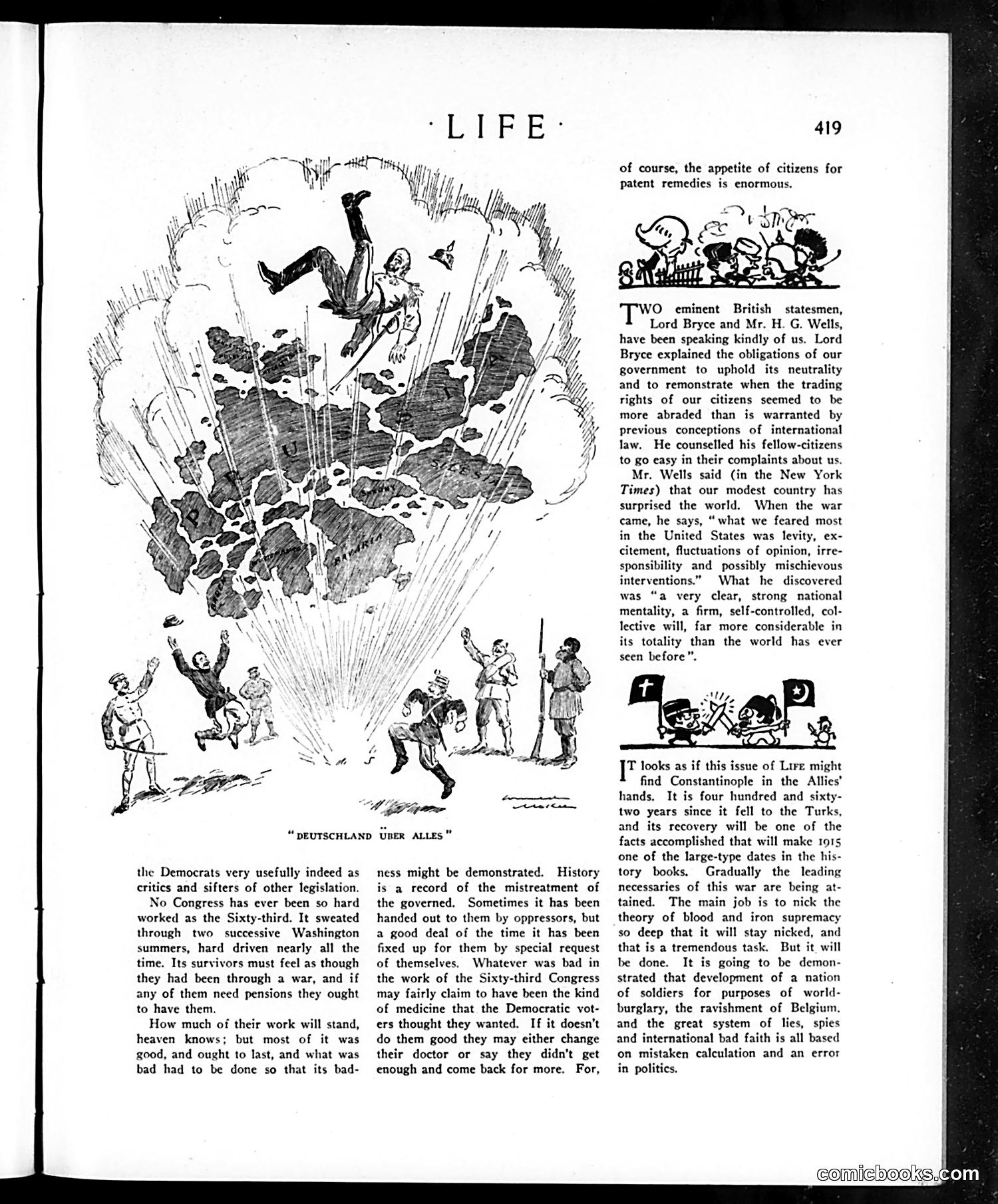
This cartoon satirizes German militarism during World War I. The title references the German nationalist phrase meaning "Germany Above All." The image depicts an explosion or violent upheaval, with figures being thrown violently into the air—likely representing the chaos and destruction resulting from Germany's aggressive military philosophy. The soldiers and civilians tumbling chaotically illustrate the consequences of the German doctrine of military supremacy ("blood and iron") that Life's accompanying text condemns. The editorial commentary explicitly criticizes Germany's theory that "development of a nation of soldiers for purposes of world-burglary, the ravishment of Belgium, and the great system of lies, spies and international bad faith" is based on "mistaken calculation and an error in politics." The cartoon mocks how this German ideology, despite appearing powerful, ultimately produces only destruction and failure. It's Cold War-era American propaganda supporting the Allied position against Germany.
📄 Transcribed text from this page (OCR, searchable)
Machine-transcribed from the original scan — historical spelling and the odd misread are preserved.
“DEUTSCHLAND UBER ALLES” the Democrats very usefully indeed as critics and sifters of other legislation. No Congress has ever been so hard worked as the Sixty-third. It sweated through two successive Washington summers, hard driven nearly all the time. Its survivors must feel as though they had been through a war, and if any of them need pensions they ought to have them. How much of their work will stand, heaven knows; but most of it was good, and ought to last, and what was bad had to be done so that its bad- ness might be demonstrated. History is a record of the mistreatment of the governed. Sometimes it has been handed out to them by oppressors, but a good deal of the time it has been fixed up for them by special request of themselves. Whatever was bad in the work of the Sixty-third Congress may fairly claim to have been the kind of medicine that the Democratic vot- ers thought they wanted. If it doesn’t do them good they may either change their doctor or say they didn’t get enough and come back for more. For, 419 of course, the appetite of citizens for patent remedies is enormous. O eminent British statesmen, Lord Bryce and Mr. H. G. Wells, have been speaking kindly of us. Lord Bryce explained the obligations of our government to uphold its neutrality and to remonstrate when the trading rights of our citizens seemed to be more abraded than is warranted by previous conceptions of international law. He counselled his fellow-citizens to go easy in their complaints about us. Mr. Wells said (in the New York Times) that our modest country has surprised the world. When the war came, he says, “what we feared most in the United States was levity, ex- citement, fluctuations of opinion, irre- sponsibility and possibly mischievous interventions.” What he discovered was “a very clear, strong national mentality, a firm, self-controlled, col- lective will, far more considerable in its totality than the world has ever seen before”. sy, WN T looks as if this issue of Lire might find Constantinople in the Allies’ hands. It is four hundred and sixty- two years since it fell to the Turks, and its recovery will be one of the facts accomplished that will make 1915 one of the large-type dates in the his- tory books. Gradually the leading necessaries of this war are being at- tained. The main job is to nick the theory of blood and iron supremacy so deep that it will stay nicked, and that is a tremendous task. But it, will be done. It is going to be demon- strated that development of a nation of soldiers for purposes of world- burglary, the ravishment of Belgium, and the great system of lies, spies and international bad faith is all based on mistaken calculation and an error in politics. comichooks.celu)