
Life, 1915-03-11 · page 26 of 48
Life — March 11, 1915 — page 26: what you’re looking at
What you’re looking at
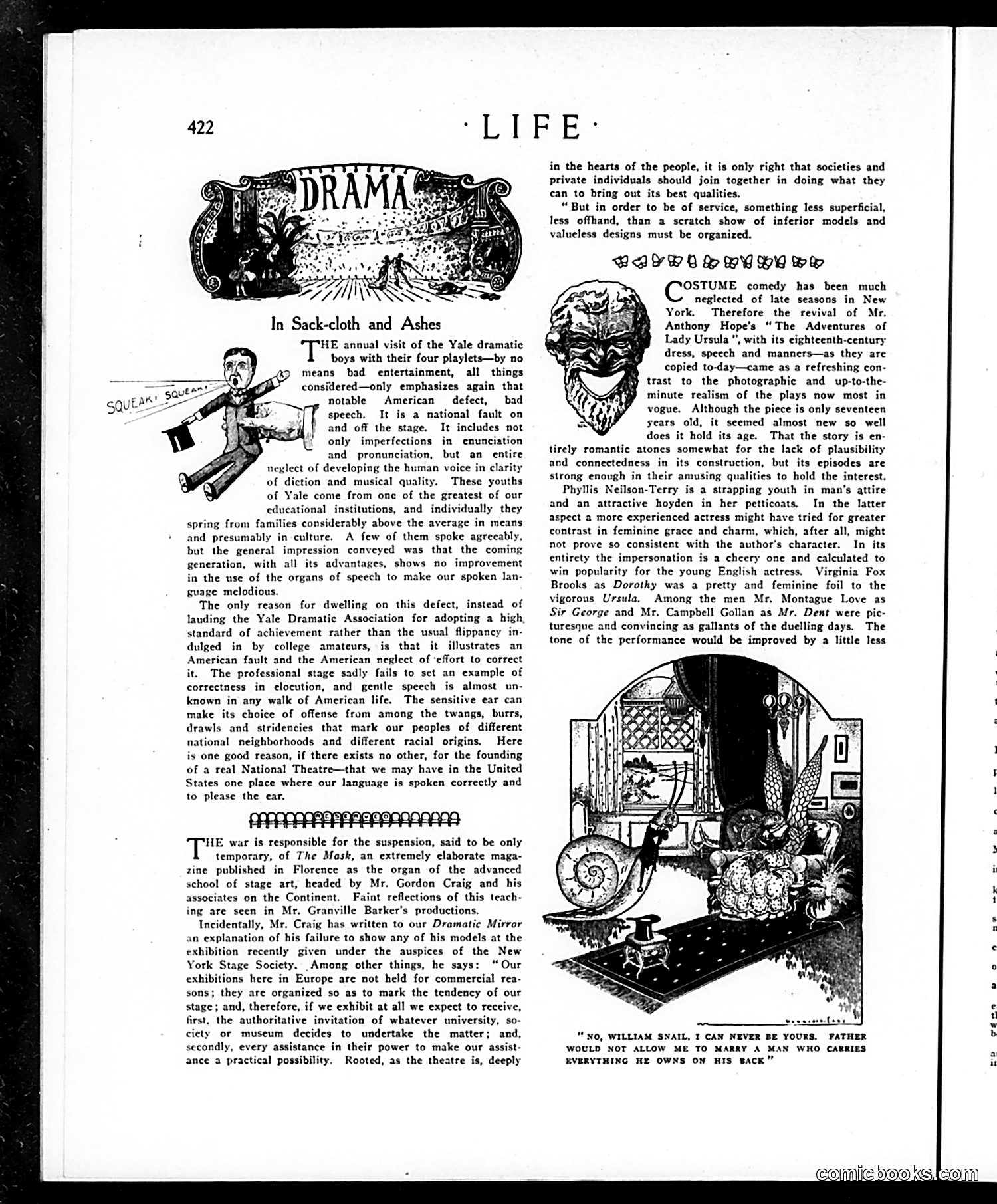
This page critiques American cultural defects through theater commentary. The main article attacks the Yale Dramatic Association's performance, not for entertainment value but as evidence of a broader national problem: poor speech and diction among Americans across all social classes. The author argues that even Yale students—from educated, affluent families—demonstrate "bad speech" including twangs, burrs, and unclear enunciation. Rather than praising the theater group, the critic uses their performance as a launching point for advocating a National Theatre where American English would be spoken correctly. The page also discusses Gordon Craig's advanced Continental stage design theories and praises a revival of Anthony Hope's costume comedy as a refreshing alternative to contemporary realistic plays. The cartoon (left) appears to mock poor elocution through visual comedy, supporting the article's central complaint about American speech quality.
📄 Transcribed text from this page (OCR, searchable)
Machine-transcribed from the original scan — historical spelling and the odd misread are preserved.
DIES In Sack-cloth and Ashes HE annual visit of the Yale dramatic boys with their four playlets—by no means bad entertainment, all things considered—only emphasizes again that notable American defect, bad speech. It is a national fault on and off the stage. It includes not only imperfections in enunciation and pronunciation, but an entire neglect of developing the human voice in clarity of diction and musical quality, These youths of Yale come from one of the greatest of our educational institutions, and individually they spring from families considerably above the average in means and presumably in culture. A few of them spoke agreeably, but the general impression conveyed was that the coming generation, with all its advantages, shows no improvement in the use of the organs of speech to make our spoken lan- guage melodious. The only reason for dwelling on this defect, instead of lauding the Yale Dramatic Association for adopting a high, standard of achievement rather than the usual flippancy in- dulged in by college amateurs, is that it illustrates an American fault and the American neglect of ‘effort to correct it. The professional stage sadly fails to set an example of correctness in elocution, and gentle speech is almost un- known in any walk of American life. The sensitive ear can make its choice of offense from among the twangs, burrs, drawls and stridencies that mark our peoples of different national neighborhoods and different racial origins, Here is one good reason, if there exists no other, for the founding of a real National Theatre—that we may have in the United States one place where our language is spoken correctly and to please the ear. HE war is responsible for the suspension, said to be only temporary, of The Mask, an extremely elaborate maga- zine published in Florence as the organ of the advanced school of stage art, headed by Mr. Gordon Craig and his associates on the Continent. Faint reflections of this teach- ing are seen in Mr. Granville Barker's productions. Incidentally, Mr. Craig has written to our Dramatic Mirror an explanation of his failure to show any of his models at the exhibition recently given under the auspices of the New York Stage Society. Among other things, he says: “Our exhibitions here in Europe are not held for commercial rea- sons; they are organized so as to mark the tendency of our stage; and, therefore, if we exhibit at all we expect to receive, the authoritative invitation of whatever university, so- ciety or museum decides to undertake the matter; and, secondly, every assistance in their power to make our assist- ance a practical possibility. Rooted, as the theatre is, deeply in the hearts of the people, it is only right that societies and private individuals should join together in doing what they can to bring out its best qualities. “But in order to be of service, something less superficial, less offhand, than a scratch show of inferior models and valueless designs must be organized. BAYH OS BY OE SS OSTUME comedy has been much neglected of late seasons in New York. Therefore the revival of Mr. Anthony Hope’s “The Adventures of Lady Ursula”, with its eighteenth-century dress, speech and manners—as they are copied to-day—came as a refreshing con- trast to the photographic and up-to-the- minute realism of the plays now most in vogue. Although the piece is only seventeen years old, it seemed almost new so well does it hold its age. That the story is en- tirely romantic atones somewhat for the lack of plausibility and connectedness in its construction, but its episodes are strong enough in their amusing qualities to hold the interest. Phyllis Neilson-Terry is a strapping youth in man’s attire and an attractive hoyden in her petticoats. In the latter aspect a more experienced actress might have tried for greater contrast in feminine grace and charm, which, after all, might not prove so consistent with the author's character. In its entirety the impersonation is a cheery one and calculated to win popularity for the young English actress. Virginia Fox Brooks as Dorothy was a pretty and feminine foil to the vigorous Ursula. Among the men Mr. Montague Love as Sir George and Mr. Campbell Gollan as Mr. Dent were pic- turesque and convincing as gallants of the duelling days. The tone of the performance would be improved by a little less EVERYTHING HE OWNS ON HIS BACK”