
A complete issue · 40 pages · 1914
Life — December 17, 1914
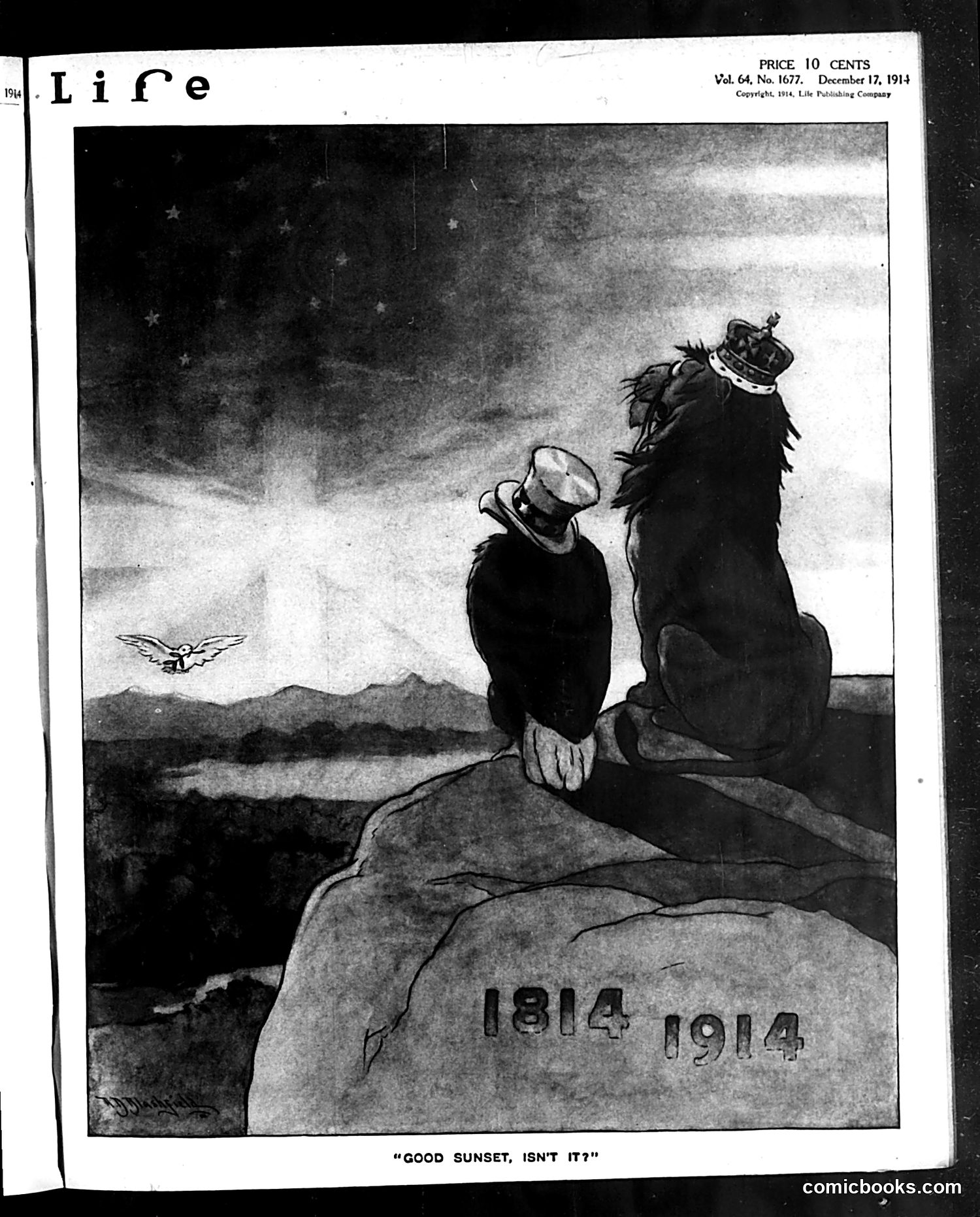
This political cartoon depicts two figures in formal dress standing on a rock marked "1814" and "1914"—marking the centennial of the War of 1812. The caption reads "Good Sunset, Isn't It?" The figures appear to represent Britain and America, shown as an older couple peacefully observing the sunset together. A small airplane flies in the distance, suggesting modern military technology. The satire celebrates 100 years of peace between the two nations after their 1812 conflict. The contrast between their 1814 antagonism and 1914 friendship—now sharing quiet companionship—humorously underscores the transformation of British-American relations into alliance, particularly relevant as Europe descended into World War I that year.
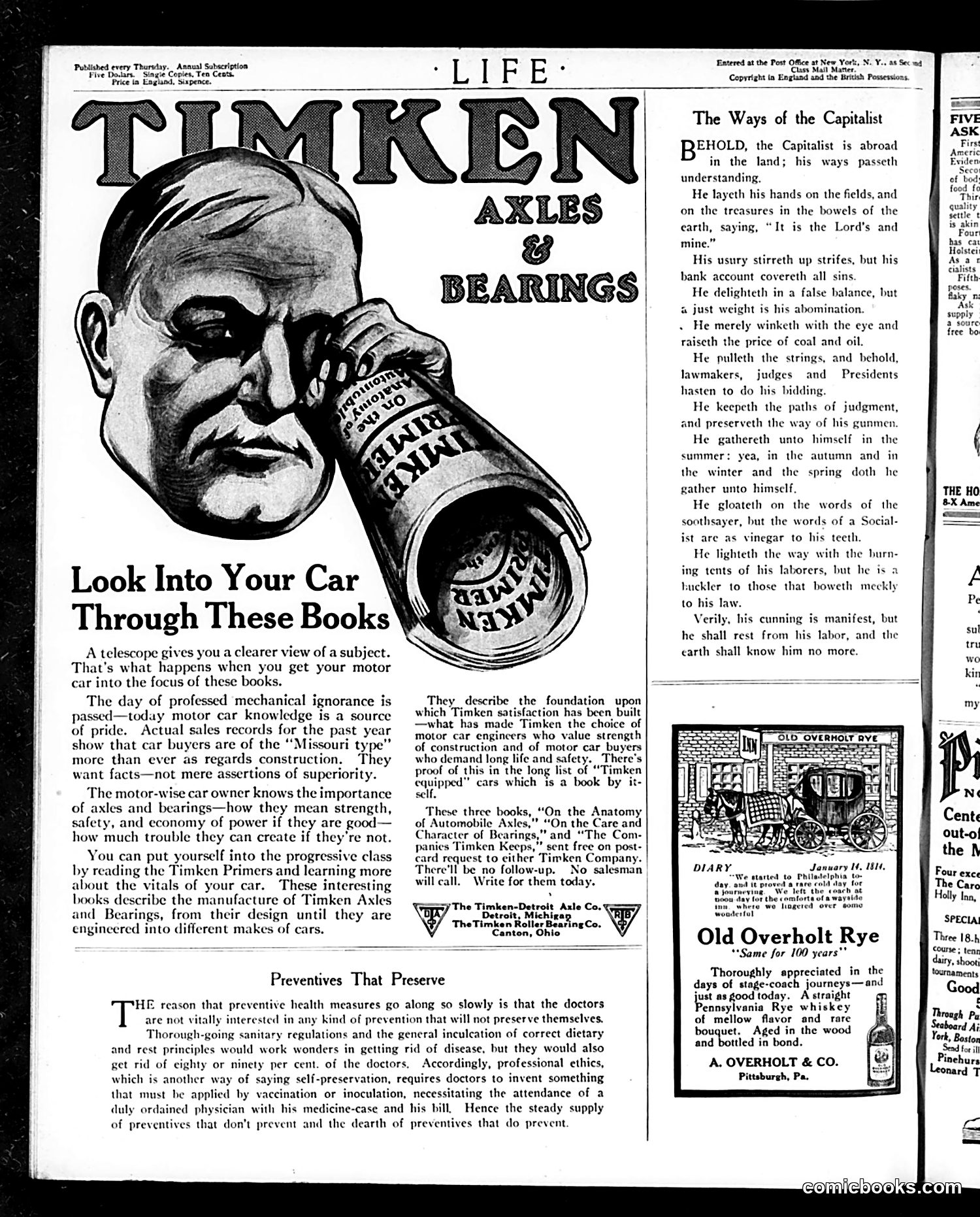
This page combines advertisement and political satire. The main advertisement promotes Timken Axles and Bearings with a caricatured face and product imagery, encouraging car owners to educate themselves about automotive mechanics. The column titled "The Ways of the Capitalist" presents a scathing critique of capitalist behavior through poetic verse. It portrays the capitalist as morally corrupt—exploiting natural resources ("the treasures in the bowels of the earth"), manipulating prices, controlling political figures ("lawmakers, judges and Presidents"), and crushing labor movements. The satire culminates with the prediction that workers and earth itself will outlast capitalist exploitation. This reflects early 20th-century socialist or labor-sympathetic sentiment common in Life magazine's satirical content during this era.
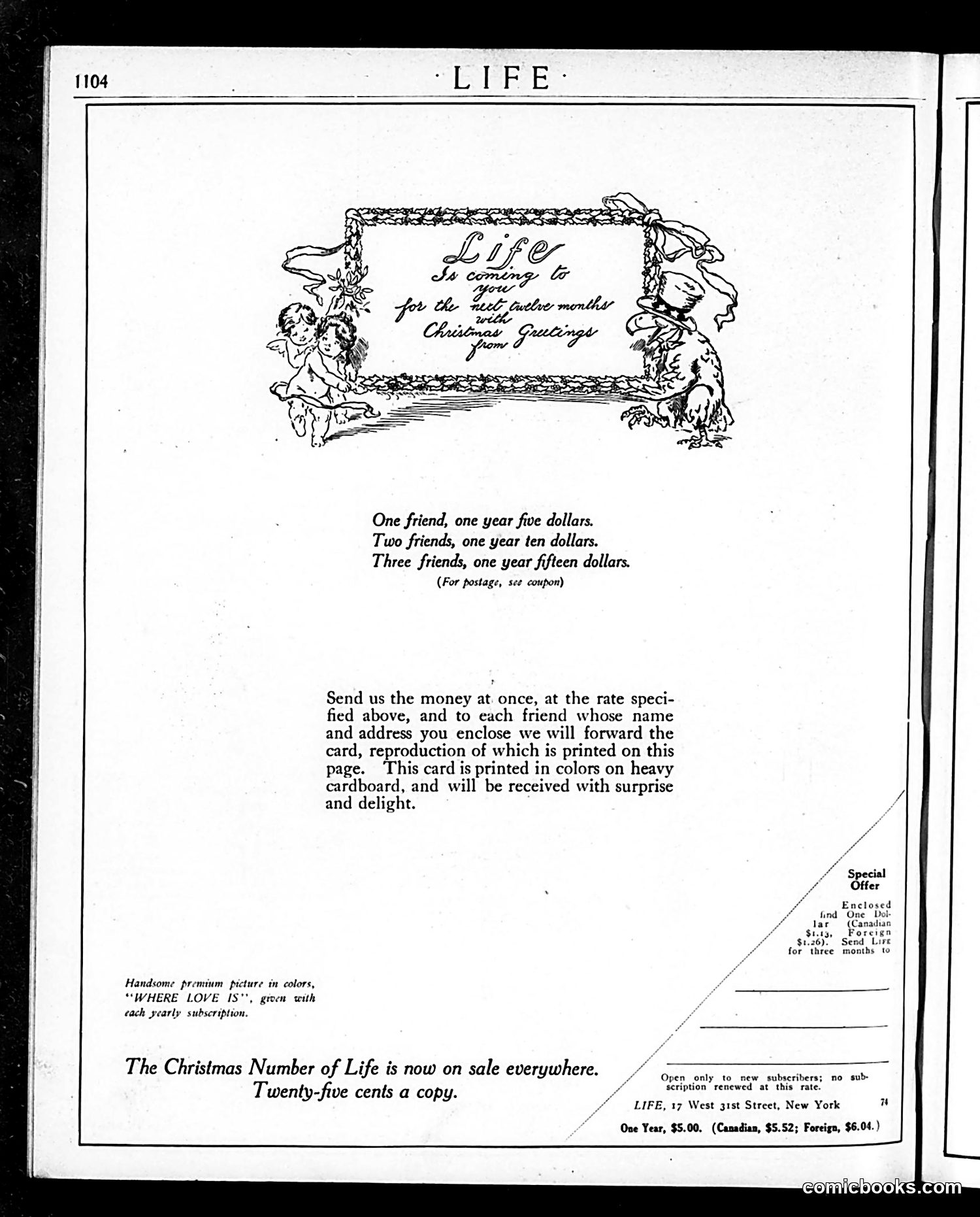
This page is primarily **advertising rather than satire**. It promotes Life magazine subscriptions through a gift-card system, featuring decorative cherubs framing the "Life" masthead. The subscription offer structure is: - One friend: $5/year - Two friends: $10/year - Three friends: $15/year The text explains that subscribers should send money upfront, provide recipient names and addresses, and Life will mail decorative color cards on heavy cardboard to those recipients. The bottom advertises Life's Christmas issue at 25 cents and annual subscriptions at $5 ($5.52 Canadian, $6.04 foreign). The decorative cherubs and framing suggest this is a holiday-season promotional piece designed to encourage gift subscriptions during the Christmas gift-giving period.
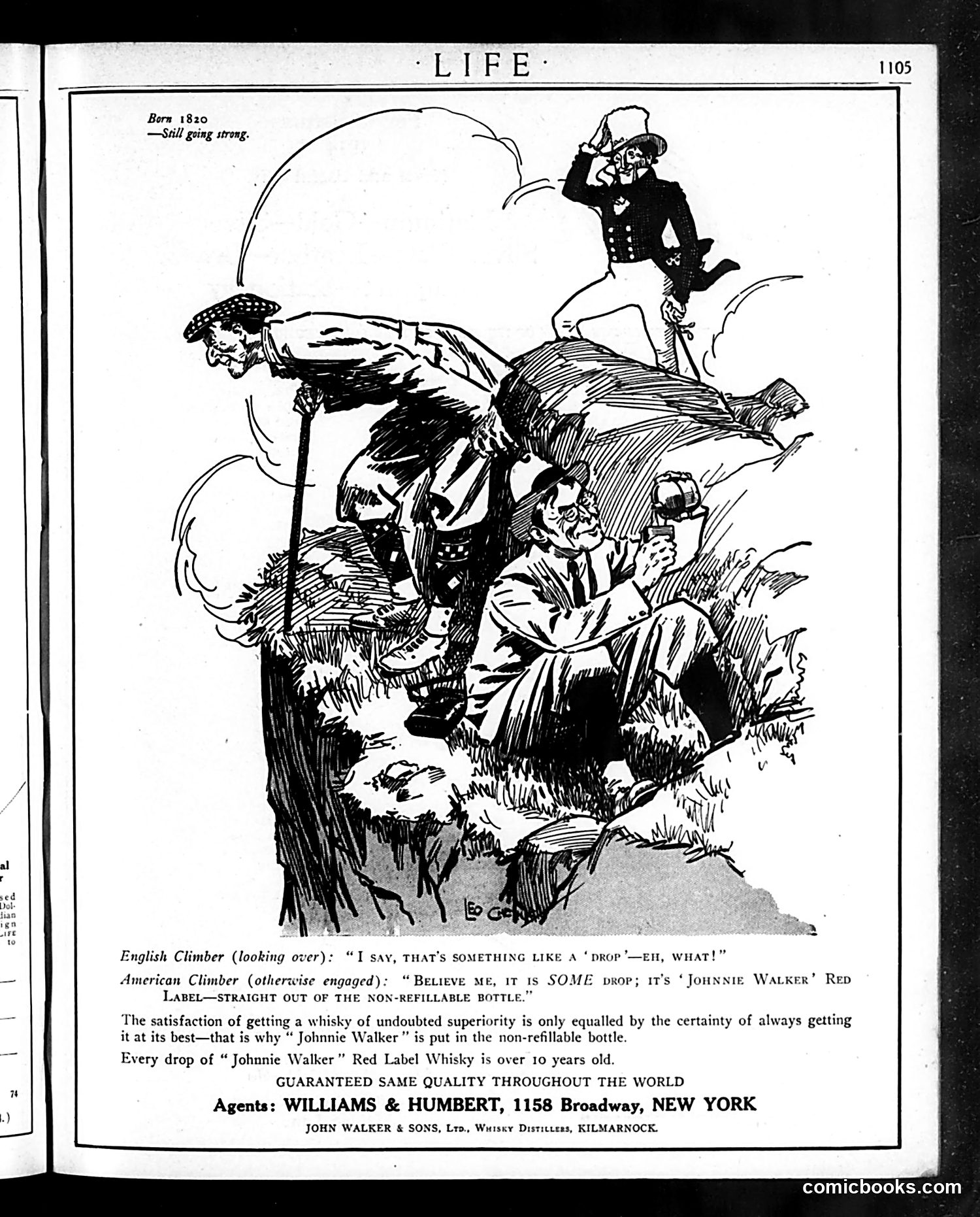
This page is primarily a **Johnnie Walker whisky advertisement** masquerading as editorial content in Life magazine. The cartoon depicts two mountain climbers—labeled "English Climber" and "American Climber"—at a precarious mountain peak. The English climber spots something below, while the American confidently identifies it as a bottle of Johnnie Walker Red Label whisky. The joke plays on stereotypes: the English climber's cautious skepticism versus the American's brash certainty and product loyalty. The ad emphasizes the whisky's "non-refillable bottle" and guaranteed quality "over 19 years old." This reflects early 20th-century advertising practice where satirical magazines like Life accepted paid content framed as humorous editorial material. The transatlantic comparison was a common advertising trope appealing to American consumers' sense of superiority.
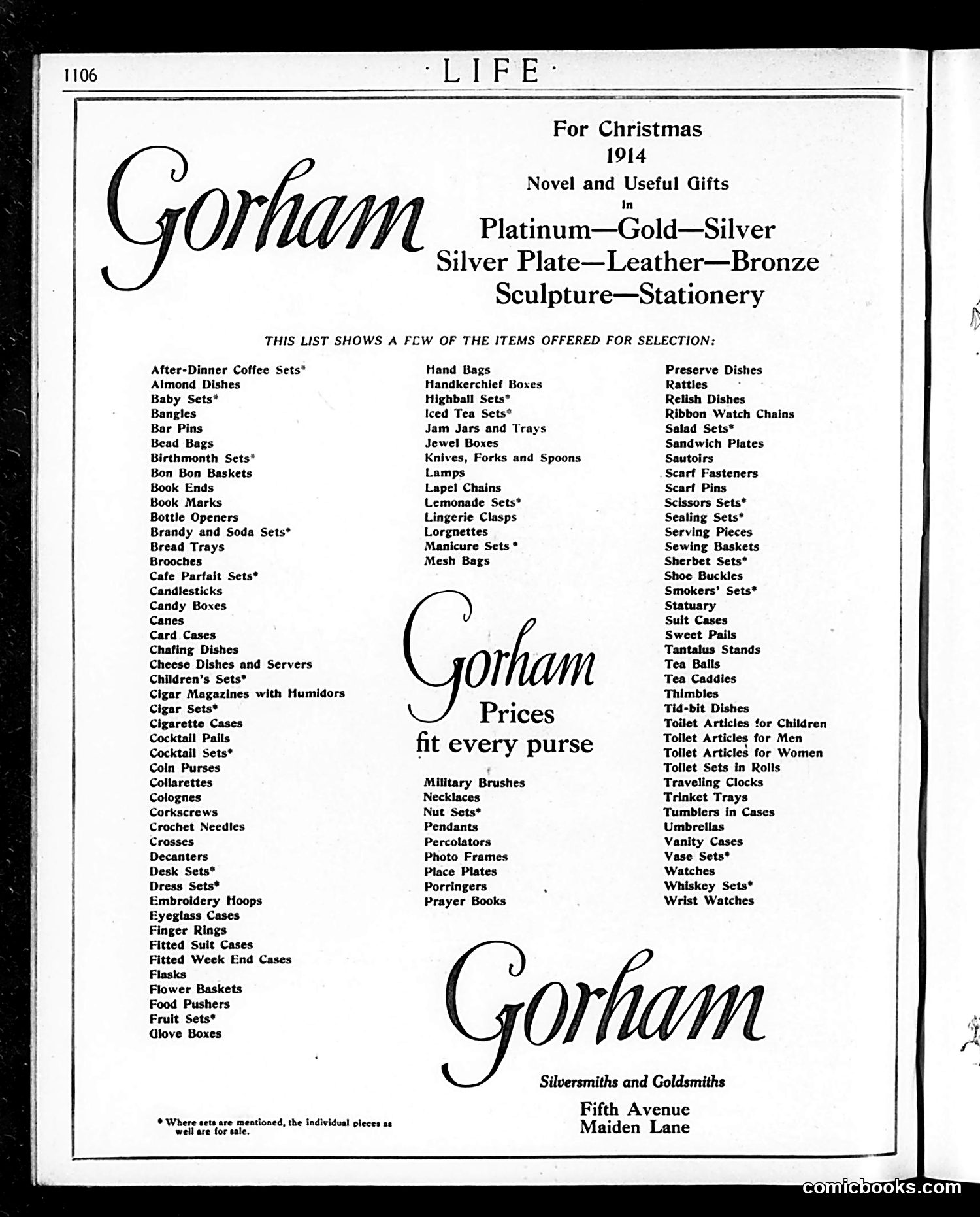
This page is **not a cartoon or satirical content**—it's a **Christmas gift advertisement** from Gorham, a major American silversmith and goldsmith company. The page lists hundreds of luxury gift items available for the 1914 Christmas season, including silverware sets, jewelry, leather goods, and decorative pieces. The advertisement emphasizes that "Gorham Prices fit every purse," suggesting products at various price points. The three instances of the Gorham name in elegant script serve as branding. The company's address (Fifth Avenue and Maiden Lane in New York) appears at bottom. This is straightforward commercial advertising with no political or satirical content—it represents early 20th-century luxury retail marketing in a prestigious publication.
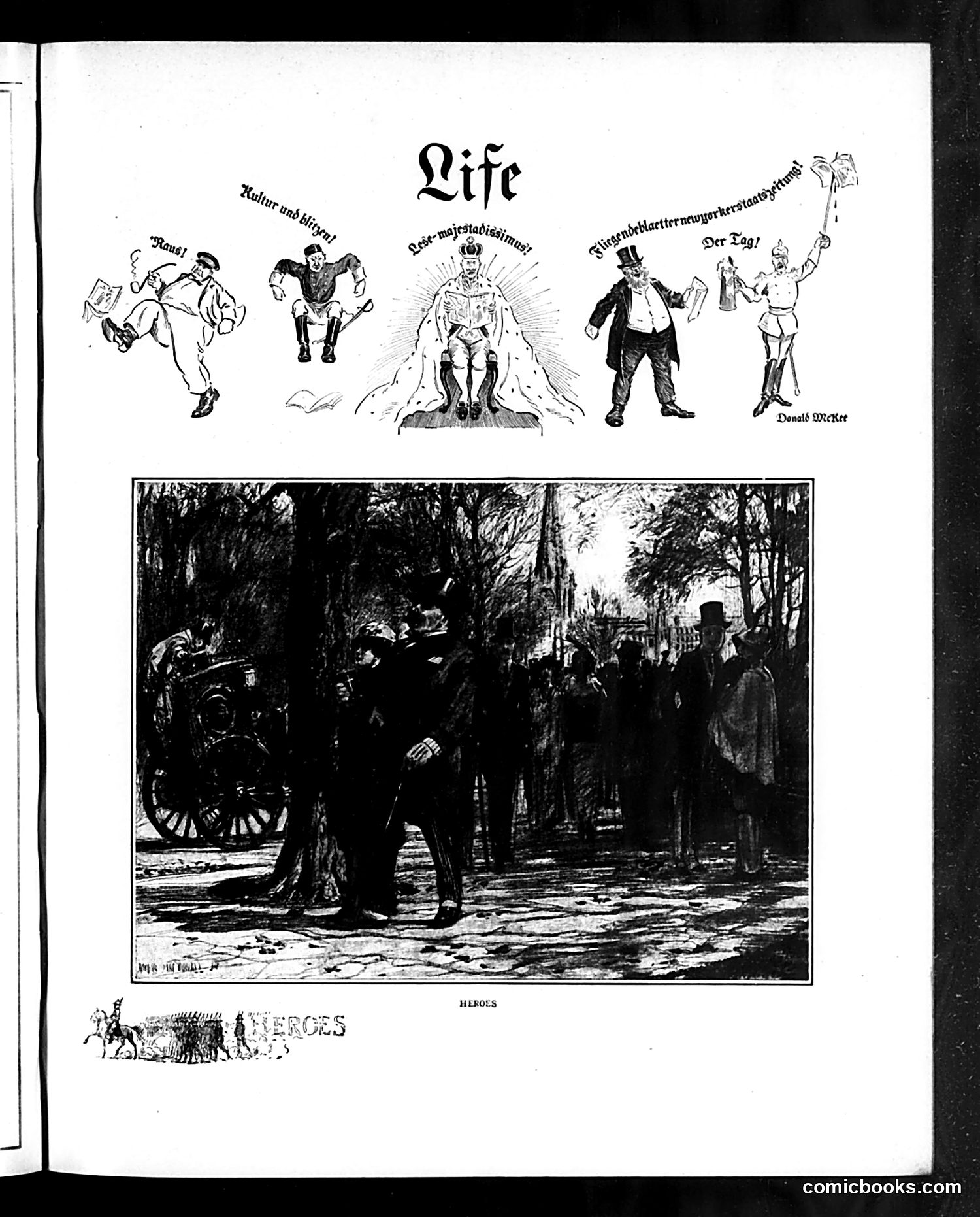
This page presents two sections: a "Life" masthead with five caricatured figures representing different social types or roles (labeled in German), and below, a larger illustration titled "HEROES" depicting what appears to be a military or formal civic ceremony. The top cartoons use exaggerated physical features typical of early 20th-century satirical illustration. The German labels suggest this reflects on European (likely German) society and character types—possibly mocking national stereotypes or social classes. The lower "HEROES" illustration shows uniformed figures in what appears to be an official state or military gathering, with crowds present. Without clearer identification of specific individuals or dates, the exact political reference remains unclear, though the heroic framing appears ironic given the satirical context. The page's overall tone suggests social or political commentary common to *Life* magazine's satirical mission.
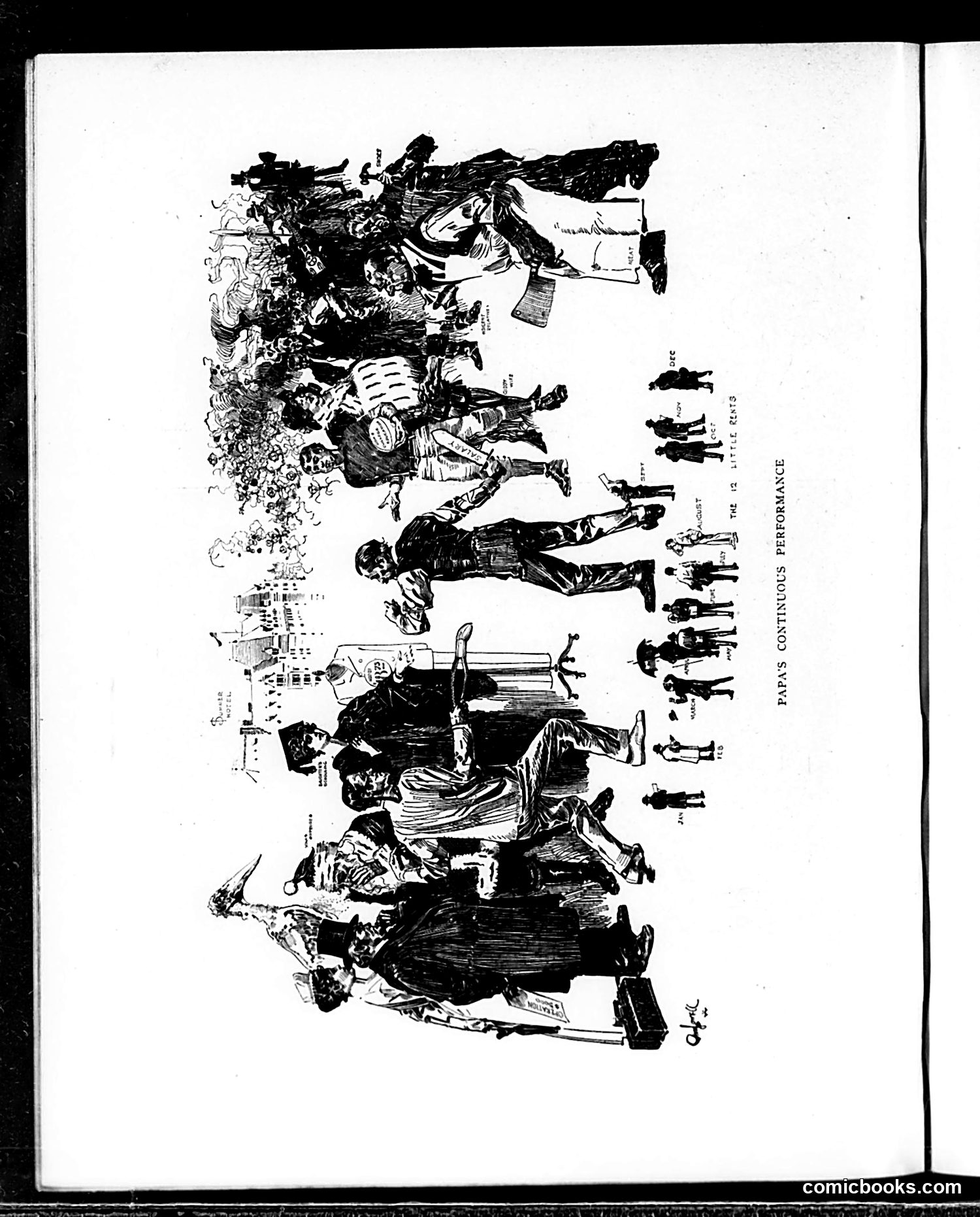
This appears to be a satirical illustration from Life magazine depicting the Paris Exposition (likely the 1900 World's Fair). The image is oriented sideways and shows various figures arranged in a chaotic, crowded composition typical of Life's visual humor style. The caption reads "PARIS EXPOSITION'S PERFORMANCE," suggesting the cartoon mocks the Exposition itself or its attendees. The densely packed, somewhat frenzied arrangement of figures—including what appear to be performers, socialites, and exposition visitors—satirizes either the event's disorder or the pretentious spectacle of international world's fairs. The exaggerated, energetic pen work emphasizes the chaotic nature of the scene. Without clearer identification of specific figures, the precise satirical targets remain unclear.
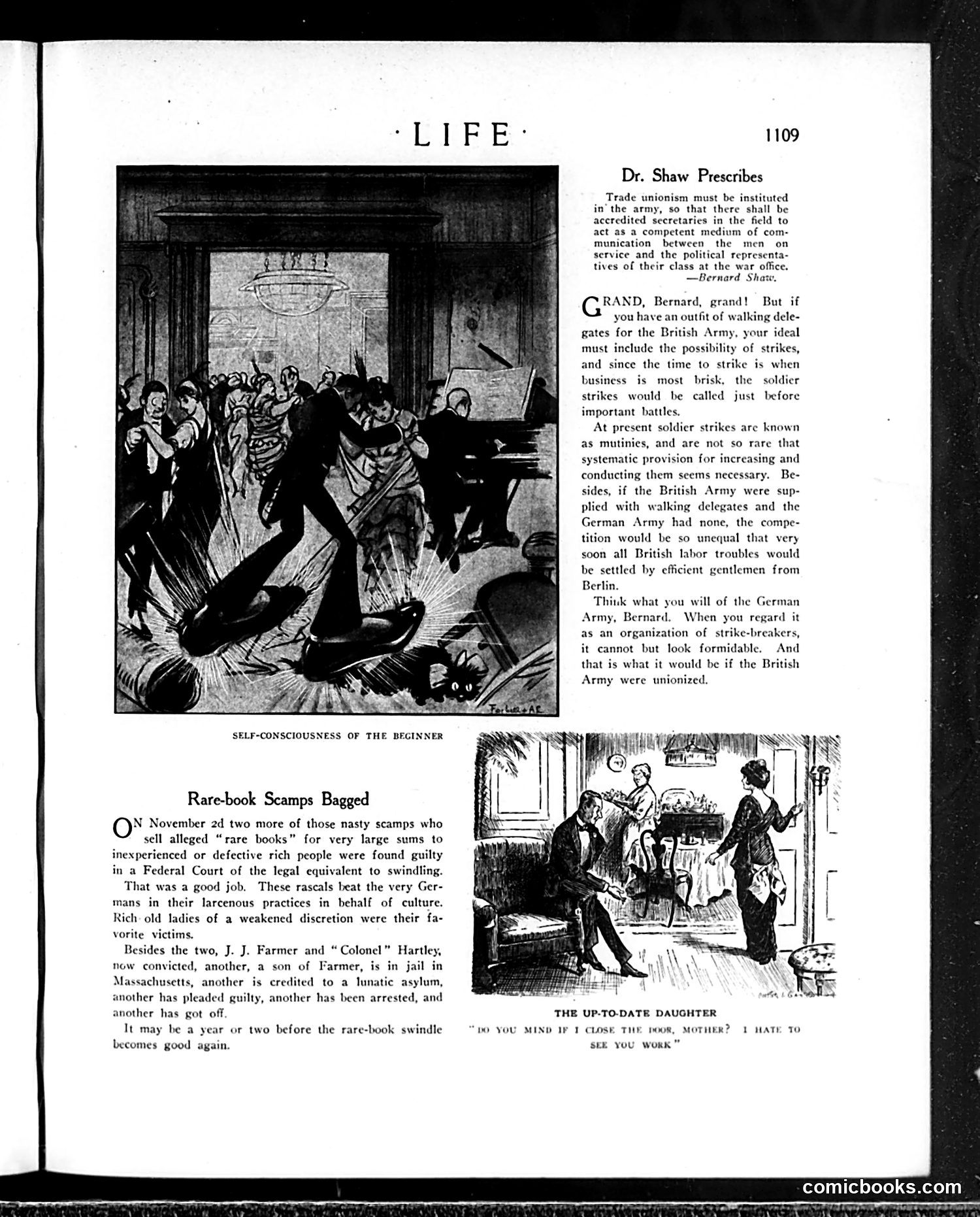
**Top Cartoon ("Self-Consciousness of the Beginner"):** This appears to be a satirical illustration of inexperienced soldiers or recruits in military quarters, depicted in an exaggerated, comedic style. The crowded, chaotic scene suggests the confusion and awkwardness of novice military personnel. **Article "Dr. Shaw Prescribes":** Discusses labor unionization in the military, debating whether British soldiers should have trade union representation and organized strike capacity. The argument compares British Army organization unfavorably to the German Army's hypothetical structure. **"Rare-book Scamps Bagged":** Reports on fraud convictions—con artists selling fake "rare books" to wealthy victims. Several perpetrators faced imprisonment or asylum commitment. **Bottom Illustration ("The Up-to-Date Daughter"):** Depicts a domestic scene with apparent social commentary about modern women and work.
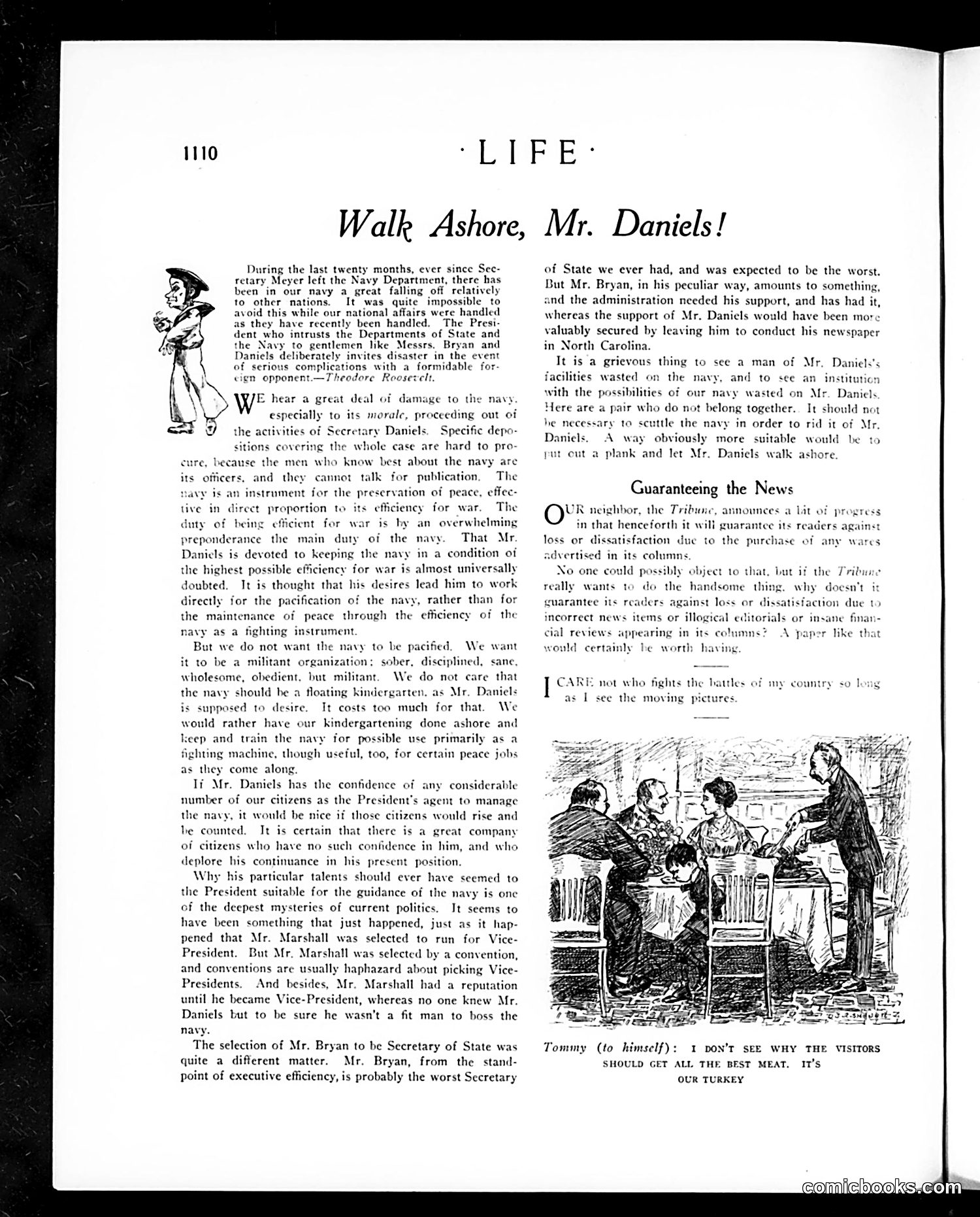
This page critiques Secretary of State William Jennings Bryan's management of the Navy during a period of diplomatic tension. The main article, "Walk Ashore, Mr. Daniels!" argues that Secretary of the Navy Josephus Daniels should resign due to navy inefficiency and lack of public confidence. The cartoon depicts a domestic scene where a character named Tommy complains about the quality of meat served to visitors, saying "I don't see why the visitors should get all the best meat. It's our turkey." This appears to be satirizing wasteful or inequitable resource allocation—likely a commentary on naval mismanagement or bureaucratic inefficiency during this period.
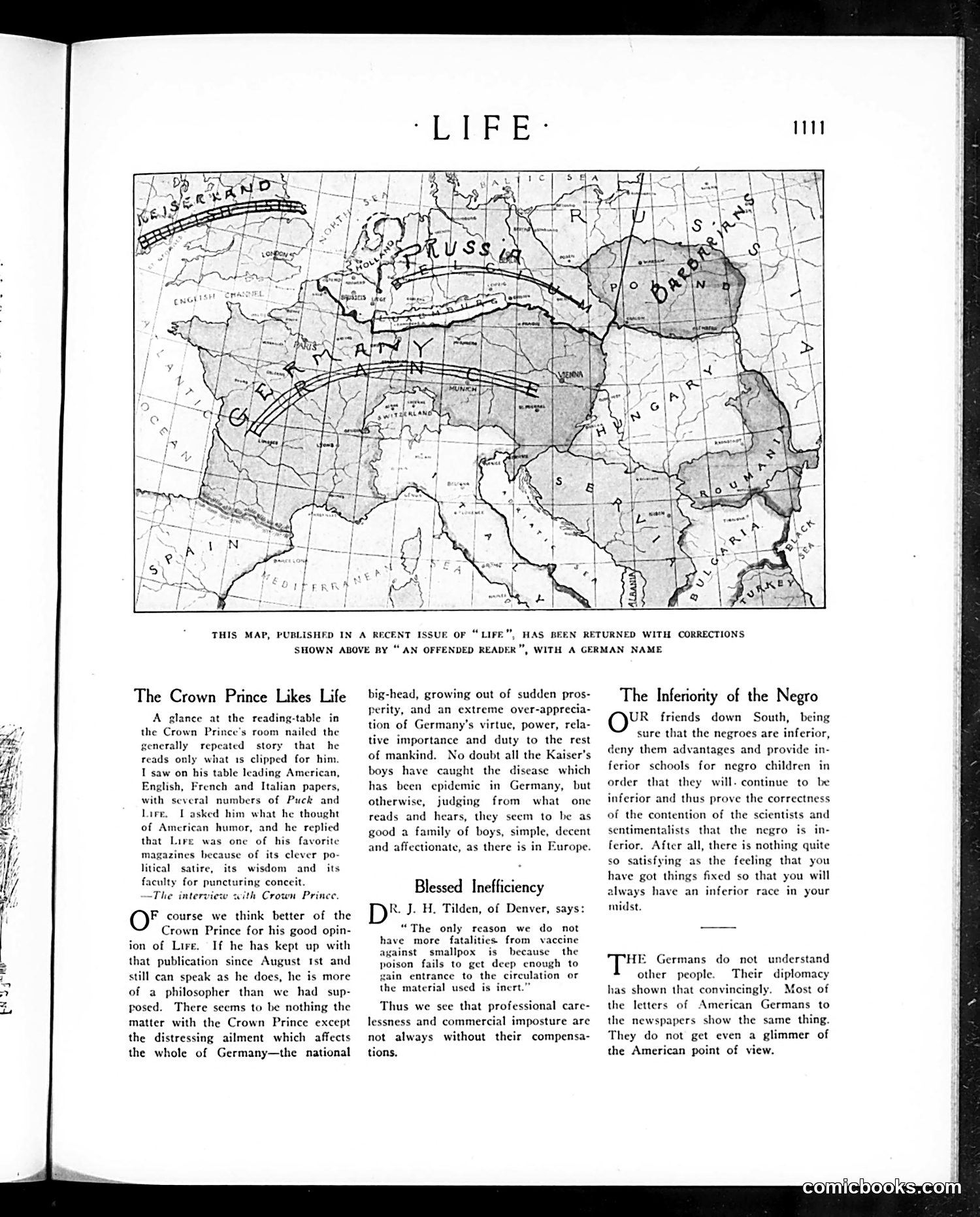
This page displays a map of Europe with corrective marks made by an offended German reader, as noted in the caption. The map appears to have shown territorial claims or borders that a German reader disputed. The three article excerpts below address early-20th-century race science and German perspectives: 1. **"The Crown Prince Likes Life"** discusses the Crown Prince's reading habits, noting his preference for Life magazine's satirical commentary. 2. **"The Inferiority of the Negro"** presents a racist pseudo-scientific argument claiming Black inferiority, advocating inferior schools as justification. 3. **"Blessed Inefficiency"** quotes Dr. J.H. Tilden on vaccine failures, followed by commentary on German diplomatic misunderstandings of American viewpoints. The page satirizes both German nationalism and American racist ideology prevalent in that era.
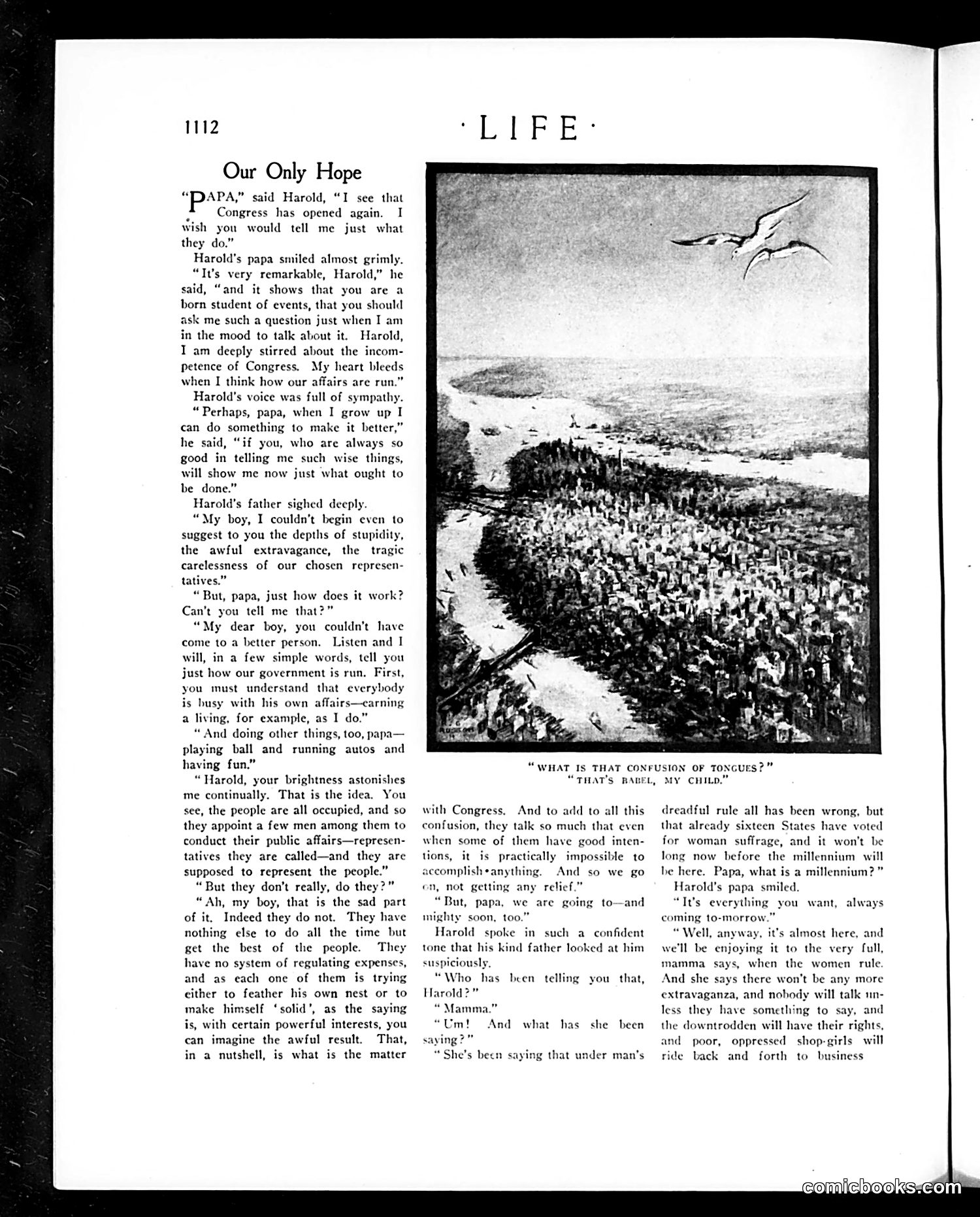
This satirical dialogue shows a father explaining to his son Harold why Congress is ineffective. The father argues that representatives are too busy with personal affairs to properly govern, and lack any system to regulate expenses. Each member pursues self-interest rather than public good—they're "occupied" running their own affairs while supposed to represent constituents. The accompanying photograph depicts a crowded city (likely Washington D.C.), illustrating the chaos referenced in the dialogue. Harold's mother reportedly says change will come through women's suffrage, suggesting female voters as "our only hope" for reform. The satire critiques early 20th-century congressional corruption and inefficiency, implying democratic institutions have failed and require radical intervention—women's participation in politics—to improve governance.
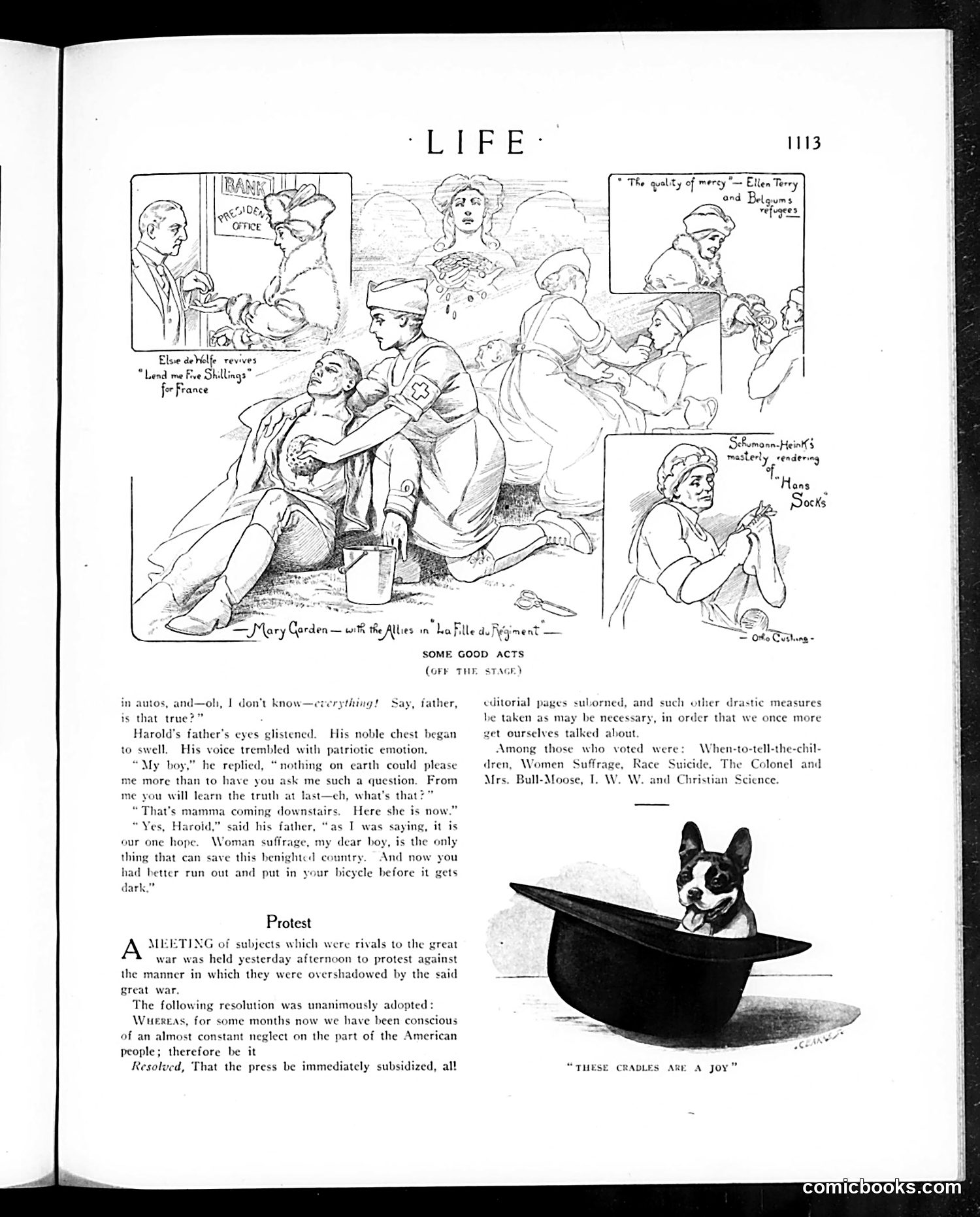
This page satirizes wartime patriotism and sacrifice during what appears to be World War I. The top section, "Some Good Acts (Off the Stage)," depicts civilians performing charitable duties: a man visiting a government office about "Lord me Five Shillings for France," a nurse tending wounded soldiers, and a woman knitting socks—common home-front contributions. The lower section, titled "Protest," mocks a resolution by subjects criticizing American neglect during the war, demanding press subsidization. The cartoons suggest ironic commentary on performative patriotism—people publicly demonstrating support for the war effort while the serious work of actual combat and sacrifice occurs elsewhere. The concluding illustration of a dog in a hat captioned "These Cradles Are a Joy" appears to mock trivial concerns amid wartime urgency.
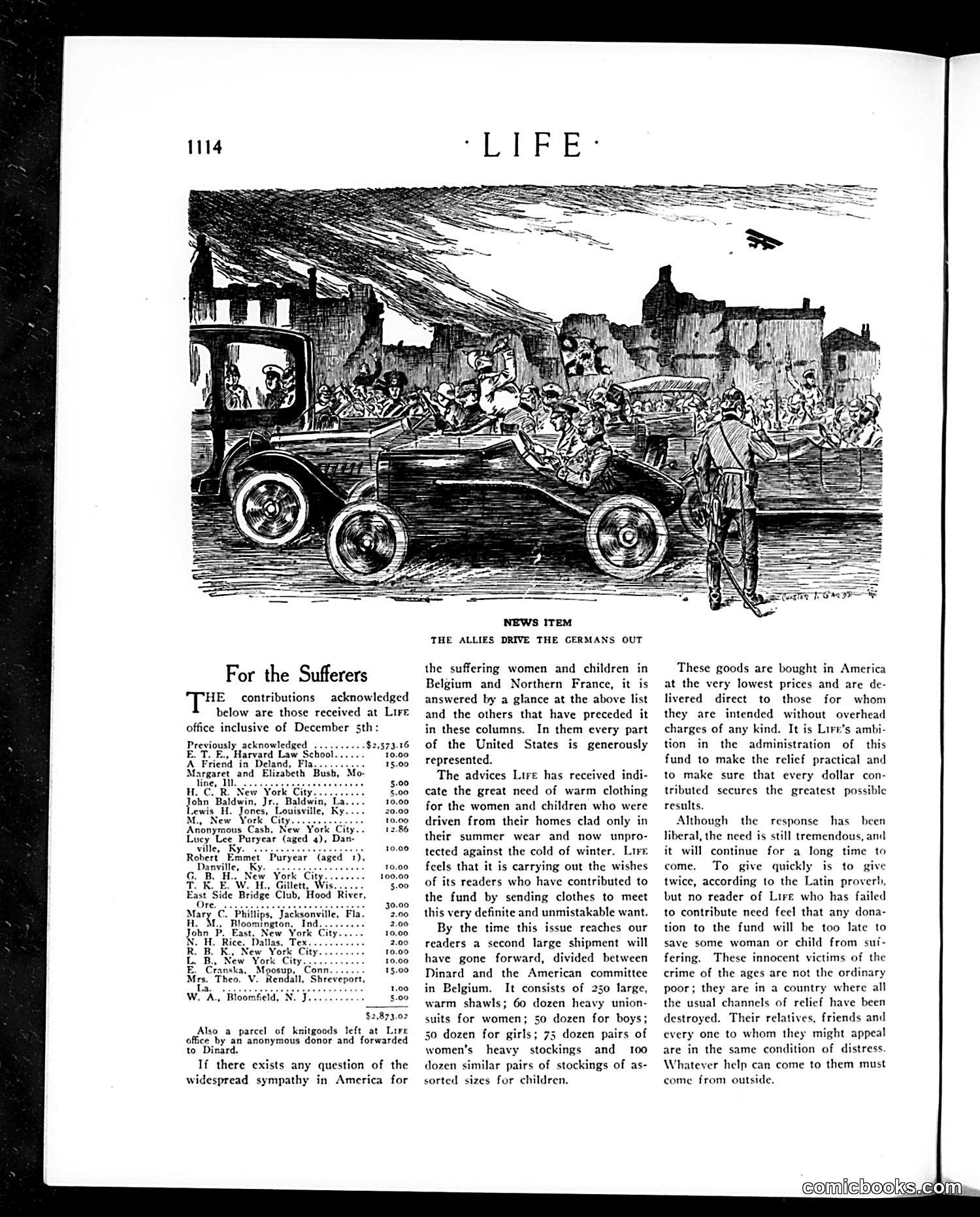
This page combines a news item about WWI relief with a satirical cartoon. The illustration depicts an overcrowded automobile packed with soldiers driving through a war-torn landscape with destroyed buildings in the background. The caption reads "THE ALLIES DRIVE THE GERMANS OUT." **The Satire:** The joke plays on the phrase "drive out" — literally showing the Allies cramming into a single car and physically driving, rather than military action. It's wartime humor mocking the crowded conditions and chaos of war. **The News Item** discusses charitable contributions for Belgian and French women and children displaced by the conflict, listing specific donations and describing shipments of clothing and supplies being sent. The article emphasizes American generosity toward war victims. This reflects 1917-era American WWI support and humanitarian efforts.
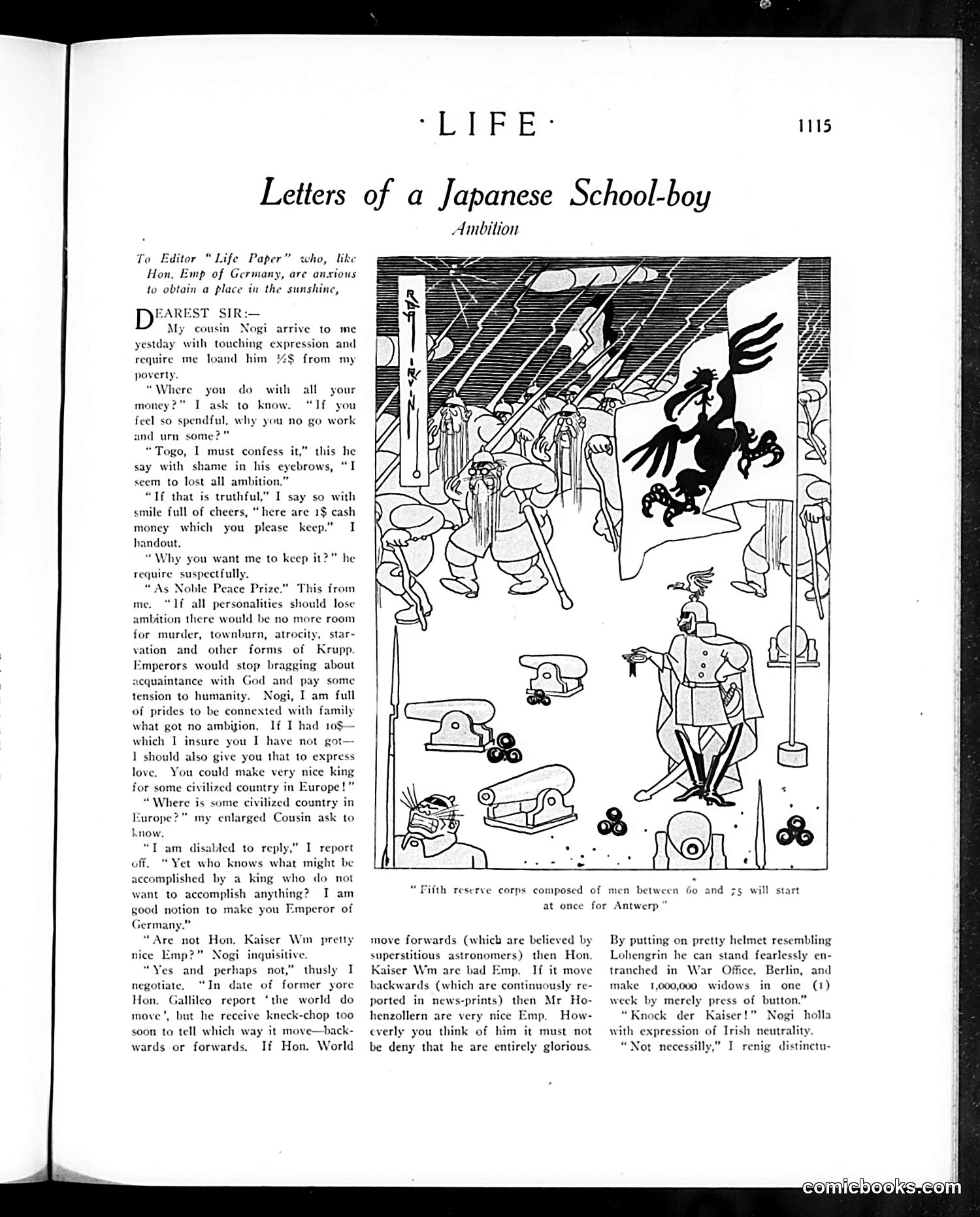
This satirical piece mocks German militarism and Kaiser Wilhelm II through a Japanese schoolboy's naive-seeming letter. The cartoon illustrates military toy soldiers and weapons alongside elderly men in helmets—likely representing Germany's mobilization of aging reserves for the war (the caption mentions "Fifth reserve corps composed of men between 60 and 75"). The satire works through the schoolboy's broken English and feigned innocence: he discusses offering General Nogi (a real Japanese military figure) a "Nobel Peace Prize" for having lost ambition, then sarcastically praises Kaiser Wilhelm for being "entirely glorious" while enabling mass death—"1,000,000 widows in one week by merely press of button." The joke targets German imperialism, militarism's glorification, and the absurdity of aging men being conscripted into warfare. The reference to Galileo and the Earth's motion appears to mock the Kaiser's supposedly unchangeable character. The piece dates to WWI-era Life magazine and uses the Japanese perspective as an outsider's critical lens on European militarism.
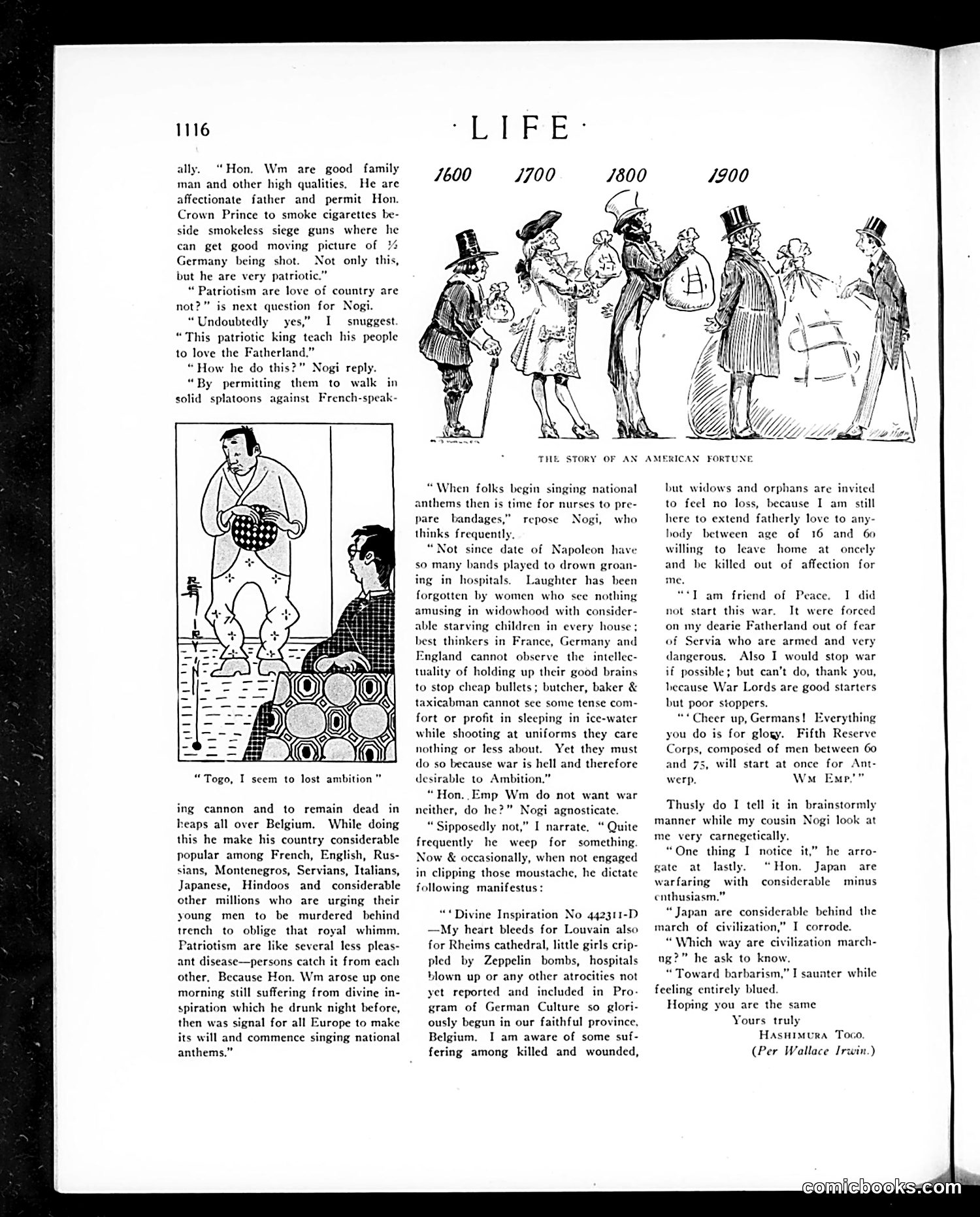
This is anti-German World War I propaganda disguised as a conversation between two Japanese figures—likely General Nogi (historical Russo-Japanese War hero) and the narrator. The satire mocks Kaiser Wilhelm II's claims of reluctant patriotism and peace-loving intentions while Germany wages brutal war. The cartoon ridicules Wilhelm's hypocrisy: he permits his son to photograph warfare for entertainment, claims patriotism requires citizens to die against French forces, and issues manifesto-style declarations expressing "bleeding heart" sympathy for Belgian atrocities (Louvain, Rheims, Zeppelin bombing) while simultaneously glorifying military ambition as "desirable." The joke relies on broken English ("are" for "is," "glogy" for "glory") attributed to the Japanese speakers, mocking their foreignness while using them as tools to expose German leadership's cynical manipulation of nationalism and sacrifice. The timeline illustrations (1600-1900) appear to show evolving warfare technology and societal militarization. This is sharply critical wartime commentary aimed at American readers.
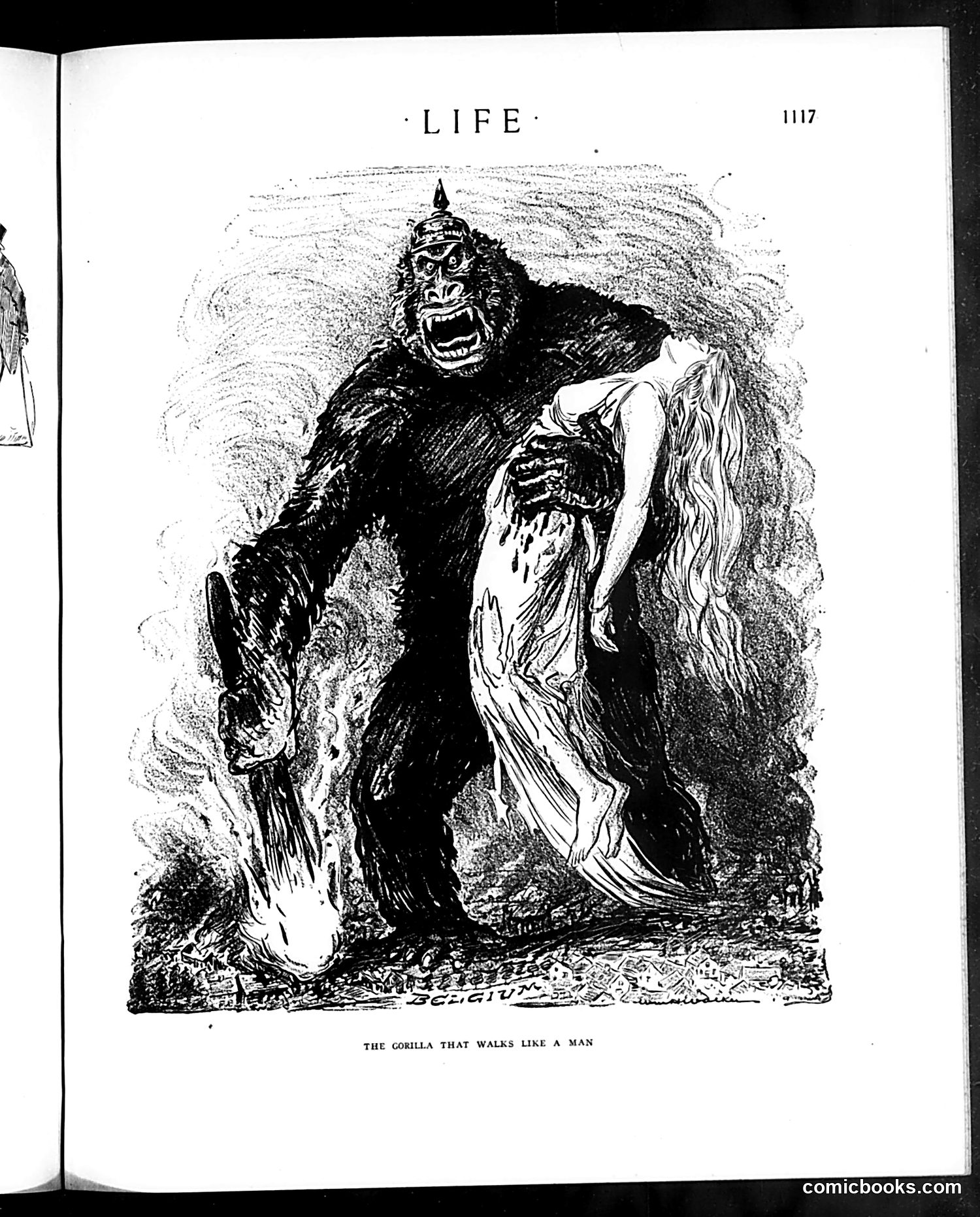
This satirical cartoon from *Life* magazine depicts a menacing gorilla in an aggressive posture with a woman in classical dress. The caption "The Gorilla That Walks Like a Man" suggests social commentary on evolutionary theory or debates about human nature versus animal brutality. Given the early 20th-century context, this likely references either: anxieties about Darwinian evolution and "primitive" human behavior, or possibly commentary on masculinity and civilized versus brutal male conduct. The woman's vulnerable position emphasizes the threat posed by unconstrained animal nature. The specific satirical target—whether a political figure, social movement, or general human tendency—remains unclear without additional context from the magazine's publication date.
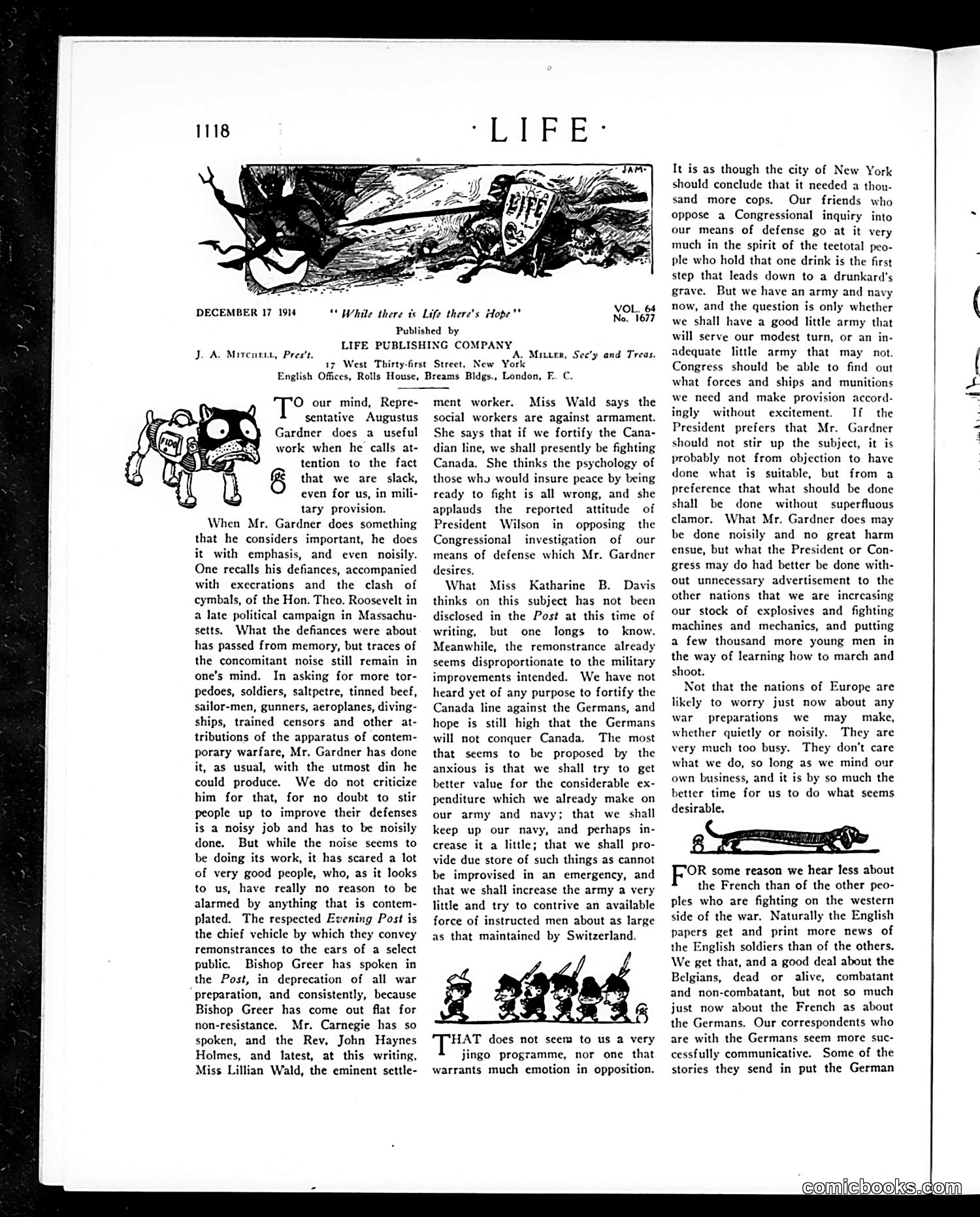
This editorial cartoon page mocks prominent pacifists opposing U.S. military expansion during WWI. Representative Augustus Gardner advocated for increased defense spending (torpedoes, soldiers, aeroplanes, etc.), but faced pushback from prominent non-resistance advocates including Bishop Greer, Andrew Carnegie, Rev. John Haynes Holmes, and settlement-house worker Lillian Wald. Life ridicules their alarmism, comparing their objections to opposing a city hiring additional police officers—suggesting the proposed measures (modest army increases, naval maintenance, supplies) are reasonable, not jingoistic warmongering. The magazine portrays pacifists as emotionally overwrought, using exaggerated analogy: they respond to minor defense proposals as if one drink inevitably leads to drunkenness and death. The cartoons (a grotesque figure and soldiers) reinforce mockery of the pacifist position during a world at war.
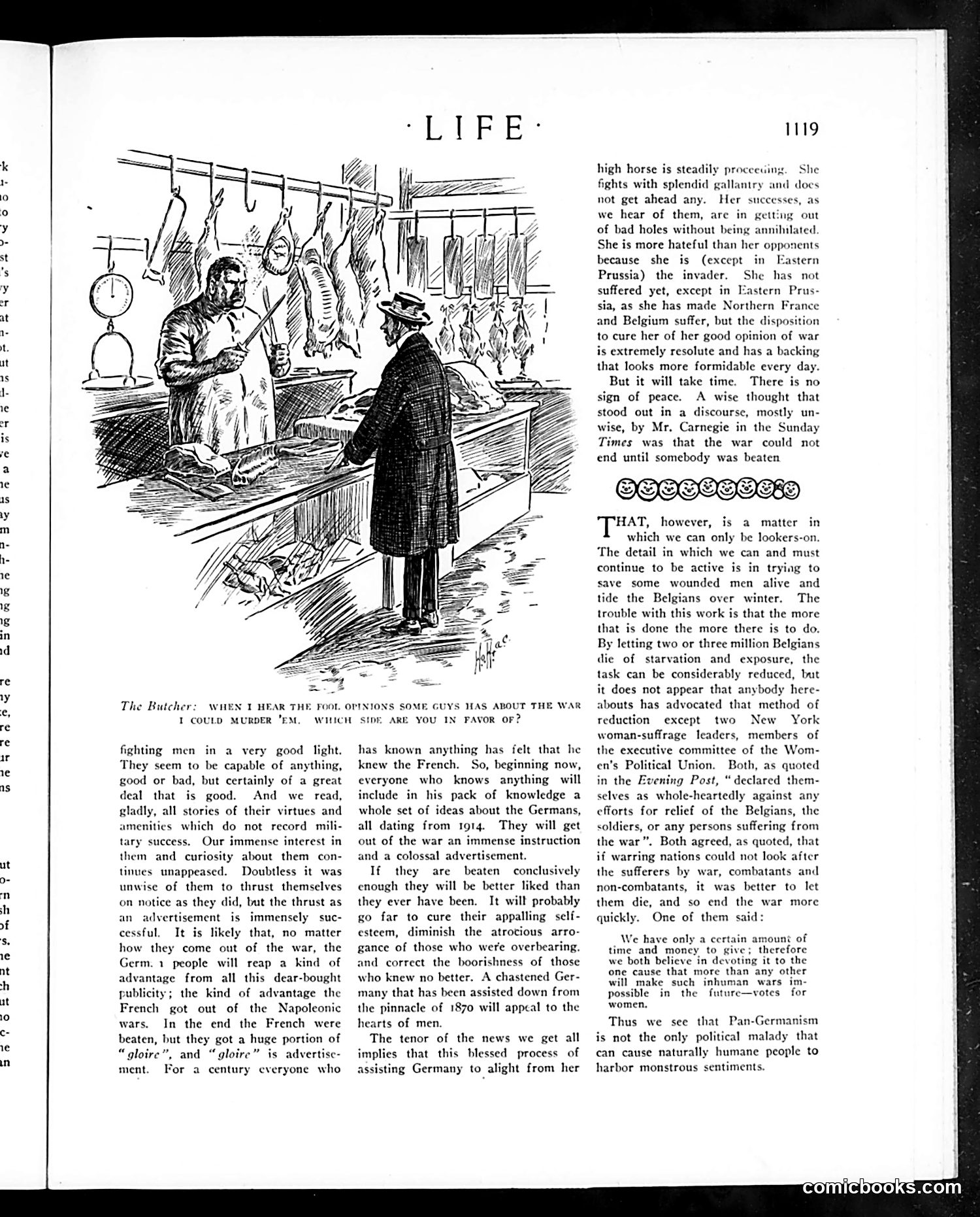
**The Cartoon:** The illustration shows a butcher shop scene where a butcher asks a well-dressed customer, "When I hear the foot opinions some guys has about the war I could murder 'em, which side are you in favor of?" The satire targets casual wartime conversation—the butcher represents working-class people debating the conflict, while his customer represents educated opinion-holders. **Historical Context:** This appears to be from early WWI (references to 1914, Belgium's suffering, Germany's "high horse" since 1870). The article discusses German military conduct and argues that Germany's defeat would ultimately benefit them through humility and international reputation ("gloire"). **The Satire's Point:** The joke mocks how ordinary people adopt strong opinions about complex geopolitical matters. The butcher's willingness to "murder" over war opinions—ironically stated in a butcher shop—suggests the absurdity of civilians passionate about abstract foreign policy disputes they barely understand. The accompanying text criticizes two New York woman-suffrage leaders for opposing Belgian relief efforts, illustrating how political ideology could override humanitarian concerns.
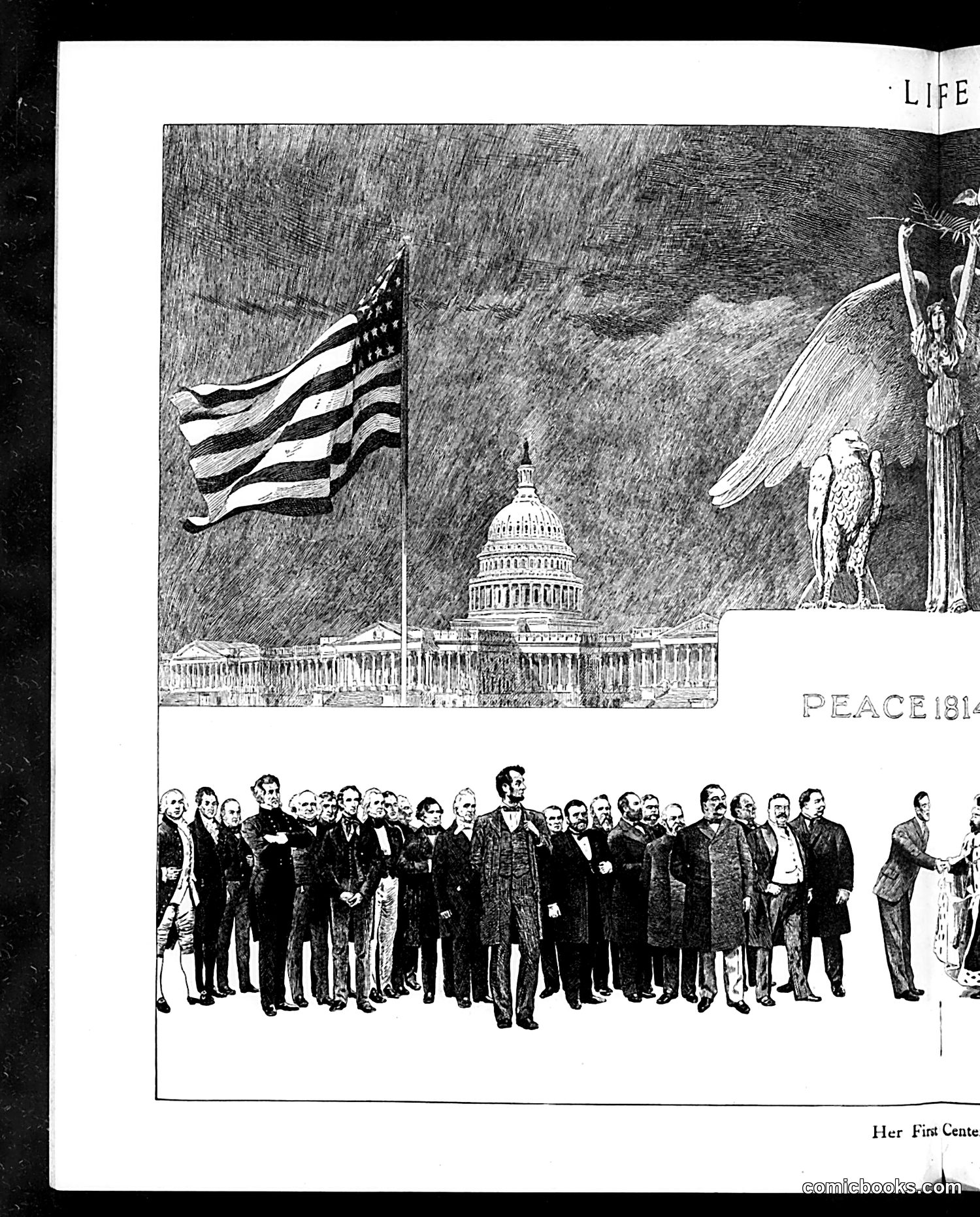
This appears to be a satirical illustration about American peace and governance. The image shows: **Upper panel:** The U.S. Capitol building with an American flag and an eagle perched on a classical column, set against stormy skies—symbolizing national authority and stability. **Lower panel:** A group of formally-dressed men (likely diplomats, politicians, or world leaders) standing together, appearing to represent international peace negotiations or a diplomatic gathering. The caption fragment reads "PEACE ISL[AND]" and "Her First Cente[nary]," suggesting this commemorates America's centennial (around 1876) and depicts hopes for international peace through American leadership. The satire likely comments on the optimistic but perhaps naive belief that political gatherings could achieve lasting peace.
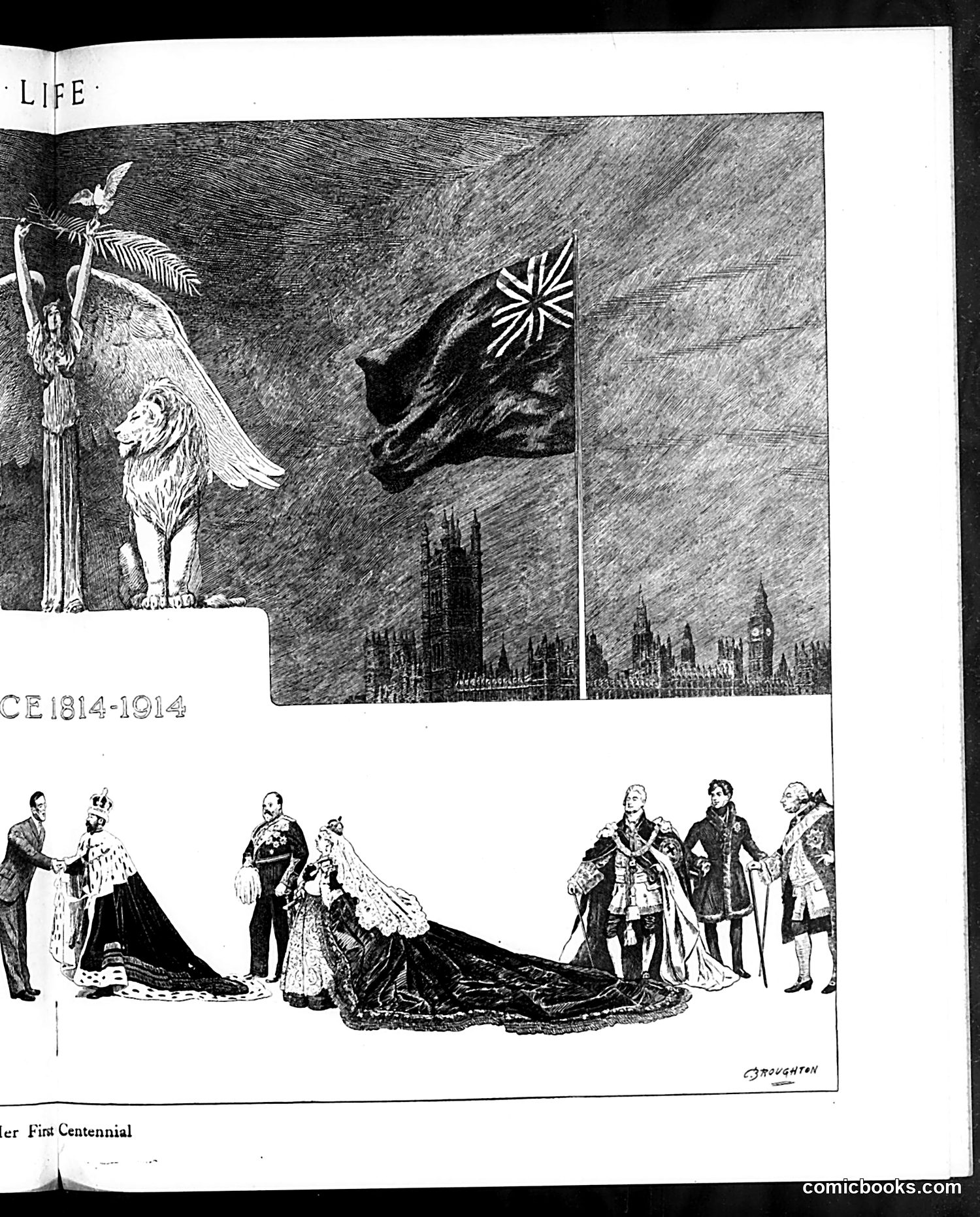
This page, labeled "CE1814-1914," commemorates a centennial (likely the hundredth anniversary of the War of 1812 or British-American relations). The top illustration shows patriotic British symbolism: a winged lion with a palm frond, a flag bearing a sun symbol over Parliament, and the Houses of Parliament below—suggesting British power and stability. The bottom scene depicts formal royal or diplomatic ceremony, with figures in elaborate ceremonial dress and robes. The positioning and formal nature suggest a state occasion or treaty signing. The overall message appears celebratory of Anglo-American relations during this centennial period, using traditional symbols of British authority and pageantry to mark the occasion. The artist's signature reads "O'Rourke" (or similar).
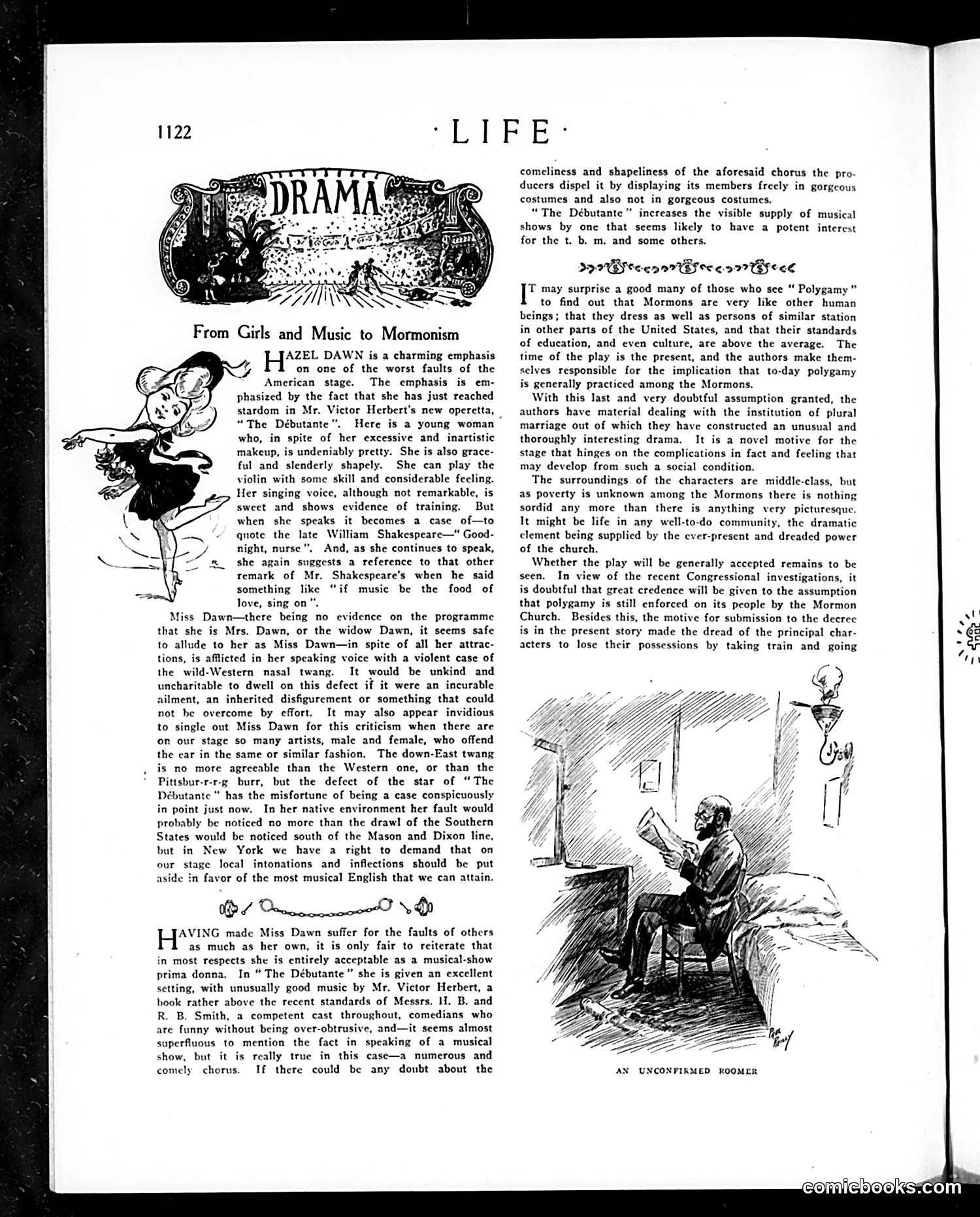
This page reviews Victor Herbert's operetta "The Débutante," starring Hazel Dawn. The critic praises her beauty, grace, and musical abilities but savagely attacks her **"wild-Western nasal twang"**—her regional accent. This was serious criticism for a stage performer; the reviewer argues that professional actors performing in New York must adopt neutral, cultivated speech rather than regional dialects. The satirical cartoon labeled "AN UNCONFIRMED BOOMER" (right) appears to illustrate this criticism, likely showing someone speaking with exaggerated regional dialect. The page also mentions a play called "Polygamy" about Mormons, discussing whether modern Mormons actually practice polygamy—suggesting contemporary theatrical engagement with debates about Mormon culture and American religious pluralism. The overall tone is typical of early-20th-century theater criticism: sophisticated, exacting about performance standards, and somewhat condescending toward regional American speech patterns.
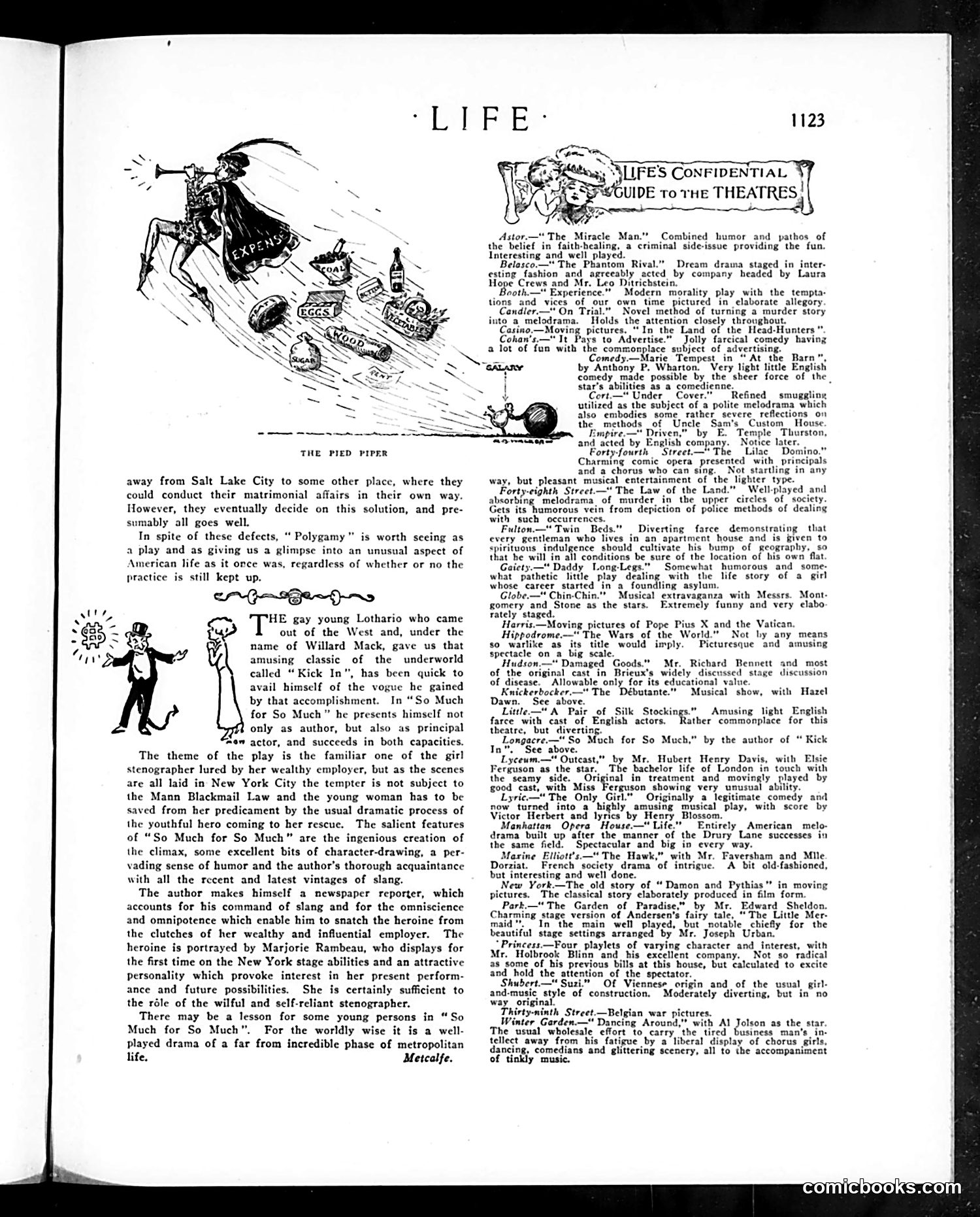
This page from *Life* magazine features a theatrical review section with an illustration titled "The Pied Piper" in the upper left. The cartoon depicts a skeletal, demon-like figure in a cape leading various items (appears to include eggs, bottles, and other objects) down a slope—a visual metaphor for theatrical trends or follies being "led astray." The cartoon likely satirizes how popular theatrical productions seduce audiences and critics into following fashionable but questionable entertainment trends. The "Pied Piper" figure represents either a charismatic performer, a particular theatrical trend, or perhaps theatrical commercialism itself, drawing followers mindlessly downward. The surrounding text reviews contemporary Broadway plays, suggesting the cartoon critiques the theater world's susceptibility to passing fads and the persuasive power of popular but artistically dubious productions—much as the original Pied Piper legend warns of dangerous seduction through charm.
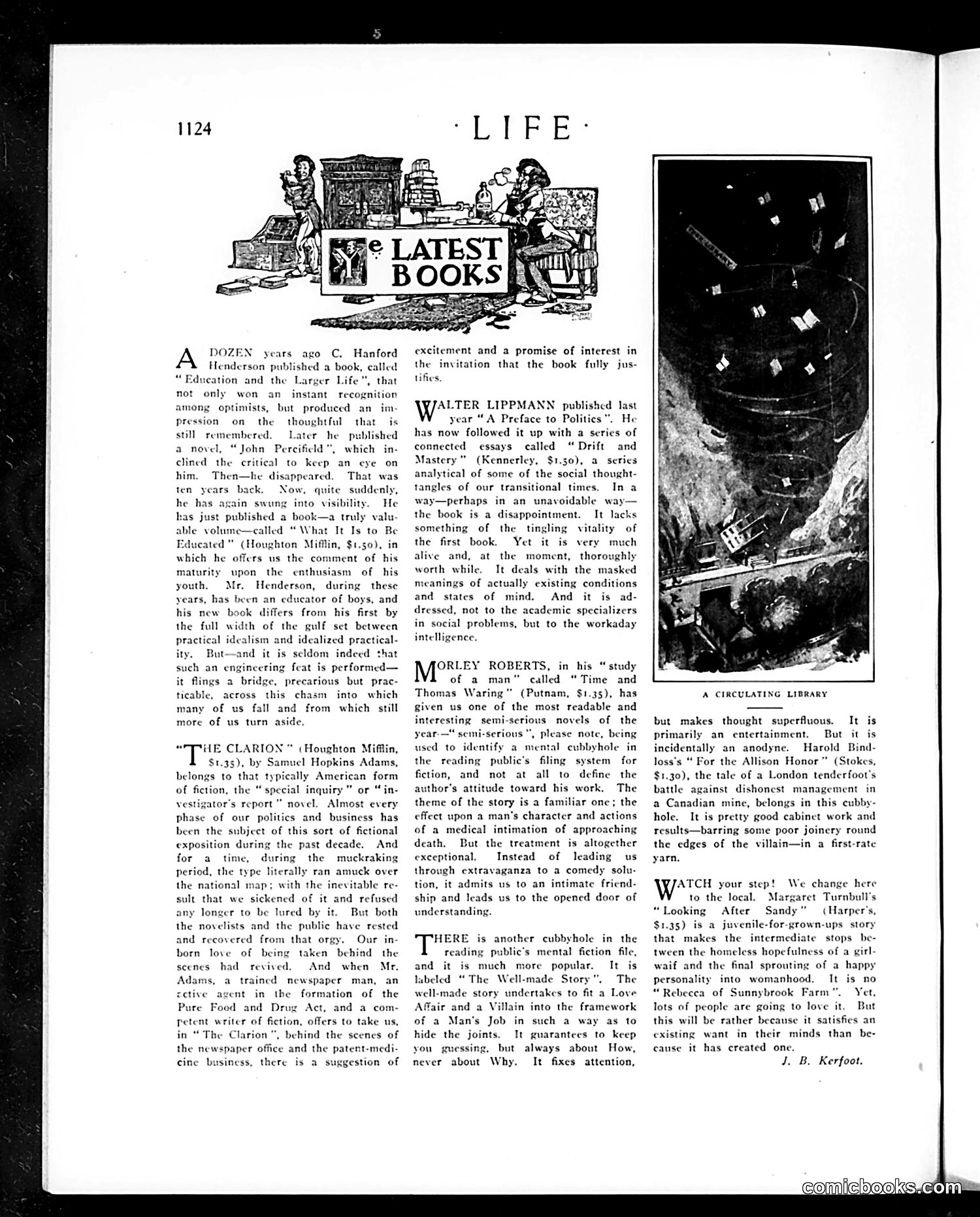
This page is primarily a **book review section** from Life magazine, not a political cartoon page. The header illustration shows figures with books, advertising "Latest Books," but the content consists of literary reviews rather than satirical commentary. The reviews discuss works by contemporary authors (C. Hanford Henderson, Samuel Hopkins Adams, Walter Lippmann, Morley Roberts) and critique the popular fiction genres of the era—particularly the "muckraking" novel (exposés of corruption in politics and business) that had dominated the previous decade. The one small photograph shows "A Circulating Library," illustrating how readers accessed books in this period. The reviews are straightforward literary criticism without apparent satirical intent, reflecting early 20th-century middlebrow cultural discussion rather than political satire.
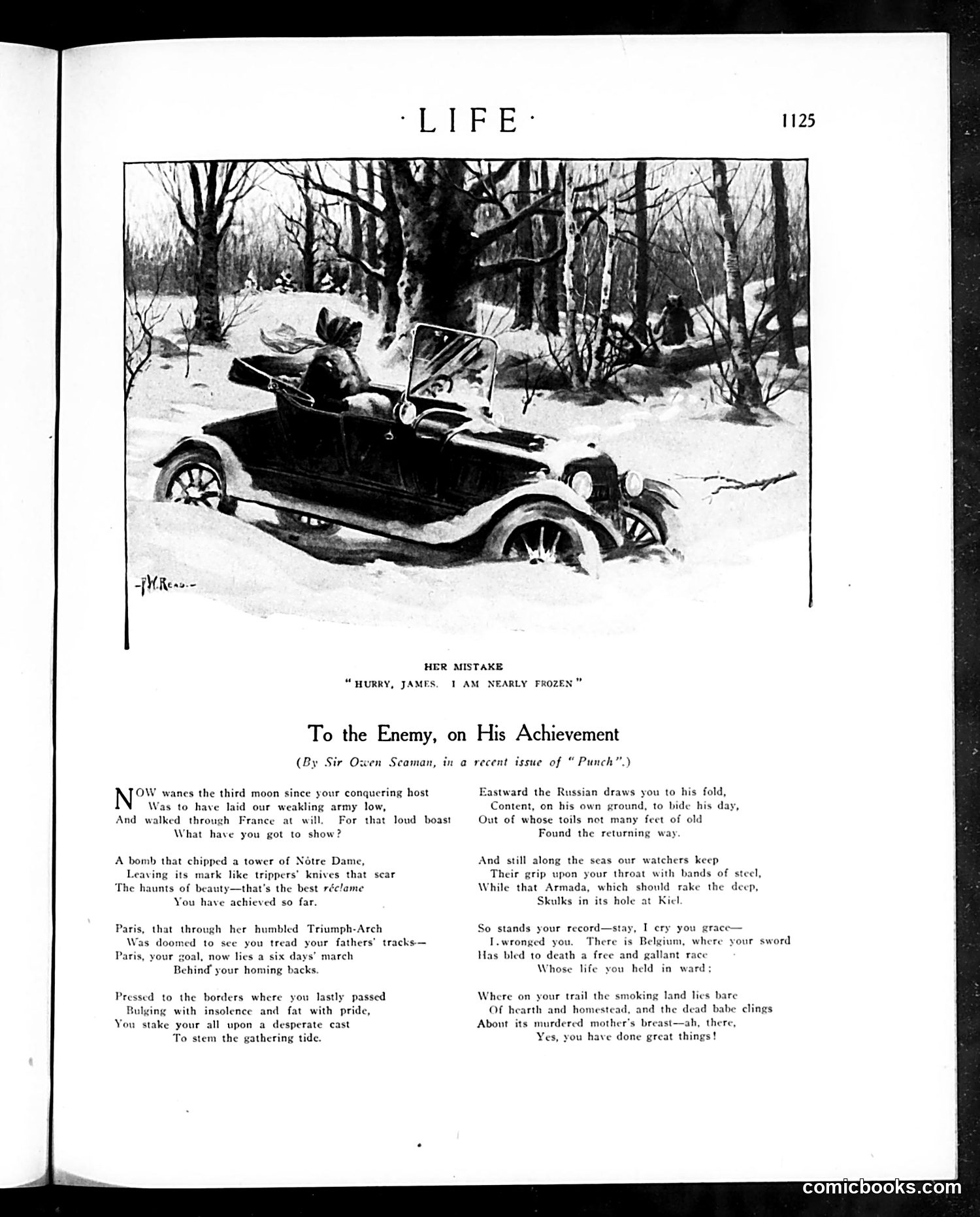
This page from *Life* magazine contains a political poem by Owen Seaman (from *Punch*) addressed to Germany during World War I. The cartoon above depicts a couple stranded in a snowy forest with their car stuck—captioned "Her Mistake: 'Hurry, James. I am nearly frozen'"—likely a visual metaphor for Germany's predicament. The poem is **sarcastic mockery** of German military achievements. Seaman taunts that despite Germany's boasts of conquering France, they've accomplished little: bombing Notre-Dame, failing to take Paris, and now being pushed back toward their borders. He invokes Russian forces to the east and British naval blockade as closing threats. The poem's bitter conclusion sarcastically "credits" Germany's one true achievement: the brutal invasion and devastation of Belgium, where they killed civilians and destroyed infrastructure. The satire's point: Germany's only real accomplishment is atrocity. This represents Allied wartime propaganda depicting Germany as failing militarily while excelling at war crimes.
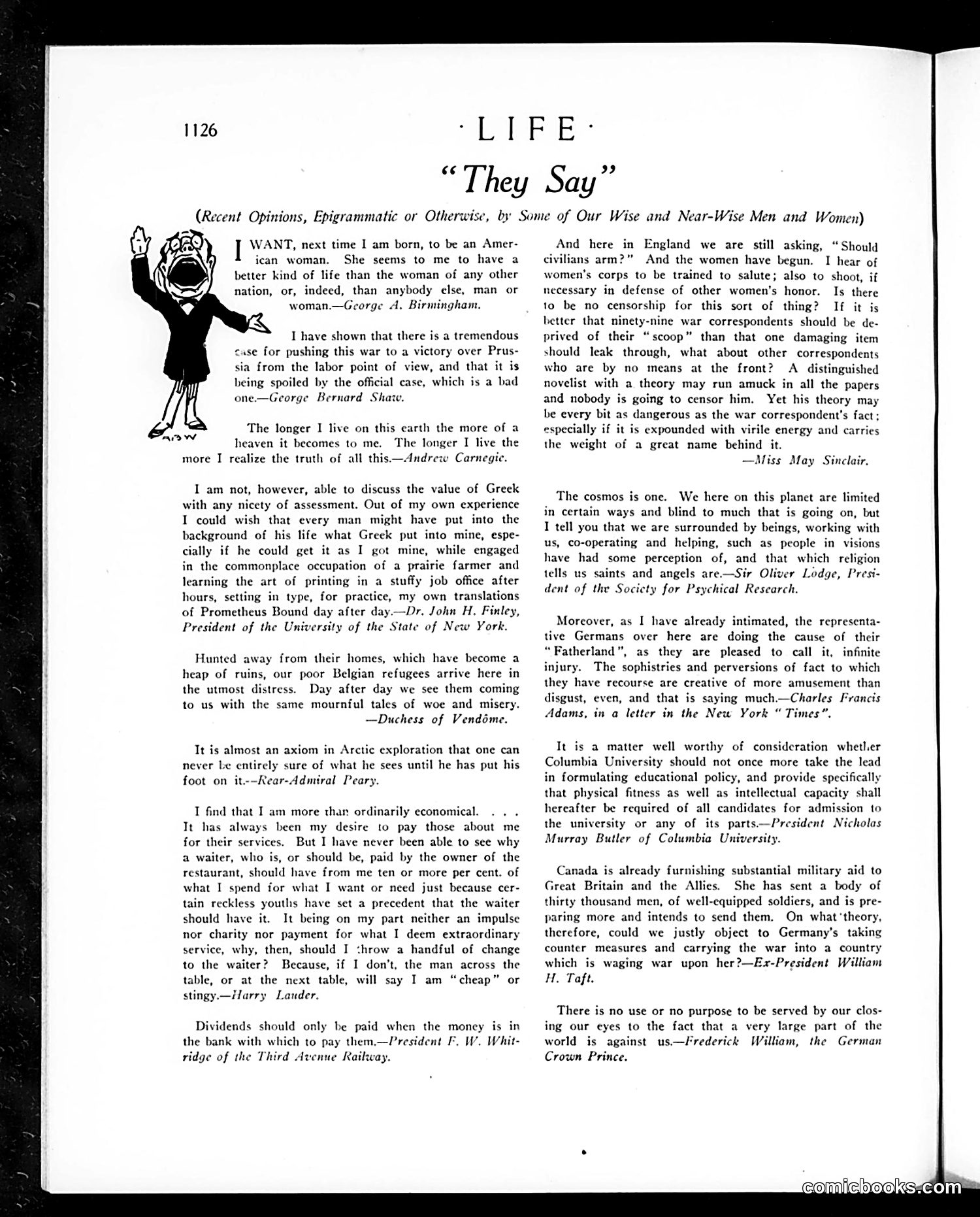
This page collects brief quotations from prominent figures of the era (circa WWI period) on various topics. The small cartoon shows a woman in an exaggerated pose, likely illustrating the opening quote from George A. Birmingham praising American women's superior life conditions. The quotations touch on war-related issues (pushing victory over Prussia, Belgian refugees), tipping etiquette (Harry Lauder's complaint about expected gratuities), economic principles, education, and spiritual matters. Several speakers critique contemporary practices or express philosophical views. The satire lies in presenting these "wise and near-wise" opinions alongside their attributions—some profound, others mundane or self-serving—allowing readers to judge the speakers' actual wisdom. The page satirizes how public figures' pronouncements are treated as gospel despite varying merit, a common Life magazine technique for social commentary.
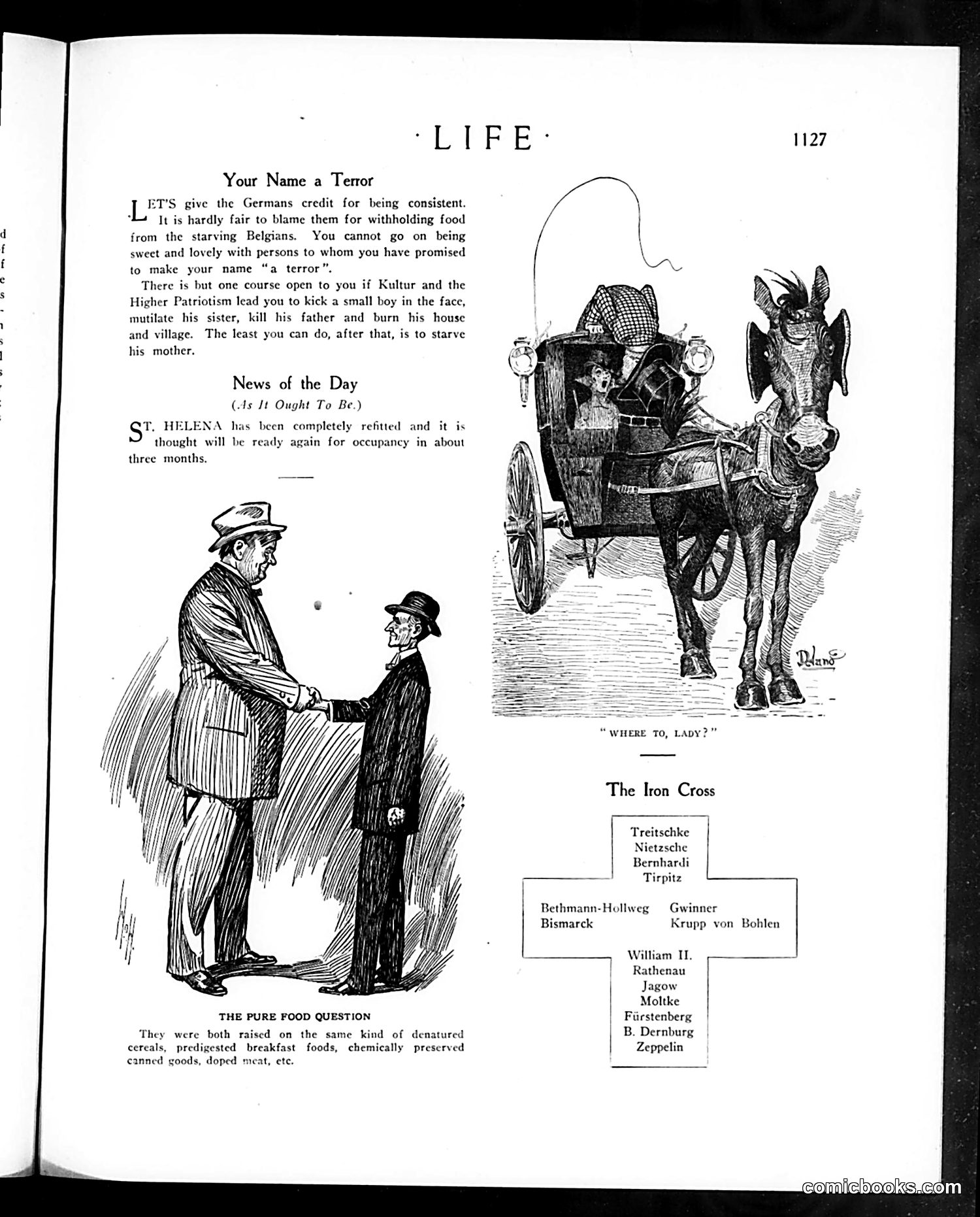
This page from *Life* magazine satirizes German conduct during World War I, specifically the starvation of Belgium under German occupation. **"Your Name a Terror"** is biting sarcasm. It mocks German military philosophy by suggesting that since German leaders (like philosopher Treitschke and military theorist Bernhardi, listed in "The Iron Cross" diagram) proclaimed making Germany's name "a terror," they should logically follow through by starving occupied populations. The piece sarcastically argues: if you've promised brutality, at least be consistent about it. **"The Pure Food Question"** cartoon compares two figures raised on identical denatured, chemically-treated foods—a contemporary American concern about food safety, but likely implying Germans and Belgians were subjected to similar poor conditions under occupation. **"Where to, Lady?"** depicts a well-dressed woman in a luxurious carriage, contrasting sharply with Belgian suffering. "The Iron Cross" genealogy charts German military and political leaders responsible for the occupation policy. The overall message: American readers should recognize German militarism as inherently brutal and consistent with its stated philosophy.
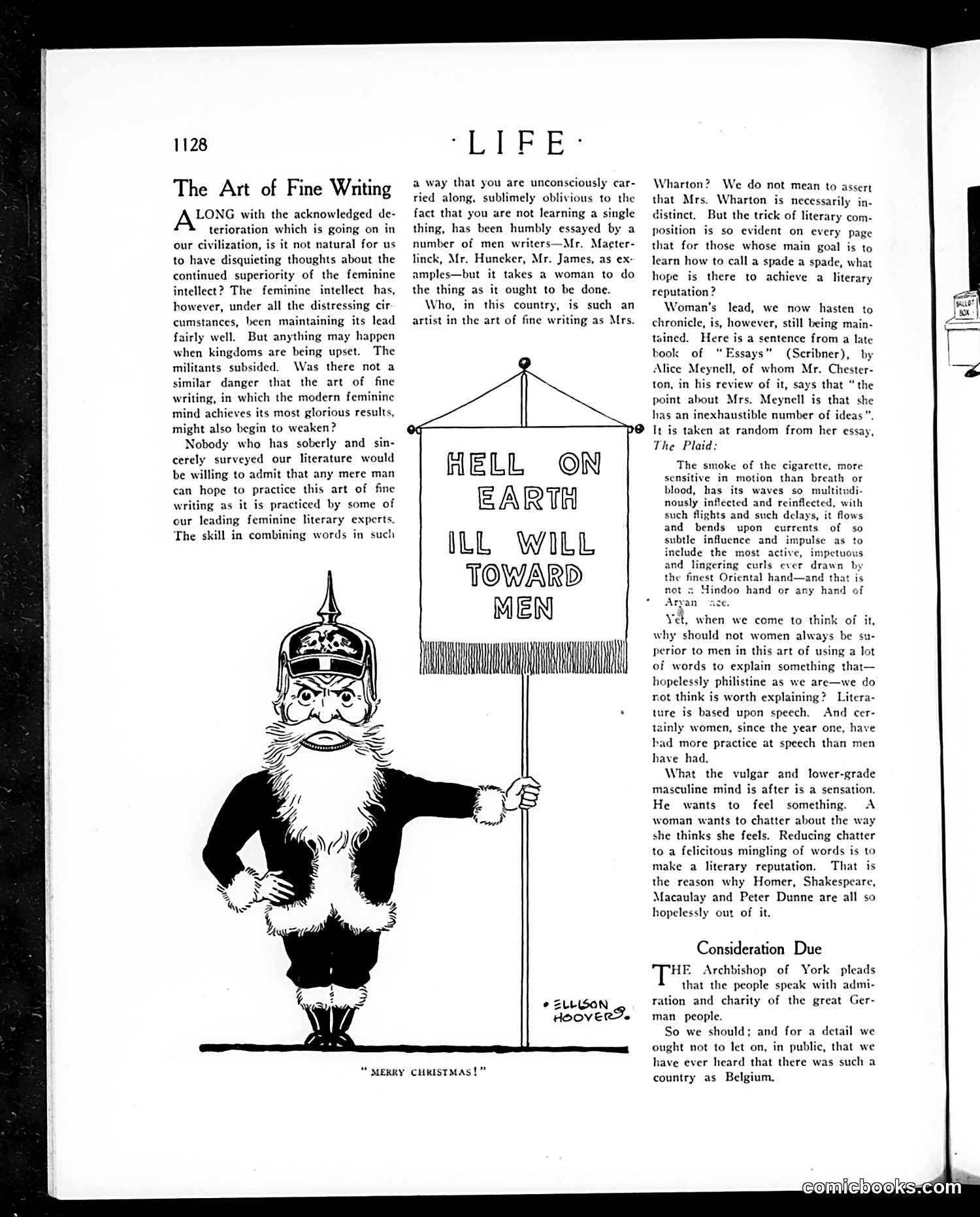
This satirical article mocks women's literary writing, particularly the ornate, verbose style of female authors like Edith Wharton and Alice Meynell. The piece claims women excel at "fine writing"—defined as using elaborate language to obscure the absence of actual content. It dismisses their work as mere "chatter" dressed in fancy words, contrasting it unfavorably with male writers (Homer, Shakespeare) who aim for genuine sensation and meaning. The accompanying cartoon by Hoover depicts a German military officer (identifiable by the spiked Prussian helmet) holding a banner reading "Hell on Earth / Ill Will Toward Men"—a cynical Christmas greeting. This likely references Germany's role in World War I and criticizes German militarism. The final section ironically suggests Britons should praise "the great German people" while publicly ignoring Belgian suffering during the war—a bitter commentary on diplomatic hypocrisy regarding German atrocities in Belgium.
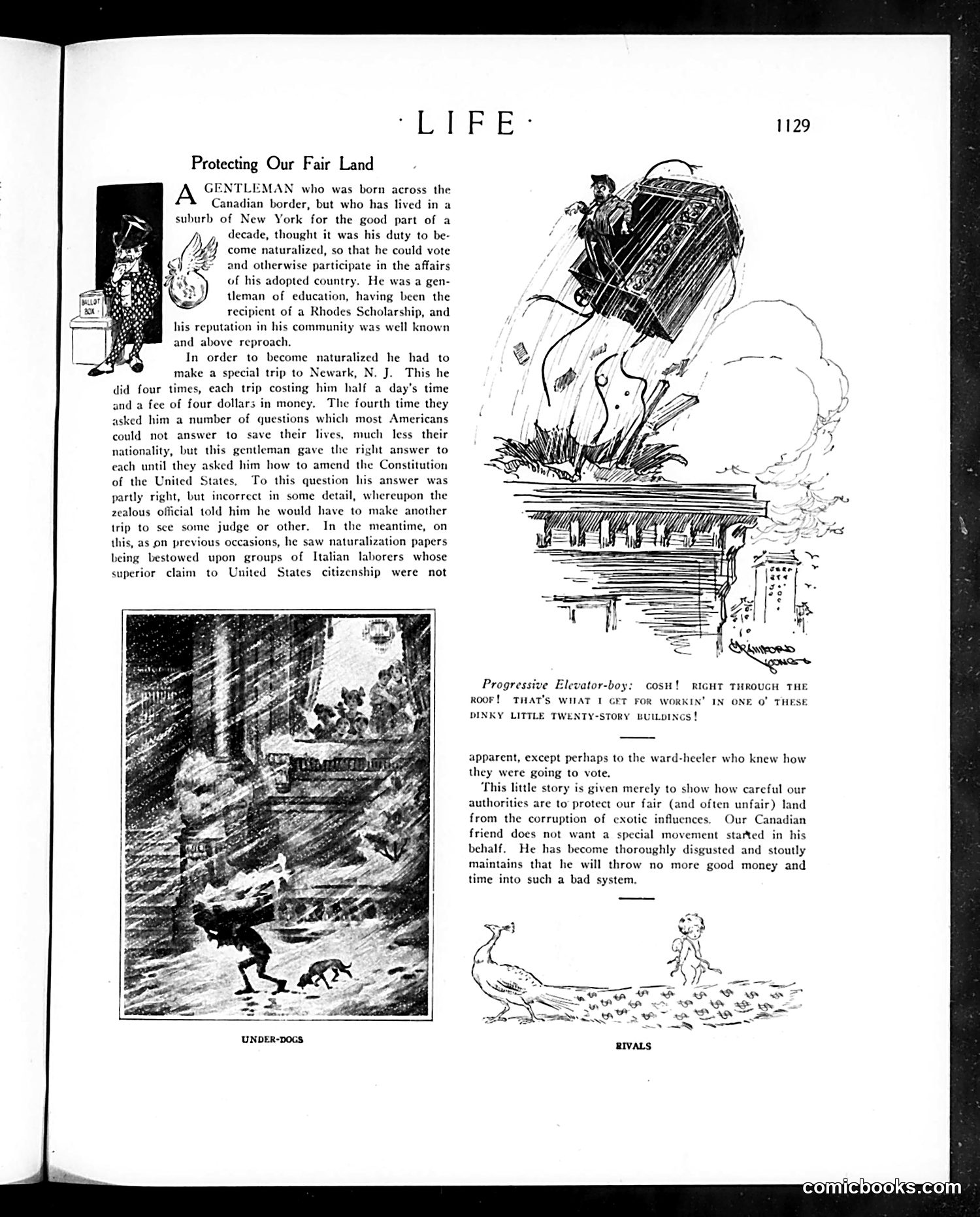
This article satirizes the hypocrisy of American naturalization procedures circa 1910s-1920s. A well-educated Canadian gentleman—a Rhodes Scholar—must make four trips to Newark, N.J. and pay repeated fees to become a citizen. On his fourth attempt, officials reject him for a minor error answering a constitutional question, demanding he see a judge. Meanwhile, the text notes, Italian laborers receive naturalization papers with apparent ease, their only qualification being connections to a "ward-heeler" (political machine operative) who controls their votes. The cartoon at top right mocks this absurdity: an elevator boy boasts he's crashing "RIGHT THROUGH THE ROOF" in a dinky twenty-story building—suggesting upward mobility through low-skill work, contrasting with the educated Canadian's bureaucratic obstacles. **The satirical point**: America's naturalization system is rigged—excluding educated, genuinely qualified immigrants while expediting those who serve political machines, revealing the system protects corrupt "exotic influences" it claims to prevent.
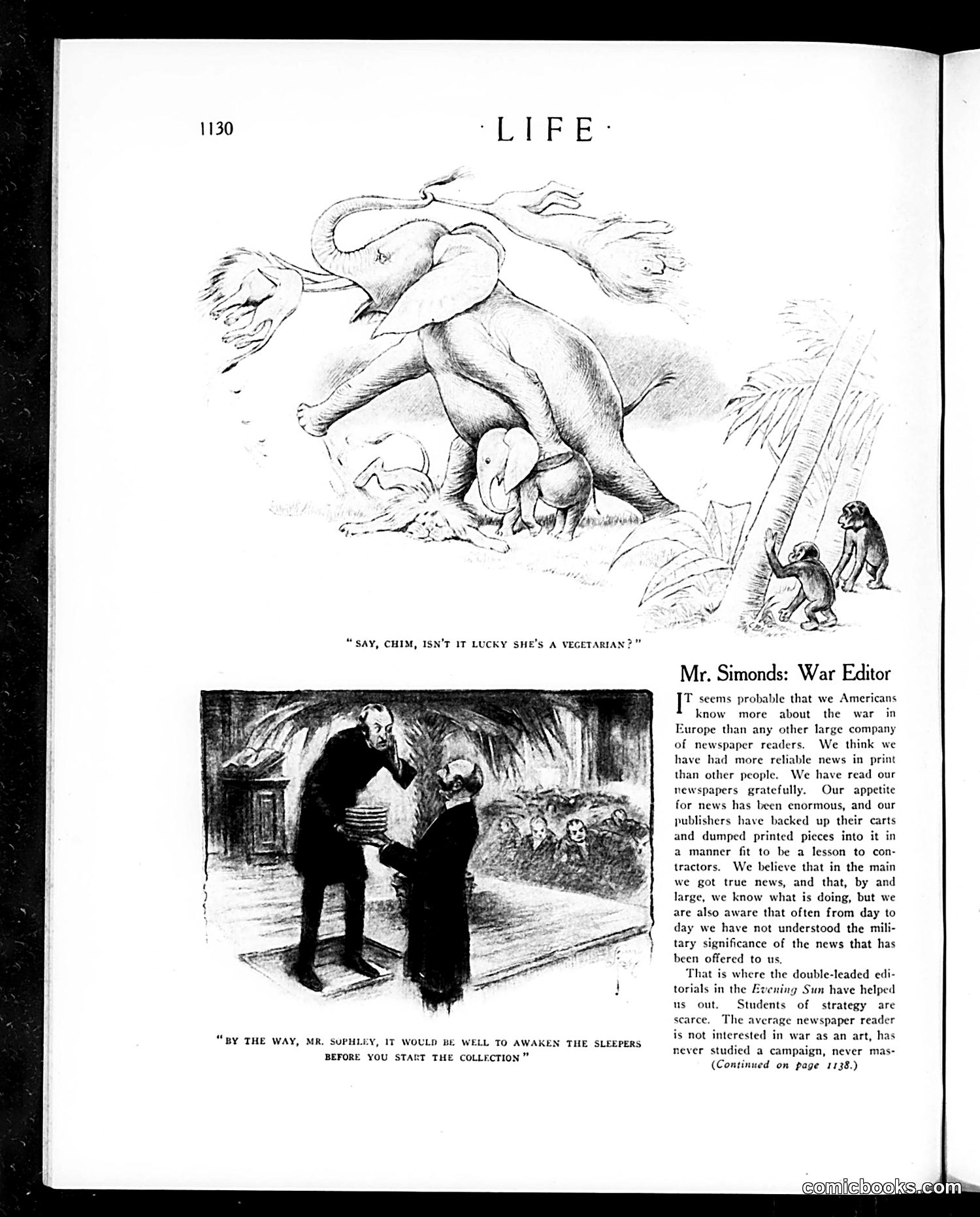
The top cartoon depicts an elephant (symbolizing the Republican Party) playfully trampling vegetation while smaller monkeys observe. The caption jokes: "Say, Chim, isn't it lucky she's a vegetarian?"—satirizing the elephant's destructive power while suggesting relief it doesn't eat meat (likely a metaphor for political restraint or harm). The bottom cartoon shows a collection agent approaching sleeping figures, with a warning to "awaken the sleepers before you start the collection"—a satirical jab at collecting money from inattentive or negligent parties. The accompanying article by Mr. Simonds, the War Editor, discusses American newspaper coverage of World War I in Europe. He argues Americans received reliable war news but often didn't understand the *military significance* of reported events—a critique of readers' superficial war knowledge despite information abundance. The Evening Sun's editorials allegedly helped fill this gap.
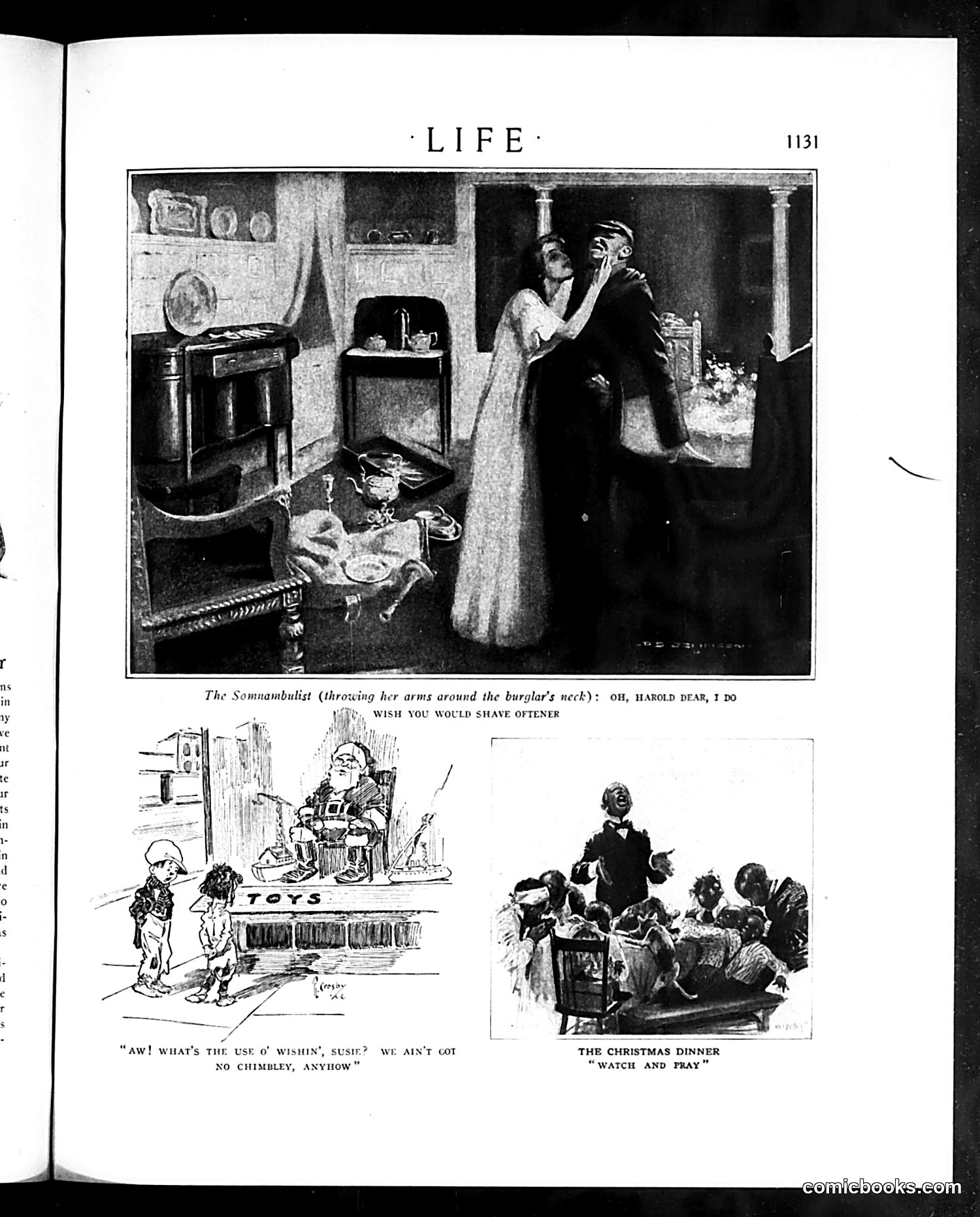
This Life magazine page contains three satirical illustrations about Christmas hardship and class inequality. The top image, "The Somnambulist," depicts a burglar stealing from a wealthy household while a woman sleeps—captioned with dark humor about wishing for a "shaved oyster." The bottom-left cartoon shows poor children outside a toy shop window, unable to afford Christmas gifts, with one child dismissively noting they lack a chimney for Santa anyway—mocking the gap between festive promises and actual poverty. The final illustration, "The Christmas Dinner—Watch and Pray," portrays impoverished children gathered around an empty table, their only recourse being prayer rather than actual food. Collectively, these images critique the stark contrast between wealthy Christmas celebrations and the destitute reality facing working-class and poor families during the holiday season.
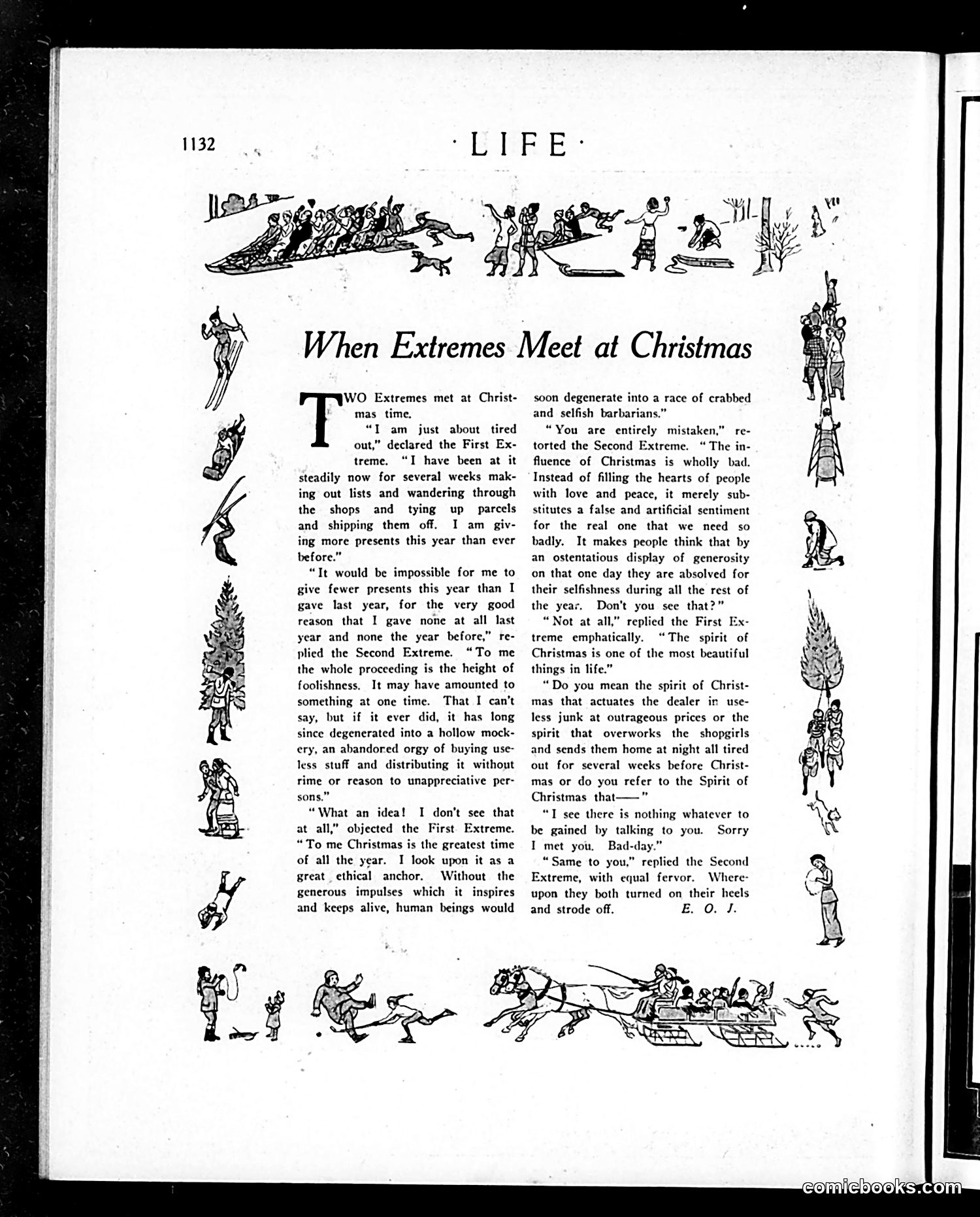
This satirical dialogue presents two opposing Christmas philosophies. The **First Extreme** enthusiastically embraces Christmas shopping and gift-giving as expressions of generosity and ethical virtue. The **Second Extreme** dismisses Christmas consumerism as hollow hypocrisy—arguing that ostentatious one-day generosity allows people to ignore selfishness the rest of the year, and that commercial Christmas exploits retail workers and peddlers of junk. The satire critiques both positions. The First Extreme represents uncritical commercial enthusiasm; the Second represents cynical rejection. Neither can see merit in the other's view. The joke is that these "extremes" are equally rigid and incapable of genuine dialogue about Christmas's true meaning—they simply walk away in mutual contempt. The surrounding decorative illustrations of Christmas activities reinforce the contrast between commercial and spiritual interpretations of the holiday.
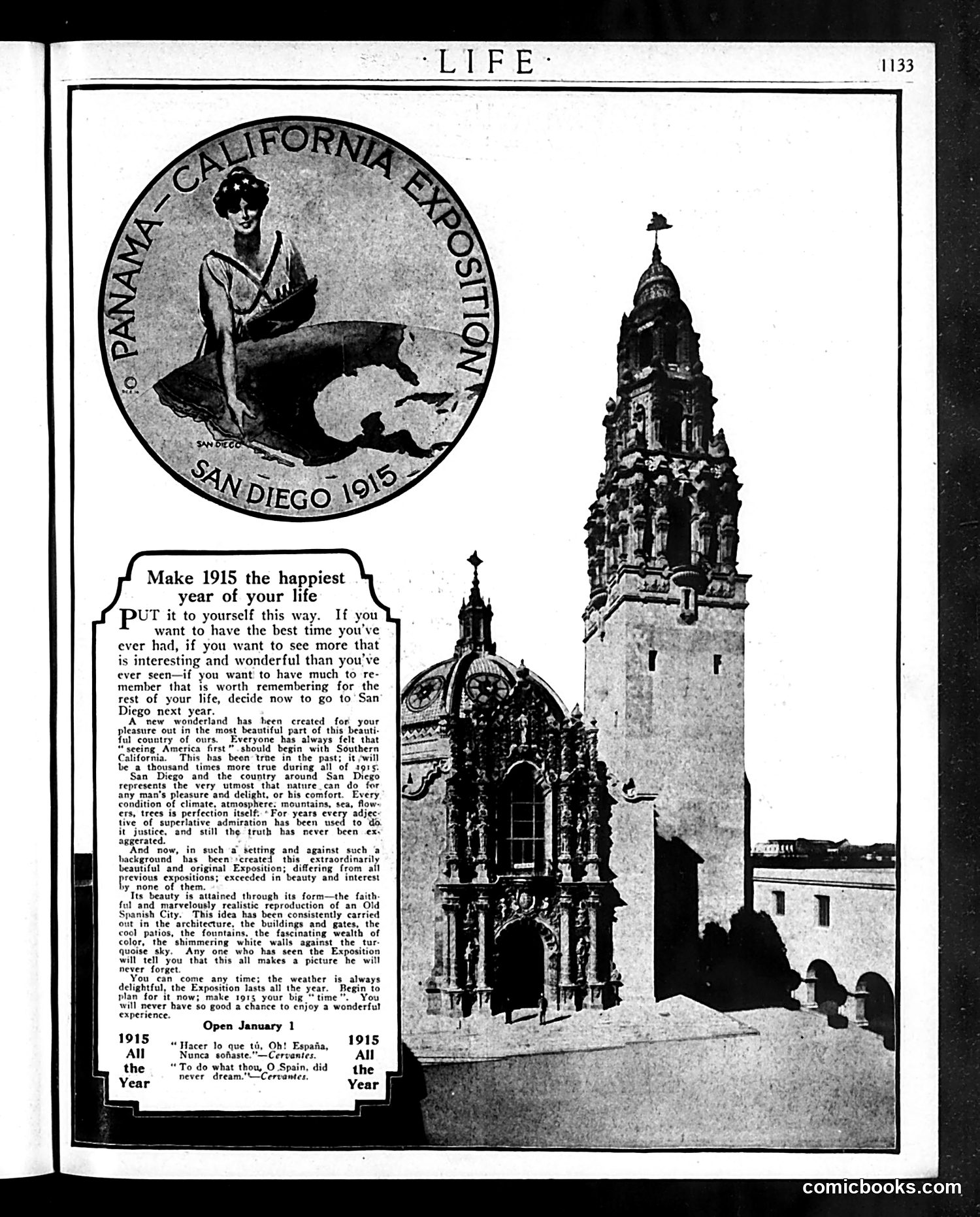
This is **promotional material**, not satire. The page advertises San Diego's 1915 Panama-California Exposition, a world's fair celebrating the Panama Canal's opening. The **seal (top left)** shows a woman presenting California's natural resources—typical exposition imagery. The **photograph (right)** displays the exposition's Spanish Colonial Revival architecture, designed to evoke "an Old Spanish City" as stated in the text. The **quotations from Cervantes** ("Never did you dream, O Spain") frame the exposition as fulfilling Spanish imperial ambitions through American achievement—a pointed historical irony, given Spain's colonial decline. The message to 1915 readers: Visit San Diego to experience California's beauty and modern American accomplishment, packaged in romantic Spanish architectural aesthetics. This was earnest promotional copy, not comic commentary.
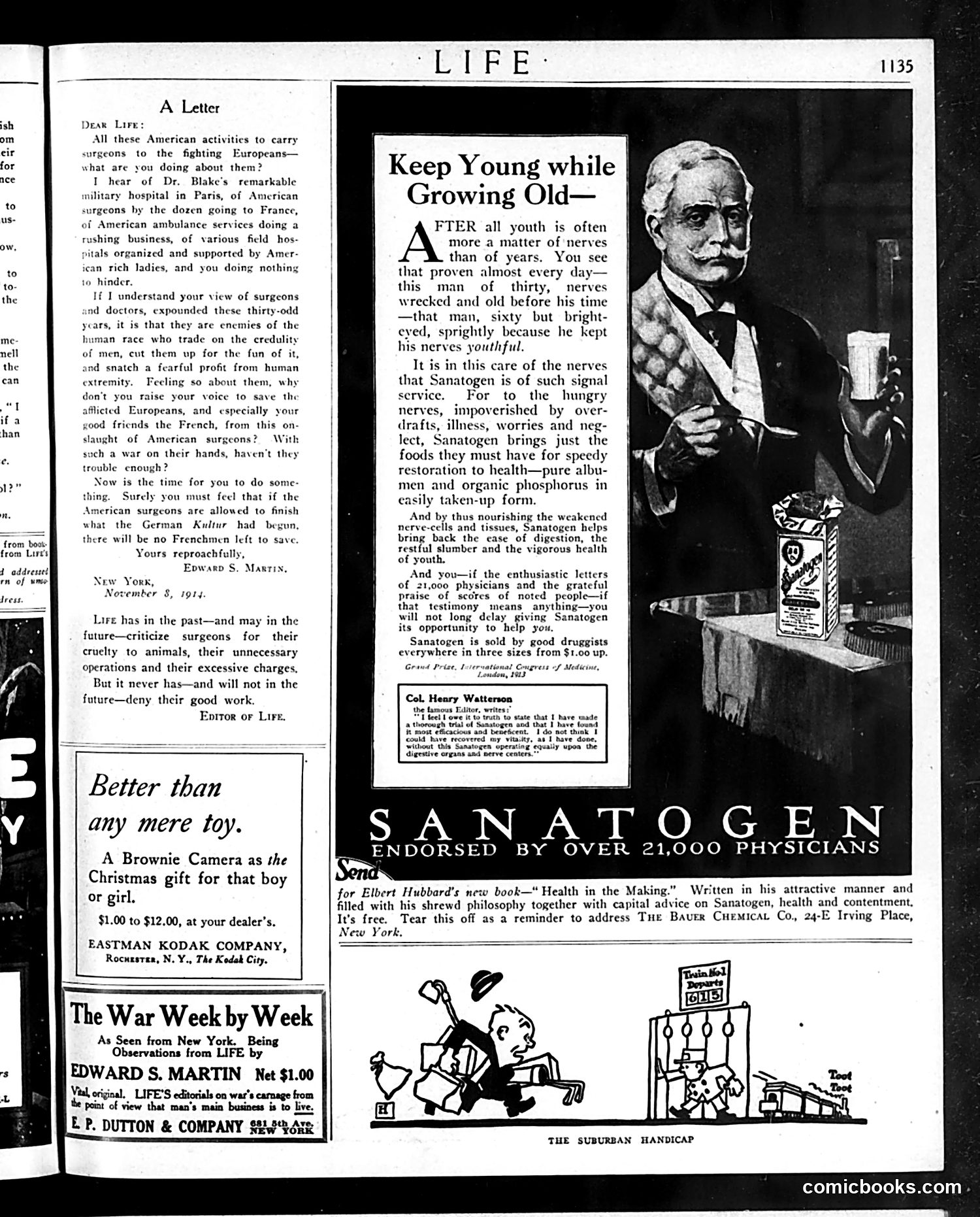
This page contains a **letter-to-editor debate** about Life's historical anti-medical stance during World War I. A reader (Edward Martin) sarcastically challenges Life magazine: if doctors are truly the "enemies of the human race" as Life has long claimed, why isn't the magazine opposing American surgeons volunteering in France? Life's editor responds by clarifying they've never denied doctors' good work—only criticized unnecessary operations and exploitation. The page is **mostly advertisements**, including: - A Brownie Camera ad - A **Sanatogen advertisement** (a nerve tonic claiming to restore youth and vigor, endorsed by 21,000 physicians) - "The War Week by Week" book promotion The Sanatogen ad features a man appearing aged at thirty versus a youthful sixty-year-old, promoting nerve restoration through dietary supplements—typical of early 20th-century patent medicine marketing that Life itself might have satirized in other contexts.
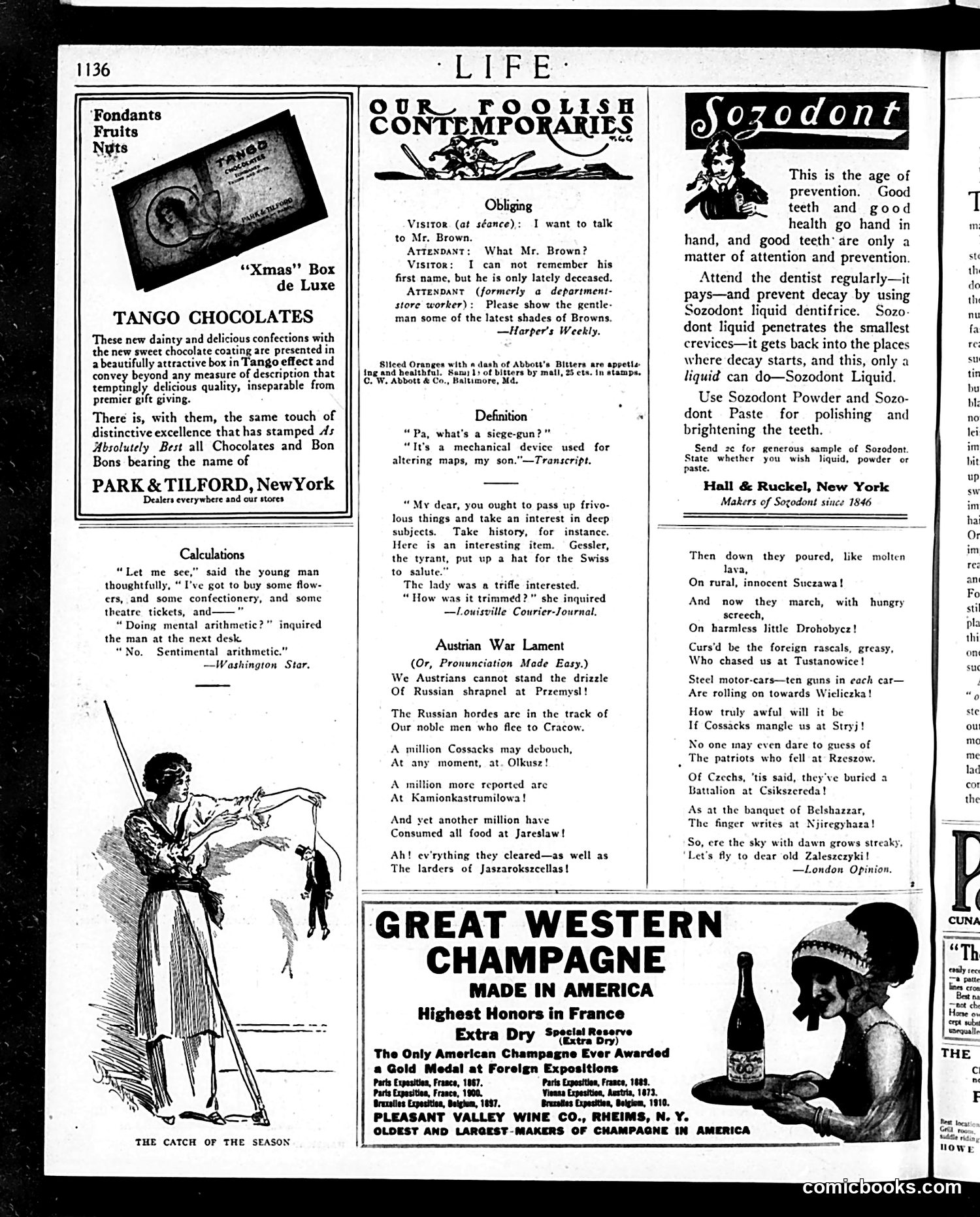
This Life magazine page mixes advertisements with satirical humor and war commentary. The main cartoon, "The Catch of the Season," depicts a fashionable woman fishing—a visual pun on courtship as "the catch" during the social season. The "Austrian War Lament" is satirical verse mocking Austria's military collapse during World War I. It lists Austrian towns in increasingly panicked tone as Russian and Cossack forces advance, turning place names into a darkly comic inventory of defeat. The humor lies in the absurdist repetition and the exaggerated desperation—"a million" soldiers reported at various locations, supplies consumed, patriots buried. Other jokes on the page ("Sentimental arithmetic," the siege-gun definition) represent typical Life magazine humor: wordplay and gentle social satire about courtship, commerce, and contemporary life. The advertisements (chocolates, champagne, dentifrice) represent standard magazine content of the era.
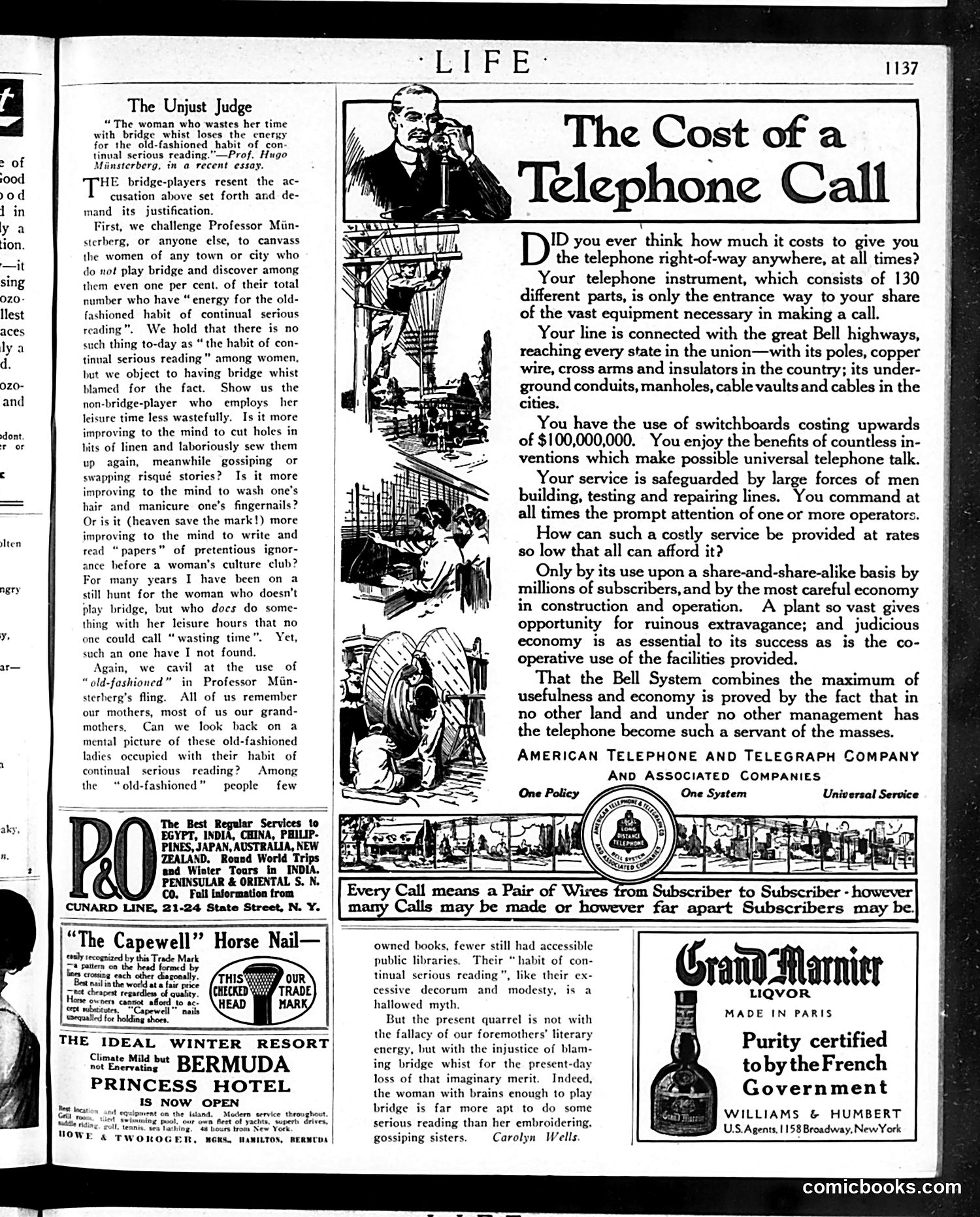
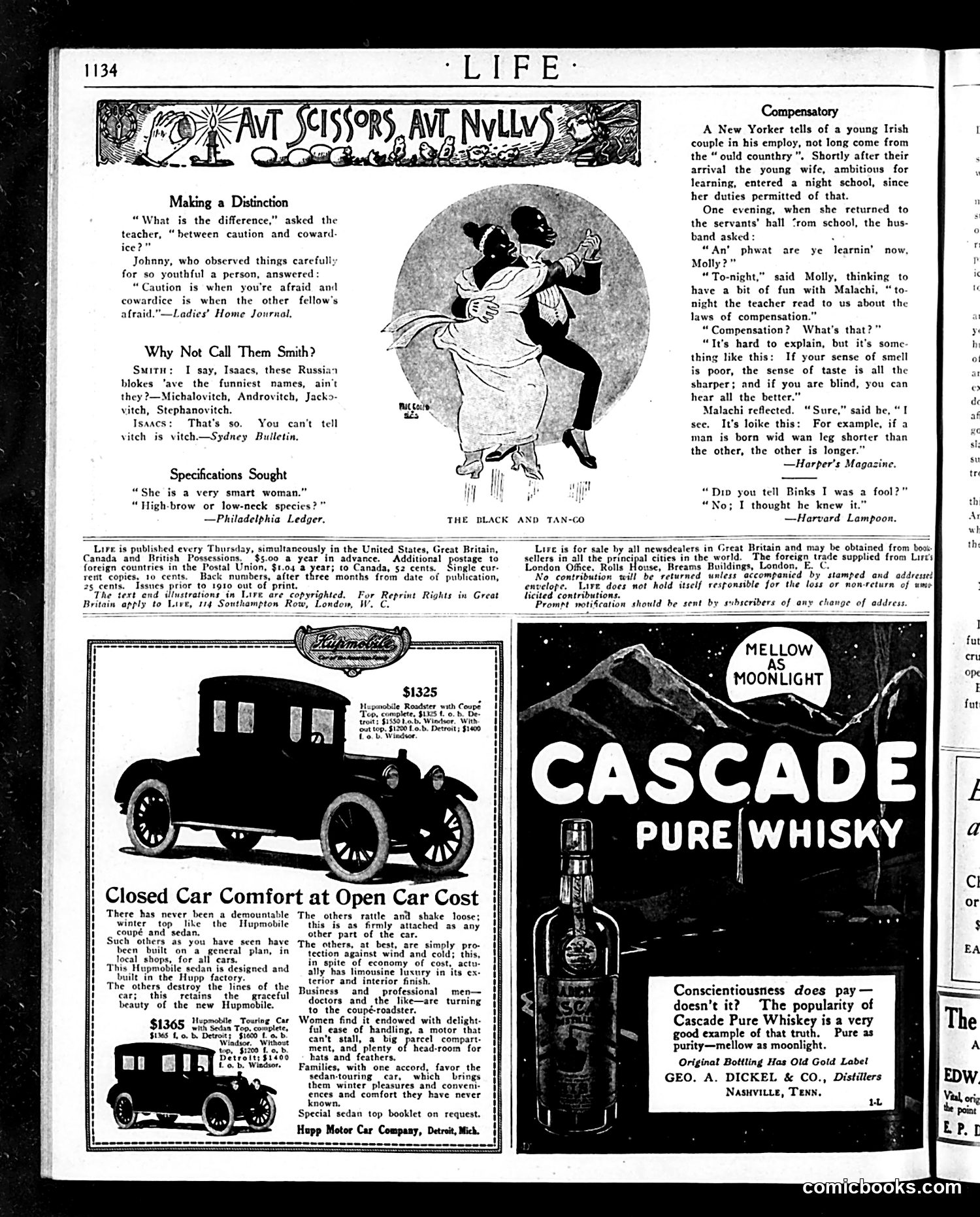
This page contains two distinct sections: **"The Unjust Judge" Editorial**: A defense of women playing bridge whist against Professor Hugo Münsterberg's criticism that bridge wastes women's energy for serious reading. The piece sarcastically argues that bridge-playing women aren't uniquely idle—non-bridge players also don't engage in serious reading, and other leisure activities (sewing, grooming, writing pretentious "culture club papers") are equally unproductive. The satire targets both the professor's moralizing and the pretensions of women's intellectual activities. **"The Cost of a Telephone Call" Advertisement**: A full-page Bell System advertisement explaining telephone infrastructure to justify service rates. It emphasizes the vast equipment, infrastructure, and labor required while promoting the "share-and-share-alike basis" and "judicious economy" that enable affordable universal service. This represents early 20th-century corporate public relations messaging. The page also contains smaller ads for travel, horse nails, and liquor—typical magazine filler of the era.
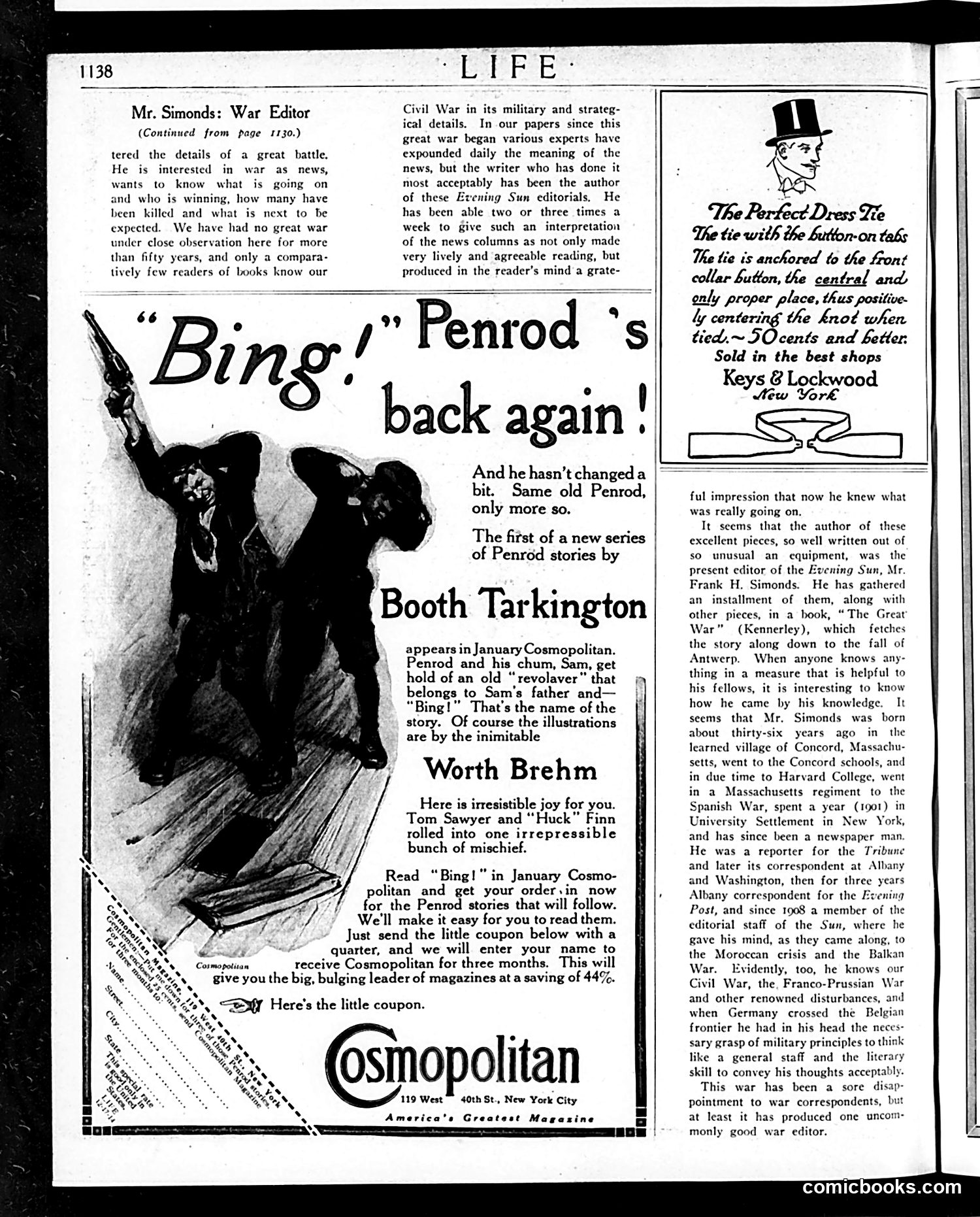
This page combines editorial commentary about the magazine's war coverage with advertisements and announcements. The main content praises **Frank H. Simonds**, the *Evening Sun's* editor, as an exceptionally skilled war correspondent and analyst during World War I. The text explains that Simonds gained his expertise through lived experience: he served in the Spanish-American War, worked as a journalist covering major conflicts (Moroccan crisis, Balkan Wars, Franco-Prussian War), and brings genuine military knowledge to interpreting battlefield reports for readers unfamiliar with warfare. The page also advertises a new **Penrod story series by Booth Tarkington**, illustrated by Worth Brehm—appealing to readers seeking lighter fare alongside war news. A tie advertisement and subscription coupon for *Cosmopolitan* magazine round out the page. The overall message: Life magazine endorses Simonds as uniquely qualified to explain confusing wartime developments to American civilians.
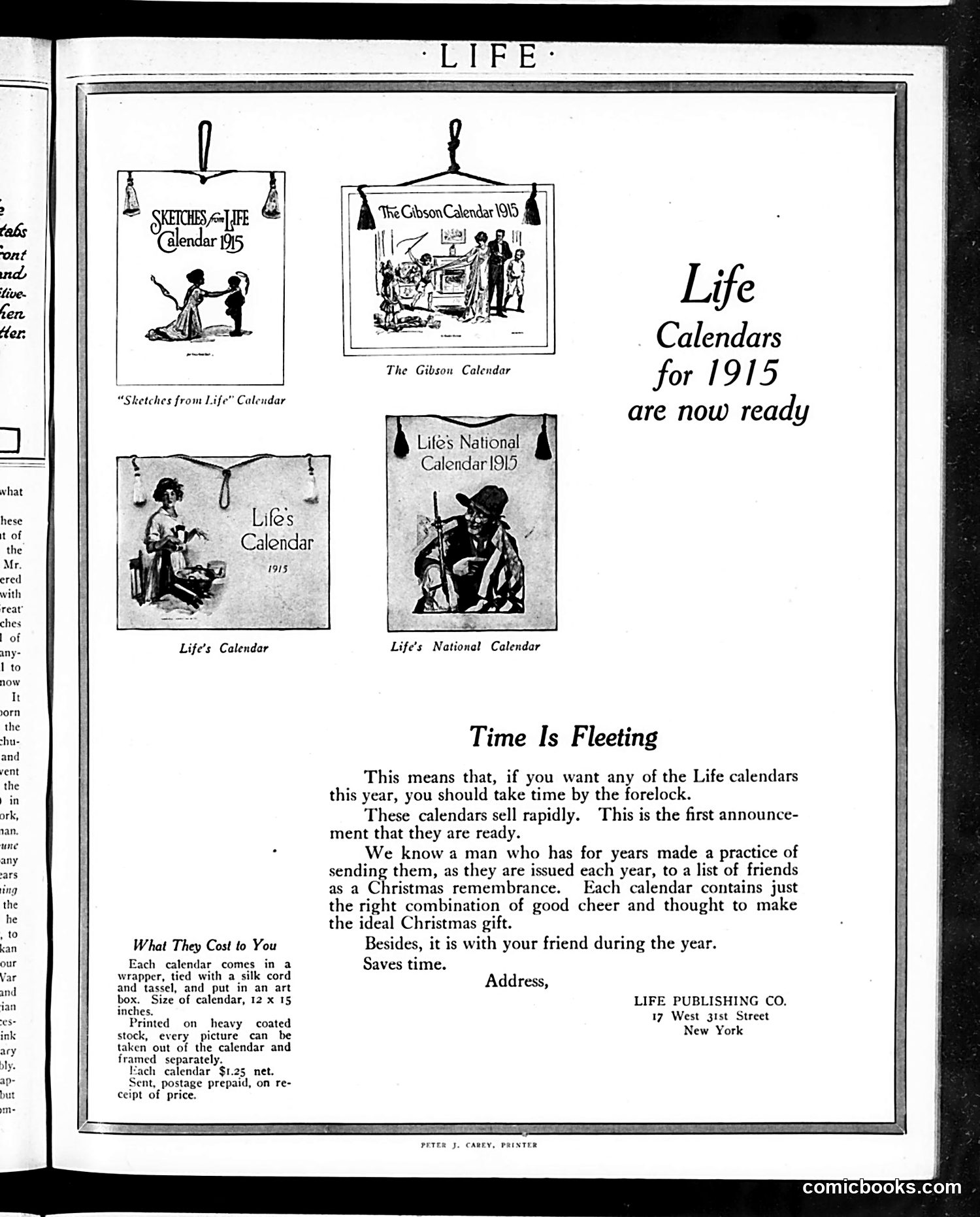
This is primarily an **advertisement**, not a political cartoon. Life Publishing Co. is promoting four calendar designs for 1915 available for purchase. The page displays four distinct calendar options: - "Sketches from Life" Calendar (showing playful figures) - The Gibson Calendar (featuring Charles Dana Gibson's iconic illustrated figures) - Life's Calendar (woman-centered design) - Life's National Calendar (appears to show a worker or laborer figure) The advertisement uses the phrase "Time Is Fleeting" as a sales pitch, urging customers to buy quickly because "these calendars sell rapidly." It positions the calendars as ideal Christmas gifts—practical items that combine "good cheer and thought." Each costs $1.25, comes gift-wrapped with silk cord and tassel in an art box. The text notes one man's practice of sending these calendars annually to friends as Christmas remembrances, suggesting they were popular gifts among the affluent readership of Life magazine.
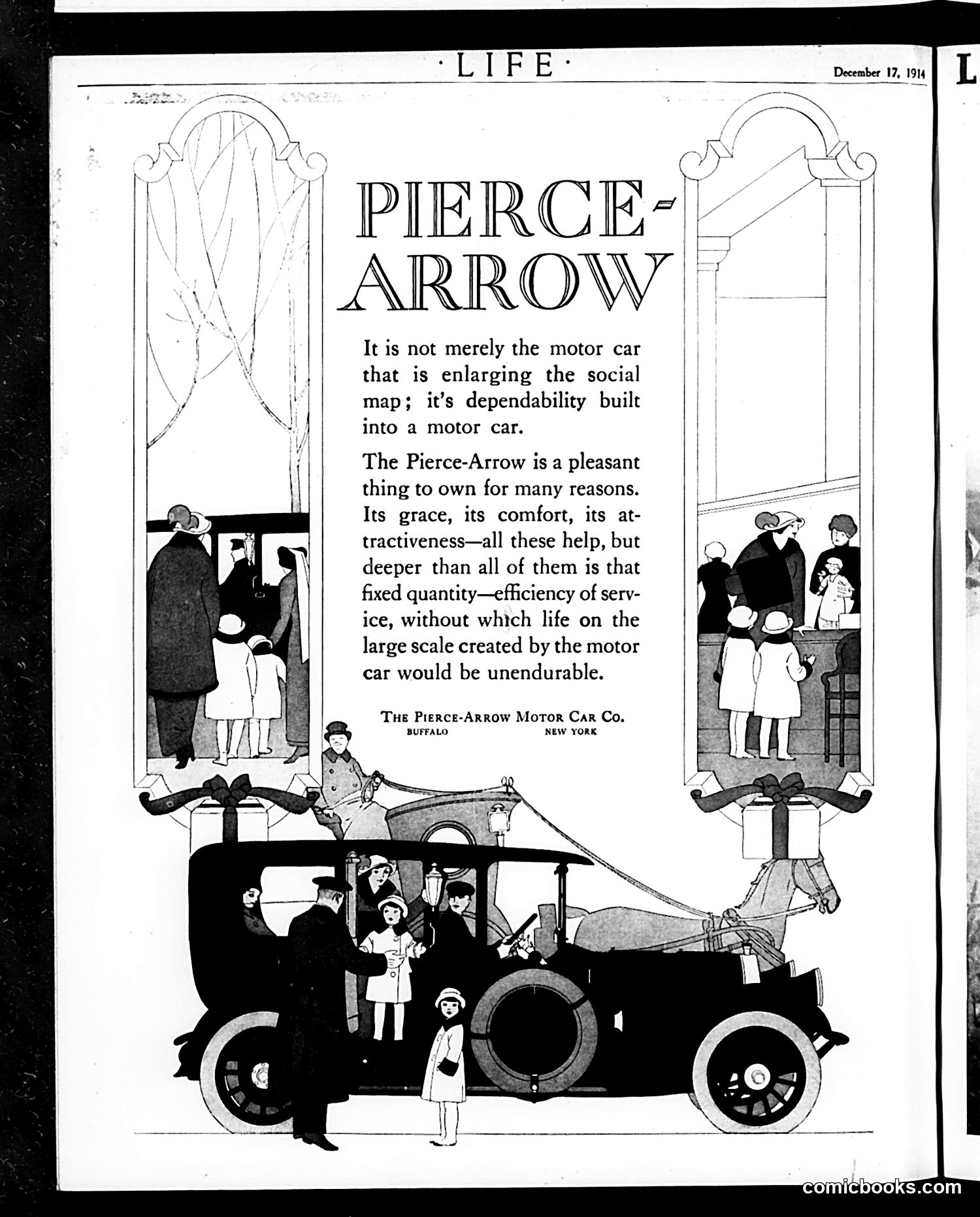
This is a **Pierce-Arrow automobile advertisement** from December 1914, not political satire. The page features an illustrated advertisement promoting the Pierce-Arrow motor car manufactured in Buffalo, New York. The central image shows a large automobile with well-dressed figures (adults and children) positioned around and inside it, depicting family life and social mobility. The smaller vignettes above show domestic interior scenes—people in homes and gathering spaces. The advertisement's message argues that the Pierce-Arrow's true value lies not in aesthetics ("grace," "comfort") but in **reliability and efficient service**. It positions automobile ownership as essential to modern social life ("life on the large scale created by the motor car"). The visual composition emphasizes the car's role in expanding social possibilities and family activities. This reflects early-automotive-era marketing that sold cars as civilization-advancing technology rather than mere luxury items.