
Life, 1914-12-17 · page 22 of 40
Life — December 17, 1914 — page 22: what you’re looking at
What you’re looking at
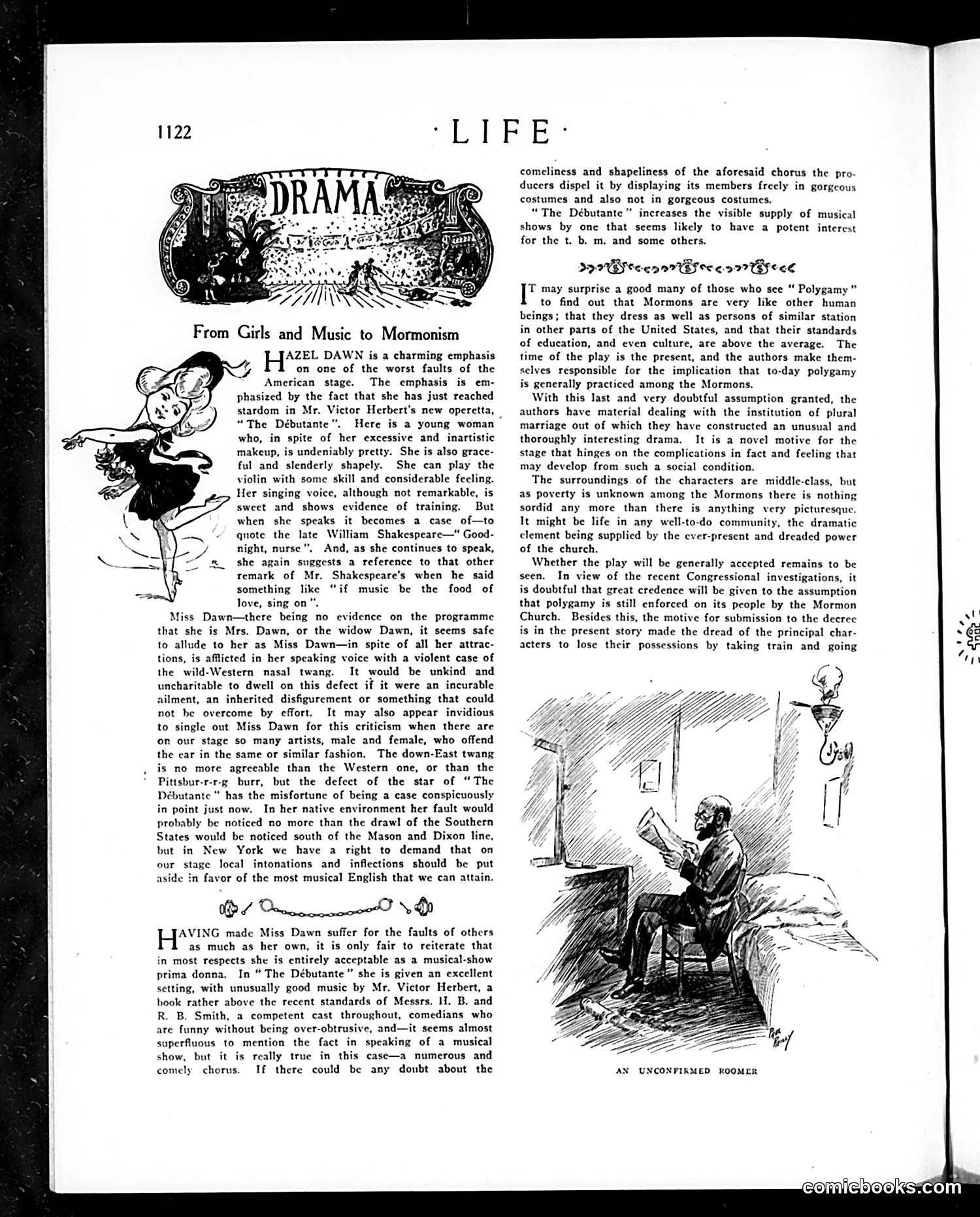
This page reviews Victor Herbert's operetta "The Débutante," starring Hazel Dawn. The critic praises her beauty, grace, and musical abilities but savagely attacks her **"wild-Western nasal twang"**—her regional accent. This was serious criticism for a stage performer; the reviewer argues that professional actors performing in New York must adopt neutral, cultivated speech rather than regional dialects. The satirical cartoon labeled "AN UNCONFIRMED BOOMER" (right) appears to illustrate this criticism, likely showing someone speaking with exaggerated regional dialect. The page also mentions a play called "Polygamy" about Mormons, discussing whether modern Mormons actually practice polygamy—suggesting contemporary theatrical engagement with debates about Mormon culture and American religious pluralism. The overall tone is typical of early-20th-century theater criticism: sophisticated, exacting about performance standards, and somewhat condescending toward regional American speech patterns.
📄 Transcribed text from this page (OCR, searchable)
Machine-transcribed from the original scan — historical spelling and the odd misread are preserved.
“LIFE™ From Girls and Music to Mormonism AZEL DAWN is a charming emphasis on one of the worst faults of the American stage. The emphasis is em- phasized by the fact that she has just reached stardom in Mr. Victor Herbert's new operetta, “The Débutante". who, in spite of her excessive and inartistic makeup, is undeniably pretty. She is also grace- ful and slenderly shapely. She can play the violin with some skill and considerable feeling. Her singing voice, although not remarkable, is sweet and shows evidence of training. But when she speaks it becomes a case of—to quote the late William Shakespeare—“ Good- night, nurse”. And, as she continues to speak, she again suggests a reference to that other remark of Mr. Shakespeare’s when he said something like “if music be the food of love, sing on”. Miss Dawn—there being no evidence on the programme that she is Mrs. Dawn, or the widow Dawn, it seems safe to allude to her as Miss Dawn—in spite of all her attrac- tions, is afflicted in her speaking voice with a violent case of the wild-Western nasal twang. It would be unkind and uncharitable to dwell on this defect if it were an incurable ailment, an inherited disfigurement or something that could not be overcome by effort. It may also appear invidious to single out Miss Dawn for this criticism when there are on our stage so many artists, male and female, who offend the ear in the same or similar fashion. The down-East twang is no more agreeable than the Western one, or than the Pittsbur-r-r-g burr, but the defect of the star of “The Débutante” has the misfortune of being a case conspicuously in point just now. In her native environment her fault would probably be noticed no more than the drawl of the Southern States would be noticed south of the Mason and Dixon line, but in New York we have a right to demand that on our stage local intonations and inflections should be put aside in favor of the most musical English that we can attain. WO / On rooonT Shp Hevine made Miss Dawn suffer for the faults of others as much as her own, it is only fair to reiterate that in most respects she is entirely acceptable as a musical-show prima donna, In “ The Débutante” she is given an excellent setting, with unusually good music by Mr. Victor Herbert, a book rather above the recent standards of Messrs. H. B. and R. B. Smith, a competent cast throughout, comedians who are funny without being over-obtrusive, and—it seems almost superfluous to mention the fact in speaking of a musical show, but it is really true in this case—a numerous and comely chorus. If there could be any doubt about the Here is a young woman” comeliness and shapeliness of the aforesaid chorus the pro- ducers dispel it by displaying its members freely in gorgeous costumes and also not in gorgeous costumes. “The Débutante” increases the visible supply of musical shows by one that seems likely to have a potent interest for the t. b. m. and some others. 29 2VES Ceca 29 TES 80 6 227TH CCE T may surprise a good many of those who see “ Polygamy” to find out that Mormons are very like other human beings; that they dress as well as persons of similar station in other parts of the United States, and that their standards of education, and even culture, are above the average. The time of the play is the present, and the authors make them- selves responsible for the implication that to-day polygamy is generally practiced among the Mormons. With this last and very doubtful assumption granted, the authors have material dealing with the institution of plural marriage out of which they have constructed an unusual and thoroughly interesting drama. It is a novel motive for the stage that hinges on the complications in fact and feeling that may develop from such a social condition. The surroundings of the characters are middle-class, but as poverty is unknown among the Mormons there is nothing sordid any more than there is anything very picturesque. It might be life in any well-to-do community, the dramatic clement being supplied by the ever-present and dreaded power of the church. Whether the play will be generally accepted remains to be seen. In view of the recent Congressional investigations, it is doubtful that great credence will be given to the assumption that polygamy is still enforced on its people by the Mormon Church. Besides this, the motive for submission to the decree is in the present story made the dread of the principal char- acters to lose their possessions by taking train and going AN UNCONFIRMED ROOMER