
Life, 1914-12-17 · page 24 of 40
Life — December 17, 1914 — page 24: what you’re looking at
What you’re looking at
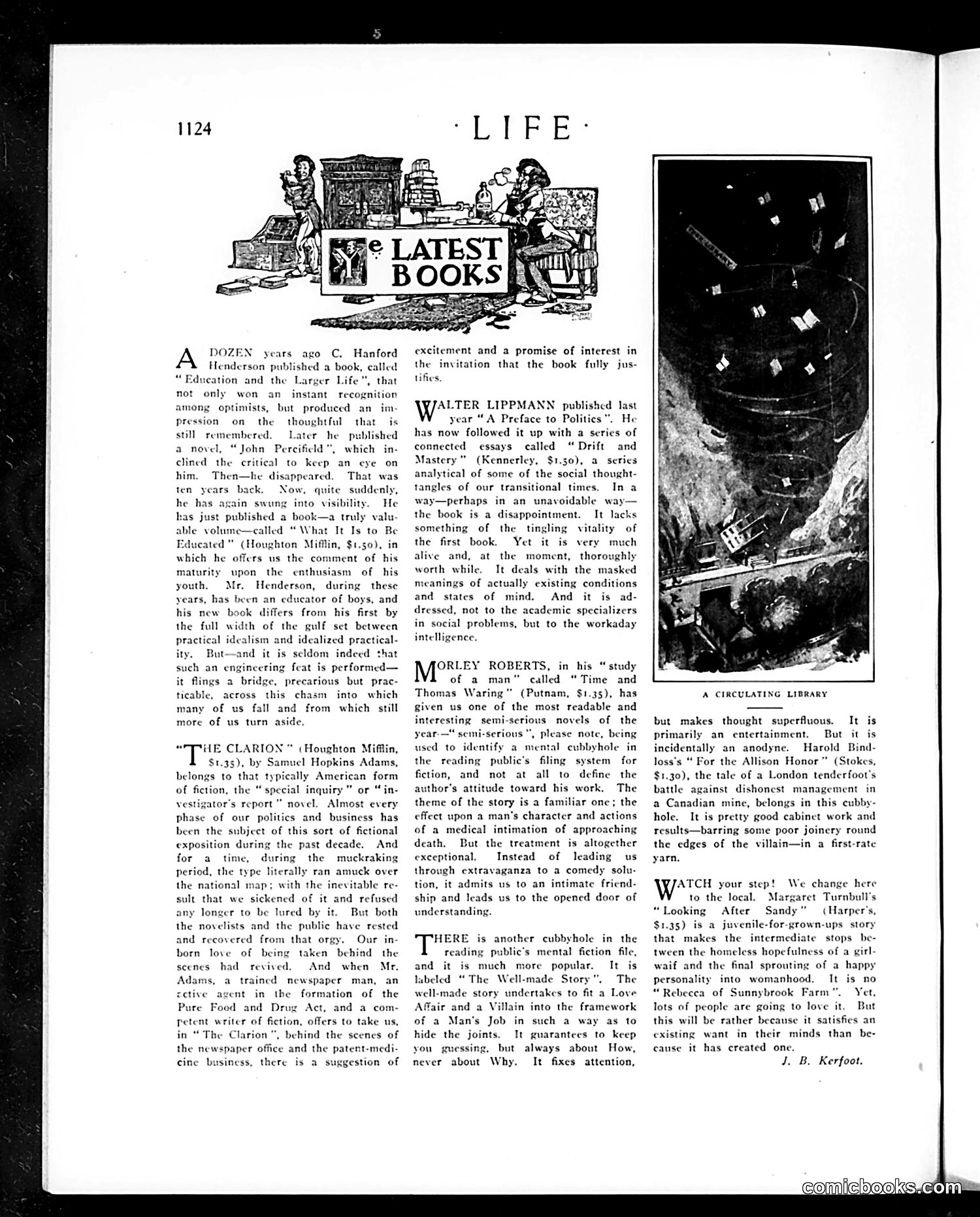
This page is primarily a **book review section** from Life magazine, not a political cartoon page. The header illustration shows figures with books, advertising "Latest Books," but the content consists of literary reviews rather than satirical commentary. The reviews discuss works by contemporary authors (C. Hanford Henderson, Samuel Hopkins Adams, Walter Lippmann, Morley Roberts) and critique the popular fiction genres of the era—particularly the "muckraking" novel (exposés of corruption in politics and business) that had dominated the previous decade. The one small photograph shows "A Circulating Library," illustrating how readers accessed books in this period. The reviews are straightforward literary criticism without apparent satirical intent, reflecting early 20th-century middlebrow cultural discussion rather than political satire.
📄 Transcribed text from this page (OCR, searchable)
Machine-transcribed from the original scan — historical spelling and the odd misread are preserved.
years A DOZEN ago C, Hanford Henderson published a book, ca ation Larger Life not only instant among optimists, but produced an im pression on the thoughtful that is still remembered. Later he published a novel, “John Percificld”, which in- clined the critical to keep an eye on him. Then—he eared. That was back. Now, quite suddenly, in swung into visibility. He published a book—a truly valu ne—called “What It Is to Be (Houghton Mifflin, $1.50), in which he offers us the comment of his maturity upon the enthusiasm of his youth. Mr, Henderson, during these years, has been an educator of boys, and his new book differs from his first by the full width of the gulf set between practical idealism and idealized practical- ity. But—and it is seldom indeed that such an engincering feat is performed— it flings a bridge, precarious but prac- ticable, across this chasm into which many of us fall and from which still more of us turn aside. and the won an dis: ten years he has E CLARION ” (Houghton Miffin, $1.35), by Samuel Hopkins Adams, belongs to that typically American form of fiction, the “special inquiry” or “in- sator’s report” novel. Almost every phase of our politics and business has been the subject of this sort of fictional exposition during the past decade. And for a the muckraking period, the type literally ran amuck over the national map; with the inevitable re- sult that we sickened of it and refused any longer to be lured by it. But both the novelists and the public have rested and recovered from that orgy. Our in born love of being taken behind the scenes had revived. And when Mr. Adams, a traincd newspaper man, an retive agent in the formation of the Pure Food and Drug Act, and a com- Petent writer of fiction, offers to take us, in “The Clarion”, behind the scenes of the newspaper office and the patent-medi cine there is time, during business, a suggestion of RecN LV excitement and a promise of interest in the invitation that the book fully jus- lifes. ALTER LIPPMANN published last year “A Preface to Politics”. He has now followed it up with a series of connected essays called “Drift and Mastery" (Kennerley, $1.50), a series analytical of some of the social thought- tangles of our transitional times. In a way—perhaps in an unavoidable way— the book is a disappointment. It lacks something of the tingling vitality of the first book. Yet it is much alive and, at the moment, thoroughly worth while. It deals with the masked meanings of actually existing conditions and states of mind. And it is dressed, not to the academic specializers in social problems, but to the workaday intelligence. very ORLEY ROBERTS, in his “ study of a man” called “Time and Thomas Waring” (Putnam, $1.35). has given us one of the most readable and interesting semi-serious novels of the year-—" semi-serious ", please note, being used to identify | ecubbyhole in the reading public's filing system for fiction, and not at all to define the author's attitude toward his work, The theme of the story is a familiar onc; the effect upon a man’s character and actions of a medical intimation of approaching death, But the treatment is altogether exceptional, Instead of leading us through extravaganza to a comedy solw- tion, it admits us to an intimate friend- ship and leads us to the opened door of understanding. a me is another cubbyhole in the reading public's mental fiction file. and it is much more popular. It is labeled “The Well-made Story". The well-made story undertakes to fit a Love Afair and a Villain into the framework of a Man’s Job in such a way hide the joints, It guarantees to keep you but always about How, never about Why. It fixes attention, as to guessing, A CIRCULATING LIBRARY but makes thought superfluous. It is primarily an entertainment. But it is incidentally an anodyne. Harold Bind- loss's “ For the Allison Honor” (Stokes, $1.30), the tale of a London tenderfoot's battle against dishonest management in a Canadian mine, belongs in this cubby- hole. It is pretty good cabinet work and results—barring some poor joinery round the edges of the villain—in a first-rate yarn, W TCH your step! We change here to the local. Margaret Turnbull's Looking After Sandy” (Harper's, $1.35) is a juvenile-for-grown-ups story that makes the intermediate tween the homeless hopefulness of a girl waif and the final sprouting of a happy personality into womanhood. It is no “Rebecea of Sunnybrook Farm”. Yet, lots of people are going to love it. But this will be rather because it satisfies an existing want in their minds than be- cause it has created one. J. B. Kerfoot. stops be-