
Life, 1914-12-17 · page 28 of 40
Life — December 17, 1914 — page 28: what you’re looking at
What you’re looking at
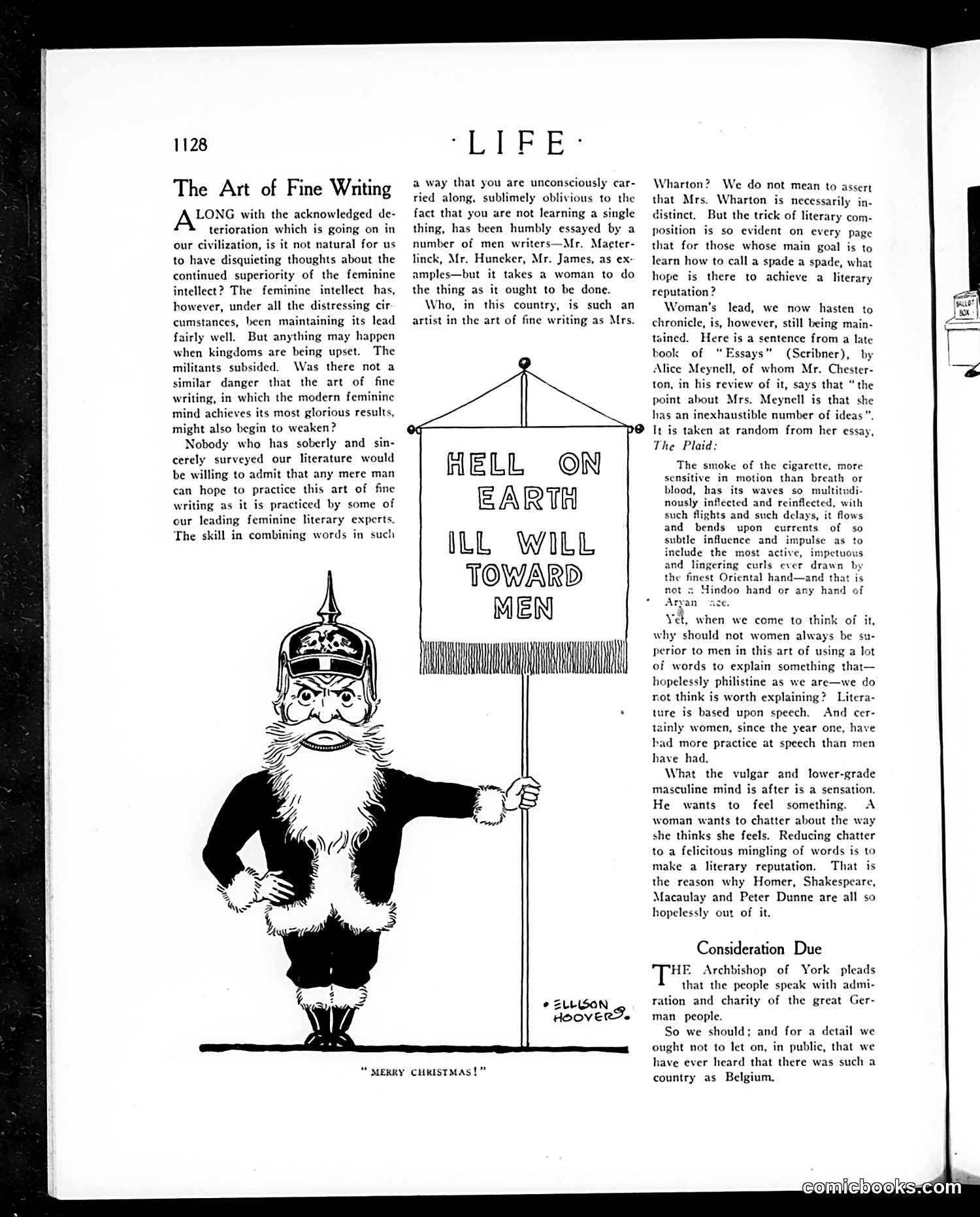
This satirical article mocks women's literary writing, particularly the ornate, verbose style of female authors like Edith Wharton and Alice Meynell. The piece claims women excel at "fine writing"—defined as using elaborate language to obscure the absence of actual content. It dismisses their work as mere "chatter" dressed in fancy words, contrasting it unfavorably with male writers (Homer, Shakespeare) who aim for genuine sensation and meaning. The accompanying cartoon by Hoover depicts a German military officer (identifiable by the spiked Prussian helmet) holding a banner reading "Hell on Earth / Ill Will Toward Men"—a cynical Christmas greeting. This likely references Germany's role in World War I and criticizes German militarism. The final section ironically suggests Britons should praise "the great German people" while publicly ignoring Belgian suffering during the war—a bitter commentary on diplomatic hypocrisy regarding German atrocities in Belgium.
📄 Transcribed text from this page (OCR, searchable)
Machine-transcribed from the original scan — historical spelling and the odd misread are preserved.
1128 The Art of Fine Wnting LONG with the acknowledged de- terioration which is going on in our civilization, is it not natural for us to have disquieting thoughts about the continued superiority of the feminine intellect? The feminine intellect has, however, under all the distressing cir cumstances, been maintaining its lead fairly well. But anything may happen when kingdoms are being upset. The militants subsided. Was there not a similar danger that the art of fine writing, in which the modern feminine mind achieves its most glorious results, might also begin to weaken? Nobody who has soberly and sin- cerely surveyed our literature would be willing to admit that any mere man can hope to practice this art of fine writing as it is practiced by some of our leading feminine literary experts. The skill in combining words in such ef) al 2 a way that you are unconsciously car- ried along, sublimely oblivious to the fact that you are not learning a single thing, has been humbly essayed by a number of men writers—Mr. Magter- linck, Mr. Huneker, Mr. James, as ex~ amples—but it takes a woman to do the thing as it ought to be done. Who, in this country, is such an artist in the art of fine writing as Mrs. RELL ON EARTH ILL WILL TOWARD MEN LE © ZLLLGON “ MERRY CHRISTMAS!” HOOVER“ Wharton? We do not mean to assert that Mrs. Wharton is necessarily in- distinct. But the trick of literary com- position is so evident on every page that for those whose main goal is to learn how to call a spade a spade, what hope is there to achieve a literary reputation ? Woman's lead, we now hasten to chronicle, is, however, still being main- tained. Here is a sentence from a late book of “Essays” (Scribner), by Alice Meynell, of whom Mr. Chester- ton, in his review of it, says that “the point about Mrs. Meynell is that she has an inexhaustible number of ideas”. ® It is taken at random from her essay, The Plaid: The smoke of the cigarette, more sensitive in motion than breath or blood, bas its waves so multitudi- nously inflected and reinflected, with such flights and such delays, it flows and bends upon currents of so subtle influence and impulse as to include the most active, impetuous and lingering curls ever drawn by the finest Oriental hand—and that is not 2 Hindoo hand or any hand of Aryan Yet, when we come to think of it, why should not women always be su- perior to men in this art of using a lot of words to explain something that— hopelessly philistine as we are—we do not think is worth explaining? Litera- ture is based upon speech. And cer- inly women, since the year one, have had more practice at speech than men have had. What the vulgar and lower-grade masculine mind is after is a sensation. He wants to feel something. A woman wants to chatter about the way she thinks she feels. Reducing chatter to a felicitous mingling of words is to make a literary reputation. That is the reason why Homer, Shakespeare, Macaulay and Peter Dunne are all so hopelessly out of it. Consideration Due HE Archbishop of York pleads that the people speak with admi- ration and charity of the great Ger- man people. So we should; and for a detail we ought not to let on, in public, that we have ever heard that there was such a country as Belgium.