
Life, 1914-12-17 · page 26 of 40
Life — December 17, 1914 — page 26: what you’re looking at
What you’re looking at
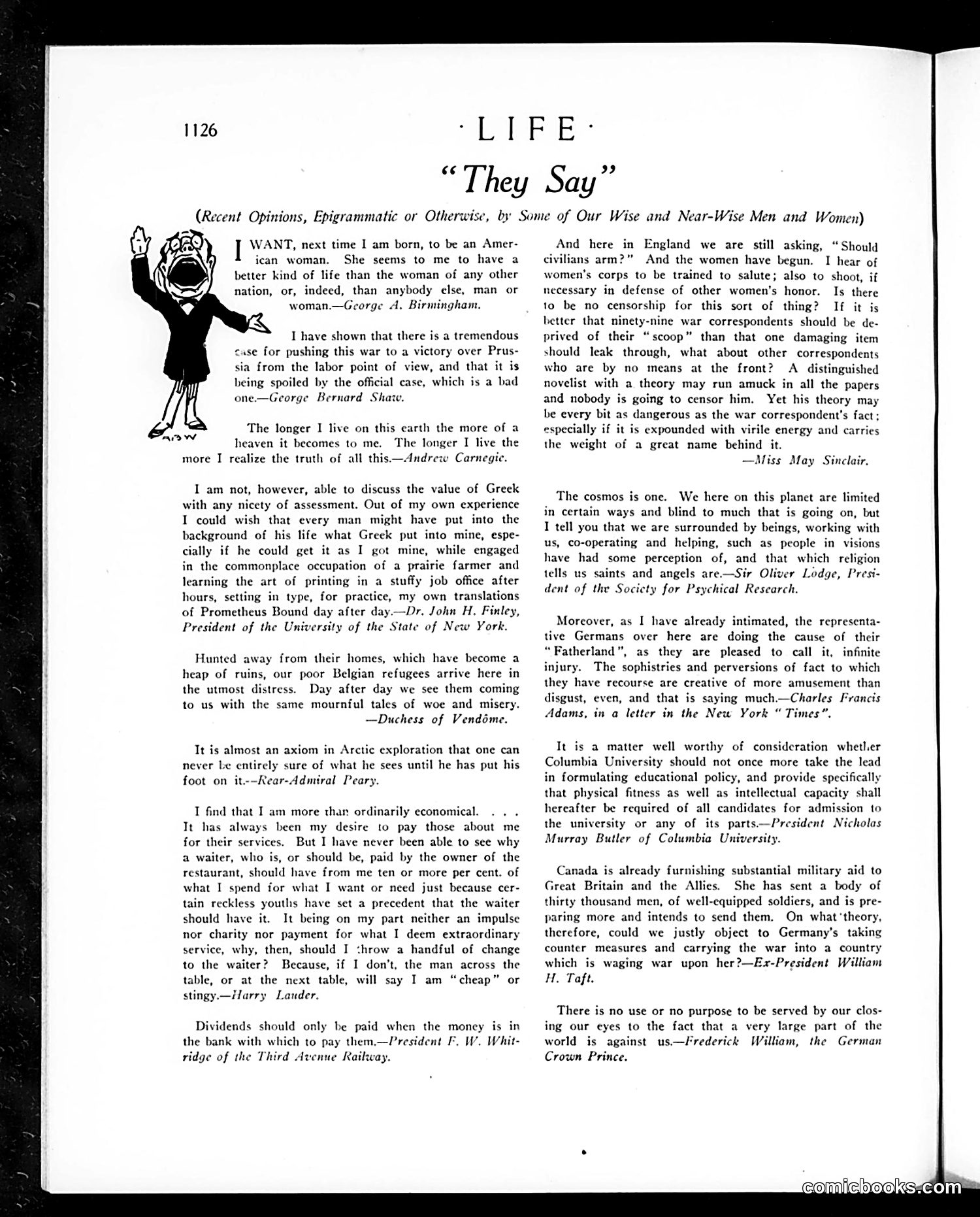
This page collects brief quotations from prominent figures of the era (circa WWI period) on various topics. The small cartoon shows a woman in an exaggerated pose, likely illustrating the opening quote from George A. Birmingham praising American women's superior life conditions. The quotations touch on war-related issues (pushing victory over Prussia, Belgian refugees), tipping etiquette (Harry Lauder's complaint about expected gratuities), economic principles, education, and spiritual matters. Several speakers critique contemporary practices or express philosophical views. The satire lies in presenting these "wise and near-wise" opinions alongside their attributions—some profound, others mundane or self-serving—allowing readers to judge the speakers' actual wisdom. The page satirizes how public figures' pronouncements are treated as gospel despite varying merit, a common Life magazine technique for social commentary.
📄 Transcribed text from this page (OCR, searchable)
Machine-transcribed from the original scan — historical spelling and the odd misread are preserved.
Aaa “LIF E* “They Say” Epigrammatic or Otherwise, by Some of Our Wise and Near-Wise Men and Women) (Recent Opinions, WANT, next time I am born, to be an Amer- ican woman. She seems to me to have a better kind of life than the woman of any other nation, or, indeed, than anybody else, man or woman.—George A. Birmingham. I have shown that there is a tremendous case for pushing this war to a victory over Prus- sia from the labor point of view, and that it is being spoiled by the official case, which is a bad one.—George Bernard Shi The longer I live on this earth the more of a heaven it becomes to me. The longer I live the more I realize the truth of all this—Andrew Carnegie. I am not, however, able to discuss the value of Greek with any nicety of assessment. Out of my own experience I could wish that every man might have put into the background of his life what Greek put into mine, espe- cially if he could get it as I got mine, while engaged in the commonplace occupation of a prairie farmer and learning the art of printing in a stuffy job office after hours, setting in type, for practice, my own translations of Prometheus Bound day after day.—Dr. John H. Finley, President of the University of the State of New York. Hunted away from their homes, which have become a heap of ruins, our poor Belgian refugees arrive here in the utmost distress. Day after day we see them coming to us with the same mournful tales of woe and misery. —Duchess of Vendéme. It is almost an axiom in Arctic exploration that one can never Le entirely sure of what he sees until he has put his foot on it--Rear-Admiral Peary. I find that I am more thar ordinarily economical. It has always been my desire to pay those about me for their services. But I have never been able to see why a waiter, who is, or should be, paid by the owner of the restaurant, should have from me ten or more per cent. of what I spend for what I want or need just because cer- tain reckless youths have set a precedent that the waiter should have it. It being on my part neither an impulse nor charity nor payment for what I deem extraordinary service, why, then, should I :hrow a handful of change to the waiter? Because, if I don’t, the man across the table, or at the next table, will say I am “cheap” or stingy.—Harry Lauder. Dividends should only be paid when the money is in the bank with which to pay them.—President F. W. Whit- ridge of the Third Avenue Railway. And here in England we are still asking, “Should civilians arm?” And the women have begun. I hear of women’s corps to be trained to salute; also to shoot, if necessary in defense of other women’s honor. Is there to be no censorship for this sort of thing? If it is hetter that ninety-nine war correspondents should be de- prived of their “scoop” than that one damaging item should leak through, what about other correspondents who are by no means at the front? A distinguished novelist with a theory may run amuck in all the papers and nobody is going to censor him. Yet his theory may be every bit as dangerous as the war correspondent’s fact; especially if it is expounded with virile energy and carries the weight of a great name behind it. —AMiss May Sinclair. The cosmos is one. We here on this planet are limited in certain ways and blind to much that is going on, but I tell you that we are surrounded by beings, working with us, co-operating and helping, such as people in visions have had some perception of, and that which religion tells us saints and angels are.—Sir Oliver Lodge, Presi- dent of the Socicty for Psychical Research. Moreover, as I have already intimated, the representa- tive Germans over here are doing the cause of their “Fatherland”, as they are pleased to call it, infinite injury. The sophistries and perversions of fact to which they have recourse are creative of more amusement than disgust, even, and that is saying much.—Charles Francis Adams, in a letter in the New York “Times”. It is a matter well worthy of consideration whether Columbia University should not once more take the lead in formulating educational policy, and provide specifically that physical fitness as well as intellectual capacity shall hereafter be required of all candidates for admission to the university or any of its parts—President Nicholas Murray Butler of Columbia University. Canada is already furnishing substantial military aid to Great Britain and the Allies. She has sent a body of thirty thousand men, of well-equipped soldiers, and is pre- paring more and intends to send them, On what'theory, therefore, could we justly object to Germany’s taking counter measures and carrying the war into a country which is waging war upon her?—Ex-President William H. Taft. There is no use or no purpose to be served by our clos- ing our eyes to the fact that a very large part of the world is against us.—Frederick William, the German Crown Prince.