
Life, 1914-12-17 · page 19 of 40
Life — December 17, 1914 — page 19: what you’re looking at
What you’re looking at
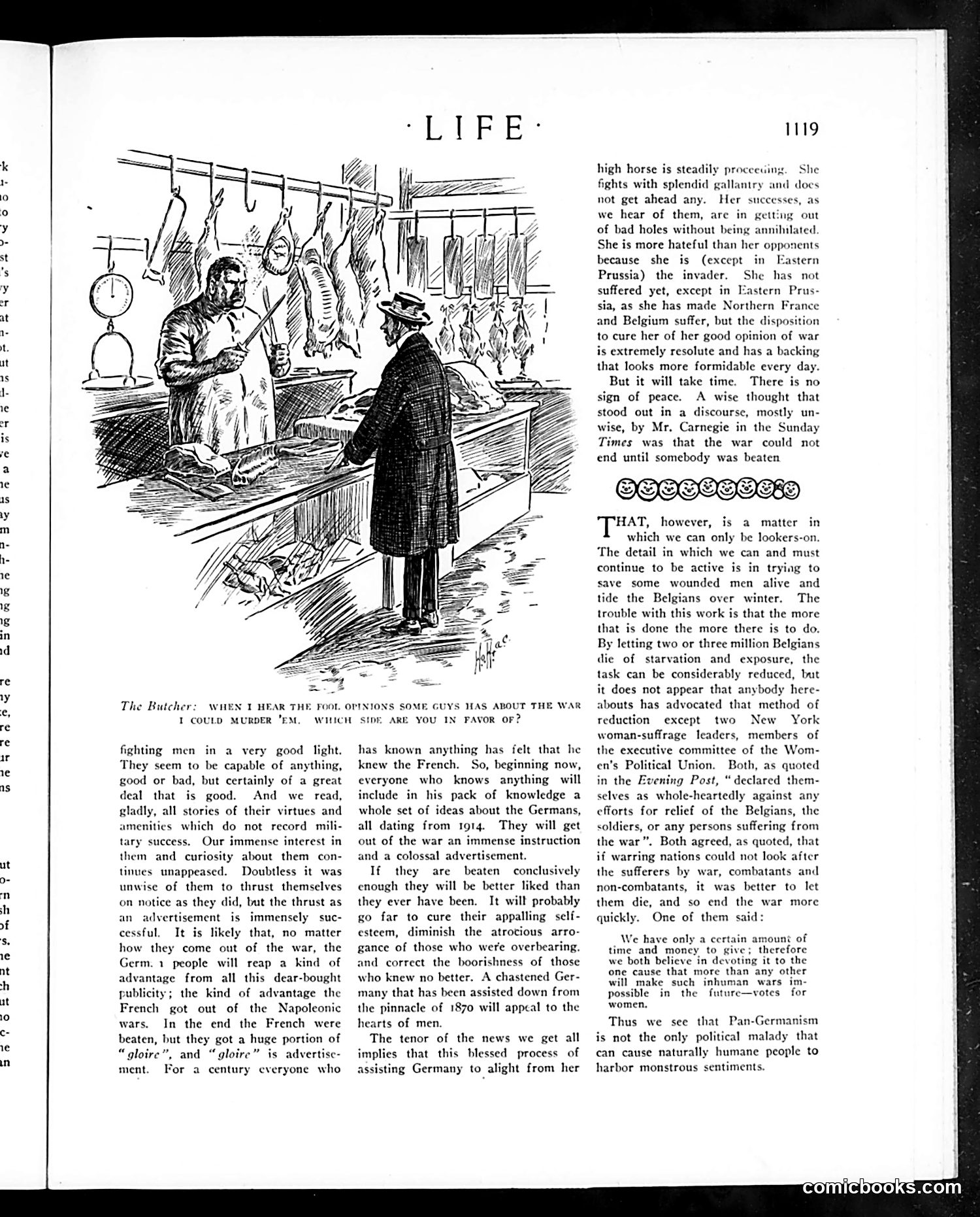
**The Cartoon:** The illustration shows a butcher shop scene where a butcher asks a well-dressed customer, "When I hear the foot opinions some guys has about the war I could murder 'em, which side are you in favor of?" The satire targets casual wartime conversation—the butcher represents working-class people debating the conflict, while his customer represents educated opinion-holders. **Historical Context:** This appears to be from early WWI (references to 1914, Belgium's suffering, Germany's "high horse" since 1870). The article discusses German military conduct and argues that Germany's defeat would ultimately benefit them through humility and international reputation ("gloire"). **The Satire's Point:** The joke mocks how ordinary people adopt strong opinions about complex geopolitical matters. The butcher's willingness to "murder" over war opinions—ironically stated in a butcher shop—suggests the absurdity of civilians passionate about abstract foreign policy disputes they barely understand. The accompanying text criticizes two New York woman-suffrage leaders for opposing Belgian relief efforts, illustrating how political ideology could override humanitarian concerns.
📄 Transcribed text from this page (OCR, searchable)
Machine-transcribed from the original scan — historical spelling and the odd misread are preserved.
The Butcher: WHEN 1 HEAR THE Foot, 1 COULD MURDER 'EM, WICH SIDE ARE YOU IN FAVOR OF? fighting men in a very good light. They seem to be capable of anything, good or bad, but certainly of a great deal that is good. And we read, gladly, all stories of their virtues and amenities which do not record mili- tary success. Our immense interest in them and curiosity about them con- tinues unappeased. Doubtless it was unwise of them to thrust themselves on notice as they did, but the thrust as an advertisement is immensely suc- cessful. It is likely that, no matter how they come out of the war, the Germ. 1 people will reap a kind of advantage from all this dear-bought publicity; the kind of advantage the French got out of the Napoleonic wars. In the end the French were beaten, but they got a huge portion of “gloire”, and “gloire” is advertise- ment. For a century everyone who S SOME GUYS HAS ABOUT THE WAR has known anything has felt that he knew the French. So, beginning now, everyone who knows anything will include in his pack of knowledge a whole set of ideas about the Germans, all dating from 1914. They will get out of the war an immense instruction and a colossal advertisement. If they are beaten conclusively enough they will be better liked than they ever have been. It will probably go far to cure their appalling self- esteem, diminish the atrocious arro- gance of those who were overbearing. and correct the boorishness of those who knew no better. A chastened Ger- many that has been assisted down from the pinnacle of 1870 will appeal to the hearts of men. The tenor of the news we get all implies that this blessed process of assisting Germany to alight from her high horse is steadily proceedir fights with splendid gallantry and docs not get ahead any. Her successes, as we hear of them, are in gett out of bad holes without being annihilated. She is more hateful than her opponents because she is (except in Eastern Prussia) the invader. She has not suffered yet, except in stern Prus- sia, as she has made Northern France and Belgium suffer, but the disposition to cure her of her good opinion of war is extremely resolute and has a backing that looks more formidable every day. But it will take time. There is no sign of peace. A wise thought that stood out in a discourse, mostly un- wise, by Mr. Carnegie in the Sunday Times was that the war could not end until somebody was beaten OOOO IED HAT, however, is a matter in which we can only be lookers-on. The detail in which we can and must continue to be active is in trying to save some wounded men alive and tide the Belgians over winter. The trouble with this work is that the more that is done the more there is to do. By letting two or three million Belgians die of starvation and exposure, the task can be considerably reduced, but it does not appear that anybody here- abouts has advocated that method of reduction except two New York woman-suffrage leaders, members of the executive committee of the Wom- en’s Political Union. Both, as quoted in the Evening Post, “declared them- selves as whole-heartedly against any efforts for relief of the Belgians, the soldiers, or any persons suffering from the war”. Both agreed, as quoted, that if warring nations could not look after the sufferers by war, combatants and non-combatants, it was better to let them die, and so end the war more quickly. One of them said: We have only a certain amount of time and money to give; therefore we both believe in devoting it to the one cause that more than any other will make such inhuman wars im- possible in the future—votes for women, Thus we see that Pan-Germanism is not the only political malady that can cause naturally humane people to harbor monstrous sentiments.