
Life, 1914-12-17 · page 18 of 40
Life — December 17, 1914 — page 18: what you’re looking at
What you’re looking at
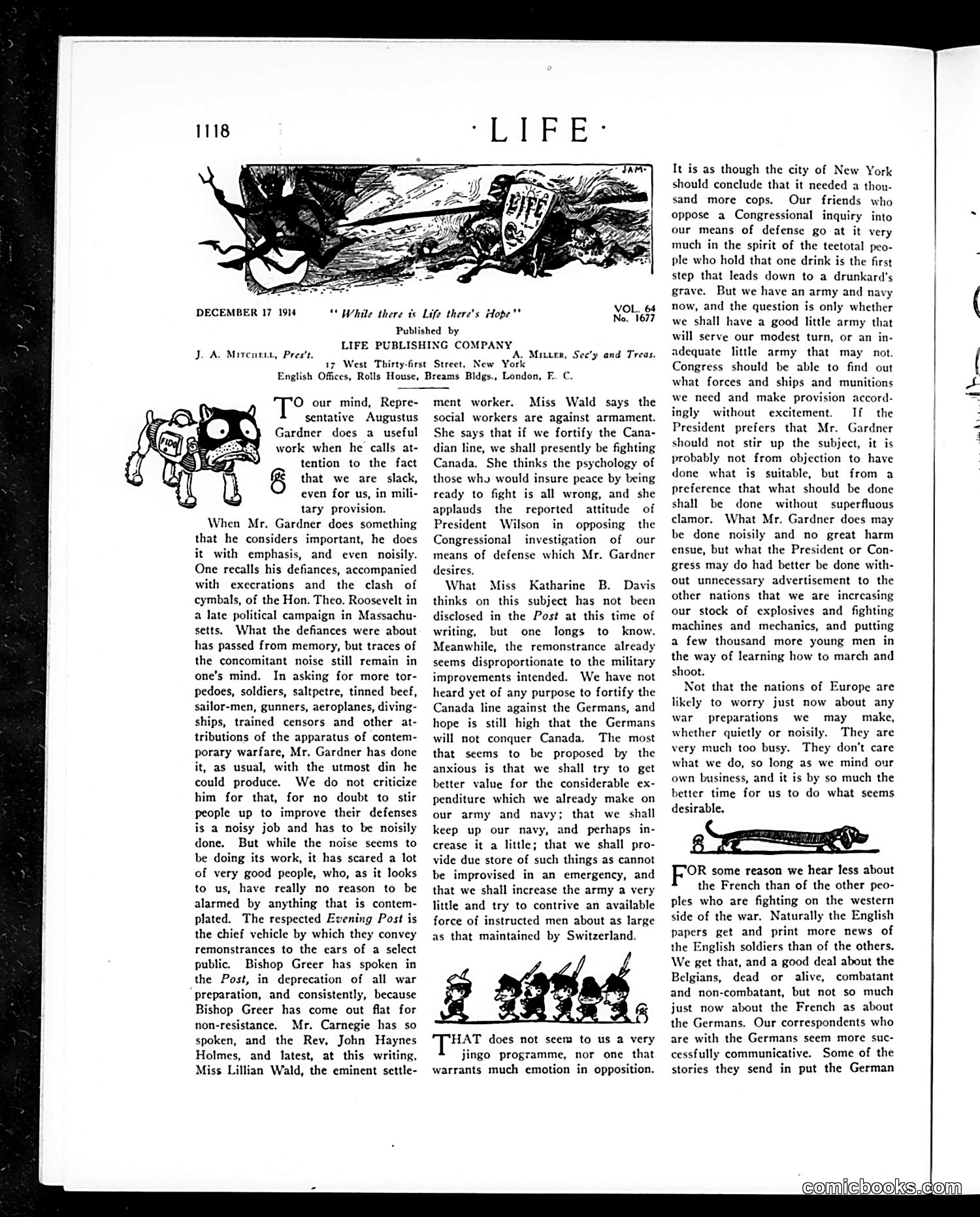
This editorial cartoon page mocks prominent pacifists opposing U.S. military expansion during WWI. Representative Augustus Gardner advocated for increased defense spending (torpedoes, soldiers, aeroplanes, etc.), but faced pushback from prominent non-resistance advocates including Bishop Greer, Andrew Carnegie, Rev. John Haynes Holmes, and settlement-house worker Lillian Wald. Life ridicules their alarmism, comparing their objections to opposing a city hiring additional police officers—suggesting the proposed measures (modest army increases, naval maintenance, supplies) are reasonable, not jingoistic warmongering. The magazine portrays pacifists as emotionally overwrought, using exaggerated analogy: they respond to minor defense proposals as if one drink inevitably leads to drunkenness and death. The cartoons (a grotesque figure and soldiers) reinforce mockery of the pacifist position during a world at war.
📄 Transcribed text from this page (OCR, searchable)
Machine-transcribed from the original scan — historical spelling and the odd misread are preserved.
DECEMBER 17 1914 “While there is Life there's Hope"* VOL. 64 No. 1677 Published by LIFE PUBLISHING COMPANY 17 West Thirty-first Street, New Yor! English Offices, Rolls House, Breams Bldgs., London, F. C. J. A. Mitenent, Pres’t. O our mind, Repre- sentative Augustus Gardner does a useful work when he calls at- tention to the fact 8 that we are slack, even for us, in mili- tary provision. When Mr. Gardner does something that he considers important, he does it with emphasis, and even noisily. One recalls his defiances, accompanied with execrations and the clash of cymbals, of the Hon. Theo. Roosevelt in a late political campaign in Massachu- setts, What the defiances were about has passed from memory, but traces of the concomitant noise still remain in one’s mind. In asking for more tor- pedoes, soldiers, saltpetre, tinned beef, sailor-men, gunners, aeroplanes, diving- ships, trained censors and other at- tributions of the apparatus of contem- porary warfare, Mr. Gardner has done it, as usual, with the utmost din he could produce. We do not criticize him for that, for no doubt to stir people up to improve their defenses is a noisy job and has to be noisily done. But while the noise seems to be doing its work, it has scared a lot of very good people, who, as it looks to us, have really no reason to be alarmed by anything that is contem- plated. The respected Evening Post is the chief vehicle by which they convey remonstrances to the ears of a select public. Bishop Greer has spoken in the Post, in deprecation of all war preparation, and consistently, because Bishop Greer has come out flat for non-resistance. Mr. Carnegie has so spoken, and the Rev, John Haynes Holmes, and latest, at this writing, Miss Lillian Wald, the eminent settle- A, Murr, See’y and Treas. ment worker. Miss Wald says the social workers are against armament. She says that if we fortify the Cana- dian line, we shall presently be fighting Canada. She thinks the psychology of those why would insure peace by being ready to fight is all wrong, and she applauds the reported attitude of President Wilson in opposing the Congressional investigation of our means of defense which Mr. Gardner desires. What Miss Katharine B. Davis thinks on this subject has not been disclosed in the Post at this time of writing, but one longs to know. Meanwhile, the remonstrance already seems disproportionate to the military improvements intended. We have not heard yet of any purpose to fortify the Canada line against the Germans, and hope is still high that the Germans will not conquer Canada. The most that seems to be proposed by the anxious is that we shall try to get better value for the considerable ex- penditure which we already make on our army and navy; that we shall keep up our navy, and perhaps in- crease it a little; that we shall pro- vide due store of such things as cannot be improvised in an emergency, and that we shall increase the army a very little and try to contrive an available force of instructed men about as large as that maintained by Switzerland. 'HAT does not seem to us a very jingo programme, nor one that warrants much emotion in opposition. It is as though the city of New York should conclude that it needed a thou- sand more cops, Our friends who oppose a Congressional inquiry into our means of defense go at it very much in the spirit of the teetotal peo- ple who hold that one drink is the first step that leads down to a drunkard’s grave. But we have an army and navy now, and the question is only whether we shall have a good little army that will serve our modest turn, or an in- adequate little army that may not. Congress should be able to find out what forces and ships and munitions we need and make provision accord- ingly without excitement. If the President prefers that Mr. Gardner should not stir up the subject, it is probably not from objection to have done what is suitable, but from a preference that what should be done shall be done without superfluous clamor. What Mr. Gardner does may be done noisily and no great harm ensue, but what the President or Con- gress may do had better be done with- out unnecessary advertisement to the other nations that we are increasing our stock of explosives and fighting machines and mechanics, and putting a few thousand more young men in the way of learning how to march and shoot. Not that the nations of Europe are likely to worry just now about any war preparations we may make, whether quietly or noi: They are very much too busy. They don’t care what we do, so long as we mind our own business, and it is by so much the better time for us to do what seems desirable, gee 'OR some reason we hear less about the French than of the other peo- ples who are fighting on the western side of the war. Naturally the English papers get and print more news of the English soldiers than of the others. We get that, and a good deal about the Belgians, dead or alive, combatant and non-combatant, but not so much just now about the French as about the Germans. Our correspondents who are with the Germans seem more suc- cessfully communicative. Some of the stories they send in put the German